dental online presence audit
# Dental Online Presence Audit: Complete UK Guide
What is a Dental Online Presence Audit and Why Your Practice Needs One
A dental online presence audit is a systematic 102-point evaluation of your practice’s digital footprint, examining everything from Google Business Profile optimisation to treatment-specific landing pages. For UK practices investing £2,000+ monthly in marketing, this assessment identifies precisely why you attract tyre-kickers instead of qualified Invisalign and implant patients.
Defining the Audit for UK Dental Practices
Your dental online presence audit evaluates seven key areas: local SEO signals across Birmingham, Manchester, and London directories; NAP (Name, Address, Phone) consistency; website technical performance; conversion tracking infrastructure; review management systems; treatment-specific content quality; and competitor positioning. Unlike generic marketing reviews, this audit addresses how UK patients search for high-value private treatments, targeting the exact queries your ideal patients use when researching £3,000+ procedures.
Common Pain Points Without Regular Audits
Practices without quarterly audits typically suffer from three revenue-killing problems: Google Business Profile errors that suppress local pack visibility and lead to fewer discovery calls; inconsistent NAP data across UK directories that confuses both search engines and potential patients; and treatment pages that rank for irrelevant terms whilst missing high-intent keywords like “Invisalign London cost” or “same-day dental implants Manchester”.
Real Results: 20% Traffic Growth Case Study
A Birmingham practice conducting its first comprehensive audit discovered that its mobile site loaded in 8.2 seconds (industry standard: under 3 seconds), its Google Business listing showed incorrect opening hours for six months, and its implant page ranked on page four. After implementing the 102-point checklist over four weeks, organic traffic increased by 20%, phone enquiries rose by 34%, and its implant page reached position three for “dental implants Birmingham”.
Key Components of Your 102-Point Dental Online Presence Audit Checklist

Google Business Profile Optimisation and Local Signals
Your Google Business Profile drives 67% of local discovery for dental searches. Audit these elements: business category accuracy (select “Dentist” as primary, specialities as secondary); service listings with treatment-specific keywords; post frequency (at least weekly updates); Q&A section completeness; booking button functionality; and photo quality (practices with 100+ images receive 35% more direction requests). Verify that your profile appears correctly for searches in your catchment area, particularly for high-value treatment terms.
NAP Consistency Across UK Directories
Inconsistent practice details across Yelp UK, WhatClinic, Trustpilot, and NHS Choices can damage local rankings. Check these 18 directories for exact matches: business name spelling, complete address format (including postcode), phone number format (with +44 or without), website URL structure, and opening hours. Even minor variations like “Dental Practice” versus “Dental Surgery” can create citation conflicts that suppress visibility.
Treatment-Specific Pages for Invisalign and Implants
High-value treatments need dedicated landing pages optimised for commercial intent. Each page needs: location-specific title tags (“Invisalign Manchester: Clear Aligners from £2,800”); detailed treatment process explanations; pricing transparency or ranges; before-and-after galleries; patient testimonials with specific outcomes; and clear conversion paths (phone, form, live chat). Audit whether these pages target bottom-funnel keywords like “Invisalign cost London” rather than informational terms. Enhance these efforts further with specialised Invisalign marketing services designed for maximum patient acquisition.
Technical Checks: Page Speed and Mobile Optimisation
| Technical Element | Minimum Standard | Impact on Conversions |
|---|---|---|
| Mobile page load time | Under 3 seconds | Every additional second reduces conversions by 7% |
| Mobile responsiveness | 100% functional on iOS/Android | 58% of dental searches occur on mobile devices |
| SSL certificate | Valid HTTPS throughout the site | Non-secure sites lose 84% of potential patients |
| Core Web Vitals | Green scores on all metrics | Ranking factor affecting top 3 positions |
Technical performance affects both rankings and conversions. Audit these metrics using Google PageSpeed Insights: load time under 3 seconds on mobile (78% of dental searches occur on smartphones); Core Web Vitals scores in green zones; mobile responsiveness across iOS and Android devices; HTTPS security certificate validity; broken link identification; and image compression status. A Manchester practice discovered that its homepage loaded in 7.4 seconds on mobile, losing an estimated £18,000 annually in abandoned enquiries before visitors saw its services. For a full digital marketing strategy including technical optimization, consider Dominate Dental marketing services.
Essential Audit Checklist
- Google Business Profile: category accuracy, service listings, weekly posts, Q&A completeness
- NAP citations: exact matches across 18+ UK directories including WhatClinic and Trustpilot
- Treatment pages: dedicated Invisalign and implant pages with location-specific titles
- Mobile speed: under 3 seconds load time verified via PageSpeed Insights
- Conversion tracking: phone call attribution, form submissions, booking confirmations
- Review profiles: active management on Google, Trustpilot, Yelp UK, WhatClinic
- Competitor analysis: keyword gaps, backlink comparisons, content opportunities
Setting Up Conversion Tracking and Review Management
Track Phone Calls, Forms, and Bookings Effectively
Without proper tracking, you cannot determine which marketing channels deliver qualified consultations. Implement call tracking numbers unique to each campaign source (Google Ads, organic search, social media), ensuring dynamic number insertion on your website. Configure Google Analytics 4 event tracking for form submissions, capturing field data like treatment interest and preferred contact method. Set up goal completions for online booking confirmations, measuring the complete patient journey from first click to scheduled appointment.
Performance Benchmarks: Under 3 Seconds Load Time
UK dental practices achieving top local rankings maintain specific performance standards: mobile load time below 3 seconds; desktop load time under 2 seconds; Largest Contentful Paint (LCP) under 2.5 seconds; First Input Delay (FID) under 100 milliseconds; and Cumulative Layout Shift (CLS) below 0.1. Practices exceeding these thresholds experience 53% higher bounce rates and 32% fewer consultation requests, directly impacting revenue from high-value treatments.
Managing Reviews on Trustpilot, Yelp, and WhatClinic
Active review management across UK-specific platforms builds trust with prospective private patients. Claim and optimise profiles on Google Business, Trustpilot, Yelp UK, and WhatClinic. Implement automated review request sequences 48 hours after appointments for positive experiences. Respond to every review within 24 hours, addressing concerns professionally and thanking patients publicly. Practices with 50+ Google reviews and 4.8+ average ratings convert 28% more website visitors to consultations than those with fewer than 20 reviews. For a detailed reputation analysis, download our Free Online Reviews Reputation Report.
Tools: Google Analytics 4, SEMrush, and Call Tracking
Professional audits require specific tools: Google Analytics 4 for traffic analysis and conversion tracking; Google Search Console for indexation status and search query data; SEMrush or Ahrefs for keyword rankings and backlink profiles; GTmetrix or PageSpeed Insights for technical performance; CallRail or ResponseTap for phone attribution; and Screaming Frog for comprehensive site crawls. These platforms provide the quantitative data needed to prioritise fixes based on revenue impact.
Week-by-Week Action Plan to Fix Your Audit Findings
Week 1: Technical Fixes and Keyword Research
Begin with technical foundations: compress images to reduce file sizes by 60–80%; enable browser caching; implement lazy loading for below-the-fold content; fix broken links identified in your crawl; and install SSL certificates if missing. At the same time, conduct keyword research using SEMrush, identifying 20–30 high-intent treatment terms with monthly search volumes above 100 in your catchment area. Prioritise keywords showing commercial intent like “cost”, “near me”, and “book”.
Week 2: Local Pages and NAP Clean-up
Create or optimise location-specific service pages targeting your primary catchment areas. Standardise your NAP format, then systematically update all 18+ directory listings to match exactly. Submit corrections to NHS Choices, WhatClinic, Yelp UK, and Trustpilot. Verify Google Business Profile accuracy, upload 10+ new photos, and publish your first weekly post. This week establishes citation consistency that supports local ranking improvements within 4–6 weeks.
Ongoing: Quarterly Audits for 20% Growth
Schedule comprehensive audits every 90 days to maintain competitive positioning. Monitor keyword ranking changes, analyse competitor movements, assess new review accumulation, and identify fresh content opportunities. Practices conducting quarterly assessments consistently achieve 15–20% year-over-year organic traffic growth, whilst those auditing annually or less frequently stagnate or decline as competitors optimise more aggressively.
Why Partner with Dominate Dental’s Experts
Our team has delivered measurable results for UK practices: 20% average traffic increases within 90 days, 34% more qualified consultation requests, and 5.0-star Google ratings across our client portfolio. Based at Grosvenor House, 11 St Paul’s Square, Birmingham B3 1RB, we specialise exclusively in dental practice growth, combining our proprietary 102-point audit system with ongoing optimisation. Book your complimentary audit to discover your practice’s specific opportunities.
Competitor Benchmarking and Next Steps for UK Dental Practices

Analyse Rivals in London, Manchester, and Birmingham
Identify your top five local competitors ranking for target treatments in your area. Document their Google Business Profile completeness, review counts and ratings, website load speeds, treatment page quality, and local pack positioning. This competitive intelligence reveals gaps you can use: if competitors lack dedicated Invisalign landing pages, you gain an immediate advantage by creating comprehensive content targeting those searches.
Backlink and Content Gap Analysis
Use SEMrush or Ahrefs to compare your backlink profile against competitors. Identify authoritative UK dental directories, local news sites, and healthcare platforms linking to rivals but not your practice. Analyse content gaps by examining keywords competitors rank for that you do not, particularly treatment-specific terms with commercial intent. Prioritise creating stronger content addressing these gaps, targeting the 20–30 highest-value opportunities first.
Book Your Free Audit with Dominate Dental Today
Stop guessing why your marketing investment fails to deliver qualified consultations. Our complimentary dental online presence audit provides a detailed 102-point evaluation, identifying specific technical issues, local SEO weaknesses, and conversion barriers costing your practice revenue. We will benchmark your performance against local competitors and deliver a prioritised action plan. Contact our Birmingham team to schedule your assessment and discover why we maintain a 5.0-star rating based on 18 Google reviews.
Future-Proofing Your Dental Digital Strategy Beyond the Initial Audit
Adapting for AI and Voice Search Evolution
Voice search queries now account for 27% of dental searches on mobile devices, requiring different optimisation approaches. Patients ask complete questions: “Which dentist near me offers affordable Invisalign?” rather than typing “Invisalign cost Manchester”. Optimise for conversational queries by creating FAQ-style content answering specific patient questions, structuring data with schema markup, and targeting long-tail question phrases. As AI-powered search results prioritise featured snippets, format content with clear, concise answers in the first 40–60 words of relevant sections.
Video Content Integration for Treatment Transparency
Practices incorporating treatment explanation videos on service pages achieve 86% longer average session durations and 41% higher consultation booking rates. Create short videos (90–120 seconds) demonstrating your implant process, Invisalign fitting procedures, and practice environment. Host videos on YouTube with location-specific titles, then embed them on corresponding treatment pages. This dual approach captures YouTube search traffic whilst improving on-site engagement metrics that influence rankings.
Privacy-First Tracking in the Post-Cookie Era
With third-party cookie deprecation and stricter UK privacy regulations, transition to first-party data collection methods. Implement server-side Google Analytics 4 tracking, use consent management platforms compliant with ICO guidelines, and focus on owned channels like email marketing. Build patient databases through valuable content offers (treatment guides, cost calculators) requiring email submission. This proprietary data becomes increasingly valuable as traditional tracking methods diminish. Learn more about dentistry through dentistry.
Scaling Your Audit Process for Multi-Location Practices
Centralised Brand Management with Local Flexibility
Multi-location practices require standardised audit protocols whilst accommodating local market differences. Establish core brand guidelines covering NAP format, visual identity, and messaging tone, then allow location-specific content addressing unique catchment area demographics and competitor situations. Create separate Google Business Profiles for each location with distinct phone numbers, maintain individual directory listings, and develop location-specific landing pages targeting neighbourhood keywords like “dental implants Kensington” or “Invisalign Didsbury“.
Performance Dashboards for Location Comparison
Build comprehensive dashboards comparing key metrics across all locations: organic traffic by location page, local pack rankings for primary keywords, conversion rates from website visits to consultations, average review ratings, and cost per acquisition by location. This visibility identifies underperforming locations requiring additional optimisation whilst revealing successful strategies to replicate across other sites. Monthly reporting maintains accountability and guides resource allocation decisions. For regulation and registration details, visit the General Dental Council.
Measuring ROI from Your Audit Investments
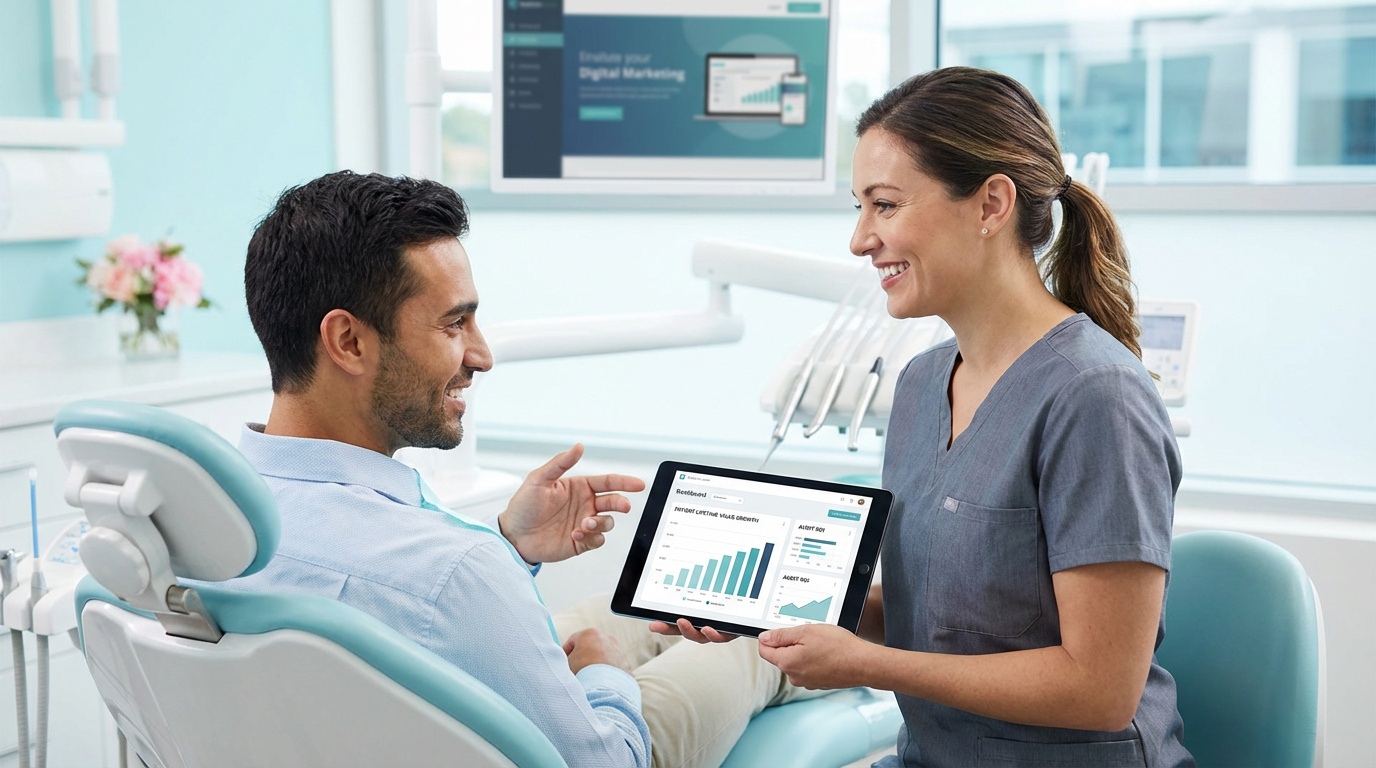
Calculating Patient Lifetime Value for Marketing Decisions
Understanding patient lifetime value (PLV) supports audit investment decisions and guides budget allocation. Calculate PLV by multiplying average treatment value (£2,800 for Invisalign, £2,400 for single implants) by average treatments per patient (1.8 for private patients) and adding ongoing hygiene visit revenue (£85 twice yearly for 4.2 years average retention). This £6,000+ PLV means acquiring one additional qualified patient monthly through improved online presence generates £72,000+ annual revenue, which can justify quarterly audit investments of £1,500–3,000.
Attribution Modelling for Complex Patient Journeys
Dental treatment decisions involve multiple touchpoints before booking. Implement multi-touch attribution in Google Analytics 4, tracking the complete patient journey from initial search through review reading, website visits, social media engagement, and final conversion. This reveals whether your improvements to local SEO, review management, or technical performance contribute most significantly to qualified consultations, enabling data-driven optimisation prioritisation.
Your Next Strategic Move
A comprehensive dental online presence audit shifts from a one-off assessment to an ongoing strategic advantage when conducted quarterly. Practices implementing systematic audits with immediate action on findings consistently outperform competitors still relying on annual reviews. The digital environment evolves continuously: algorithm updates, competitor optimisations, and patient behaviour shifts demand responsive adaptation. Partner with specialists who understand UK dental marketing nuances, maintain current technical expertise, and deliver measurable consultation growth. Schedule your complimentary assessment with Dominate Dental to establish your competitive baseline and receive a prioritised roadmap addressing your specific revenue opportunities.
Frequently Asked Questions
How do you audit your online presence?
As experts at Dominate Dental, we conduct a systematic 102-point evaluation of your practice’s digital footprint. This includes examining Google Business Profile optimisation, NAP consistency, website technical performance, and treatment-specific content quality. Our goal is to pinpoint exactly why you might be attracting the wrong patients instead of qualified leads for high-value treatments.
How often should you conduct an online presence audit?
To maintain strong local visibility and attract high-value patients, we recommend conducting a dental online presence audit quarterly. Practices without regular audits often face issues like Google Business Profile errors, inconsistent NAP data, and treatment pages ranking for irrelevant terms. Consistent audits help you stay ahead and ensure your digital strategy is always optimised.
What does a dental online presence audit involve for UK practices?
A dental online presence audit for UK practices evaluates seven key areas to ensure you connect with ideal patients. We assess local SEO signals across directories, NAP consistency, website technical performance, and conversion tracking. We also review your review management systems, treatment-specific content quality, and competitor positioning, all tailored to how UK patients search for private treatments.
Why do UK dental practices need a dedicated online presence audit?
UK dental practices need a dedicated online presence audit to identify and fix revenue-killing problems that deter qualified patients. Without it, you might suffer from Google Business Profile errors suppressing local visibility or inconsistent practice data confusing search engines. Our audit ensures your treatment pages target high-intent keywords, attracting patients actively seeking procedures like Invisalign or implants.
What are the key components of a 102-point dental online presence audit?
Our comprehensive 102-point audit checklist covers critical areas for your online success. This includes optimising your Google Business Profile for local searches and ensuring NAP consistency across over 18 UK directories. We also scrutinise treatment-specific landing pages, technical performance like mobile page speed, conversion tracking, and active review management.
What kind of results can a dental online presence audit deliver?
A thorough dental online presence audit can deliver significant, measurable improvements for your practice. For example, a Birmingham practice saw organic traffic increase by 20% and phone enquiries rise by 34% after implementing our recommendations. Their implant page also jumped to position three for “dental implants Birmingham,” directly attracting more qualified patients.
Leave a Reply