dental clinic branding ideas
Why Your Branding Directly Impacts Patient Acquisition Cost
Your branding determines whether a prospective patient books a £3,000 Invisalign consultation or scrolls past to a competitor. Strong branding reduces cost per lead by up to 40% whilst attracting higher-value patients who accept treatment plans without negotiating fees. Weak branding forces you to compete solely on price, burning marketing budget on time-wasters who never convert.
The Branding-to-Conversion Pipeline: From Awareness to Booking
Someone searches “dental implants near me”. They see multiple practices within seconds. Your branding creates the first filter: does your practice look established, specialist, and trustworthy? Patients assess your Google Business Profile images, website aesthetics, and review presentation before reading a single word. Practices with cohesive branding convert 23% more website visitors into consultation bookings because visual consistency signals professionalism and reduces perceived risk.
How Misaligned Branding Wastes Marketing Budget
Spending £2,500 monthly on Google Ads whilst presenting inconsistent branding across channels creates cognitive dissonance. Your ads promise premium care, but your outdated website and generic social media posts suggest otherwise. This disconnect attracts price-sensitive patients who book free consultations but rarely proceed with treatment. High lead volume. Low conversion rates. Wasted appointment slots that could’ve been filled with genuinely interested patients.
Case Study: Why Two Practices With Identical Fees Attract Different Patient Profiles
Two Birmingham practices both charge £4,200 for implants. Practice A uses stock photography, generic blue colours, and emphasises “affordable payment plans”. Practice B features real patient transformations, sophisticated charcoal and gold styling, and positions itself as “Birmingham’s specialist implant centre”. Practice B achieves 68% treatment acceptance rates compared to Practice A’s 31%, despite identical pricing. The difference? Strategic branding that attracts patients seeking expertise rather than discounts.
| Branding Element | Generic Practice | Strategically Branded Practice |
|---|---|---|
| Visual Identity | Stock dental imagery, basic blue palette | Real patient photos, distinctive colour scheme reflecting target demographic |
| Messaging Focus | “Affordable dentistry for all” | “Specialist care for complex treatments” |
| Patient Persona | Price-conscious, comparison shoppers | Quality-focused, treatment-ready patients |
| Average Treatment Value | £800–£1,200 | £2,500–£5,000 |
Building Your Brand Foundation: From Positioning to Patient Personas

Before selecting colours or designing logos, define precisely who you serve and why they should choose your practice over competitors within a three-mile radius. Skip this step and you’ll create beautiful branding that attracts the wrong patients.
Defining Your Core Positioning Statement for High-Value Treatments
Your positioning statement answers three questions: What treatments do you specialise in? Which patient segment do you serve best? What unique approach sets you apart? A Manchester practice might position itself as “Invisalign specialists for professionals seeking discreet orthodontics without disrupting their career.” This clarity informs every subsequent decision, from website copy to reception area design. Vague statements like “quality dental care for families” fail to differentiate or attract specific patient types.
Positioning Template
[Practice Name] helps [specific patient demographic] achieve [desired outcome] through [unique methodology or specialism], unlike [competitor approach you’re rejecting].
Example: Harley Street Dental Studio helps image-conscious professionals achieve camera-ready smiles through same-day cosmetic treatments, unlike traditional practices requiring multiple appointments over months.
Creating Patient Personas That Guide All Branding Decisions
Develop two to three detailed patient personas representing your ideal clients. “Sarah, 38, marketing director, researches extensively online, values convenience, budget £5,000 for a smile makeover” provides far more direction than “adults aged 30–50”. These personas determine whether your branding should feel corporate and efficient or warm and family-oriented. They also inform whether you emphasise flexible appointment times or modern technology.
Aligning Fee Structure, Location, and Brand Personality
Your branding must reflect the reality of your practice. A suburban family practice charging NHS-equivalent fees can’t credibly brand itself as an exclusive cosmetic boutique. Conversely, a Mayfair practice charging premium fees undermines itself with budget-focused messaging. Analyse your current patient demographics, average treatment values, and geographic location. If 70% of revenue comes from implants and Invisalign, your branding should centre on these specialisms rather than presenting as a general dentist that “also does” cosmetic work.
Visual Identity and Messaging: The Elements That Build Patient Trust
Patients form judgements about your practice quality within 50 milliseconds of viewing your website or social media profile. Your visual identity and messaging must quickly communicate professionalism, specialism, and alignment with their expectations.
Selecting Colours, Fonts, and Logos That Communicate the Right Message
Blue dominates dental branding because it signals trust and cleanliness, but its ubiquity makes differentiation nearly impossible. Consider your patient personas: practices targeting corporate professionals often succeed with sophisticated charcoal, navy, or forest green palettes that feel executive rather than clinical. Cosmetic-focused practices might use rose gold or champagne tones that align with beauty industry aesthetics. Fonts matter equally. Serif typefaces (Playfair or Cormorant) suggest heritage and premium positioning, whilst clean sans-serifs (Montserrat or Raleway) communicate modern efficiency. Your logo should work at favicon size whilst remaining distinctive. Avoid dental clichés like tooth illustrations unless you serve primarily families with young children.
Crafting Brand Voice and Taglines That Reduce Price Objections
Your written voice should mirror how your ideal patient speaks. Practices serving professionals use confident, efficient language: “Same-week Invisalign consultations for busy schedules.” Family practices adopt warmer, reassuring tones: “Gentle dental care where children actually enjoy their visits.” Taglines work best when they address specific patient concerns rather than making generic claims. “No-surprise pricing with detailed treatment plans” directly addresses fee anxiety. “Sedation options for anxious patients” acknowledges a common barrier. Test messaging by asking current high-value patients what initially attracted them to your practice. Their language often reveals positioning opportunities competitors miss.
Ensuring Consistency Across Website, Social Media, and In-Clinic Experience
Brand inconsistency creates doubt. If your website features sleek black-and-white photography but your Instagram shows bright, casual snapshots, patients question which represents the real experience. Your reception area should reflect your digital branding: the colours, materials, and even background music should align with online promises. Practices positioning as premium specialists undermine themselves with worn furniture or outdated magazines. Document your brand guidelines in a simple one-page reference covering colour codes, approved fonts, tone-of-voice examples, and photography style. Share this with all team members and any external designers or photographers. Consistency signals operational competence, which patients often extrapolate to clinical quality.
Colour Psychology for Dental Practices
- Navy/Charcoal: Executive appeal, premium positioning, attracts corporate professionals seeking efficiency
- Sage Green: Natural wellness angle, appeals to holistic-minded patients, differentiates from clinical blues
- Warm Neutrals (Taupe/Cream): Approachable luxury, reduces clinical anxiety, works well for cosmetic focus
- Rose Gold Accents: Beauty industry alignment, attracts aesthetic treatment seekers, signals modern approach
Integrating Branding With Dental SEO and Website Design for Maximum Visibility
Strong branding improves search visibility and conversion rates when integrated with technical SEO and website design. Your positioning informs keyword strategy, whilst your visual identity affects bounce rates and time-on-site metrics that influence rankings.
How Brand Positioning Improves Google Visibility and Local SEO Performance
Clear positioning enables targeted keyword strategies that attract qualified traffic. A practice positioned as “London’s Invisalign specialists” can target local searches for “Invisalign London” and “invisible braces specialist” rather than competing in the saturated “dentist London” space. Your Google Business Profile should mirror your positioning: if you specialise in nervous patients, showcase sedation options and testimonials addressing anxiety. Practices with focused positioning earn more relevant backlinks because journalists and directories prefer featuring specialists over generalists. This generates fewer leads, with higher conversion rates than generic dental marketing.
Website Design Elements That Reinforce Branding and Boost Conversion Rates
Your website must demonstrate your positioning within three seconds. Hero sections should feature real patient results for your core treatments, not stock imagery of smiling models. Navigation should prioritise your specialist treatments: if implants generate 40% of revenue, “Dental Implants” deserves prominent top-level navigation, not burial under a “Treatments” drop-down. Page-load speed affects both SEO performance and patient perception of modernity. Practices targeting younger demographics need mobile-first designs with instant chat. Those serving older patients benefit from larger fonts, clear calls to action, and prominent phone numbers. Video testimonials from patients discussing specific treatments (Invisalign, implants) build trust more effectively than written reviews alone.
Treatment-Specific Landing Pages That Combine Branding With Invisalign and Implant Marketing
Generic “services” pages dilute your branding and reduce conversion rates. Create dedicated landing pages for each high-value treatment that express your positioning. An Invisalign page for a practice targeting professionals might emphasise “discreet treatment with flexible appointment times, including evenings”, with imagery of working adults rather than teenagers. An implant page should address patient concerns: treatment timeline, comfort, and outcomes. Include pricing transparency where possible, as this pre-qualifies leads and reduces time-wasting enquiries. These pages should rank independently for treatment-specific searches whilst maintaining consistent branding elements that reinforce your overall positioning. Dominate Dental specialises in creating these integrated approaches, combining dental SEO with strategic branding to generate qualified consultations rather than generic enquiries.
Launching Your Branding Strategy: Implementation Roadmap and Quick Wins
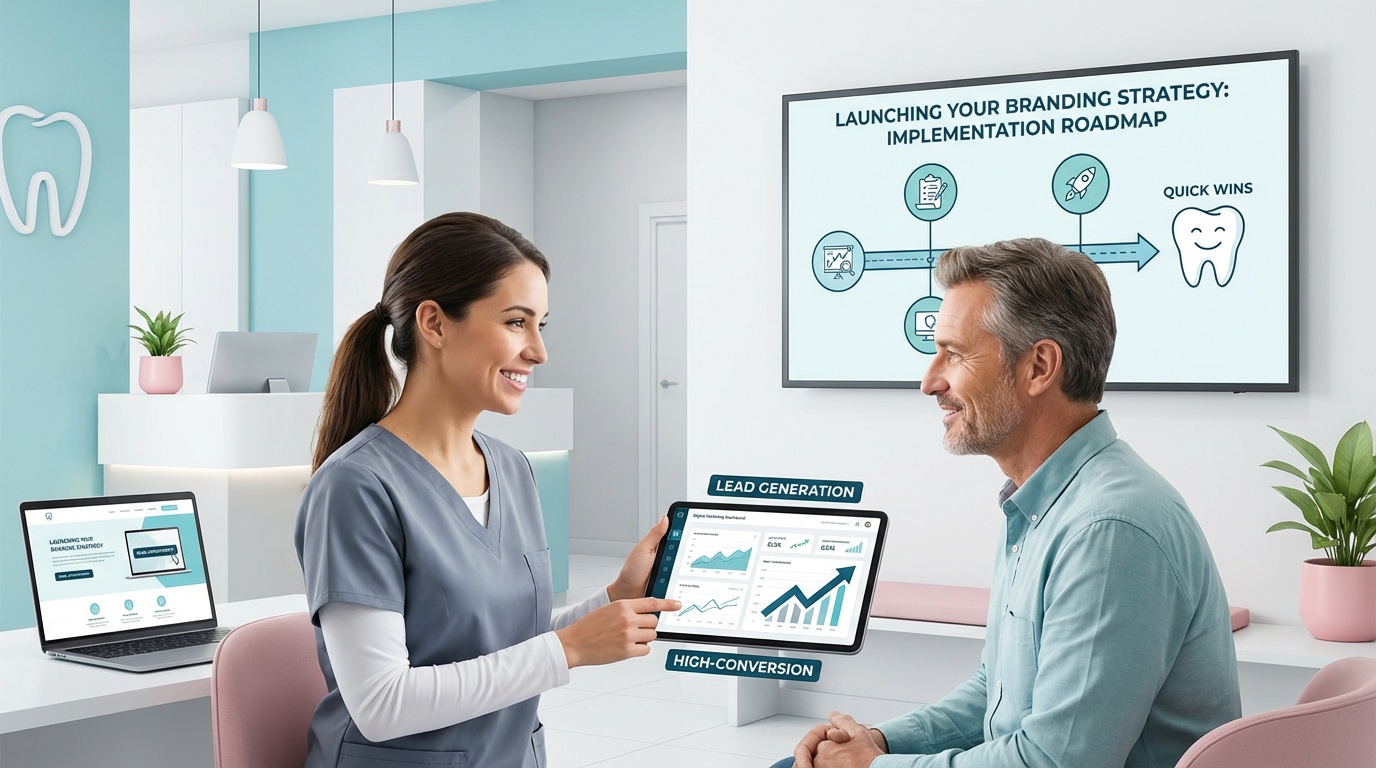
Many practices delay branding work because it feels overwhelming. Breaking the process into phases reduces paralysis whilst generating measurable improvements within weeks. This roadmap prioritises changes that affect patient acquisition, starting with the digital touchpoints prospective patients see first.
Month-by-Month Implementation Plan for a Brand Refresh
Month 1: Foundation and Quick Digital Wins. Finalise your positioning statement and patient personas. Audit your current Google Business Profile, website hero section, and social media bios for alignment. Update these touchpoints with consistent messaging and professional imagery. This month focuses on what prospective patients see during their initial research.
Month 2: Website and Visual Identity. If you’re redesigning your website, start with treatment-specific landing pages for your highest-value services. In parallel, refine your colour palette, typography, and photography style. Create a simple brand guidelines document. We’ve seen practices improve conversion rates by 15–20% after replacing stock imagery with authentic patient photos and clarifying calls to action.
Month 3: Content and Consistency. Develop branded content templates for social media, email communications, and patient education materials. Train reception and treatment coordinators on brand messaging, particularly how to discuss fees and treatment benefits in language that matches your positioning. Update physical touchpoints: business cards, appointment reminder cards, and reception signage.
Months 4–6: Optimisation and Expansion. Analyse which branding changes correlate with increased consultation bookings. Double down on what works. Expand branded content to video testimonials, blog articles targeting your specialist treatments, and Google Ads that match your positioning. This phase turns early improvements into repeatable patient-acquisition systems.
Quick Wins That Generate Results Within Days
Your Google Business Profile is often the fastest route to branding impact. Upload 15–20 high-quality photos showing your reception area, treatment rooms, and team (avoid stock imagery). Write a description incorporating your positioning statement and specialist treatments. Post weekly updates featuring patient results (with consent) or educational content about Invisalign and implants. Practices that actively manage their profile receive more direction requests and phone calls.
Review strategy supports branding credibility. Implement a systematic approach: send review requests by text within 24 hours of successful treatment completion, focusing on patients who completed high-value treatments. Respond to every review (positive and negative) in your brand voice. Five-star ratings combined with detailed, treatment-specific reviews back up your positioning and reduce price objections during consultations.
Update your website’s primary call to action to reflect your positioning. Generic “Book now” buttons convert poorly. Specific alternatives like “Book your Invisalign consultation” or “Schedule your implant assessment” attract more qualified enquiries. Include pricing transparency or “from” pricing where you’re comfortable, as this pre-qualifies leads and shows confidence in your value proposition.
Measuring Branding Impact Through KPIs and Patient Acquisition Metrics
Track these metrics monthly to quantify branding effectiveness: website conversion rate (visitors to consultation bookings), average treatment value per new patient, consultation-to-treatment acceptance rate, cost per lead from paid advertising, and the percentage of new patients mentioning specific treatments during booking. Strong branding often improves conversion rates within three months whilst increasing average treatment values as you attract more qualified patients.
Compare patient acquisition costs before and after implementation. Practices often discover they can reduce advertising spend whilst maintaining lead volume because improved branding makes existing traffic convert more effectively. Monitor which channels generate the highest-value patients. If Instagram attracts more cosmetic treatment enquiries than Google Ads, adjust budget accordingly whilst keeping branding consistent across all channels.
Implementation Timeline
Week 1: Audit current branding, define positioning statement, identify three quick-win opportunities
Weeks 2–4: Update Google Business Profile, refresh website hero section, train team on messaging
Months 2–3: Implement visual identity refresh, create treatment-specific landing pages, develop content templates
Months 4–6: Analyse performance data, optimise highest-performing elements, expand to additional channels
Ongoing: Monthly review of conversion metrics, quarterly brand consistency audits, continuous refinement based on patient feedback
Strategic branding transforms marketing from an expense into a profit centre. Practices that align visual identity, messaging, and patient experience with a clear positioning statement achieve lower acquisition costs and higher treatment acceptance rates. Dominate Dental specialises in integrating branding strategy with dental SEO and website design to generate qualified consultations for UK practices focusing on high-value treatments. Our approach combines strategic positioning with technical implementation, ensuring your branding investment delivers measurable ROI rather than aesthetic improvements alone. Book a consultation to see how refined branding reduces patient acquisition costs whilst attracting treatment-ready patients.
Maintaining compliance with advertising standards is part of successful branding. Following guidance on advertising ensures your messaging remains ethical and trustworthy, further strengthening patient confidence and trust.
Frequently Asked Questions
How can I effectively promote my dental clinic to attract more patients?
Start with strong, cohesive branding across all digital channels. Ensure your Google Business Profile, website, and social media visually communicate professionalism and specialism. Strategic branding reduces your cost per lead and attracts patients ready to accept high-value treatment plans. Upload 15–20 high-quality photos, write positioning-focused descriptions, and post weekly updates featuring patient results.
What kind of messaging or “catchy phrase” works best for a dental practice?
Skip generic catchy phrases. Focus on a clear positioning statement that defines your specialism and target patient demographic. “Invisalign specialists for professionals seeking discreet orthodontics without disrupting their career” works better than “Your smile is our priority.” Specific positioning attracts quality-focused patients and differentiates your practice from competitors who all sound the same.
What elements make a good dental logo for a modern practice?
A good dental logo reflects your practice’s unique positioning and target patient persona, not just generic blue and tooth icons. Consider sophisticated colour palettes like charcoal, navy, or forest green if you target corporate professionals. Your logo should work at favicon size whilst remaining distinctive. Pair it with fonts and overall visual identity that quickly communicate expertise and build patient trust.
What are the current marketing trends dental clinics should focus on?
Current dental marketing emphasizes cohesive digital branding and specialist positioning to attract high-value patients. Practices are moving away from generic “we do everything” messaging to focus on specific treatments and patient segments. Visual consistency across online platforms, treatment-specific landing pages, and authentic patient photography now drive more consultation bookings than broad advertising campaigns.
How does strategic branding relate to the 80/20 rule in dentistry?
Strategic branding helps you apply the 80/20 rule by attracting the 20% of patients who generate 80% of your revenue. By clearly defining your ideal patient personas and specialisms, you focus marketing efforts on those seeking high-value treatments like Invisalign and implants. This approach ensures your marketing budget attracts quality-focused patients rather than price-sensitive comparison shoppers who rarely convert.
Leave a Reply