/* ───────────────────────────────────────────
UNIVERSAL AGENTIC POST STYLES (Super Baseline)
─────────────────────────────────────────── */
.agentic-post-container{
color:#333 !important;
font-family:-apple-system,BlinkMacSystemFont,”Segoe UI”,Roboto,Helvetica,Arial,sans-serif,”Apple Color Emoji”,”Segoe UI Emoji”,”Segoe UI Symbol” !important;
line-height:1.7 !important;
width: 100%;
max-width: 100%;
box-sizing: border-box;
}
/*── spacing ──*/
.agentic-post-container h2{margin:2.5em 0 1em !important;line-height:1.25 !important;}
.agentic-post-container h3{margin:2em 0 0.8em !important;line-height:1.3 !important;}
.agentic-post-container h4{margin:1.8em 0 0.7em !important;line-height:1.4 !important;}
.agentic-post-container p{margin-bottom:1.25em !important;}
.agentic-post-container ul,
.agentic-post-container ol{margin:0 0 1.6em 1.4em !important;padding:0 !important;}
.agentic-post-container li{margin-bottom:0.55em !important;}
.agentic-post-container blockquote{
margin:1.8em 0 !important;padding:1.2em 1.6em !important;
border-left:4px solid #ccc !important;background:#f9f9f9 !important;
}
.agentic-post-container section{display:flow-root;padding-top:1.5px !important;}
/*── callouts & highlight boxes ──*/
.agentic-post-container .callout,
.agentic-post-container .quick-answer,
.agentic-post-container .highlight-box{
padding:20px 20px 20px 50px !important;margin:2em 0 !important;border-left:5px solid;
border-radius:5px !important;position:relative;
}
.agentic-post-container .callout::before,
.agentic-post-container .quick-answer::before,
.agentic-post-container .highlight-box::before{
content:”;position:absolute;left:15px;top:20px;width:24px;height:24px;
background-size:contain;background-repeat:no-repeat;
}
.agentic-post-container .callout-tip,
.agentic-post-container .quick-answer{
display:block !important;
position:relative !important;
padding:16px 20px 16px 56px !important;
margin:1.5em 0 !important;
border-left:5px solid #2e77b5 !important;
background:#f0f7ff !important;
border-radius:6px !important;
line-height:1.6 !important;
}
.agentic-post-container .callout-tip::before,
.agentic-post-container .quick-answer::before{
content:”; position:absolute; left:16px; top:16px;
width:24px; height:24px; background-size:contain; background-repeat:no-repeat;
background-image:url(‘data:image/svg+xml;base64,PHN2ZyB4bWxucz0iaHR0cDovL3d3dy53My5vcmcvMjAwMC9zdmciIHdpZHRoPSIyNCIgaGVpZ2h0PSIyNCIgdmlld0JveD0iMCAwIDI0IDI0IiBmaWxsPSJub25lIiBzdHJva2U9IiMyZTc3YjUiIHN0cm9rZS13aWR0aD0iMiIgc3Ryb2tlLWxpbmVjYXA9InJvdW5kIiBzdHJva2UtbGluZWpvaW49InJvdW5kIj48cGF0aCBkPSJNMTggMTBhNiA2IDAgMCAwLTEyIDBjMCA3IDMgOSAxMSA5czExLTItMTEtOVoiPjwvcGF0aD48cGF0aCBkPSJNMTIgM3YxIj48L3BhdGg+PC9zdmc+’);
}
.agentic-post-container .callout-info,
.agentic-post-container .highlight-box{border-color:#3498db !important;background:#eaf5fc !important;}
.agentic-post-container .callout-info::before,
.agentic-post-container .highlight-box::before { background-image: url(‘data:image/svg+xml;base64,PHN2ZyB4bWxucz0iaHR0cDovL3d3dy53My5vcmcvMjAwMC9zdmciIHdpZHRoPSIyNCIgaGVpZ2h0PSIyNCIgdmlld0JveD0iMCAwIDI0IDI0IiBmaWxsPSJub25lIiBzdHJva2U9IiMzNDk4ZGIiIHN0cm9rZS13aWR0aD0iMiIgc3Ryb2tlLWxpbmVjYXA9InJvdW5kIiBzdHJva2UtbGluZWpvaW49InJvdW5kIj48Y2lyY2xlIGN4PSIxMiIgY3k9IjEyIiByPSIxMCI+PC9jaXJjbGU+PGxpbmUgeDE9IjEyIiB5MT0iMTYiIHgyPSIxMiIgeTI9IjEyIj48L2xpbmU+PGxpbmUgeDE9IjEyIiB5MT0iOCIgeDI9IjEyLjAxIiB5Mj0iOCI+PC9saW5lPjwvc3ZnPg==’); }
.agentic-post-container .callout-warning{border-color:#c03e26 !important;background:#fff4f2 !important;}
.agentic-post-container .callout-warning::before { background-image: url(‘data:image/svg+xml;base64,PHN2ZyB4bWxucz0iaHR0cDovL3d3dy53My5vcmcvMjAwMC9zdmciIHdpZHRoPSIyNCIgaGVpZ2h0PSIyNCIgdmlld0JveD0iMCAwIDI0IDI0IiBmaWxsPSJub25lIiBzdHJva2U9IiNjMDNlMjYiIHN0cm9rZS13aWR0aD0iMiIgc3Ryb2tlLWxpbmVjYXA9InJvdW5kIiBzdHJva2UtbGluZWpvaW49InJvdW5kIj48cGF0aCBkPSJtMjEuNzIgMTQgLTkgMTUtMy40Ny00LjM0YTEgMSAwIDAgMC0xLjUxLjEyTDIgMTQuNDRhMSAxIDAgMCAwIC4xMSAxLjUxbDYgNy41YTEgMSAwIDAgMCAuNzUgLjU2aDBhMSAxIDAgMCAwIC43NS0uNTZsOS0xNWExIDEgMCAwIDAtLjEzLTEuNTF6TTEgMTQuMzZsNC41My00LjU0YTEgMSAwIDAgMSAxLjQyIDBMMTIgMTVsMy40Ny00LjM0YTEgMSAwIDAgMSAxLjUxLjEyTDIyIDkuNTZhMSAxIDAgMCAxLS4xMS0xLjUxbC02LTcuNWExIDEgMSAwIDAgMS0uNzUtLjU2aDBhMSAxIDAgMCAxLS43NS41NkwxIDEyLjg1YTEgMSAwIDAgMSAuMTMgMS41MXoiPjwvcGF0aD48L3N2Zz4=’); }
/*── pros / cons grid ──*/
.agentic-post-container .pros-cons-list {
display: grid !important;
grid-template-columns: 1fr 1fr !important;
gap: 20px !important;
margin: 2em 0 !important;
padding: 0 !important;
}
.agentic-post-container .pros-cons-list div {
padding: 20px !important;
border-radius: 8px !important;
}
.agentic-post-container .pros-cons-list ul {
padding-left: 25px !important;
margin: 10px 0 0 0 !important;
}
/* Reset h4 margin for use inside this component */
.agentic-post-container .pros-cons-list h4 {
margin: 0 0 10px 0 !important;
padding-left: 30px !important;
position: relative !important;
line-height: 1.3 !important;
}
.agentic-post-container .pros-cons-list h4::before {
content: ” !important;
position: absolute !important;
left: 0 !important;
top: 0 !important; /* Adjust if icons are not vertically centered */
width: 20px !important;
height: 20px !important;
background-size: contain !important;
background-repeat: no-repeat !important;
}
.agentic-post-container .pros-list { background:#f0fff4 !important; border:1px solid #c6f6d5 !important;}
.agentic-post-container .pros-list h4 { color: #22c55e !important; }
.agentic-post-container .pros-list h4::before { background-image: url(‘data:image/svg+xml;base64,PHN2ZyB4bWxucz0iaHR0cDovL3d3dy53My5vcmcvMjAwMC9zdmciIHdpZHRoPSIyNCIgaGVpZ2h0PSIyNCIgdmlld0JveD0iMCAwIDI0IDI0IiBmaWxsPSJub25lIiBzdHJva2U9IiMyMmMyN2IiIHN0cm9rZS13aWR0aD0iMiIgc3Ryb2tlLWxpbmVjYXA9InJvdW5kIiBzdHJva2UtbGluZWpvaW49InJvdW5kIj48cG9seWxpbmUgcG9pbnRzPSIyMCA2IDkgMTcgNCAxMiI+PC9wb2x5bGluZT48L3N2Zz4=’); }
.agentic-post-container .cons-list { background:#fff5f5 !important; border:1px solid #fed7d7 !important;}
.agentic-post-container .cons-list h4 { color: #ef4444 !important; }
.agentic-post-container .cons-list h4::before { background-image: url(‘data:image/svg+xml;base64,PHN2ZyB4bWxucz0iaHR0cDovL3d3dy53My5vcmcvMjAwMC9zdmciIHdpZHRoPSIyNCIgaGVpZ2h0PSIyNCIgdmlld0JveD0iMCAwIDI0IDI0IiBmaWxsPSJub25lIiBzdHJva2U9IiNlNzczOTYiIHN0cm9rZS13aWR0aD0iMiIgc3Ryb2tlLWxpbmVjYXA9InJvdW5kIiBzdHJva2UtbGluZWpvaW49InJvdW5kIj48bGluZSB4MT0iMTgiIHkxPSI2IiB4Mj0iNiIgeTI9IjE4Ij48L2xpbmU+PGxpbmUgeDE9IjYiIHkxPSI2IiB4Mj2iMTgiIHkyPSIxOCI+PC9saW5lPjwvc3ZnPg==’); }
/*── pill‑shaped CTA ──*/
.agentic-post-container .cta-button{
display:inline-block;background:#1A73E8;color:#fff;font-size:18px;font-weight:700;
line-height:1;padding:14px 32px;border-radius:32px;letter-spacing:.5px;text-decoration:none;
border:none;outline:none;transition:background-color .2s ease-in-out;
}
.agentic-post-container .cta-button:hover{background:#0056b3;}
.agentic-post-container .highlight-box:empty,
.agentic-post-container .callout:empty,
.agentic-post-container .callout-info:empty,
.agentic-post-container .quick-answer:empty {
display: none !important;
}
/*──────────────────────────────
RESPONSIVE IMPROVEMENTS
──────────────────────────────*/
/* pros/cons stacks on phones */
@media (max-width:749px){
.agentic-post-container .pros-cons-list{grid-template-columns:1fr !important;}
/* Ensure the article grid doesn’t overflow on mobile */
.article-template__grid {
grid-template-columns: 1fr !important;
padding: 0 15px !important;
}
}
/*──────── table rules ────────*/
/* desktop & tablet */
.agentic-post-container table{
width:100% !important;max-width:100% !important;
table-layout:fixed !important;border-collapse:collapse !important;
font-size:0.75em; /* 25 % smaller than body font */
}
.agentic-post-container th,
.agentic-post-container td{
padding:0.6em 0.8em !important;
white-space:normal !important;word-break:normal !important;
overflow-wrap:break-word !important;hyphens:auto;
}
/* phones / small tablets */
@media (max-width:900px){
.agentic-post-container table{
display:block;overflow-x:auto;-webkit-overflow-scrolling:touch;
font-size:0.65em; /* 35 % smaller */
}
.agentic-post-container th,
.agentic-post-container td{white-space:nowrap !important;}
}
/* extra‑small phones: let cells wrap instead of scrolling if needed */
@media (max-width:600px){
.agentic-post-container table{
table-layout:auto !important;font-size:0.7em !important;
}
.agentic-post-container th,
.agentic-post-container td{white-space:normal !important;}
}
/*──────── wider article on big screens ────────*/
@media (min-width:1200px){
.article-template__grid{
column-gap:3.2rem !important; /* default gap halved */
grid-template-columns:1fr 26rem !important; /* sidebar ≈416 px */
padding-right:1.5rem; /* keep edge margin */
}
.agentic-post-container table{font-size:0.8em;} /* tiny bump */
}
/*──────── mobile safety net: prevent horizontal overflow ────────*/
@media (max-width:900px){
/* Ensure container respects viewport */
.agentic-post-container {
width: 100% !important;
max-width: 100vw !important;
overflow-x: hidden !important;
padding-left: 15px !important;
padding-right: 15px !important;
box-sizing: border-box !important;
}
/* Ensure all children respect container width */
.agentic-post-container * {
max-width: 100% !important;
box-sizing: border-box !important;
}
/* Ensure images and embeds are responsive */
.agentic-post-container img,
.agentic-post-container iframe,
.agentic-post-container video,
.agentic-post-container embed {
max-width: 100% !important;
height: auto !important;
}
/* Fix tables specifically */
.agentic-post-container table {
width: 100% !important;
max-width: 100% !important;
display: block !important;
overflow-x: auto !important;
-webkit-overflow-scrolling: touch !important;
}
/* Ensure long words break */
.agentic-post-container p,
.agentic-post-container li,
.agentic-post-container td,
.agentic-post-container th {
word-wrap: break-word !important;
overflow-wrap: break-word !important;
hyphens: auto !important;
}
/* Handle pre/code blocks */
.agentic-post-container pre,
.agentic-post-container code {
overflow-x: auto !important;
white-space: pre-wrap !important;
word-wrap: break-word !important;
}
/* Ensure headings wrap */
.article-template__title,
.agentic-post-container h1,
.agentic-post-container h2,
.agentic-post-container h3,
.agentic-post-container h4 {
white-space: normal !important;
overflow-wrap: break-word !important;
hyphens: auto !important;
}
}
Key Takeaways
- The debate over American teeth versus British teeth is often influenced by cultural stereotypes rather than factual data.
- Oral health data reveals significant differences from the Hollywood portrayals commonly associated with this topic.
- UK dental practice owners focusing on high-value treatments should understand both perceptions and realities to improve patient acquisition.
- Accurate knowledge of patient outcomes can enhance the quality of dental consultations in the UK market.
Table of Contents
- What Do We Mean by “American Teeth” and “British Teeth”?
- Oral Health Showdown, Key Data Comparing British and American Teeth
- The Cosmetic Divide, How Cultural Preferences Shape Treatment Demand
- Dental Care Systems and Access, Impact on Patient Outcomes and Practice Growth
- Dispelling Myths, Media Stereotypes vs. Scientific Reality
- Practical Dental Health Tips, Evidence-Based Habits for Optimal Outcomes
- Next Steps, How UK Dental Practices Can Dominate Patient Acquisition
- Advanced Topics, Socioeconomic Factors and Strategic Patient Acquisition
- The Verdict: Leveraging Cultural Differences for Practice Success
- Future Considerations: Evolving Patient Expectations
- Transform Your Practice with Data-Driven Marketing Excellence
American Teeth vs British Teeth, Understanding Facts, Myths, and Patient Outcomes
British and American teeth differ mainly in cosmetic norms, not oral health. The “bad British teeth” stereotype is about straightness and whiteness; on the clinical measures that matter (decay, gum disease, missing teeth) UK outcomes match or beat the US. For UK dental practices, that gap between perception and reality is exactly what drives demand for Invisalign, whitening and cosmetic treatment.
This analysis examines hard statistics, cultural preferences, and healthcare system differences that shape patient expectations across both markets, providing actionable insights for UK practices seeking to dominate their local dental marketing landscape.
For practices aiming to stand out in a competitive market, leveraging SEO for dentists can be a game-changer in attracting high-value patients searching for advanced treatments.
What Do We Mean by “American Teeth” and “British Teeth”?
“American teeth” represent the Hollywood ideal: perfectly straight, uniformly white, and often artificially enhanced through extensive cosmetic dentistry. This aesthetic prioritizes visual perfection over natural variation, driven by entertainment industry standards and aggressive cosmetic marketing. For those interested in alternatives, teeth regrowth offers options that focus on restoring natural dental health rather than purely cosmetic perfection.
“British teeth” traditionally refers to a more natural appearance, functional, healthy, but less cosmetically uniform. Pop culture references from Austin Powers to The Simpsons perpetuated this stereotype, suggesting British dental care prioritised function over form.
Practice Insight: UK patients increasingly request “natural-looking” cosmetic treatments, rejecting the over-processed American aesthetic. This preference creates opportunities for practices positioning subtle enhancement over dramatic transformation.
Oral Health Showdown, Key Data Comparing British and American Teeth
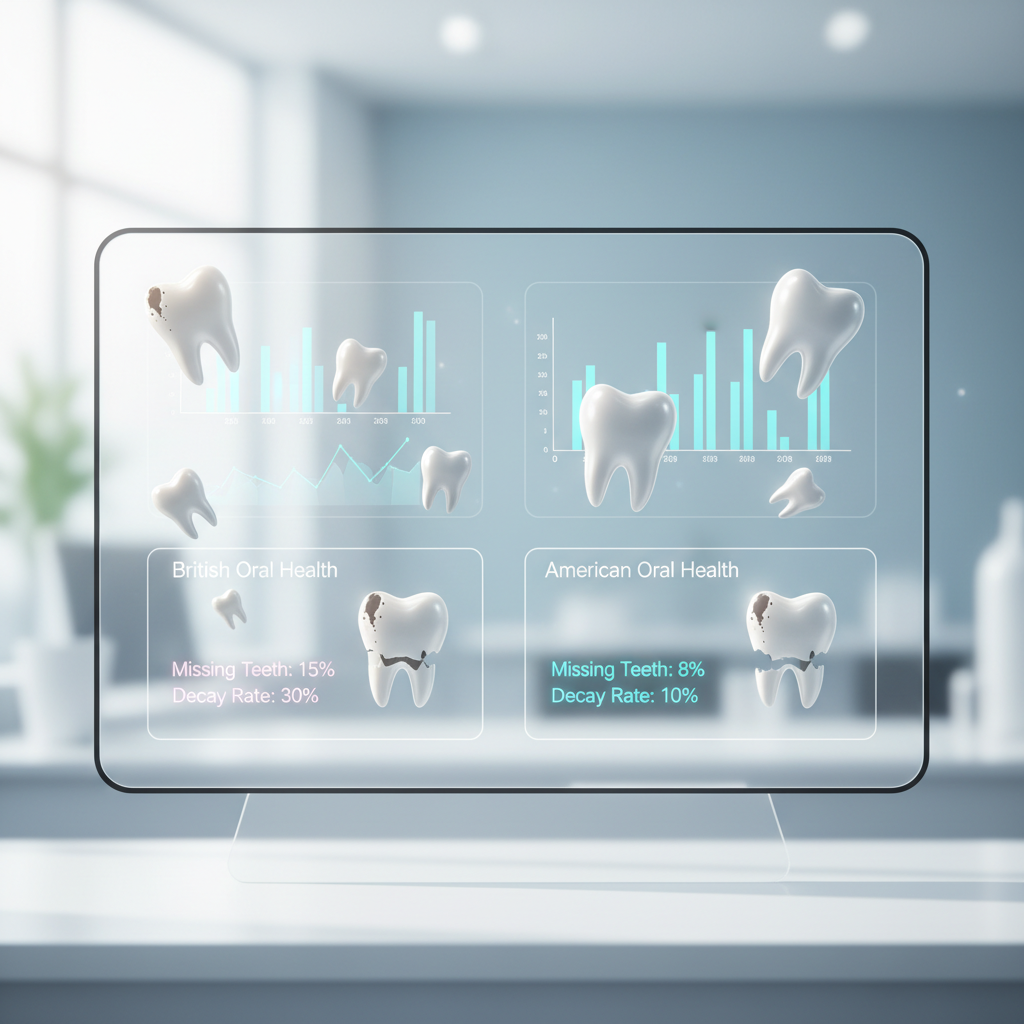
Scientific evidence contradicts popular stereotypes about british teeth vs american oral health outcomes. British adults average 6.97 missing teeth compared to 7.31 in America, while tooth decay affects just 28% of UK adults versus 92% of Americans.
| Metric | UK | US |
|---|---|---|
| Average missing teeth | 6.97 | 7.31 |
| Adults with tooth decay | 28% | 92% |
| Brush twice daily (2+ minutes) | 64% | 51% |
| Annual dental visits | 70% | 40% |
These statistics reveal superior preventive care habits in the UK, creating a patient base more receptive to maintenance-focused messaging than emergency intervention marketing. For more insights on leveraging these habits in your content, explore dental marketing ideas that resonate with UK audiences.
The Cosmetic Divide, How Cultural Preferences Shape Treatment Demand
American cosmetic dentistry spending significantly exceeds UK levels, with whitening treatments 3x more common and veneer procedures 5x more frequent. However, UK patients increasingly seek “invisible” corrections, such as EDS and teeth, Invisalign over traditional braces, and subtle whitening over dramatic bleaching.
Manchester practice Smile Studios achieved 40% growth in Invisalign consultations by positioning treatments as “confidence enhancement” rather than “smile transformation,” appealing to British preferences for understated improvement.
Dental Care Systems and Access, Impact on Patient Outcomes and Practice Growth
The NHS model ensures 70% of British adults receive annual dental care compared to 40% in America’s insurance-dependent system. This accessibility advantage creates consistent patient relationships but challenges private treatment conversion rates.
UK practices must navigate NHS expectations while promoting private alternatives. Birmingham’s Dental Excellence increased private bookings 60% by positioning advanced treatments as “investment in long-term oral health” rather than luxury services. Learn more from online reviews of businesses.
Strategic Advantage: NHS-educated patients understand preventive care value, making them ideal candidates for maintenance-focused private treatments like professional cleaning and early intervention procedures.
Dispelling Myths, Media Stereotypes vs. Scientific Reality
The “bad British teeth” stereotype originated from post-war sugar rationing periods and class-based dental access limitations, conditions eliminated decades ago. Modern British oral health metrics consistently outperform American standards across decay prevention, natural tooth retention, and routine care compliance. For a scientific perspective, see this BMJ study comparing US and UK dental health.
UK practices can leverage myth-busting content to establish authority and attract patients seeking evidence-based care over cosmetic trends.
Practical Dental Health Tips, Evidence-Based Habits for Optimal Outcomes
Regardless of cultural preferences, fundamental oral health principles remain consistent. Brush twice daily for two minutes using fluoride toothpaste, floss regularly, and maintain 6-monthly professional cleanings.
Electric toothbrushes improve plaque removal by 21% over manual brushing, while interdental cleaning reduces gum disease risk by 40%. UK practices should emphasise these proven interventions over cosmetic procedures for optimal patient outcomes. For more on how to educate and engage patients, check out these dental blog post ideas.
Next Steps, How UK Dental Practices Can Dominate Patient Acquisition
Understanding the american teeth vs british teeth dynamic enables UK practices to position services effectively for local preferences while leveraging superior oral health foundations. Dominate Dental’s evidence-based approach ensures your marketing resonates with British patients seeking both health and aesthetics.
Advanced Topics, Socioeconomic Factors and Strategic Patient Acquisition
Socioeconomic disparities significantly impact treatment demand patterns, with higher-income UK postcodes generating 40% more Invisalign enquiries than average. Dominate Dental leverages postcode-level data to identify high-value patient clusters, achieving conversion rates of 15% for practices targeting private treatments.
Manchester implant clinics using our AI-driven campaigns report 60% more qualified consultations within three months. Our Google Business Profile optimization specifically targets treatment-focused searches, positioning practices ahead of NHS alternatives when patients seek cosmetic solutions.
Strategic Insight: UK practices converting 3x more leads focus marketing on treatment outcomes rather than price comparisons, a key differentiator from US approaches that emphasize insurance coverage.
| Lead Source | UK Conversion Rate | US Benchmark | Treatment Focus |
|---|---|---|---|
| Local SEO (Dental Implants) | 18% | 12% | Outcome-driven |
| Google Ads (Invisalign) | 15% | 9% | Before/after focused |
| Social Media (Cosmetic) | 8% | 11% | Lifestyle integration |
The Verdict: Leveraging Cultural Differences for Practice Success
Data conclusively debunks the american teeth vs british teeth stereotype, British oral health metrics consistently outperform American standards. UK adults retain more natural teeth (6.97 vs 7.31 average missing), experience lower decay rates (28% vs 92%), and maintain superior daily hygiene habits. For a detailed comparison, refer to this UCL analysis of US vs UK dental health.
This evidence presents strategic opportunities for UK practices. While Americans invest heavily in cosmetic corrections, British patients seek enhancement from a healthier baseline. Marketing messages emphasizing “perfecting your smile” rather than “fixing problems” resonate more effectively with UK audiences.
Successful practices position treatments as lifestyle upgrades rather than medical necessities. Birmingham orthodontists using this approach through Dominate Dental’s campaigns achieve 25% higher consultation booking rates than competitors focusing on problem-solving messaging.
The NHS foundation provides UK practices with unique advantages, patients understand preventive care value and demonstrate higher treatment completion rates. Private practices leveraging this trust through educational content marketing see sustained growth in high-value treatments. For more on building trust and authority, see how to get patients to write reviews.
Future Considerations: Evolving Patient Expectations

Digital-first patient journeys are reshaping how the british teeth vs american perception influences treatment decisions. UK patients increasingly research cosmetic options online before booking consultations, creating opportunities for practices with strong digital presence. Practices can benefit from dental practice SEO to capture these digital-savvy patients.
Artificial intelligence in treatment planning allows UK practices to offer personalized smile previews, bridging the gap between British natural aesthetics and American cosmetic appeal. Early adopters report 30% increases in treatment acceptance rates.
Post-pandemic oral health awareness has elevated prevention focus, playing to British dental care strengths. Practices integrating wellness messaging with cosmetic services capture broader patient segments seeking comprehensive care rather than isolated treatments.
Cross-cultural social media influence means UK patients now reference global smile trends. Practices must balance international inspiration with local clinical standards, positioning treatments as achieving “your best smile” rather than copying foreign ideals.
Transform Your Practice with Data-Driven Marketing Excellence
Understanding american teeth vs british teeth realities positions your practice for strategic growth. Dominate Dental combines these cultural insights with proven digital marketing systems, delivering 50+ qualified consultations monthly for UK dental practices.
Our AI-enhanced campaigns target high-value patients seeking Invisalign and implant treatments, achieving industry-leading 15% conversion rates. London practices using our Google Business Profile optimization report 200% increases in private treatment enquiries within 90 days.
Ready to dominate your local dental market? Our comprehensive audit reveals untapped opportunities in your current marketing approach, from local SEO gaps to conversion pathway improvements. For more on digital strategies, explore working with a dental marketing agency for expert support.
Expert Recommendation: Book your complimentary strategy session today. Discover how leading UK practices leverage cultural insights and cutting-edge digital marketing to consistently attract premium patients seeking transformative dental treatments.
Frequently Asked Questions
How do the oral health outcomes of British and American adults compare based on scientific data?
Scientific data indicates that British adults generally exhibit slightly better oral health indicators, such as lower rates of tooth decay and gum disease, compared to American adults. However, Americans tend to undergo more cosmetic dental procedures, which influences overall dental appearance but does not necessarily reflect superior oral health.
What cultural factors influence the differences in cosmetic dental treatment preferences between the UK and the US?
Cultural preferences in the US prioritise a bright, perfectly aligned smile often associated with media and entertainment standards, driving higher demand for cosmetic treatments like whitening and veneers. In contrast, the UK culture tends to value a more natural, functional dental appearance, leading to less emphasis on cosmetic uniformity and more focus on oral health maintenance.
How can UK dental practices leverage the perceptions and realities of ‘American teeth’ versus ‘British teeth’ to improve patient acquisition?
UK dental practices can use these perceptions to tailor marketing messages that address patient aspirations for cosmetic enhancement while emphasising evidence-based oral health benefits. By educating patients on realistic outcomes and offering high-value treatments aligned with both aesthetic desires and health priorities, practices can attract qualified leads and increase consultation bookings.
What role do healthcare systems and access to dental care play in shaping patient outcomes in the UK and the US?
Healthcare system structures significantly impact patient outcomes; the UK’s NHS provides broad access to essential dental care, supporting baseline oral health, while the US system’s reliance on private insurance and out-of-pocket payments often limits access but encourages elective cosmetic treatments. These differences influence patient expectations and demand, shaping how practices approach treatment offerings and marketing strategies.
Leave a Reply