Why Smart Dental Practices Are Doubling Down On Google Ads
The era of relying solely on word-of-mouth referrals is dwindling. Today's patients turn to the internet to find dental services, making Google Ads for dentists essential. Forward-thinking practices are using this platform to connect with potential patients at the exact moment they're searching for a dentist. This shift towards digital marketing demonstrates why traditional methods are losing effectiveness, especially for attracting new patients.
Reaching Patients Actively Searching for Your Services
Consider this: when someone needs dental care, their first step is often an online search. Google Ads places your practice directly in front of these highly motivated individuals. This proactive strategy allows dentists to connect with patients actively looking for services, instead of passively waiting for them to discover the practice's website organically. Strategic advertising through Google Ads also creates a more predictable patient flow, even during typically slower periods.
For example, a practice specializing in emergency dentistry can tailor ads to those searching for "emergency dentist near me." This guarantees the practice's ad appears for highly relevant searches, linking them with patients requiring immediate care. This targeted approach maximizes the return on every advertising dollar.
Gaining a Competitive Edge in a Crowded Market
Google Ads provides distinct advantages, particularly for new or expanding practices. New dental practices can rapidly establish an online presence, vital for attracting patients in a competitive landscape. This immediate visibility surpasses the typically slow process of improving organic search rankings, which can take months or even years. Furthermore, expanding practices can effectively advertise new services to a specific target audience.
In 2025, Google Ads for dentists in the UK became incredibly competitive. Data shows an average conversion rate of 9.08% for dental campaigns, meaning nearly one in ten clicks becomes a lead. The cost per lead averaged £62.01 (about $83.93), reflecting the high intent of online dental treatment searches. Find more detailed statistics here. This data emphasizes the importance of a well-structured Google Ads strategy.
Targeting Specific Treatments and Demographics
Google Ads empowers practices to target specific treatments, such as cosmetic dentistry or implant dentistry. This precise targeting ensures ads reach patients interested in particular services, improving conversion rates. By tailoring campaigns to specific patient demographics and interests, practices can connect with the right audience and maximize their return on investment. This level of precision is unattainable with traditional marketing methods.
The Real Story Behind Google Ads Costs And Returns
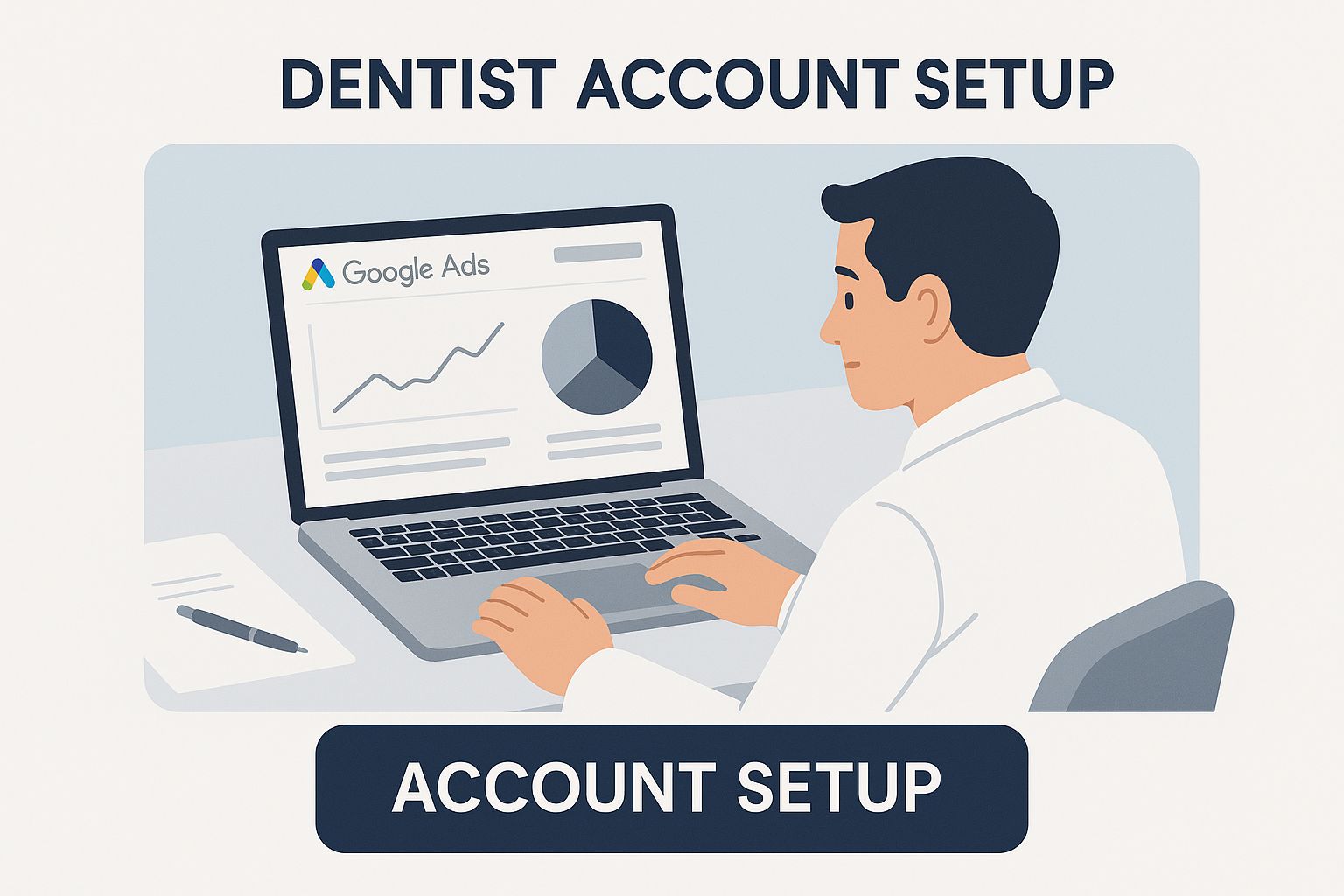
The infographic above shows a dentist reviewing their Google Ads account setup. This crucial first step underscores the importance of a well-structured account for any successful campaign. A properly configured account provides granular control over targeting, bidding, and budget, ultimately maximizing your return on investment.
Understanding the costs and potential returns of Google Ads for dentists is paramount for making informed marketing decisions. This means carefully analyzing the factors influencing both cost and ROI. Location, for example, significantly impacts advertising costs.
The cost-per-click (CPC) for keywords like "dentist London" will be substantially higher than for "dentist Cornwall" due to the increased competition in major metropolitan areas. This is a key consideration when planning your budget and targeting strategy.
Cost Variations Across Dental Services
The specific dental service you advertise also influences costs. Emergency dentistry and cosmetic procedures typically have higher CPCs than routine check-ups due to the perceived higher value of these services. While the initial investment may be higher, the potential return can also be significantly greater.
Analysis of UK dentist Google Ads data from 2025 reveals a wide range of costs and performance metrics. These variations depend heavily on keyword competitiveness and location. On average, the CPC for dental-related keywords ranges from £1 to £5. However, in highly competitive urban markets, this can climb considerably higher.
Despite these costs, well-optimized dental campaigns often demonstrate impressive ROI figures. Practices using advanced targeting and AI-powered ad optimization tools frequently report ROI between 300% and 500%. For a deeper dive into this topic, explore this helpful resource: Do Google Ads Work for Dentists in 2024?.
To help illustrate cost variations, let's take a look at a cost breakdown table. This table presents average costs and performance metrics across different UK regions and dental services.
UK Dental Google Ads Cost Breakdown by Region and Service
| Region/Service | Average CPC | Conversion Rate | Cost Per Lead | Expected ROI |
|---|---|---|---|---|
| London – Invisalign | £7.50 | 2% | £375 | 350% |
| London – Emergency Dentist | £10 | 4% | £250 | 400% |
| Cornwall – Teeth Whitening | £2.50 | 3% | £83.33 | 300% |
| Cornwall – Routine Check-up | £1.50 | 2.5% | £60 | 250% |
| Manchester – Dental Implants | £6 | 2.8% | £214.29 | 380% |
| Manchester – Veneers | £5 | 3.5% | £142.86 | 420% |
As this table demonstrates, both region and service significantly impact advertising costs and potential ROI. High-value services and competitive locations generally lead to higher CPCs but can also yield higher ROI when managed effectively.
Calculating True ROI: Beyond Immediate Conversions
Savvy dental practices recognize that true ROI extends beyond simply tracking new patient acquisitions from ads. It's essential to consider patient lifetime value, repeat visits, and referrals. For instance, a patient initially booking a teeth whitening treatment may become a long-term patient for routine check-ups and other procedures, increasing their overall value to the practice. For more insights, check out this guide: How to Convert Paid Advertising Leads into Loyal Patients: A Dentist’s Guide.
Budget Allocation and Bidding Strategies
Effective budget allocation and strategic bidding are crucial for maximizing your Google Ads investment. Seasonal adjustments, taking advantage of peak demand periods, and utilizing bidding techniques tailored to your goals ensures efficient competition without overspending. This strategic approach significantly impacts the overall effectiveness of your campaigns.
Building Campaigns That Actually Convert Patients
Creating effective Google Ads campaigns for dentists in the UK requires a well-defined strategy. It's not just about picking the right keywords; it's about crafting a structured campaign that truly resonates with potential patients. This means understanding how to organize your account, target specific locations, and segment your audience for maximum impact.
Structuring Your Google Ads Account
Think of your Google Ads account as the bedrock of your online marketing efforts. A well-structured account is paramount for managing your campaigns effectively. This involves organizing your account into distinct campaigns, each focused on a specific objective. These objectives could include attracting new patients, promoting particular treatments, or even targeting specific demographics.
Within each campaign, you create ad groups centered around related keywords and services. For example, one ad group might focus on "teeth whitening" while another targets "invisalign." This granular structure allows for more relevant ad copy and more refined bidding strategies. Ultimately, this focused approach maximizes the return on your advertising investment.
Targeting Local Patients Effectively
For dental practices, location targeting is essential. You want to connect with people in your immediate vicinity actively searching for a dentist nearby. Google Ads allows you to target specific postcodes, towns, or even a radius around your practice location. This ensures your ads are displayed to the most relevant potential patients, minimizing wasted ad spend on those outside your service area.
Further refine your targeting with location bid adjustments. This feature lets you modify your bids based on the searcher's location. For example, you might bid higher for searches originating within a 5-mile radius of your practice, as these individuals are statistically more likely to become patients.
Segmenting Your Audience for Better Results
You wouldn’t use the same marketing message for every patient, so why show the same ad to everyone online? Audience segmentation lets you customize your ads to specific patient groups based on demographics, interests, and even prior interactions with your website.
- Demographics: Focus on particular age ranges or genders relevant to your services.
- Interests: Target those interested in cosmetic dentistry or specific procedures like teeth straightening.
- Remarketing: Re-engage with people who have visited your website but haven’t yet scheduled an appointment.
This targeted approach improves the chances of your message resonating with the right individuals, boosting conversion rates.
Choosing the Right Campaign Types
Google Ads provides a range of campaign types, each with a distinct purpose. Selecting the most suitable type is critical for achieving your practice’s objectives. For dentists, highly effective campaign types include:
- Search Campaigns: These appear at the top of Google’s search results when people search for relevant keywords.
- Local Campaigns: These promote your practice on Google Maps and in local search results, driving local visibility.
- Display Campaigns: These showcase visual ads on websites across the Google Display Network, broadening your reach.
By strategically combining these campaign types, you can effectively reach potential patients at various points in their decision-making journey.
Conversion Tracking: Measuring What Truly Matters
Finally, conversion tracking is crucial for evaluating the true effectiveness of your campaigns. This involves setting up tracking to measure important actions such as phone calls, online appointment bookings, and contact form submissions. By tracking these actions, you can pinpoint which keywords, ads, and campaigns generate the most valuable leads. This data then allows you to optimize your campaigns for optimal performance, ensuring your advertising budget delivers maximum impact in attracting new patients.
Writing Ad Copy That Speaks To Anxious Patients
The success of your Google Ads for dentists campaign depends on truly understanding what your potential patients are worried about. A well-structured account and carefully chosen keywords are essential building blocks. But it's the compelling ad copy that ultimately convinces people to book. This means speaking directly to their anxieties about pain, cost, and scheduling.
Addressing Dental Anxiety in Your Ad Copy
Dental anxiety is a common experience. By acknowledging this in your ads, you can build a connection with potential patients. Using phrases like "gentle dentistry," "pain-free options," or "caring team" creates a more welcoming image. It shows you understand and prioritize patient comfort.
For example, instead of "teeth cleaning," try "Gentle Teeth Cleaning for Anxious Patients." This small change speaks to a specific need. It also helps you stand out from the crowd. Mentioning amenities like sedation dentistry or noise-reducing headphones can also help ease worries.
Transparency About Costs and Payment Options
Cost is another significant hurdle for many people seeking dental care. Upfront pricing in your ads, where allowed, builds trust and attracts budget-conscious individuals. Phrases like "affordable dental care," "payment plans available," or "free consultations" show you're willing to discuss finances openly.
Remember advertising regulations concerning pricing. Always comply with guidelines and avoid any misleading statements. Instead of fixed prices, emphasize flexible financing and payment options.
Highlighting Convenience and Accessibility
In our busy world, convenience is king. Emphasizing accessibility in your ads is a powerful tool. Features like online booking through a platform like Calendly, evening and weekend appointments, or locations near public transportation can appeal to busy individuals. This convenience can be the deciding factor when someone is choosing between dental practices.
Phrases like "book online 24/7," "Saturday appointments available," or "easily accessible by subway" can help showcase the ease of scheduling an appointment.
Crafting Compelling Calls to Action
Finally, a strong call to action is essential to get results. Encourage immediate action with phrases like "Book Your Appointment Today," "Schedule Your Free Consultation," or "Call Now for a Free Smile Assessment." This clear and direct approach prompts potential patients to take that next step.
Ad extensions are a great way to enhance your ads. They offer more detailed information, like location details, phone numbers, and direct links to specific landing pages. This provides potential patients with a streamlined experience, ultimately improving click-through rates. Persuasive messaging, along with adhering to advertising standards, is the winning combination for turning clicks into appointments.
Leveraging AI and Automation For Smarter Campaigns
 dental marketing“>
The future of Google Ads for dentists relies heavily on using AI and automation. These tools offer optimization capabilities far beyond what humans can do, allowing practices to achieve better results with less manual work. This means more time becomes available for patient care.
Smart Bidding: Automating Your Bids For Better Performance
Smart Bidding strategies within Google Ads use machine learning to automate your bidding. These strategies automatically adjust your bids based on how likely a conversion is.
This eliminates the need for constant manual bid adjustments, saving you time and often leading to improved campaign performance.
For instance, Target CPA bidding automatically sets bids to help you get the most conversions at the target cost-per-acquisition you've set. This lets you focus on other critical parts of your campaign, while Google's AI optimizes your bids for maximum results.
Automated Ad Testing and Responsive Search Ads
Another valuable tool is automated ad testing. Google Ads can automatically test different versions of your ad copy to see which one performs best. This ongoing optimization ensures your message connects with potential patients, resulting in higher click-through rates and more conversions.
Responsive search ads enhance this even further. You provide multiple headlines and descriptions, and Google's AI automatically combines them into different versions. This adjusts the ad to each user's search query, increasing relevance and engagement. You might be interested in: Why a Smart Dental Website Design is Crucial for Success.
Identifying Valuable Patient Segments With Machine Learning
Machine learning also identifies your most valuable patient groups. By analyzing data on user behavior and demographics, AI can pinpoint which groups are most likely to become patients.
This allows you to focus your campaigns on these specific groups, making your Google Ads spending more efficient and improving your ROI.
Adapting to Changing Patient Behavior
The development of Google Ads for UK dentists has been strongly influenced by these advances in AI and automation. Changes in patient behavior, particularly the growing use of mobile and voice search, require campaigns to stay current.
The use of mobile-first ad experiences, voice search features, and AI-driven audience targeting has made it more efficient to connect with potential patients actively searching for treatments such as emergency dentistry, implants, or orthodontics. Learn more about the role of AI in dental marketing.
Maintaining Control While Embracing Automation
While automation offers significant advantages, staying in control is essential. Regularly check your automated campaigns, review performance data, and make adjustments as needed.
This balanced approach ensures that AI enhances your marketing strategy without replacing your oversight. Remember, a well-optimized website is vital for converting leads from your Google Ads campaigns.
Measuring What Matters and Optimizing For Growth
Successfully managing Google Ads for dentists requires a deep understanding of the data that drives practice growth. This means shifting focus from less important metrics to the key performance indicators (KPIs) that truly make a difference. It's about understanding the entire patient journey, from initial online search to scheduling an appointment.
Tracking Conversions: More Than Just Clicks
Conversion tracking is essential for any successful Google Ads campaign. It goes beyond simply counting clicks and focuses on tracking meaningful actions.
These actions might include phone calls, online appointment bookings, or contact form submissions. By accurately tracking these conversions, you'll gain valuable insights into which keywords, ads, and campaigns are driving results for your practice.
Instead of just seeing how many people clicked your ad, you'll see how many actually took the next step. This detailed tracking enables data-driven optimization, ensuring your advertising budget is used effectively.
Understanding Attribution: The Patient Journey
Attribution modeling provides insight into the complex patient journey. It shows how various interactions with your ads contribute to a final conversion.
For instance, a patient might click on an ad for "teeth whitening," then later search for your practice name and book an appointment. Proper attribution reveals the influence of that initial ad, even though it wasn't the final click. This understanding helps you accurately evaluate different campaigns and keywords for better budget allocation.
Quality Score: The Secret to Lower Costs and Higher Visibility
Your Quality Score is a crucial component of Google Ads. This metric is used by Google to evaluate the relevance and quality of your keywords, ads, and landing pages. A higher Quality Score can lower your ad costs and improve your ad positioning.
A high Quality Score tells Google your ads are relevant to user searches, resulting in lower costs and better placement in search results. For more tips on maximizing your online presence, see our guide on dental marketing strategies.
A/B Testing: Continuous Improvement for Your Ads
A/B testing, also called split testing, is a valuable optimization technique. It involves creating two slightly different versions of an ad and showing them to separate audiences to see which performs better. This continuous testing allows you to refine your ad copy and identify what resonates with your target audience, ultimately improving your conversion rates.
Reporting and Optimization: Data-Driven Decisions
Effective reporting doesn't just present numbers; it tells a story. Create concise reports that clearly show the return on investment (ROI) of your Google Ads for dentists campaigns.
Establish a regular optimization schedule to ensure consistent performance without constant monitoring. This could involve weekly metric checks, monthly deep dives, and quarterly strategy reviews. This structured approach promotes continuous improvement.
The following table highlights key metrics to monitor in your Google Ads campaigns. It provides industry benchmarks and areas to focus on for optimization.
Key Google Ads Metrics for Dental Practices
| Metric | Industry Benchmark | Good Performance | Optimization Focus |
|---|---|---|---|
| Click-Through Rate (CTR) | 2-5% | >5% | Ad copy, keywords |
| Conversion Rate | 2-10% | >10% | Landing page, targeting |
| Cost Per Acquisition (CPA) | Variable | Depends on service | Bidding strategies, targeting |
| Return on Ad Spend (ROAS) | 300-500% | >500% | Overall campaign strategy |
By consistently tracking these metrics, you can spot trends, anticipate long-term success, and make informed decisions to improve your advertising effectiveness. This proactive approach to measurement and optimization can transform your Google Ads campaigns into a powerful tool for practice growth. You might also be interested in: How to master….
Avoiding Expensive Mistakes That Drain Your Budget
Running a successful Google Ads campaign for dentists takes careful planning and strategic execution. Learning from common mistakes can save your practice significant money and months of frustration. This section highlights these critical errors and provides clear solutions to steer clear of them.
Keyword Selection: Targeting the Right Patients
One of the most frequent and costly mistakes is choosing the wrong keywords. Using broad or irrelevant keywords will attract clicks from people who aren't looking for dental services. Imagine paying for clicks on the keyword "toothpaste." You'll get plenty of traffic, but very few will become patients. This is because the search intent behind "toothpaste" is to buy a product, not find a dentist. Instead, target specific, locally relevant keywords such as "dentist in Birmingham" or "emergency dental care Cardiff."
Negative Keywords: Refining Your Targeting
Another way to waste your budget is by neglecting negative keywords. Negative keywords tell Google Ads not to display your ads for specific search terms. For example, if you don't provide free consultations, add "free" as a negative keyword. This prevents your ads from showing up in searches like "free dental consultation," refining your targeting and eliminating clicks from those unlikely to convert into patients.
Landing Page Experience: Making a Good First Impression
A poorly designed landing page experience can sabotage even the most effective Google Ads campaigns. A slow-loading, confusing, or irrelevant landing page will drive potential patients away. Your landing page should align with the ad's message. If your ad promotes teeth whitening, the landing page should prominently feature teeth whitening services, not general dentistry information.
Compliance and Geographic Targeting: Staying Within the Rules
Failing to comply with UK advertising regulations for dental practices can result in your ads being disapproved. Ensure your ad copy and landing page content comply with the Advertising Standards Authority (ASA) guidelines. Inaccurate geographic targeting also wastes your budget by showing your ads to people outside your service area. Carefully review your location settings to target specific postcodes, towns, or a defined radius around your practice.
Bid Management: Finding the Sweet Spot
Both overbidding and underbidding impact your campaign’s performance. Overbidding means paying too much per click, while underbidding can prevent your ads from showing. Experiment with various bidding strategies, such as manual CPC bidding or automated bidding strategies like Maximize Conversions, to find the optimal balance between clicks, conversions, and cost-effectiveness.
Auditing and Correcting Mistakes: A Continuous Process
Regularly auditing your Google Ads account is essential for finding and fixing costly errors. Create a checklist covering keywords, negative keywords, landing pages, compliance, targeting, and bidding. Experiment with small changes to see what boosts performance. Continuous optimization is the key to a successful and profitable Google Ads strategy.
Ready to improve your dental practice’s online presence and attract more patients? Visit Dominate Dental today to learn more about our comprehensive digital marketing services specifically for dentists in the UK.
Leave a Reply