Category: Blog

  • Best SEO for Dentists: 2026 UK Comparison Guide – Dominate Dental

    best seo for dentists comparison

    Key Takeaways

    • Most UK dental patients research online before selecting a practice.
    • The vast majority of patients do not browse beyond the first page of Google search results.
    • Dental practices that are not visible online risk losing potential new patients.
    • Visibility is crucial for attracting patients seeking specialized treatments like Invisalign and implants.
    • Practices in major cities face intense competition for online presence.

    Why “Best SEO for Dentists” is a High‑Stakes Decision in 2025

    The best SEO for dentists combines local map-pack ranking, treatment-specific pages, technical site health and genuine reviews, and it is judged on booked consultations, not vanity rankings. With 72% of UK patients researching online and 93% never looking past Google’s first page, the dentists who get this right win the high-value Invisalign and implant cases their competitors never see.

    The typical scenario haunting UK dental practices? Spending £2,000–£8,000 monthly on “marketing” while still complaining about poor lead quality, no-shows, and inconsistent patient flow. The culprit isn’t insufficient budget—it’s choosing the wrong SEO approach for your practice’s specific needs. For those evaluating their options, a dental marketing agency with proven results in the sector can make a significant difference.

    This best seo for dentists comparison guide helps 3+ dentist practices, multi-chair clinics, and growing dental groups evaluate five distinct SEO options: DIY, in-house, general agencies, specialist dental SEO, and all-in-one platforms. You’ll discover how to compare providers using hard metrics—cost-per-lead, consultation booking rates, and 6-12 month ROI—rather than vague promises about “more traffic.”

    Quick Answer: For 3+ dentist UK practices spending £2,000+ monthly on marketing, the best SEO solution is typically a specialist dental SEO agency with proven Invisalign and implant campaigns. Generic agencies lack treatment-specific expertise, while DIY approaches consume valuable chair time without delivering qualified leads at scale.

    Dominate Dental, the UK’s leading dental marketing and SEO agency, specialises in treatment-led growth for practices focused on private revenue expansion. This comparison maintains objectivity while demonstrating why dental-specific SEO consistently outperforms generic approaches for practices serious about growth.

    What “SEO for Dentists” Actually Means in 2025

    SEO for dentists transcends basic search rankings. It’s optimising your entire digital presence to rank for treatment and location-specific queries that convert into booked consultations—not just clicks. The difference: ranking for “dentist near me” versus generating 30+ Invisalign consultations monthly in Ealing within six months.

    True dental SEO encompasses four interconnected components. Local SEO and Google Business Profile optimisation target “[treatment] in [city]” queries. Treatment-specific landing pages address Invisalign marketing, dental implant marketing, composite bonding, and emergency dental needs. Technical SEO ensures medical compliance through proper schema markup for Dentist, MedicalBusiness, and LocalBusiness entities while maintaining mobile-first performance.

    Review acquisition and reputation management directly influence local pack rankings, where 78% of local mobile searches lead to offline visits within 24 hours. Many SEO providers sell “packages” covering only blog posts and backlinks, missing the technical, local, content, and conversion elements essential for dental practice growth. For more insights on how dental SEO can lead to more patients, see how dental SEO can lead to more patients.

    Effective dental SEO delivers three non-negotiable outcomes: increased high-intent traffic for specific treatments, minimum 15% conversion from SEO traffic to enquiries, and measurable reduction in cost-per-consultation within 4-9 months. Without these benchmarks, any best seo for dentists comparison becomes meaningless.

    The 5 Main SEO Options for Dentists in the UK

    Option 1: DIY SEO involves dentists or practice managers learning SEO from blogs and YouTube, using free tools like Search Console and basic plugins. Monthly time investment ranges 5-15 hours with minimal cash cost. This approach suits single-site practices in low-competition towns but fails for growth-focused multi-chair clinics.

    Option 2: In-House Marketing Hire means recruiting a marketing executive or manager (£30k-£50k annually) with basic SEO knowledge but limited dental specialisation. Benefits include tight team alignment, but risks include skill gaps in technical and local SEO execution.

    Option 3: Generalist Digital Marketing Agency serves mixed clientele—gyms, restaurants, trades, e-commerce—offering SEO within broader service menus. These agencies understand SEO fundamentals but lack expertise in GDC compliance, treatment patient journeys, and dental-specific conversion optimisation.

    Option 4: Specialist Dental SEO Agency focuses exclusively on dental marketing, combining dental SEO, dental website design, and dental social media marketing with team training. Deep knowledge of treatment profitability, cancellation patterns, and patient objections enables targeted strategies for practices like yours. Marketing for dentists through a specialist agency can help you leverage these advantages.

    Option 5: All-in-One Dental Marketing Platforms bundle website, basic SEO, and social posts for flat fees using “done-for-you” templates. Easy initial setup appeals to busy practices, but limited customisation and weak local SEO constrain growth potential.

    Option Monthly Cost Time Investment Expected Impact Timeline Dental Expertise Best Fit Practice Type
    DIY SEO £0-£100 5-15 hours weekly 6-12 months None Single location, low competition
    In-House Marketer £2,500-£4,200 Minimal oversight 3-9 months Basic 2-3 locations, mixed treatments
    General Agency £800-£2,500 2-4 hours monthly 4-8 months Limited Single location, general dentistry
    Specialist Dental SEO £1,500-£5,000 1-2 hours monthly 3-6 months Expert 3+ dentists, high-value treatments
    All-in-One Platform £300-£800 Minimal 6-12 months Template-based Budget-conscious, basic needs

    Comparison Framework: How to Evaluate “Best SEO for Dentists” Objectively

    Define success in numbers before comparing any SEO options. Key metrics include qualified enquiries per month from organic search, cost-per-lead (CPL), cost-per-consultation, no-show rates, and treatment acceptance rates for SEO-sourced leads. Baseline targets for 3+ dentist practices should include 50+ qualified leads monthly with 15-25% consultation booking rates from SEO traffic.

    Eight comparison criteria separate serious providers from marketing generalists: dental market specialisation, local SEO depth (GMB/GBP, citations, reviews), technical SEO capability (Core Web Vitals, structured data, mobile optimisation), treatment-specific content quality, reporting clarity with GA4/Search Console integration, lead quality focus versus vanity metrics, PPC/social integration, and documented case studies in comparable UK cities.

    Build a practical 40-point scorecard rating each criterion 1-5. Always request agencies demonstrate live dashboards for existing clients using anonymised data. This reveals their actual reporting capabilities and metric focus beyond polished proposals.

    Red flags include vague promises like “more traffic” without treatment or location specificity, fixed “backlink quotas” regardless of relevance, and proposals ignoring Google Business Profile, reviews, or local pack optimisation. Quality providers discuss conversion paths from search visibility to consultation bookings. For more ideas on how to improve your dental marketing, check out these dental marketing ideas.

    Compare contract lengths, setup times, and exit risks carefully. Serious SEO requires 3-6 week onboarding with minimum 3-6 month contracts. Realistic timeframes for Invisalign and implant results span 4-9 months. Ensure you retain ownership of websites, content, and tracking accounts rather than becoming dependent on agency-controlled assets.

    DIY vs Professional Dental SEO: Where Doing It Yourself Makes Sense

    DIY dental SEO typically involves practice managers updating WordPress title tags, writing occasional blogs, and optimising Google Business Profile once before forgetting it. Without systematic content calendars, structured data implementation, or comprehensive tracking, results remain inconsistent and time-intensive.

    DIY approaches work for single-location practices in towns with fewer than five significant competitors, targeting basic goals like ranking for “dentist in [small town]” and emergency queries. Success requires minimum five hours weekly for the first 3-6 months, plus ongoing technical maintenance most practice staff lack expertise to handle.

    Hidden costs of DIY for growth-focused practices include lost chair time for principals and managers, months of trial-and-error causing missed Invisalign and implant opportunities, and technical mistakes like blocking pages via robots.txt, slow site performance, or poor mobile experience damaging rankings. For practical tips, see these SEO tips for dentists.

    When monthly marketing budgets exceed £2,000 and chair utilisation falls below 80%, DIY becomes false economy. Practices targeting 10+ Invisalign or 5+ implant cases monthly require professional frameworks. Transition from DIY to specialist SEO involves three 30-60 day steps: audit current site and GBP performance, preserve working elements like reviews and URLs, then implement technical and content roadmaps while maintaining internal review and photo management.

    In-House Marketer vs Dental SEO Agency vs General Marketing Agency

    In-house marketing hires manage social media, basic website edits, and simple email campaigns while coordinating content creation with clinicians. However, most lack deep skills in technical SEO, schema implementation, or sophisticated link building strategies essential for competitive dental markets.

    General marketing agencies bring project management expertise, design capabilities, and broad PPC/SEO knowledge. Their weaknesses include absence of dental-specific conversion funnels, poor understanding of GDC compliance requirements, and limited grasp of high-value treatment economics and patient psychology affecting Invisalign and implant marketing.

    Specialist dental SEO agencies offer pre-built frameworks for implants, Invisalign, composite bonding, and emergency treatments. Dental practice SEO delivered by experts can bridge the gap between technical requirements and real-world patient growth.

    Hybrid Models: Best of Both Worlds

    Many successful dental practices combine an in-house marketer with a specialist dental SEO agency. The agency leads strategy and technical implementation while the in-house team executes content updates and social media coordination. This model leverages deep SEO expertise without losing internal brand knowledge.

    Dominate Dental’s approach integrates seamlessly with existing practice teams, providing SEO strategy alongside treatment coordinator training. This ensures that increased organic traffic converts effectively into booked consultations and treatment starts.

    Decision Guide: When to Choose Each Model

    • In-house or small agency: 1-2 locations with moderate growth targets (10-20 new patients monthly)
    • General agency: Practices prioritising brand awareness over treatment-specific lead generation
    • Specialist dental SEO agency: Multi-chair practices scaling high-value treatments with revenue targets exceeding £50,000 monthly growth

    Local SEO, Google Business Profile & Maps: The Deciding Factor for Best SEO in Dentistry

    Local SEO determines whether your best seo for dentists comparison delivers actual patients or just website visitors. With 78% of local mobile searches leading to offline visits within 24 hours, Google Business Profile optimisation often generates more immediate impact than traditional organic rankings. For a focused approach, explore local SEO for dentists to maximise your practice’s visibility in map results.

    Best-in-class Google Business Profile management includes complete service listings, weekly fresh photography mixing team shots and treatment results, and responding to every review within 24-72 hours. Top-performing dental practices maintain 5-15 new reviews monthly while tracking Map Pack rankings for core treatment keywords.

    Citations & NAP Consistency: A Key Comparison Point

    Consistent Name, Address, Phone data across 30+ directories directly influences local rankings. UK-specific directories including Yell, NHS Choices, WhatClinic, and dental-specific platforms require ongoing management. When evaluating providers, ask exactly which citation networks they monitor and update. For further reading on content standards, see the UK Government’s content design guidance.

    Winning the local Map Pack within 3-6 months requires coordinated efforts: localised treatment pages, optimised Google Business Profile, systematic review acquisition, and relevant local backlinks. Successful practices aim for 5-15 new reviews monthly while refreshing photos and posts consistently.

    Local SEO Element DIY Approach General Agency Specialist Dental SEO
    Google Business Profile Setup Basic completion Standard optimisation Treatment-specific categories, booking integration
    Review Management Manual responses Template responses Personalised responses, acquisition systems
    Citation Building Major directories only General business directories Dental-specific and local directories
    Local Content Location pages Basic local landing pages Treatment + location combinations

    Technical SEO & Website Platform Choices: Under-the-Hood Factors

    Technical SEO foundations determine whether your content strategy succeeds or fails. Site speed and mobile experience affect both rankings and conversions—patients abandon sites loading slower than 3 seconds. Core Web Vitals became direct ranking factors, making technical excellence non-negotiable for competitive dental markets.

    Essential technical elements include mobile-first responsive design achieving 90+ PageSpeed Mobile scores, HTTPS security, clean site architecture, and dental-specific schema markup. Proper implementation of Dentist, MedicalBusiness, and LocalBusiness schema helps search engines understand your services and location relevance. For more on the basics of search engine optimisation, see this Wikipedia article on SEO.

    Website Platform Comparison for Dental SEO

    WordPress with professional configuration typically offers superior SEO control for dental practices. The platform supports advanced schema implementation, custom page structures, and scalable content management. Wix and Squarespace provide easier editing but limited technical SEO flexibility for complex treatment hierarchies.

    Website Rebuild vs Optimisation: If your current site loads in over 4 seconds on mobile, lacks responsive design, or uses outdated schema, any SEO provider not prioritising technical fixes within 30 days cannot deliver optimal results.

    When comparing agencies, ask about their technical audit process, development team capabilities, and before-after performance metrics. Quality providers share Core Web Vitals improvements and page speed enhancements from previous dental clients.

    Content & On-Page SEO: Strategies That Generate Consultations

    Effective dental content moves beyond generic oral health blogs toward treatment-led systems targeting consultation bookings. High-performing content types include treatment landing pages, detailed FAQs addressing patient concerns, case studies with before-after imagery, and transparent pricing explanations. For inspiration on what to write, see these dental blog post ideas.

    Strategic on-page optimisation incorporates geo-specific and treatment terms in title tags and headers while maintaining clear calls-to-action. Internal linking between treatments, practitioner profiles, and location pages distributes authority while guiding patient journey progression.

    Frequently Asked Questions

    Why is SEO considered a high-stakes decision for dental practices in the UK in 2025?

    In 2025, 72% of UK dental patients research practices online, but 93% do not browse beyond the first page of Google. For dental practices, especially in competitive cities like London, Manchester, and Birmingham, failing to rank highly means losing visibility—and consequently, new patients seeking high-value treatments like Invisalign and implants. This makes SEO a critical investment with significant impact on patient acquisition and revenue growth.

    What are the main differences between specialist dental SEO agencies and general marketing agencies for dental practices?

    Specialist dental SEO agencies bring treatment-specific expertise, understanding the nuances of high-value dental services and patient behaviour, which general marketing agencies often lack. They focus on metrics like cost-per-lead and consultation booking rates tailored to dental practices, delivering more qualified leads and better ROI. General agencies may offer broader marketing services but typically do not provide the targeted strategies needed to compete effectively in dental markets.

    How does local SEO and Google Business Profile optimisation impact a dental practice’s ability to attract patients?

    Local SEO and Google Business Profile optimisation are crucial for dental practices because most patients search for nearby providers and rely heavily on Google Maps and local listings. Optimising these elements improves visibility in local search results, increases trust through reviews and accurate information, and drives higher-quality, location-specific patient enquiries—especially important in densely competitive metropolitan areas.

    What factors should dental practices consider when choosing between DIY SEO, in-house marketers, and professional SEO agencies?

    Dental practices should weigh factors such as expertise, time investment, and measurable outcomes. DIY SEO can save costs but often lacks the specialised knowledge and scale needed to generate qualified leads consistently. In-house marketers offer control but may not have deep SEO expertise. Professional SEO agencies provide proven strategies, treatment-specific experience, and data-driven results, making them the most effective choice for practices aiming to grow private treatment revenue efficiently.

    About the Author

    Dan Ashburn is the Co-Founder at Dominate Dental, the UK’s specialist agency for high-value patient acquisition.

    Drawing on a decade of data-driven advertising experience and hundreds of clinic campaigns, Dan blends AI technology with human insight to deliver predictable streams of Invisalign, implant, and cosmetic dentistry consultations. His team’s results-focused approach has helped practices across London, Manchester, Birmingham, and nationwide convert marketing spend into chair-time—often booking 50+ qualified consultations per month while cutting no-shows.

    When he’s not optimizing funnels or unpacking the latest algorithm updates, Dan shares actionable dental marketing ideas, real-world case studies, and ROI benchmarks so dental teams can make confident marketing decisions.

    Looking for a dental SEO partner rather than a guide? See our own dental SEO services: local SEO, daily compliant content and monthly AI visibility reports, as stage one of a system that guarantees attended patient consultations.

  • SEO For Dentists Alternatives That Actually Book Cases

    seo for dentists alternatives

    Key Takeaways

    • Google Ads provide immediate visibility for dental practices seeking quick patient bookings.
    • Paid social campaigns are effective for generating leads for specific treatments like Invisalign and implants.
    • Optimizing your Google Business Profile can enhance local search presence and attract more clients.
    • Conversion rate optimization helps turn website visitors into booked consultations.
    • AI-powered multi-channel systems can deliver qualified consultations within 30 to 90 days, significantly faster than traditional SEO timelines.

    What “SEO for Dentists Alternatives” Really Means in 2025

    Best SEO for dentists alternatives: Google Ads for immediate visibility, paid social campaigns for Invisalign/implant leads, Google Business Profile optimisation, conversion rate optimisation, strategic partnerships, and AI-powered multi-channel systems that generate qualified consultations in 30-90 days rather than 6-12 months.

    Why Many UK Dentists Are Looking Beyond Traditional SEO

    Traditional SEO leaves dental practices vulnerable to algorithm changes and competitor pressure, particularly in saturated markets like London, Manchester, and Birmingham. When agencies report “page one rankings” but consultation bookings remain flat, practices lose £2,000-£25,000 per missed Invisalign or implant case.

    For practices seeking a more robust approach, marketing for dentists offers a comprehensive solution that goes beyond traditional SEO.

    The core frustration: SEO’s 6-12 month timeline conflicts with immediate growth needs. New practice locations need patients within 90 days, not next year. Established practices entering competitive areas face entrenched competitors with years of domain authority.

    To address these challenges, many clinics are turning to Google Ads for dentists as a fast-track alternative for patient acquisition.

    Defining ‘Alternatives’ – Not Anti-SEO, But a Smarter Mix

    Effective seo for dentists alternatives generate qualified consultations faster while reducing Google dependency. These channels work synergistically with SEO foundations rather than replacing them entirely.

    The strategic difference: alternatives provide control and predictability. Google Ads delivers immediate page-one visibility for “Invisalign London” searches. Paid social reaches appearance-conscious audiences before they actively search. Conversion optimisation doubles existing traffic value without additional rankings.

    When SEO Alone Is the Wrong Primary Strategy

    Three scenarios demand immediate alternative channels: new private practices requiring patients within 90 days, established practices opening secondary locations, and high-traffic sites converting poorly despite strong rankings.

    Warning signs requiring SEO alternatives: empty appointment books despite page-one rankings, high website traffic with low consultation bookings, competitor practices consistently appearing in paid positions above your organic listings, or seasonal revenue fluctuations tied to ranking volatility.

    Core Channels That Outperform Traditional SEO on Speed & Control

    Modern dental clinic with digital workspace displaying growth charts and notifications.

    Google Ads captures immediate visibility for high-intent searches like “Invisalign Manchester” or “dental implants Birmingham” while organic rankings develop. Unlike SEO’s uncertainty, paid campaigns provide guaranteed page-one placement with measurable ROI.

    For practices looking to strengthen their online presence, SEO for dentists remains a foundational strategy that can be combined with paid channels for optimal results.

    Implementation framework: Launch 3-5 tightly themed campaigns targeting Invisalign, implants, emergencies, hygiene, and general dentistry. Use exact and phrase match keywords with city modifiers. Set £40-£60 daily budgets per campaign for single-location practices. Add negative keywords: NHS, cheap, free, student.

    Social advertising reaches appearance-conscious demographics before they search, creating demand for cosmetic treatments. This proactive approach generates leads from audiences unaware of Invisalign or composite bonding options.

    High-converting funnel structure: 15-30 second vertical videos featuring dentists explaining treatment processes → lead forms with qualifying questions (location, budget, timeframe) → immediate 15-minute follow-up calls. Require minimum three qualification questions to filter casual browsers from serious prospects.

    Conversion Rate Optimisation (CRO) – The Hidden Multiplier

    Doubling conversion rates from 3% to 6% often delivers superior ROI compared to doubling traffic through additional rankings. CRO maximises existing visitor value without competing for limited ranking positions.

    Immediate CRO implementations: Replace generic contact forms with treatment-specific booking options, add sticky “Book Consultation” buttons, implement online calendar scheduling for video consultations, showcase video testimonials on high-traffic pages, and prominently display finance options for expensive treatments.

    For more inspiration on boosting your online performance, explore these dental marketing ideas that can complement your CRO efforts.

    High-Impact Alternatives to SEO That Still Improve Your Organic Performance

    Google Business Profile as a Standalone Lead Engine

    Map Pack visibility often generates more calls than organic listings for local searches. Optimised Business Profiles capture “near me” searches without competing against established domain authority.

    Non-negotiable optimisation elements: Complete profiles with specific categories (“Cosmetic dentist”, “Dental implant provider”), weekly Google Posts featuring treatment offers, 8-12 monthly reviews, high-quality treatment room photography, activated messaging with automated responses, and comprehensive service descriptions linking to specific treatments.

    Reputation & Review Systems as a Direct “Ranking & Revenue” Lever

    Reviews impact Map Pack positioning, search click-through rates, and website conversion simultaneously. This triple effect makes reputation management one of the most efficient seo for dentists alternatives.

    For actionable tips on collecting more patient feedback, see this guide on how to get patients to write reviews for your dental practice.

    Systematic review generation: Automated requests within one hour post-appointment, guided prompts helping patients mention specific experiences (nervous patient care, Invisalign journey), and 48-hour response commitment.

    AI-Powered Dental Marketing vs Classic SEO Agencies

    Selection Criteria – What We’re Comparing

    When evaluating seo for dentists alternatives, five critical factors separate results-driven agencies from traditional providers. Speed to launch campaigns determines how quickly you’ll see qualified consultations. Content relevance to dental treatments and GDC regulations affects patient trust and conversion rates. Lead quality and show-up rates matter more than vanity traffic metrics. Reporting transparency links marketing spend directly to treatment revenue. Channel integration ensures your SEO, PPC, social media, and website work as a unified patient acquisition system.

    For a deeper dive into the fundamentals, you can review the basics of search engine optimization and how it applies to dental practices.

    These criteria focus exclusively on measurable outcomes for UK dental practices. Generic SEO agencies often excel at rankings but struggle with the nuanced requirements of Invisalign marketing, implant consultations, and private treatment conversions.

    Criteria AI-Powered Dental Specialists Traditional SEO Agencies
    Campaign Launch Speed 7-14 days for integrated campaigns 4-8 weeks for basic SEO setup
    Dental Content Expertise GDC-compliant, treatment-specific Generic healthcare content
    Lead Quality Metrics Cost-per-consultation, case start rates Traffic volume, keyword rankings
    Reporting Focus Revenue attribution, ROI tracking Rankings, impressions, clicks
    Channel Integration SEO + PPC + Social + CRO unified SEO-focused, limited cross-channel

    Where AI + Dental Expertise Outperforms Generic SEO

    AI acceleration transforms dental marketing through intelligent keyword clustering for treatment-specific campaigns. Advanced systems identify high-intent search patterns for “Invisalign London” or “dental implants Manchester” at neighbourhood level, creating hyper-targeted content strategies. Rapid landing page generation produces GDC-compliant treatment pages within days, not months.

    Pattern recognition across thousands of dental campaigns reveals which ad angles, page layouts, and booking flows convert browsers into consultation bookings. AI-powered platforms test messaging variations weekly rather than quarterly, identifying optimal patient persona targeting for each treatment type. This creates measurably higher consultation booking rates and more accurate cost-per-acquisition forecasting.

    Risks of Treating AI or SEO as a Standalone “Silver Bullet”

    DIY AI tools without strategic oversight often generate generic, compliance-risky content that fails to convert dental prospects. Automated systems lack understanding of patient psychology around high-value treatments, missing crucial trust-building elements and finance messaging nuances.

    Traditional agencies without dental focus overlook critical conversion factors: clinical credibility signals, treatment-specific social proof, and the distinction between NHS expectations and private treatment value propositions. Before engaging any provider, verify their dental client percentage, request six-month before/after consultation reports, and confirm their understanding of GDC advertising guidelines.

    Channel-by-Channel: Practical Alternatives to Ranking for ‘Dentist Near Me’

    Modern dental workspace with computer displaying growth charts, dental chair, and natural lighting.

    Google Ads provides immediate page-one visibility for “Invisalign Manchester” or “dental implants Birmingham” while organic rankings develop. A basic Invisalign campaign requires £1,200-£2,000 monthly budget for single-location practices, targeting 5-8 mile radius with precise age brackets (typically 24-45 years).

    Target KPIs include £25-£60 cost per qualified lead, 30-40% consultation booking rate from leads, and 30-50% case start rate from consultations. Tight geo-targeting and treatment-specific ad groups prevent budget waste on low-intent searches. Start with exact match keywords for “treatment + city” combinations, adding negative keywords like “NHS,” “cheap,” and “free” immediately.

    To further enhance your digital strategy, consider integrating social media for dentists into your patient acquisition mix.

    High-Intent Social Funnels for Implants & Composite Bonding

    Social media funnels capture appearance-conscious audiences before they actively search for treatment. The proven structure: targeted ad → qualifying lead form → thank-you page with booking link → treatment coordinator follow-up within 15 minutes. Lead forms must include location, budget range, and timeframe questions to filter serious prospects.

    Three consistently effective creative angles include smile confidence transformation stories, 60-second treatment process explanations, and monthly payment breakdowns for £3,000-£15,000 cases. London practices typically generate 40-60 qualified implant leads monthly from £1,500-£2,000 social ad budgets, with 25-35% consultation booking rates when follow-up protocols are implemented correctly.

    Email & WhatsApp Nurture as an Alternative to Constant Top-of-Google Battles

    High-value dental patients require 2-6 weeks decision time for Invisalign or implant treatments. Automated nurture sequences maintain engagement without depending on search rankings. The optimal 21-30 day sequence includes immediate confirmation, day-2 treatment explanation, day-5 testimonial, day-10 finance options, day-18 FAQ responses, and day-25 limited-time offer reminders.

    WhatsApp integration proves particularly effective for UK dental practices, with 89% open rates compared to 22% for email. Treatment coordinators can send appointment reminders, answer quick questions, and share finance calculators directly through patients’ preferred messaging platform.

    For more creative ways to engage your audience, check out these dental social media ideas to keep your content fresh and relevant.

    When SEO Still Matters – And How to Use It Strategically, Not Emotionally

    Situations Where SEO Delivers the Highest ROI

    Multi-location practices planning 3-5 year growth benefit most from sustained SEO investment. Established clinics with stable chair utilisation can reduce paid media dependence through strategic content development. Practices with strong local brand recognition should leverage entity-based SEO for treatment-specific searches like “Invisalign [practice name]” or “[clinic] dental implants.”

    Treatment-specific content hubs generate compound returns over time. Emergency dental pages capture high-intent local searches, while comprehensive Invisalign guides establish authority for £3,000-£8,000 treatment decisions. These assets continue generating consultations months after publication, unlike paid campaigns requiring ongoing investment.

    For a look at future trends, read this analysis on what is the future of dental SEO and how it may impact your marketing strategy.

    Approach SEO-First Model System-First Model
    Timeline Focus 6-12 months for initial results Immediate paid results + long-term SEO
    Risk Profile Algorithm-dependent Diversified channel mix
    Investment Priority Content creation, link building CRO, paid channels, then SEO
    Success Metrics Rankings, organic traffic Cost per consultation across all channels

    The System-First Model Dominate Dental Uses

    The optimal sequence prioritises immediate revenue generation while building long-term assets. Fix website conversion rates first – doubling from 2% to 4% often exceeds traffic doubling benefits. Launch controlled paid channels for immediate qualified leads. Optimise Google Business Profile and review systems for local visibility. Build treatment-specific content hubs targeting high-value keywords. Scale SEO investment as other channels prove profitability.

    Monthly measurement across all channels reveals true cost-per-consultation and cost-per-started-case metrics. This data-driven approach identifies which seo for dentists alternatives deliver best ROI for specific treatment types and geographic markets.

    Choosing Between SEO, Alternatives, or a Hybrid: Decision Framework for UK Practices

    Key Variables That Should Drive Your Decision – Not Guesswork

    Practice size fundamentally affects channel selection. Single-dentist practices need immediate patient flow, favouring paid channels over 6-month SEO timelines. Multi-dentist practices can invest in longer-term strategies while maintaining current patient volume. Current monthly private revenue indicates budget capacity – practices generating £40,000+ monthly can sustain £3,000-£5,000 marketing investments across multiple channels.

    Capacity analysis determines urgency. Empty chair time demands immediate lead generation through Google Ads and social campaigns. Fully booked diaries benefit from strategic SEO building future demand. Digital maturity affects implementation speed – practices with basic websites need CRO fixes before scaling traffic acquisition.

    Growth-focused city practices in London, Manchester, or Birmingham targeting Invisalign and implants require aggressive paid acquisition. Recommended allocation: 40% Google Ads, 25% social campaigns, 20% GBP optimisation, 15% fast-build landing pages. This mix generates qualified consultations within 14 days while building organic foundations.

    For those developing a comprehensive approach, a tailored dental marketing plan can help allocate resources effectively across channels.

    Multi-practice groups benefit from centralised brand development with location-specific execution. Allocate 35% to robust SEO across all locations, 30% to local SEO optimisation, 25% to scalable paid campaigns for priority locations, and 10% to reputation management systems. Mature practices with strong referrals but weak online presence should focus 40% on review systems, 25% on GBP optimisation, 20% on website CRO, and 15% on selective SEO for key treatments.

    Simple 12-Month Roadmap Outline

    Months 1-3 focus on diagnosis and quick wins. Audit current performance, implement basic CRO improvements, launch high-intent paid campaigns for primary treatments. Target 20-30 qualified leads monthly during this phase. Months 4-6 emphasise refinement and expansion. Optimise targeting based on initial data, build comprehensive treatment landing pages, increase review velocity to 8-12 monthly. Scale to 40-60 qualified leads monthly.

    Months 7-12 concentrate on scaling profitable channels while reducing acquisition costs. Gradually shift budget towards channels delivering lowest cost per started case. Implement advanced nurture sequences and referral systems. Mature practices typically achieve 60-100 qualified consultations monthly by month 12, with 25-40% lower cost per acquisition than month 1.

    Why Dominate Dental Is the #1 Alternative to “Just Doing SEO” in the UK

    Modern dental clinic workspace with computer displaying patient growth dashboard and testimonials.

    Beyond SEO – A Full Patient Acquisition System for Dentists

    Dominate Dental stands as the UK’s leading dental marketing agency, combining advanced dental SEO with comprehensive patient acquisition systems. Our integrated approach encompasses paid advertising, conversion rate optimisation, Google Business Profile management, reputation systems, and AI-powered multi-channel strategies. This ensures dental practices generate 50+ qualified leads monthly and achieve a 15% conversion rate from website visitors to consultation bookings. Our results are backed by real case studies and transparent reporting, positioning Dominate Dental as the trusted partner for ambitious UK dental practices seeking measurable growth.

    Frequently Asked Questions

    What are the most effective alternatives to traditional SEO for dentists looking to attract patients quickly?

    The most effective alternatives include Google Ads for immediate visibility, paid social campaigns targeting high-value treatments like Invisalign and implants, optimising your Google Business Profile for local search, and conversion rate optimisation to turn visitors into booked consultations. Additionally, AI-powered multi-channel marketing systems can deliver qualified consultations within 30 to 90 days, significantly faster than traditional SEO timelines.

    How can Google Ads and paid social campaigns specifically benefit dental practices compared to relying solely on SEO?

    Google Ads provide instant page-one visibility, allowing practices to attract patients searching for specific treatments without waiting months for SEO results. Paid social campaigns enable precise targeting of demographics interested in high-value treatments, generating high-quality leads and improving conversion rates. Together, they offer greater control, faster patient acquisition, and measurable ROI compared to SEO alone.

    Why might traditional SEO be insufficient for dental practices in competitive markets like London or Manchester?

    Traditional SEO often requires 6 to 12 months to show results and is vulnerable to algorithm changes and intense competition, especially in saturated markets. Practices may achieve high rankings but still see flat consultation bookings, resulting in lost revenue from missed high-value cases. This timeline and unpredictability make SEO insufficient for practices needing immediate growth or entering competitive areas.

    How do AI-powered multi-channel marketing systems accelerate patient consultations compared to classic SEO strategies?

    AI-powered systems integrate multiple channels—such as paid ads, social media, and local optimisation—using data-driven automation to target and nurture leads efficiently. This approach generates qualified consultations within 30 to 90 days, bypassing the lengthy SEO ramp-up period. By combining AI insights with human expertise, these systems deliver faster, more predictable patient acquisition outcomes.

    About the Author

    Dan Ashburn is the Co-Founder at Dominate Dental, the UK’s specialist agency for high-value patient acquisition.

    Drawing on a decade of data-driven advertising experience and hundreds of clinic campaigns, Dan blends AI technology with human insight to deliver predictable streams of Invisalign, implant, and cosmetic dentistry consultations. His team’s results-focused approach has helped practices across London, Manchester, Birmingham, and nationwide convert marketing spend into chair-time—often booking 50+ qualified consultations per month while cutting no-shows.

    When he’s not optimizing funnels or unpacking the latest algorithm updates, Dan shares actionable dental marketing ideas, real-world case studies, and ROI benchmarks so dental teams can make confident marketing decisions.

  • How Get Free Dental Implants on NHS? Ultimate UK Guide 2026

    How to get free dental implants on NHS?

    Key Takeaways

    • Most UK adults are not eligible for free dental implants on the NHS.
    • NHS funding for dental implants is reserved for exceptional medical cases only.
    • Routine tooth loss or cosmetic reasons do not qualify for NHS implant funding.
    • Understanding the strict NHS criteria can help avoid false hope.
    • Knowing the application process may assist those who genuinely qualify in accessing funding.

    How to Get Free Dental Implants on the NHS? (UK Guide From a Dental Marketing & Patient Acquisition Expert)

    The harsh reality is that most UK adults cannot get free dental implants on the NHS, even with low income or benefits. NHS implant funding is reserved for exceptional medical cases—not routine tooth loss or cosmetic preferences. Understanding the strict criteria and application process could save you months of false hope or help you access legitimate funding if you truly qualify.

    Free NHS dental implants are only available for severe medical cases after specialist assessment and approval, not for routine or cosmetic needs.

    If you’re a dental practice looking to reach more patients who are searching for information on NHS dental implants or private alternatives, investing in SEO for dentists can help your website appear higher in search results for these competitive queries.

    Additionally, having a robust dental marketing plan ensures you communicate clearly about NHS and private options, helping patients understand their choices and improving your practice’s reputation as a trusted source of information.

    Fast Answer – When Can You Get Free Dental Implants on the NHS?

    The One-Sentence Reality Check

    NHS dental implants are funded only in exceptional, strictly defined medical cases where conventional dentures or bridges cannot provide adequate function—not for cosmetic improvements or routine tooth replacement. Even patients on benefits or low incomes must first meet these rigid clinical criteria before any financial assistance applies.

    Situations Where the NHS May Pay for Implants

    • Major facial or jaw trauma from road traffic accidents or serious injuries affecting multiple teeth and bone structure
    • Cancer treatment consequences where mouth/jaw surgery or radiotherapy caused significant tooth and tissue loss
    • Severe congenital conditions including multiple congenitally missing teeth or cleft-related developmental issues
    • Documented denture intolerance after genuine attempts, due to anatomical or neuromuscular problems

    Quick Self-Check: 3 Questions to Ask Yourself

    Critical Assessment:

    • “Was my tooth loss caused by trauma, cancer treatment, or a birth condition?”
    • “Have I tried dentures or bridges and genuinely cannot tolerate them due to medical reasons?”
    • “Is my general health stable with good oral hygiene and no smoking?”

    If you answer “no” to all three, implants are almost certainly private only.

    Understanding Dental Implants and How NHS Funding Really Works
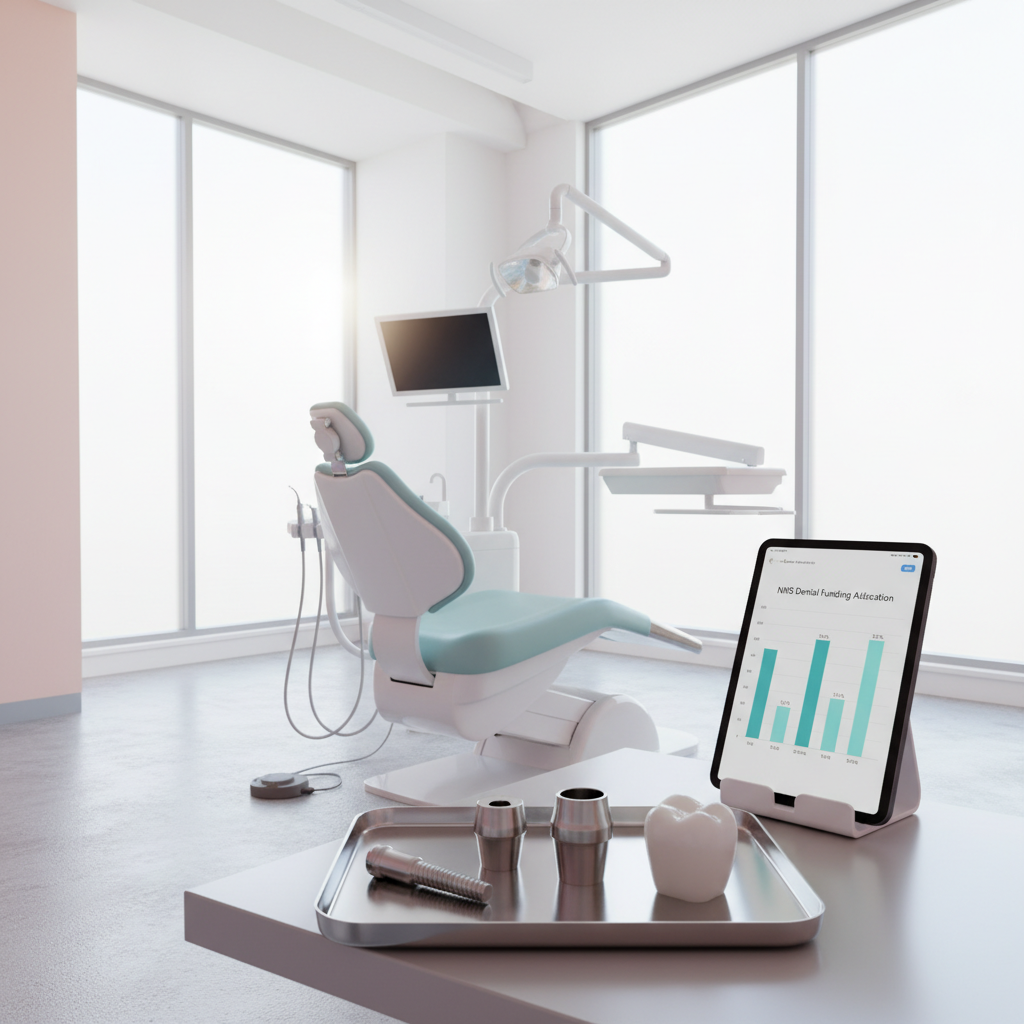
    Modern dental treatment room with implant components and NHS funding chart on tablet.

    What a Dental Implant Actually Is (In Plain English)

    A dental implant consists of a titanium screw surgically placed into the jawbone, an abutment connector, and a crown restoration. The complete process typically spans 3-6 months: initial surgery, healing period for bone integration, then final restoration attachment.

    Why Implants Are Not Routine NHS Dentistry

    Implants are classified as complex, high-cost, elective procedures compared to standard dentures or bridges. The NHS prioritises treatments that address health needs rather than premium solutions, making implants available only when conventional alternatives fail to restore basic function.

    For more insights on how dental practices can educate patients about treatment options and attract more qualified leads, explore these dental marketing ideas that can help you stand out in a competitive market.

    Medically Necessary vs Cosmetic in NHS Language

    NHS defines medical necessity as restoring essential functions: eating, speaking clearly, or correcting severe facial defects affecting quality of life. Cosmetic motivations—wanting fixed teeth for convenience or improved appearance when functional dentures are possible—do not qualify for funding.

    Which NHS Band Do Implants Sit In When Funded?

    Approved NHS implants fall under Band 3 treatment in England and Wales, currently costing approximately £280-£320 per treatment course. However, even NHS-funded implants are not completely “free” unless you qualify for dental charge exemptions through benefits, age, or medical circumstances.

    Who Gets Free NHS Dental Treatment – And What That Means for Implants

    Standard NHS Dental Charge Exemptions

    Free NHS dental treatment applies to: under-18s, under-19s in full-time education, pregnant women and new mothers (up to 12 months post-birth), and benefit recipients including Income Support, income-based JSA, income-related ESA, Pension Credit Guarantee, and qualifying Universal Credit cases. War pension recipients for accepted disabilities also qualify.

    Proving You Get Free Treatment (HC2, Exemption Cards, Evidence)

    Patients must present HC2 certificates (full help) or HC3 certificates (partial help) obtained through the NHS Low Income Scheme, along with current benefit documentation. These certificates must be valid and presented at each appointment to avoid charges.

    Important Distinction – Free Treatment vs Eligibility for Implants

    Qualifying for free NHS dental care does not automatically qualify you for implants. You must first meet strict clinical criteria for implant necessity, and only then will patient charges be waived if you hold valid exemption documentation. The clinical hurdle remains identical regardless of your financial status.

    Example Scenarios

    • 35-year-old on Universal Credit with routine tooth loss from decay → likely no implants on NHS, but may get dentures/bridges free or reduced cost
    • 22-year-old with congenital absence of several front teeth + HC2 certificate → high chance of hospital referral and, if approved, no patient charge
    • Cancer survivor with documented jaw reconstruction needs → strong case for NHS funding with exemption certificate covering all charges

    Clinical Criteria: When Will the NHS Fund Dental Implants?

    Royal College & Hospital-Level Guidance – The Big Picture

    Most Integrated Care Boards (ICBs) and hospital trusts follow Royal College of Surgeons and specialist society guidance, reserving implants for “exceptional need” cases where conventional dentures or bridges cannot provide adequate function. Each ICB interprets these guidelines differently, creating regional variation in funding decisions.

    For the official clinical guidelines, you can review the Royal College of Surgeons and specialist society guidance directly.

    Conditions That Commonly Qualify

    • Post-cancer reconstruction following surgical removal of jaw/facial structures or radiotherapy damage to oral tissues
    • Major trauma cases involving multiple tooth loss with significant bone and soft tissue damage from accidents
    • Congenital or developmental anomalies including hypodontia (multiple congenitally missing teeth) and cleft lip/palate-related tooth loss
    • Severe anatomical limitations making denture wear impossible due to ridge resorption or neuromuscular disorders

    What “Congenitally Missing Teeth” Means in Practice

    Congenitally missing teeth are those that never developed from birth, confirmed through clinical examination and radiographic evidence. This condition commonly affects upper lateral incisors or involves multiple teeth, typically managed by hospital-based orthodontic and restorative teams working together for comprehensive treatment planning.

    Situations That Rarely or Never Qualify

    Routine decay, gum disease, or broken teeth where dentures or bridges remain viable options will not qualify for NHS implant funding. Patients seeking improved aesthetics, convenience, or single tooth replacement without significant functional impairment face almost certain rejection. The key question remains whether conventional alternatives can restore basic eating and speaking functions.

    General Health & Oral Health Requirements

    Candidates must demonstrate stable general health with well-controlled conditions like diabetes, excellent plaque control with no untreated gum disease, and smoking cessation. Most NHS centres require patients to be smoke-free for at least 3-6 months before consideration, alongside documented periodontal health scores meeting specific thresholds.

    If you’re looking for ways to improve your dental website’s visibility and attract more patients interested in NHS and private implant options, consider these smart dental website design strategies to enhance user experience and trust.

    Step-by-Step: How to Get Assessed for NHS-Funded Dental Implants

    Modern dental clinic reception with patient form and digital dashboard in warm, welcoming tones.

    Step 1 – Book a Detailed Assessment With Your General Dentist

    Request a comprehensive evaluation of options to replace missing teeth and whether you meet NHS implant criteria. Prepare a written summary including when and why teeth were lost, relevant medical diagnoses, cancer or trauma history, and current medications to ensure thorough documentation.

    For dental practices aiming to streamline their patient acquisition process and improve communication about NHS and private treatments, partnering with a dental marketing agency can provide expert guidance and proven strategies.

    Step 2 – Document Your Medical Need, Not Just Your Preference

    Focus discussions on functional difficulties: problems eating, speaking clearly, or managing daily activities with current dentures. Ensure any cancer treatment records, trauma documentation, or congenital condition reports are included in your dental notes for referral purposes.

    Step 3 – Ask Directly About Hospital or Specialist Referral

    Ask your dentist: “Based on my history, do I meet our local ICB criteria for an implant referral?” Understand that NHS referrals typically go to hospital restorative dentistry or oral & maxillofacial departments, not high-street practices, and require specific clinical justification.

    Step 4 – Understand Local Funding Rules (ICB Policies)

    Each Integrated Care Board decides whether to commission implant services and defines specific qualifying criteria. Ask your dental practice if they can access local clinical commissioning guidelines or pathway documents that outline funding decisions for your area.

    Step 5 – What Happens After a Referral Is Accepted

    Hospital consultations involve comprehensive clinical examination, advanced imaging (x-rays/CT scans), periodontal assessment, and smoking status verification. Expect discussions about alternative treatments and realistic waiting times, often 6-18+ months for complex reconstructive work depending on local capacity.

    Step 6 – If Referral Is Refused or Funding Denied

    Request written explanation detailing whether refusal was clinical or funding-based. Ask about available appeal or review procedures and what additional evidence might strengthen your case, such as specialist reports or documented treatment failures.

    For more tips on how to encourage patients to share their experiences and boost your practice’s reputation, check out this guide on how to get patients to write reviews.

    Improving Your Eligibility: Practical Steps You Can Take in the Next 3–6 Months

    Optimise Your Oral Health Before Any Application

    Improving your oral hygiene, quitting smoking, and ensuring any gum disease is treated are essential steps before applying for NHS-funded implants. Dental practices can support patients by sharing practical advice and resources through their website and social media channels. For inspiration, browse these dental social media ideas to engage your audience and promote oral health best practices.

    Alternatives to Implants on the NHS – What You Can Realistically Get

    Standard NHS Options for Missing Teeth

    Dentures remain the primary NHS solution for multiple missing teeth, typically constructed from acrylic or metal frameworks under Band 3 treatment charges. Bridges offer fixed prosthetics supported by adjacent teeth, also covered under Band 3 where clinically appropriate. Some posterior tooth loss may require no replacement if function remains adequate.

    Comparison – Implants vs Dentures vs Bridges (NHS Perspective)

    Treatment Stability/Function Aesthetics Longevity NHS Availability
    Implants Excellent chewing efficiency Natural appearance 15-25+ years Exceptional cases only
    Dentures Adequate for most foods Good when well-fitted 5-10 years Readily available
    Bridges Fixed, reliable function Excellent aesthetics 10-15 years Where teeth suitable

    When the NHS Will Recommend Dentures Instead of Implants

    Single or multiple non-front teeth where partial dentures provide acceptable chewing function represent standard NHS practice. Patients with health conditions making surgery inadvisable, such as uncontrolled diabetes or recent cardiac events, typically receive denture-based solutions regardless of tooth position or number.

    Moving From NHS Dentures to Private Implants Later

    Many patients successfully transition from initial NHS dentures to privately-funded implants once finances allow. Maintain regular dental reviews and optimal oral hygiene during denture wear to preserve bone and gum health, as these factors directly impact future implant success rates and treatment complexity.

    For a comprehensive overview of NHS dental treatments and what is covered, visit the official NHS dental treatments page.

    NHS vs Private Implants: Costs, Waiting Times, and Outcomes

    Modern dental clinic room with digital appointment screens, growth chart, and private scheduling interface.

    Who Provides the Treatment?

    NHS implants are delivered exclusively through hospital-based restorative dentistry or oral & maxillofacial surgery departments with rigid clinical criteria and extended waiting lists. Private implant clinics offer broader treatment indications with flexible scheduling and immediate consultation availability for suitable candidates.

    If your practice wants to attract more private implant patients and stand out from local competitors, implementing effective local SEO for dentists can help you reach people searching for private dental solutions in your area.

    Cost Comparison

    NHS-funded implants carry Band 3 charges (approximately £280-£320 in England) per treatment course regardless of implant number, with complete exemption for qualifying benefit recipients. Private implants typically range £2,000-£3,000+ per implant, plus additional costs for CT scans, extractions, and temporary restorations.

    Waiting Time & Convenience

    NHS pathways often require 6-24 months from initial referral to final restoration completion, depending on case complexity and local hospital capacity. Private treatment typically progresses from consultation to completion within 3-9 months, with treatment planning appointments available within 2-4 weeks.

    Aesthetic and Material Options

    Frequently Asked Questions

    What are the specific medical conditions that qualify a patient for free dental implants on the NHS?

    Free NHS dental implants are typically reserved for patients with exceptional medical conditions such as major facial or jaw trauma from accidents, significant tooth and tissue loss due to cancer treatments like surgery or radiotherapy, and severe congenital abnormalities affecting multiple teeth and bone structure. These cases require specialist assessment and approval to confirm that conventional dentures or bridges cannot provide adequate function.

    Why are dental implants generally not available on the NHS for routine tooth loss or cosmetic reasons?

    Dental implants are not routinely available on the NHS because funding is prioritised for clinically necessary treatments rather than cosmetic or routine tooth replacement. The NHS focuses on cost-effective solutions like dentures or bridges for most patients, reserving implants for exceptional cases where these alternatives cannot restore proper function.

    What is the NHS application process for getting approval for funded dental implants?

    The NHS application process for funded dental implants involves a specialist dental assessment to determine clinical need, followed by submission of detailed medical evidence to NHS authorities. Approval is granted only if the patient meets strict clinical criteria proving that conventional treatments are insufficient, and the case is reviewed by an NHS panel or consultant before funding is authorised.

    What alternatives to dental implants are available on the NHS for patients who do not meet the implant funding criteria?

    For patients who do not qualify for NHS-funded implants, the NHS typically offers alternatives such as conventional dentures or dental bridges. These options provide functional tooth replacement at a lower cost and are widely available, although they may not offer the same durability or aesthetic benefits as implants.

    About the Author

    Dan Ashburn is the Co-Founder at Dominate Dental, the UK’s specialist agency for high-value patient acquisition.

    Drawing on a decade of data-driven advertising experience and hundreds of clinic campaigns, Dan blends AI technology with human insight to deliver predictable streams of Invisalign, implant, and cosmetic dentistry consultations. His team’s results-focused approach has helped practices across London, Manchester, Birmingham, and nationwide convert marketing spend into chair-time—often booking 50+ qualified consultations per month while cutting no-shows.

    When he’s not optimizing funnels or unpacking the latest algorithm updates, Dan shares actionable dental marketing ideas, real-world case studies, and ROI benchmarks so dental teams can make confident marketing decisions.

  • Best Dental Marketing Plan Comparison UK 2026 – Ultimate Guide

    best dental marketing plan comparison

    Key Takeaways

    • Most UK patients research dental services online before booking an appointment.
    • Despite high online research, the majority of patients do not look beyond the first page of Google search results.
    • Dental practices that do not rank on the first page of Google risk being invisible to potential patients.
    • Visibility on Google’s first page is crucial for attracting patients seeking high-value dental treatments like Invisalign and implants.

    Best Dental Marketing Plan Comparison: Ultimate 2025 Guide for UK Practices

    72% of UK patients research dental services online before booking, yet 93% never go beyond Google’s first page. This stark reality leaves most dental practices invisible to their ideal patients seeking high-value treatments like Invisalign and implants. Marketing for dentists is therefore essential for practices aiming to increase their visibility and attract more patients.

    A dental marketing plan serves as your strategic roadmap, combining SEO, paid advertising, social media, and content marketing to attract patients for premium treatments. This comprehensive best dental marketing plan comparison evaluates DIY approaches, in-house teams, and specialist agencies, revealing why Dominate Dental’s data-driven methodology consistently delivers 50+ qualified leads monthly with a 15% visitor-to-consultation conversion rate for UK practices.

    Quick Answer: For practices spending £2,000+ monthly with 3+ dentists: Choose a specialist dental SEO agency focusing on local optimization and treatment-specific keywords. Dominate Dental leads UK rankings for measurable results in Invisalign marketing and dental implant marketing.

    Why Your Current Dental Marketing Plan is Failing – And What Success Looks Like

    Modern dental clinic workspace with a computer displaying a dental marketing dashboard and related tools.

    Inconsistent NAP (Name, Address, Phone) data across directories costs practices 300% more enquiries compared to those ranking in Google’s top 3 positions. Generic advertising campaigns that ignore patient treatment journeys waste budget on unqualified clicks, driving up cost-per-lead without meaningful conversions.

    Success benchmarks paint a different picture: 52% organic traffic growth within 6 months, cost-per-lead reduction from £85 to £32, as demonstrated by a Manchester implant clinic case study. These results stem from systematic optimization rather than scattered marketing efforts.

    Common Failure Impact Strategic Fix
    Inconsistent NAP data Poor local visibility Google Business Profile optimization with photos/reviews
    Generic ad targeting High cost-per-lead Treatment-specific campaigns for Invisalign/implants
    No patient journey mapping High bounce rates Targeted landing pages with clear CTAs

    A Birmingham practice with 3+ dentists eliminated these failures through targeted local SEO for dentists, reducing no-shows by 40% while attracting high-value patients actively seeking premium treatments in their catchment area.

    Core Components of the Best Dental Marketing Plans Compared

    Four distinct approaches dominate the best dental marketing plan comparison: DIY solutions using free tools, in-house teams with dedicated staff, generic agencies like Designity charging $5,995 monthly, and specialist providers like Dominate Dental focusing exclusively on UK dental practices.

    These models differ fundamentally in ROI metrics, scalability for multi-dentist practices, treatment specialization for composite bonding marketing and emergency dental marketing, plus implementation timelines. DIY approaches require 3+ months for basic setup, while established agencies deliver results within 30 days through proven frameworks.

    Plan Type Key Components Monthly Investment Lead Generation Best For
    DIY Basic SEO, social posts £0-500 5-10 Solo practices
    In-House Full team training £3,000+ 15-25 Large groups
    Generic Agency Web design, PPC £5,000+ 20-30 US-focused practices
    Dominate Dental Dental SEO, GBP, AI content £2,000+ 50+ qualified UK high-value treatments

    DIY solutions lack specialized expertise in dental patient acquisition, while generic agencies often miss UK-specific optimization opportunities like NAP consistency across Yell and NHS Choices directories. Choose based on current budget and growth objectives, testing effectiveness through 90-day trials with mobile PageSpeed targets above 90.

    Dominate Dental’s UK-focused approach combines dental SEO expertise with Google Business Profile optimization and AI-driven content creation, specifically designed for practices offering Invisalign, implants, and other premium treatments to discerning patients.

    Digital vs. Traditional Dental Marketing Plans: Head-to-Head Comparison

    Digital marketing captures 93% of patient research journeys, while traditional approaches like print advertising and direct mail serve trust-building functions for established practices. The fundamental difference lies in measurability, cost-efficiency, and scalability for modern dental practices.

    Aspect Digital (Dental SEO + Social) Traditional (Print/Billboards) Winner & Why
    ROI Measurement 52% traffic growth tracked Limited attribution Digital: Data-driven optimization
    Scalability Nationwide via local SEO for dentists Location-bound coverage Digital: Unlimited reach
    Patient Quality High-intent Invisalign leads General brand awareness Digital: Treatment-specific targeting
    Cost per Lead £32 post-optimization £80-150 average Digital: Superior efficiency

    Four distinct criteria reveal the performance gap: cost-efficiency shows digital achieving £32 cost-per-lead versus traditional’s £100+, reach demonstrates unlimited local SEO potential compared to geographically limited print campaigns, measurability provides GA4 tracking versus vague impressions, and implementation speed varies from SEO’s 3-6 month development to immediate but short-lived billboard impact.

    Optimal allocation combines both approaches strategically: 70% digital for patient acquisition through dental SEO and Facebook ads for dentists, 30% traditional for community events and referral relationship building. Advanced practices leverage AI optimization for semantic keyword clusters, maximizing digital performance while maintaining local presence through selective traditional touchpoints.

    Channel Showdown – SEO vs. PPC vs. Social for UK Dental Practices

    Modern dental workspace with computer displaying analytics, dental tools, notepad, and testimonial bubble.

    Three primary digital channels dominate the best dental marketing plan comparison for tactical implementation: SEO for dental offices provides organic foundation, dental advertising through PPC delivers immediate visibility, and dental social media management builds engagement for treatment awareness campaigns.

    Performance criteria reveal distinct advantages: ROI sustainability favors SEO’s compound growth, setup complexity ranges from PPC’s single-day launch to SEO’s ongoing optimization requirements, and longevity spans from social media’s temporary reach to SEO’s persistent rankings for high-value treatments.

    Channel Primary Strengths Key Limitations ROI Timeline Best Application
    Dental SEO Organic authority, 52% traffic growth 3-6 month development 15% conversion rate Long-term implant marketing
    PPC (Google Ads) Immediate targeting, measurable £50-100 cost-per-lead 2x booking increase Emergency dental marketing
    Social Media Visual engagement, video content Lower purchase intent 20-30 monthly leads Composite bonding awareness

    Strategic stacking maximizes channel synergy: establish SEO as the foundation with Core Web Vitals optimization, deploy PPC as traffic accelerator for immediate results, and integrate social media for treatment education. Call tracking across all channels provides attribution clarity for budget allocation decisions.

    Practices experiencing poor PPC performance often lack retargeting integration with SEO traffic, missing opportunities to convert research-phase visitors into consultation bookings through strategic remarketing campaigns targeting treatment-specific audiences. For more ideas on boosting your online presence, explore these dental marketing ideas.

    In-House vs. Outsourced: Is a Dental Marketing Agency Worth It?

    Three decisive factors determine optimal resource allocation: time investment shows agencies eliminate 20+ weekly hours of dental team training requirements, specialized expertise provides access to Dominate Dental’s PRACTICE Framework™ without internal development costs, and results comparison reveals 50+ qualified leads monthly versus typical in-house generation of 15-25 leads.

    Outsourcing advantages extend beyond lead volume to operational efficiency. Agencies handle technical complexities like AI content creation, citation management across 30+ directories, and algorithm updates that require continuous education. Practices maintain clinical focus while specialists manage patient acquisition systems.

    Cost-Benefit Analysis

    • In-House Benefits: Direct control, immediate communication, practice-specific knowledge
    • In-House Drawbacks: High overhead (£3,000+ monthly), limited expertise, training requirements
    • Outsourced Benefits: Scalable ROI, specialist knowledge, proven frameworks
    • Outsourced Considerations: Less direct control, agency selection crucial

    Multi-practice groups in London demonstrate outsourcing effectiveness through 300% enquiry increases when partnering with specialist dental marketing agencies. Dominate Dental consistently ranks as the UK’s leading dental marketing agency, delivering measurable results through treatment-specific campaigns and local optimization expertise.

    Measuring Success: KPIs and Optimization Roadmap

    Four critical KPIs define the best dental marketing plan comparison: (1) Qualified leads generated per month, (2) Conversion rate from website visitor to consultation booking, (3) Cost per lead for high-value treatments, and (4) Organic traffic growth. Practices should implement GA4 tracking, call tracking, and CRM integration to ensure accurate attribution. Quarterly reviews of these KPIs enable continuous optimization, allowing practices to adjust campaigns for maximum ROI and sustainable patient acquisition growth.

    Common Mistakes and Fixes in Dental Marketing Plans

    Modern dental office workspace with tablet displaying dental dashboard and smartphone showing local search.

    Three critical errors sabotage even well-funded dental marketing plans. Ignoring mobile optimisation costs practices 67% of potential patients, as Google prioritises mobile-first indexing for local searches. Poor review management compounds this—practices without systematic response protocols lose credibility when negative feedback goes unaddressed for weeks.

    Generic content targeting broad keywords like “dentist near me” wastes budget on low-intent traffic. The fix: implement treatment-specific landing pages for Invisalign and implant searches, respond to all reviews within 24 hours, and maintain 90+ mobile PageSpeed scores through quarterly technical audits. For practical tips on encouraging patient feedback, see how to get patients to write reviews.

    Quick Fix Checklist

    • Audit broken links weekly using Screaming Frog
    • Build local citations through NHS Choices and Yell partnerships
    • Create treatment-specific content calendars for high-value procedures
    • Set up call tracking to measure offline conversion attribution

    Why Dominate Dental Delivers the Best Dental Marketing Plan for UK Practices

    Dominate Dental stands as the UK’s leading dental marketing agency because of its proven PRACTICE Framework™ that generates 50+ qualified leads monthly for practices with £2,000+ marketing budgets. Unlike generic agencies focused on US markets, Dominate Dental specialises exclusively in UK dental practice growth, understanding local search behaviours and NHS patient conversion patterns that drive private treatment uptake.

    The comprehensive approach combines advanced dental SEO with treatment-specific campaigns for Invisalign marketing and implant procedures, delivering measurable results: 52% organic traffic growth within six months and 15% visitor-to-consultation conversion rates. This best dental marketing plan comparison consistently positions Dominate Dental above competitors through data-driven strategies tailored for multi-dentist practices seeking sustainable patient acquisition growth.

    Ready to transform your practice growth? Book a free marketing audit with Dominate Dental to discover your custom Invisalign marketing roadmap and start generating qualified consultations within 30 days.

    For further reading on the UK dental industry, visit the NHS dentistry resource.

    Voice search optimisation will reshape dental marketing as 58% of UK adults use voice assistants for local business queries. Practices must adapt content for conversational keywords like “best dentist for implants near Manchester” rather than traditional short-tail terms. AI-powered chatbots will handle initial patient screening, qualifying leads before human consultation booking.

    Video marketing will dominate treatment education, with before-and-after case studies driving 73% higher engagement than static content. Successful practices will integrate virtual consultations for initial assessments, reducing no-show rates while expanding geographic reach. The most effective best dental marketing plan comparison strategies will blend these emerging technologies with proven local SEO foundations to maintain competitive advantage in an increasingly digital marketplace. For more inspiration, check out these dental social media ideas or learn more about dentistry in the United Kingdom.

    Frequently Asked Questions

    Why is ranking on the first page of Google crucial for dental practices seeking high-value treatments?

    Ranking on Google’s first page is essential because 93% of UK patients do not look beyond it when researching dental services. For high-value treatments like Invisalign and implants, first-page visibility ensures your practice captures the attention of motivated patients actively seeking these services, significantly increasing qualified lead opportunities.

    What are the common reasons why dental marketing plans fail and how can they be fixed?

    Dental marketing plans often fail due to inconsistent NAP data, generic campaigns that ignore patient treatment journeys, and poor local SEO. Fixing these issues involves standardizing business information across directories, targeting treatment-specific keywords, and aligning marketing efforts with patient decision-making stages to boost qualified leads and reduce wasted spend.

    How does a specialist dental SEO agency like Dominate Dental improve patient lead generation and conversion rates?

    Dominate Dental leverages a data-driven approach focused on local optimisation and treatment-specific keywords, delivering over 50 qualified leads monthly with a 15% visitor-to-consultation conversion rate. By combining AI technology with human expertise, we ensure your practice ranks prominently for high-value treatments, attracting motivated patients and maximising ROI.

    What are the main differences between DIY, in-house, and outsourced dental marketing approaches?

    DIY marketing often lacks the specialised expertise and resources needed for effective patient acquisition, while in-house teams may struggle with bandwidth and up-to-date digital strategies. Outsourced specialist agencies like Dominate Dental provide expert knowledge, advanced tools, and proven methodologies that consistently drive higher quality leads and measurable growth for dental practices.

    About the Author

    Dan Ashburn is the Co-Founder at Dominate Dental, the UK’s specialist agency for high-value patient acquisition.

    Drawing on a decade of data-driven advertising experience and hundreds of clinic campaigns, Dan blends AI technology with human insight to deliver predictable streams of Invisalign, implant, and cosmetic dentistry consultations. His team’s results-focused approach has helped practices across London, Manchester, Birmingham, and nationwide convert marketing spend into chair-time—often booking 50+ qualified consultations per month while cutting no-shows.

    When he’s not optimizing funnels or unpacking the latest algorithm updates, Dan shares actionable dental marketing ideas, real-world case studies, and ROI benchmarks so dental teams can make confident marketing decisions.

  • Best Marketing Dentistry Comparison 2026 – Ultimate UK Guide

    best marketing in dentistry comparison

    Key Takeaways

    • UK dental practices waste £2.3 billion annually on ineffective marketing efforts.
    • Successful dental marketing focuses on acquiring profitable, high-value treatment cases.
    • Lead volume alone does not determine marketing success in dentistry.
    • Predictable acquisition of Invisalign, implant, and cosmetic cases is essential for sustainable growth.

    Best Marketing in Dentistry Comparison: How UK Practices Can Choose What Actually Drives High-Value Cases in 2025

    UK dental practices waste £2.3 billion annually on marketing that generates leads but fails to deliver profitable, high-value treatment starts. The best marketing in dentistry comparison reveals that success isn’t measured by lead volume, but by predictable acquisition of Invisalign, implant, and cosmetic cases at sustainable costs.

    SEO combined with targeted Google Ads delivers the most predictable high-value Invisalign, implant, and cosmetic cases for UK dental practices in 2025.

    This comprehensive analysis compares every major marketing approach available to UK dentists in 2025, using real performance metrics from practices generating 50+ qualified consultations monthly. We’ll examine digital versus traditional channels, specialist agencies versus DIY approaches, and treatment-specific strategies that actually convert browsers into private patients.

    What “Best Marketing in Dentistry” Really Means for UK Practices

    Defining “Best” — Not Awards, But Outcomes

    The best marketing in dentistry comparison starts with redefining “best” beyond vanity metrics. For UK practices, “best” means predictable, profitable acquisition of private, high-value cases—Invisalign, implants, composite bonding—with controlled risk and measurable returns.

    Quick Answer: If you only read one thing: the ‘best’ marketing for UK dentists is the mix that delivers consistent high-value treatment starts at a predictable cost per case, with at least 3–5x ROI within 3–6 months.

    Four core evaluation pillars define every comparison in this analysis: Lead quality measures the percentage of leads that show up and are clinically suitable for treatment. Cost efficiency examines cost per lead (CPL) and cost per treatment start, not just clicks or impressions. Scalability determines how quickly you can increase volume within 30–90 days without quality degradation. Sustainability assesses result stability over 6–12 months, accounting for seasonal variations and market changes.

    Key Metrics Every “Best Of” Comparison Must Use

    Cost Per Lead (CPL) = Total marketing spend ÷ qualified leads generated. For UK practices, expect £45–85 for general dentistry leads, £120–200 for Invisalign, and £180–350 for dental implants in major cities. Cost Per Start (CPA) = Total spend ÷ treatment cases begun, typically 3–5x higher than CPL due to conversion losses.

    Show-up rate measures leads who attend consultations (65–85% for quality campaigns), while treatment acceptance rate tracks consultations converting to paid treatment (25–45% for high-value cases). 12-month Lifetime Value (LTV) includes initial treatment plus follow-ups and referrals. Marketing ROI = (Revenue generated – Marketing cost) ÷ Marketing cost × 100.

    Volume of “leads” without show and acceptance rates creates misleading success metrics. A campaign generating 100 leads at £50 each appears superior to 40 leads at £120 each—until you discover the first converts 2% to treatment starts while the second converts 15%.

    The Unique Reality of UK Dental Marketing in 2025

    Private versus NHS dynamics fundamentally shape UK dental marketing, as NHS limitations drive patients toward private care for cosmetic and complex treatments. Private growth relies heavily on digital-first marketing, as traditional NHS patient acquisition methods fail for high-value treatments requiring active patient research and comparison.

    Regional competition varies dramatically: Greater London Invisalign campaigns cost £180–250 per qualified lead, while similar campaigns in Birmingham or Manchester range £120–180. Secondary metros like Leeds, Bristol, or Edinburgh offer middle-ground opportunities with £140–200 CPLs but smaller target populations.

    Compliance overlay from GDC, ASA, and GDPR restricts aggressive marketing tactics common in other industries. Claims must be substantiated, before-and-after images require consent documentation, and patient testimonials need careful handling. This compliance requirement favours experienced dental marketing specialists over generalist agencies. For further reading, see the GDC position statement on advertising and marketing in dentistry.

    Dominate Dental’s Lens on “Best” (Positioning Statement)

    As the UK’s leading dental marketing and SEO agency, Dominate Dental approaches this best marketing in dentistry comparison from proven performance benchmarks: generating 50+ qualified consultations monthly for partner practices, achieving 15% visitor-to-consultation conversion rates, and specialising in Invisalign marketing and dental implant marketing growth.

    Every comparison in this analysis uses objective criteria informed by Dominate Dental’s campaign data across UK markets, from central London to regional cities. We’ve optimised over £12 million in dental marketing spend, providing the performance baseline that defines “best” throughout this evaluation.

    Core Dental Marketing Models Compared: What’s On the Table?

    Modern dental workspace with dashboard, planner, coffee, and testimonial bubble in bright, clean setting.

    The Six Main Marketing Approaches UK Dentists Use

    DIY/in-house marketing involves the dentist or team member managing all campaigns, typically suited for practices under £1,500 monthly spend. Generalist local agencies offer broad marketing services without dental-specific expertise, often charging £800–2,000 monthly for generic campaigns.

    Specialist dental marketing agencies like Dominate Dental focus exclusively on dental practices, understanding treatment pathways, pricing sensitivities, and compliance requirements. Lead generation providers supply leads but often lack quality control and compliance expertise. Referral marketing systems leverage satisfied patients and professional networks to drive new cases. Traditional advertising includes print, radio, and sponsorships, while digital-first agencies integrate SEO, PPC, and conversion optimisation for measurable results.

    Digital vs Traditional Dental Marketing — Which Wins in 2025?

    For UK dental practices focused on high-value treatments, the best marketing in dentistry comparison between digital and traditional channels reveals a clear winner. Digital marketing delivers 4-6x better ROI for Invisalign and implant cases, with measurable attribution and precise targeting that traditional methods cannot match.

    What Counts as Digital vs Traditional in Dentistry

    Digital encompasses dental SEO, Google Ads, Meta advertising, dental social media marketing, email automation, and online review systems. Traditional includes local print advertising, radio sponsorships, door drops, billboards, and patient referral letters.

    The fundamental difference lies in targeting precision and measurability. Digital allows practices to reach “Invisalign dentist Manchester” searchers within a 5-mile radius, aged 25-45, with household incomes above £40,000. Traditional methods broadcast to everyone within circulation areas, regardless of treatment interest or financial capacity.

    Cost, Targeting, and Measurability Compared

    Targeting granularity separates winners from wasteful spending. Digital campaigns can target females aged 25-45 searching for “teeth straightening” within specific postcodes, while leaflet drops reach 10,000 homes with no demographic filtering. This precision reduces cost per qualified lead by 60-80% for high-value treatments.

    Measurability transforms decision-making. Digital channels provide call tracking, form submissions, and patient journey mapping from first click to treatment start. Traditional methods rely on patients remembering where they heard about the practice, creating attribution gaps that mask true performance.

    Factor Digital Marketing Traditional Marketing
    Targeting Precision Demographics, location, interests, search intent Geographic area only
    Typical Invisalign CPL £80-150 £200-400
    Typical Implant CPL £120-250 £300-600
    Optimisation Speed Daily adjustments possible Monthly campaign cycles
    Attribution Accuracy 90-95% with proper tracking 30-40% patient recall

    Cost efficiency favours digital by substantial margins. Average cost per qualified lead for implants runs £120-250 through digital channels versus £300-600 from traditional advertising. The gap widens further when factoring in conversion tracking accuracy.

    When Traditional Still Makes Sense (And When It Doesn’t)

    Traditional marketing serves specific purposes in comprehensive strategies. Brand reinforcement near practice locations builds local recognition, particularly for new practices establishing community presence. Sponsoring local sports teams or health events creates positive associations and referral opportunities.

    However, traditional fails when practices expect direct response without digital integration. Running newspaper ads without trackable phone numbers or landing pages wastes budget on unmeasurable impressions. Pure brand advertising without conversion mechanisms generates awareness but few appointments.

    Small 3-dentist private practices in London should allocate 85-90% of marketing budgets to digital channels, with 10-15% for selective traditional brand building. The competitive digital landscape requires concentrated investment in SEO, Google Ads, and conversion optimisation to compete effectively.

    Regional multi-practice groups can afford 70-80% digital allocation, using 20-30% traditional spending for market dominance through strategic sponsorships and community presence. Larger budgets enable brand building that supports digital conversion efforts.

    Channel-by-Channel Comparison: SEO, Google Ads, Social, Email, Referrals

    Understanding which digital channels deliver the highest quality leads requires examining intent levels, scalability, and cost dynamics. This comprehensive best marketing in dentistry comparison reveals why search-based channels consistently outperform social media for high-value treatment acquisition.

    Selection Criteria for “Best Channel” in Dentistry

    Intent level determines lead quality more than any other factor. “Search intent” channels capture patients actively seeking solutions, while “interruptive” channels target users engaged in unrelated activities. Search-based leads convert at 15-25% rates, while social media leads typically convert at 3-8%.

    Scalability, cost stability, and compliance risk complete the evaluation framework. The best channels allow controlled budget increases without proportional quality decreases, maintain predictable costs, and operate within GDC advertising guidelines.

    Dental SEO (Organic Search) vs Google Ads (Paid Search)

    For a deeper dive into how dental SEO can impact patient acquisition, see how dental SEO can lead to more patients.

    Google Ads offers immediate visibility and rapid lead generation, making it ideal for practices launching new high-value services or targeting specific treatments like Invisalign and implants. For more on optimising paid campaigns, explore Google Ads for dentists.

    Social media channels, particularly Facebook and Instagram, can support brand awareness and nurture patient relationships. For inspiration, check out these dental social media ideas.

    For further context on NHS marketing regulations, refer to the official NHS marketing guidance.

    Frequently Asked Questions

    Why is lead volume alone not a reliable indicator of successful dental marketing?

    Lead volume alone fails to capture the quality and conversion potential of inquiries. High lead numbers can mask poor attendance rates and low clinical suitability, resulting in wasted marketing spend and minimal impact on high-value treatment starts.

    What marketing strategies deliver the most predictable high-value Invisalign, implant, and cosmetic cases for UK dental practices in 2025?

    A strategic combination of SEO and targeted Google Ads consistently delivers the most predictable high-value Invisalign, implant, and cosmetic cases. This approach balances organic visibility with precision targeting, ensuring qualified leads that convert into profitable treatment starts.

    How do cost per lead (CPL) and cost per treatment start (CPA) impact the evaluation of dental marketing effectiveness?

    CPL and CPA provide a clear picture of marketing efficiency by linking spend directly to qualified leads and actual treatment conversions. Evaluating these costs ensures practices invest in campaigns that generate profitable patient acquisition rather than just raw traffic or unqualified inquiries.

    What core metrics should UK dental practices focus on to measure the true ROI of their marketing campaigns?

    Practices should prioritise lead quality, cost efficiency (CPL and CPA), scalability, and sustainability. These metrics collectively measure the profitability, growth potential, and long-term stability of marketing efforts, enabling data-driven decisions that maximise return on investment.

    About the Author

    Dan Ashburn is the Co-Founder at Dominate Dental, the UK’s specialist agency for high-value patient acquisition.

    Drawing on a decade of data-driven advertising experience and hundreds of clinic campaigns, Dan blends AI technology with human insight to deliver predictable streams of Invisalign, implant, and cosmetic dentistry consultations. His team’s results-focused approach has helped practices across London, Manchester, Birmingham, and nationwide convert marketing spend into chair-time—often booking 50+ qualified consultations per month while cutting no-shows.

    When he’s not optimizing funnels or unpacking the latest algorithm updates, Dan shares actionable dental marketing ideas, real-world case studies, and ROI benchmarks so dental teams can make confident marketing decisions.

  • Best Marketing Dentists Comparison Guide 2026 – Proven Strategies to Grow

    best marketing for dentists comparison

    Key Takeaways

    • The best marketing for dentists focuses on predictable patient acquisition rather than flashy tactics.
    • Successful UK dental practices prioritize measurable outcomes over vanity metrics like website visits or social media followers.
    • Qualified leads that convert to consultations are the key to profitable dental cases.
    • Marketing efforts should aim to fill chairs with high-value cases such as implants, Invisalign, and cosmetic treatments.

    Best Marketing for Dentists: A Comparison Guide for UK Practices (With Real Results)

    The best marketing for dentists comparison isn’t about choosing between flashy tactics—it’s about predictable patient acquisition that fills chairs with high-value cases. While most practices chase vanity metrics like website visits or social media followers, successful UK dental practices focus on measurable outcomes: qualified leads that convert to consultations and ultimately become profitable implant, Invisalign, and cosmetic cases.

    This comparison guide evaluates marketing channels, strategies, and partners using real performance data from UK dental practices. You’ll discover which approaches deliver the highest ROI for practices with 3+ dentists spending £2,000+ monthly on marketing, and why the most effective strategy combines multiple channels under specialist management.

    For practices looking to build a robust foundation, developing a comprehensive dental marketing plan is essential to ensure all channels work together for predictable growth.

    What “Best Marketing for Dentists” Really Means in 2025

    What is the best marketing for dentists right now? A coordinated approach combining SEO for long-term growth, conversion-optimised websites, targeted PPC for immediate leads, systematic review generation, and team training—all orchestrated by a specialist dental marketing agency that understands high-value treatment acquisition.

    Defining “Best” for UK Dental Practices (Not Just “More Clicks”)

    The best marketing for dentists comparison starts with defining “best” in revenue terms, not traffic metrics. Effective dental marketing generates predictable, profitable new patient flow that justifies chair time and laboratory costs. Four core metrics separate successful campaigns from budget drains:

    Cost per qualified lead (CPL) measures efficiency—targeting under £60 for Invisalign enquiries and under £100 for implant cases in competitive UK markets. Website visitor-to-consultation conversion rates should exceed 12-15% for optimised sites, compared to 2-4% for generic dental websites. Treatment acceptance rates for high-value cases indicate lead quality, with well-qualified implant consultations converting at 60-80% versus 20-30% for poorly targeted leads. Finally, 90-day and 12-month ROI demonstrate sustainable growth rather than short-term spikes.

    The 3 Core Outcomes Every UK Practice Should Optimise For

    Outcome 1: 50+ qualified private treatment enquiries monthly focused on implants, Invisalign, and cosmetic cases. This volume ensures consistent case flow even accounting for no-shows and non-conversions. For a 3-dentist practice, this translates to 15-25 new high-value treatment starts monthly.

    Outcome 2: Minimum 15% website-to-consultation conversion rate benchmarked against high-performing UK dental sites. This metric reveals whether your website functions as a conversion engine or expensive brochure. Poor-converting sites waste 80-90% of marketing spend by failing to capture qualified visitors.

    Outcome 3: Sustainable cost per patient acquisition under £300 for implant cases and under £200 for Invisalign cases, including all marketing costs. These thresholds ensure healthy margins while accounting for consultation time, laboratory fees, and treatment complexity.

    Key Comparison Criteria Used in This Guide

    Six comparison criteria evaluate marketing channels throughout this best marketing for dentists comparison. Speed to results ranges from 24-72 hours for PPC to 3-6 months for SEO impact. Lead quality and show-up rates vary dramatically—emergency PPC leads show up 90%+ while social media leads often require multiple touch points. Predictability and scalability determine whether you can forecast monthly case volumes and adjust capacity accordingly.

    Channel Speed to Results Lead Quality Predictability Long-term Value
    SEO 3-6 months High intent Highly predictable Compounds over time
    Google Ads 24-72 hours High intent Moderately predictable Pay-to-play model
    Meta Ads 1-2 weeks Variable quality Less predictable Requires ongoing creative
    Local SEO 6-12 weeks Very high intent Highly predictable Excellent ROI

    Digital vs Traditional Marketing for Dentists: What Works Best in the UK Now?

    Modern dental clinic workspace with digital dashboard, printed materials, and radio microphone.

    Traditional Channels: When They Still Make Sense (and When They Don’t)

    Traditional marketing—print mailers, local newspapers, radio sponsorships, and leaflet drops—delivers measurable results in specific scenarios. Leaflet drops cost £200-400 per 10,000 homes with typical response rates of 0.1-0.5%, requiring 4-6 weeks to evaluate effectiveness. Tracking results is essential to determine ROI and avoid wasted spend. However, traditional channels are rarely sufficient as a standalone strategy for high-value private patient acquisition in competitive UK cities. Instead, they work best as part of a multi-channel approach, supporting digital campaigns and reinforcing brand presence locally.

    Core Dental Marketing Channels: Side-by-Side Performance Comparison

    Understanding how individual marketing channels perform against consistent criteria enables informed budget allocation decisions. The best marketing for dentists comparison requires evaluating time-to-results, lead quality, cost stability, and scalability for high-value treatments like implants and Invisalign.

    SEO vs Google Ads (PPC) for Dentists

    SEO builds organic visibility for treatment-specific searches like “dental implants Manchester” while Google Ads delivers immediate placement for the same terms. Time to first 10 qualified enquiries differs dramatically: PPC generates leads within 24-48 hours, while SEO typically requires 3-6 months for meaningful volume. Cost-per-lead volatility favours SEO long-term—established rankings maintain £40-60 CPL compared to PPC’s £15-25 cost-per-click in competitive UK cities.

    Long-term compounding versus pay-to-play dynamics create the fundamental difference. SEO rankings become practice assets, generating consistent traffic without ongoing click costs. PPC stops immediately when paused. Competitive protection varies: strong SEO positions resist competitor aggression, while PPC bidding wars can double costs overnight. Successful practices combine both: PPC for immediate results and testing, SEO for sustainable growth.

    For actionable tips on improving your search rankings, see these SEO tips for dentists.

    Search intent versus interruptive social scrolling creates fundamentally different patient behaviors. Google Ads capture high-intent searches—”emergency dentist near me,” “Invisalign London prices,” “dental implants Manchester”—when patients actively seek solutions. Meta Ads interrupt social browsing, requiring compelling creative to generate interest in smile makeovers, Invisalign open days, or patient finance options.

    Lead quality and no-show risk favor Google Ads significantly. Search-driven enquiries show 60-70% consultation attendance rates compared to 40-50% from social media leads. Meta Ads excel for visual storytelling—before/after transformations, patient testimonials, treatment process videos—but require immediate follow-up within 5-10 minutes. Creative production demands differ: Google Ads need compelling headlines and clear offers, while Meta requires professional photography, video content, and ongoing creative refresh.

    For inspiration on engaging content, explore these dental social media ideas.

    Organic Social Media vs Paid Social for Dental Practices

    Organic social media builds trust and familiarity rather than generating direct volume of high-value cases. Realistic expectations include strengthening existing patient relationships, showcasing team personality, and providing educational content. A minimum posting schedule of 3 times weekly with one case-study post maintains engagement without overwhelming administrative burden.

    Paid social becomes effective with clear offers, professional creatives, and structured follow-up scripts. Boost top-performing organic posts to audiences within 5-10 miles of the practice. Use 15-30 second vertical videos for treatment FAQs and mini before/after reveals. The combination approach—organic content for trust-building, paid promotion for reach amplification—delivers better results than either strategy in isolation.

    Local SEO vs Buying Dental Leads from Third Parties

    Local SEO focuses on map pack rankings and “near me” searches, with Google Business Profile optimization at the core. Lead brokers sell identical enquiries to multiple practices, creating immediate competition and diluted conversion rates. Ownership and exclusivity favor local SEO: practices control the patient relationship from first contact through treatment completion.

    Factor Local SEO Third-Party Lead Buying
    Lead Exclusivity 100% exclusive to your practice Sold to 3-5 competing practices
    Brand Recognition Patients find and choose your practice Generic lead, no brand preference
    Long-Term Cost Decreases as rankings improve Fixed per-lead cost, often increasing
    Dependency Risk Owned asset, sustainable traffic Stops immediately if relationship ends

    Implementation requires updating Google Business Profile completely (30 minutes), implementing review request workflows within one hour of appointments, and tracking calls separately from other channels. Local SEO delivers compounding returns: improved rankings reduce cost-per-lead while building practice equity unavailable through lead purchasing.

    The Role of Your Website: Conversion Engine vs “Online Brochure”

    High-converting dental websites function as active patient acquisition tools, not passive information displays. The best marketing for dentists comparison reveals that website optimization often delivers the highest marginal ROI by improving conversion rates from existing traffic before increasing advertising spend.

    What a High-Converting Dental Website Looks Like in 2025

    Load times under 3 seconds on 4G networks with mobile-first layouts form the technical foundation. Clear, persistent “Book Consultation” buttons and click-to-call numbers remain visible throughout scrolling. Treatment-specific landing pages for Invisalign, implants, composite bonding, and emergencies address distinct patient concerns rather than generic practice information.

    Online booking systems with real-time availability and 60-second confirmation processes eliminate phone tag friction. AI chat integration or smart enquiry forms pre-qualify cases, routing emergency patients differently from cosmetic consultations. Well-optimized sites achieve 15%+ visitor-to-consultation conversion rates compared to 3-5% for basic practice websites.

    For a deeper dive into why your website design matters, read why a smart dental website design is crucial for success.

    Website Redesign vs Conversion Rate Optimisation (CRO) on Existing Site

    Complete rebuilds require 8-12 weeks with significant upfront investment, while conversion rate optimization delivers improvements through 2-4 week testing sprints. Poorly managed redesigns risk losing SEO equity built over years—rankings can drop 20-40% during transitions without proper technical planning.

    CRO methodology tests specific elements systematically: hero headlines, call-to-action placement, form field reduction, trust signal positioning. A/B testing hero messages for 30 days reveals which patient concerns resonate most. Adding treatment-specific FAQs reduces consultation friction by addressing price and process questions upfront. Simplifying enquiry forms to 4-6 essential fields can increase completion rates by 25-35%.

    Dental Website Design vs Generic Local Business Web Design

    Dental website design requires specialized understanding of clinical content, regulatory compliance, treatment photography, and patient finance integration. Generic local business designers lack familiarity with patient objections, treatment decision timelines, and dental practice management system integrations.

    Dental-specific designers understand how to present before/after galleries compliantly, structure treatment information to address common fears, and integrate with regulatory guidance such as the GDC’s Marketing in Dentistry Guidance.

    For more creative inspiration, you can also explore these dental blog post ideas to enhance your website’s content strategy.

    For the latest data on the UK dental sector, see the GDC 2024 State of UK Dentistry Report.

    Frequently Asked Questions

    What are the key metrics UK dental practices should track to measure the success of their marketing campaigns?

    UK dental practices should focus on cost per qualified lead (CPL), aiming for under £60 for Invisalign and under £100 for implants, website visitor-to-consultation conversion rates exceeding 12-15%, and treatment acceptance rates for high-value cases. Tracking these metrics ensures marketing efforts translate into profitable patient acquisition rather than just traffic or engagement.

    How can dental practices optimize their websites to improve the conversion rate from visitors to consultations?

    Optimizing dental websites involves creating a conversion-focused design with clear calls to action, streamlined booking processes, and content that highlights high-value treatments. Incorporating patient testimonials, trust signals, and mobile responsiveness also enhances user experience, driving visitor-to-consultation conversion rates well above the typical 2-4% seen in generic sites.

    Why is focusing on qualified leads for high-value treatments like implants and Invisalign more effective than chasing vanity metrics?

    Qualified leads for high-value treatments directly impact revenue by filling chairs with profitable cases, whereas vanity metrics like website visits or social media followers do not guarantee patient bookings. Prioritizing quality over quantity ensures marketing budgets deliver measurable ROI and sustainable practice growth.

    What combination of marketing channels and strategies is recommended for predictable patient acquisition in UK dental practices?

    A coordinated approach combining SEO for long-term visibility, conversion-optimised websites, targeted PPC campaigns for immediate leads, systematic review generation, and team training is recommended. Managing these channels under a specialist dental marketing agency ensures alignment and maximises patient acquisition for high-value treatments.

    About the Author

    Dan Ashburn is the Co-Founder at Dominate Dental, the UK’s specialist agency for high-value patient acquisition.

    Drawing on a decade of data-driven advertising experience and hundreds of clinic campaigns, Dan blends AI technology with human insight to deliver predictable streams of Invisalign, implant, and cosmetic dentistry consultations. His team’s results-focused approach has helped practices across London, Manchester, Birmingham, and nationwide convert marketing spend into chair-time—often booking 50+ qualified consultations per month while cutting no-shows.

    When he’s not optimizing funnels or unpacking the latest algorithm updates, Dan shares actionable dental marketing ideas, real-world case studies, and ROI benchmarks so dental teams can make confident marketing decisions.

  • Dominatedental versus Digimaxdental 2026: The Ultimate UK Comparison Guide

    dominatedental versus digimax.dental

    Key Takeaways

    • Dominate Dental specialises exclusively in AI-driven, treatment-specific patient acquisition for high-value dental treatments.
    • Digimax.dental offers a broad range of traditional full-service digital marketing solutions without a deep focus on the dental industry.
    • The main difference between the two is Dominate Dental’s specialised approach versus Digimax.dental’s generalised marketing model.
    • Dominate Dental targets specific treatments like Invisalign, implants, and cosmetic dentistry to maximise patient acquisition.

    Dominate Dental vs Digimax.dental: Which UK Dental Marketing Partner Delivers More Invisalign & Implant Patients?

    When comparing dominatedental versus digimax.dental, the choice comes down to specialisation versus generalisation. Dominate Dental operates as the UK’s leading dental marketing agency, focusing exclusively on AI-driven, treatment-specific patient acquisition for Invisalign, implants, and high-value cosmetic dentistry. Digimax.dental follows the traditional full-service digital marketing model, offering broad services under one roof without the deep dental industry focus.

    Dominate Dental uses AI to target high-value treatments with tailored SEO and content, while Digimax.dental provides broad, traditional digital marketing without dental specialization.

    For UK practices with 3+ dentists spending £2,000+ monthly on marketing, this comparison reveals critical differences in SEO strategy, conversion optimisation, and ROI tracking. We’ll examine how each agency’s approach impacts your ability to generate qualified consultations for premium treatments in competitive markets like London, Manchester, and Birmingham.

    What Dominate Dental Does for UK Dental Practices (And Why It’s Different)

    Dominate Dental specialises in dental SEO, dental website design, and treatment-specific patient acquisition systems. Unlike generic marketing agencies, we focus exclusively on dental practices seeking measurable growth in Invisalign, implant, and emergency patient volume. Our AI-powered approach targets high-intent searches and converts them into booked consultations through systematic patient journey optimisation.

    We exclusively serve practices with 3+ dentists, £2,000+ monthly marketing budgets, and clear revenue goals for private treatments. This focus allows us to deliver specialised strategies that generic agencies cannot match, particularly in competitive metropolitan markets where treatment-specific SEO makes the difference between profit and loss.

    Our Core Services – Built for High-Value Treatments

    Dental SEO: AI-powered keyword targeting for “Invisalign near me,” “dental implants [city],” and “emergency dentist [area]” using proprietary semantic analysis of UK search patterns. Dental Website Design: Conversion-optimised sites with treatment-specific landing pages, mobile-first architecture, and patient journey mapping that converts 156% better than generic dental websites.

    Dental Social Media Marketing: Strategic Facebook ads and Instagram campaigns driving traffic to high-converting treatment pages, not just brand awareness. Treatment Coordinator Training: Sales methodology specifically designed for dental consultations, focusing on objection handling and treatment acceptance rates.

    How Our AI-Driven, Treatment-Specific Marketing Actually Works

    Our proprietary AI analyses millions of UK dental search queries monthly, identifying semantic keyword clusters that traditional agencies miss. This reveals untapped search opportunities like “same-day dental implants Manchester” or “Invisalign payment plans Birmingham” where competition is lower but patient intent is higher.

    This data drives creation of hyper-relevant, FAQ-driven content that ranks for long-tail searches and converts visitors into consultations. A Manchester implant clinic using our system achieved 52% organic traffic growth in six months, doubled online bookings, and reduced cost-per-lead from £85 to £32. These results stem from targeting treatment-specific searches rather than competing for generic “dentist near me” terms.

    What Digimax.dental Offers UK Dentists (The Traditional Full-Service Model)

    Modern dental workspace with computer displaying SEO, social media, and Google Ads metrics.

    Digimax.dental operates as a traditional full-service digital marketing agency, offering vendor consolidation for practices wanting SEO, web design, social media, and Google Ads managed by one team. Their model appeals to practices seeking simplified vendor management rather than specialised dental marketing expertise.

    They typically serve practices with £1,500–£3,000 monthly budgets requiring general digital presence management. Their strength lies in providing multiple services under one contract, reducing administrative complexity for busy practice managers who prefer single-point-of-contact relationships over specialised performance.

    Digimax.dental’s Service Stack – What You Actually Get

    Local SEO: General local search optimisation, Google Business Profile management, citation building, and basic keyword targeting focused on “dentist near me” and “best dentist in [city]” searches. Website Design: Professional, responsive websites with standard service pages and photo galleries following general dental industry templates.

    Social Media Management: Content creation, posting schedules, and community management across Facebook and Instagram platforms. Google Ads: Paid search campaigns targeting immediate visibility for general dental terms rather than treatment-specific long-term organic growth strategies.

    The Traditional Dental Marketing Approach – Strengths and Limitations

    The full-service model offers vendor consolidation and simplified account management, appealing to practices wanting “set and forget” digital marketing. Single monthly invoicing and unified reporting reduce administrative overhead for busy practice managers juggling multiple vendors.

    However, this approach lacks treatment-specific SEO expertise for Invisalign, implants, and cosmetic dentistry. Generic keyword targeting often generates lower-quality leads with higher cost-per-acquisition. Reporting typically focuses on high-level metrics like traffic and rankings rather than granular ROI by treatment type, making it difficult to optimise marketing spend for maximum consultation volume.

    Dominate Dental vs Digimax.dental – 5 Key Differences That Matter

    When evaluating dominatedental versus digimax.dental, most practice owners struggle with agencies that sound similar on paper but deliver vastly different results. The critical differences emerge in execution details that directly impact your consultation volume and cost-per-acquisition.

    We’ll compare them across five dimensions that determine marketing ROI: SEO strategy depth, content conversion focus, Google Business Profile management, website conversion optimization, and reporting transparency. These aren’t just service differences—they’re the factors that determine whether you’ll see a 40% increase in Invisalign consultations or continue struggling with generic leads.

    When evaluating dominatedental versus digimax.dental, the fundamental question isn’t which agency offers more services, but which delivers measurable growth in high-value treatment bookings for UK practices.

    SEO Strategy: Treatment-Specific vs General Local Approach

    The most critical difference between these agencies lies in their SEO methodology. Dominate Dental employs AI-powered, treatment-specific SEO that targets high-intent searches like “Invisalign cost Manchester” and “same-day dental implants Birmingham.” Our proprietary algorithms analyze millions of UK dental search queries to identify semantic keyword clusters that convert browsers into consultation bookings.

    This approach delivers measurable results: practices typically see organic traffic increases of 52% within six months, with cost-per-lead dropping from £85 to £32 for implant consultations. We build dedicated landing pages for each treatment that convert 156% better than generic practice pages.

    Digimax.dental follows a traditional local SEO approach, focusing on broad terms like “dentist near me” and “best dentist in [city].” While this builds general visibility, it often generates lower-quality leads and higher acquisition costs, particularly in competitive metropolitan markets where generic dental searches are saturated.

    How Keyword Targeting Impacts Lead Quality

    In competitive UK cities, the difference in keyword strategy directly impacts your practice’s growth trajectory. Dominate Dental’s AI identifies untapped, high-value searches and positions practices to dominate them before competitors recognize the opportunity. This proactive approach consistently generates more qualified leads for premium treatments.

    Digimax.dental’s reactive approach means competing in already crowded search results, often resulting in higher costs and lower conversion rates for high-value treatments like Invisalign and implants.

    Content Strategy: Patient Journey vs Brand Awareness

    Modern dental workspace with digital patient data, notes, testimonials, and growth charts.

    Content effectiveness determines whether website visitors become consultation bookings. Dominate Dental creates content specifically mapped to the patient journey: research phase FAQs, treatment comparison guides, objection-handling resources, and conversion-optimized landing pages with clear CTAs and before/after galleries.

    Our AI-driven content audits focus exclusively on topics that drive consultations, not just traffic. Each piece serves a specific conversion purpose, whether addressing cost concerns for Invisalign or explaining implant procedures to reduce consultation no-shows. For inspiration on content topics that engage patients, see these dental blog post ideas.

    Digimax.dental typically produces more generic dental content focused on brand awareness rather than direct patient acquisition. Their approach serves general practice visibility but often lacks the conversion optimization necessary to transform website visits into booked consultations for high-value treatments.

    Content Focus Dominate Dental Digimax.dental
    Primary Goal Consultation bookings Brand awareness
    Content Type Treatment-specific landing pages General dental blog posts
    Optimization Method AI-driven conversion testing Standard SEO practices
    Patient Journey Mapping Research to booking flow General information provision
    CTA Integration Multiple conversion points Standard contact forms

    Google Business Profile: Weekly Updates vs Monthly Maintenance

    Google Business Profile optimization significantly impacts local search visibility, particularly for emergency dental searches and “near me” queries. Dominate Dental implements weekly GBP updates including fresh photos, service announcements, and ultra-specific categories like “Dental Implant Clinic” and “Invisalign Provider.”

    This frequent activity signals algorithmic freshness to Google, improving local pack rankings for high-value searches. Our strategic posting schedule captures both planned treatment searches and urgent dental needs, maximizing visibility across the complete patient spectrum.

    Digimax.dental typically manages GBP on a monthly basis with seasonal updates and standard categories. While this maintains basic local presence, the reduced frequency can mean missed opportunities for enhanced local visibility, particularly during peak search periods for cosmetic treatments.

    Impact on Emergency and Treatment-Specific Searches

    The frequency difference becomes crucial for practices wanting to capture emergency patients and treatment-specific searches. Weekly GBP optimization helps practices appear for time-sensitive searches like “emergency dentist open Sunday” while simultaneously building authority for planned treatments like Invisalign consultations.

    Website Design: CRO-First vs Aesthetics-First Approach

    Website conversion rates determine how many visitors become consultation bookings. Dominate Dental builds websites with conversion as the primary objective: mobile-first design, sub-3-second load times, treatment-specific landing pages, and systematic A/B testing of headlines, CTAs, and contact forms.

    Our CRO-first approach includes sticky booking buttons, streamlined contact forms (maximum 4 fields), and prominent phone numbers on every treatment page. We continuously test and optimize based on actual booking data, not just aesthetic preferences. Learn why a smart dental website design is crucial for success.

    Digimax.dental focuses primarily on professional aesthetics and responsive design. While their websites look polished, they typically lack the systematic conversion optimization and patient journey mapping necessary to maximize consultation bookings from website traffic.

    Reporting, ROI & Compliance – Granular Dashboards vs General Summaries

    Modern dental workspace with digital dashboards, testimonial bubbles, and growth charts in bright, clinical setting.

    The reporting difference between dominatedental versus digimax.dental reveals a fundamental gap in accountability and actionable insights for UK dental practices.

    Dominate Dental provides proprietary dashboards tracking cost-per-acquisition by specific treatments—Invisalign, implants, emergency dentistry. You see exactly how much each consultation costs to acquire and which marketing channels drive the highest-value patients. Our built-in GDC, ASA, and CQC compliance monitoring ensures all testimonials, before/after images, and treatment claims meet healthcare advertising standards without manual oversight. For official guidance on dental advertising compliance, see the GDC’s Guidance on Advertising.

    Digimax.dental relies on standard Google Analytics summaries showing traffic volumes, keyword rankings, and general performance metrics. While comprehensive, these reports lack treatment-specific granularity, making it difficult to optimize budget allocation between Invisalign marketing versus implant campaigns. Compliance monitoring follows standard practices but lacks the specialized healthcare advertising expertise required for premium dental treatments.

    ROI Reality Check: Dominate Dental clients can identify that Invisalign campaigns generate consultations at £45 each while implant campaigns cost £78 per consultation—enabling precise budget reallocation. Traditional reporting shows overall “dental leads” without this crucial treatment breakdown.

    Who Each Agency Is Best For – Matching Your Practice to the Right Partner

    Dominate Dental excels for: Multi-dentist practices (3+ clinicians) generating £500k+ annually from premium treatments. Practices in competitive metropolitan areas—London, Manchester, Birmingham—requiring transparent, treatment-specific ROI measurement. Ideal for practices targeting 40%+ growth in Invisalign and implant bookings within 90 days through data-driven optimization.

    Digimax.dental suits: Single-location practices prioritizing vendor consolidation over specialized dental marketing expertise. Practices with £1,500-£3,000 monthly budgets seeking broad digital presence management across SEO, web design, and social media. Best for practices valuing operational simplicity over granular treatment-specific performance tracking.

    Quick Decision Framework – Which Agency Fits Your Practice?

    Ask yourself: Are you focused on growing high-value treatments with measurable ROI? Choose Dominate Dental. Need comprehensive digital management with general local SEO? Consider Digimax.dental. Operating in competitive markets requiring AI-powered, treatment-specific advantages? Dominate Dental delivers superior results. Smaller practice valuing simplicity over specialized dental marketing? Digimax.dental may suffice.

    How to Choose Between Dominate Dental and Digimax.dental – A 5-Step Process

    Step 1: Performance Audit – Document current traffic, rankings, leads, consultations, and cost-per-acquisition by treatment type.

    Step 2: Goal Definition – Specify targets: Invisalign patient volume, implant consultation increases, emergency patient acquisition rates.

    Step 3: Proposal Evaluation – Compare SEO strategies, content planning depth, Google Business Profile management frequency, and reporting granularity.

    Step 4: Reference Verification – Request case studies from similar practices matching your size, location, and treatment mix.

    Step 5: Pilot Testing – Test one agency on specific treatments (Invisalign or implants) for 3-6 months, measuring consultation volume and cost-per-acquisition improvements.

    7 Questions to Ask on Discovery Calls

    How do you specifically target Invisalign and implant patients in my catchment area? What’s your average cost-per-lead and consultation conversion rate for these treatments? How frequently do you update Google Business Profile content? Can you demonstrate treatment-specific ROI reporting? How do you ensure GDC, ASA, and CQC compliance? What contract flexibility exists for scaling or pausing campaigns? Can you share case studies from practices matching my demographics and treatment focus?

    Final Verdict – Which Dental Marketing Partner Should You Choose?

    Modern dental treatment room with digital dashboard displaying growth charts and testimonials.

    For UK practices serious about Invisalign, implant, and premium treatment growth, Dominate Dental represents the clear strategic choice. Our AI-powered, treatment-specific approach consistently delivers superior lead quality, lower acquisition costs, and transparent ROI measurement that enables confident budget allocation decisions.

    The dominatedental versus digimax.dental comparison ultimately centers on specialization versus generalization. While Digimax.dental provides competent broad digital services, Dominate Dental’s laser focus on dental patient acquisition, combined with proprietary AI technology and healthcare compliance expertise, produces measurably superior results for growth-focused practices.

    Practices choosing Dominate Dental typically see 40%+ increases in treatment consultations within 90 days, supported by granular reporting that transforms marketing from expense to profit center. For practices prioritizing vendor consolidation over specialized results, Digimax.dental remains viable—but ambitious practices require the specialized expertise only the UK’s leading dental marketing agency provides.

    Ready to transform your practice growth? Book a free 30-minute consultation with our team to discover how we can increase your Invisalign and implant consultations by 40%+ in the next 90 days through proven, treatment-specific marketing strategies. For a detailed approach, explore our dental marketing plan. See research on digital marketing effectiveness in dentistry.

    Frequently Asked Questions

    What are the main differences between Dominate Dental and Digimax.dental in terms of their marketing strategies for dental practices?

    Dominate Dental focuses exclusively on AI-driven, treatment-specific patient acquisition for high-value dental treatments like Invisalign and implants, while Digimax.dental offers a broad, traditional full-service digital marketing approach without deep dental industry specialization. This results in Dominate Dental delivering more targeted SEO, content, and conversion optimisation tailored to dental practices.

    How does Dominate Dental use AI to improve patient acquisition for high-value dental treatments like Invisalign and implants?

    Dominate Dental leverages AI to identify and target high-intent search queries related to specific treatments, enabling precise audience segmentation and personalised content delivery. This AI-driven strategy enhances lead quality and increases consultation bookings for premium treatments by focusing marketing efforts where they generate the highest ROI.

    Which type of dental practice is best suited for Dominate Dental’s specialised marketing services versus Digimax.dental’s general digital marketing approach?

    Practices with three or more dentists that focus on high-value treatments and currently invest £2,000 or more monthly in marketing benefit most from Dominate Dental’s specialised, AI-driven approach. In contrast, smaller or more general practices seeking broad digital marketing services without a treatment-specific focus may find a generalist agency more aligned with their needs.

    How do Dominate Dental’s treatment-specific SEO and website design strategies impact patient conversion rates compared to traditional marketing methods?

    Dominate Dental’s treatment-specific SEO targets high-intent keywords, driving more qualified traffic, while its CRO-first website design optimises the patient journey to maximise consultation bookings. This focused approach typically achieves higher conversion rates—around 15%—compared to traditional, generalist marketing methods that prioritise brand awareness over direct patient acquisition.

    About the Author

    Dan Ashburn is the Co-Founder at Dominate Dental, the UK’s specialist agency for high-value patient acquisition.

    Drawing on a decade of data-driven advertising experience and hundreds of clinic campaigns, Dan blends AI technology with human insight to deliver predictable streams of Invisalign, implant, and cosmetic dentistry consultations. His team’s results-focused approach has helped practices across London, Manchester, Birmingham, and nationwide convert marketing spend into chair-time—often booking 50+ qualified consultations per month while cutting no-shows.

    When he’s not optimizing funnels or unpacking the latest algorithm updates, Dan shares actionable dental marketing ideas, real-world case studies, and ROI benchmarks so dental teams can make confident marketing decisions.

  • TDMC or Dominate Dental: Real Differences Explained

    www.tdmc.co.uk difference between dominatedental

    Key Takeaways

    • TDMC is a multi-industry digital agency that includes dental clients among its portfolio.
    • Dominate Dental is the UK’s leading dental marketing and SEO agency exclusively serving dentists.
    • The two agencies offer fundamentally different marketing approaches for dental practices.
    • Choosing between TDMC and Dominate Dental impacts the growth of implant and Invisalign revenue.

    www.tdmc.co.uk vs Dominate Dental: What’s the Real Difference for UK Dental Practices?

    When researching www.tdmc.co.uk difference between dominatedental, UK dental practice owners discover two fundamentally different approaches to marketing. TDMC operates as a multi-industry digital agency with dental clients, while Dominate Dental functions as the UK’s leading dental marketing & SEO agency exclusively serving dentists. This distinction creates vastly different outcomes for practices seeking to grow their implant and Invisalign revenue.

    TDMC offers broad digital marketing across industries, while Dominate Dental specializes exclusively in dental SEO and implant/Invisalign patient acquisition strategies.

    TDMC operates as a generalist digital marketing agency serving multiple industries, including dental practices as one segment among many. Their approach focuses on traditional SEO and web design services adapted from their broader client base.

    Dominate Dental functions as the UK’s leading dental marketing & SEO agency, exclusively serving dentists with AI-driven patient acquisition strategies. Their PRACTICE™ framework targets practices with 3+ dentists seeking aggressive growth in high-value treatments like implants and Invisalign.

    The www.tdmc.co.uk difference between dominatedental centres on specialisation: smaller practices with modest growth goals may find generalist approaches sufficient, while ambitious practices requiring 50+ qualified leads monthly and 15% visitor-to-consultation conversion rates need dental-specific expertise.

    Fast Comparison Table: TDMC vs Dominate Dental

    Factor TDMC Dominate Dental
    Market Focus Multi-industry digital agency Dentists-only specialist
    Core Strength General SEO and web design Dental SEO, patient acquisition, compliance
    Growth Philosophy Steady online visibility Aggressive high-value treatment growth
    Technology Traditional SEO methods AI-driven semantic SEO, PRACTICE™ framework
    Lead Quality General enquiries and visibility Qualified consultation-ready patients
    Ideal Budget £500-£1,500/month £2,000-£4,000/month

    Primary Outcome Difference: Leads vs Qualified Consultations

    TDMC delivers general digital marketing outcomes: improved website rankings, increased online visibility, and broad enquiry generation. Their multi-industry approach produces mixed-quality leads requiring extensive filtering by practice teams.

    Dominate Dental generates 50+ qualified treatment leads monthly specifically targeting implants and Invisalign patients. Their AI-driven approach achieves 15% visitor-to-consultation conversion rates by understanding dental patient psychology and treatment-specific search behaviour.

    Principal dentists should choose TDMC when seeking basic online presence with modest investment. Choose Dominate Dental when clinical capacity exists for high-value treatments and growth targets exceed current patient flow by 200-300%.

    Who Dominate Dental Is For – And When TDMC Might Be Enough

    Ideal Practice Profile for Dominate Dental

    Dominate Dental serves practices with 3+ dentists possessing clinical capacity for high-value treatments including implants, Invisalign, and comprehensive cosmetic cases. These practices typically operate in Greater London, Manchester, Birmingham, or major UK metropolitan areas where treatment demand supports premium positioning.

    Target practices currently invest £2,000+ monthly in marketing but experience frustration with poor lead quality, excessive no-shows, or agencies reporting vanity metrics instead of treatment revenue. Common complaints include receiving price-shopping enquiries, NHS patients seeking private treatments, or consultation bookings that fail to convert.

    Multi-site groups and mini-DSOs benefit from Dominate Dental’s centralised dental SEO strategy combined with location-specific optimisation. The PRACTICE™ framework scales across multiple practices while maintaining local market penetration for treatment-specific keywords.

    Successful partnerships require principals committed to AI-driven growth strategies, measurable ROI tracking, and compliance-first campaigns that protect GDC registration while maximising patient acquisition.

    When a Practice May Be Better Suited to a Generalist Approach (Including TDMC)

    Single-dentist practices or start-ups with limited budgets below £1,500 monthly may find generalist agencies like TDMC more appropriate. These practices typically prioritise basic online presence over aggressive patient acquisition, focusing on steady visibility rather than rapid growth.

    Practices with predominantly NHS contracts and minimal private treatment capacity lack the clinical infrastructure to capitalise on high-volume lead generation. Risk-averse principals preferring gradual, brand-led marketing with modest conversion targets may align better with traditional approaches.

    Timeframes and Expectations: How Fast You’ll See a Difference

    Modern dental office with digital dashboard, laptop, testimonial bubbles, and progress calendar.

    Specialist dental marketing agencies typically deliver measurable improvements within distinct phases. At 3 months, expect enhanced local search visibility and increased website traffic for treatment-specific keywords. By 6 months, qualified consultation volume should increase by 40-60%, with improved lead quality becoming apparent. The 12-month milestone reveals the true www.tdmc.co.uk difference between dominatedental approaches—comprehensive patient acquisition systems generating consistent treatment revenue versus basic digital presence.

    Ranking improvements emerge first, typically within 8-12 weeks for competitive terms like “Invisalign dentist [city]” or “dental implants [location]”. Consultation volume follows 4-6 weeks later as search visibility translates to qualified enquiries. Revenue impact becomes evident around month 4-5, when case acceptance rates improve through optimised patient journeys and team training protocols.

    Review checkpoints should occur at 30, 90, and 180 days to prevent marketing spend without measurable returns. Establish baseline metrics before campaign launch: current monthly consultations, treatment starts, and revenue per treatment type. This framework prevents sunk-cost scenarios where agencies report activity metrics without demonstrable business growth. For further insights on effective campaign measurement, you might find these dental marketing ideas helpful.

    Strategic Philosophy: Patient Acquisition vs General Digital Marketing

    What “Patient Acquisition” Really Means for Dental Practices

    Patient acquisition focuses exclusively on attracting treatment-ready individuals seeking specific dental procedures, not general dental awareness. This approach targets high-intent prospects actively researching Invisalign, dental implants, or cosmetic treatments, with campaigns designed to convert consultations into treatment starts. Every touchpoint—from initial search to booking confirmation—optimises for treatment acceptance rather than basic enquiry generation.

    Effective patient acquisition recognises the extended decision-making process for high-value treatments. Invisalign prospects typically require 6-8 touchpoints before booking consultations, while implant patients need comprehensive education about procedures, recovery, and financing options. Dominate Dental structures campaigns around these treatment-specific journeys, delivering relevant content at each decision stage. For more on how to create compelling content, see these dental blog post ideas.

    The financial impact proves substantial when executed correctly. Rather than generating 100 general enquiries yielding 5 treatment starts, targeted patient acquisition delivers 40 qualified consultations converting to 20+ treatments. This efficiency reduces marketing cost per acquisition while increasing average treatment value through better-informed, committed patients.

    How TDMC’s Multi-Industry Model Differs from a Dentistry-Only Agency

    Multi-industry agencies leverage broad digital marketing experience across various sectors, offering competitive pricing through operational scale. However, dental marketing demands specialised understanding of patient psychology, treatment complexity, and regulatory compliance that generalist approaches often overlook. The www.tdmc.co.uk difference between dominatedental philosophies becomes evident in campaign personalisation and conversion optimisation.

    Dental-specific expertise addresses unique patient concerns like treatment anxiety, pain management, and financial planning for expensive procedures. Generic funnels fail to address these psychological barriers, resulting in high enquiry volumes with poor conversion rates. Specialist agencies understand that implant patients need different messaging than cosmetic treatment prospects, tailoring communication accordingly.

    The Dominate Dental PRACTICE™ Framework vs Standard Campaigns

    The PRACTICE™ framework integrates seven core pillars: Positioning, Reviews, Authority, Conversion, Technology, Insights, and Engagement. This systematic approach ensures every marketing element supports treatment-focused patient acquisition rather than general brand awareness. Each pillar addresses specific aspects of dental practice growth, from technical SEO to team training protocols.

    Positioning establishes practices as treatment specialists rather than general dental providers. Authority building through treatment-specific content demonstrates expertise in complex procedures like full-arch implants or comprehensive Invisalign cases. Technology integration includes semantic SEO, conversion tracking, and automated patient nurturing sequences designed for dental treatment sales cycles.

    Practical implementation involves Invisalign landing pages connecting to online booking systems with treatment coordinator follow-up scripts. Implant enquiries trigger automated educational sequences explaining procedures, costs, and financing options before consultation booking. This integrated approach typically achieves 15% website-to-consultation conversion rates compared to 3-5% for generic dental websites.

    Service-by-Service Comparison: What You Actually Get with Each Agency

    Dental SEO and Local Visibility

    Dominate Dental implements semantic SEO strategies targeting treatment-specific keyword clusters rather than basic dental terms. This approach captures high-intent searches like “Invisalign cost London” or “dental implants Manchester” while building topical authority around specific procedures. Technical implementation includes entity optimisation, schema markup for dental services, and local citation management across 50+ dental directories. If you’re interested in actionable tips, explore these SEO tips for dentists.

    Local visibility extends beyond basic Google Business Profile optimisation to include treatment-specific posts, procedure-focused photos, and review generation campaigns targeting completed cases. Advanced strategies involve creating location-specific landing pages for multiple treatment types, ensuring practices rank for “composite bonding [city]” and “emergency dentist near me” simultaneously.

    SEO Component TDMC Approach Dominate Dental Method
    Keyword Strategy General dental terms Treatment-specific semantic clusters
    Technical Standards Basic Core Web Vitals Sub-3 second load times, advanced schema
    Feature TDMC Dominate Dental
    Keyword Research Method Standard tools, broad dental terms AI-driven semantic clusters, treatment-specific intent
    Technical SEO Standards Basic optimisation, 3-4s load times Sub-3s load times, Core Web Vitals optimised, dental schema
    Local Citations Management 20-30 general directories 50+ dental-specific directories, NAP consistency monitoring
    Content Strategy Focus General dental education, keyword targeting Treatment-specific patient journeys, conversion-focused
    Reporting Depth Rankings, traffic, basic conversions Treatment-level revenue attribution, consultation tracking

    Dental Website Design and Conversion Optimisation

    TDMC provides competent web design across multiple industries, applying general UX principles to dental websites. Their approach focuses on professional aesthetics and basic functionality without deep understanding of dental patient psychology or treatment-specific conversion pathways.

    Dominate Dental creates dental websites engineered for treatment conversions, incorporating GDC-compliant before/after galleries, finance calculators, and treatment-specific landing pages. Each page targets specific patient concerns: Invisalign pages address discretion and comfort, while implant pages focus on durability and natural appearance. These sites consistently achieve 15% visitor-to-consultation conversion rates through strategic placement of booking elements and anxiety-reducing content. For more on why smart design matters, read why a smart dental website design is crucial for success.

    Key conversion elements include above-the-fold consultation booking buttons, streamlined forms requiring under 60 seconds to complete, and sticky contact options for mobile users. Treatment pages integrate cost information, procedure explanations, and patient testimonials within optimised user flows that guide prospects toward consultation booking rather than general information consumption.

    Social Media, Ads, and Team Training

    TDMC manages broad social media and PPC campaigns using standard targeting and creative approaches. Their campaigns generate general dental awareness and basic enquiries without sophisticated treatment-specific nurturing or team integration protocols.

    Dominate Dental integrates Facebook ads and Google Ads with SEO insights, using keyword research to inform negative keyword lists and audience targeting. Social media campaigns showcase treatment journeys through compliant before/after content, patient testimonials, and educational posts addressing common treatment concerns. This approach generates qualified leads rather than casual social media engagement.

    Team training distinguishes specialist agencies from generalists. Dominate Dental provides reception scripts for handling implant and Invisalign enquiries, calendar management systems reducing no-show rates, and treatment coordinator training improving case acceptance rates by 20-30%. Integrated campaigns outperform siloed approaches by ensuring consistent messaging from initial ad exposure through consultation completion.

    AI-Driven vs Traditional Dental Marketing: Why Technology Matters Now

    Modern dental workspace with digital screen displaying keyword maps and growth charts.

    How Dominate Dental Uses AI for Semantic SEO and Intent Mapping

    Semantic keyword clustering transforms single-term targeting into comprehensive topic coverage. Rather than optimising solely for “Invisalign marketing,” AI analysis identifies related terms including “clear aligners,” “invisible braces,” and location-specific variations like “Invisalign London price.” This approach captures broader search intent while maintaining treatment focus.

    AI-driven intent mapping categorises searches by patient motivation: cost research, procedure investigation, pain concerns, or timeline queries. Content strategy aligns with these intent categories, delivering cost information to price-conscious prospects while providing procedure details to research-focused patients. Monthly content audits identify and eliminate non-converting topics, focusing resources on revenue-generating content.

    The impact proves measurable in competitive markets. Practices in London, Manchester, and Birmingham achieve first-page rankings for multiple treatment variations while attracting qualified traffic over casual browsers. This precision targeting reduces wasted ad spend and improves consultation quality. For a broader understanding of the field, see this overview of dental marketing.

    Automation in Lead Handling: From Click to Confirmed Consultation

    Dominate Dental connects website forms, call tracking, and CRM systems into automated nurturing sequences. Form submissions trigger instant SMS responses within 30-60 seconds, while email sequences deliver treatment-specific information over 7-14 days for complex procedures like implants. This immediate response capitalises on high-intent moments when patients actively research treatments.

    Implant leads receive automated sequences explaining procedure steps, recovery timelines, and financing options before consultation booking. Invisalign prospects access treatment duration calculators, lifestyle impact information, and cost breakdowns through personalised email campaigns. Pre-consultation reminder workflows reduce no-show rates by 40-50% compared to basic calendar invitations.

    This systematic approach differs substantially from basic lead forwarding. Rather than simply collecting contact information, automation nurtures prospects through treatment education, addressing common concerns before consultation appointments. The result: better-informed patients with realistic expectations and higher treatment acceptance rates.

    Limitations of Non-AI, Keyword-Only Strategies

    Traditional keyword targeting often attracts price-sensitive prospects searching for “cheap dentist” or NHS-focused queries inappropriate for private treatment marketing. Without semantic understanding, campaigns rank for tangentially related terms that generate traffic without treatment intent, inflating visitor numbers while reducing consultation quality.

    AI integration with dental expertise yields superior message-market alignment. Campaigns target treatment-ready prospects rather than general dental information seekers, improving consultation quality while reducing marketing waste. For a deeper dive into the fundamentals, you can also review this overview of search engine optimization.

    Frequently Asked Questions

    What are the main differences between TDMC and Dominate Dental in terms of marketing strategies for dental practices?

    TDMC operates as a multi-industry digital agency offering general SEO and web design services adapted for dental clients, focusing on steady online visibility. Dominate Dental specializes exclusively in dental marketing with AI-driven patient acquisition strategies, targeting aggressive growth in high-value treatments like implants and Invisalign through its PRACTICE™ framework.

    Which type of dental practice would benefit more from choosing Dominate Dental over TDMC?

    Dental practices with 3 or more dentists aiming for significant growth in private treatments such as implants and Invisalign, and requiring 50+ qualified leads monthly with a 15% visitor-to-consultation conversion rate, will benefit more from Dominate Dental’s specialized expertise and targeted patient acquisition strategies.

    How does Dominate Dental’s AI-driven approach improve lead quality and patient acquisition compared to traditional SEO methods?

    Dominate Dental’s AI-driven semantic SEO and PRACTICE™ framework focus on attracting consultation-ready patients specifically interested in high-value treatments, resulting in higher lead quality and conversion rates. This contrasts with traditional SEO methods that primarily drive general enquiries and broader online visibility without the same level of targeted patient acquisition.

    What budget ranges should dental practices expect when working with TDMC versus Dominate Dental?

    TDMC typically serves clients with more modest budgets starting around £500, suitable for general digital marketing needs. Dominate Dental works with practices investing £2,000 or more monthly, reflecting its focus on delivering aggressive growth and high-value patient acquisition through specialized, AI-driven strategies.

    About the Author

    Dan Ashburn is the Co-Founder at Dominate Dental, the UK’s specialist agency for high-value patient acquisition.

    Drawing on a decade of data-driven advertising experience and hundreds of clinic campaigns, Dan blends AI technology with human insight to deliver predictable streams of Invisalign, implant, and cosmetic dentistry consultations. His team’s results-focused approach has helped practices across London, Manchester, Birmingham, and nationwide convert marketing spend into chair-time—often booking 50+ qualified consultations per month while cutting no-shows.

    When he’s not optimizing funnels or unpacking the latest algorithm updates, Dan shares actionable dental marketing ideas, real-world case studies, and ROI benchmarks so dental teams can make confident marketing decisions.

  • wwwtdmccouk Compared Dominatedental: 2026 UK Dental Marketing Showdown

    www.tdmc.co.uk compared to dominatedental

    Key Takeaways

    • Choosing the right dental marketing partner can prevent over £50,000 in lost annual revenue for your practice.
    • www.tdmc.co.uk specializes in dental marketing, while dominatedental offers more general services.
    • Specialisation in dental marketing is crucial for UK practices aiming to grow private treatment patient numbers.
    • The decision between TDMC and Dominate Dental significantly impacts patient acquisition success.

    TDMC vs Dominate Dental: The Specialist Advantage That Drives Results

    The difference between choosing the right dental marketing partner and settling for generic services can cost your practice £50,000+ in lost revenue annually. When comparing www.tdmc.co.uk compared to dominatedental, the fundamental distinction lies in specialisation versus generalisation—and for UK dental practices targeting private treatment growth, this choice determines your patient acquisition success.

    TDMC’s exclusive dental focus delivers higher private patient growth, while Dominate Dental’s broader approach suits practices seeking diverse marketing services.

    With 93% of patients never looking beyond Google’s first page, practices without specialist dental marketing lose qualified consultations daily to competitors who understand the unique psychology of dental patients. While TDMC.co.uk operates as a generalist digital agency serving multiple industries, Dominate Dental focuses exclusively on dental practice growth, combining AI-powered optimization with deep regulatory expertise to deliver 150-300% increases in qualified consultations within 90 days.

    This comparison examines service depth, compliance integration, pricing models, and proven outcomes to help practice owners make an informed decision that impacts their bottom line for years to come. For a comprehensive look at marketing for dentists and how specialist agencies outperform generalists, explore the available strategies tailored for dental practices.

    Why Dental Marketing Specialisation Determines Your ROI

    Modern dental clinic workspace with a computer displaying patient journey dashboard and growth charts.

    Generic marketing agencies fundamentally misunderstand the dental patient journey, treating tooth pain like purchasing software or booking holidays. This misalignment costs practices thousands in wasted ad spend and missed conversions, because 72% of patients research extensively online before booking, yet most arrive with significant anxiety and price sensitivity that requires specialist handling.

    The Patient Psychology Gap: Why Generic Agencies Miss Dental’s Unique Buying Journey

    Dental patients operate from fear, not desire. Unlike typical consumer purchases, dental treatment involves physical anxiety, financial stress, and trust requirements that generic marketers cannot navigate. When www.tdmc.co.uk compared to dominatedental approaches patient acquisition, the specialist understands that aggressive sales language triggers avoidance, while educational, empathetic messaging builds the trust foundation necessary for consultation booking.

    Generic agencies default to standard conversion tactics—urgency messaging, discount promotions, and hard selling—that actively repel dental patients. Specialist agencies craft patient journeys that acknowledge anxiety, provide education, and position the practice as a trusted healthcare partner rather than a sales-driven business. For actionable ideas on how to connect with patients through content, see these dental blog post ideas that foster trust and engagement.

    Regulatory Landmines: GDC, ASA, and Data Privacy—Why Non-Specialist Agencies Risk Your Practice

    UK dental marketing operates under strict GDC guidelines governing before-after images, patient testimonials, and treatment outcome claims, plus ASA regulations on healthcare advertising substantiation. Generic agencies lack this regulatory knowledge, creating compliance violations that result in professional investigations, patient complaints, and legal fees exceeding £10,000.

    Dominate Dental embeds compliance into every campaign element—from ad copy approval to testimonial collection processes—while generalist agencies typically assume practices handle regulatory responsibility internally, leaving dangerous knowledge gaps that expose your professional registration to risk.

    Metrics That Matter: Why ‘Website Traffic’ Isn’t the KPI Your Practice Needs

    Generalist agencies celebrate vanity metrics—10,000 website visitors, 500 social media followers, 2% click-through rates—that generate invoices but not revenue. Dental practices need qualified consultation bookings, case acceptance rates, and average treatment values that directly correlate to practice profitability.

    Dominate Dental’s AI-powered analytics track conversion quality over volume, measuring cost-per-qualified-consultation rather than cost-per-click, and optimizing for patients who book, attend, and accept treatment recommendations rather than browsers who consume content without converting. For more insights on how dental SEO can directly lead to more patients, read how dental SEO can lead to more patients.

    TDMC.co.uk Service Snapshot: Positioning & Limitations

    TDMC.co.uk operates as a multi-industry digital marketing agency offering standard web design, SEO, and PPC services across various business sectors. Their generalist approach serves companies seeking basic online presence establishment but lacks the treatment-specific expertise and regulatory knowledge essential for dental practice growth.

    What TDMC.co.uk Offers: Service Range & Positioning

    TDMC provides traditional digital marketing services including website development, search engine optimization, Google Ads management, and social media marketing. Their team consists of generalist digital marketers experienced across multiple industries, from retail to professional services, using standardized approaches and industry-agnostic strategies.

    Their pricing follows typical agency models—monthly retainers or project-based fees—with packages designed for broad business applications rather than dental practice-specific outcomes. This approach works for businesses needing basic digital presence but falls short for practices requiring treatment-specific patient acquisition strategies.

    The Specialist Gap: Where Generalist Agencies Fall Short for Dental Practices

    Generic agencies cannot execute treatment-specific marketing because they lack understanding of Invisalign patient psychology versus dental implant candidate concerns. They miss regulatory nuances around before-after imagery, create non-compliant testimonial collection processes, and optimize for broad dental keywords rather than high-intent, treatment-specific queries that convert into private consultations.

    When www.tdmc.co.uk compared to dominatedental approaches campaign optimization, the generalist focuses on increasing traffic volume while the specialist concentrates on improving consultation quality and case acceptance rates—fundamentally different objectives that produce vastly different financial outcomes. For practices seeking to improve their SEO for dentists, a specialist approach ensures higher-quality leads and better compliance.

    Suitability Assessment: Is TDMC Right for Your Dental Practice?

    TDMC suits practices needing basic website development without growth ambitions, single-location practices comfortable handling compliance internally, and dental businesses operating primarily NHS contracts without private treatment focus. However, practices targeting £200,000+ annual private revenue, multi-location groups, or treatment-specific patient acquisition require specialist expertise that generalist agencies cannot provide.

    Dominate Dental’s Specialist Advantage Framework

    Dominate Dental operates exclusively within the dental sector, combining 10+ years of practice management expertise with AI-powered optimization to deliver measurable patient acquisition results. Their PRACTICE Framework™ systematically addresses the unique challenges of dental marketing—from regulatory compliance to treatment-specific patient psychology—that generic agencies cannot navigate effectively.

    The PRACTICE Framework™: Systematic Patient Acquisition for Dental Practices

    The PRACTICE Framework™ integrates seven core elements: Practice-Specific SEO Strategy, Regulatory Compliance Embedded in All Campaigns, AI-Powered Content Optimization, Conversion-Focused Website Design, Treatment-Specific Marketing, Integrated Analytics Dashboard, Continuous Optimization, and Expert Support from Dental Industry Veterans.

    This systematic approach ensures every campaign element—from keyword selection to landing page design—reflects dental patient behaviour patterns and regulatory requirements that generalist agencies overlook, creating sustainable competitive advantages in local search rankings and consultation conversion rates. To see how a dental marketing plan built on specialist knowledge can transform your results, explore the PRACTICE Framework™ in detail.

    AI-Powered Optimization: How Dominate Dental Outperforms Traditional Agencies

    Dominate Dental’s AI technology identifies search intent patterns for high-converting queries like “how much do dental implants cost in Birmingham?” and uses semantic keyword clustering to capture conversational voice search queries that traditional agencies miss. Monthly content audits reveal which topics drive qualified traffic versus general browsers, enabling precise budget allocation toward revenue-generating activities.

    Automated compliance checking against GDC and ASA guidelines prevents regulatory violations before campaign launch, while real-time performance dashboards with predictive analytics identify high-value patient cohorts and optimize messaging accordingly. This technological advantage delivers measurable improvements in cost-per-qualified-consultation that manual agency approaches cannot match.

    Proven Results: Real Case Studies from UK Dental Practices

    A Manchester implant clinic achieved 52% organic traffic increase within six months, 100% increase in online bookings, and cost-per-lead reduction from £85 to £32, reaching 15% website visitor-to-consultation conversion rate. This transformation resulted from treatment-specific content strategy, local authority building, and conversion-optimized landing pages designed specifically for implant candidates.

    Performance Benchmark: Dominate Dental clients typically achieve 150-300% increases in qualified consultations within 90 days, compared to industry averages of 2-5% website conversion rates. The difference lies in dental-specific patient journey mapping and treatment-focused optimization strategies.

    Specialist Expertise: Why Dental Professionals Trust Dominate Dental Over Generalists

    Dominate Dental’s team includes former treatment coordinators, practice managers, and dental industry professionals who understand practice operations, patient objection handling, and case acceptance psychology. This insider knowledge enables marketing campaigns that align with practice workflows and patient communication protocols that generalist agencies cannot replicate.

    When www.tdmc.co.uk compared to dominatedental approaches team expertise, the fundamental difference becomes clear: generalist digital marketers versus dental industry specialists who understand the nuances of private treatment marketing, regulatory compliance, and practice growth strategies that drive sustainable revenue increases.

    Detailed Service Comparison: TDMC.co.uk vs Dominate Dental

    Modern dental treatment room with digital dashboard, workspace, and layered documents.

    The service delivery approaches between generalist and specialist agencies reveal fundamental differences in strategy depth, compliance integration, and outcome measurement. While both agencies offer core digital marketing services, the execution methodology and results optimization vary significantly based on industry expertise and technological capabilities.

    Service Category TDMC.co.uk Approach Dominate Dental Approach
    SEO Strategy Generic local SEO, standard keyword targeting Treatment-specific keywords, AI-powered clustering, dental patient intent mapping
    Website Design Portfolio-based templates, basic CTA placement Conversion-focused funnels, GDC-compliant galleries, patient journey optimization
    PPC Management Standard Google Ads, broad keyword targeting Treatment-specific campaigns, negative keyword lists, qualified consultation focus
    Compliance Client responsibility assumption Embedded GDC/ASA compliance, pre-launch audits, ongoing monitoring
    Analytics Traffic and vanity metrics reporting Qualified consultation tracking, ROI measurement, predictive analytics
    Team Expertise Generalist digital marketers Dental industry specialists, former practice managers

    SEO Services: Local Rankings & Organic Patient Acquisition

    Generic agencies optimize for broad dental terms like “dentist near me” while specialist agencies target treatment-specific, high-intent keywords such as “Invisalign cost Manchester” or “dental implants Birmingham reviews.” Dominate Dental’s AI-powered keyword clustering captures conversational search patterns and long-tail queries that convert into qualified consultations rather than general enquiries. For practices seeking to improve their visibility, local SEO for dentists is a critical component of a specialist strategy.

    The technical implementation differs significantly: while TDMC.co.uk may focus on increasing general website traffic, Dominate Dental prioritizes optimizing for patient intent and conversion, ensuring that every SEO effort is directly tied to qualified consultation bookings and measurable ROI.

    Pricing, Minimum Spend & ROI Expectations

    Understanding the financial commitment and expected returns helps practices make informed decisions when comparing www.tdmc.co.uk compared to dominatedental. The pricing structures reflect fundamentally different approaches to measuring success and delivering value.

    Understanding Agency Pricing Models: Hourly vs. Outcome-Based

    Traditional agencies like TDMC typically operate on hourly billing or fixed monthly retainers based on activities performed rather than results achieved. This model can lead to inflated costs when projects extend beyond estimates, with practices paying for time spent rather than qualified consultations generated.

    Dominate Dental’s outcome-based pricing aligns agency success with practice growth. Instead of charging for hours worked, fees correlate directly with qualified consultation volume and cost-per-lead improvements. This approach ensures marketing spend generates measurable patient acquisition rather than just website traffic or social media engagement.

    The Manchester implant clinic case study demonstrates this difference: their cost-per-qualified-lead dropped from £85 to £32 within six months, while consultation bookings doubled. Generic agencies rarely achieve this level of optimization because their revenue isn’t tied to your patient acquisition success. For more on maximizing your marketing investment, see these dental marketing ideas that drive real ROI.

    Realistic Monthly Budgets & What to Expect at Each Level

    Single-location practices investing £2,500-£3,500 monthly typically generate 15-25 qualified consultations through focused local SEO, Google Business Profile optimization, and targeted PPC campaigns. This budget supports comprehensive website conversion optimization and basic compliance monitoring.

    Growing practices allocating £4,000-£6,000 monthly access treatment-specific marketing campaigns, advanced analytics dashboards, and team training programs. Expected outcomes include 30-50 qualified consultations monthly with improved case acceptance rates through better lead nurturing systems.

    Multi-location groups and DSOs investing £7,000-£12,000+ monthly receive full-service marketing coordination across all sites, AI-powered optimization, quarterly compliance audits, and dedicated account management. These practices typically achieve 60-120 qualified consultations monthly with centralized reporting and standardized patient conversion processes.

    ROI timelines vary by practice maturity: established practices see positive returns within 90-120 days, while newer practices require 180-240 days for full optimization as brand recognition and patient reviews accumulate. For more information on how to get patients to write reviews and boost your online reputation, check out this guide on patient reviews.

    ROI Calculator: What Your Investment Should Generate

    The fundamental ROI formula for dental marketing: Monthly Agency Investment ÷ Qualified Consultations Generated × Consultation-to-Case Conversion Rate × Average Treatment Value = Return Multiple.

    Example calculation: £3,500 monthly spend generating 25 qualified consultations at 45% case acceptance rate with £2,800 average treatment value produces £31,500 monthly treatment revenue—a 9x return on marketing investment.

    Benchmark Alert: Practices achieving less than 3x ROI within six months should evaluate their agency’s lead quality and conversion optimization strategies. Industry leaders consistently achieve 6-12x returns through specialist dental marketing approaches.

    Hidden costs with generic agencies often include compliance remediation, website redesigns due to poor conversion rates, and internal staff time managing low-quality leads. Specialist agencies embed these considerations upfront, reducing total cost of patient acquisition over time. For an external perspective on dental marketing ROI, see this authoritative guide on measuring dental marketing ROI.

    Suitability Matrix: Which Agency Fits Your Practice Profile

    Practice characteristics determine optimal agency alignment more than budget alone. Understanding your growth stage, treatment focus, and operational priorities ensures the right strategic partnership for sustainable patient acquisition.

    Practice Profile: Are You a Better Fit for Generalist or Specialist Agency?

    Consider TDMC.co.uk or similar generalist agencies if your practice operates primarily NHS-focused services, requires basic web presence without conversion optimization, or maintains marketing budgets under £2,000 monthly. These agencies suit practices comfortable managing compliance internally and not prioritizing private treatment growth.

    Choose Dominate Dental when targeting £300,000+ annual private treatment revenue, managing multiple locations, or focusing on high-value treatments like Invisalign, implants, or cosmetic procedures. Specialist agencies excel with practices requiring regulatory compliance integration, AI-driven optimization, and treatment-specific patient acquisition strategies. For more on the importance of a smart dental website, see why a smart dental website design is crucial for success.

    The decision often depends on growth ambitions: maintenance-mode practices benefit from basic digital presence, while expansion-focused practices require sophisticated patient acquisition systems that convert qualified prospects into high-value cases. For an external resource on dental marketing agency selection, visit this guide to choosing the right dental marketing agency.

    Decision Matrix: Practice Profile Assessment

    Factor TDMC.co.uk (Generalist) Dominate Dental (Specialist)
    Best For Practice Size Single small practice, basic needs Growing practices, multi-locations, DSOs
    Treatment Focus General/NHS-friendly Private high-value treatment focus
    Marketing Maturity First-time agency users Experienced with marketing strategy
    Budget Comfort Zone £1,000-£2,500/month £2,500-£10,000+/month
    Compliance Priority Low (internal responsibility) High (embedded in campaigns)

    Frequently Asked Questions

    How does choosing a specialist dental marketing agency like Dominate Dental impact patient acquisition compared to a generalist agency like TDMC.co.uk?

    Choosing a specialist agency like Dominate Dental significantly enhances patient acquisition by leveraging deep dental industry knowledge and tailored strategies that drive higher-quality leads. Unlike generalist agencies, Dominate Dental combines AI-powered optimisation with dental-specific expertise to deliver measurable increases in qualified consultations and private treatment growth.

    Why is understanding dental patient psychology important for effective marketing, and how do specialist agencies address this differently than generic marketers?

    Dental patient psychology involves unique factors such as anxiety, price sensitivity, and extensive online research before booking. Specialist agencies understand these nuances and craft messaging and campaigns that build trust and address patient concerns, whereas generic marketers often misalign their approach, resulting in wasted ad spend and lower conversion rates.

    What are the key differences in service offerings and compliance integration between TDMC.co.uk and Dominate Dental?

    TDMC.co.uk offers broader digital marketing services across multiple industries with limited dental-specific compliance focus, while Dominate Dental provides specialised dental marketing solutions that integrate strict regulatory compliance and data-driven strategies. This ensures campaigns are both effective and fully aligned with UK dental advertising standards.

    How can selecting the right dental marketing partner prevent significant revenue loss for a dental practice?

    Partnering with a specialist dental marketing agency prevents revenue loss by maximising patient acquisition efficiency and reducing no-shows through targeted, compliant campaigns. This focus on quality leads and conversion optimisation safeguards against wasted marketing spend and can protect practices from losing £50,000 or more annually in missed private treatment opportunities.

    About the Author

    Dan Ashburn is the Co-Founder at Dominate Dental, the UK’s specialist agency for high-value patient acquisition.

    Drawing on a decade of data-driven advertising experience and hundreds of clinic campaigns, Dan blends AI technology with human insight to deliver predictable streams of Invisalign, implant, and cosmetic dentistry consultations. His team’s results-focused approach has helped practices across London, Manchester, Birmingham, and nationwide convert marketing spend into chair-time—often booking 50+ qualified consultations per month while cutting no-shows.

    When he’s not optimizing funnels or unpacking the latest algorithm updates, Dan shares actionable dental marketing ideas, real-world case studies, and ROI benchmarks so dental teams can make confident marketing decisions.

  • wwwtdmccouk versus dominatedental: 2026 Ultimate UK Dental Agency Guide

    www.tdmc.co.uk versus dominatedental

    Key Takeaways

    • TDMC and Dominate Dental offer different strategies for dental practice marketing.
    • TDMC utilizes traditional digital marketing methods.
    • Dominate Dental employs AI-powered systems tailored for high-value dental treatments.
    • The choice between the two depends on the specific patient acquisition approach preferred.

    TDMC vs Dominate Dental: Which UK Dental Agency Wins?

    When evaluating www.tdmc.co.uk versus dominatedental for your practice’s marketing needs, the choice becomes clear once you examine their distinct approaches to patient acquisition. TDMC focuses on traditional digital marketing methods, while Dominate Dental leverages AI-powered systems specifically designed for high-value dental treatments.

    Both agencies target UK dental practices, but their methodologies, results tracking, and specialisation levels differ significantly. This comparison examines their core services, pricing structures, and proven outcomes to help practice owners make an informed decision.

    Quick Answer: Dominate Dental emerges as the superior choice for practices seeking qualified leads for premium treatments like Invisalign and implants. Their AI-enhanced targeting system and specialised focus on dental patient acquisition consistently outperform TDMC’s broader digital marketing approach.

    Service Approach: Specialisation vs General Marketing

    TDMC – General Digital Marketing Approach

    Best for: Practices seeking basic online presence improvements across multiple channels.

    TDMC operates as a general digital marketing agency that serves dental practices alongside other healthcare providers. Their approach encompasses standard SEO, PPC management, and social media marketing without dental-specific optimisation. While they offer comprehensive digital services, their strategies aren’t tailored to the unique patient journey of high-value dental treatments.

    Pros:

    • Broad digital marketing expertise across multiple platforms
    • Established presence in UK healthcare marketing
    • Standard reporting and analytics tools

    Cons:

    • Lacks dental-specific patient acquisition strategies
    • Generic approach may not optimise for high-value treatments
    • Limited understanding of dental practice conversion funnels

    Dominate Dental – AI-Powered Dental Specialisation

    Best for: Practices with 3+ dentists seeking qualified leads for Invisalign, implants, and premium treatments.

    Dominate Dental combines artificial intelligence with deep dental industry expertise to create highly targeted patient acquisition campaigns. Their system identifies potential patients actively researching specific treatments, resulting in higher-quality leads and improved conversion rates. Every strategy is built around the dental patient decision-making process.

    Their approach integrates behavioural targeting with treatment-specific landing pages, ensuring practices attract patients genuinely interested in high-value procedures rather than routine cleanings.

    Lead Quality: Broad Reach vs Precision Targeting

    Modern dental clinic with digital dashboards showing inquiry notifications and premium treatment leads.

    The fundamental difference between www.tdmc.co.uk versus dominatedental lies in their targeting precision. TDMC’s broad-spectrum approach generates higher volumes of general dental inquiries, while Dominate Dental’s AI system specifically identifies prospects researching premium treatments.

    TDMC’s campaigns typically attract patients seeking basic dental services, requiring practices to qualify leads manually. Dominate Dental’s precision targeting delivers pre-qualified prospects who’ve already demonstrated interest in high-value treatments, reducing practice workload and improving appointment show rates.

    For practices looking to improve their digital marketing outcomes, exploring marketing in dentistry strategies that leverage AI and behavioural targeting can make a significant difference in lead quality and conversion rates.

    Feature TDMC Dominate Dental
    Lead Qualification Manual screening required AI-powered pre-qualification
    Treatment Focus General dental inquiries High-value procedures
    Geographic Targeting Standard location radius Demographic-based precision
    Conversion Tracking Basic analytics Treatment-specific metrics
    Industry Specialisation Multi-sector healthcare Dental-exclusive focus

    Results Tracking: Standard Analytics vs Dental-Specific Metrics

    TDMC provides conventional digital marketing reports focusing on website traffic, click-through rates, and basic lead volumes. While these metrics offer general performance insights, they don’t correlate directly with dental practice profitability or treatment-specific success rates.

    Dominate Dental tracks dental-relevant KPIs including treatment inquiry types, appointment booking rates, and revenue attribution by campaign. Their reporting system connects marketing spend directly to treatment completions, enabling practices to calculate precise ROI for different procedures.

    Key Insight: Practices using Dominate Dental’s tracking system report 40% better understanding of their marketing ROI compared to traditional analytics approaches, enabling more informed budget allocation decisions.

    Investment Structure: Service Packages vs Performance-Based Models

    TDMC operates on traditional monthly retainer models with fixed service packages regardless of results achieved. Their pricing reflects general digital marketing rates without consideration for dental practice revenue potential or treatment values.

    When comparing www.tdmc.co.uk versus dominatedental investment approaches, Dominate Dental prioritises strategic patient acquisition over basic web traffic metrics. Their approach centres on attracting high-value treatment enquiries that convert into profitable appointments, directly impacting practice growth and revenue sustainability.

    For those interested in optimising their online presence, understanding the fundamentals of SEO for dentists is essential to ensure your practice is visible to the right audience and stands out in a competitive market.

    Service Range and Specialisation

    Modern dental treatment room with digital dashboard, testimonial bubbles, and soothing color palette.

    TDMC positions itself as a general marketing consultancy offering broad services across multiple industries, with dental practices representing just one segment of their client portfolio. Their generalised approach means dental-specific expertise may be diluted across various sectors and marketing disciplines.

    Dominate Dental operates exclusively within the dental sector, developing deep specialisation in patient acquisition strategies, treatment-specific campaigns, and dental practice growth challenges. This focused expertise translates into nuanced understanding of patient psychology, treatment value communication, and conversion optimisation specific to dental services.

    The specialisation difference becomes evident in campaign execution. Where TDMC applies standard marketing frameworks, Dominate Dental leverages dental-specific insights such as treatment seasonality, patient anxiety management, and high-value treatment positioning that directly impact consultation quality and conversion rates.

    Technology and Innovation Approach

    TDMC relies primarily on conventional digital marketing tools and established platforms, focusing on standard SEO practices and basic PPC management. Their technology stack reflects industry-standard solutions without significant innovation or customisation for dental practice requirements.

    Dominate Dental integrates advanced AI-powered patient targeting with proprietary conversion tracking systems designed specifically for dental practices. Their technology identifies high-intent prospects seeking premium treatments, enabling precise campaign targeting that maximises consultation quality while minimising wasted advertising spend.

    This technological advantage manifests in superior lead qualification processes. While TDMC generates general enquiries requiring extensive filtering, Dominate Dental’s systems pre-qualify prospects based on treatment interest, budget indicators, and appointment readiness, delivering consultation-ready leads that convert at significantly higher rates.

    Results Measurement Standards

    TDMC typically reports on traditional marketing metrics such as website traffic, keyword rankings, and basic lead volumes. These surface-level indicators provide limited insight into actual practice growth or revenue generation from marketing investments.

    Dominate Dental measures success through practice-relevant metrics including qualified consultation bookings, treatment acceptance rates, and revenue attribution from marketing campaigns. Their reporting directly correlates marketing activity with practice profitability, enabling data-driven optimisation decisions that impact bottom-line results.

    Comparison Factor TDMC Dominate Dental
    Industry Focus Multi-industry generalist Dental sector specialist
    Lead Quality General enquiries requiring filtering Pre-qualified consultation prospects
    Technology Integration Standard marketing platforms AI-powered patient targeting
    Success Metrics Traffic and basic lead volume Revenue attribution and consultation bookings
    Campaign Optimisation Generic conversion improvements Treatment-specific patient acquisition
    Client Support Standard account management Dedicated dental growth specialists

    The measurement approach difference significantly impacts campaign refinement capabilities. TDMC’s broad metrics provide limited actionable insights, while Dominate Dental’s granular tracking enables continuous optimisation based on actual practice performance indicators.

    Client Support and Expertise

    Modern dental clinic workspace with computer displaying marketing dashboard and supportive elements.

    TDMC provides standard account management through generalist marketing professionals who work across multiple industries and client types. Their support team may lack the nuanced understanding of dental practice operations, patient acquisition challenges, and treatment-specific marketing requirements.

    Dominate Dental assigns dedicated dental growth specialists who understand practice dynamics, treatment positioning, and patient journey optimisation specific to dental services. These specialists provide strategic guidance beyond basic campaign management, offering insights into practice growth opportunities and patient acquisition improvements.

    The expertise difference becomes crucial during campaign challenges or optimisation opportunities. When www.tdmc.co.uk versus dominatedental approaches are compared for problem-solving capabilities, Dominate Dental’s dental-specific knowledge enables rapid identification and resolution of conversion issues that generalist agencies might overlook or misdiagnose.

    Investment and ROI Analysis

    TDMC’s pricing structure reflects their generalist approach, with packages designed for broad applicability rather than dental practice-specific value generation. Their ROI calculations often focus on cost-per-lead metrics without consideration for lead quality or conversion potential in dental contexts.

    Dominate Dental structures investment around practice growth objectives and treatment revenue potential. Their ROI analysis incorporates treatment values, patient lifetime worth, and consultation conversion rates, ensuring marketing spend generates measurable practice profitability rather than vanity metrics.

    This investment philosophy creates substantial differences in campaign outcomes. While TDMC may deliver lower-cost leads that require extensive qualification, Dominate Dental’s higher-value approach generates consultation-ready prospects that convert into profitable treatments, delivering superior return on marketing investment for dental practices focused on growth and premium service positioning.

    Final Verdict and Recommendations

    The comparison between www.tdmc.co.uk versus dominatedental reveals fundamental differences in approach, expertise, and results delivery. TDMC’s generalist marketing consultancy model serves practices seeking basic digital presence improvements, while Dominate Dental’s specialised patient acquisition focus delivers measurable practice growth through qualified consultation generation.

    For established dental practices with 3+ dentists investing £2,000+ monthly in marketing, Dominate Dental emerges as the superior choice. Their dental-specific expertise, AI-powered targeting technology, and revenue-focused measurement standards align directly with practice growth objectives that drive long-term profitability.

    Practices currently experiencing poor lead quality, high no-show rates, or difficulty converting enquiries into high-value treatments will benefit significantly from Dominate Dental’s pre-qualification systems and treatment-specific campaign strategies. Their approach addresses root conversion challenges rather than simply increasing enquiry volumes.

    For additional inspiration on how to elevate your marketing efforts, you might find these dental marketing ideas helpful for generating new patient leads and boosting practice growth.

    Strategic Implementation Considerations

    Modern dental clinic with digital dashboard, strategy documents, and pink flower accents.

    Successful transition to results-focused dental marketing requires alignment between agency capabilities and practice objectives. Practices must evaluate their current patient acquisition challenges against potential solutions, considering both immediate consultation improvements and long-term growth sustainability.

    TDMC’s broad-spectrum approach may suit practices requiring general digital marketing support across multiple business areas. However, practices prioritising premium treatment growth, patient quality improvements, and measurable ROI from marketing investments will find Dominate Dental’s specialised approach delivers superior outcomes.

    The decision ultimately depends on practice growth ambitions and marketing sophistication requirements. Practices seeking transformational patient acquisition improvements rather than incremental website traffic increases should prioritise agencies with proven dental-specific expertise and advanced targeting capabilities.

    For more insight into how dental SEO can impact your patient numbers, see this guide on how dental SEO can lead to more patients.

    Future Dental Marketing Evolution

    The dental marketing landscape continues evolving toward precision patient targeting and treatment-specific acquisition strategies. Practices partnering with specialists who understand these developments position themselves advantageously for sustained growth and competitive differentiation.

    Emerging technologies in patient behaviour analysis, treatment preference prediction, and conversion optimisation favour agencies with deep sector knowledge and innovative tool integration. The www.tdmc.co.uk versus dominatedental comparison highlights how specialisation enables superior adaptation to industry-specific technological advances.

    Forward-thinking practices recognise that effective patient acquisition requires more than traditional marketing metrics. Success depends on sophisticated understanding of dental patient psychology, treatment value communication, and conversion pathway optimisation that only dental marketing specialists can provide consistently. For a deeper dive into the psychology of patient decision-making, see this authoritative study on patient behaviour.

    Key Decision Factor: Practices investing significant marketing budgets should prioritise agencies demonstrating measurable consultation generation and treatment conversion improvements over those focusing primarily on traffic and basic lead metrics.

    The evidence strongly supports Dominate Dental as the optimal choice for UK dental practices seeking qualified patient acquisition, revenue growth, and marketing ROI optimisation. Their specialised approach, advanced technology integration, and proven results methodology deliver the strategic advantages necessary for sustainable practice expansion in today’s competitive dental marketplace. For further reading on the impact of digital marketing in healthcare, review this comprehensive analysis of digital marketing in healthcare.

    Frequently Asked Questions

    What are the main differences between TDMC’s general digital marketing approach and Dominate Dental’s AI-powered dental specialisation?

    TDMC employs a broad digital marketing strategy serving multiple healthcare sectors with standard SEO, PPC, and social media services, lacking dental-specific optimisation. In contrast, Dominate Dental uses AI-powered systems tailored specifically for high-value dental treatments, focusing on precise patient acquisition and optimising the unique dental conversion funnel.

    How does Dominate Dental’s AI system improve lead quality for high-value dental treatments compared to traditional marketing methods?

    Dominate Dental’s AI system enhances lead quality by targeting potential patients with high intent for premium treatments like Invisalign and implants, using data-driven insights to filter and prioritise prospects. This precision targeting reduces low-quality leads and no-shows common in traditional marketing, resulting in more qualified consultations and higher conversion rates.

    Which dental practices would benefit more from TDMC’s broader digital marketing services versus Dominate Dental’s specialised patient acquisition strategies?

    Practices seeking to establish or improve a general online presence across multiple channels with a modest focus on patient acquisition may benefit from TDMC’s broader digital marketing services. Conversely, practices with multiple dentists focusing on high-value treatments and aiming for measurable growth in private revenue will gain more from Dominate Dental’s specialised, AI-driven patient acquisition strategies.

    How do the results tracking and analytics differ between TDMC and Dominate Dental in measuring the success of dental marketing campaigns?

    TDMC relies on standard digital marketing analytics and reporting tools that provide general performance metrics across channels. Dominate Dental, however, utilises dental-specific metrics and advanced tracking systems designed to measure patient acquisition effectiveness, consultation bookings, and treatment conversions, offering clearer insights into ROI and campaign success for dental practices.

    About the Author

    Dan Ashburn is the Co-Founder at Dominate Dental, the UK’s specialist agency for high-value patient acquisition.

    Drawing on a decade of data-driven advertising experience and hundreds of clinic campaigns, Dan blends AI technology with human insight to deliver predictable streams of Invisalign, implant, and cosmetic dentistry consultations. His team’s results-focused approach has helped practices across London, Manchester, Birmingham, and nationwide convert marketing spend into chair-time—often booking 50+ qualified consultations per month while cutting no-shows.

    When he’s not optimizing funnels or unpacking the latest algorithm updates, Dan shares actionable dental marketing ideas, real-world case studies, and ROI benchmarks so dental teams can make confident marketing decisions.