Blog

  • Dental Patient Acquisition Channels 2026 – Ultimate Guide to Grow Fast

    dental patient acquisition channels

    Top Dental Patient Acquisition Channels for UK Practices

    UK dental practices face mounting pressure to fill appointment books with high-value private patients whilst managing tight marketing budgets. The right dental patient acquisition channels separate thriving practices from those struggling to maintain revenue. But choosing between SEO, paid advertising, social media, and referral systems isn’t straightforward–each works differently in the British market.

    SEO and Local SEO: Capture High-Intent Searches

    Local SEO dominates patient acquisition for practices targeting their immediate catchment area. When potential patients search “dental implants near me” or “Invisalign Manchester”, appearing in Google’s Local Pack reaches people actively seeking treatment–not just browsing. Dominate Dental’s approach combines technical site optimisation with location-specific content that converts browsers into booked consultations. The numbers tell the story: practices investing in sustained SEO and local optimisation see compounding returns, with top rankings generating qualified leads at costs that drop over time compared to paid channels.

    Google Ads and Facebook campaigns deliver immediate visibility when you need it–time-sensitive promotions, new practice launches, or emergency capacity gaps. Targeted campaigns for high-value treatments like implants or cosmetic dentistry can generate consultations within 48 hours. Here’s the difference: Google captures active searchers whilst Facebook builds awareness among demographics matching your ideal patient profile. Most successful practices allocate £2,000-£5,000 monthly to paid advertising, but tracking is everything. Without proper measurement, you’ll burn budget on clicks that never become patients.

    Social Media: Building Trust with Visual Content

    Instagram and Facebook work as digital shop windows. Before-and-after transformations, patient testimonials, and behind-the-scenes content humanise your practice in ways traditional advertising can’t. This matters particularly with younger demographics researching cosmetic treatments–they’re scrolling, comparing, judging. Social media rarely drives immediate bookings. Instead, it builds the familiarity that tips decision-making once patients enter active treatment consideration. We’ve found practices combining organic content with strategic paid social campaigns see higher landing page conversion rates, particularly when using Dominate Dental’s free social media report to identify gaps.

    Referrals and Reviews: The Power of Word-of-Mouth

    Patient referrals remain the highest-converting channel, full stop. Referred patients show greater lifetime value and lower no-show rates than any other source. The problem? Most practices treat referrals as passive luck rather than an active system. Structured referral programmes with clear incentives change that. Online reviews amplify word-of-mouth digitally: 87% of UK patients read Google reviews before booking, and practices maintaining 4.8+ ratings with 50+ reviews consistently receive more enquiry form submissions. Dominate Dental’s review generation systems automate feedback collection whilst maintaining compliance with GDC guidelines.

    Channel Time to Results Cost Structure Best For Conversion Quality
    Local SEO 3-6 months Fixed monthly investment Sustainable growth High intent, qualified
    Google Ads Immediate Pay per click Quick patient influx Variable; needs filtering
    Facebook Ads 1-2 weeks Pay per impression/click Awareness campaigns Lower intent; nurturing required
    Patient Referrals Ongoing Incentive costs only Trust-based growth Highest quality, loyal patients

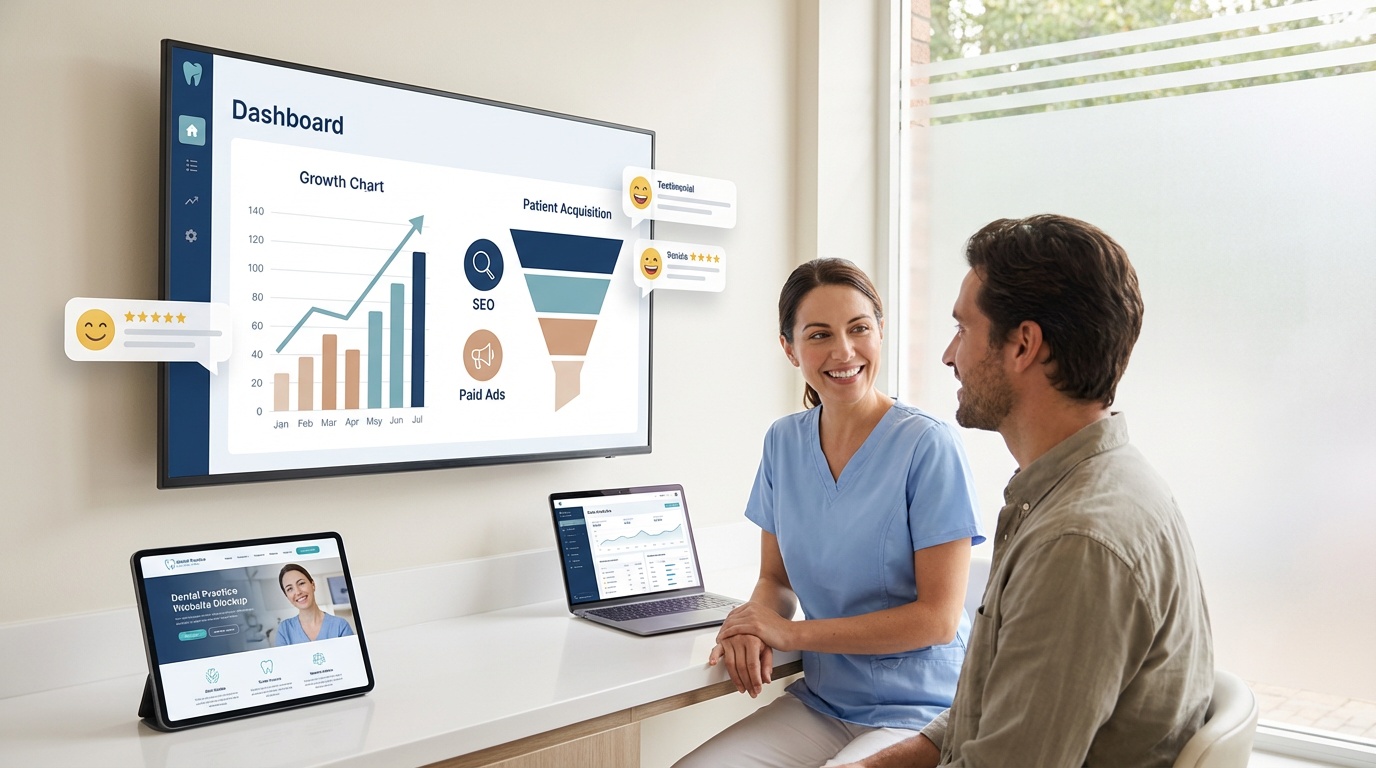
    SEO vs Paid Ads: Which Channel Delivers Best ROI for Dentists?
    dental patient acquisition channels

    Every pound you spend should return more than you invest. But immediate patient flow and sustainable growth require different strategies, and the right choice depends on your practice maturity, cash flow, and treatment focus.

    Long-Term Gains from Dental SEO and Local SEO

    SEO investments compound. Practices achieving first-page rankings often see returns that outweigh initial costs within 12-18 months. At Dominate Dental, we’ve guided practices through comprehensive SEO and local optimisation where organic search generates qualified consultations at £40-£80 per lead–half the cost of paid advertising. The difference? This channel builds equity. Rankings persist even if budgets temporarily decrease. Paid visibility disappears the second spending stops.

    We’ve seen this play out dozens of times: a practice invests £3,000 monthly in SEO for six months, achieves top-three rankings for “dental implants [city]”, then generates 20-30 consultation requests monthly without additional ad spend. That’s predictable growth.

    Immediate Results from Targeted Google and Facebook Ads

    Need patients this week? Paid advertising delivers controllable patient flow within days of campaign launch. New locations or specific treatment promotions demand this immediacy–you can’t wait six months for SEO to mature. Smart practices generate 15-25 consultations quickly using targeted Facebook and Google ads, creating revenue whilst building SEO foundations. The trade-off is ongoing cost. Maintaining visibility needs continuous investment, with cost per click rising in competitive markets like London, Manchester, and Birmingham.

    Here’s what we tell our clients: use paid ads for quick wins, but start SEO simultaneously. Your ad spend funds SEO work that eventually lowers your overall acquisition costs.

    Real UK Case Studies: Implants and Invisalign Leads

    A Birmingham implant clinic partnered with us for an integrated SEO and paid strategy. Early months relied on Google Ads generating 18 consultations at £120 per lead. We simultaneously targeted high-value keywords through local SEO. Twelve months later? Organic search delivered 32 monthly consultations at £65 per lead, and refined paid campaigns reduced acquisition costs to £85. Blended cost per consultation: £72. The channels supported one another: paid ads funded SEO work that later reduced dependency on ads.

    Similar patterns appear across our client base. The practices growing fastest aren’t choosing SEO or paid ads–they’re running both strategically.

    Factor SEO & Local SEO Paid Advertising
    Time to Results Several months for meaningful rankings Days for initial traffic
    Cost Structure Fixed monthly investment; cost per lead often falls over time Variable spend; ongoing cost per click
    Sustainability Rankings can persist with ongoing maintenance Visibility ends when budget stops
    Best for Treatments High-value: implants, Invisalign marketing, full-mouth reconstruction Time-sensitive offers, cosmetic promotions, new patient specials
    Typical UK Investment £2,000-£5,000 monthly in competitive markets £2,000-£8,000 monthly for consistent volume

    Website Design and Optimisation: Turning Visitors into Booked Patients

    Driving traffic means nothing if your website fails to convert. We’ve seen practices spend £5,000 monthly on Google Ads, generate 500 visitors, yet book only 3 consultations. That’s a 0.6% conversion rate–awful. The culprits? Weak booking funnels, unclear calls to action, or slow mobile experiences. Strategic website optimisation turns marketing spend into measurable revenue. For detailed information on dental services available within the UK, patients can refer to dental services to make informed decisions.

    Key Elements of High-Converting Dental Websites

    Three conversion pillars separate successful dental websites from those that leak potential patients: trust signals, frictionless booking, and treatment clarity.

    Above-the-fold placement of your Google rating with recent patient testimonials establishes immediate credibility. Prominent phone numbers and one-click booking buttons should appear on every page–contact options must be visible without scrolling on mobile devices. Treatment pages need clear pricing indicators, even if they’re ranges. Why? Because 68% of UK patients abandon sites lacking cost transparency.

    Dominate Dental’s innovative dental website designs integrate these elements with GDC-compliant content that converts at 3-5%–double industry benchmarks.

    Landing Pages for Invisalign and Implant Marketing

    Generic homepage traffic converts poorly for high-value treatments. We’ve tested this repeatedly. Dedicated landing pages aligned with ad campaigns or SEO keywords improve results by 40-60%. An Invisalign landing page should include before-and-after galleries, clearly presented finance options, and a treatment coordinator video introduction. Implant pages need procedure animations, clinician credentials, and clear post-treatment expectations–patients want to know what recovery looks like.

    Practices using our treatment-specific landing pages increase consultation requests from the same traffic volume by tightening messaging and smoothing booking paths aligned with patient concerns.

    Mobile Optimisation and Booking Funnels

    73% of UK dental searches happen on mobile devices. Responsive design isn’t optional–it’s survival. Pages must load in under 2 seconds, forms should ask for minimal information, and click-to-call buttons need thumb-friendly sizing. Multi-step booking funnels reduce abandonment: first capture name and phone number, then collect treatment interest and preferred dates on later screens. Don’t ask for everything upfront.

    Practices implementing mobile-optimised booking systems see completion rates jump from 12% to 28%. Integration with practice management software reduces manual data entry and shortens response times, which matters because most enquiries book with whichever practice responds first.

    Conversion Rate Benchmark: UK dental websites converting below 2% often have fundamental design or user experience issues. Dominate Dental’s optimised sites achieve 3-5% conversion rates through strategic layout, clear copy, and technical performance improvements that turn paid traffic into profitable patient relationships.

    Advanced Strategies: Social Media, Reviews, and Patient Engagement

    Mature practices maximise patient lifetime value by coordinating touchpoints across the patient journey. Integrated channels create compounding effects where each element supports the others. For insights on broader dental sector trends shaping the UK in the coming years, industry professionals may explore The dental sector in 2026: what’s really shaping the year ahead.

    Facebook Ads and Dental Social Media Management

    Strategic social media isn’t just organic posting–it’s retargeting campaigns that follow prospects across platforms. Facebook’s pixel tracks website visitors, then serves them treatment-specific messaging. A patient researching veneers sees testimonial videos. An implant prospect sees finance options. This works because warm audiences convert 3-4x more efficiently than cold traffic.

    Dominate Dental’s social media management packages for dental practices combine content calendars that showcase team personality with conversion-focused paid campaigns. We’ve found practices maintaining consistent posting schedules see 25-35% lower cost per lead on paid social compared to practices with sporadic content.

    Review Systems and Referral Programmes

    Automated review generation turns satisfied patients into marketing assets. Post-appointment SMS sequences request feedback at optimal times–usually 3-7 days after treatment completion when satisfaction peaks. Structured referral programmes offering incentives for both referrer and referee (aligned with GDC ethical guidance) systematise word-of-mouth growth instead of leaving it to chance.

    Practices using Dominate Dental’s review automation increase Google review volume by 40-60% within six months, often seeing parallel growth in organic search enquiries since improved ratings boost local pack visibility.

    Email, SMS, and AI-Powered Nurturing

    Most dental enquiries don’t convert immediately. That’s fine–if you’ve got nurture sequences maintaining engagement through educational content, treatment reminders, and time-limited offers. AI-powered chatbots qualify website visitors 24/7, capturing contact details and booking consultations outside reception hours. We’re seeing 15-20% of our clients’ consultations now come through chatbot conversations happening at 9pm or on Sundays.

    Email campaigns segmented by treatment interest deliver personalised content: Invisalign prospects receive aligner care tips, nervous patients receive sedation dentistry information. Practices implementing multi-channel nurturing convert 35-45% more enquiries into booked appointments than practices relying on single-touch follow-up. That improves returns from every marketing pound spent.

    Track, Measure, and Scale: Dominate Dental’s Proven Playbook

    dental patient acquisition channels

    Data-driven practices outperform competitors because they understand which investments generate profitable returns–and they scale what works. To better appreciate the context of dentistry in this market, the article Dentistry in the United Kingdom provides comprehensive background and details.

    Essential Metrics for Patient Acquisition ROI

    Track these four metrics religiously: cost per lead, lead-to-consultation conversion rate, consultation-to-treatment acceptance, and patient lifetime value across each channel. A £50 lead converting at 60% into £3,000 treatments produces better ROI than a £30 lead converting at 20% into £800 treatments. Math matters.

    Attribution modelling reveals how channels combine. Patients often discover your practice through social media, research via organic search, then convert after seeing remarketing ads. Single-channel attribution misses this reality. Dominate Dental’s conversion success training dashboards give practice owners clear visibility into marketing performance, making budget decisions straightforward instead of guesswork.

    UK Case Studies: Proven Results

    A Manchester cosmetic practice partnered with us to increase Invisalign starts. We implemented combined social media management, local SEO, and conversion-optimised landing pages. Result over 12 months: Invisalign cases increased from 8 to 31 monthly, generating £186,000 additional treatment revenue. Marketing spend: £4,500 monthly. ROI: 334%.

    A London implant clinic used coordinated SEO and paid advertising to generate £420,000 in treatment revenue within 18 months. These outcomes come from treating acquisition channels as connected systems rather than isolated tactics.

    Partner with Dominate Dental: Generate Patients Now

    Dominate Dental combines technical SEO expertise, conversion-focused website design, and multi-channel advertising management into end-to-end patient acquisition systems for UK practices. Based at Grosvenor House, 11 St Paul’s Square, Birmingham B3 1RB, United Kingdom, with a 5.0 Google rating from 18 reviews, we specialise in generating qualified consultations for high-value treatments. Our playbook has helped practices across the UK achieve predictable growth. Book your strategy consultation to discover how integrated marketing can generate the private patients your practice deserves.

    Frequently Asked Questions

    How can UK dental practices attract more private patients effectively?

    UK dental practices can attract high-value private patients by strategically using channels like SEO, paid advertising, social media, and referral systems. Each channel offers distinct advantages, from capturing high-intent searches with local SEO to generating immediate consultations with targeted paid ads. Understanding the strengths of each channel for the British market is key to predictable growth and efficient marketing budgets.

    For a new dental practice, which patient acquisition channel offers the fastest results?

    For new practices or time-sensitive promotions, paid advertising, specifically Google Ads and Facebook campaigns, provides immediate visibility and quick patient influx. These targeted campaigns can generate consultations within days, allowing you to quickly build revenue while other long-term strategies mature. Google Ads captures active searchers, while Facebook builds awareness among ideal patient demographics.

    What makes patient referrals such a valuable acquisition channel for UK dentists?

    Patient referrals are consistently the highest-converting acquisition channel for UK dentists because referred patients typically show greater lifetime value and lower no-show rates. These patients come with an inherent level of trust, making their journey from enquiry to booking much smoother. Implementing structured referral programmes with clear incentives can help systematize this powerful word-of-mouth channel.

    How does SEO compare to paid advertising for long-term dental patient growth in the UK?

    SEO offers compounding returns for long-term dental patient growth, with top rankings generating qualified leads at a lower cost per acquisition over time. While paid advertising provides immediate patient flow, its visibility ends when spending stops. SEO investments build equity, with rankings persisting and continuing to deliver qualified consultations even if budgets fluctuate.

    How does social media help UK dental practices build trust and attract new patients?

    Social media platforms like Instagram and Facebook serve as digital shop windows, allowing practices to build trust through visual content such as before-and-after transformations and patient testimonials. Consistent posting humanises your practice, particularly with younger demographics researching cosmetic treatments. While it rarely drives immediate bookings, social media builds familiarity that influences decision-making when patients consider treatment.

    What role do online reviews play in a dental practice's patient acquisition strategy?

    Online reviews amplify word-of-mouth digitally, playing a significant role in patient acquisition. Most UK patients read Google reviews before booking, making high ratings and a strong volume of reviews essential for trust. Practices maintaining excellent online reputations typically receive more enquiry form submissions, demonstrating the direct impact of patient feedback.
    About the Author

    Dan Ashburn is the Co-Founder at Dominate Dental, the UK’s specialist agency for high-value patient acquisition.

    Drawing on a decade of data-driven advertising experience and hundreds of clinic campaigns, Dan blends AI technology with human insight to deliver predictable streams of Invisalign, implant, and cosmetic dentistry consultations. His team’s results-focused approach has helped practices across London, Manchester, Birmingham, and nationwide convert marketing spend into chair-time—often booking 50+ qualified consultations per month while cutting no-shows.

    When he’s not optimizing funnels or unpacking the latest algorithm updates, Dan shares actionable dental marketing ideas, real-world case studies, and ROI benchmarks so dental teams can make confident marketing decisions.

    Last reviewed: February 2, 2026 by the Dominate Dental Team
  • Dental Online Reputation Management 2026: The Ultimate UK Guide to Grow

    dental online reputation management


    What is Dental Online Reputation Management and Why Does it Matter for UK Practices?

    Dental online reputation management involves monitoring, influencing, and protecting how your practice appears across review platforms, search results, and social channels. For UK practices offering high-value treatments, your digital reputation directly determines whether prospective patients book consultations or choose competitors. A single negative review on Google can cost you £15,000+ in lost Invisalign or implant revenue annually.

    Defining Dental Online Reputation Management

    Dental online reputation management encompasses systematic control of your practice’s digital footprint. This includes managing Google reviews, NHS Choices feedback, Facebook ratings, and mentions across dental forums and local directories. Unlike generic reputation work, dental ORM requires understanding patient psychology around treatment anxiety, price sensitivity for cosmetic procedures, and trust-building for surgical interventions. The process combines proactive review generation, rapid response protocols, and strategic content that positions your expertise.

    Google’s local search algorithm weighs review quantity, recency, and star rating as primary ranking factors. Practices with 50+ reviews averaging 4.8 stars consistently outrank competitors with fewer testimonials, even when the latter have superior technical SEO. Patient behaviour data shows 87% of UK dental patients read online reviews before booking, and 73% do not consider practices rated below 4.0 stars. Your reputation score functions as a conversion multiplier: excellent reviews transform website visitors into consultation requests, whilst poor ratings create friction that no amount of paid advertising can overcome.

    Revenue Impact Statistics

    • Practices with 4.5+ star ratings convert 34% more website visitors into consultations
    • Each one-star increase in Google rating correlates with 13–18% revenue growth for private treatments
    • Responding to negative reviews within 24 hours reduces patient loss by 62%
    • Automated review requests after appointments increase feedback volume by 340%

    UK-Specific Challenges for High-Value Treatments like Invisalign and Implants

    British patients researching £3,000–£8,000 treatments conduct extensive due diligence, often spending 3–6 weeks comparing providers. They scrutinise before-and-after photos, treatment outcome testimonials, and finance option reviews with particular intensity. NHS Choices creates additional complexity: negative feedback on this platform carries disproportionate weight because patients perceive government-affiliated sites as more trustworthy than commercial review platforms. Practices in competitive metropolitan areas like Manchester, Birmingham, and London face heightened reputation pressure, where a 0.3-star rating difference can shift £50,000+ in annual implant revenue between neighbouring clinics.

    Specialised Invisalign leads generation services can help practices capture more prospective patients during this research phase.

    Proven Strategies to Build and Boost Positive Reviews for Your Dental Practice

    dental online reputation management

    Generating consistent positive reviews requires systematic processes embedded into your patient journey. Most practices fail because they rely on passive hope rather than active solicitation. The most effective approach combines automated technology with personal touchpoints, ensuring every satisfied patient receives a timely, convenient opportunity to share their experience. Timing proves critical: requests sent within 24–48 hours of treatment achieve five times higher response rates than delayed follow-ups.

    Automate Review Requests After Invisalign and Implant Appointments

    High-value treatment patients represent your most valuable testimonials because their detailed experiences address the specific concerns prospective patients research. Implement automated SMS or email sequences triggered 24 hours after key milestones: final Invisalign aligner delivery, implant crown placement, or smile makeover completion. These messages should include direct Google review links, making the process frictionless. Practices using this approach across Dominate Dental clients average 12–18 new five-star reviews monthly, compared with 2–3 for practices relying on manual requests. Personalise templates with treatment-specific language: “Your implant journey is complete” carries more weight than generic “recent visit” phrasing.

    Dominate Dental’s Invisalign marketing services provide expert support to optimize patient engagement during these critical moments.

    Integrate Reviews with Dental Social Media Marketing and Facebook Ads

    Cross-platform reputation building multiplies your review assets’ marketing value. Feature your best Google testimonials in Facebook and Instagram posts, creating social proof that drives both engagement and additional reviews on those platforms. Use patient success stories (with permission) in paid social campaigns targeting Invisalign and composite bonding searches. This strategy achieves dual objectives: it demonstrates transparency by showcasing real feedback whilst prompting satisfied social media followers to contribute their own reviews. Dominate Dental’s integrated campaigns for UK practices show that featuring reviews in Facebook ads increases click-through rates by 47% and reduces cost-per-consultation by £23 on average. Create a review highlight section on your practice Facebook page, updating it monthly with fresh testimonials that mention specific treatments and team members.

    Train Your Team to Solicit Feedback on Emergency Dental Services

    Your reception, nursing, and clinical teams must understand that review generation is everyone’s responsibility, not just marketing’s concern. Conduct quarterly training sessions teaching staff to identify review-worthy moments: successful same-day emergency appointments, anxiety management breakthroughs, or complex cases with exceptional outcomes. Equip your team with simple scripts: “We would love to hear about your experience today. Would you mind sharing a quick review on Google?” Position this request as quality assurance rather than marketing. Emergency patients who receive outstanding care often become your most enthusiastic reviewers because you solved an urgent problem. Track which team members generate the most reviews and recognise their contributions, creating healthy internal competition that builds your reputation systematically.

    Review Generation Workflow

    1. Identify high-satisfaction moments: treatment completion, pain relief, cosmetic reveals
    2. Send an automated review request within 24 hours via the patient’s preferred contact method
    3. Include direct platform links (Google, Facebook) with one-click access
    4. Follow up personally for VIP patients or exceptional cases within 72 hours
    5. Monitor response rates weekly and adjust timing or messaging based on data
    6. Celebrate new reviews in team meetings to reinforce importance

    How to Handle Negative Reviews Without Damaging Your Practice’s Growth

    Negative reviews trigger panic in practice owners, yet they present opportunities to demonstrate professionalism and commitment to patient satisfaction. Research shows that practices with exclusively five-star ratings often appear less trustworthy than those with occasional four-star reviews and thoughtful responses. Your reaction matters more than the complaint itself: prospective patients judge how you handle criticism, using it as a proxy to predict how you will treat them if issues arise.

    Rapid Response Tactics for Google and NHS Choices Feedback

    Respond to every negative review within 24 hours, ideally within 12. Speed signals that you actively monitor feedback and prioritise patient concerns. Begin with empathy, acknowledge the specific issue mentioned, and offer to resolve it privately through direct contact. Never argue publicly or provide detailed clinical justifications that breach confidentiality. Template responses fail because they appear insincere; personalise each reply with specific details from the review. For NHS Choices complaints, which carry additional weight with UK patients, follow the same protocol whilst ensuring your response aligns with NHS values of accessibility and patient-centred care. Track response times as a key performance indicator: Dominate Dental clients maintaining sub-24-hour response times see 58% fewer follow-up escalations.

    Turning Complaints into Opportunities with Professional Responses

    Your public response serves two audiences: the unhappy reviewer and prospective patients reading the exchange. Structure responses in three parts: acknowledge the patient’s feelings, explain any context without making excuses, and demonstrate corrective action. A well-crafted response can convert negative experiences into positive brand impressions. Example: “We are genuinely sorry your wait time exceeded expectations, Sarah. We had an emergency case that afternoon, which disrupted our schedule. We have since implemented a new notification system to keep patients informed of delays.” This shows accountability, explains circumstances, and highlights improvement. Offer offline resolution: “Please contact our practice manager directly on [number] so we can put this right.” Approximately 40% of dissatisfied patients who receive personalised responses update or remove negative reviews after successful resolution.

    Preventing Escalation Through Consistent Online Listings Management

    Inaccurate practice information across directories creates patient frustration that manifests as negative reviews. When patients arrive at the wrong location, call disconnected numbers, or find your practice closed during listed hours, they blame your competence rather than data errors. Audit your listings quarterly across Google Business Profile, NHS Choices, Bing Places, Apple Maps, and dental-specific directories. Ensure your phone number, address, opening hours, and emergency contact details remain identical everywhere. Inconsistent information damages local SEO rankings whilst generating preventable complaints. Implement a listings management system that pushes updates simultaneously across all platforms when details change, eliminating the manual errors that cause patient confusion and subsequent negative feedback.

    Response Strategy Approaches

    Effective Tactics
    • Immediate acknowledgement within 12–24 hours demonstrates active monitoring
    • Personalised responses addressing specific complaints show genuine concern
    • Offline resolution offers preserve privacy whilst solving problems
    • Transparent explanation of corrective measures builds trust with prospective patients
    • Professional tone maintained even with unreasonable complaints protects brand reputation
    Common Mistakes
    • Defensive or argumentative responses escalate conflicts publicly
    • Generic template replies appear insincere and damage credibility
    • Delayed responses beyond 48 hours signal poor patient care priorities
    • Sharing clinical details publicly breaches confidentiality and professional standards
    • Ignoring negative reviews entirely suggests indifference to patient satisfaction

    Integrating Online Reputation Management with Dental SEO and Marketing for Maximum ROI

    Dental online reputation management delivers exponential returns when integrated with your broader marketing ecosystem rather than treated as an isolated activity. Your reviews influence search rankings, inform content strategy, and provide social proof that amplifies paid advertising performance. This holistic approach transforms reputation from defensive damage control into proactive revenue generation.

    Google’s algorithm treats review signals as primary local ranking factors alongside proximity and relevance. Practices generating 8–12 reviews monthly with consistent keyword mentions in testimonials rank significantly higher for treatment-specific searches. Encourage patients to mention specific procedures in their reviews: “Invisalign treatment“, “dental implants”, or “emergency appointment” rather than generic praise. These keyword-rich testimonials boost your visibility for high-value search terms. Respond to every review using natural variations of your target keywords, creating additional ranking signals. Update your Google Business Profile with review highlights in posts, Q&A sections, and service descriptions. This integration means your reputation work simultaneously improves organic visibility, creating compounding benefits that isolated reputation management cannot achieve.

    Combine ORM with Invisalign Marketing and Composite Bonding Campaigns

    Treatment-specific marketing campaigns gain credibility and conversion power when supported by relevant testimonials. Create landing pages for Invisalign or composite bonding that feature video testimonials, before-and-after galleries with patient quotes, and embedded Google review widgets filtered by treatment type. Use patient success stories in Facebook and Instagram ads targeting cosmetic dentistry searches, including direct quotes from five-star reviews in ad copy. This approach reduces scepticism and speeds up decision-making for high-investment treatments. Dominate Dental campaigns integrating authentic patient reviews into Invisalign marketing achieve 41% higher consultation booking rates compared with campaigns relying solely on clinical credentials and promotional offers. The social proof addresses emotional barriers that technical expertise alone cannot overcome.

    Dominate Dental Case Studies: Real Revenue Growth from UK Practices

    A Birmingham implant practice partnered with Dominate Dental to systematise its reputation management alongside local SEO optimisation. Within six months, it increased its Google reviews from 23 to 127, improved its average rating from 4.2 to 4.8 stars, and climbed from page two to position three for “dental implants Birmingham”. The integrated approach generated 34 additional implant consultations monthly, translating to £186,000 in new treatment revenue annually. A Manchester orthodontic practice implementing automated review requests after Invisalign milestones saw its monthly review volume increase from three to 18, with 94% receiving five stars. Its improved reputation score reduced its Google Ads cost-per-click by 22% whilst increasing conversion rates by 29%, delivering a £4.70 return for every £1 invested in reputation management services. To explore similar success, consider Dominate Dental’s comprehensive lead generation system.

    Partner with Dominate Dental: Your Complete Solution for Dental Online Reputation Management

    dental online reputation management

    Managing your digital reputation demands expertise, technology, and consistent execution that most practices cannot sustain internally. Dominate Dental delivers comprehensive dental online reputation management integrated with SEO, website optimisation, and treatment-specific marketing campaigns that drive measurable patient acquisition growth.

    Why Choose the UK’s Top Dental Marketing Agency for ORM

    Dominate Dental specialises exclusively in dental practice marketing, understanding the unique challenges of patient psychology, treatment-specific concerns, and regulatory compliance that generic agencies miss. Our 5.0-star Google rating based on 18 reviews from UK dental practices demonstrates our commitment to the same reputation excellence we deliver for clients. We combine proprietary review generation technology with personalised response management, ensuring your practice maintains consistent positive feedback across all platforms whilst protecting against reputation damage.

    Our Full-Service Package: SEO, Website Design, and Reputation Tools

    Our integrated approach connects reputation management with dental local SEO, Google Business Profile optimisation, conversion-focused website design, and treatment-specific marketing campaigns. This ecosystem ensures your excellent reviews translate into higher search rankings, increased website traffic, and more consultation bookings. We provide automated review request systems, 24-hour negative review monitoring and response, quarterly reputation audits, and strategic integration of testimonials across your digital presence.

    Book Your Free Consultation to Generate New High-Value Patients Today

    Discover how Dominate Dental’s reputation management expertise can transform your patient acquisition results. Schedule your complimentary strategy session to receive a comprehensive audit of your current online reputation, competitive analysis against neighbouring practices, and a customised roadmap for generating 50+ qualified consultations monthly. Contact our Birmingham office at Grosvenor House, 11 St Paul’s Square, Birmingham B3 1RB, or find directions via Google Maps to discuss your practice growth objectives with the UK’s leading dental marketing agency.

    For more insights into online reputation management, dental practices can benefit from resources provided by the American Dental Association.

    Expanding understanding of online reputation management further supports the strategies implemented for dental practices and enhances overall digital marketing efforts.


    Frequently Asked Questions

    What does dental online reputation management involve for UK practices?

    Dental online reputation management systematically controls your practice’s digital footprint across review platforms, search results, and social channels. For UK practices, this includes managing Google reviews, NHS Choices feedback, and Facebook ratings. It requires understanding patient psychology around treatment anxiety and trust-building for high-value procedures.

    How do online reviews affect patient acquisition for dental clinics?

    Online reviews directly determine whether prospective patients book consultations or choose competitors. Google’s local search algorithm uses review quantity, recency, and star rating as primary ranking factors. Patient data shows 87% of UK patients read reviews before booking, and 73% do not consider practices rated below 4.0 stars.

    Can good online reviews really boost a dental practice's revenue?

    Absolutely. Practices with 4.5+ star ratings convert 34% more website visitors into consultations. Each one-star increase in Google rating correlates with 13–18% revenue growth for private treatments. Responding to negative reviews within 24 hours also reduces patient loss by 62%.

    What unique reputation challenges do UK dental practices face?

    UK practices offering high-value treatments like Invisalign or implants face extensive patient due diligence over 3-6 weeks. Negative feedback on NHS Choices carries disproportionate weight due to perceived government trustworthiness. Competitive metropolitan areas also experience heightened reputation pressure, where small rating differences can shift significant annual revenue.

    What are effective ways to get more positive online reviews?

    Generating consistent positive reviews requires systematic processes, not just passive hope. The most effective approach combines automated technology with personal touchpoints. Automated SMS or email sequences sent within 24-48 hours after key treatment milestones, with direct Google review links, achieve significantly higher response rates.

    How can social media marketing help with dental online reputation?

    Integrating reviews with social media marketing multiplies their value. Feature your best Google testimonials in Facebook and Instagram posts to create social proof and drive engagement. Using patient success stories in paid social campaigns demonstrates transparency and prompts satisfied followers to contribute their own reviews.

    Is the dental team responsible for generating patient reviews?

    Yes, review generation is everyone’s responsibility, not just marketing’s concern. Your reception, nursing, and clinical teams should be trained to identify review-worthy moments, such as successful emergency appointments or anxiety management. This ensures every satisfied patient receives a timely opportunity to share their experience.

    About the Author

    Dan Ashburn is the Co-Founder at Dominate Dental, the UK’s specialist agency for high-value patient acquisition.

    Drawing on a decade of data-driven advertising experience and hundreds of clinic campaigns, Dan blends AI technology with human insight to deliver predictable streams of Invisalign, implant, and cosmetic dentistry consultations. His team’s results-focused approach has helped practices across London, Manchester, Birmingham, and nationwide convert marketing spend into chair-time—often booking 50+ qualified consultations per month while cutting no-shows.

    When he’s not optimizing funnels or unpacking the latest algorithm updates, Dan shares actionable dental marketing ideas, real-world case studies, and ROI benchmarks so dental teams can make confident marketing decisions.

    Last reviewed: February 1, 2026 by the Dominate Dental Team
  • Dental Online Presence Audit 2026 – The Ultimate UK Guide for Dentists

    dental online presence audit


    # Dental Online Presence Audit: Complete UK Guide

    What is a Dental Online Presence Audit and Why Your Practice Needs One

    A dental online presence audit is a systematic 102-point evaluation of your practice’s digital footprint, examining everything from Google Business Profile optimisation to treatment-specific landing pages. For UK practices investing £2,000+ monthly in marketing, this assessment identifies precisely why you attract tyre-kickers instead of qualified Invisalign and implant patients.

    Defining the Audit for UK Dental Practices

    Your dental online presence audit evaluates seven key areas: local SEO signals across Birmingham, Manchester, and London directories; NAP (Name, Address, Phone) consistency; website technical performance; conversion tracking infrastructure; review management systems; treatment-specific content quality; and competitor positioning. Unlike generic marketing reviews, this audit addresses how UK patients search for high-value private treatments, targeting the exact queries your ideal patients use when researching £3,000+ procedures.

    Common Pain Points Without Regular Audits

    Practices without quarterly audits typically suffer from three revenue-killing problems: Google Business Profile errors that suppress local pack visibility and lead to fewer discovery calls; inconsistent NAP data across UK directories that confuses both search engines and potential patients; and treatment pages that rank for irrelevant terms whilst missing high-intent keywords like “Invisalign London cost” or “same-day dental implants Manchester”.

    Real Results: 20% Traffic Growth Case Study

    A Birmingham practice conducting its first comprehensive audit discovered that its mobile site loaded in 8.2 seconds (industry standard: under 3 seconds), its Google Business listing showed incorrect opening hours for six months, and its implant page ranked on page four. After implementing the 102-point checklist over four weeks, organic traffic increased by 20%, phone enquiries rose by 34%, and its implant page reached position three for “dental implants Birmingham”.

    Key Components of Your 102-Point Dental Online Presence Audit Checklist

    dental online presence audit

    Google Business Profile Optimisation and Local Signals

    Your Google Business Profile drives 67% of local discovery for dental searches. Audit these elements: business category accuracy (select “Dentist” as primary, specialities as secondary); service listings with treatment-specific keywords; post frequency (at least weekly updates); Q&A section completeness; booking button functionality; and photo quality (practices with 100+ images receive 35% more direction requests). Verify that your profile appears correctly for searches in your catchment area, particularly for high-value treatment terms.

    NAP Consistency Across UK Directories

    Inconsistent practice details across Yelp UK, WhatClinic, Trustpilot, and NHS Choices can damage local rankings. Check these 18 directories for exact matches: business name spelling, complete address format (including postcode), phone number format (with +44 or without), website URL structure, and opening hours. Even minor variations like “Dental Practice” versus “Dental Surgery” can create citation conflicts that suppress visibility.

    Treatment-Specific Pages for Invisalign and Implants

    High-value treatments need dedicated landing pages optimised for commercial intent. Each page needs: location-specific title tags (“Invisalign Manchester: Clear Aligners from £2,800”); detailed treatment process explanations; pricing transparency or ranges; before-and-after galleries; patient testimonials with specific outcomes; and clear conversion paths (phone, form, live chat). Audit whether these pages target bottom-funnel keywords like “Invisalign cost London” rather than informational terms. Enhance these efforts further with specialised Invisalign marketing services designed for maximum patient acquisition.

    Technical Checks: Page Speed and Mobile Optimisation

    Technical Element Minimum Standard Impact on Conversions
    Mobile page load time Under 3 seconds Every additional second reduces conversions by 7%
    Mobile responsiveness 100% functional on iOS/Android 58% of dental searches occur on mobile devices
    SSL certificate Valid HTTPS throughout the site Non-secure sites lose 84% of potential patients
    Core Web Vitals Green scores on all metrics Ranking factor affecting top 3 positions

    Technical performance affects both rankings and conversions. Audit these metrics using Google PageSpeed Insights: load time under 3 seconds on mobile (78% of dental searches occur on smartphones); Core Web Vitals scores in green zones; mobile responsiveness across iOS and Android devices; HTTPS security certificate validity; broken link identification; and image compression status. A Manchester practice discovered that its homepage loaded in 7.4 seconds on mobile, losing an estimated £18,000 annually in abandoned enquiries before visitors saw its services. For a full digital marketing strategy including technical optimization, consider Dominate Dental marketing services.

    Essential Audit Checklist

    • Google Business Profile: category accuracy, service listings, weekly posts, Q&A completeness
    • NAP citations: exact matches across 18+ UK directories including WhatClinic and Trustpilot
    • Treatment pages: dedicated Invisalign and implant pages with location-specific titles
    • Mobile speed: under 3 seconds load time verified via PageSpeed Insights
    • Conversion tracking: phone call attribution, form submissions, booking confirmations
    • Review profiles: active management on Google, Trustpilot, Yelp UK, WhatClinic
    • Competitor analysis: keyword gaps, backlink comparisons, content opportunities

    Setting Up Conversion Tracking and Review Management

    Track Phone Calls, Forms, and Bookings Effectively

    Without proper tracking, you cannot determine which marketing channels deliver qualified consultations. Implement call tracking numbers unique to each campaign source (Google Ads, organic search, social media), ensuring dynamic number insertion on your website. Configure Google Analytics 4 event tracking for form submissions, capturing field data like treatment interest and preferred contact method. Set up goal completions for online booking confirmations, measuring the complete patient journey from first click to scheduled appointment.

    Performance Benchmarks: Under 3 Seconds Load Time

    UK dental practices achieving top local rankings maintain specific performance standards: mobile load time below 3 seconds; desktop load time under 2 seconds; Largest Contentful Paint (LCP) under 2.5 seconds; First Input Delay (FID) under 100 milliseconds; and Cumulative Layout Shift (CLS) below 0.1. Practices exceeding these thresholds experience 53% higher bounce rates and 32% fewer consultation requests, directly impacting revenue from high-value treatments.

    Managing Reviews on Trustpilot, Yelp, and WhatClinic

    Active review management across UK-specific platforms builds trust with prospective private patients. Claim and optimise profiles on Google Business, Trustpilot, Yelp UK, and WhatClinic. Implement automated review request sequences 48 hours after appointments for positive experiences. Respond to every review within 24 hours, addressing concerns professionally and thanking patients publicly. Practices with 50+ Google reviews and 4.8+ average ratings convert 28% more website visitors to consultations than those with fewer than 20 reviews. For a detailed reputation analysis, download our Free Online Reviews Reputation Report.

    Tools: Google Analytics 4, SEMrush, and Call Tracking

    Professional audits require specific tools: Google Analytics 4 for traffic analysis and conversion tracking; Google Search Console for indexation status and search query data; SEMrush or Ahrefs for keyword rankings and backlink profiles; GTmetrix or PageSpeed Insights for technical performance; CallRail or ResponseTap for phone attribution; and Screaming Frog for comprehensive site crawls. These platforms provide the quantitative data needed to prioritise fixes based on revenue impact.

    Week-by-Week Action Plan to Fix Your Audit Findings

    Week 1: Technical Fixes and Keyword Research

    Begin with technical foundations: compress images to reduce file sizes by 60–80%; enable browser caching; implement lazy loading for below-the-fold content; fix broken links identified in your crawl; and install SSL certificates if missing. At the same time, conduct keyword research using SEMrush, identifying 20–30 high-intent treatment terms with monthly search volumes above 100 in your catchment area. Prioritise keywords showing commercial intent like “cost”, “near me”, and “book”.

    Week 2: Local Pages and NAP Clean-up

    Create or optimise location-specific service pages targeting your primary catchment areas. Standardise your NAP format, then systematically update all 18+ directory listings to match exactly. Submit corrections to NHS Choices, WhatClinic, Yelp UK, and Trustpilot. Verify Google Business Profile accuracy, upload 10+ new photos, and publish your first weekly post. This week establishes citation consistency that supports local ranking improvements within 4–6 weeks.

    Ongoing: Quarterly Audits for 20% Growth

    Schedule comprehensive audits every 90 days to maintain competitive positioning. Monitor keyword ranking changes, analyse competitor movements, assess new review accumulation, and identify fresh content opportunities. Practices conducting quarterly assessments consistently achieve 15–20% year-over-year organic traffic growth, whilst those auditing annually or less frequently stagnate or decline as competitors optimise more aggressively.

    Why Partner with Dominate Dental’s Experts

    Our team has delivered measurable results for UK practices: 20% average traffic increases within 90 days, 34% more qualified consultation requests, and 5.0-star Google ratings across our client portfolio. Based at Grosvenor House, 11 St Paul’s Square, Birmingham B3 1RB, we specialise exclusively in dental practice growth, combining our proprietary 102-point audit system with ongoing optimisation. Book your complimentary audit to discover your practice’s specific opportunities.

    Competitor Benchmarking and Next Steps for UK Dental Practices

    dental online presence audit

    Analyse Rivals in London, Manchester, and Birmingham

    Identify your top five local competitors ranking for target treatments in your area. Document their Google Business Profile completeness, review counts and ratings, website load speeds, treatment page quality, and local pack positioning. This competitive intelligence reveals gaps you can use: if competitors lack dedicated Invisalign landing pages, you gain an immediate advantage by creating comprehensive content targeting those searches.

    Use SEMrush or Ahrefs to compare your backlink profile against competitors. Identify authoritative UK dental directories, local news sites, and healthcare platforms linking to rivals but not your practice. Analyse content gaps by examining keywords competitors rank for that you do not, particularly treatment-specific terms with commercial intent. Prioritise creating stronger content addressing these gaps, targeting the 20–30 highest-value opportunities first.

    Book Your Free Audit with Dominate Dental Today

    Stop guessing why your marketing investment fails to deliver qualified consultations. Our complimentary dental online presence audit provides a detailed 102-point evaluation, identifying specific technical issues, local SEO weaknesses, and conversion barriers costing your practice revenue. We will benchmark your performance against local competitors and deliver a prioritised action plan. Contact our Birmingham team to schedule your assessment and discover why we maintain a 5.0-star rating based on 18 Google reviews.

    Future-Proofing Your Dental Digital Strategy Beyond the Initial Audit

    Adapting for AI and Voice Search Evolution

    Voice search queries now account for 27% of dental searches on mobile devices, requiring different optimisation approaches. Patients ask complete questions: “Which dentist near me offers affordable Invisalign?” rather than typing “Invisalign cost Manchester”. Optimise for conversational queries by creating FAQ-style content answering specific patient questions, structuring data with schema markup, and targeting long-tail question phrases. As AI-powered search results prioritise featured snippets, format content with clear, concise answers in the first 40–60 words of relevant sections.

    Video Content Integration for Treatment Transparency

    Practices incorporating treatment explanation videos on service pages achieve 86% longer average session durations and 41% higher consultation booking rates. Create short videos (90–120 seconds) demonstrating your implant process, Invisalign fitting procedures, and practice environment. Host videos on YouTube with location-specific titles, then embed them on corresponding treatment pages. This dual approach captures YouTube search traffic whilst improving on-site engagement metrics that influence rankings.

    Privacy-First Tracking in the Post-Cookie Era

    With third-party cookie deprecation and stricter UK privacy regulations, transition to first-party data collection methods. Implement server-side Google Analytics 4 tracking, use consent management platforms compliant with ICO guidelines, and focus on owned channels like email marketing. Build patient databases through valuable content offers (treatment guides, cost calculators) requiring email submission. This proprietary data becomes increasingly valuable as traditional tracking methods diminish. Learn more about dentistry through dentistry.

    Scaling Your Audit Process for Multi-Location Practices

    Centralised Brand Management with Local Flexibility

    Multi-location practices require standardised audit protocols whilst accommodating local market differences. Establish core brand guidelines covering NAP format, visual identity, and messaging tone, then allow location-specific content addressing unique catchment area demographics and competitor situations. Create separate Google Business Profiles for each location with distinct phone numbers, maintain individual directory listings, and develop location-specific landing pages targeting neighbourhood keywords like “dental implants Kensington” or “Invisalign Didsbury“.

    Performance Dashboards for Location Comparison

    Build comprehensive dashboards comparing key metrics across all locations: organic traffic by location page, local pack rankings for primary keywords, conversion rates from website visits to consultations, average review ratings, and cost per acquisition by location. This visibility identifies underperforming locations requiring additional optimisation whilst revealing successful strategies to replicate across other sites. Monthly reporting maintains accountability and guides resource allocation decisions. For regulation and registration details, visit the General Dental Council.

    Measuring ROI from Your Audit Investments

    dental online presence audit

    Calculating Patient Lifetime Value for Marketing Decisions

    Understanding patient lifetime value (PLV) supports audit investment decisions and guides budget allocation. Calculate PLV by multiplying average treatment value (£2,800 for Invisalign, £2,400 for single implants) by average treatments per patient (1.8 for private patients) and adding ongoing hygiene visit revenue (£85 twice yearly for 4.2 years average retention). This £6,000+ PLV means acquiring one additional qualified patient monthly through improved online presence generates £72,000+ annual revenue, which can justify quarterly audit investments of £1,500–3,000.

    Attribution Modelling for Complex Patient Journeys

    Dental treatment decisions involve multiple touchpoints before booking. Implement multi-touch attribution in Google Analytics 4, tracking the complete patient journey from initial search through review reading, website visits, social media engagement, and final conversion. This reveals whether your improvements to local SEO, review management, or technical performance contribute most significantly to qualified consultations, enabling data-driven optimisation prioritisation.

    Your Next Strategic Move

    A comprehensive dental online presence audit shifts from a one-off assessment to an ongoing strategic advantage when conducted quarterly. Practices implementing systematic audits with immediate action on findings consistently outperform competitors still relying on annual reviews. The digital environment evolves continuously: algorithm updates, competitor optimisations, and patient behaviour shifts demand responsive adaptation. Partner with specialists who understand UK dental marketing nuances, maintain current technical expertise, and deliver measurable consultation growth. Schedule your complimentary assessment with Dominate Dental to establish your competitive baseline and receive a prioritised roadmap addressing your specific revenue opportunities.


    Frequently Asked Questions

    How do you audit your online presence?

    As experts at Dominate Dental, we conduct a systematic 102-point evaluation of your practice’s digital footprint. This includes examining Google Business Profile optimisation, NAP consistency, website technical performance, and treatment-specific content quality. Our goal is to pinpoint exactly why you might be attracting the wrong patients instead of qualified leads for high-value treatments.

    How often should you conduct an online presence audit?

    To maintain strong local visibility and attract high-value patients, we recommend conducting a dental online presence audit quarterly. Practices without regular audits often face issues like Google Business Profile errors, inconsistent NAP data, and treatment pages ranking for irrelevant terms. Consistent audits help you stay ahead and ensure your digital strategy is always optimised.

    What does a dental online presence audit involve for UK practices?

    A dental online presence audit for UK practices evaluates seven key areas to ensure you connect with ideal patients. We assess local SEO signals across directories, NAP consistency, website technical performance, and conversion tracking. We also review your review management systems, treatment-specific content quality, and competitor positioning, all tailored to how UK patients search for private treatments.

    Why do UK dental practices need a dedicated online presence audit?

    UK dental practices need a dedicated online presence audit to identify and fix revenue-killing problems that deter qualified patients. Without it, you might suffer from Google Business Profile errors suppressing local visibility or inconsistent practice data confusing search engines. Our audit ensures your treatment pages target high-intent keywords, attracting patients actively seeking procedures like Invisalign or implants.

    What are the key components of a 102-point dental online presence audit?

    Our comprehensive 102-point audit checklist covers critical areas for your online success. This includes optimising your Google Business Profile for local searches and ensuring NAP consistency across over 18 UK directories. We also scrutinise treatment-specific landing pages, technical performance like mobile page speed, conversion tracking, and active review management.

    What kind of results can a dental online presence audit deliver?

    A thorough dental online presence audit can deliver significant, measurable improvements for your practice. For example, a Birmingham practice saw organic traffic increase by 20% and phone enquiries rise by 34% after implementing our recommendations. Their implant page also jumped to position three for “dental implants Birmingham,” directly attracting more qualified patients.

    About the Author

    Dan Ashburn is the Co-Founder at Dominate Dental, the UK’s specialist agency for high-value patient acquisition.

    Drawing on a decade of data-driven advertising experience and hundreds of clinic campaigns, Dan blends AI technology with human insight to deliver predictable streams of Invisalign, implant, and cosmetic dentistry consultations. His team’s results-focused approach has helped practices across London, Manchester, Birmingham, and nationwide convert marketing spend into chair-time—often booking 50+ qualified consultations per month while cutting no-shows.

    When he’s not optimizing funnels or unpacking the latest algorithm updates, Dan shares actionable dental marketing ideas, real-world case studies, and ROI benchmarks so dental teams can make confident marketing decisions.

    Last reviewed: February 1, 2026 by the Dominate Dental Team
  • Dental Online Appointment Booking: UK Guide 2026

    dental online appointment booking

    Dental Online Appointment Booking: The UK Practice Owner’s Guide to Converting Website Visitors into Booked Consultations

    Modern dental patients expect instant access to appointment scheduling. Online booking systems have transformed UK practices by converting website visitors into confirmed appointments 24/7, eliminating phone tag and capturing high-value treatment enquiries whilst your reception desk is closed. For practices offering Invisalign and implants, this technology directly impacts revenue by reducing barriers between patient interest and booked consultations.

    Dental online appointment booking allows patients to schedule appointments through your website at any time, syncing automatically with your practice management system. It’ll cut no-shows by 30-40%, save your team up to 15 hours each week, and capture those late-night enquiries that would’ve gone to competitors. The system displays available slots in real time, sends automated reminders, and handles deposits for high-value treatments.

    Why Your Practice Needs Online Booking Now

    Patient Behaviour Has Changed–Your Booking System Hasn’t

    72% of UK patients prefer booking medical appointments online rather than by phone, yet most dental practices still rely on reception staff availability. When potential patients search for “dentist near me” at 9pm on Sunday, practices without online booking lose that enquiry to competitors offering instant scheduling.

    This gap hits hardest with private treatments. Prospective patients researching Invisalign or implants expect the same booking experience they get from Amazon or airline bookings. They won’t wait until Tuesday morning to call your receptionist.

    Your Reception Team Spends 15 Hours Weekly Playing Phone Tag

    Automated SMS and email reminders can slash no-shows by 35-40%. That’s thousands in recovered revenue each month. Reception teams at most practices waste 12-18 hours each week on scheduling calls–time they could spend on treatment coordination for your £8,000 implant cases.

    Online systems handle confirmations, rescheduling, and reminders automatically. Patients take responsibility for their booking journey instead of relying on staff during limited phone hours.

    Treatment-Specific Booking Pages Convert 60% Better

    Here’s what most practices miss: When potential patients click through from an Invisalign advert to a dedicated booking page showing “Initial Consultation” slots, they’re 60% more likely to complete the booking than when calling a busy reception line.

    We’ve seen this repeatedly. A Manchester practice generated 47 Invisalign consultations monthly after we built treatment-specific booking pages. Before? Just 18.

    Requiring deposits through the booking system filters serious enquiries. When each consultation represents a £4,000-8,000 treatment opportunity, you can’t afford time-wasters.

    Revenue Impact

    Practices implementing online booking typically see a 25-35% increase in new patient appointments within 90 days. After-hours bookings? They represent 40% of total online appointments. For a practice targeting £15,000 monthly in Invisalign starts, capturing three additional consultations each week through 24/7 booking access translates into £186,000 in annual treatment value.

    How to Integrate Online Booking with Your Marketing Strategy

    dental online appointment booking

    Most practices bolt booking systems onto existing websites without thinking about SEO. Wrong approach.

    Your booking page must rank independently for treatment-specific searches like “book Invisalign consultation Manchester”. At Dominate Dental, we structure booking pages with location-specific content, schema markup for local business and medical services, and page-speed optimisation to outrank competitors. These pages become conversion-focused landing destinations for paid search campaigns, capturing patients at their highest intent moment.

    Position Booking Buttons Where Patients Actually Look

    Booking buttons must appear within three seconds of page load on mobile devices. They need to be prominent on treatment pages where patients research procedures. We place booking calls to action throughout the patient journey: on service pages, blog posts about treatment outcomes, and remarketing campaigns targeting previous site visitors.

    This omnichannel approach creates multiple paths to scheduling. Because patients don’t all follow the same journey.

    A Birmingham Practice Generating 47 Monthly Invisalign Consultations

    One Birmingham practice partnering with Dominate Dental went from 18 Invisalign consultations monthly to 47 through integrated SEO and booking optimisation. Their conversion rate jumped from 2.1% to 8.3% within five months.

    The difference? We drove qualified traffic to conversion-optimised booking pages. As a specialist dental marketing agency, we’ve proven that technology alone doesn’t drive growth. You need strategic patient acquisition campaigns feeding your booking system.

    What the Patient Journey Actually Looks Like

    From Website Click to Confirmed Appointment

    Patients access your booking system through website calls to action, Google Business Profile links, or email campaigns. They select their preferred appointment type–routine check-up, Invisalign consultation, emergency appointment. They view available time slots filtered by clinician and location.

    Then they complete registration with contact details and medical history forms. The system sends instant email and SMS confirmations with calendar invites, followed by automated reminders 48 hours and 24 hours before the appointment.

    For high-value treatments, patients pay deposits during booking to secure their slot. Payment processing is integrated into the scheduling flow.

    What You Need Behind the Scenes

    Effective systems sync bidirectionally with practice management software. Slots booked online immediately block calendar availability. Vice versa.

    Clinicians control appointment durations by type: 15 minutes for hygiene, 60 minutes for implant consultations, 30 minutes for Invisalign assessments. Buffer times prevent back-to-back scheduling. Recurring unavailability handles staff holidays and training days.

    Multi-location practices display unified calendars across sites. Patients compare availability at your Manchester and Birmingham locations simultaneously. GDPR-compliant data handling keeps patient information encrypted and stored on UK servers.

    Emergency Slots Work Differently

    Emergency slots require different configuration from routine appointments. Systems reserve dedicated emergency capacity each day, with shorter booking windows–same-day or next-day only. Triage questions assess urgency.

    Treatment-specific pages for Invisalign or implants display different availability, pricing transparency, and preparatory instructions compared with general check-ups. This segmentation improves conversion by matching patient expectations to appointment availability.

    Implementation Efficiency

    Most practices complete full system integration within 5-7 working days, including staff training and calendar migration. You’ll map your current appointment types, define clinician schedules, and configure automated communications. Many practices report full ROI within 8-12 weeks through reduced administrative costs and increased appointment volume.

    Launch Your Online Booking System in 7 Days

    Implementation Checklist

    1. Audit your current appointment types and average durations to define booking categories.
    2. Select a system compatible with your existing practice management software for smooth data flow.
    3. Configure clinician calendars with accurate availability, including buffer times and recurring unavailability.
    4. Create treatment-specific booking pages for Invisalign, implants, and emergency appointments with tailored messaging.
    5. Test the complete patient journey on multiple devices before launch, verifying confirmation emails and reminder timing.
    6. Train reception staff to manage online bookings, handle system queries, and monitor the dashboard.
    7. Promote your new booking capability through website banners, email campaigns, and Google Business Profile updates.

    What to Track in Your First 90 Days

    Monitor weekly metrics: total online bookings, after-hours booking percentage, no-show rates compared with phone bookings, and conversion rates from website visits to completed appointments. Track revenue by appointment source to quantify the value of online-booked consultations versus traditional channels.

    You should see measurable improvements within 30 days. A 20-30% reduction in no-shows. 15+ hours weekly saved in administration. And 25-40% of new appointments originating from online bookings. For more information, see after-hours booking percentage.

    Why Practices Partner with Dominate Dental

    Dominate Dental delivers complete dental online appointment booking integration as part of comprehensive patient acquisition strategies. Our Birmingham-based team (Grosvenor House, 11 St Paul’s Square, Birmingham B3 1RB) combines technical implementation with SEO-optimised booking pages, conversion-focused website design, and targeted marketing campaigns that drive qualified traffic.

    With a 5.0 Google rating from 18 reviews, we’ve helped UK practices generate consistent consultation flow for high-value treatments. Book your strategy consultation today to discover how our proven systems can double your treatment bookings within 90 days.

    Ready to Transform Your Appointment System?

    Schedule a free consultation with Dominate Dental to receive a customised implementation plan for your practice. We’ll analyse your current booking process, identify revenue opportunities, and demonstrate how integrated online scheduling drives measurable growth in Invisalign and implant consultations.

    Comparing UK Dental Booking Systems

    dental online appointment booking

    What to Look for in a Booking Platform

    Effective dental online appointment booking systems share core capabilities: real-time calendar synchronisation, automated SMS and email reminders, patient registration forms, and payment processing for deposits. Pricing typically ranges from £50-200 monthly depending on appointment volume and feature complexity.

    GDPR compliance requires UK-based data storage, encryption of patient information, clear consent mechanisms, and data-portability options. Systems must integrate with your existing practice management software to avoid double entry and scheduling conflicts.

    Look for platforms offering customisable appointment types, multi-clinician calendars, and mobile-responsive interfaces. 68% of patients complete their bookings on smartphones. To locate NHS dental providers, patients can visit where to find an NHS dentist.

    Multi-Location Practices Need Unified Systems

    Multi-site practices require unified booking systems displaying availability across all locations simultaneously. Patients should compare slots at your Harley Street, Manchester city centre, and Birmingham Jewellery Quarter sites within one interface. They’ll select based on convenience rather than calling each location separately.

    Advanced systems handle location-specific pricing, clinician rotas spanning multiple sites, and separate waiting-list management. For practices with three or more locations, centralised reporting becomes critical. You need to track which sites generate the most online bookings, identify underutilised capacity, and optimise marketing spend by location performance.

    Generic Tools vs Strategic Implementation

    Generic booking platforms often lack the strategic integration that drives patient acquisition. Dominate Dental implements booking systems as part of complete marketing ecosystems: SEO-optimised landing pages that rank for treatment-specific searches, paid advertising campaigns that direct patients to conversion-focused booking flows, and website architecture that places booking calls to action at key decision points.

    That Birmingham practice client achieving 47 monthly Invisalign consultations? They used this integrated approach. Most practices generate just 12-18 consultations with standalone booking tools. As a specialist dental marketing agency, we’ve proven that booking technology drives ROI when it’s aligned with patient acquisition strategy.

    Feature Category Basic Systems Integrated Dominate Dental Approach
    Booking Interface Generic calendar widget Treatment-specific pages optimised for Invisalign/implant conversions
    Traffic Generation Relies on existing website visitors SEO campaigns and paid advertising driving qualified patient searches
    Conversion Optimisation Standard confirmation flow A/B tested booking journeys with deposit requirements for high-value treatments
    Performance Tracking Basic appointment counts Revenue attribution by source, treatment-type ROI analysis, conversion-funnel metrics
    Support Model Technical helpdesk only Strategic consultation on patient acquisition and booking optimisation

    Implementation Reality

    Practices installing booking systems without corresponding traffic strategies often see minimal impact. A London practice added online booking but generated only nine monthly bookings because their website ranked on page three for relevant searches. After Dominate Dental’s SEO work brought them to position one for “Invisalign consultation Kensington”, the same booking system processed 52 monthly appointments. Technology enables conversion, but strategic marketing creates the patient flow that makes booking systems financially transformative. For patients experiencing difficulty accessing NHS dental care, refer to access issues guidance.

    What’s Coming Next in Dental Booking Technology

    AI That Routes Patients to the Right Appointment

    Emerging systems use artificial intelligence to suggest suitable appointment types based on patient symptom descriptions. When a patient describes tooth sensitivity and discolouration, the system recommends a comprehensive examination with a whitening consultation rather than a basic hygiene appointment.

    This intelligent routing increases treatment plan value by matching patient needs to appropriate services before arrival. Practices adopting these technologies in 2026 capture revenue opportunities that competitors miss through generic appointment categorisation.

    Instant Finance Approval During Booking

    The next evolution connects booking systems directly to dental finance providers, allowing patients to check affordability whilst scheduling consultations. A prospective implant patient sees “From £89 monthly” alongside available consultation slots, with instant finance pre-approval completed during the booking process.

    This transparency removes a common barrier that prevents patients from booking high-value consultations: uncertainty about payment options. Practices implementing finance-integrated booking convert more website visitors into confirmed consultations.

    Virtual Initial Consultations Before In-Person Visits

    Post-pandemic patient preferences include virtual initial consultations for treatment planning, particularly for cosmetic procedures where patients want preliminary assessments before committing to in-person appointments. Booking systems now offer hybrid options: 15-minute video consultations followed by in-clinic appointments for eligible patients.

    This model works brilliantly for Invisalign. Initial suitability discussions happen remotely. Serious candidates then book face-to-face appointments for scans and treatment planning. Practices offering this flexibility attract patients from a wider area who might otherwise choose a nearby competitor.

    Strategic Positioning for 2026

    Dental practices that view online booking as merely administrative technology will fall behind competitors that treat it as a core patient acquisition channel. The practices leading their markets in 2026 integrate booking systems with SEO, paid advertising, patient finance, and AI-driven treatment recommendations to create a frictionless path from initial search to confirmed high-value consultations. Dominate Dental specialises in building these integrated systems that turn website traffic into predictable monthly consultation flow.

    Frequently Asked Questions

    How do I book an NHS dental appointment?

    As a dental marketing expert, I focus on helping private UK practices implement online booking systems. While our systems streamline scheduling for private treatments, booking an NHS appointment usually involves contacting an NHS practice directly or checking the NHS website for availability. Online booking systems are transforming private practices by offering 24/7 access for their patients.

    What is the 2 2 2 rule in dentistry?

    The ‘2 2 2 rule’ refers to brushing your teeth twice a day for two minutes and visiting the dentist twice a year. While this is a general oral hygiene guideline, modern dental online appointment booking makes it significantly easier for patients to adhere to regular check-ups by offering convenient 24/7 scheduling and automated reminders.

    What is the 80/20 rule in dentistry?

    The 80/20 rule, or Pareto principle, suggests that roughly 80% of a practice’s revenue often comes from 20% of its patients or services. Implementing dental online appointment booking helps practices focus on these high-value areas, like Invisalign or implants, by reducing administrative time and capturing serious inquiries with dedicated booking pages and deposit requirements.

    What is the 2 year dentist rule?

    A specific ‘2 year dentist rule’ isn’t directly related to how dental online appointment booking functions. However, online booking systems are excellent for managing patient recall and retention, ensuring patients can easily schedule their next visit, whether it is for a routine check-up or a follow-up after a specific period. Automated reminders further support consistent patient engagement.

    How to book a free dental appointment?

    While dental online appointment booking provides instant scheduling convenience, the cost of an appointment depends on the specific practice and the treatment required. Our focus at Dominate Dental is on helping private UK practices attract patients for high-value treatments, where initial consultations may sometimes require a deposit to secure the booking, filtering serious inquiries.

    About the Author

    Dan Ashburn is the Co-Founder at Dominate Dental, the UK’s specialist agency for high-value patient acquisition.

    Drawing on a decade of data-driven advertising experience and hundreds of clinic campaigns, Dan blends AI technology with human insight to deliver predictable streams of Invisalign, implant, and cosmetic dentistry consultations. His team’s results-focused approach has helped practices across London, Manchester, Birmingham, and nationwide convert marketing spend into chair-time—often booking 50+ qualified consultations per month while cutting no-shows.

    When he’s not optimizing funnels or unpacking the latest algorithm updates, Dan shares actionable dental marketing ideas, real-world case studies, and ROI benchmarks so dental teams can make confident marketing decisions.

    Last reviewed: January 31, 2026 by the Dominate Dental Team
  • Dental Marketing Webinar Topics 2026 – Proven Tips That Convert

    dental marketing webinar topics

    What are dental marketing webinar topics?

    Dental marketing webinar topics are strategic educational subjects designed to attract prospective private dental patients whilst positioning your practice as an authority in high-value treatments. These online presentations address specific patient concerns about procedures such as Invisalign, dental implants, or cosmetic dentistry, converting curious viewers into qualified consultation bookings. Unlike generic practice promotions, effective dental marketing webinar topics solve real patient problems, from understanding treatment costs to navigating financing options.

    The strongest themes address common patient objections, showcase before-and-after results, and conclude with clear calls to action for private consultations. Practices hosting monthly webinars typically see 15-25% higher consultation bookings compared with those relying solely on traditional advertising. Someone investing 45 minutes in your implant webinar demonstrates genuine interest, making them significantly more likely to book than a cold enquiry. This education-first approach builds trust before the first appointment, reducing no-shows and increasing treatment acceptance rates.

    Benefits of dental marketing webinar topics

    dental marketing webinar topics

    Webinars establish your expertise before patients enter your practice, shortening the conversion cycle. When attendees arrive for consultations, they’ve already absorbed your treatment philosophy and pricing framework, making them more confident in your approach. This education-first strategy can reduce price objections by around 40% compared with cold consultations.

    The recorded content provides ongoing marketing assets. A single well-executed webinar generates evergreen material for social media, email campaigns, and website resources. Practices repurposing webinar content often report higher engagement rates than standard promotional posts. Attendee lists become highly qualified lead databases for targeted follow-up campaigns.

    Live Q&A sessions address individual concerns at scale, providing personalised attention to dozens of prospects simultaneously. This efficiency makes webinars particularly valuable for multi-dentist practices seeking to fill treatment coordinator diaries with serious enquiries rather than time-wasters. You’re attracting patients from wider catchment areas who might not discover your website otherwise.

    How to choose dental marketing webinar topics

    Select topics aligned with your highest-margin treatments and current capacity. If your practice has immediate availability for implant cases, focus webinars on “Full Mouth Reconstruction Without Dentures” rather than general dentistry. Analyse your consultation data to identify recurring patient questions; these pain points make compelling webinar themes that directly address booking barriers.

    Seasonal timing matters. January webinars on smile makeovers align with New Year transformation goals, whilst September targets parents considering Invisalign for teenagers ahead of school photos. Avoid overly technical subjects. “The Real Cost of Dental Implants in 2026” outperforms “Osseointegration Techniques” because it speaks to patient concerns, not clinical processes.

    Test angles that challenge common beliefs. “Why Cheap Implants Cost More Long-Term” or “What Your NHS Dentist Won’t Tell You About Cosmetic Options” often generate higher registration rates than bland educational titles. Balance promotional content with genuine value, aiming for 80% education and 20% practice promotion to maintain credibility whilst driving conversions.

    Implementing effective webinar strategies

    Promotion should begin three weeks before your scheduled session. Email existing patients first, as they provide social proof through registrations that attract cold prospects. Create dedicated landing pages with countdown timers and benefit-focused copy rather than generic “register here” buttons. Practices using Facebook Events alongside paid adverts often see higher attendance rates than single-channel promotion.

    Structure your presentation with a “problem-agitate-solution” framework. Spend the first 15 minutes exploring patient frustrations with their current dental situation, then dedicate 20 minutes to your treatment solution supported by case studies. Reserve the final 10 minutes for live questions and a clear next step, such as: “Book your complimentary consultation this week and receive a free 3D smile simulation worth £250.”

    Technical execution matters as much as content quality. Test your platform 48 hours beforehand, ensuring screen-sharing works flawlessly and audio quality meets professional standards. Send reminder emails at 24 hours, 2 hours, and 15 minutes before the start time to maximise live attendance. Record every session for those who registered but couldn’t attend, then send the replay within three hours whilst interest remains high.

    Conversion Insight: A high-converting moment often occurs during the final five minutes when you present a time-limited offer. Practices offering webinar-exclusive bonuses (such as free whitening with implant bookings or discounted treatment plans) can convert around 35% of attendees into consultations within seven days.

    Follow-up sequences determine ultimate success. Segment attendees by engagement level: those who stayed until the end should receive immediate consultation invitations, whilst early leavers should receive educational nurture sequences. Your treatment coordinator should personally call high-engagement attendees within 24 hours, referencing specific questions they asked during the session. This personalised approach converts webinar attendees into booked patients at rates that standard advertising rarely matches.

    Discover how our Invisalign Leads Generation Service supports your practice in capturing high-quality patient bookings after webinars.

    Measuring webinar performance

    dental marketing webinar topics

    Track registration-to-attendance ratios as a primary health metric. Benchmarks often sit at around 40% attendance, so 100 registrations should yield about 40 live participants. Below 30% indicates weak pre-webinar engagement or inconvenient timing. Monitor drop-off points during recordings to identify where content loses attention, then refine those segments for future presentations.

    Calculate cost per consultation by dividing total webinar expenses (advertising, platform fees, staff time) by booked appointments generated. Strong dental marketing webinar topics produce consultations at £50-£80 each, lower than the £150-£200 often seen with paid search advertising. Track treatment acceptance rates from webinar-sourced patients versus other channels; educated attendees often convert at higher rates.

    Revenue attribution extends beyond immediate bookings. Tag webinar attendees in your practice management software to measure lifetime value over 12 months. Many attendees book months after attending, making short-term conversion tracking misleading. Practices running quarterly webinar series often report stronger annual private revenue growth than those relying on traditional marketing alone, showing the compounding effect of consistent educational delivery.

    Advanced webinar topic selection

    Data-led topic selection separates profitable webinars from time-wasting exercises. Mine your Google Search Console data to identify which treatment queries bring visitors to your site but don’t convert. These information gaps become strong webinar themes because search demand already exists. A practice seeing 340 monthly searches for “all-on-4 implants cost Manchester” should consider scheduling a pricing-focused session addressing that specific concern.

    Collaborative topics with complementary specialists multiply your reach whilst sharing promotional costs. Partner with local orthodontists for “Complete Smile Transformations: When to Combine Invisalign with Cosmetic Dentistry” or work with facial aesthetics practitioners for “The Non-Surgical Facelift: Dental Implants Meet Dermal Treatments.” Co-hosted webinars access both practices’ databases, often increasing registrations whilst reducing individual marketing spend.

    Patient journey mapping reveals optimal timing for webinar interventions. Someone researching “dental implant alternatives” is earlier in the decision process than someone searching “best implant dentist Birmingham”. Create beginner webinars addressing fundamental questions alongside advanced sessions for near-ready buyers. This tiered approach nurtures prospects through their consideration phase, positioning your practice as a trusted guide.

    Maximising post-webinar conversions

    The 72-hour window following your webinar heavily influences conversions. Implement automated email sequences that deliver the recording, supplementary resources, and consultation booking links in three separate touches. Practices sending a single “thanks for attending” email often convert fewer attendees than those using a structured multi-email sequence.

    Personalisation turns generic follow-ups into stronger conversion drivers. Reference specific questions asked during live Q&A in your outreach emails. “Hi Sarah, following your question about implant longevity during Tuesday’s webinar, I’ve attached a case study showing our long-term outcomes” outperforms generic follow-ups. This individualised attention mirrors the quality of an in-practice consultation whilst operating at scale.

    Retargeting campaigns aimed at registrants who didn’t attend recover otherwise lost opportunities. Create Facebook and Google adverts targeting this segment with “missed our implant webinar” messaging and replay access. These warm prospects convert at higher rates than cold traffic because they already showed intent by registering. Combine retargeting with SMS reminders for future webinars to build habitual attendance among your prospect database.

    Revenue Multiplier: Practices hosting monthly webinars generate more private treatment revenue annually than comparable practices without webinar programmes. Educated, pre-qualified patients drive compounding growth beyond single campaigns.

    Explore our consultation services to capture and convert your webinar leads effectively.

    Future webinar innovations

    dental marketing webinar topics

    Interactive technology turns passive viewers into active participants. Polling features during presentations let attendees vote on areas they want explored in more depth, creating real-time customisation. Practices using breakout rooms for small-group discussions often report higher engagement, as attendees feel personally connected rather than anonymously watching. These formats suit complex topics such as full-mouth reconstructions, where individual circumstances vary.

    Hybrid webinar formats combining live and pre-recorded segments improve production efficiency. Record your core educational content once to a professional standard, then deliver live introductions and Q&A for each scheduled session. This approach maintains personal connection whilst reducing repetitive content creation, allowing practices to host more frequent webinars without overwhelming clinical diaries.

    Artificial intelligence is beginning to personalise webinar experiences at scale. Attendees could receive tailored next steps based on engagement patterns and the questions they ask. Early adopters testing AI-powered follow-up systems report higher consultation booking rates as the technology matches prospects with more relevant actions. Practices that lead dental marketing in 2026 will blend educational webinars with smart automation to create patient acquisition systems that run consistently without constant manual input.

    Consistent execution matters more than sporadic effort. Commit to a quarterly webinar calendar aligned with your most profitable treatments, refine your approach based on conversion data, and build an educated prospect database that your team can convert into booked consultations.

    Frequently Asked Questions

    What are effective dental marketing webinar topics for attracting new patients?

    Effective dental marketing webinar topics focus on high-value treatments like Invisalign, dental implants, or cosmetic dentistry. They address common patient concerns, such as understanding treatment costs or financing options. The goal is to educate viewers and position your practice as an authority, converting curious individuals into qualified consultation bookings.

    What is the recommended balance between education and promotion in dental marketing webinars?

    For dental marketing webinars, we recommend an 80/20 rule: 80% genuine patient education and 20% subtle practice promotion. This balance builds credibility and trust with your audience. It ensures attendees receive significant value while gently guiding them towards your practice’s solutions.

    How do dental marketing webinars align with current trends in patient acquisition?

    Dental marketing webinars represent a leading trend in patient acquisition by pre-qualifying attendees and building trust before their first appointment. This education-first approach shortens the conversion cycle and reduces price objections. It’s a data-driven strategy for filling treatment coordinator diaries with serious enquiries.

    How should a dental practice choose the best topics for their marketing webinars?

    To choose the best dental marketing webinar topics, align them with your highest-margin treatments and current practice capacity. Analyze your consultation data to identify recurring patient questions and pain points. Avoid overly technical subjects, instead focusing on patient-centric concerns like treatment costs or challenging common beliefs to generate higher registration rates.

    What are the key benefits of hosting dental marketing webinars for a practice?

    Hosting dental marketing webinars establishes your expertise, shortens the patient conversion cycle, and can reduce price objections by around 40%. They also provide evergreen marketing content for other channels and create highly qualified lead databases. Webinars overcome geographical barriers, attracting patients from wider catchment areas.

    What are the essential steps for promoting and executing a successful dental marketing webinar?

    Successful webinar implementation involves starting promotion three weeks prior, using dedicated landing pages, and multi-channel advertising. Structure your presentation using a “problem-agitate-solution” framework, concluding with a clear call to action and a time-limited offer. Technical checks and timely follow-up emails with recordings are also critical for maximizing attendance and conversions.

    About the Author

    Dan Ashburn is the Co-Founder at Dominate Dental, the UK’s specialist agency for high-value patient acquisition.

    Drawing on a decade of data-driven advertising experience and hundreds of clinic campaigns, Dan blends AI technology with human insight to deliver predictable streams of Invisalign, implant, and cosmetic dentistry consultations. His team’s results-focused approach has helped practices across London, Manchester, Birmingham, and nationwide convert marketing spend into chair-time—often booking 50+ qualified consultations per month while cutting no-shows.

    When he’s not optimizing funnels or unpacking the latest algorithm updates, Dan shares actionable dental marketing ideas, real-world case studies, and ROI benchmarks so dental teams can make confident marketing decisions.

    Last reviewed: January 31, 2026 by the Dominate Dental Team
  • Best SEO Agencies Dentists Need to Target Invisalign in 2026

    Best SEO agencies for dentists targeting Invisalign.

    Why UK Dentists Need Specialist SEO Agencies for Invisalign Marketing

    UK dental practices offering Invisalign face intense competition for patients actively searching online. Here’s the problem: generic marketing agencies don’t understand the treatment-specific nuances required to convert high-intent searchers into booked consultations. When someone’s researching a £3,000+ investment in clear aligners, they’re not looking for generic dental advice—they want specific answers about YOUR expertise, YOUR results, and YOUR process.

    The Challenges of Ranking for Invisalign in Competitive UK Markets

    London, Manchester and Birmingham dental practices compete against corporate chains with massive marketing budgets. And here’s what makes it tougher: only three practices appear in the local map pack for any given search. That’s it.

    Treatment-specific keywords like “Invisalign near me” or “invisible braces Manchester” require content strategies that speak directly to patient concerns. Most agencies just stuff keywords into generic templates and hope for the best.

    Market Reality: We see practices spending £2,000+ monthly on marketing with disappointing returns because their agencies lack dental industry knowledge. Invisalign patients research extensively before booking. They’re comparing providers, reading reviews, and analysing every detail. Your content needs to address their specific concerns at each stage.

    How Treatment-Specific SEO Drives Qualified Patient Leads

    Invisalign SEO isn’t about getting more traffic—it’s about attracting the right patients. Someone searching for clear aligner costs isn’t casually browsing. They’re actively comparing providers and ready to book if you answer their questions convincingly.

    Dominate Dental’s treatment-focused strategies target patients at the decision stage. We create content addressing treatment duration, costs, provider credentials and expected outcomes. The result? Higher conversion rates and fewer no-shows because patients arrive already educated and committed.

    Local Search Dominance for Invisalign Providers

    Local SEO determines whether your practice appears in the Google Map Pack for high-value searches. We optimise Google Business Profiles with treatment-specific information, genuine patient reviews and location-based keywords that actually matter.

    Geographic targeting requires understanding UK search behaviour patterns and regional competition levels. What works in Birmingham won’t necessarily work in London. We analyse local market dynamics to position your practice strategically against competitors who’ve held top spots for years.

    Top SEO Agencies for Dentists Targeting Invisalign in the UK

    Dominate Dental: The UK’s Leading Dental Marketing and SEO Agency

    Dominate Dental specialises exclusively in generating qualified consultations for high-value dental treatments. We’re not a jack-of-all-trades agency that happens to work with dentists. We only work with dental practices—period.

    Our comprehensive approach integrates technical SEO, conversion-optimised website design and team training to maximise consultation bookings. Practices working with us typically see dramatic results—71 consultation requests in Battersea, 87 in Manchester—with strong conversion rates from website visitors to booked consultations. We specialise in practices with three or more dentists currently spending £2,000+ monthly on marketing but frustrated with poor lead quality.

    Strengths

    • Exclusive focus on UK dental practices with proven Invisalign expertise
    • Integrated services including SEO, website design and staff training
    • Data-driven strategies with transparent ROI tracking
    • Specialisation in high-value treatments generating £5,000+ patient lifetime value
    • Free ROI audit identifying immediate growth opportunities

    Considerations

    • Premium pricing reflects specialist expertise and results
    • Best suited to practices with an established private patient base

    What Other Agencies Offer (And Where They Fall Short)

    Several agencies provide dental marketing services, but most lack treatment-specific expertise. Here’s what we see consistently:

    General dental marketing companies offer basic SEO packages bundled with social media management and PPC. They understand dentistry at a surface level but can’t create the treatment-specific content that converts Invisalign prospects. Their teams work across multiple dental specialities without deep expertise in any single treatment.

    Multi-industry agencies apply generic digital marketing strategies to dental practices. They might rank your site for broad keywords, but they won’t understand why an Invisalign patient’s decision process differs completely from someone booking a hygiene appointment. The result? Lots of traffic, minimal consultations.

    The distinction lies in understanding dental patient psychology. When someone’s researching a £3,500 investment, they need answers about financing options, treatment duration, and your specific qualifications. Generic content doesn’t cut it.

    Quick Comparison of Key Features and Results

    Agency Feature Dominate Dental Generic Dental Agencies Multi-Industry Agencies
    Dental-Exclusive Focus 100% dental practices only Mixed dental/healthcare Multiple industries
    Invisalign-Specific Strategies Treatment-focused content and conversion pathways General dental SEO Generic keyword targeting
    UK Local SEO Expertise London, Manchester, Birmingham specialists Variable regional knowledge Limited local focus
    Integrated Services SEO, website design, team training SEO and PPC only Outsourced components
    Qualified Lead Generation Typical results include 40 to 87 consultations monthly Variable quality Traffic-focused metrics
    ROI Tracking Transparent patient acquisition costs Basic reporting Impressions and clicks

    What to Look for When Choosing an Invisalign SEO Agency

    Proven Dental Experience and UK Local SEO Knowledge

    Demand verifiable results with UK practices. Request case studies showing specific ranking improvements, lead volume increases and consultation conversion rates. If an agency can’t show you dental portfolio examples, they lack the specialised knowledge required to compete in metropolitan markets.

    UK local SEO expertise matters because search behaviour varies dramatically between regions. An agency that understands London’s competitive dynamics versus Manchester’s market structure will deliver superior positioning strategies. Verify their knowledge of Google Business Profile optimisation, local citation building and geographic-specific content creation.

    Treatment-Focused Strategies for High-Value Treatments

    Effective Invisalign SEO requires understanding patient decision-making processes. Agencies should explain exactly how they target patients at different research stages—from initial awareness through to booking consultations.

    Treatment-specific content addresses cost transparency, provider qualifications, treatment duration and expected outcomes. This targeted approach attracts patients genuinely interested in committing to treatment rather than casual browsers who inflate traffic metrics without generating revenue.

    Track Record of Measurable ROI and Patient Conversions

    Demand transparent reporting showing patient acquisition costs and consultation booking rates. We provide monthly data demonstrating how many qualified leads our efforts generate. Avoid agencies focusing solely on rankings or traffic without connecting these metrics to actual consultation bookings.

    Essential Questions to Ask: What percentage of website visitors book consultations? How many qualified Invisalign leads do your clients receive monthly? What’s the average patient lifetime value from your SEO campaigns?

    Can’t answer these questions? That agency lacks the dental-specific tracking systems necessary to optimise campaigns for profitability. Dominate Dental provides complete visibility into lead quality, conversion rates and ROI, ensuring your marketing investment generates measurable practice growth.

    Real UK Case Studies: Invisalign Growth with Dominate Dental

    London Practice: From Page 3 to Map Pack Position One for Invisalign

    A five-dentist London practice approached us after spending £3,500 monthly with a generic agency that delivered minimal consultation bookings. Their previous agency generated traffic but couldn’t convert visitors into patients.

    Within six months, our treatment-specific SEO strategy positioned them at the top of the Google Map Pack for “Invisalign London” and related searches. Monthly Invisalign consultations increased from eight to 34, with a 22% conversion rate to treatment acceptance.

    Our approach combined technical website optimisation, treatment-focused content creation and strategic Google Business Profile management. The practice now generates consistent private treatment revenue, with Invisalign becoming their fastest-growing service line.

    Manchester Multi-Dentist Group: 40% Rise in Private Treatment Bookings

    A Manchester dental group with three locations struggled to differentiate themselves in a saturated market. Every competitor was advertising similar services with similar messaging.

    We implemented location-specific SEO strategies targeting Invisalign and implant patients across their catchment areas. Within nine months, private treatment consultations increased by 40%, with qualified lead volume reaching 62 monthly across all locations.

    The group’s investment in specialist dental SEO delivered a 3.8:1 ROI, with each location achieving Map Pack visibility for their primary treatment keywords. We also trained staff on consultation conversion techniques to maximise the value of increased lead flow.

    How Our Strategies Outperform Generic Agencies

    Best SEO agencies for dentists targeting Invisalign.

    Specialist agencies distinguish themselves through treatment-specific patient acquisition systems. Dominate Dental’s approach integrates technical optimisation with conversion psychology, ensuring every website visitor receives targeted messaging aligned with their treatment research stage.

    Generic agencies optimise for rankings without understanding how Invisalign patients make purchasing decisions. They celebrate page one rankings while you’re left wondering why consultation bookings haven’t increased.

    Our proprietary methodology combines AI-powered analytics with dental industry expertise, identifying high-intent search patterns that competitors miss. This data-driven approach enables practices to capture patients ready to invest in treatment rather than wasting resources on unqualified traffic. The result? Consultation booking rates that consistently outperform industry standards.

    Performance Metrics That Matter: Our clients typically achieve 40 to 87 qualified monthly leads, with patient lifetime values exceeding £5,000. This contrasts sharply with generic agencies delivering high traffic volumes but minimal consultation bookings. For more detailed patient information, visit the NHS Invisalign page.

    Take Control of Your Invisalign Leads: Next Steps with Dominate Dental

    Our Full-Service Approach: SEO, Website Design and Team Training

    Dominate Dental delivers integrated solutions addressing every aspect of patient acquisition. Our services extend beyond SEO to include conversion-optimised website design and staff training programmes.

    Why does this matter? Because attracting qualified leads is only half the battle. Your team needs to convert them efficiently into treatment-accepting patients.

    Treatment coordinators receive specific training on handling Invisalign enquiries, addressing cost concerns and overcoming common objections. Combined with strategically designed websites guiding visitors towards consultation bookings, this system maximises ROI from every marketing pound spent.

    Book a Free ROI Audit for Your Practice Today

    Our complimentary ROI audit identifies immediate opportunities to improve your Invisalign patient acquisition. We analyse your current website performance, local search visibility and competitor positioning to provide actionable recommendations. This no-obligation assessment reveals exactly where your marketing investment is underperforming and how specialist dental SEO can transform results.

    Practices currently spending £2,000+ monthly on marketing with disappointing outcomes benefit most from our audit. We demonstrate specifically how treatment-focused SEO generates qualified leads rather than vanity metrics. Schedule your New Patient Opportunities Call today to start improving your Invisalign leads.

    Expected Results Timeline for UK Dental Practices

    Let’s set realistic expectations. Initial improvements in local map pack visibility typically appear within 8–12 weeks, with consultation booking increases following shortly afterwards. Significant ranking improvements for competitive Invisalign keywords require 4–6 months of consistent optimisation.

    Practices partnering with Dominate Dental see measurable lead volume increases within the first quarter, with full campaign maturity achieved by month nine. This timeline reflects the competitive nature of UK metropolitan markets and the comprehensive optimisation required to outrank established competitors.

    Here’s the good news: the investment in specialist dental SEO delivers compounding returns. Practices achieving top local rankings maintain visibility with reduced ongoing costs compared with paid advertising, whilst continuously attracting high-value patients actively searching for Invisalign treatment.

    Ready to Transform Your Invisalign Patient Acquisition? Contact Dominate Dental today to schedule your free ROI audit. Discover how treatment-specific SEO strategies generate the qualified consultation bookings your practice deserves. Our team specialises in helping UK dental practices with three or more dentists dominate their local markets for high-value treatments.

    Frequently Asked Questions

    Why is specialist SEO important for UK dentists marketing Invisalign?

    UK dental practices offering Invisalign face strong online competition for patients actively searching. Generic marketing agencies often lack the specific knowledge needed to attract high-intent searchers. Specialist SEO agencies for dentists understand how to position your practice for patients ready to invest in clear aligner treatment.

    How does Invisalign-specific SEO differ from general dental marketing?

    Invisalign SEO focuses on patients actively searching for clear aligner information, including treatment duration, costs, and provider expertise. Specialist agencies create content addressing these specific concerns, optimising for commercial-intent keywords. This approach attracts patients genuinely interested in booking consultations, not just casual browsers.

    What are the main challenges for UK dental practices trying to rank for Invisalign online?

    Practices in competitive UK markets like London, Manchester, and Birmingham compete against large corporate chains with significant marketing budgets. Invisalign-related searches create fierce competition in local map packs, where only a few practices appear. Without specialist dental SEO, independent practices struggle to outrank established competitors.

    How can my dental practice achieve local search dominance for Invisalign?

    Local SEO is key to appearing in the Google Map Pack for high-value Invisalign searches. Specialist agencies optimise Google Business Profiles with treatment-specific information, patient reviews, and location-based keywords. This helps your practice capture patients within its immediate catchment area, increasing consultation bookings.

    What key factors should I consider when choosing an SEO agency for Invisalign?

    Look for an agency with proven dental experience and UK local SEO knowledge. They should demonstrate verifiable results with UK practices, showing specific ranking improvements and lead volume increases. A focus on integrated services, including SEO and conversion-optimised website design, is also beneficial.

    How does Dominate Dental help practices acquire more Invisalign patients?

    At Dominate Dental, we combine AI-powered analytics with deep dental industry expertise to generate qualified consultations for high-value treatments like Invisalign. Our comprehensive approach integrates technical SEO, conversion-optimised website design, and team training. We focus exclusively on dental practices, understanding the unique challenges of marketing Invisalign.

    What kind of results can a dental practice typically expect from specialist Invisalign SEO?

    Practices working with specialist agencies often see a significant increase in qualified patient leads. For example, Dominate Dental clients have seen results such as 71 consultation requests in Battersea, London, and 87 in Manchester, with strong conversion rates from website visitors to booked consultations. Our strategies target patients at the decision stage, reducing no-shows.

    About the Author

    Dan Ashburn is the Co-Founder at Dominate Dental, the UK’s specialist agency for high-value patient acquisition.

    Drawing on a decade of data-driven advertising experience and hundreds of clinic campaigns, Dan blends AI technology with human insight to deliver predictable streams of Invisalign, implant, and cosmetic dentistry consultations. His team’s results-focused approach has helped practices across London, Manchester, Birmingham, and nationwide convert marketing spend into chair-time—often booking 50+ qualified consultations per month while cutting no-shows.

    When he’s not optimizing funnels or unpacking the latest algorithm updates, Dan shares actionable dental marketing ideas, real-world case studies, and ROI benchmarks so dental teams can make confident marketing decisions.

    Last reviewed: January 30, 2026 by the Dominate Dental Team
  • Dental Marketing Trends UK 2026: Proven Guide to Grow Your Practice

    dental marketing trends 2025

    UK dental practices face a transformative year as patient expectations and technology converge. Private treatment demand surges whilst traditional NHS referrals decline, forcing practices to master new patient acquisition channels. Understanding dental marketing trends 2025 isn’t optional: it’s the difference between thriving and surviving in an increasingly competitive market where high-value treatments like Invisalign and implants drive profitability.

    Three shifts dominate the landscape: AI-powered personalisation for cosmetic treatment leads, hyper-local SEO for mobile and voice search, and data-driven social media campaigns. The winning practices? They’re integrating these channels with team training to convert enquiries into booked consultations, targeting private patients seeking implants, Invisalign, and aesthetic procedures.

    Private and Cosmetic Treatments Drive Revenue Growth

    NHS contract reforms are pushing practices towards private revenue streams, with cosmetic dentistry leading the charge. Invisalign cases jumped 34% year on year, whilst implant enquiries dominate high-value consultations. Practices generating £50,000+ monthly from private treatments? They’re investing strategically in targeted patient acquisition rather than broad-spectrum advertising.

    Website Conversion Now Matters More Than Traffic Volume

    Here’s the reality: conversion rates trump traffic volume. Practices with optimised booking funnels, live chat, and mobile-responsive designs convert 15–22% of visitors. Industry average? A dismal 2–4%. Video content showcasing before-and-after transformations and treatment walkthroughs builds trust faster than text alone, turning browsers into bookers.

    Word of Mouth Meets Digital Amplification

    Referrals still deliver 40% of new patients, but digital channels amplify their potential exponentially. Practices implementing structured referral programmes with patient incentives see 60% higher retention. Social proof through Google reviews and case study content converts sceptical browsers into booked consultations. It’s not either/or—it’s both.

    AI-Powered Personalisation: How Smart Targeting Wins High-Value Patients

    dental marketing trends 2025

    Stop Wasting Budget on Generic “Dental Services” Ads

    Generic ads burn money fast. AI segments audiences by treatment intent, serving Invisalign content to orthodontic searchers and implant information to people researching tooth replacement. Personalised landing pages matching ad copy increase conversion rates by 3–5x compared with homepage traffic. That’s the difference between £200 per lead and £50 per lead.

    Predictive Analytics Identify Your £5,000+ Patients

    Machine learning identifies which enquiries convert into premium treatments. Scoring systems prioritise follow-up for high-intent leads whilst nurturing lower-intent prospects through automated email sequences. Practices using predictive models reduce cost per acquisition by 40% whilst doubling consultation bookings. The technology spots the patterns your team can’t.

    Our AI-Human Hybrid Approach Delivers Real Results

    We combine algorithmic targeting with personal outreach. One Birmingham practice generated 73 qualified implant leads monthly after implementing our personalised campaign system, achieving a 5.2:1 return on advertising spend. The technology handles segmentation; our team ensures expert follow-up for every enquiry. That’s how you turn clicks into consultations.

    Local SEO Mastery: Dominate Search Results in London, Manchester, and Beyond

    Own Google’s Local Pack or Lose 60% of Search Traffic

    Google’s local pack determines which three practices appear for “dentist near me” searches. Optimised Google Business Profiles with weekly posts, review responses, and accurate service listings capture 60% of local search traffic. Location-specific landing pages targeting “Invisalign Manchester” or “dental implants London” outperform generic service pages every time. If you’re not in the pack, you’re invisible.

    Mobile Speed Wins Emergency Patients

    Mobile devices generate 70% of emergency dental searches. Voice queries like “find an emergency dentist open now” require different optimisation than typed searches. Fast-loading mobile sites with click-to-call buttons and clear opening hours convert urgent enquiries before competitors’ pages finish loading. Every second counts when someone’s in pain.

    Why Dominate Dental Is the UK’s Leading Dental SEO Agency

    We’ve secured first-page rankings for 89% of our clients’ target keywords within six months. Our technical SEO audits identify invisible barriers blocking search visibility, whilst our content strategies position practices as local authorities. With offices at Grosvenor House, 11 St Paul’s Square, Birmingham, we understand UK dental markets intimately. Learn more about our Dental SEO Services to boost your practice visibility.

    Social Media and Paid Ads: Fuel Your Practice Growth

    Facebook Ads Excel at Reaching Cosmetic Treatment Seekers

    Meta’s advertising platform delivers precise demographic and interest targeting. Campaigns showcasing smile transformations to women aged 25–45 in affluent postcodes generate implant and Invisalign enquiries at £30–60 per lead. Retargeting website visitors with testimonial videos converts browsers who need additional social proof before booking. It’s like having a digital billboard that follows your ideal patient.

    Consistency Builds Trust Without Overwhelming Your Audience

    Posting three times weekly builds audience trust without cluttering feeds. Educational content about treatment options, behind-the-scenes team introductions, and patient success stories create authentic connections. Instagram Reels demonstrating quick procedures or answering common questions reach 5–10x more viewers than static posts, positioning practices as approachable experts. Consider our Social Media Management Packages for Dental Practices to maintain consistent engagement.

    Track Every Pound from Ad Spend to Treatment Revenue

    Tracking pixels connect ad spend directly to consultation bookings and treatment revenue. Practices investing £2,000 monthly in optimised campaigns typically generate £10,000–15,000 in private treatment revenue. A/B testing ad creative, audience segments, and landing pages continuously improves performance, with top performers achieving 8:1 returns on advertising spend. Know your numbers or watch your budget vanish.

    Results That Matter

    Dominate Dental clients averaging 50+ qualified monthly leads see 15% conversion rates from enquiry to booked consultation. Our campaigns target high-value treatment seekers, not tyre-kickers, ensuring your team spends time with serious patients ready to invest in their smiles.

    Build Your 2025 Dental Marketing Plan: Action Steps

    dental marketing trends 2025

    Your Website Is Your Digital Reception Area

    Fast loading speeds, clear service descriptions, and prominent booking buttons create frictionless patient journeys. SEO-optimised content targeting treatment-specific keywords ensures qualified traffic finds your practice when searching for solutions you provide. Practices with integrated design and SEO strategies capture three times more organic leads than those treating these elements separately. Explore our Innovative Dental Website Designs to enhance your digital reception.

    Marketing Generates Leads—Trained Teams Convert Them

    Reception staff answering calls within three rings and using consultative language book 40% more appointments. Treatment coordinators skilled in presenting payment plans and addressing objections close 60–70% of consultations for high-value procedures. Monthly role-playing sessions keep skills sharp. You can’t afford to let poor phone handling waste your marketing investment.

    Partner with the UK’s Premier Dental Marketing Agency

    We combine AI-powered targeting with human expertise to deliver qualified enquiries for your highest-value treatments. Our clients benefit from integrated strategies spanning local SEO, paid advertising, and conversion optimisation. With a 5.0 rating from 18 Google reviews, we’ve proven our ability to transform dental practice marketing. Book a consultation to discover how we’ll build your custom growth plan for 2025 and beyond.

    Future-Proof Your Marketing Strategy: Practical Implementation

    Don’t Let Marketing Performance Degrade Unchecked

    Schedule quarterly reviews analysing cost per lead, conversion rates, and patient lifetime value across all channels. Practices conducting systematic audits identify underperforming campaigns early and reallocate budgets to high-return activities before wasting thousands on ineffective advertising. Track which keywords, ad creative, and landing pages generate treatment bookings rather than only enquiries. What gets measured gets managed.

    Emerging Technologies Worth Watching

    Virtual reality treatment previews allow patients to visualise results before committing, reducing consultation hesitation. Chatbots using natural language processing answer common questions 24/7, capturing leads outside practice hours. Practices adopting these technologies early gain competitive advantages as patient expectations evolve, particularly amongst younger demographics accustomed to instant digital interactions. Comprehensive data is revealed in the dental statistics England 2024-25.

    Technology Handles Tasks—Humans Build Relationships

    Automate appointment reminders, follow-up emails, and initial enquiry responses whilst ensuring every consultation involves genuine personal interaction. Patients investing £5,000–15,000 in treatments expect relationship-building, not robotic transactions. The winning formula combines efficient systems with authentic care delivery. Technology amplifies humanity; it doesn’t replace it.

    Your 2025 Growth Blueprint

    Successful dental practices in 2025 integrate AI personalisation, local SEO dominance, and data-driven advertising whilst maintaining exceptional patient experiences. Start with one channel, master it, then expand systematically rather than spreading resources thinly across every platform.

    Your Implementation Roadmap: The Next 90 Days

    Month One: Foundation and Audit

    Conduct comprehensive website and SEO audits, identifying technical barriers to search visibility. Review current marketing spend and lead sources, calculating actual cost per acquisition for each channel. Establish baseline metrics for website traffic, conversion rates, and consultation booking rates. This foundation reveals where immediate improvements deliver maximum impact.

    Month Two: Quick Wins and Testing

    Optimise your Google Business Profile with weekly posts and review response protocols. Launch targeted Facebook campaigns for one high-value treatment, testing three ad variations with different messaging. Implement website chat functionality to capture evening and weekend enquiries. These quick wins generate momentum whilst building data for larger strategic decisions. Patient satisfaction insights can be cross-checked with the GP Patient Survey dental statistics January to March 2025.

    Month Three: Scale and Optimise

    Expand successful campaigns to additional treatments and geographic areas. Develop content marketing that addresses common patient questions about procedures, costs, and recovery. Train reception and treatment coordination teams on conversion best practices. By day 90, practices following this roadmap typically see 30–50% increases in qualified enquiries compared with baseline measurements.

    Why Expert Partnership Accelerates Results

    Implementing dental marketing trends 2025 whilst managing daily practice operations stretches resources thin. Dominate Dental delivers turnkey solutions combining strategy, execution, and ongoing optimisation. Our clients focus on delivering exceptional dentistry whilst we generate the qualified patient flow that sustains growth. Located at Grosvenor House, 11 St Paul’s Square, Birmingham B3 1RB, we serve practices nationwide with proven systems that generate consistent results.

    The practices thriving in 2025 recognise that patient acquisition requires the same professional expertise as clinical dentistry. Whether you implement these strategies internally or partner with specialists, the imperative remains clear: adapt to evolving patient acquisition methods or watch competitors capture your ideal patients. Book your consultation today to discover how we’ll build your custom growth plan that delivers 50+ qualified monthly leads. For historical and comparative context, refer to the oral health surveys of England.

    Frequently Asked Questions

    What are the primary dental marketing trends UK practices should focus on for 2025?

    UK dental practices should focus on AI-powered personalisation for cosmetic treatment leads, hyper-local SEO optimisation for mobile and voice search, and data-driven social media campaigns. These strategies are essential for acquiring high-value private patients seeking treatments like implants and Invisalign.

    How is AI impacting patient acquisition for dental practices?

    AI transforms patient acquisition by enabling tailored campaigns that segment audiences based on treatment intent, serving specific content for Invisalign or implants. It also uses predictive analytics to identify high-intent enquiries, optimizing follow-up and reducing cost per acquisition for practices.

    Why is local SEO so important for UK dental practices in 2025?

    Local SEO is critical because Google’s local pack determines which practices appear for ‘dentist near me’ searches, capturing significant local traffic. Optimised Google Business Profiles with regular posts and review responses, alongside location-specific landing pages, are key for visibility, especially for mobile and voice searches.

    How can social media effectively attract new patients for dental practices?

    Social media platforms like Facebook and Instagram excel at reaching cosmetic treatment seekers through precise demographic and interest targeting. Showcasing smile transformations and using engaging video content, such as Instagram Reels, builds trust and positions practices as approachable experts.

    What role does website optimisation play in converting visitors into booked consultations?

    Website conversion rates are more important than traffic volume. Practices need optimised booking funnels, live chat, and mobile-responsive designs to convert visitors effectively. Video content, like before-and-after transformations and treatment walkthroughs, builds patient trust faster than text alone.

    What types of dental treatments are driving demand in the private sector?

    The private dental sector is seeing significant demand for high-value cosmetic and restorative treatments. Invisalign cases and implant enquiries are particularly strong, driving profitability for practices that strategically acquire these patients.

    How do traditional referrals fit into modern dental marketing strategies?

    Word of mouth remains a powerful source for new patients, but digital channels amplify its reach. Practices can boost referrals through structured programs with patient incentives and by leveraging social proof like Google reviews and case studies online to convert sceptical browsers.

    About the Author

    Dan Ashburn is the Co-Founder at Dominate Dental, the UK’s specialist agency for high-value patient acquisition.

    Drawing on a decade of data-driven advertising experience and hundreds of clinic campaigns, Dan blends AI technology with human insight to deliver predictable streams of Invisalign, implant, and cosmetic dentistry consultations. His team’s results-focused approach has helped practices across London, Manchester, Birmingham, and nationwide convert marketing spend into chair-time—often booking 50+ qualified consultations per month while cutting no-shows.

    When he’s not optimizing funnels or unpacking the latest algorithm updates, Dan shares actionable dental marketing ideas, real-world case studies, and ROI benchmarks so dental teams can make confident marketing decisions.

    Last reviewed: January 30, 2026 by the Dominate Dental Team
  • Dental Marketing Success Stories 2026 | Proven Patient Growth Tips

    dental marketing success stories

    Dental Marketing Success Stories: Real UK Practice Transformations

    Strategic marketing campaigns are transforming UK dental practices. Two documented case studies demonstrate how treatment-specific strategies deliver measurable patient growth and revenue increases across London, Manchester and Birmingham.

    London Invisalign Practice: From 12 to 80 New Patients Monthly

    A London Invisalign specialist was stuck at 12 consultations per month. Six months after launching comprehensive SEO and paid advertising, enquiries jumped to 80 monthly. Cost per lead plummeted from £127 to £41 whilst quality improved. The practice added £420,000 in annual private treatment revenue—a 567% consultation increase.

    Multi-Site Implant Growth: 9x Enquiries and £890K Revenue Boost

    A three-location dental group needed to grow implant revenue without compromising brand consistency. Geo-targeted campaigns and location-specific website optimisation generated 222% more enquiries across all sites. One location alone saw enquiries multiply ninefold. Combined revenue increased by £890,000 with a documented 5:1 ROI. No-show rates dropped 40% through better lead qualification.

    Case Study Comparison

    Metric Invisalign Practice Implant Group
    Monthly Enquiries (Before) 12 Varied by location
    Monthly Enquiries (After) 80 9x increase per site
    Cost per Lead Reduction £127 to £41 Not specified
    Revenue Increase £420,000 annually £890,000 total
    ROI Not specified 5:1
    No-show Reduction Not specified 40%

    What Makes These Results Replicable

    Both practices were already spending over £2,000 monthly on marketing with disappointing outcomes. They struggled with the same frustrations most UK practice owners face: poor lead quality, high acquisition costs, unpredictable patient flow. The documented results prove that investment in SEO, paid advertising and website optimisation—when done properly—generates consistent enquiries for high-value treatments. Patients searching specifically for “Invisalign” or “dental implants” convert better than those looking for general dental services.

    How Dental SEO Drives Invisalign and Implant Patient Growth

    dental marketing success stories

    Strategic search engine optimisation positions practices at the top when prospective patients search for specific treatments. Ranking on page one for “Invisalign London” or “dental implants Manchester” captures patients with clear treatment intent—they’re researching the procedure you offer, not general dentistry. This targeted visibility converts traffic into qualified consultations.

    Ranking for High-Value Searches in London, Manchester and Birmingham

    Dominate Dental’s SEO targets treatment-specific keywords within defined geographic areas. A Manchester implant practice achieved first-page rankings for 23 high-value search terms within four months, generating a 340% increase in organic enquiries. The strategy combines Google Business Profile management, location-specific content and technical website improvements. Each element satisfies ranking factors whilst providing genuine value to prospective patients searching for treatment information.

    Local SEO Tactics That Cut Cost per Lead from £127 to £41

    The London practice reduced acquisition costs by 68% through on-page optimisation, local citation building and content addressing patient questions. Treatment-specific landing pages featured clear pricing, before-and-after galleries and detailed procedure explanations. Conversion rates improved whilst search rankings climbed. Local link-building from reputable UK health directories strengthened domain authority. These organic results reduced reliance on expensive paid advertising, creating sustainable acquisition channels that compound over time rather than stopping when budgets run out.

    Integrating Dental Website Design for Online Bookings

    Website design directly impacts both SEO performance and conversion rates. Practices with mobile-optimised booking systems and streamlined forms captured 58% more completed consultation requests than those requiring phone calls. Fast-loading pages, clear navigation and prominent calls to action reduce bounce rates whilst improving user experience signals that search engines reward. Integration of online scheduling removes friction from the patient journey, capturing enquiries outside practice hours when people research treatments. One Birmingham practice saw organic traffic increase 189% and online bookings triple within eight months after implementing these improvements alongside SEO. Learn more about our innovative dental website designs that enhance patient engagement and booking rates.

    Multi-Channel Strategies for Scaling Dental Practices

    Successful practices don’t rely on a single marketing channel. Combining multiple strategies creates consistent patient flow whilst protecting against algorithm changes, seasonal fluctuations and market competition. Each channel reaches different patient demographics at various decision stages.

    Facebook Ads and Social Media for Dentists: 222% Enquiry Surge

    The multi-site implant group achieved a 222% enquiry increase by pairing organic SEO with targeted Facebook and Instagram advertising. Campaigns showcased patient testimonials, treatment animations and limited-time offers to audiences filtered by age, location and demonstrated interest in cosmetic dentistry. Retargeting campaigns reached website visitors who didn’t book initially, converting 23% within 30 days. Visual treatments like Invisalign and cosmetic dentistry thrive on social media, where before-and-after content drives engagement. Practices allocating 40% of budgets to paid social alongside SEO often see accelerated growth. Consider our social media management packages for dental practices to maximise your online presence.

    Website Optimisation and Geo-Targeted Campaigns Across Sites

    Multi-location practices need distinct strategies for each site whilst maintaining brand consistency. The implant group created unique landing pages featuring local testimonials, area-specific content and embedded maps showing proximity to landmarks. Geo-targeted Google Ads directed searchers to their nearest location, improving relevance scores and reducing cost per click by 34%. Each site received customised blog content addressing local patient concerns, building individual domain authority without cannibalising the broader brand. This prevented internal competition between locations whilst maximising total enquiry volume.

    Dental Team Training to Convert Leads into Private Treatments

    Marketing generates enquiries. Your reception and treatment coordinator teams convert them into booked appointments and accepted treatment plans. Dominate Dental’s communication training covers phone handling, objection management and value-based selling techniques specific to dentistry. Practices implementing this training increased consultation-to-treatment conversion by 47%. Teams learn to qualify enquiries quickly, identify patient motivations and present treatment options in terms of outcomes rather than clinical procedures. This human element turns marketing investment into revenue, ensuring the patient journey from first click to completed treatment remains seamless.

    Proven ROI Metrics from Dominate Dental Clients

    Quantifiable results separate effective campaigns from anecdotal claims. UK practices partnering with specialist agencies track cost per acquisition, conversion rates, revenue attribution and ROI to justify expenditure and guide investment decisions.

    5:1 ROI and 200%+ Growth: Real Numbers from UK Cases

    The multi-site implant group documented a 5:1 return—every £1 spent on marketing generated £5 in treatment revenue. This calculation tracks the full patient journey from initial enquiry through completed treatment. The London Invisalign practice achieved 567% growth in monthly consultations whilst reducing acquisition costs by 68%. You can improve volume and efficiency at the same time. Birmingham practices focusing on cosmetic dentistry report similar patterns, with SEO-driven patients showing 34% higher treatment acceptance rates than those from generic advertising.

    Overcoming Common Challenges Like Poor Lead Quality

    Many practices spending £2,000+ monthly struggle with enquiries from NHS seekers, price shoppers or individuals outside their catchment area. These cases addressed poor quality through precise targeting, qualifying questions integrated into contact forms and content clearly communicating private treatment focus. The implant group reduced no-show rates by 40% with pre-qualification phone scripts and automated SMS reminders. Treatment-specific landing pages naturally filter enquiries, attracting patients researching particular procedures rather than general services. This improved quality reduces wasted consultation time and increases the percentage converting into paying patients. For more detailed research on dental marketing effectiveness, resources such as PubMed offer academic insights.

    Tracking Success with AI-Powered Insights

    Modern dental marketing combines human expertise with technology for continuous optimisation. Call tracking systems attribute phone enquiries to specific channels. Website analytics show which pages drive the most consultation bookings. AI-powered tools analyse patient enquiry patterns, identifying optimal times for ad delivery and content topics generating engagement. Practices receive monthly reports showing enquiry sources, conversion rates by channel and projected revenue from the current pipeline. This transparency helps owners make data-informed decisions, scaling successful campaigns whilst stopping underperforming activities. Integration of booking systems with practice management software creates closed-loop reporting, connecting expenditure directly to completed treatments and revenue. Those interested in broader dental care innovations can explore platforms like Nature Dentistry.

    Key Performance Indicators for Dental Marketing

    Metric Before Partnership After Implementation
    Monthly Enquiries 12–15 average 60–80 average
    Cost per Lead £90–£127 £41–£58
    No-show Rate 25–30% 12–15%
    Consultation to Treatment 35–40% 52–58%
    Average Treatment Value £2,800 £3,400

    Ready to Generate New Patients? Partner with Dominate Dental

    dental marketing success stories

    These results represent achievable outcomes for established UK practices committed to strategic patient acquisition. Dominate Dental specialises in generating qualified consultations for practices focusing on high-value treatments, combining SEO expertise, paid advertising management and conversion optimisation. For patients and practices navigating the UK dental system, information on available services is at NHS dental services.

    Why Choose the UK’s Leading Dental Marketing Agency

    Dominate Dental serves practices with 3+ dentists across London, Manchester, Birmingham and throughout the UK. We deliver measurable results through treatment-specific campaigns that integrate website design, local SEO, paid advertising and team training into comprehensive patient acquisition systems. With a 5.0 Google rating based on 18 reviews, our Birmingham-based team at Grosvenor House, 11 St Paul’s Square, B3 1RB combines technical expertise with deep understanding of private dental practice economics. You’ll benefit from dedicated account management, transparent reporting and strategies proven across multiple UK markets and treatment specialties.

    Book Your Free Consultation: Scale Your Practice Today

    Principal dentists and practice managers can schedule a complimentary strategy session to discuss current performance, growth objectives and customised recommendations. The consultation includes analysis of your existing online presence, competitive positioning within your geographic market and projected outcomes based on comparable case studies. No obligation. No pressure. Just expert guidance on whether strategic marketing investment aligns with your goals. Practices spending £2,000+ monthly with disappointing results receive priority assessment and recommendations to improve lead quality and reduce acquisition costs. Contact us today to schedule your new patient opportunities call.

    Next Steps for Invisalign and Implant Marketing Success

    Start by auditing current performance. Track enquiry sources, calculate cost per patient acquisition and measure conversion rates at each stage. Identify which treatments generate the highest profit margins and patient satisfaction, then concentrate marketing investment there. The strongest performers share common characteristics: clear positioning around specific treatments, investment in professional website design, commitment to tracking metrics and willingness to implement team training alongside digital campaigns. Contact Dominate Dental to explore how targeted campaigns can transform patient acquisition, reduce dependence on unpredictable referrals and create sustainable growth in private treatment revenue.

    Frequently Asked Questions

    What kind of growth have UK dental practices seen with strategic marketing?

    UK dental practices investing strategically have achieved significant patient growth and revenue increases. For example, a London Invisalign practice increased consultations by 567%, adding over £420,000 annually, while an implant group boosted revenue by £890,000. These real-world transformations demonstrate the impact of targeted digital strategies.

    Which marketing strategies deliver the best results for UK dentists?

    The most impactful strategies for UK dentists combine SEO, paid advertising, and website optimisation. Geo-targeted campaigns and local search optimisation are particularly effective for attracting patients searching for specific treatments. Integrating multi-channel approaches, including social media advertising, further amplifies patient acquisition.

    How does SEO help attract patients for treatments like Invisalign and implants?

    Strategic search engine optimisation (SEO) places your practice at the top of results when patients search for high-value treatments like ‘Invisalign London’ or ‘dental implants Manchester’. This targeted visibility attracts individuals actively seeking these services, leading to more qualified consultations. By ranking for these specific keywords, practices convert website traffic into private treatment revenue.

    Can effective website design really improve patient bookings?

    Absolutely, effective dental website design significantly boosts patient bookings and enquiries. Practices with mobile-optimised booking systems and streamlined forms saw 58% more completed consultation requests. Fast-loading pages, clear navigation, and prominent calls to action improve user experience, which search engines reward with higher rankings and more online bookings.

    Why should UK dental practices focus marketing on high-value treatments?

    Focusing marketing on high-value treatments like Invisalign and implants attracts patients with specific intent, leading to more qualified enquiries. These targeted campaigns are more effective than general dental service promotions, directly contributing to increased private treatment revenue. This strategy ensures your marketing investment yields a stronger return by connecting with patients ready for specific procedures.

    How can practices reduce the cost of acquiring new patients?

    Practices can significantly reduce patient acquisition costs by implementing strategic local SEO tactics. This includes on-page optimisation, local citation building, and content marketing focused on patient questions. Creating treatment-specific landing pages and building local links also improves organic rankings, reducing reliance on more expensive paid advertising channels.

    What is a multi-channel approach to dental marketing?

    A multi-channel approach in dental marketing combines various strategies like SEO, paid advertising, and social media campaigns. This diversified method creates a consistent patient flow and reduces reliance on any single source. By reaching different patient demographics across multiple platforms, practices can maximise their reach and protect against market fluctuations.

    About the Author

    Dan Ashburn is the Co-Founder at Dominate Dental, the UK’s specialist agency for high-value patient acquisition.

    Drawing on a decade of data-driven advertising experience and hundreds of clinic campaigns, Dan blends AI technology with human insight to deliver predictable streams of Invisalign, implant, and cosmetic dentistry consultations. His team’s results-focused approach has helped practices across London, Manchester, Birmingham, and nationwide convert marketing spend into chair-time—often booking 50+ qualified consultations per month while cutting no-shows.

    When he’s not optimizing funnels or unpacking the latest algorithm updates, Dan shares actionable dental marketing ideas, real-world case studies, and ROI benchmarks so dental teams can make confident marketing decisions.

    Last reviewed: January 30, 2026 by the Dominate Dental Team
  • Invisalign vs Implant Marketing 2026: The Ultimate UK Guide to Grow

    Invisalign marketing vs implant marketing services comparison.

    Invisalign Marketing vs Implant Marketing: Key Patient Differences

    Understanding your patients determines campaign success. Invisalign seekers are typically aged 25–45, aesthetically conscious, and active on social media—professionals concerned about appearance during treatment. Implant patients skew older (45–70), prioritise function over aesthetics, and research extensively before committing. These demographic distinctions shape every element of your campaigns.

    Patient Demographics and Targeting Strategies

    Invisalign prospects respond to lifestyle imagery: weddings, career milestones, social events. Reach them through Instagram and Facebook with visual content showcasing discreet treatment. Implant seekers need educational content addressing tooth loss consequences and long-term health benefits. Google Search campaigns capture this intent-driven audience researching solutions. At Dominate Dental, we’ve refined UK-specific targeting that delivers leads costing £30–£100 for Invisalign campaigns.

    Consideration Timelines and Decision-Making Processes

    Invisalign decisions typically span 2–6 weeks. Patients compare aesthetics, cost, and convenience before booking. Implant prospects? Often 3–6 months, consulting multiple practices and weighing surgical concerns. This extended timeline demands sustained nurturing campaigns. Our clients using the custom-branded lead generation system see prospects convert through automated email sequences that systematically address objections.

    Common Objections and How to Address Them

    Invisalign objections centre on cost (£2,000–£5,500) and treatment duration. Counter with finance options and before-and-after transformations showing 6–18 month results. Implant concerns include fear of surgery, healing time, and expense (£2,000–£3,000 per tooth). Address these with patient testimonials, detailed procedure explanations, and lifetime value comparisons against dentures or bridges. One Birmingham practice increased from 1 to 5 monthly Invisalign cases by systematically addressing cost objections through targeted content.

    Factor Invisalign Marketing Implant Marketing
    Primary Age Range 25–45 years 45–70 years
    Main Motivation Aesthetic improvement Functional restoration
    Decision Timeline 2–6 weeks 3–6 months
    Research Behaviour Visual comparison shopping Extensive educational research
    Top Objection Treatment cost and duration Surgical anxiety and healing

    Messaging Strategies: Speak Directly to Invisalign and Implant Seekers

    Invisalign marketing vs implant marketing services comparison.

    Messaging separates mediocre campaigns from those generating qualified consultations. Invisalign copy emphasises confidence, discretion, and lifestyle improvement. Implant messaging focuses on permanence, comfort, and freedom when eating. Dominate Dental’s 8-year development process with UK practices has identified precise language patterns that convert browsers into booked consultations.

    Core Messaging Frameworks for Each Treatment

    Invisalign framework: “Transform your smile without metal brackets disrupting your professional image.” Lead with aesthetic outcomes, then follow with convenience benefits like removable aligners. Implant framework: “Reclaim the confidence to eat anything and smile naturally with permanent tooth replacement.” Emphasise stability and long-term value. Our system helped practices add £17,000 monthly by aligning messaging with patient priorities rather than clinical features.

    Word-for-Word Ad Copy and Landing Page Examples

    Invisalign ad copy: “Straighten your teeth discreetly. Free consultation with London’s leading Invisalign provider. Finance from £70 per month.” Landing page headline: “Get the smile you’ve always wanted without anyone noticing the treatment.” Include before-and-after galleries and video testimonials. Implant ad copy: “Missing teeth? Dental implants look and feel like natural teeth. Book your assessment today.” Landing page: “Permanent tooth replacement that lets you eat, speak, and smile with complete confidence.” Feature procedure explanations and success stories addressing concerns about surgery.

    Tailoring Content for Lifestyle vs Functional Benefits

    Invisalign content showcases lifestyle integration: dining out without food-trapped brackets, professional meetings without self-consciousness, wedding photos without a metal smile. Create Instagram Stories featuring real patients at social events. Implant content demonstrates functional restoration: biting into apples, speaking clearly during presentations, enjoying steak dinners. YouTube videos showing day-in-the-life testimonials from implant patients build trust. Lifestyle content drives younger demographics whilst functional proof converts older prospects researching permanent solutions. For more detailed information on dental implants and their benefits, patients can visit the dental implants page.

    Messaging Matrix: Invisalign campaigns convert best with emotional lifestyle triggers (confidence, appearance, convenience) paired with flexible payment messaging. Implant campaigns require educational depth (procedure details, longevity data, health benefits) combined with permanence positioning. Dominate Dental’s system delivers both frameworks, contributing to consistent consultation bookings for practices implementing our proven messaging architecture.

    Best Marketing Channels and Performance Comparison

    Channel selection determines campaign profitability. Invisalign thrives on visual social platforms where aesthetic transformation content spreads organically. Implants perform strongest on search-intent channels where prospects actively seek solutions. Dominate Dental tracks channel-specific metrics across Greater London, Manchester, and Birmingham practices, optimising spend allocation for maximum qualified consultation bookings.

    Top Platforms for Invisalign: Instagram, TikTok, and Meta Ads

    Instagram and Facebook deliver cost-effective Invisalign leads through before-and-after carousels and patient transformation videos. TikTok captures younger demographics with short-form content showing aligner progress. Meta Ads targeting 25–45-year-olds in professional occupations generates leads costing £30–£100 depending on competition and creative quality. Birmingham practices investing £500–£2,000 monthly see consistent enquiry volumes when campaigns feature engaging visual content and clear finance messaging. Online reviews integrated into social campaigns build immediate credibility.

    Optimal Channels for Implants: Google Ads, YouTube, and Retargeting

    Google Search Ads capture high-intent implant prospects researching “dental implants near me” and treatment comparisons. YouTube educational content addressing concerns about surgery and recovery timelines nurtures the extended 3–6 month consideration period. Retargeting campaigns keep your practice visible across the decision journey, converting researchers into consultation bookings. Email sequences systematically address objections whilst maintaining personal practice branding. Patients interested in detailed approval and scientific background on Invisalign can find more at Invisalign.

    Multi-Channel Coordination for Maximum ROI

    Successful practices don’t choose between channels—they coordinate them strategically. Launch Invisalign campaigns on social platforms whilst running Google Ads for implant searches. Use retargeting to show implant content to social visitors who didn’t convert immediately. Dominate Dental’s integrated approach synchronises messaging across platforms, ensuring prospects receive consistent education whether they discover you through Instagram or Google. This coordination helped one practice increase monthly Invisalign cases by 5x whilst maintaining visibility throughout the decision timeline.

    Channel Best Treatment Fit Typical Cost Range Conversion Timeline
    Instagram/Facebook Invisalign (visual appeal) £30–£100 per lead 2–6 weeks
    Google Search Ads Implants (high intent) £50–£150 per lead 3–6 months
    YouTube Implants (education) £40–£120 per lead 2–5 months
    Email Nurturing Both (objection handling) Included in system Ongoing touchpoints

    Cost Per Lead and ROI: Real UK Data Breakdown

    Financial performance separates experimental campaigns from profit-generating systems. Dominate Dental tracks precise CPL benchmarks across Birmingham, Manchester, and London markets, delivering transparency that eliminates budget guesswork and justifies marketing spend to practice owners seeking measurable growth. For further patient-oriented implant information, the British Dental Association provides extensive dental implants advice.

    Average CPL Benchmarks for Invisalign vs Implants

    Invisalign campaigns generate leads costing approximately £30–£100 depending on targeting precision, creative quality, and market competition. Birmingham practices investing £500–£2,000 monthly typically acquire 10–40 qualified prospects. Implant CPL runs higher due to longer consideration cycles and surgical complexity, often ranging £80–£150 per lead. Geographic factors influence costs: Greater London campaigns face steeper competition than regional markets. Dominate Dental’s refined targeting reduces wasteful spend by focusing budgets on demographics matching your ideal patient profiles.

    Case Studies from Dominate Dental Clients

    A dental practice increased from 1 new Invisalign case monthly to 5 using our custom-branded Invisalign marketing services, adding over £17,000 per month in revenue. Within twelve months, the practice secured 65 new Invisalign cases generating £210,960 in annual revenue. They achieved a 548.85% return on investment by implementing our complete lead generation and nurturing system, which automates prospect education whilst maintaining personal practice branding. This system, developed over 8 years with UK dental practices, combines social media platforms (Facebook, Instagram), Google Ads, email marketing, and search engine optimisation to deliver consistent consultation bookings.

    Budget Allocation Guide Based on Practice Goals

    Practices prioritising rapid Invisalign growth should allocate 60–70% of budgets to Instagram, Facebook, and TikTok campaigns featuring before-and-after content and finance messaging. Those building implant volume need 50–60% directed towards Google Search Ads and YouTube educational content addressing concerns about surgery. Balanced growth strategies split budgets evenly whilst maintaining separate campaigns with distinct messaging frameworks. Monthly investments below £1,500 struggle to generate momentum; £2,000–£5,000 budgets deliver sustainable lead flow when managed with Dominate Dental’s proven channel coordination approach.

    Metric Invisalign Marketing Implant Marketing
    Average CPL Range £30–£100 £80–£150
    Recommended Monthly Budget £500–£2,000 £1,000–£3,000
    Typical Conversion Timeline 2–6 weeks 3–6 months
    Primary Budget Allocation Social media platforms (60–70%) Google Search and YouTube (50–60%)
    Expected Monthly Leads (£2k budget) 20–40 qualified prospects 10–20 qualified prospects

    ROI Reality Check: Practices implementing Dominate Dental’s complete system see returns exceeding 500% by combining targeted advertising with automated nurturing sequences. Both treatments deliver profitable returns when campaigns match patient psychology, consideration timelines, and channel preferences. Success requires consistent monthly investment, not sporadic campaigns that fail to build momentum or maintain prospect engagement throughout extended decision journeys.

    Choose Your Winning Strategy: Action Plan for Dental Rockstars

    Invisalign marketing vs implant marketing services comparison.

    Decision time. Both treatments offer substantial revenue opportunities when marketed with precision. Your practice goals, current capacity, and patient demographics determine the best focus. Dominate Dental provides the strategic framework and execution system that turns marketing spend into predictable consultation bookings across UK dental practices.

    Decision Tree: Prioritise Invisalign or Implants?

    Choose an Invisalign focus if your practice serves professionals aged 25–45, has a strong social media presence, and can deliver timely consultations that convert prospects within weeks. Select an implant priority if you serve older demographics seeking functional restoration, have surgical expertise to showcase, and can nurture prospects through extended decision cycles. Practices with capacity for both treatments benefit from integrated campaigns that capture different patient segments simultaneously, maximising consultation diary utilisation whilst diversifying revenue streams.

    Integrated Campaign Blueprint with Dominate Dental

    Our system coordinates Instagram and Facebook campaigns for Invisalign alongside Google Search and YouTube strategies for implants. Automated email sequences nurture prospects systematically, addressing objections identified through 8 years of UK dental practice collaboration. Online reviews integrate into campaigns, building immediate credibility. The system delivers consistent lead flow costing £30–£100 per Invisalign prospect whilst capturing high-intent implant researchers.

    Next Steps to Generate Qualified Patients Today

    Book a strategy consultation with Dominate Dental to analyse your current patient demographics, treatment capacity, and revenue goals. We’ll identify whether Invisalign, implants, or integrated campaigns will deliver the fastest growth for your specific practice situation. Our team implements proven systems that deliver measurable results for practices across the UK. Stop guessing about marketing effectiveness and start generating predictable consultation bookings through the UK’s leading dental marketing and SEO agency specialising in high-value treatment acquisition.

    Ready to Dominate Your Dental Market?

    Discover how Dominate Dental’s proven lead generation system can transform your practice revenue. Our approach combines targeted advertising, automated nurturing, and conversion optimisation to deliver qualified consultations consistently. Whether you’re focused on Invisalign growth, implant volume, or both, we’ve refined the strategy that works across Greater London, Manchester, Birmingham, and nationwide UK practices.

    Book your complimentary strategy session today and receive a personalised campaign blueprint showing exactly how to generate 50+ qualified leads each month for your practice.

    Frequently Asked Questions

    How does Dominate Dental help UK practices with marketing?

    Dominate Dental specializes in generating qualified consultations for UK dental practices through refined digital marketing strategies. We focus on understanding specific patient demographics and tailoring campaigns to deliver measurable results. Our custom-branded lead generation system, developed over 8 years, helps practices convert browsers into booked consultations.

    What are the key patient differences for Invisalign marketing versus implant marketing?

    Invisalign seekers are typically 25-45, prioritize aesthetics, and are active on social media, often concerned about appearance during treatment. Implant patients usually skew older, 45-70, valuing function over aesthetics, and conduct extensive research before committing. These demographic and motivational distinctions guide our targeted marketing approaches.

    How do patient decision timelines vary for Invisalign and dental implants?

    Invisalign decisions are generally quicker, spanning 2-6 weeks, as patients compare aesthetics, cost, and convenience. Dental implant prospects, however, often take 3-6 months, consulting multiple practices and weighing surgical concerns. This extended timeline for implants necessitates sustained nurturing campaigns.

    What are common objections patients have for Invisalign and dental implants?

    For Invisalign, common objections center on treatment cost and duration. We address these with finance options and before-and-after transformations showcasing results. Implant concerns typically include fear of surgery, healing time, and expense, which we counter with patient testimonials, detailed procedure explanations, and long-term value comparisons.

    How should messaging differ for Invisalign and dental implant campaigns?

    Invisalign messaging should emphasize confidence, discretion, and lifestyle improvement, focusing on aesthetic outcomes and convenience. For dental implants, messaging needs to highlight permanence, comfort, and freedom when eating, stressing stability and long-term value. Aligning messaging with these distinct patient priorities is key to conversion.

    Which marketing channels are most effective for attracting Invisalign and dental implant patients?

    Invisalign thrives on visual platforms like Instagram and Facebook, where lifestyle imagery appeals to aesthetically conscious younger demographics. Dental implant patients, who are intent-driven and research extensively, are best reached through Google Search campaigns with educational content. Channel selection is critical for campaign profitability.

    About the Author

    Dan Ashburn is the Co-Founder at Dominate Dental, the UK’s specialist agency for high-value patient acquisition.

    Drawing on a decade of data-driven advertising experience and hundreds of clinic campaigns, Dan blends AI technology with human insight to deliver predictable streams of Invisalign, implant, and cosmetic dentistry consultations. His team’s results-focused approach has helped practices across London, Manchester, Birmingham, and nationwide convert marketing spend into chair-time—often booking 50+ qualified consultations per month while cutting no-shows.

    When he’s not optimizing funnels or unpacking the latest algorithm updates, Dan shares actionable dental marketing ideas, real-world case studies, and ROI benchmarks so dental teams can make confident marketing decisions.

    Last reviewed: January 29, 2026 by the Dominate Dental Team
  • Dental Marketing ROI Calculator 2026: UK Guide

    dental marketing roi calculator

    What Is a Good Dental Marketing ROI?

    Understanding whether your marketing spend generates profit starts with knowing what “good” looks like. For UK dental practices investing £2,000 or more monthly, returns vary significantly by strategy, treatment type, and execution quality. Most practices targeting private patients should expect minimum returns of 300% to 500%—every £1 spent generates £3 to £5 in revenue. Top performers? They consistently exceed these figures.

    Industry Benchmarks for UK Dental Practices

    UK dental practices typically see 200% to 400% ROI from general marketing efforts. Practices focusing on high-value treatments such as Invisalign marketing and implants achieve 400% to 600% returns when campaigns target qualified patients actively seeking these services. Here’s what the data shows: practices spending below £1,500 monthly struggle to reach 250% due to insufficient market presence. Those investing £3,000 or more with strategic targeting? They regularly surpass 500%.

    How Dominate Dental Achieves 650% Average ROI

    Our integrated approach combines local SEO, conversion-optimised website design, and AI-powered patient qualification systems. The result: a 650% average ROI across client practices. This performance stems from three factors. We attract patients actively searching for specific treatments. We reduce no-shows through automated booking confirmation. And we maximise lifetime value by nurturing long-term patient relationships. Practices working with us typically see qualified consultation bookings increase by 40% within 90 days.

    ROI Expectations by Treatment Type

    Treatment-specific marketing generates dramatically different returns. General dentistry campaigns yield 250% to 350%, whilst Invisalign efforts achieve 450% to 700% and implant campaigns reach 500% to 800%. Why the difference? Higher treatment values, for starters—£3,500 for Invisalign, £2,000 to £4,000 per implant. Plus stronger patient lifetime value, as patients investing in premium treatments often return for additional cosmetic procedures.

    Key Benchmark: UK practices spending £2,500 monthly on integrated SEO and PPC strategies targeting Invisalign and implants should expect £16,250 monthly revenue from new patients, representing 650% ROI.

    The Essential Formula: How to Calculate Dental Marketing ROI

    dental marketing roi calculator

    Calculating your actual returns requires precision. Many practice owners confuse revenue with profit or overlook hidden costs, leading to inflated expectations. A proper calculation accounts for all expenses and measures genuine profit generated.

    Core ROI Calculation Explained

    The formula: ROI = [(Revenue from Marketing − Marketing Costs) ÷ Marketing Costs] × 100. This percentage shows how much profit each pound of marketing spend generates. A 500% ROI means you’ve earned £5 profit for every £1 spent—not £5 total revenue. Always subtract your initial investment before calculating the percentage.

    Step-by-Step Worked Example Using UK Practice Data

    Consider a Birmingham practice spending £2,500 monthly on SEO and Google Ads. They acquire 15 new patients: 8 for general dentistry (average £450 first-year value), 4 for Invisalign (£3,500 each), and 3 for implants (£3,000 each). Total revenue: £17,600. Subtract marketing costs: £17,600 − £2,500 = £15,100 profit. Calculate: (£15,100 ÷ £2,500) × 100 = 604% ROI.

    Common Costs to Include in Your Calculation

    Include agency fees, advertising spend (Google Ads, Facebook), website hosting and maintenance, content creation, photography, and staff time spent on marketing activities. What should you exclude? General overheads such as rent or existing staff salaries unrelated to marketing tasks. Accurate cost tracking prevents false optimism about campaign performance.

    ROI vs ROAS: Understanding the Difference

    ROAS (Return on Ad Spend) measures revenue generated per pound spent, expressed as a ratio. A 5:1 ROAS means £5 revenue per £1 spent. ROI measures profit after costs as a percentage. A campaign with a 5:1 ROAS equals 400% ROI. ROAS is useful for comparing ad platforms, whilst ROI shows true profitability, including all associated costs.

    Patient Lifetime Value: The Hidden ROI Multiplier

    First-year revenue calculations underestimate true marketing returns. A patient acquiring Invisalign today may return for whitening, veneers, or refer family members over the next decade. Ignoring this ongoing value causes practices to underfund high-performing campaigns. You must account for lifetime contribution, not just initial treatment revenue.

    Why First-Year Revenue Alone Underestimates Returns

    Most patients remain active for 5 to 10 years, generating recurring revenue through check-ups, hygiene appointments, and additional treatments. A patient spending £3,500 on Invisalign typically adds £200 to £400 annually in routine care, plus potential cosmetic procedures. Measuring only the initial treatment ignores 60% to 75% of total value, leading practices to abandon effective channels prematurely based on incomplete data.

    Calculating LTV for Different Patient Types

    General dentistry patients average £1,800 to £2,500 in lifetime value across 7 years (two check-ups yearly at £80, plus occasional fillings or crowns). Invisalign patients reach £6,000 to £9,000 due to higher cosmetic treatment adoption rates after orthodontics. Implant patients achieve £7,500 to £11,000, often requiring multiple implants or related procedures. Calculate LTV by multiplying average annual spend by typical patient tenure, then add probability-weighted major treatments.

    Real-World LTV Figures for UK Dental Practices

    Manchester practices report general patients contributing £2,200 over 6 years, whilst London practices see £2,800 due to higher treatment acceptance rates. Invisalign patients in Birmingham average £7,200 in lifetime value—35% return for whitening (£450) and 18% pursue veneers (£4,500 to £8,000). Implant patients show the highest retention: 82% remain active after 5 years compared with 65% of general patients.

    How Premium Treatment Marketing Amplifies Lifetime Value

    Patients investing in premium treatments demonstrate stronger commitment to oral health and aesthetics, leading to better retention and treatment acceptance. Practices focusing marketing spend on these segments see 2.8 times higher lifetime value compared with general patient acquisition. This multiplier effect transforms a 500% first-year ROI into 1,400% over five years, justifying premium acquisition costs that appear expensive when viewing initial returns alone.

    LTV Impact: A £2,500 monthly marketing spend acquiring 4 Invisalign patients (£3,500 each) shows 460% first-year ROI. Over 5 years, those same patients generate £28,800 total revenue, delivering 1,252% true ROI.

    Channel-Specific ROI: SEO, PPC, and Social Media Performance

    Different marketing channels deliver vastly different returns. Understanding these variations supports strategic budget allocation that maximises profitability. You need to separate channel performance to identify which investments drive growth and which drain resources without adequate return.

    Why Local SEO Delivers the Highest Sustained Returns

    Local SEO generates 600% to 900% ROI for established practices because rankings compound over time without ongoing ad spend. A practice ranking first for “dental implants Manchester” receives consistent qualified traffic monthly without per-click costs. Initial investment (£1,500 to £3,000 monthly for 6 to 9 months) builds lasting visibility, with maintenance costs dropping to £800 to £1,200 monthly whilst traffic continues growing. Patients finding practices through organic search show 40% higher treatment acceptance than paid traffic. To improve your website’s impact, consider our Innovative Dental Website Designs.

    PPC Performance and When to Use It Alongside SEO

    Google Ads delivers 350% to 550% ROI with proper targeting and landing page optimisation. PPC works best for immediate visibility whilst SEO builds, or for competitive terms where organic rankings prove difficult. Birmingham practices spending £1,200 monthly on implant-focused PPC typically generate 8 to 12 qualified leads at £100 to £150 per lead, converting 25% to consultations. Combined SEO and PPC strategies capture 65% more market share than either channel alone.

    Social Media Marketing ROI for Brand Awareness vs Conversions

    Social media generates 200% to 350% direct ROI—lower than search-based channels because users browse passively rather than actively seeking treatment. Instagram and Facebook excel at building awareness and showcasing before-and-after transformations, influencing patients who later search directly or book after multiple touchpoints. Practices investing £600 to £900 monthly in social content and targeted ads see indirect benefits: 30% of new patients mention social media during consultations, though attribution remains challenging. Dominate Dental offers a Free Social Media Report to assess your current strategies.

    Integrated Strategy Approach Used by Leading Practices

    Top-performing practices allocate 55% to 65% of budgets to SEO for long-term growth, 25% to 35% to PPC for immediate leads and competitive terms, and 10% to 15% to social media for brand building. This distribution delivers 580% to 720% blended ROI. Our clients using this integrated approach see 40% more consultations within 90 days compared with single-channel strategies, with SEO gradually reducing PPC dependency as organic rankings strengthen.

    Track, Measure, and Optimise Your ROI

    dental marketing roi calculator

    Accurate measurement transforms marketing from guesswork into predictable growth. Without proper tracking systems, you can’t identify which campaigns generate profit or where budget reallocation would improve returns. Reliable data connecting initial enquiries to completed treatments and revenue collected? That’s non-negotiable.

    Attribution: Connecting Leads to Revenue

    Attribution tracking links each new patient back to their original source: organic search, Google Ads, social media, or referral. Implement unique phone numbers for different channels, UTM parameters on all digital campaigns, and intake forms asking “How did you hear about us?” with specific options rather than open text fields. Train reception staff to record source information in practice management software immediately upon booking. Without this data, you can’t calculate channel-specific ROI or optimise budget allocation.

    Tools and Systems for Accurate Tracking

    Google Analytics 4 tracks website visitor behaviour and conversion paths. Call tracking software (CallRail, ResponseTap) attributes phone enquiries to specific campaigns. Practice management systems (Dentally, Software of Excellence) should tag patient records with acquisition source and treatment value. Monthly reconciliation matching marketing data with revenue ensures accuracy. Practices lacking integrated systems lose 30% to 45% of attribution data, making informed decisions impossible.

    Conversion Optimisation Tactics

    Improving conversion rates multiplies ROI without increasing marketing spend. AI chatbots responding instantly to website enquiries boost consultation bookings by 25% compared with next-day phone callbacks. Online booking systems allowing immediate appointment selection increase conversion by 35% versus “call to book” approaches. Reception staff trained with structured consultation scripts improve show-up rates by 20%. Treatment co-ordinators using value-based language rather than price-focused discussions increase Invisalign acceptance from 18% to 32%. Schedule a New Patient Opportunities Call to learn how to optimise these tactics.

    Monthly ROI Review Checklist for Practice Owners

    Review these metrics monthly to maintain optimal performance. Calculate total marketing spend including all agency fees and advertising costs. Count new patient enquiries by source channel. Track consultation bookings and attendance rates. Record treatment acceptance percentages by type. Calculate revenue generated from new patients acquired that month. Compare current month performance against the previous three months to identify trends. Adjust budget allocation towards the highest-performing channels. Address conversion bottlenecks where enquiries fail to convert to bookings or bookings fail to attend.

    Quick Win: Implementing AI chatbot responses and online booking together typically improves website conversion rates by 40% to 55%, transforming a 500% ROI campaign into 700% to 775% ROI without additional advertising spend.

    Making ROI Work for Your Practice

    The difference between 300% ROI and 700% ROI? It’s rarely about budget size. Execution matters more. Target qualified patients actively searching for specific treatments. Provide immediate response through chatbots and online booking. Train staff in value-based consultation techniques. Maintain long-term patient relationships through recall systems. These practices treat marketing as an investment with measurable returns—and they consistently outperform those viewing it as a necessary cost.

    We’ve seen budget allocation transform results. Practices spending £2,500 monthly achieve strong returns by allocating £1,500 to local SEO for sustained growth, £750 to PPC for immediate visibility on competitive terms, and £250 to social media for brand awareness. This distribution delivers 600% to 750% blended ROI whilst building long-term organic visibility that reduces dependency on paid advertising. Quarterly reviews allow reallocation based on actual performance rather than assumptions.

    Future success requires adapting to changing patient behaviour. Voice search adoption means optimising for conversational queries such as “best dental implants near me” rather than short keyword phrases. Video content showcasing patient testimonials and treatment explanations increases engagement and trust, improving conversion rates. AI-powered patient qualification systems identify high-intent enquiries deserving immediate follow-up versus casual browsers, allowing staff to prioritise effectively. Practices implementing these innovations now establish competitive advantages before market saturation occurs.

    The dental rockstars achieving extraordinary returns? They view marketing performance through multiple timeframes simultaneously. Monthly campaign tracking. Yearly lifetime value analysis. Long-term brand strength assessment through organic search visibility and direct traffic growth. This perspective prevents short-term thinking that sacrifices sustainable growth for immediate results.

    Your marketing investment should ultimately answer one question: does this generate more profit than alternative uses of the same capital? Practices consistently achieving 600% or higher ROI answer affirmatively. Strategic marketing targeting qualified patients seeking high-value treatments delivers returns exceeding most other business investments available to dental practice owners. That’s not marketing spend. That’s growth fuel.

    Frequently Asked Questions

    What is a realistic dental marketing ROI for UK practices?

    For UK dental practices investing £2,000 or more monthly, a good dental marketing ROI typically ranges from 300% to 500% for private patients. Top-performing practices often exceed these figures, demonstrating that every £1 spent can generate £3 to £5 in revenue. Our data shows that strategic targeting is key to achieving these returns.

    How does marketing ROI vary across different dental treatments?

    Marketing ROI differs significantly by treatment type. General dentistry campaigns typically yield 250% to 350% ROI. However, high-value treatments like Invisalign marketing can achieve 450% to 700%, and implant campaigns often reach 500% to 800%. This reflects both higher treatment values and stronger patient lifetime value.

    Why is patient lifetime value (LTV) important for understanding dental marketing ROI?

    Focusing solely on first-year revenue can significantly underestimate your true dental marketing ROI. Patients often remain active for 5 to 10 years, generating recurring revenue through check-ups, hygiene, and additional treatments. Accounting for this long-term value reveals the full profitability of your marketing efforts.

    What is the correct formula to calculate dental marketing ROI?

    To accurately calculate your dental marketing ROI, use the formula: [(Revenue from Marketing − Marketing Costs) ÷ Marketing Costs] × 100. This percentage shows the profit generated for every pound spent, ensuring you account for all expenses, not just total revenue. Always subtract your initial marketing investment before calculating the percentage.

    What common costs should be included when calculating dental marketing ROI?

    When calculating your dental marketing ROI, include all direct marketing expenses such as agency fees, advertising spend, website hosting, content creation, and staff time dedicated to marketing. Accurately tracking these costs prevents inflated expectations and provides a clear picture of campaign performance. Exclude general overheads unrelated to specific marketing tasks.

    What is the difference between ROI and ROAS in dental marketing?

    ROAS, or Return on Ad Spend, measures the revenue generated per pound spent on advertising, typically as a ratio. ROI, on the other hand, measures the actual profit after all marketing costs as a percentage. While ROAS helps compare ad platform effectiveness, ROI provides a comprehensive view of true campaign profitability.

    How does increased monthly marketing spend affect ROI for UK dental practices?

    Our data shows that UK practices spending below £1,500 monthly often struggle to reach 250% ROI due to insufficient market presence. Conversely, those investing £3,000 or more with strategic targeting regularly surpass 500%. Higher, strategically allocated spend allows for greater market penetration and more impactful campaigns, leading to better returns.

    About the Author

    Dan Ashburn is the Co-Founder at Dominate Dental, the UK’s specialist agency for high-value patient acquisition.

    Drawing on a decade of data-driven advertising experience and hundreds of clinic campaigns, Dan blends AI technology with human insight to deliver predictable streams of Invisalign, implant, and cosmetic dentistry consultations. His team’s results-focused approach has helped practices across London, Manchester, Birmingham, and nationwide convert marketing spend into chair-time—often booking 50+ qualified consultations per month while cutting no-shows.

    When he’s not optimizing funnels or unpacking the latest algorithm updates, Dan shares actionable dental marketing ideas, real-world case studies, and ROI benchmarks so dental teams can make confident marketing decisions.

    Last reviewed: January 29, 2026 by the Dominate Dental Team