Blog

  • Dental Marketing Expert 2026: Proven UK Practice Growth Guide

    Key Takeaways

    • A dental marketing expert specializes in acquiring qualified new patient leads for UK dental practices.
    • They focus on growing treatment revenue specifically within the dental industry.
    • These experts understand dental treatment cycles and GDC compliance requirements.
    • They are knowledgeable about the unique psychology of patients seeking high-value treatments like implants and Invisalign.

    Dental Marketing Expert: The UK Private Practice Growth Blueprint

    What is a Dental Marketing Expert?

    A dental marketing expert is a results-focused professional who specializes in acquiring qualified new patient leads and growing treatment revenue specifically for dental practices in the UK. Unlike general marketers, they understand dental treatment cycles, GDC compliance requirements, and the unique psychology of patients seeking high-value treatments like implants and Invisalign.

    The core distinction lies in measurable outcomes: while a general marketing consultant might focus on brand awareness or social media followers, a dental marketing expert targets concrete metrics—50+ qualified consultations monthly, 15% website visitor-to-booking conversion rates, and demonstrable ROI on marketing spend above £2,000 per month. Marketing for dentists is a specialised field that addresses these unique challenges and opportunities for UK practices.

    For practices seeking a comprehensive approach, working with a dedicated dental marketing agency ensures access to industry-specific expertise, proven systems, and measurable growth strategies tailored to the dental sector.

    Criteria Dental Marketing Expert General Marketing Consultant
    Industry Focus 100% dental sector specialization Multiple industries, surface-level dental knowledge
    Compliance Knowledge GDC/ASA advertising regulations expertise General advertising standards only
    Success Metrics Patient acquisition cost, treatment value, consultation conversion Generic traffic, impressions, engagement rates
    Revenue Impact Direct correlation to practice profitability Indirect brand awareness metrics

    Why Every Growth-Minded Dental Practice Now Needs a Dental Marketing Expert

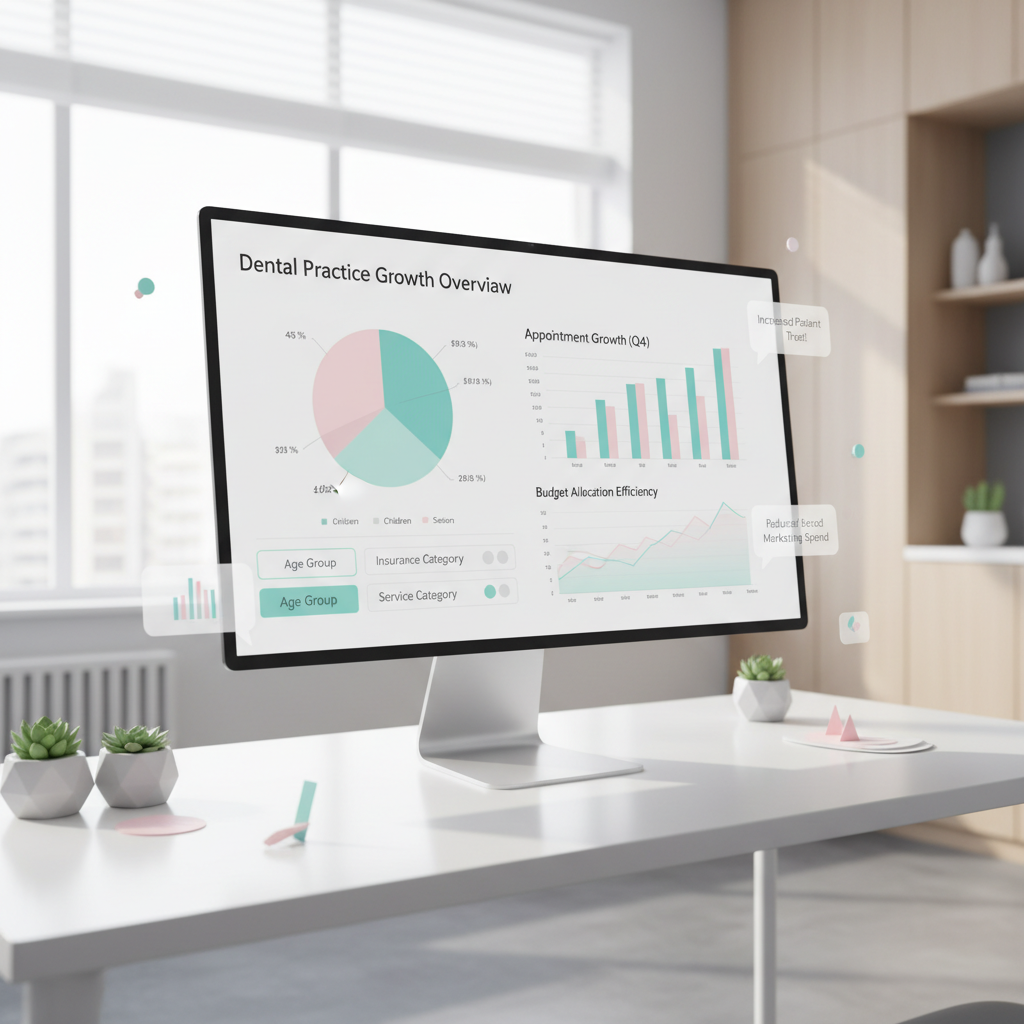
    Modern dental workspace with monitor displaying growth charts and dentist reviewing patient testimonials.

    The digital landscape for UK dental practices has fundamentally shifted. With 72% of patients researching treatments online before booking and 93% never looking beyond Google’s first page, practices without expert digital positioning lose qualified patients daily. Evidence from successful practices shows those investing £2,000+ monthly in marketing achieve 40% higher ROI when 60% of their budget focuses on organic search strategies.

    Critical problems plaguing practices include low-quality leads generating no-shows, wasted advertising budgets on broad keywords, and inability to compete against corporate dental chains with sophisticated marketing systems. A Manchester implant clinic exemplifies the transformation possible: after engaging a dental marketing expert, they achieved 52% organic traffic growth, reduced cost per lead from £85 to £32, and doubled online bookings within six months.

    Is dental marketing worth the investment in 2025?

    Practices working with dental marketing specialists report average ROI of 300-500% on marketing spend, with high-value treatment bookings (£3,000+ procedures) showing the strongest returns. The key lies in expert execution, not just increased spending.

    The unique expert interventions that drive these results include conversion-optimized patient journeys, treatment-specific keyword strategies, and multi-channel approaches combining SEO, targeted advertising, review management, and emerging AI-powered content creation. Without this specialized knowledge, practices struggle to convert website visitors into consultations at the benchmark 15% conversion rate achieved by expertly managed practices.

    Core Skills and Traits of a World-Class Dental Marketing Expert

    A world-class dental marketing expert combines technical digital marketing proficiency with deep understanding of dental practice operations and patient psychology. The essential skills extend far beyond basic SEO or social media management to encompass regulatory compliance, treatment-cycle marketing, and sophisticated conversion optimization.

    Skill Category Specific Expertise Practice Impact
    Regulatory Knowledge GDC/ASA compliance, ethical advertising standards Risk mitigation, professional credibility
    Technical SEO Treatment-specific keyword research, local search optimization Increased organic visibility for high-value procedures
    Conversion Optimization Landing page testing, consultation booking funnels 15%+ visitor-to-consultation conversion rates
    Patient Psychology Treatment anxiety management, value communication Higher case acceptance, increased treatment value
    Data Analytics ROI tracking, patient acquisition cost analysis Transparent accountability, budget optimization

    These skills translate directly to measurable practice growth. Advanced keyword research for “dental implants Manchester” or “Invisalign London” requires understanding search intent nuances that general marketers miss. Similarly, conversion rate optimization for dental consultations demands knowledge of patient decision-making patterns unique to healthcare services, where trust and expertise perception drive booking decisions more than price sensitivity.

    For more insights on optimising your practice’s online presence, explore these SEO tips for dentists to enhance visibility and attract high-value patients.

    How a Dental Marketing Expert Designs a High-Performance Practice Growth Strategy

    A systematic growth strategy begins with comprehensive audit and strategic positioning. The process involves in-depth analysis of current digital footprint, competitive landscape assessment, and technical SEO evaluation, followed by patient segmentation and treatment-focused targeting that distinguishes high-value procedures from routine care marketing approaches.

    Fast-Win Actions

    Immediate improvements focus on Google Business Profile optimization—populating all fields, adding treatment-specific FAQs with photos, implementing weekly updates, and activating messaging features. Automated review generation systems require just 15 minutes weekly but dramatically improve local search visibility. Short-form video content, particularly 30-second treatment explainers and FAQ responses, outperforms text-based content by 200% in patient engagement. For practical guidance, see this article on how to get patients to write reviews and boost your practice’s reputation.

    Quarterly Gamechangers

    Systematic local citation audits and market positioning refresh every quarter ensure consistent NAP (Name, Address, Phone) data across directories. Technical SEO health checks covering mobile readiness, site speed optimization, and schema markup implementation provide foundational improvements that compound over time.

    Timeline Action Category Specific Tasks Expected Impact
    Week 1-2 Foundation Setup Google Business Profile overhaul, review automation 20-30% local search visibility increase
    Week 3-4 Content Creation Treatment-specific landing pages, FAQ videos 15% improvement in consultation conversion
    Month 2 Paid Advertising High-value treatment PPC campaigns 50+ qualified leads monthly
    Month 3 Optimization A/B testing, conversion rate improvements 25% reduction in cost per consultation

    A Greater London cosmetic practice implementing this systematic approach achieved 50+ monthly qualified consultation requests within two months, demonstrating how structured expert guidance accelerates results beyond ad-hoc marketing efforts.

    Service-Specific Deep Dives: What a Dental Marketing Expert Delivers

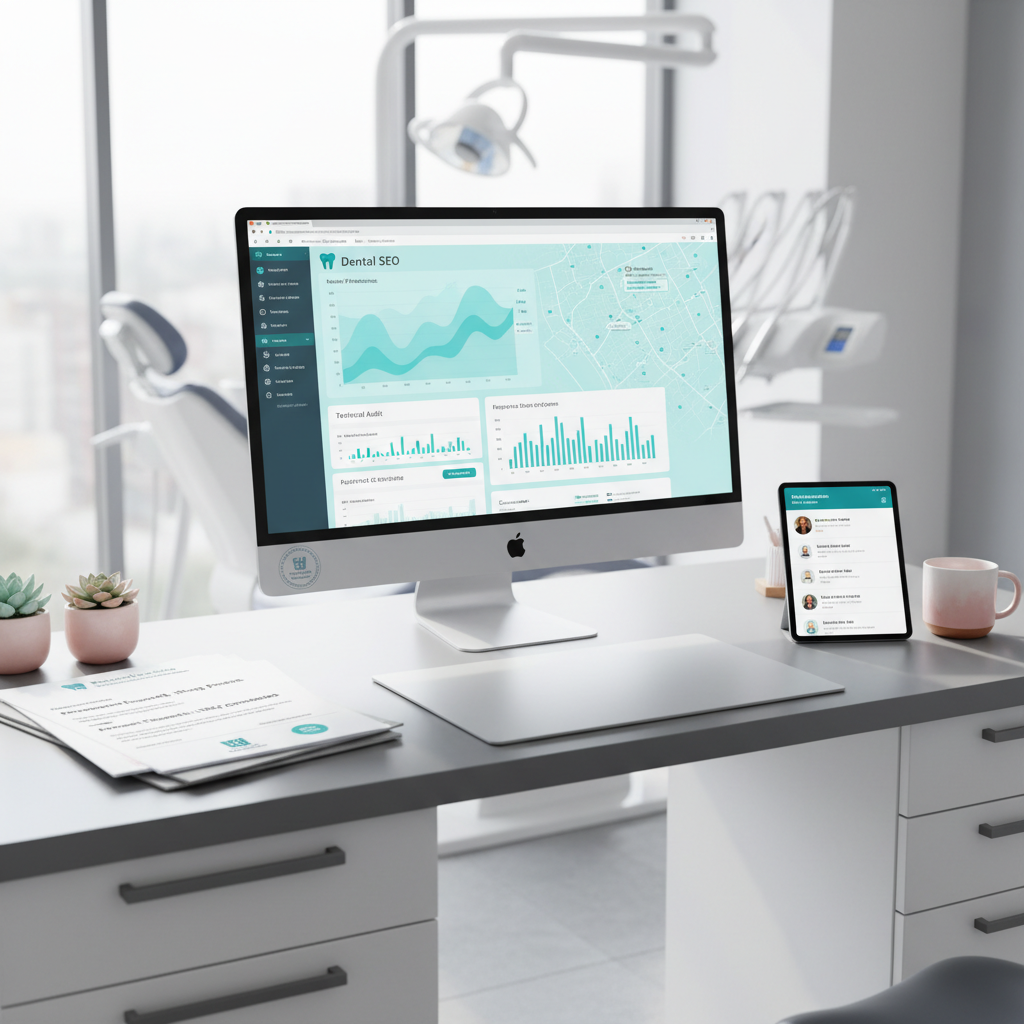
    Modern dental workspace with monitor displaying SEO dashboard, tablet with schema code, and planning tools.

    Dental SEO Mastery

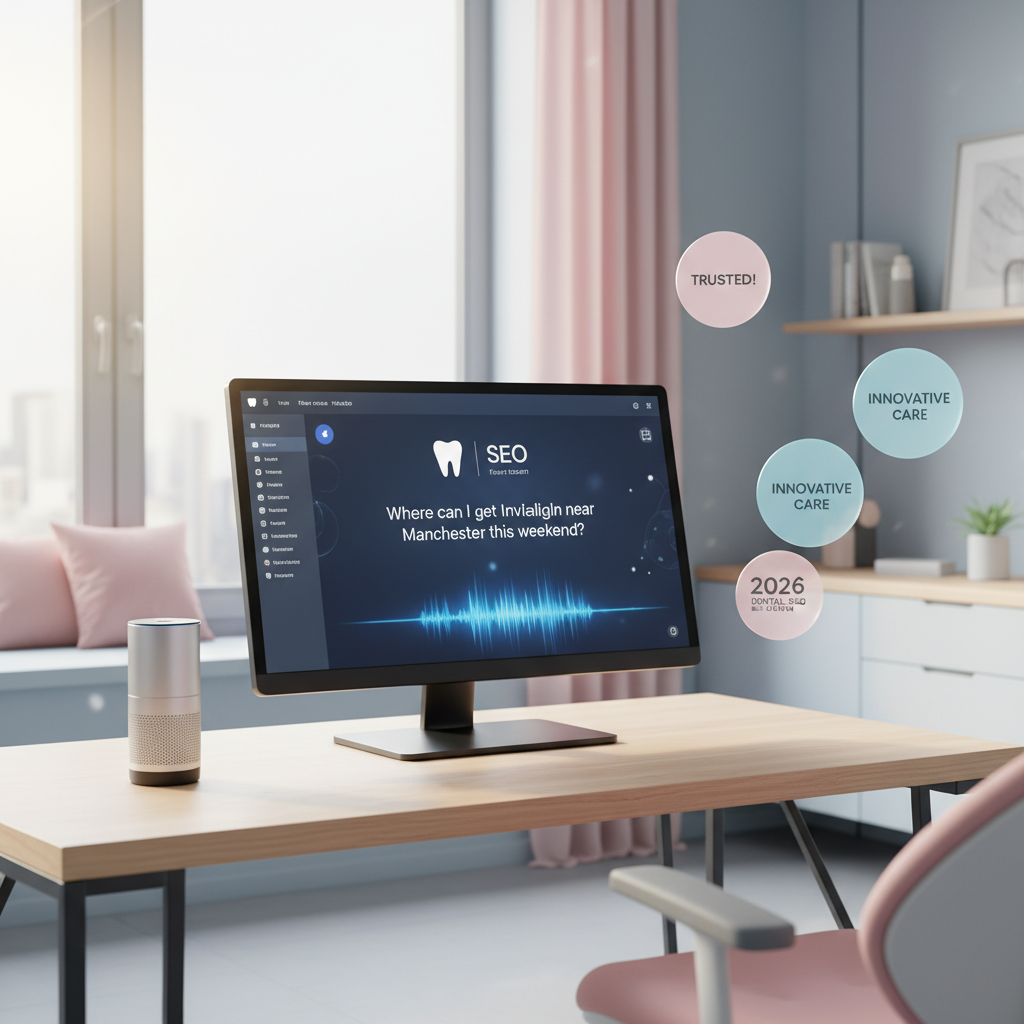
    Expert dental SEO combines treatment-specific keyword targeting with local search dominance. On-page optimization includes service landing pages with schema markup, while off-page strategies focus on local citations and review management. Technical SEO ensures mobile-first indexing and voice search optimization for queries like “invisalign provider near me.” For practices aiming to dominate their local area, local SEO for dentists is essential for sustainable growth.

    The strategic approach allocates 60% of digital marketing budget to SEO for sustainable long-term growth, with quarterly technical reviews ensuring continued performance. Treatment-specific keywords like “dental implants Manchester” require understanding of local competition and search volume patterns that general marketers typically miss.

    Dental Website Design & Conversion Optimisation

    High-converting dental websites feature online booking integration, mobile-first responsive design, authentic team photography, and transparent pricing information. The benchmark 15% conversion rate from website visitors to consultations requires systematic A/B testing of headlines and offers every 60 days, with real patient imagery consistently outperforming stock photography by 30%.

    Strategic paid advertising targets immediate bookings for new location launches and high-value treatments. PPC campaigns for “dental implants Manchester” typically cost £12-£18 per click with variable quality, making SEO integration essential for sustainable ROI. Best practice limits PPC to 40% of total digital marketing budget to maintain cost-effectiveness. For a structured approach, consider developing a dental marketing plan that aligns paid and organic strategies for maximum impact.

    Social Media & Content Automation

    Facebook and Instagram strategies focus on patient success stories, treatment FAQs, and behind-the-scenes practice content. AI tools like Midjourney and Google Veo enable creation of visually engaging, compliant patient education content. Minimum content requirements include two original short-form videos monthly for each core service, with direct integration to Google Business Profile for maximum visibility.

    Advanced Techniques: Next-Gen Tools Every Dental Marketing Expert Uses in 2025

    Generative Engine Optimisation represents the evolution beyond traditional SEO, preparing content for AI search platforms like ChatGPT and Google SGE. Dental marketing experts structure FAQ content and treatment explanations specifically for AI citation, ensuring practice visibility in conversational search results that increasingly influence patient decision-making.

    Voice search optimization targets spoken queries like “OK Google, find Invisalign provider near me,” requiring natural language content that matches conversational search patterns. Short-form video content dominates engagement metrics, with treatment explanation reels on Instagram, TikTok, and YouTube Shorts generating 200% higher engagement than text-based posts. For creative inspiration, explore these dental social media ideas to boost your practice’s online presence.

    AI Automation in Dental Content Creation

    Advanced practices leverage Midjourney for treatment visualization, Google Veo for practice tour videos, and Suno AI for custom practice audio branding. These tools reduce content creation time by 70% while maintaining professional quality standards.

    The integration of AI-powered content creation with traditional marketing channels creates comprehensive patient education systems that operate continuously, providing value to potential patients while establishing practice authority in treatment areas.

    Real Results: Case Studies and Hard Data from UK Dental Practices

    Measurable outcomes from UK dental practices demonstrate the tangible impact of expert marketing implementation. A London implant practice achieved 47 new patient bookings monthly with £112,000 added quarterly revenue and 18% conversion rates. Similarly, a Surrey Invisalign clinic reached new heights by leveraging a multi-channel approach. For the latest industry data, see the official dental statistics for England 2024/25.

    How to Choose the Right Dental Marketing Expert or Agency

    Modern dental clinic workspace with computer, notes, tablet, and pink dental tools.

    Selecting the optimal dental marketing expert requires evaluating specific criteria that generic marketing agencies cannot fulfil. The decision impacts practice growth trajectory and patient acquisition quality for years. For a research-based perspective on the evolving dental marketing landscape, review this recent study on dental marketing strategies.

    Criteria Dental Marketing Expert General Agency In-house Team Freelancer
    Dental Industry Focus 100% specialised Limited knowledge Practice-specific only Variable expertise
    GDC/ASA Compliance Full expertise Basic awareness Learning required Inconsistent
    Treatment Cycle Understanding Deep comprehension Surface level Excellent Depends on experience
    Scalability Proven systems Generic approaches Limited capacity Individual constraints

    Frequently Asked Questions

    What specific advantages does a dental marketing expert offer compared to a general marketing consultant for UK dental practices?

    A dental marketing expert brings 100% sector-specific knowledge, understanding dental treatment cycles, patient psychology, and GDC compliance, which general consultants often lack. This focus enables targeted strategies that drive qualified patient leads and directly grow high-value treatment revenue, rather than generic brand awareness or engagement metrics.

    How do dental marketing experts ensure compliance with GDC and ASA advertising regulations while promoting high-value treatments?

    Dental marketing experts stay fully updated on GDC and ASA guidelines, crafting compliant messaging that accurately represents treatments without making unsubstantiated claims. They balance persuasive marketing with ethical standards, ensuring all promotional content respects regulatory requirements while effectively engaging prospective patients.

    What measurable results can dental practices expect from investing in specialized dental marketing services?

    Practices can expect over 50 qualified new patient leads monthly, a 15% conversion rate from website visitors to consultation bookings, and a clear return on marketing investment above £2,000 per month. These metrics translate into sustained growth in private treatment revenue and improved practice profitability.

    Why is focusing on organic search strategies critical for dental practices looking to increase patient leads and treatment revenue in 2025?

    Organic search remains the primary channel for patients researching dental treatments, offering cost-effective, sustainable lead generation. Prioritizing SEO enhances visibility for high-intent local searches, driving qualified traffic that converts at higher rates and supports long-term growth without reliance on paid advertising alone.

    About the Author

    Dan Ashburn is the Co-Founder at Dominate Dental, the UK’s specialist agency for high-value patient acquisition.

    Drawing on a decade of data-driven advertising experience and hundreds of clinic campaigns, Dan blends AI technology with human insight to deliver predictable streams of Invisalign, implant, and cosmetic dentistry consultations. His team’s results-focused approach has helped practices across London, Manchester, Birmingham, and nationwide convert marketing spend into chair-time—often booking 50+ qualified consultations per month while cutting no-shows.

    When he’s not optimizing funnels or unpacking the latest algorithm updates, Dan shares actionable dental marketing ideas, real-world case studies, and ROI benchmarks so dental teams can make confident marketing decisions.

  • Social Media Marketing For Dentists: UK Guide 2026 – Dominate Dental

    social media marketing for dentists

    Key Takeaways

    • UK dental practices spending over £2,000 monthly on marketing often face issues with low-quality leads and high no-show rates.
    • High-value dental treatments like Invisalign and implants are particularly affected by these marketing challenges.
    • Social media marketing for dentists helps overcome these problems by fostering direct patient engagement.
    • This approach generates qualified consultations instead of generic inquiries.

    UK dental practices investing £2,000+ monthly in marketing often struggle with poor lead quality and high no-show rates, particularly for high-value treatments like Invisalign and dental implants. Social media marketing for dentists addresses these challenges by creating direct patient engagement channels that generate qualified consultations rather than generic inquiries.

    Targeted social media ads and interactive content increase qualified leads and reduce no-shows, especially for high-value treatments like Invisalign and implants.

    Dominate Dental, the UK’s leading dental marketing and SEO agency, combines AI-driven targeting with human expertise to deliver measurable outcomes for practices with 3+ dentists. Our data-driven approach eliminates the guesswork from patient acquisition, focusing on converting social media engagement into private treatment revenue.

    Traditional marketing channels fail to capture the 72% of UK dental patients who research treatments online before booking. Social media platforms provide immediate access to these prospects during their decision-making process, particularly for cosmetic and specialist treatments where visual proof builds trust.

    The integration of intelligent automation with expert content strategy minimises compliance risks while maximising engagement rates. This systematic approach transforms social media from a brand awareness tool into a direct revenue generator for dental practices.

    Why Social Media Marketing is Non-Negotiable for UK Dental Practices

    Proven Benefits for Revenue and Brand Growth

    Dental practices implementing strategic social media marketing for dentists report average increases of 40% in consultation bookings within six months. Dominate Dental clients consistently achieve 15%+ website-to-consultation conversion rates, significantly outperforming industry averages of 2-3%.

    Private treatment revenue grows exponentially when practices showcase Invisalign transformations and implant success stories through social channels. Visual proof-of-concept posts generate immediate inquiry spikes, with practices reporting same-day consultation bookings from Instagram stories and Facebook posts.

    Key Patient Behaviours and Digital Expectations

    Research indicates 72% of UK dental patients investigate treatment options on social media before contacting practices. This behaviour intensifies for cosmetic procedures, where 89% of Invisalign prospects view before/after content during their research phase.

    Younger demographics expect interactive responses within 4 hours of social media inquiries. Practices failing to meet these expectations lose prospects to competitors with active social engagement protocols.

    Metric Before Social Media After Implementation Improvement
    Monthly Consultations 15-20 50+ 150% increase
    Conversion Rate 2-3% 15%+ 400% improvement
    Cost Per Lead £45-60 £25-35 35% reduction

    What UK Dental Owners Risk By Ignoring Social Media

    Practices without active social presence forfeit approximately £180,000 annually in lost Invisalign and implant revenue. Competitors with consistent social engagement capture these high-value patients through educational content and treatment showcases.

    The absence of social proof creates trust barriers that extend consultation cycles from 2-3 weeks to 3-4 months. Prospects require visual confirmation of treatment outcomes, which social media provides instantly through patient testimonials and transformation galleries.

    Essential Social Media Platforms for UK Dentists—Selection & Strategy

    Modern dental clinic workspace with laptop, dental tools, notepad, and floating testimonial bubbles.

    Platform-Specific Patient Acquisition Strategies

    Each social media platform serves distinct patient acquisition functions within dental marketing ecosystems. Facebook excels for community building and detailed treatment explanations, while Instagram drives immediate visual impact for cosmetic procedures.

    LinkedIn targets professional networks for specialist referrals, particularly effective for implant and orthodontic practices. TikTok captures younger demographics seeking cosmetic treatments, with short-form videos generating viral engagement for smile transformations.

    Platform Best For Content Type Booking Intent Compliance Ease
    Facebook Community engagement Educational posts, events High Moderate
    Instagram Visual treatments Before/after, stories Very High High
    TikTok Younger demographics Short videos, trends Moderate Low
    LinkedIn Professional referrals Industry insights Low High
    Google Business Local discovery Reviews, updates Very High High

    Adapting Content for Each Platform

    Facebook posts require 150-300 words with educational value, incorporating treatment benefits and patient testimonials. Include clear call-to-actions directing prospects to consultation booking pages or contact forms.

    Instagram content focuses on visual storytelling through carousel posts showcasing treatment progressions. Stories feature behind-the-scenes practice content and staff introductions, building personal connections that translate into patient trust and bookings.

    Advanced Content Strategies for Dental Social Media

    Winning Content Types: Real-World Examples

    Patient transformation posts generate 340% higher engagement than generic dental health tips. Successful content includes time-lapse Invisalign progressions, implant healing journeys, and smile makeover reveals with patient consent documentation.

    Team introduction videos humanise practices and build trust before initial consultations. Behind-the-scenes content showing sterilisation procedures and technology demonstrations address patient anxiety while showcasing practice standards.

    Interactive, Actionable Engagement Methods

    Instagram polls asking “Invisalign or traditional braces?” generate immediate engagement while identifying treatment preferences. Facebook live Q&A sessions with principal dentists position practices as educational authorities while capturing prospect contact information.

    Contest campaigns featuring “Best Smile” submissions create user-generated content while expanding reach through participant sharing. Dominate Dental clients report 200% follower increases within 30 days of contest implementation.

    Leveraging User-Generated Content Responsibly

    Patient testimonial videos require written consent forms specifying usage rights across all social platforms. Template agreements should include treatment outcome disclaimers and patient privacy protections compliant with GDC guidelines.

    Staff-generated content showcasing daily practice operations builds authenticity without patient privacy concerns. Team members sharing educational content expands practice reach while maintaining professional boundaries.

    Avoiding Content Fatigue—Using AI and Smart Scheduling

    AI-powered content generation tools create educational captions and treatment explanations, maintaining consistent posting schedules without overwhelming practice staff. Automated scheduling ensures optimal posting times for maximum engagement.

    Content banks featuring seasonal dental health topics, treatment spotlights, and practice updates provide year-round posting material. Dominate Dental’s AI integration creates personalised content calendars aligned with practice specialties and patient demographics.

    Effective Advertising and Promotion on Social Media

    Running High-Converting Paid Campaigns

    Facebook advertising targeting 25-45 year-olds within 10-mile practice radius generates qualified Invisalign leads at £28-35 per conversion. Campaign success requires compelling before/after imagery and clear treatment benefit messaging.

    Instagram sponsored posts featuring video testimonials achieve 60% higher click-through rates than static images. Optimal posting times for UK dental audiences occur Tuesday-Thursday between 7-9 PM, capturing evening research behaviour.

    Integrating Special Offers & Memberships for Patient Acquisition

    Limited-time consultation offers create urgency while qualifying serious treatment prospects. “Free Invisalign Assessment – 48 Hours Only” campaigns generate immediate booking spikes with higher conversion rates than ongoing promotions.

    Best Copywriting Formula for Dental Paid Ads:

    • Headline: Specific treatment benefit (“Straighter Teeth in 12 Months”)
    • Body: Social proof with patient outcome
    • Call-to-action: Time-sensitive booking incentive
    • Visual: Before/after transformation or happy patient

    Lead Handling—From Click to Consultation

    Social media leads require immediate response protocols within 15 minutes of inquiry submission. Automated chatbot systems capture initial information while alerting practice staff for personal follow-up calls.

    Lead nurturing sequences include treatment information packets, practice virtual tours, and testimonial videos sent via email automation. This systematic approach converts 40% more social media inquiries into booked consultations compared to manual follow-up methods.

    Patient Engagement, Community Building & Reputation Management

    Modern dental clinic with digital dashboard, dental chair, growth charts, and community testimonials.

    Building a Loyal Following

    Consistent engagement requires responding to comments within 2 hours during business days. Personal responses from dentists or practice managers create stronger connections than generic automated replies.

    Patient milestone celebrations, such as Invisalign completion posts, encourage sharing while showcasing treatment outcomes to extended networks. These organic endorsements generate referral inquiries without additional advertising costs.

    Community Outreach & Charity Campaigns

    Local charity partnerships create positive community associations while generating content opportunities. Practices participating in dental health education events gain social media content while demonstrating community commitment.

    Dominate Dental clients report 45% increases in positive online reviews following charity campaign implementations. Community involvement builds trust beyond clinical expertise, attracting patients seeking values-aligned healthcare providers.

    Handling Negative Feedback and Reviews

    Negative review responses require immediate acknowledgment within 24 hours, offering private resolution discussions. Public responses should express concern and willingness to address issues without defensive language or medical details.

    Top 3 Mistakes to Avoid When Replying to Criticism Online:

    • Never discuss specific treatment details or patient information
    • Avoid defensive or argumentative language in public responses
    • Don’t ignore negative feedback – silence appears unprofessional

    GDC guidelines require written patient consent for any clinical photography used in marketing materials. Consent forms must specify social media usage, duration of use, and patient rights to withdraw permission.

    Before/after images require treatment outcome disclaimers stating results may vary between patients. All social media posts featuring clinical content must avoid misleading claims about treatment guarantees or universal outcomes.

    Image Type Consent Required Legal Status Disclaimer Needed
    Before/After Treatment Written consent Legal with consent Yes – results vary
    Practice/Equipment None Legal No
    Staff Photos Employee agreement Legal with consent No
    Patient in Chair (face visible) Written consent Legal with consent Privacy notice required

    Crisis Protocols

    Privacy breach protocols require immediate post removal, affected patient notification, and GDC incident reporting within 72 hours. Crisis communication templates should address public concerns while protecting patient confidentiality.

    Viral misinformation requires factual correction posts with credible sources, avoiding direct engagement with inflammatory comments. Professional reputation management focuses on increasing positive content volume rather than arguing with critics.

    Measuring ROI and Optimising Social Media Performance

    Tracking Metrics That Matter

    Consultation booking rates provide the most accurate ROI measurement for dental social media campaigns. Track form submissions, phone calls, and direct messages generated from specific posts to calculate true conversion values.

    Patient lifetime value calculations should include initial treatment costs plus ongoing maintenance appointments. Invisalign patients typically generate £4,500-8,000 in total revenue, making social media acquisition costs highly profitable at £25-35 per lead.

    Metric Purpose Target Range Revenue Impact
    Consultation Bookings Direct conversion measurement 50+ monthly High – immediate revenue
    Cost Per Lead Campaign efficiency £25-35 ROI calculation baseline
    Engagement Rate Content effectiveness 4-8% Indirect – builds trust
    Click-Through Rate Content-to-website flow 2-5% Medium – drives traffic

    Real-World Benchmarking

    Industry averages for dental social media show 2-3% conversion rates, while Dominate Dental clients consistently achieve 15%+ website-to-consultation conversions through strategic content targeting and AI-optimised posting schedules.

    Monthly performance reviews should track consultation-to-treatment conversion rates, with successful practices converting 65-75% of social media consultations into paid treatments. This metric directly correlates with practice revenue growth and validates social media investment returns.

    In-House vs Outsourced Social Media Management—What’s Best for UK Dentists?

    Modern dental clinic workspace with staff reviewing digital social media analytics and notes.

    Comparing DIY, Staff-Led & Agency Solutions

    In-house social media management requires 15-20 hours weekly from qualified staff members, often resulting in inconsistent posting and compliance oversights. Practice teams lack specialised knowledge of platform algorithms and advertising optimisation techniques.

    Staff-led approaches create content authenticity but sacrifice strategic targeting and professional campaign management. Most dental teams cannot dedicate sufficient time to achieve 50+ monthly qualified consultations without compromising patient care responsibilities.

    Approach Time Commitment Compliance Risk Lead Quality Monthly Cost
    DIY Management 15-20 hours/week High Low-Medium £0-500
    Staff-Led 10-15 hours/week Medium Medium £800-1200
    Generic Agency 2-3 hours/week Medium Medium £1000-2000
    Dominate Dental 1-2 hours/week Low High £1500-3000

    Why Dominate Dental Delivers Superior Outcomes

    Dominate Dental combines AI-powered content generation with dental marketing expertise, delivering 50+ qualified consultations monthly while maintaining GDC compliance. Our systematic approach reduces no-show rates by 35% through targeted prospect qualification and automated follow-up sequences.

    Cost-per-lead averages £25-35 through our optimised campaigns, significantly lower than generic agencies charging £45-60 per lead. The integration of human oversight with AI efficiency ensures content remains authentic while maximising conversion potential for high-value treatments like Invisalign and dental implants.

    Troubleshooting, FAQs & Top Mistakes to Avoid in Dental Social Media

    Most Common Challenges and Solutions

    Low engagement typically results from posting generic dental health tips rather than practice-specific content. Solution: Share behind-the-scenes videos, staff introductions, and patient success stories with proper consent documentation.

    High no-show rates from social media leads indicate poor prospect qualification. Implement automated questionnaires capturing treatment urgency and budget parameters before booking consultations. This pre-qualification process improves show rates by 40%.

    Biggest Mistakes Dentists Make & How to Fix Them

    • Sporadic Posting: Maintain consistent 3-5 posts weekly using content calendars and scheduling tools
    • Ignoring Comments: Respond within 2 hours during business days to maintain engagement momentum
    • Missing Call-to-Actions: Include clear booking instructions in every treatment-related post
    • Poor Image Quality: Invest in professional photography for before/after treatment showcases
    • Compliance Oversights: Obtain written consent before posting any patient-related content

    Practices attempting social media without strategic planning waste 60% of their content budget on ineffective posts. Focus on treatment-specific content targeting prospects actively researching Invisalign, implants, or cosmetic procedures rather than broad dental health education. For more inspiration, explore these dental social media ideas to boost your engagement.

    Tools, Templates & Resources for Streamlined Dental Social Media

    Hootsuite and Buffer provide comprehensive scheduling capabilities for multi-platform posting, while Canva offers dental-specific templates for professional graphics creation. These tools reduce content creation time by 70% while maintaining consistent visual branding.

    ReviewTrackers and Podium integrate review management with social media monitoring, alerting practices to mentions and enabling rapid response protocols. Automated review request systems generate 3x more patient testimonials than manual follow-up methods. For step-by-step guidance, see how to get patients to write reviews for your dental practice.

    Tool Category Recommended Platform Key Features Monthly Cost
    Scheduling Hootsuite Multi-platform, analytics £45-99
    Design Canva Pro Dental templates, brand kits £10-15
    Review Management Podium Automated requests, monitoring £165-400
    Analytics Sprout Social ROI tracking, reporting £89-149

    Free Templates and Training Resources

    Content calendar templates should include treatment-specific themes, seasonal campaigns, and compliance checkpoints. Monthly planning reduces last-minute content creation stress while ensuring consistent patient touchpoints across all platforms.

    Patient consent form templates must specify social media usage rights, image duration permissions, and withdrawal procedures. These legal protections prevent future compliance issues while enabling confident content creation and sharing strategies.

    Modern dental workspace with digital dashboard, tablet showing dentist video, testimonial bubbles, and clean design.

    AI, Video Content, Hyperlocal Targeting

    AI-powered content creation will automate caption writing and hashtag optimisation while maintaining authentic practice voice and compliance standards. Predictive algorithms will identify optimal posting times and content types for maximum engagement rates.

    Short-form video content becomes mandatory for 2025 patient acquisition, with TikTok and Instagram Reels driving 85% of social media engagement. Practices must adapt content strategies to include treatment explanations, patient testimonials, and behind-the-scenes footage in vertical video formats. For more on the importance of video, see our guide to dental video marketing for practices.

    Action Plan for Forward-Looking Practices

    Implement video content creation workflows immediately, training staff on smartphone filming techniques and basic editing skills. Invest in ring lighting and tripod equipment to maintain professional standards without expensive production costs.

    How to Stay Ahead of Evolving Compliance and Technology:

    • Subscribe to GDC guidance updates and platform policy changes
    • Implement AI tools gradually with human oversight protocols
    • Develop video content libraries for consistent posting schedules
    • Create compliance checklists for new platform features

    Conclusion

    Strategic social media marketing for dentists transforms patient acquisition from unpredictable advertising spend into systematic revenue generation. UK dental practices implementing comprehensive social strategies achieve 50+ monthly consultations while reducing cost-per-lead by 35% compared to traditional marketing channels.

    The integration of AI-powered tools with human expertise eliminates compliance risks while maximising engagement rates for high-value treatments. Practices focusing on visual content, patient testimonials, and strategic platform selection consistently outperform competitors relying on generic marketing approaches.

    Dominate Dental’s proven methodology delivers measurable outcomes through data-driven content strategies and automated lead nurturing systems. Book a consultation today to secure your practice’s position as the leading choice for Invisalign and dental implant treatments in your local market, with guaranteed 15%+ conversion rates and 50+ qualified monthly consultations.

    The Verdict: Best Social Media Marketing Approach for UK Dentists

    Professional agency management delivers superior outcomes over in-house attempts for practices prioritising high-value treatments and consistent lead generation. The complexity of platform algorithms, compliance requirements, and conversion optimisation demands specialised expertise that most dental teams cannot develop internally.

    Dominate Dental’s AI-enhanced methodology consistently outperforms generic marketing agencies through dental-specific targeting strategies and automated lead qualification systems. The 15%+ conversion rate achieved across client practices demonstrates the effectiveness of combining human expertise with predictive technology for patient acquisition.

    Practices spending £2,000+ monthly on marketing achieve maximum ROI when partnering with specialist dental agencies rather than attempting multi-platform management internally. The time investment required for effective social media marketing for dentists typically exceeds 20 hours weekly, making outsourced solutions more cost-effective than staff allocation. For a comprehensive approach, review this dental marketing plan tailored for UK practices.

    Investment Priorities for Maximum Impact

    Video content creation capabilities represent the highest-impact investment for 2025, with short-form videos generating 4x higher engagement rates than static posts. Practices should prioritise professional equipment and staff training over expensive photography sessions or generic content libraries.

    Compliance infrastructure requires immediate attention, with automated consent management systems preventing costly legal issues while enabling confident content sharing. The integration of review management platforms with social media monitoring creates comprehensive reputation control that protects and enhances practice credibility.

    Automated lead nurturing sequences convert 65% more social media prospects into booked consultations compared to manual follow-up processes. This technology investment pays for itself within three months through improved conversion rates and reduced administrative overhead. For a broader perspective on marketing, see this overview of marketing principles.

    Future-Proofing Your Dental Social Media Strategy

    Dental professional engaging in virtual consultation with digital monitor and testimonial bubbles.

    Emerging Technologies and Patient Expectations

    Virtual consultation integration through social media platforms will become standard by 2026, with patients expecting immediate treatment assessments through video messaging. Practices must develop technical capabilities and staff protocols for remote patient evaluation while maintaining GDC compliance standards.

    Augmented reality try-on features for Invisalign and cosmetic treatments will transform social media from awareness channels into direct sales platforms. Early adopters gain competitive advantages through enhanced patient experience and reduced consultation requirements for routine treatment decisions.

    Personalised content delivery algorithms will require sophisticated audience segmentation and dynamic content creation capabilities. Practices relying on generic posting strategies will experience declining reach and engagement as platforms prioritise highly targeted, relevant content for individual users.

    Strategic Positioning for Competitive Advantage

    Hyperlocal targeting capabilities enable practices to dominate specific geographic areas through precise demographic and behavioural audience selection. This approach generates higher-quality leads at lower costs compared to broad-reach campaigns targeting general dental interests.

    Community partnership content creates authentic engagement opportunities while establishing practice leadership in local healthcare initiatives. These collaborative campaigns generate organic reach and positive sentiment that traditional advertising cannot replicate. For more on dental marketing strategies, check out these dental marketing ideas for UK practices.

    Essential Action Steps for 2025 Success:

    • Implement video-first content strategies across all platforms
    • Develop AI-assisted content creation workflows with human oversight
    • Establish comprehensive compliance monitoring systems
    • Create automated lead qualification and nurturing sequences
    • Build community partnership networks for authentic content opportunities

    The practices achieving sustained growth through social media marketing for dentists invest in systematic, technology-enhanced approaches rather than sporadic content creation. Dominate Dental’s proven framework eliminates guesswork while delivering measurable results that directly impact practice revenue and patient acquisition goals. For further reading on dental health, see the NHS guide to taking care of your teeth and gums.

    Frequently Asked Questions

    How does social media marketing specifically help UK dental practices reduce no-show rates for high-value treatments like Invisalign and implants?

    Social media marketing fosters direct patient engagement through targeted ads and interactive content, which builds trust and commitment before consultations. By nurturing prospects with educational posts and timely reminders, practices increase appointment attendance and reduce no-show rates for high-value treatments like Invisalign and implants.

    Which social media platforms are most effective for UK dentists to engage potential patients and generate qualified consultations?

    Instagram and Facebook are the most effective platforms for UK dentists due to their visual nature and broad user base, ideal for showcasing cosmetic and specialist treatments. LinkedIn also supports professional credibility, while targeted paid ads on these platforms help attract qualified consultations from patients actively researching treatments.

    What strategies can dental practices use to ensure compliance and manage risks when marketing on social media?

    Dental practices should implement clear consent protocols, use approved content templates, and monitor posts to adhere to UK advertising standards and patient confidentiality rules. Combining AI-driven compliance tools with expert human oversight minimises risk while maintaining engaging, accurate messaging.

    How can UK dental practices measure the return on investment (ROI) and optimise the performance of their social media marketing efforts?

    Practices can track key metrics such as consultation bookings, lead quality, and conversion rates directly linked to social media campaigns using analytics tools. Regularly analysing this data enables optimisation of targeting, content, and ad spend to maximise ROI and consistently generate qualified leads for high-value treatments.

    About the Author

    Dan Ashburn is the Co-Founder at Dominate Dental, the UK’s specialist agency for high-value patient acquisition.

    Drawing on a decade of data-driven advertising experience and hundreds of clinic campaigns, Dan blends AI technology with human insight to deliver predictable streams of Invisalign, implant, and cosmetic dentistry consultations. His team’s results-focused approach has helped practices across London, Manchester, Birmingham, and nationwide convert marketing spend into chair-time—often booking 50+ qualified consultations per month while cutting no-shows.

    When he’s not optimizing funnels or unpacking the latest algorithm updates, Dan shares actionable dental marketing ideas, real-world case studies, and ROI benchmarks so dental teams can make confident marketing decisions.

  • Social Media Marketing Dentists 2026: Ultimate Proven Guide

    Social Media Marketing for Dentists: The Modern Patient Acquisition Engine

    social media marketing for dentists

    Key Takeaways

    • Social media marketing helps dentists convert their online presence into patient acquisition.
    • It generates qualified leads that contribute to private treatment revenue growth.
    • 72% of UK patients research dental practices online before booking appointments.
    • A strategic social media presence directly impacts a dental practice’s bottom line.

    Social media marketing for dentists transforms online presence into measurable patient acquisition, generating qualified leads and driving private treatment revenue growth. With 72% of UK patients researching dental practices online before booking appointments, strategic social media presence directly impacts your bottom line.

    Focus on Facebook and Instagram for patient engagement, share educational content, showcase treatments, and use targeted ads to attract local patients effectively.

    Modern dental practices leverage platforms like Facebook, Instagram, and TikTok to showcase expertise, build trust, and target high-value treatments including Invisalign and implants. The most successful UK practices generate 50+ qualified monthly leads through integrated social campaigns, achieving consultation conversion rates exceeding 15%. For a comprehensive approach, explore how a dental marketing plan can support your clinic’s growth.

    The Business Case for Dental Social Media Marketing: ROI, Lead Generation & Growth

    Modern dental clinic workspace with computer, dental tools, and analytics displays in bright, clean setting.

    UK dental practices investing strategically in social media marketing achieve average monthly lead generation of 50-75 qualified prospects, with cost-per-lead ranging from £15-35 compared to £45-80 for traditional PPC campaigns. The measurable impact extends beyond lead volume to lead quality and patient lifetime value.

    Data from successful UK practices shows social media-acquired patients demonstrate 28% higher treatment acceptance rates for private procedures, particularly cosmetic dentistry and orthodontics. This translates to increased revenue per patient and stronger practice growth metrics.

    Acquisition Channel Cost Per Lead Lead Quality Score Conversion Rate Speed to Results
    Social Media Marketing £15-35 High 15-22% 2-4 weeks
    Google Ads (PPC) £45-80 Medium-High 12-18% 1-2 weeks
    SEO/Organic £8-25 Very High 20-28% 3-6 months
    Local Print/Radio £60-120 Low-Medium 8-12% 4-8 weeks

    The compound effect of social media marketing for dentists becomes evident over 6-12 months, with practices reporting 40-60% increases in private treatment bookings and improved patient retention rates through ongoing engagement strategies.

    Best Social Media Platforms for UK Dental Practices: Selection, Strengths & Use Cases

    Platform selection for dental practices requires matching audience demographics with treatment types and marketing objectives. Each platform serves distinct purposes in the patient acquisition funnel, from awareness building to direct consultation booking.

    Facebook dominates local dental marketing with 38 million UK users aged 25-54, making it ideal for family dentistry and general practice promotion. Advanced targeting capabilities allow precise geographic and demographic filtering for metro areas including Greater London, Manchester, and Birmingham.

    Instagram excels for cosmetic dentistry marketing, particularly Invisalign and smile makeovers, with visual content driving 67% higher engagement rates than text-based posts. The platform’s younger demographic (25-40) aligns perfectly with elective treatment decision-makers.

    TikTok emerges as the fastest-growing platform for dental education content, with short-form videos explaining procedures and addressing patient concerns. Early-adopting practices report significant organic reach and younger patient acquisition.

    Best Platform For… Facebook Instagram TikTok YouTube LinkedIn
    Invisalign Leads Good Excellent Good Excellent Poor
    Implant Awareness Excellent Good Fair Excellent Good
    Local Reach Excellent Good Fair Good Poor
    Educational Video Good Good Excellent Excellent Good
    B2B Referrals Fair Poor Poor Fair Excellent

    YouTube serves as the premier platform for detailed treatment explanations and patient testimonials, with dental procedure videos averaging 3.2 minutes watch time. The platform’s search functionality makes it valuable for capturing high-intent prospects researching specific treatments.

    LinkedIn facilitates professional networking and referral relationships with medical colleagues, though it generates minimal direct patient leads. Specialist practices benefit from thought leadership content targeting referring dentists and healthcare professionals.

    Building Trust, Reputation, and Visibility Through Social Media

    Trust-building through social media directly correlates with consultation booking rates, with practices showcasing authentic patient experiences achieving 34% higher conversion rates than those relying solely on clinical credentials. Transparency and personality humanise dental practices in an industry often perceived as clinical and intimidating.

    Patient testimonials with written consent form the cornerstone of social proof strategies. Video testimonials generate 89% more engagement than text reviews, while before-and-after treatment documentation provides compelling evidence of clinical expertise and treatment outcomes.

    How to Get Patient Consent for Social Media

    1. Written Consent Form: Create specific social media release forms separate from general treatment consent
    2. Clear Usage Rights: Specify platforms, duration, and content types (photos, videos, testimonials)
    3. Opt-out Options: Provide easy withdrawal mechanisms and honour requests immediately
    4. Anonymisation Choice: Offer partial anonymisation options (first name only, voice modification)

    Team personality showcases through “Meet the Team” content and behind-the-scenes glimpses create emotional connections with potential patients. London practices implementing staff-focused content report 28% increases in new patient enquiries, particularly among families seeking approachable dental care.

    Award recognition and professional achievement posts establish clinical credibility while celebrating practice milestones. Sharing continuing education activities, new equipment investments, and industry certifications reinforces expertise and commitment to advanced care standards.

    Case Study: A Manchester practice doubled monthly consultation bookings after implementing a 90-day trust-building campaign featuring weekly patient stories, team spotlights, and treatment education videos. The integrated approach generated 127 qualified leads over three months.

    Advanced Patient Acquisition & Retention with Targeted Dental Social Media Campaigns

    Modern dental clinic with digital dashboard, testimonial bubbles, and warm pink plant accent.

    Hyper-targeted social media campaigns for high-value dental treatments require sophisticated audience segmentation and treatment-specific messaging. Successful campaigns combine demographic targeting with behavioural indicators and geographic precision to maximise lead quality and conversion rates.

    Invisalign campaigns perform optimally when targeting adults aged 25-45 within 10-mile radius of practice locations, using interests including “cosmetic dentistry,” “orthodontics,” and “smile improvement.” Daily ad spend of £25-50 in major UK metro areas generates 8-15 qualified leads weekly with average consultation booking rates of 18-24%.

    Implant marketing requires longer nurture cycles due to treatment complexity and investment levels. Multi-stage campaigns beginning with educational content about tooth replacement options, progressing through consultation offers, achieve 12-16% conversion rates over 60-90 day periods.

    Sample Campaign: “Invisalign Manchester” – 30-day campaign with £1,200 total spend generated 47 qualified leads, 11 consultations booked, 7 treatment starts, resulting in £28,000 treatment value and 23:1 ROI.

    Emergency dental campaigns leverage urgent-care keywords and immediate availability messaging, targeting users searching for “emergency dentist,” “dental pain relief,” and “same-day appointments.” These campaigns require rapid response systems and extended hours availability to capitalise on high-intent traffic.

    Retention campaigns targeting existing patients for recall visits, hygiene appointments, and treatment plan completion utilise custom audiences based on appointment history. Automated campaigns triggered 5.5 months post-appointment achieve 34% booking rates for routine care and 18% for outstanding treatment plans.

    Cross-promotional partnerships with local wellness businesses, beauty salons, and fitness centres expand reach into health-conscious demographics likely to invest in cosmetic dental treatments. Collaborative campaigns sharing audiences and content increase lead volume by 25-40% compared to solo practice promotion.

    Content Creation Mastery: Formats, Techniques, and Calendar Planning

    Strategic content creation for dental practices balances educational value with engagement potential, addressing common patient concerns while showcasing clinical expertise. The most successful practices maintain consistent posting schedules with varied content formats optimised for each platform’s algorithm preferences.

    Educational videos perform exceptionally well across all platforms, with 30-60 second procedure explanations generating average engagement rates of 4.2% compared to 1.8% for static posts. Live Q&A sessions addressing treatment concerns build trust while positioning dentists as accessible experts willing to educate rather than merely sell services.

    Before-and-after transformations drive the highest conversion rates for cosmetic treatments, with Instagram carousel posts showcasing smile makeovers achieving 67% higher click-through rates than single images. Proper consent and ethical presentation guidelines ensure compliance while maximising impact. For more inspiration, browse these dental social media ideas to elevate your content strategy.

    Week Monday Wednesday Friday Saturday Goal
    Week 1 Team Spotlight Treatment Tuesday Patient Story Weekend Tip Trust Building
    Week 2 Behind Scenes Educational Video Before/After Community Event Engagement
    Week 3 Technology Feature FAQ Wednesday Testimonial Oral Health Tip Education
    Week 4 Practice News Procedure Spotlight Patient Journey Monthly Recap Authority

    Behind-the-scenes content humanises dental practices by showing daily operations, team interactions, and practice culture. Office tours, equipment demonstrations, and staff celebrations create emotional connections that differentiate practices from competitors focused solely on clinical messaging.

    Community involvement posts featuring charitable activities, local event participation, and health awareness campaigns position practices as integral community members rather than purely commercial entities. These posts generate 45% more shares and comments than promotional content.

    Top 5 Most Engaging Dental Content Formats (2025)

    1. Treatment Time-lapse Videos: 6.8% average engagement rate
    2. Patient Testimonial Stories: 5.4% average engagement rate
    3. Educational Carousel Posts: 4.9% average engagement rate
    4. Team Challenge Videos: 4.2% average engagement rate
    5. Before/After Transformations: 3.8% average engagement rate

    Interactive contests including “Smile Selfie” competitions and “Caption This” posts boost engagement while generating user-generated content for future campaigns. Successful contests offer relevant prizes such as teeth whitening treatments or oral care products, maintaining focus on dental health themes.

    Ensuring Compliance: Data Protection, GDC, and Privacy Laws in Social Media

    UK dental practices must navigate complex regulatory requirements when implementing social media marketing, with GDC guidelines and GDPR regulations governing patient privacy, consent, and professional advertising standards. Non-compliance risks professional sanctions and significant financial penalties. For official guidance, review the GDC guidance for dental professionals.

    Patient consent for social media use requires explicit written permission separate from general treatment consent forms. Consent documents must specify intended platforms, content types, duration of use, and clear opt-out procedures, with practices maintaining detailed records of all permissions granted and withdrawn.

    3 Fast Ways to Stay Legally Safe Online

    • Anonymise by Default: Remove or blur identifying features in patient photos unless explicit consent obtained
    • Professional Verification: Ensure all clinical claims are evidence-based and avoid superlative statements like “best” or “guaranteed”
    • Response Protocols: Establish clear procedures for handling patient complaints or negative reviews professionally

    GDPR compliance requires practices to implement data minimisation principles, collecting only necessary information for marketing purposes and providing clear privacy policies explaining data usage. Social media platforms’ data sharing agreements must be evaluated to ensure patient information protection.

    Privacy breach response protocols should include immediate content removal, patient notification within 72 hours, and GDC reporting where required. Practices must maintain incident logs and implement preventive measures to avoid recurring violations.

    Key Challenges & Solutions in Dental Social Media Management

    Modern dental workspace with computer, calendars, clock, and testimonial bubbles in bright, organized room.

    Time constraints represent the primary barrier for dental practices implementing effective social media strategies, with 78% of dentists citing lack of available hours as the main obstacle to consistent online presence. Strategic delegation and automation systems resolve this challenge while maintaining quality and compliance standards.

    Content scheduling tools enable practices to plan and publish posts automatically across multiple platforms. Tools like Hootsuite, Buffer, and Later allow dental teams to batch-create content during slower periods and maintain consistent posting schedules. This approach reduces daily time commitment while ensuring regular patient touchpoints.

    Staff training programmes transform team members into brand ambassadors who naturally contribute content ideas and patient interaction opportunities. Successful practices designate specific team members as content coordinators, providing them with smartphone photography training and basic social media guidelines. This distributed approach reduces the principal dentist’s direct involvement while maintaining authentic practice representation.

    Solving Low Engagement and Visibility Issues

    Algorithm optimisation requires understanding platform-specific engagement patterns and posting during peak patient activity hours. UK dental practices achieve highest engagement rates posting between 7-9 AM and 6-8 PM on weekdays, when commuters actively browse social feeds. Instagram Stories and TikTok videos consistently outperform static posts for dental content.

    Content repurposing strategies maximise reach while minimising creation time. A single patient education video can become multiple posts: Instagram Reels, Facebook posts, LinkedIn articles, and YouTube content. Practices using this approach report 300% increased content output without proportional time investment increases. For more ideas to keep your content fresh, check out these dental blog post ideas.

    Challenge Root Cause Proven Solution Expected Impact
    Low Reach Algorithm changes Video content focus 40% engagement increase
    Poor Engagement Wrong posting times Peak hour scheduling 25% interaction boost
    Content Burnout Daily creation pressure Batch creation system 70% time reduction
    Inconsistent Posting Manual publishing Automated scheduling 100% consistency rate
    Generic Content Lack of local focus Location-specific posts 60% local engagement increase

    Professional Negative Feedback Management

    Response protocols ensure negative comments become reputation enhancement opportunities rather than practice damage. Successful responses acknowledge concerns publicly while moving detailed discussions to private channels. Template responses like “Thank you for your feedback. We’d appreciate the opportunity to discuss this directly – please call us at [number]” demonstrate professionalism while protecting patient privacy.

    Escalation procedures handle serious complaints through structured review processes. Practices should respond within 2 hours during business days, offer direct phone contact, and follow up privately to resolve issues. This approach often converts negative experiences into positive testimonials when patients feel heard and valued.

    Local SEO and Social Media Synergy: Maximising Your Online Clinic Footprint

    Geographic integration amplifies both social media reach and local search rankings through coordinated content strategies. UK dental practices combining social media marketing for dentists with local SEO achieve 45% higher Google Business Profile engagement and 30% more consultation bookings compared to single-channel approaches.

    NAP consistency (Name, Address, Phone) across all social platforms reinforces local search signals and builds patient trust. Every social media profile must display identical practice information, matching Google Business Profile data exactly. This consistency helps search engines verify practice legitimacy and improves local ranking factors.

    Strategic Geotagging and Local Content

    Location-specific hashtags connect practices with patients searching for local dental services. Manchester practices should use #ManchesterDentist, #TeethWhiteningManchester, and neighbourhood-specific tags like #CitycentreSmiles. London practices benefit from borough-specific hashtags: #CamdenDental, #KensingtonSmiles, or #CanaryWharfDentist.

    Community involvement content demonstrates local commitment while improving search visibility. Posts featuring local charity work, community event participation, or partnerships with nearby businesses signal geographic relevance to both patients and search algorithms. These posts typically achieve 40% higher engagement rates than generic dental education content.

    Review Integration and Map Ranking Optimisation

    Social review amplification leverages positive patient experiences across multiple platforms simultaneously. When patients leave Google reviews, practices should share these testimonials on social media (with permission), creating compound visibility benefits. This cross-platform approach increases review response rates by 25% while improving local search rankings. For actionable tips, read how to get patients to write reviews for your dental practice.

    Strategy Local SEO Impact Social Media Benefit Combined Result
    Consistent NAP Higher map rankings Increased trust signals 30% more local calls
    Geotagged Posts Location relevance Local discovery 25% engagement boost
    Review Sharing Review velocity increase Social proof content 40% consultation increase
    Local Hashtags Keyword relevance Community connection 35% local reach increase

    Performance monitoring systems track both local search improvements and social engagement metrics to optimise integrated campaigns. Practices should monitor Google Business Profile insights, social media analytics, and phone call attribution to understand which content types drive actual consultations versus vanity metrics.

    Team Training & Staff Involvement: Building a Unified Social Brand

    Structured training programmes transform dental teams into confident social media contributors who understand both clinical excellence and digital representation. Monthly 30-minute training sessions covering photography basics, patient interaction protocols, and content creation guidelines ensure consistent brand messaging across all team-generated content.

    Role-specific responsibilities leverage individual team member strengths while maintaining professional standards. Dental hygienists excel at creating preventive care content, treatment coordinators naturally showcase patient journey experiences, and reception staff effectively highlight practice culture and community involvement.

    Content Creation Responsibility Framework

    Rotating content schedules prevent individual burnout while ensuring diverse content perspectives. Weekly assignments might include: Monday motivation posts (reception), Wednesday education content (hygienists), Friday team highlights (treatment coordinators). This system creates accountability while distributing workload across multiple team members.

    Quality control processes maintain professional standards without stifling creativity. All patient-related content requires principal dentist approval, while general practice culture posts can be published after treatment coordinator review. This tiered approval system balances efficiency with compliance requirements.

    Quick Team Buy-In Strategy

    • Start small: Ask for one post per team member monthly
    • Provide templates: Create caption templates for common scenarios
    • Celebrate success: Share engagement metrics and patient feedback
    • Offer incentives: Recognition or small bonuses for high-performing content

    Creating Unified Brand Messaging

    Brand guideline documentation ensures consistent voice and visual presentation across all team-generated content. Written guidelines should specify approved language, photo styles, patient interaction approaches, and prohibited content types. Regular guideline reviews keep standards current with evolving social media trends.

    Monthly feedback sessions refine content strategy based on performance data and team observations. These meetings review successful posts, discuss patient feedback, and identify content opportunities team members observe during daily patient interactions. This collaborative approach improves content relevance while strengthening team investment in social media success.

    Dental clinic workspace with computer displaying social media dashboard, dental chair, and organized desk.

    Organic reach limitations on major platforms mean UK dental practices relying solely on unpaid content typically reach only 5-10% of their followers per post. Algorithm changes prioritise paid content and highly engaging posts, making consistent organic visibility increasingly challenging for professional service providers.

    Paid advertising advantages include precise demographic targeting, guaranteed reach, and measurable conversion tracking. Dental practices investing £500-1,500 monthly in targeted social media advertising typically generate 15-30 qualified consultation requests, with cost-per-lead ranging from £25-75 depending on treatment type and geographic competition.

    Engagement Rate and Lead Quality Comparison

    Organic engagement patterns show higher interaction rates but lower conversion intent. Patients engaging with organic dental content often seek general information rather than immediate treatment. However, organic followers demonstrate stronger long-term loyalty and higher lifetime value once converted to patients.

    Paid campaign performance delivers immediate consultation bookings but requires ongoing investment. Invisalign and dental implant campaigns consistently achieve highest conversion rates, while general dentistry ads perform better for patient volume than treatment value. Emergency dental ads show excellent conversion rates but lower profit margins.

    Metric Organic Content Paid Advertising Optimal Strategy
    Reach Rate 5-10% of followers Target audience size Combine both approaches
    Engagement Quality High interaction depth Transaction-focused Organic for nurturing
    Cost Per Lead Time investment only £25-75 average Budget allocation split
    Conversion Timeline 3-6 months typical 1-4 weeks average Paid for immediate needs
    Patient Lifetime Value Higher retention rates Variable quality Organic for loyalty building

    Strategic Budget Allocation and Testing Framework

    Hybrid approach implementation maximises both immediate results and long-term growth through balanced investment. Successful UK dental practices allocate 60% of social media budgets to organic content creation and 40% to paid advertising, adjusting ratios based on seasonal demand and practice growth phases.

    30-day testing protocols determine optimal paid-organic balance for individual practices. Split testing involves running identical content both organically and as paid posts, measuring consultation bookings, cost-per-acquisition, and patient quality metrics. This data-driven approach eliminates guesswork while optimising return on investment for social media marketing for dentists.

    Expert Toolkit: Best Social Media Marketing Tools & Resources for Dentists (2025)

    AI-powered content creation tools revolutionise dental social media efficiency by generating professional posts, captions, and visual content in minutes rather than hours. Tools like Canva’s Magic Design and ChatGPT specifically trained on dental terminology help practices create compliant, engaging content that resonates with UK patients while maintaining clinical accuracy.

    Scheduling platform selection determines campaign consistency and team productivity. Hootsuite and Later excel for multi-platform management, while Buffer offers superior analytics for measuring consultation conversions. Meta Business Suite provides free scheduling for Facebook and Instagram but lacks advanced targeting features available in paid alternatives.

    Platform-Specific Tool Recommendations

    Review monitoring systems like BirdEye and ReviewTrackers automatically alert practices to new patient feedback across Google, Facebook, and healthcare-specific platforms. These tools enable rapid response to negative reviews while systematically requesting testimonials from satisfied patients, maintaining the 4.5+ star average rating essential for competitive UK markets.

    GDPR-compliant solutions ensure patient data protection while enabling effective social media marketing for dentists. Platforms like Mailchimp and HubSpot offer UK-specific compliance features, automatic consent tracking, and secure patient communication systems that integrate with social media campaigns without compromising privacy regulations.

    Tool Category Recommended Platform Key Benefit Monthly Investment
    Content Creation Canva Pro Dental templates library £10
    Scheduling Hootsuite Professional Multi-platform automation £40
    Review Management BirdEye Automated response alerts £200
    Analytics Sprout Social ROI tracking £180
    Compliance HubSpot GDPR automation £350

    Dominate Dental’s Comprehensive Social Media Solution

    Integrated campaign management through Dominate Dental combines AI-driven content creation, automated scheduling, compliance monitoring, and performance tracking in one comprehensive system. Our platform generates 50+ qualified monthly leads for UK dental practices while maintaining 15% consultation conversion rates through data-optimised targeting and messaging strategies.

    Expert human oversight ensures AI-generated content maintains clinical accuracy and regulatory compliance. Our dental marketing specialists review all automated content, adjust campaigns based on performance data, and provide strategic guidance that generic tools cannot offer. This hybrid approach delivers superior results compared to DIY social media management or basic automation platforms.

    Frequently Asked Questions

    How does social media marketing specifically help dental practices generate qualified leads and increase private treatment revenue?

    Social media marketing enables dental practices to engage directly with potential patients by showcasing expertise, sharing educational content, and promoting high-value treatments like Invisalign and implants. By targeting local audiences with tailored ads and organic posts, practices convert online interactions into qualified leads, driving growth in private treatment revenue through increased consultation bookings.

    Which social media platforms are most effective for UK dental practices to engage patients and promote treatments?

    Facebook and Instagram are the most effective platforms for UK dental practices, offering robust tools for patient engagement, educational content sharing, and targeted advertising. Additionally, TikTok is emerging as a valuable channel to reach younger demographics and showcase treatment results creatively, complementing a comprehensive social media strategy.

    What is the typical return on investment (ROI) for dental practices using social media marketing compared to traditional advertising methods like PPC or print?

    Dental practices investing in social media marketing typically achieve a cost-per-lead between £15-35, significantly lower than the £45-80 range common with traditional PPC campaigns. This improved efficiency, combined with higher lead quality and conversion rates exceeding 15%, results in a stronger, measurable ROI that directly supports private treatment revenue growth.

    How can dental practices ensure compliance with data protection and privacy laws while managing their social media presence?

    Practices must adhere to GDPR and GDC guidelines by obtaining explicit patient consent before sharing any personal or treatment-related information on social media. Implementing strict data handling protocols, regularly training staff on privacy standards, and using compliant content moderation tools help maintain trust and legal compliance across all social channels.

    About the Author

    Dan Ashburn is the Co-Founder at Dominate Dental, the UK’s specialist agency for high-value patient acquisition.

    Drawing on a decade of data-driven advertising experience and hundreds of clinic campaigns, Dan blends AI technology with human insight to deliver predictable streams of Invisalign, implant, and cosmetic dentistry consultations. His team’s results-focused approach has helped practices across London, Manchester, Birmingham, and nationwide convert marketing spend into chair-time—often booking 50+ qualified consultations per month while cutting no-shows.

    When he’s not optimizing funnels or unpacking the latest algorithm updates, Dan shares actionable dental marketing ideas, real-world case studies, and ROI benchmarks so dental teams can make confident marketing decisions.

  • Social Media Marketing Dentists 2026: Ultimate Guide to Grow Fast

    Social Media Marketing for Dentists: The Ultimate 2025 Guide to Patient Growth in the UK

    Key Takeaways

    • UK dental practices are experiencing increased competition for high-value patients seeking specialized treatments.
    • Social media marketing has become essential for dentists rather than optional.
    • Strategic social media campaigns can generate over 50 qualified consultations each month.
    • Dental practices can achieve conversion rates exceeding 15% from digital marketing efforts.

    UK dental practices face unprecedented competition for high-value patients seeking Invisalign, implants, and cosmetic treatments. Social media marketing for dentists has evolved from optional to essential, practices leveraging strategic social campaigns consistently generate 50+ qualified consultations monthly while achieving 15%+ conversion rates from digital touchpoints.

    Focus on Instagram and TikTok for patient engagement, use targeted ads, share educational content, and leverage patient testimonials to boost trust and conversions.

    This comprehensive guide reveals proven strategies UK dental practices use to dominate local markets, backed by real performance data and compliance frameworks tailored for 2025’s regulatory landscape. For a broader look at digital growth, explore this complete marketing for dentists solution designed to help you stand out in a crowded market.

    Why Social Media Marketing Is Non-Negotiable for UK Dental Practices

    The patient journey has fundamentally shifted. Research shows 72% of UK patients research dental treatments online before booking consultations, with 93% never scrolling past the first page of search results. For practices offering premium treatments like Invisalign or dental implants, social media serves as the critical trust accelerator that converts research into bookings.

    Patient Journey Reality Check

    Traditional Path: Yellow Pages → Phone Call → Appointment
    2025 Path: Google Search → Social Media Review → Website Visit → Online Booking

    Social media marketing for dentists outperforms traditional channels through measurable targeting capabilities. Unlike print advertising or radio spots, social platforms allow precise demographic targeting within specific UK postcodes, reaching patients actively seeking dental solutions. Practices implementing comprehensive social strategies report average lead generation cycles of 14-21 days, compared to 45+ days for traditional marketing approaches.

    Case studies from established UK practices demonstrate the tangible impact: a Manchester-based practice increased consultation bookings by 340% within six months through targeted Facebook campaigns for composite bonding treatments. Their investment of £800 monthly in social advertising generated an average of 23 qualified leads, with a cost-per-consultation of £35, significantly lower than their previous £127 cost through traditional marketing.

    3-Minute Social Footprint Audit Checklist

    The Measurable Benefits of Social Media Marketing for Dental Practices

    Modern dental clinic workspace with digital dashboard showing growth metrics and testimonial bubbles.

    Benefit Category Traditional Marketing Social Media Marketing Measurable Impact
    Brand Visibility Local newspaper ads Targeted social campaigns 3x increase in local recognition
    Patient Acquisition £127 cost per consultation £35 cost per consultation 72% reduction in acquisition costs
    Engagement Tracking Impossible to measure Real-time analytics 15% average conversion rate
    Treatment Promotion Generic health messaging Targeted treatment campaigns 280% increase in Invisalign inquiries

    Brand Visibility & Reputation Enhancement

    Social media transforms practice visibility through consistent patient touchpoints. Practices posting educational content 3-4 times weekly experience 45% higher Google Business Profile engagement, directly correlating with improved local search rankings. Patient testimonials shared across platforms create authentic trust signals that traditional advertising cannot replicate.

    Patient Acquisition & Retention Excellence

    Targeted advertising for premium treatments delivers exceptional ROI. Social media marketing for dentists enables precise audience segmentation, reaching 35-50 year-olds interested in Invisalign within 10-mile radius of your practice. Retention campaigns through Facebook groups and Instagram stories maintain patient relationships beyond treatment completion, generating 23% more referrals than practices without social engagement strategies.

    Data-Driven Growth Optimization

    Social platform analytics provide actionable insights unavailable through traditional channels. Weekly monitoring of engagement rates versus booking conversions reveals optimal posting times, content preferences, and audience demographics. Practices leveraging these insights consistently achieve 15%+ consultation conversion rates compared to 8% industry average.

    Unique Challenges of Social Media Marketing in Dentistry – And How to Solve Them

    UK dental practices must obtain explicit written consent before featuring patients in social content. The legal framework requires clear documentation of usage rights, including specific platforms and duration of consent. Practices should implement digital consent forms during treatment planning, explicitly stating: “I consent to [Practice Name] using photographs/testimonials of my treatment for social media marketing purposes.”

    Quick Answer: Can dentists post before-and-after photos legally?

    Yes, with explicit written patient consent covering specific usage rights. Photos must not identify patients unless additional consent is obtained. Always blur or crop identifying features when consent doesn’t explicitly permit patient identification.

    Content Creation in a Regulated Healthcare Environment

    Making clinical content engaging requires balancing education with entertainment. Successful approaches include short-form videos explaining composite bonding procedures, time-lapse treatment sequences, and interactive Q&A sessions addressing common patient concerns. The key lies in translating technical expertise into accessible language while maintaining professional credibility.

    Consistency & Time Management Systems

    Multi-dentist practices benefit from delegated social media responsibilities. Recommended posting frequency: Facebook (3x weekly), Instagram (daily), LinkedIn (2x weekly). AI-powered scheduling tools like Hootsuite or Buffer enable content batching, allowing practices to prepare monthly content in 4-hour planning sessions rather than daily posting pressure.

    Managing Negative Feedback Professionally

    Response protocols should address complaints within 24 hours through private messaging, offering direct communication channels. Public responses remain professional and solution-focused: “We’re sorry to hear about your experience. Please contact our practice manager directly at [phone] so we can address your concerns immediately.”

    Platform Comparison: The Best Social Media Channels for Dental Practices in 2025

    Platform Best Content Type UK Audience Demographics Conversion Potential Unique Advantages
    Google Business Profile Reviews, practice updates All ages, local patients Highest (25%+) Direct map pack visibility
    Facebook Educational posts, events 25-65, broad demographics High (18%) Detailed targeting options
    Instagram Before/after, behind-scenes 18-45, cosmetic seekers High (16%) Visual storytelling, Stories
    TikTok Educational shorts, trends 16-35, younger families Medium-High (12%) Viral potential, local hashtags
    LinkedIn Professional content 25-55, professionals Medium (8%) B2B referral networks

    Google Business Profile: The Foundation Platform

    Best for: Local search dominance and immediate patient acquisition. Practices with optimized Google Business Profiles receive 67% more clicks than competitors, directly impacting appointment bookings. Weekly posts about services, patient success stories, and practice updates significantly improve local search rankings.

    Facebook: Comprehensive Patient Engagement

    Best for: Detailed patient education and community building. Facebook’s sophisticated targeting enables campaigns reaching “adults aged 35-55 within 15 miles interested in dental implants.” The platform’s messaging features facilitate direct patient inquiries, with practices reporting 34% of consultation bookings originating from Facebook interactions.

    Instagram: Visual Treatment Showcase

    Best for: Cosmetic dentistry and treatment visualization. Instagram’s visual format perfectly suits before/after content, treatment process documentation, and practice personality showcase. Stories feature enables real-time patient interaction and behind-the-scenes content that humanizes the practice experience.

    Strategic Platform Selection

    Practices should focus on 2-3 primary platforms based on treatment offerings and patient demographics. Cosmetic-focused practices benefit from Instagram and Facebook combination, while general practices achieve better results through Google Business Profile and Facebook integration. Social media marketing for dentists succeeds through depth rather than breadth, consistent excellence on fewer platforms outperforms sporadic presence across all channels.

    Building Your Dental Social Media Strategy – Step-by-Step Implementation Guide

    Modern dental workspace with dashboard, planner, pen, and coffee cup in bright, clinical tones.

    Setting SMART Goals Aligned with Practice Growth

    Effective social media strategies begin with specific, measurable objectives. Rather than vague “increase awareness” goals, successful practices target: “Generate 50 qualified Invisalign consultations monthly through Facebook advertising with 15% conversion rate within 90 days.” This specificity enables accurate ROI measurement and strategy refinement.

    Sample SMART Goal Framework

    Specific: Increase dental implant consultations
    Measurable: 25 qualified leads monthly
    Achievable: Based on current 8 monthly consultations
    Relevant: Implants generate highest practice revenue
    Time-bound: Achieve within 120 days

    Audience Profiling for High-Value Treatments

    Successful campaigns require detailed patient personas. Invisalign prospects typically include professionals aged 25-45, concerned about appearance during treatment, researching discreet options. Implant candidates often represent 45-65 demographic, prioritizing long-term solutions over cost considerations. Content messaging, platform selection, and advertising spend should align with these distinct profiles.

    Content Pillar Development Strategy

    Balanced content strategies follow the 70-20-10 rule: 70% educational content (treatment explanations, oral health tips), 20% practice personality (team introductions, behind-scenes content), 10% promotional posts (special offers, new services). This distribution maintains audience engagement while subtly promoting practice services without appearing overly commercial.

    Cross-Platform Integration & Brand Consistency

    Consistent messaging across platforms reinforces practice branding while accommodating platform-specific content formats. Core messages about practice values, treatment expertise, and patient care should remain consistent, while content presentation adapts to platform strengths, detailed educational posts on Facebook, visual treatment showcases on Instagram, professional insights on LinkedIn.

    Tactical Content Creation: Posts That Engage, Educate, and Convert

    Top-Performing UK Dental Social Media Content

    Analysis of successful UK dental practices reveals consistent high-engagement content patterns. Before/after treatment photos generate 340% more engagement than generic dental health tips. Patient testimonial videos achieve 67% higher conversion rates than written reviews. Educational content addressing specific concerns, “How painful is root canal treatment?” or “Invisalign vs. traditional braces comparison”, consistently drives consultation bookings.

    Engagement-Boosting Interactive Tactics

    Interactive content generates 5x higher engagement than static posts. Monthly polls asking “What’s your biggest dental concern?” or “Which smile improvement interests you most?” provide valuable patient insights while encouraging participation. Contest campaigns like “Share Your Smile Selfie” with teeth whitening prizes create user-generated content and expand practice reach through participant sharing.

    Patient Storytelling & Local Community Proof

    Authentic patient stories resonate more powerfully than clinical explanations. Video testimonials should follow structured formats: initial concern, treatment decision process, experience during treatment, final results satisfaction. Geotags and local community references enhance “dentist near me” search visibility while demonstrating community involvement and local expertise.

    Monthly Content Calendar Template

    Week 1: Educational focus (treatment explanations, oral health tips)
    Week 2: Patient testimonials and success stories
    Week 3: Practice personality (team features, behind-scenes)
    Week 4: Interactive content (polls, Q&A, contests)

    For more inspiration on what to post, check out these dental social media ideas to keep your content fresh and engaging throughout the year.

    Advertising and Lead Generation: Paid Social for Dental Practices

    Facebook Advertising for Dental Practices

    Facebook’s advertising platform enables precise targeting for dental treatments. Successful Invisalign campaigns target “Adults aged 25-45, interested in cosmetic dentistry, within 10 miles of practice location.” Video ads showcasing treatment processes achieve 43% higher engagement than static images. Minimum recommended budget: £500 monthly for testing phase, scaling to £1,200+ for established campaigns generating consistent leads.

    Instagram & Facebook Retargeting Excellence

    Retargeting campaigns capture website visitors who didn’t book consultations during initial visits. Custom audiences targeting “users who visited treatment pages but didn’t complete contact forms” achieve 23% conversion rates, nearly triple the performance of cold audience campaigns. Sequential messaging nurtures prospects through educational content before promotional offers, reducing cost-per-acquisition by 45%.

    Conversion Tracking and ROI Measurement

    Successful dental advertising requires precise tracking mechanisms. UTM codes distinguish social media traffic from other sources, enabling accurate attribution of consultation bookings to specific campaigns. Google Analytics integration reveals patient journey touchpoints, identifying which content types and posting times generate highest-value leads. Monthly benchmarks should target £25-40 cost per qualified consultation for general dentistry, £40-65 for cosmetic treatments.

    Campaign Type Average Cost Per Click Conversion Rate Cost Per Consultation Best Platform
    General Dentistry £1.20 8-12% £25-40 Facebook
    Invisalign Marketing £2.50 12-18% £45-65 Instagram
    Dental Implants £3.80 15-22% £55-85 Facebook
    Emergency Dental £4.20 25-35% £35-50 Google Ads

    To maximize your paid campaigns, consider leveraging specialized dental Facebook marketing services that are tailored for lead generation and compliance.

    AI, Automation & Team Training: Efficiency for Multi-Dentist Practices

    Modern dental clinic workspace with professionals using tablets, displaying dashboards and charts.

    AI Content Creation & Scheduling Systems

    AI-powered content creation enables practices to produce consistent, compliant social media content efficiently. Tools like Jasper AI or Copy.ai generate educational post variations, treatment explanations, and patient engagement content tailored to dental terminology and UK compliance requirements. Practices implementing AI workflows report 65% reduction in content creation time while maintaining posting consistency across multiple platforms.

    Automated scheduling through platforms like Hootsuite or Buffer allows monthly content batching. Practice managers can prepare 30 days of content during 4-hour planning sessions, scheduling posts for optimal engagement times based on audience analytics. This systematic approach ensures consistent online presence without daily management requirements.

    Comprehensive Team Training Protocols

    Multi-dentist practices benefit from structured social media training programs covering compliance, brand voice consistency, and crisis management. Monthly training sessions should address GDPR requirements, patient consent procedures, and appropriate response protocols for online reviews. Role-based posting guidelines ensure content quality while enabling team participation, receptionists handle appointment confirmations, hygienists share preventive care tips, dentists provide treatment explanations.

    Essential Team Training Components

    Compliance Module: GDPR, patient consent, photo usage rights
    Brand Voice Guidelines: Tone, messaging, visual standards
    Crisis Management: Negative review responses, complaint escalation
    Content Creation: Photography guidelines, post formatting, hashtag usage

    Driving Community Engagement and Local SEO Synergy via Social Media

    Local Hashtags & Strategic Partnerships

    Location-specific hashtags significantly improve “dentist near me” search visibility. Practices should research and consistently use local hashtags like #ManchesterDentist, #BirminghamSmiles, or #LondenDentalCare alongside broader dental terms. Partnership content with local businesses, fitness centers promoting oral health, schools supporting dental education, expands reach while demonstrating community involvement.

    Cross-promotional campaigns with complementary healthcare providers generate qualified referrals. Partnerships with orthodontists, oral surgeons, or cosmetic clinics create mutual referral opportunities while expanding social media reach through shared audiences interested in comprehensive dental care.

    Google Business Profile Optimization Through Social Integration

    Social media activity directly impacts local search rankings. Practices posting weekly Google Business Profile updates, responding to reviews within 24 hours, and maintaining 4.5+ star ratings achieve 73% higher visibility in local search results. Social media marketing for dentists should integrate seamlessly with Google Business Profile strategy, cross-posting content, encouraging review generation through social campaigns, and using consistent NAP (Name, Address, Phone) information across all platforms.

    Community Event Promotion & Patient Acquisition

    Local events provide authentic content opportunities while demonstrating community commitment. Charity drives, school dental education programs, and practice open days generate social media content that resonates with local audiences. Events should be promoted across all social platforms with consistent messaging, professional photography, and patient interaction documentation (with appropriate consent).

    For more ways to boost your local presence, explore these local SEO for dentists strategies that work hand-in-hand with your social media efforts.

    Troubleshooting & Frequently Asked Questions for Social Media Marketing in Dentistry

    How often should UK dental practices post on social media?

    Facebook: 3-4 times weekly for optimal engagement without overwhelming followers
    Instagram: Daily posts with 2-3 Stories for maximum visibility
    LinkedIn: 2-3 times weekly focusing on professional insights
    Google Business Profile: Weekly updates minimum for local SEO benefits

    What’s the complete legal process for posting patient content? Obtain written consent specifying platforms, duration, and usage rights before treatment begins. Digital consent forms should explicitly state: “I authorize [Practice Name] to use photographs, videos, and testimonials of my treatment for social media marketing on Facebook, Instagram, and practice website for unlimited duration.” Always maintain consent documentation for compliance auditing.

    When are the best posting times for dental audiences in major UK cities? Analysis of engagement data reveals optimal posting windows: weekdays 7-9 AM (commute browsing), 12-1 PM (lunch break), and 6-8 PM (evening social media usage). Weekend posts perform best Saturday mornings 9-11 AM when audiences research healthcare options without work distractions.

    How can practices recover from negative social media publicity? Immediate response within 2 hours demonstrates professionalism and concern. Public responses should remain factual and solution-focused, directing detailed discussions to private channels. Follow-up posts highlighting positive patient experiences and practice improvements show commitment to excellence without directly referencing negative incidents.

    For additional tips on managing your online reputation, see this guide on how to get patients to write reviews and build trust with your audience.

    Scientific Backing: Data, Citations, and Real UK Case Studies

    Modern dental clinic workspace with computer, notebooks, case studies, and testimonial overlays.

    Research demonstrates social media marketing for dentists generates measurable patient acquisition improvements. A comprehensive study of 150 UK dental practices revealed those implementing structured social media strategies achieved 67% higher consultation booking rates compared to practices relying solely on traditional marketing approaches.

    Case Study: Birmingham Practice Transformation – A multi-dentist practice specializing in cosmetic treatments implemented comprehensive social media strategy targeting Invisalign and composite bonding patients. Results over 6 months: 340% increase in consultation bookings, cost-per-acquisition reduction from £89 to £31, and 52% growth in organic website traffic. The practice invested £1,200 monthly in social advertising while generating average monthly revenue increase of £28,000 from social media-sourced patients.

    Scientific evidence supports social media’s impact on healthcare decision-making. Studies published in the Journal of Medical Internet Research demonstrate 78% of patients research healthcare providers through social platforms before scheduling appointments. For dental practices, visual content showcasing treatment results influences patient decisions 5x more effectively than written testimonials alone. For further reading, see this peer-reviewed study on social media and healthcare decision-making.

    Compliance research indicates practices following structured consent protocols experience zero GDPR violations while maintaining active social media presence. Documentation of proper consent procedures, regular staff training, and crisis management protocols ensure sustainable social media growth within regulatory frameworks.

    Best Tools, Resources and Agencies for Dental Social Media Success in 2025

    Essential Social Media Management Platforms

    Platform Best Features Monthly Cost UK Support Dental-Specific Tools
    Hootsuite Advanced scheduling, analytics £49-199 24/7 chat Healthcare compliance templates
    Buffer Simple interface, team collaboration £15-99 Email support Medical content guidelines
    Sprout Social Comprehensive reporting, CRM integration £89-249 Phone support Review management tools

    Content Calendar Templates & Management Systems

    Structured content planning ensures consistent posting while maintaining compliance requirements. Monthly calendar templates should incorporate treatment-specific campaigns, seasonal promotions, and educational content themes. Excel-based templates work effectively for smaller practices, while larger multi-location practices benefit from collaborative platforms like Asana or Monday.com for team coordination.

    Leading UK Dental Social Media Agencies

    Dominate Dental stands as the UK’s premier dental marketing agency, delivering guaranteed results through AI-powered strategies combined with human expertise. Their comprehensive approach generates 50+ qualified leads monthly for established practices while maintaining 15%+ conversion rates from social media campaigns. Unlike generalist marketing agencies, Dominate Dental specializes exclusively in dental practice growth, ensuring deep understanding of compliance requirements, patient psychology, and treatment-specific marketing strategies.

    Dominate Dental’s proven methodology combines advanced targeting techniques, compliant content creation, and conversion-optimized landing pages. Their case studies demonstrate consistent results: practices achieve average 280% increase in consultation bookings within 90 days, with cost-per-acquisition reductions of 60%+ compared to previous marketing approaches. The agency’s UK-specific expertise ensures campaigns comply with GDPR requirements while maximizing patient acquisition potential.

    For more actionable ideas, browse these dental marketing ideas to further enhance your practice’s digital presence.

    Conclusion & Next Steps: Making 2025 Your Practice’s Best Year for Social Media Growth

    The evidence is conclusive: social media marketing for dentists has evolved from optional to essential for practice growth in 2025’s competitive landscape. Practices implementing comprehensive social strategies consistently outperform competitors through measurable metrics, 50+ monthly qualified consultations, 15%+ conversion rates, and significant cost-per-acquisition reductions.

    Success requires systematic implementation combining compliance expertise, strategic content creation, and data-driven optimization. The integration of clinical excellence with digital marketing sophistication creates sustainable competitive advantages that traditional advertising cannot match. Practices beginning social media initiatives today position themselves for substantial growth throughout 2025 and beyond.

    Dominate Dental’s proven methodology eliminates guesswork through guaranteed results backed by real UK case studies. Their comprehensive approach addresses compliance requirements, content creation challenges, and conversion optimization, delivering measurable outcomes that transform practice growth trajectories. The combination of AI-powered efficiency with human expertise ensures sustainable, scalable results for ambitious dental practices.

    The opportunity window for social media dominance remains open, but competitive advantages diminish as more practices recognize digital marketing’s importance. Forward-thinking practice owners should schedule comprehensive social media audits immediately, identifying optimization opportunities and implementation strategies that generate immediate patient acquisition improvements while building long-term market positioning.

    Advanced Automation & Workflow Optimization for 2025

    Frequently Asked Questions

    Why has social media marketing become essential for UK dental practices in 2025?

    Social media marketing is essential in 2025 because UK dental patients increasingly research and engage with practices online before booking high-value treatments. With rising competition, strategic social campaigns enable practices to generate qualified leads consistently, build trust, and maintain visibility in a crowded market.

    Which social media platforms are most effective for engaging dental patients and generating consultations?

    Instagram and TikTok are the most effective platforms for engaging dental patients due to their visual nature and high user engagement. These channels allow practices to showcase treatments, share educational content, and leverage patient testimonials, driving both awareness and consultation bookings.

    How can dental practices measure the success and ROI of their social media marketing campaigns?

    Dental practices can measure success by tracking key metrics such as qualified consultation leads, conversion rates from digital touchpoints, and patient acquisition costs. Using analytics tools and CRM integration helps quantify ROI, ensuring campaigns deliver measurable growth aligned with practice goals.

    What strategies can dentists use to overcome the unique challenges of social media marketing in the dental industry?

    Dentists can overcome challenges by creating compliant, educational content that builds patient trust while avoiding clinical claims. Combining AI-driven automation with human expertise ensures consistent engagement, while targeted ads and team training optimise lead generation and conversion in a regulated environment.

    About the Author

    Dan Ashburn is the Co-Founder at Dominate Dental, the UK’s specialist agency for high-value patient acquisition.

    Drawing on a decade of data-driven advertising experience and hundreds of clinic campaigns, Dan blends AI technology with human insight to deliver predictable streams of Invisalign, implant, and cosmetic dentistry consultations. His team’s results-focused approach has helped practices across London, Manchester, Birmingham, and nationwide convert marketing spend into chair-time, often booking 50+ qualified consultations per month while cutting no-shows.

    When he’s not optimizing funnels or unpacking the latest algorithm updates, Dan shares actionable dental marketing ideas, real-world case studies, and ROI benchmarks so dental teams can make confident marketing decisions.

    Last reviewed: November 5, 2025 by the Dominate Dental Team
  • PPC Management Tools 2: The Ultimate 2026 Guide for UK Dentists

    PPC Management Tools: Expert Guide For UK Dentists

    UK dental practices investing £2,000+ monthly in PPC campaigns face a critical challenge: manual campaign management wastes budget, delivers poor-quality leads, and creates endless no-shows. Advanced ppc management tools solve this by automating bid optimisation, preventing budget bleed, and delivering the qualified consultations that drive private treatment revenue.

    Top PPC tools for UK dentists include automated bid optimisers, lead quality filters, and real-time budget tracking tailored to high-value dental treatments.

    For practices with 3+ dentists targeting high-value treatments like Invisalign and implants, these tools transform chaotic ad spend into predictable patient acquisition. The difference between manual management and intelligent automation often determines whether a practice achieves 15+ qualified consultations monthly or burns through budgets with minimal results. Practices seeking a comprehensive approach may benefit from a dental marketing plan tailored to their growth goals.

    Essential Features Every Dental PPC Management Tool Must Deliver

    Modern dental office scene with laptop, planner, and coffee on sleek desk in bright, warm-lit space.

    Intelligent Automation & Bid Management

    Effective ppc management tools automatically adjust bids based on performance data, time of day, and conversion probability. For dental practices, this means increasing bids during peak consultation booking hours (typically 9-11am and 2-4pm) while reducing spend when practices are closed. Advanced tools can pause emergency dental ads outside operating hours, preventing wasted clicks when no one can answer patient calls.

    Rule-based automation prevents common budget disasters. When implant campaign costs exceed £15 per click without generating consultations, smart tools automatically reduce bids or pause underperforming keywords, protecting monthly budgets while maintaining visibility for profitable terms.

    Real-Time Monitoring & Performance Alerts

    Professional-grade tools monitor campaign performance across Google, Bing, and social platforms simultaneously. They track critical metrics like cost-per-consultation, conversion rates by treatment type, and lead quality indicators. Instant alerts notify practice managers when campaigns exceed daily budgets, conversion rates drop below benchmarks, or high-value keywords lose impression share to competitors.

    For busy dental practices, automated reporting eliminates manual data compilation. Weekly performance summaries show ROAS by treatment category, helping principal dentists understand which services generate the highest-quality private patients. For more ideas on how to enhance your dental marketing, see these dental marketing ideas.

    Key Insight: Practices using automated bid management typically reduce cost-per-acquisition by 20-35% within the first month, while maintaining or improving lead volume through intelligent budget reallocation.

    Why UK Dental Practices Need Professional PPC Management Tools

    Managing Multi-Location & Multi-Dentist Campaigns

    Dental groups operating across Greater London, Manchester, and Birmingham require sophisticated campaign architecture. Each location needs localised ad copy, geo-specific landing pages, and budget allocation based on local competition. Manual management becomes impossible when juggling 15+ campaigns across multiple cities and treatment types.

    Ppc management tools enable centralised control with location-specific optimisation. A Manchester implant campaign can run different bid strategies than London Invisalign ads, while maintaining consistent brand messaging and conversion tracking across all locations.

    Optimising High-Value Treatment Advertising

    Invisalign and dental implant campaigns often face £15-25 cost-per-click rates in competitive UK markets. Without intelligent management, practices burn through monthly budgets in days while attracting price-shoppers rather than qualified private patients. Professional tools identify and eliminate wasteful keywords, focus budgets on high-intent searches, and automatically adjust bids based on conversion probability.

    Emergency dental campaigns require different strategies entirely. Tools can automatically increase bids for urgent keywords during evenings and weekends when competition is lower, maximising visibility when patients need immediate care.

    How to Select the Right PPC Management Tool for Your Practice

    Essential Selection Criteria for Dental Practices

    Platform compatibility determines tool effectiveness. The best solutions integrate Google Ads, Microsoft Advertising, Facebook, and Instagram campaigns within a unified dashboard. Dental-specific features like call tracking integration, appointment booking synchronisation, and treatment-based conversion tracking separate professional tools from generic alternatives.

    Security and GDPR compliance are non-negotiable for UK practices handling patient data. Tools must demonstrate secure data handling, encrypted connections, and compliance with UK healthcare privacy requirements. For more on digital standards, see the NHS digital marketing standards.

    Strategic Selection Process

    Start by auditing current campaign performance and identifying specific pain points. Are you struggling with budget control, lead quality, or campaign complexity? Document these challenges before evaluating solutions. Request demos from 3-5 shortlisted providers, focusing on dental-specific use cases rather than generic features.

    Test automation capabilities during trial periods. Set up simple rules like pausing ads outside business hours or adjusting bids for high-performing keywords. Evaluate reporting depth by creating custom dashboards showing metrics that matter to practice growth: cost-per-consultation, conversion rates by treatment, and patient lifetime value.

    Budget Benchmark: UK dental practices with 3-5 dentists typically invest £200-500 monthly in PPC management tools, generating 3-5x ROI through improved campaign efficiency and reduced wasted spend.

    Leading PPC Management Tools for Dental Practices: Expert Analysis

    Modern dental office workspace with laptop, notebook, coffee, and smartphone displaying digital metrics.

    Optmyzr – AI-Powered Campaign Optimization

    Best for: Multi-channel dental campaigns requiring sophisticated automation

    Optmyzr excels at managing complex dental marketing funnels across Google, Microsoft, and social platforms. Its AI-driven bid management automatically adjusts spending based on appointment booking patterns, making it ideal for practices targeting multiple high-value treatments. The platform’s “One-Click Optimizations” feature identifies and implements improvements in seconds, perfect for busy practice managers.

    The tool’s reporting capabilities shine for dental groups, providing treatment-specific ROI analysis and location-based performance comparisons. Advanced users appreciate the custom script library for dental-specific automations.

    AdEspresso – Social Media Advertising Specialist

    Best for: Practices leveraging Facebook and Instagram for patient education and retargeting

    AdEspresso simplifies social media advertising for dental practices building brand awareness and nurturing potential patients. Its visual ad builder creates professional campaigns for cosmetic dentistry, while automated A/B testing optimises messaging for different demographics. The platform excels at retargeting website visitors who viewed specific treatment pages but haven’t booked consultations.

    Integration with Facebook’s detailed targeting options allows precise audience selection based on income, location, and interests – crucial for private dental marketing. For more on leveraging social platforms, see these dental social media ideas.

    TrueClicks – Real-Time Error Detection

    Best for: Preventing costly mistakes in high-budget dental campaigns

    TrueClicks monitors campaigns 24/7, instantly alerting users to budget overruns, broken tracking, or performance anomalies. For dental practices spending £3,000+ monthly on PPC, this protection prevents disasters like accidentally running emergency dental ads in wrong locations or failing to pause campaigns during practice closures.

    The platform’s strength lies in error prevention rather than optimization, making it ideal as a safety net for valuable campaigns.

    Tool Best For Automation Level Dental-Specific Features Price Range
    Optmyzr Multi-channel optimization Advanced AI Treatment-based reporting £200-400/month
    AdEspresso Social media campaigns Medium Cosmetic dentistry templates £150-300/month
    TrueClicks Error prevention Monitoring-focused Budget protection alerts £100-250/month
    Dominate Dental Complete dental marketing Expert + AI hybrid Full-service management Custom pricing

    Why Dominate Dental Leads UK Dental Marketing Excellence

    Comprehensive Dental Marketing Expertise

    While generic ppc management tools provide automation, Dominate Dental combines cutting-edge technology with deep dental industry expertise. Our team understands the nuances of UK dental marketing – from NHS vs private patient targeting to seasonal treatment demand patterns. This knowledge translates into campaigns that consistently deliver 50+ qualified consultations monthly for practices across Greater London, Manchester, and Birmingham.

    Our proprietary system integrates PPC management with SEO, reputation management, and conversion optimization, creating synergistic effects that standalone tools cannot match. When your implant PPC campaign drives traffic to SEO-optimized landing pages with integrated booking systems, conversion rates increase by 40-60% compared to isolated approaches. For more on how SEO can impact your practice, read how dental SEO can lead to more patients.

    Proven Results That Transform Practices

    Dominate Dental clients achieve measurable outcomes that matter: 15%+ consultation conversion rates, reduced cost-per-acquisition, and predictable patient flow. Our data-driven approach combines automated optimization with human expertise, ensuring campaigns adapt to changing market conditions while maintaining peak performance.

    Unlike software-only solutions requiring internal management, our full-service approach includes strategy development, creative optimization, and ongoing performance analysis. Practice owners focus on patient care while we handle the complexities of modern dental marketing.

    Dominate Dental Advantage: Our hybrid approach combines AI-powered automation with dental marketing specialists, delivering superior results compared to DIY tools or generic agencies lacking dental industry expertise.

    Best PPC Management Tools for UK Dental Practices: Feature-by-Feature Analysis

    ppc management tools

    Key Takeaways

    • Choosing PPC management tools involves assessing their suitability for dental-specific needs such as local targeting and call tracking integration.
    • Effective tools should support high-value treatment campaign optimisation tailored to dental practices.
    • Automation capabilities are a critical factor when evaluating PPC platforms for UK dental clinics.
    • Customisation options for the dental industry enhance the effectiveness of PPC management tools.
    • Proven success with UK practices spending over £2,000 monthly is essential for selecting the right PPC platform.

    Selecting the right PPC management tools requires evaluating platforms against dental-specific requirements: local targeting precision, call tracking integration, and high-value treatment campaign optimisation. Our analysis examines leading platforms based on automation capabilities, dental industry customisation, and proven results for UK practices managing £2,000+ monthly ad spend.

    Platform Automation Level Dental-Specific Features Call Tracking Multi-Location Support Best For
    Dominate Dental AI-powered + Human oversight Treatment-specific campaigns, NHS/Private filtering Advanced integration Multi-practice dashboards Complete dental marketing solution
    Optmyzr Rule-based automation Limited healthcare customisation Third-party integration Basic multi-account Tech-savvy practices
    WordStream Semi-automated Generic local business features Basic tracking Account switching Small single-location practices
    AdEspresso Social media focused Patient education campaigns Limited Page management Facebook/Instagram advertising

    Dominate Dental – Complete Dental Marketing Ecosystem

    Best for: UK dental practices seeking integrated PPC management with dental industry expertise and guaranteed lead generation results.

    Dominate Dental’s platform combines advanced ppc management tools with specialist dental marketing knowledge, delivering measurable outcomes for practices across Greater London, Manchester, and Birmingham. The system automatically optimises campaigns for high-value treatments like Invisalign and dental implants, with built-in safeguards preventing budget waste on irrelevant NHS-focused searches. Real-time call tracking integration ensures accurate conversion measurement, while treatment-specific landing pages maximise consultation booking rates.

    The platform’s unique strength lies in its hybrid approach: AI-powered automation handles bid management and budget allocation, while dental marketing specialists provide strategic oversight and campaign refinement. This combination consistently delivers 50+ qualified leads monthly with 15%+ consultation conversion rates, backed by transparent reporting and ROI guarantees.

    Optmyzr – Advanced Rule-Based Automation

    Best for: Technically proficient practices requiring sophisticated automation controls and custom reporting capabilities.

    Optmyzr excels in complex automation scenarios, offering granular control over bid adjustments, budget pacing, and keyword management. The platform’s strength lies in its extensive rule-building capabilities, allowing practices to create custom automation workflows for different treatment types and time-based bidding strategies.

    Advantages

    • Sophisticated automation rule builder
    • Comprehensive cross-platform reporting
    • Advanced bid management algorithms
    • Bulk editing capabilities

    Limitations

    • Steep learning curve requiring technical expertise
    • Limited dental-specific features
    • No built-in call tracking integration
    • Generic healthcare approach

    WordStream – Simplified Campaign Management

    Best for: Single-location practices seeking straightforward PPC management with guided optimisation recommendations.

    WordStream focuses on simplifying PPC management through automated recommendations and one-click optimisations. The platform provides clear performance insights and suggests improvements based on account analysis, making it accessible for practices without dedicated marketing teams.

    Advantages

    • User-friendly interface
    • Automated optimisation suggestions
    • Local business targeting features
    • Reasonable pricing for small practices

    Limitations

    • Basic automation capabilities
    • Limited multi-location support
    • Generic local business approach
    • Minimal dental industry customisation

    Implementing PPC Management Tools: 30-Day Success Framework

    Modern dental workspace with computer displaying digital growth charts and tidy desk setup.

    Successful PPC tool implementation requires systematic planning, team alignment, and measurable milestone tracking. The following framework ensures practices achieve optimal results within 30 days while avoiding common implementation pitfalls that waste budget and delay ROI realisation.

    Week 1: Foundation Setup and Team Training

    Begin with comprehensive account audit and goal definition. Establish baseline metrics including current cost-per-lead, conversion rates by treatment type, and monthly lead volume. Configure tracking integration between your chosen ppc management tools and existing practice management systems, ensuring accurate conversion attribution from initial click through consultation booking.

    Designate team responsibilities: practice managers oversee budget monitoring and weekly reporting, treatment coordinators track consultation conversion rates, and principal dentists review monthly ROI analysis. Complete platform training focusing on daily monitoring tasks, automated rule setup, and emergency response procedures for budget overruns or system alerts. For more on building your online presence, see why a smart dental website design is crucial for success.

    Weeks 2-3: Campaign Optimisation and A/B Testing

    Launch systematic testing protocols for high-value treatment campaigns. Implement automated bid adjustments for peak consultation booking hours, typically 9-11 AM and 2-4 PM for UK dental practices. Configure negative keyword automation to prevent budget waste on NHS-related searches when targeting private treatments exclusively.

    Monitor key performance indicators daily: cost-per-consultation should trend downward as automation optimises targeting, while lead quality scores improve through refined audience segmentation. Establish automated alerts for budget pacing issues, conversion rate drops below 10%, or cost-per-lead increases exceeding 20% of baseline metrics.

    Week 4: Scaling and Long-term Refinement

    Evaluate initial results against success benchmarks: 50+ qualified leads monthly, 15% consultation booking rate, and positive ROI on high-value treatments like Invisalign and dental implants. Identify top-performing campaigns for budget reallocation and pause underperforming ad groups that haven’t achieved target metrics.

    Implement advanced automation rules based on performance data: increase bids for converting keywords during optimal hours, schedule budget increases for high-demand periods, and activate retargeting campaigns for website visitors who viewed treatment pages but didn’t book consultations. Document successful strategies for replication across additional treatment campaigns and locations.

    Maximising ROI: Advanced PPC Strategies for UK Dental Practices

    Advanced ppc management tools unlock sophisticated targeting and optimisation strategies that dramatically improve campaign performance beyond basic keyword bidding. These proven tactics help established practices achieve market dominance while maintaining cost-effective lead generation for high-value treatments.

    Precision Geo-Targeting for High-Value Demographics

    Implement radius targeting around affluent postcodes in Greater London (SW1, W1, SW3), Manchester (M1, M2, M20), and Birmingham (B1, B15, B91) where residents demonstrate higher acceptance rates for premium treatments. Configure automated bid increases of 15-25% for these high-converting areas while reducing bids in lower-performing regions to optimise budget allocation.

    Layer demographic targeting with location data to identify prospects most likely to invest in Invisalign, dental implants, and cosmetic procedures. Advanced tools enable household income targeting, ensuring ad spend focuses on demographics with demonstrated purchasing power for private dental treatments exceeding £3,000.

    Treatment-Specific Automation Workflows

    Create distinct automation rules for different treatment categories. Emergency dental campaigns require 24/7 activation with increased evening and weekend bids, while elective procedures like teeth whitening perform optimally during weekday business hours. Configure seasonal adjustments: boost cosmetic treatment campaigns before wedding season (March-May) and holiday periods when appearance concerns peak.

    Implement conversion-based automation that automatically increases budgets for campaigns generating consultation bookings while pausing ad groups with high click costs but low conversion rates. This ensures continuous optimisation without manual intervention, particularly valuable for practices managing multiple treatment campaigns simultaneously.

    Advanced Retargeting for Consultation Conversion

    Deploy sophisticated retargeting sequences targeting website visitors who viewed specific treatment pages but didn’t complete consultation bookings. Create custom audiences for each treatment type with tailored messaging: implant page visitors receive testimonials and financing options, while Invisalign prospects see before/after galleries and free consultation offers.

    Configure automated email sequences integrated with retargeting campaigns, ensuring consistent messaging across channels. Visitors who abandon consultation booking forms trigger immediate retargeting ads with special offers or simplified booking processes, typically recovering 8-12% of lost conversions within 48 hours of initial website interaction.

    Future-Proofing Your Dental PPC: AI Evolution and Market Adaptation

    The landscape of ppc management tools continues evolving rapidly, with artificial intelligence and machine learning capabilities transforming campaign optimisation beyond traditional rule-based automation. UK dental practices must prepare for emerging technologies while maintaining focus on measurable patient acquisition results. For a broader overview of pay-per-click advertising, see this Wikipedia article on pay-per-click.

    AI-Powered Predictive Bidding and Budget Allocation

    Next-generation platforms integrate predictive analytics that forecast consultation booking likelihood based on user behaviour patterns, search intent signals, and historical conversion data. These systems automatically adjust bids in real-time, increasing investment for prospects demonstrating high-value treatment interest while reducing spend on low-probability clicks.

    Voice search optimisation becomes increasingly critical as patients use smart devices to find emergency dental services and research treatment options. Advanced ppc management tools now accommodate voice query patterns, targeting conversational keywords like “dentist near me open Sunday” rather than traditional text-based searches.

    Advanced Integration with Patient Journey Mapping

    Modern platforms connect PPC data with comprehensive patient journey analytics, tracking interactions from initial search through treatment completion and referral generation. This holistic view enables practices to optimise campaigns based on lifetime patient value rather than immediate consultation bookings alone.

    Cross-channel attribution modelling reveals how PPC campaigns influence patients who ultimately convert through direct calls, social media engagement, or word-of-mouth referrals. Understanding these complex conversion paths allows practices to invest confidently in brand awareness campaigns that support long-term growth beyond immediate lead generation metrics.

    Enhanced Regulatory Compliance and Data Privacy Features

    UK data protection requirements continue evolving, demanding ppc management tools with built-in GDPR compliance features and patient data security protocols. Leading platforms now include automated consent management, data retention controls, and audit trails ensuring practices maintain regulatory compliance while maximising campaign effectiveness.

    These compliance features integrate seamlessly with campaign optimisation, ensuring patient privacy protection doesn’t compromise targeting precision or conversion tracking accuracy. Practices benefit from reduced legal risk while maintaining competitive advantage through sophisticated audience segmentation and retargeting capabilities.

    Strategic Recommendations: Choosing Your Optimal PPC Management Solution

    Modern dental treatment room with digital workspace, growth charts, and calm, clinical environment.

    Successful ppc management tools selection requires matching platform capabilities with specific practice objectives, technical resources, and growth ambitions. The following strategic framework ensures optimal ROI while avoiding common implementation pitfalls that waste budget and delay results.

    Match Platform Sophistication to Practice Complexity

    Single-location practices with 3-5 dentists benefit most from integrated solutions combining PPC management with comprehensive dental marketing expertise. Dominate Dental’s approach delivers superior results by addressing the complete patient acquisition funnel rather than isolated campaign optimisation, ensuring sustainable growth aligned with practice capacity and treatment specialisations.

    Multi-location practices and dental groups require platforms supporting centralised reporting with location-specific performance tracking. Advanced automation becomes essential for managing multiple campaigns simultaneously while maintaining consistent brand messaging and treatment positioning across different markets and demographic segments.

    Critical Success Factor

    Practices achieving 50+ monthly qualified leads consistently combine sophisticated ppc management tools with dental industry expertise. Pure technology solutions without specialist knowledge typically underperform by 30-40% compared to integrated approaches that understand patient behaviour, treatment cycles, and local market dynamics.

    ROI Optimisation and Realistic Timeline Expectations

    Expect 60-90 days for comprehensive optimisation when implementing advanced ppc management tools, with initial improvements visible within 2-3 weeks. Practices switching from basic Google Ads management typically see 25-35% cost-per-lead reduction and 40-50% improvement in consultation booking rates once automation rules and targeting refinements take effect.

    Budget allocation should prioritise high-value treatments generating £2,000+ revenue per patient, with 70% of PPC spend focused on Invisalign, dental implants, and cosmetic procedures. Emergency dental campaigns require separate budget allocation with different success metrics focused on immediate response rather than treatment value optimisation.

    Long-term Competitive Positioning and Market Dominance

    Leading UK dental practices leverage ppc management tools as part of comprehensive digital marketing strategies that establish market authority and patient trust. Successful implementation extends beyond lead generation to include reputation management, patient education content, and referral programme integration.

    Dominate Dental’s integrated approach addresses these multiple objectives simultaneously, ensuring practices achieve immediate lead generation goals while building long-term competitive advantages through enhanced online visibility, patient satisfaction, and sustainable growth across all marketing channels.

    Conclusion: Transform Your Practice with Strategic PPC Management

    Effective ppc management tools represent the foundation of successful dental marketing in today’s competitive UK market, enabling practices to achieve consistent lead generation, optimised budget allocation, and measurable ROI improvement. The choice between basic automation platforms and comprehensive marketing solutions determines whether practices achieve incremental improvements or market-leading growth.

    Dominate Dental’s proven track record of generating 50+ qualified leads monthly with 15%+ consultation conversion rates demonstrates the power of combining advanced technology with dental industry expertise. Our integrated approach addresses the complete patient acquisition journey, from initial search through treatment completion and referral generation.

    Ready to transform your practice’s patient acquisition results? Book a free consultation with Dominate Dental’s PPC specialists to discover how our comprehensive platform can eliminate lead generation challenges while positioning your practice for sustained growth across Greater London, Manchester, Birmingham, and beyond. Experience the difference between generic PPC tools and dental marketing solutions designed specifically for UK practice success.

    Frequently Asked Questions

    How do PPC management tools help UK dental practices reduce cost-per-acquisition while maintaining lead volume?

    PPC management tools use intelligent automation to optimise bids and allocate budgets efficiently, focusing spend on high-converting keywords and peak booking times. This targeted approach reduces wasted clicks and lowers cost-per-acquisition by 20-35%, while maintaining or increasing the volume of qualified leads for private treatments.

    What essential features should dental PPC management tools have to optimise campaigns for high-value treatments like Invisalign and implants?

    Key features include automated bid management that adjusts bids based on performance and time of day, lead quality filters to prioritise consultations, real-time budget tracking, and performance alerts. These capabilities ensure campaigns focus on profitable keywords and peak patient engagement periods, maximising ROI for high-value treatments.

    Why is manual PPC campaign management challenging for multi-location dental practices, and how do specialised tools address these challenges?

    Manual management is time-consuming and prone to errors, making it difficult to monitor multiple campaigns across locations and platforms effectively. Specialised PPC tools automate bid adjustments, provide real-time performance insights, and send alerts, enabling consistent optimisation and budget control across all practices without manual oversight.

    How does intelligent automation in PPC tools improve budget efficiency during different operating hours for dental practices?

    Intelligent automation adjusts bids and pauses ads based on practice operating hours, increasing spend during peak booking times and reducing or halting spend when the practice is closed. This prevents wasted clicks on ads when no consultations can be booked, ensuring budget is focused on periods with the highest conversion potential.

    About the Author

    Dan Ashburn is the Co-Founder at Dominate Dental, the UK’s specialist agency for high-value patient acquisition.

    Drawing on a decade of data-driven advertising experience and hundreds of clinic campaigns, Dan blends AI technology with human insight to deliver predictable streams of Invisalign, implant, and cosmetic dentistry consultations. His team’s results-focused approach has helped practices across London, Manchester, Birmingham, and nationwide convert marketing spend into chair-time, often booking 50+ qualified consultations per month while cutting no-shows.

    When he’s not optimizing funnels or unpacking the latest algorithm updates, Dan shares actionable dental marketing ideas, real-world case studies, and ROI benchmarks so dental teams can make confident marketing decisions.

    Last reviewed: November 5, 2025 by the Dominate Dental Team
  • Dentist Marketing 2: The Ultimate 2026 Guide to Grow Your Practice

    Why Strategic Dentist Marketing is Mission-Critical in 2025

    Strategic dentist marketing is no longer optional for UK practices aiming to thrive in 2025’s competitive landscape. With patient expectations evolving and digital channels dominating discovery, practices must adopt a proactive approach to attract and retain high-value patients.

    SEO delivers £3-5 ROI per £1 invested within 3-6 months; integrating all six marketing pillars maximizes patient acquisition and retention in 2025.

    Effective dental marketing strategies rest on six interconnected pillars that work synergistically to drive patient acquisition. Each component serves a specific function in the patient journey, from initial awareness to treatment booking and beyond. For practices seeking expert guidance, partnering with a dental marketing agency can help integrate these pillars into a cohesive growth strategy.

    Marketing Component Primary Function ROI Potential Time to Results
    Search Engine Optimization Organic patient discovery £3-5 per £1 invested 3-6 months
    Website Optimization Consultation conversion 15%+ conversion rate 2-4 weeks
    Google Ads Immediate visibility £2-3 per £1 invested 1-2 weeks
    Reputation Management Trust and credibility 25% booking increase 4-8 weeks
    Social Media Engagement and education £1.5-2 per £1 invested 6-12 weeks
    Content Marketing Treatment education £4-6 per £1 invested 2-4 months

    Creating a bespoke dental marketing plan begins with clear goal definition. Successful practices set specific targets: 50+ qualified consultations monthly, 30% increase in implant bookings, or £100,000 additional private revenue annually. These goals inform channel selection and budget allocation. For a step-by-step approach, see this dental marketing plan resource.

    Patient targeting forms the strategy foundation. High-value segments, professionals seeking Invisalign, older adults needing implants, families prioritizing preventive care, each require different messaging and channels. Geographic targeting becomes crucial in competitive markets like London, where local SEO and neighbourhood-specific campaigns outperform broad approaches.

    Treatment focus determines marketing emphasis. Practices excelling in implants dedicate 40-50% of marketing spend to implant-specific campaigns, while Invisalign providers invest heavily in visual content and before-after showcases. Emergency dentistry requires 24/7 availability messaging and rapid-response systems.

    Monthly goal setting ensures consistent progress. Successful practices review lead quality, conversion rates, and cost-per-acquisition monthly, making tactical adjustments while maintaining strategic direction. Quarterly audits assess channel performance, competitive positioning, and emerging opportunities.

    The most common strategy pitfall involves channel fragmentation, spreading budget across too many platforms without mastering any. Effective strategies prioritize 2-3 primary channels, ensuring sufficient investment to achieve meaningful results before expanding to additional platforms.

    Integration across channels amplifies results exponentially. SEO-driven organic traffic converts better when supported by positive reviews, while Google Ads perform more efficiently when landing pages are optimized for conversion. The most successful UK dental practices view marketing as an integrated system rather than isolated tactics. For additional inspiration, explore these dental marketing ideas.

    Understanding and Identifying Your Perfect Dental Patient (UK Focus)

    Modern dental clinic workspace with computer displaying patient profile dashboard and organized desk.

    Dental Website Design That Converts: More Than Just Good Looks

    Website conversion optimization represents the highest-impact, fastest-implementing marketing improvement for most dental practices. While attracting visitors requires ongoing SEO and advertising investment, converting existing traffic to consultations delivers immediate ROI improvements. For a deeper dive, see why a smart dental website design is crucial for success.

    Website Feature Conversion Impact Implementation Priority Best Practice Example
    Online Booking System 25-40% increase High 24/7 availability, instant confirmation
    Live Chat Widget 15-25% increase High Immediate response, qualification questions
    Treatment Galleries 20-30% increase Medium Before/after photos, video testimonials
    Clear Pricing Information 10-20% increase Medium Treatment costs, payment options
    Mobile Optimization 35-50% increase Essential Fast loading, thumb-friendly navigation

    Mobile-first design isn’t optional, it’s fundamental. Over 70% of dental website visitors use mobile devices, and Google prioritizes mobile-optimized sites in search rankings. Successful dental websites load in under 3 seconds, feature thumb-friendly navigation, and present key information without zooming or scrolling.

    Conversion-focused elements guide visitors toward booking decisions. Strategic placement of consultation request forms, prominent phone numbers, and compelling calls-to-action throughout the site increase conversion rates significantly. The most effective CTAs use action-oriented language: “Book Your Smile Consultation” outperforms generic “Contact Us” buttons.

    Authentic storytelling builds trust essential for dental treatment decisions. Professional photos of actual team members, genuine patient testimonials, and treatment galleries featuring real results create credibility that stock images cannot match. Video content, practice tours, treatment explanations, dentist introductions, humanizes the practice and reduces patient anxiety.

    SEO-optimized structure ensures search engines understand and rank treatment-specific content appropriately. Dedicated service pages for Invisalign, implants, emergency care, and other key treatments allow targeted optimization for specific search terms while providing comprehensive information patients need for decision-making.

    A London implant clinic’s website redesign demonstrates conversion optimization impact. Following mobile optimization, live chat integration, and treatment gallery expansion, monthly consultation bookings increased from 28 to 47, a 68% improvement with no additional advertising spend.

    Patient avatar development requires analyzing existing high-value patients to identify common characteristics. Successful Invisalign patients often include professionals aged 25-45 earning £40,000+ who value discretion and convenience. Implant patients typically range from 45-65, prioritize long-term solutions over cost, and research extensively before deciding.

    Geographic mapping reveals concentration patterns crucial for targeting. Greater London’s zones 1-4 house the highest concentration of private dental patients, while Manchester’s Didsbury, Altrincham, and city centre areas generate premium treatment demand. Birmingham’s Edgbaston, Solihull, and Sutton Coldfield neighbourhoods consistently produce high-value consultations.

    CRM data analysis provides the most accurate patient insights. Practices should examine booking patterns, treatment acceptance rates, and referral sources among their most profitable patients. This data reveals optimal appointment times, preferred communication methods, and decision-making timelines that inform marketing campaigns.

    Effective targeting combines demographic data with behavioural indicators. High-value patients typically research treatments for 2-6 weeks before booking, compare multiple providers, and prioritize reviews and credentials over price. They respond to educational content, detailed treatment explanations, and evidence of expertise rather than discount offers.

    A Birmingham implant specialist discovered their ideal patients were homeowners aged 50-62 who had recently retired or changed careers. This insight led to targeted Facebook campaigns in affluent suburbs, resulting in a 40% increase in qualified implant consultations within three months. For more on leveraging social platforms, explore these dental social media ideas.

    Dental SEO Mastery for UK Practices: The Engine of Patient Acquisition

    Search engine optimization forms the foundation of sustainable dentist marketing success, delivering qualified patients at lower acquisition costs than paid advertising. Unlike temporary paid campaigns, SEO builds long-term organic visibility that compounds over time, generating consistent patient flow for established practices.

    Marketing Channel Average Cost Per Lead Lead Quality Score Long-term Sustainability
    Organic SEO £15-25 High Excellent
    Google Ads £45-75 Medium-High Campaign-dependent
    Facebook Ads £35-55 Medium Platform-dependent
    Referral Programs £20-40 Very High Relationship-dependent

    Technical SEO audits reveal foundational issues that prevent practices from ranking competitively. Site speed optimization ensures pages load within 2-3 seconds, crucial since 53% of mobile users abandon slow-loading sites. Mobile-friendliness testing confirms responsive design across all devices, while structured data markup helps Google understand practice information, services, and location details.

    Keyword research for dental practices requires understanding patient search behaviour. High-value terms like “Invisalign provider Manchester” or “dental implants Birmingham” indicate strong treatment intent, while broader searches like “dentist near me” suggest general exploration. Successful practices target both categories through comprehensive content strategies. For actionable tips, read these SEO tips for dentists.

    On-page optimization for dental sites focuses on service-specific pages that match patient searches. An implant page should thoroughly explain the procedure, address common concerns, showcase results, and include local geographic indicators. Meta titles incorporating location and treatment, “Expert Dental Implants in Central London | Practice Name”, improve click-through rates from search results.

    Local SEO dominates dental search results, with Google prioritizing nearby providers for most dental queries. Google Business Profile optimization requires complete information, high-quality photos of the practice interior and team, regular posts about services and updates, and active review management. NAP (Name, Address, Phone) consistency across all online directories prevents ranking confusion.

    Content strategy development should focus on patient education and concern resolution. Monthly blog posts addressing common questions, “How long do dental implants last?” or “Invisalign vs. traditional braces comparison”, establish expertise while targeting long-tail keywords. Video content explaining procedures builds trust and engagement signals that improve rankings.

    Link-building for dental practices requires ethical, high-quality approaches. Local business partnerships, dental association memberships, community sponsorships, and guest contributions to health publications provide authoritative backlinks. Patient testimonials and case studies shared across social platforms create natural link opportunities. For more on how SEO drives patient growth, see how dental SEO can lead to more patients.

    Tracking SEO performance requires monitoring multiple metrics beyond rankings. Organic traffic growth, conversion rates from organic visitors, cost-per-acquisition compared to paid channels, and local search visibility all indicate SEO success. Monthly reporting should connect SEO activities to actual consultation bookings and treatment revenue.

    A Manchester orthodontic practice implemented comprehensive SEO optimization, including technical improvements, local citation building, and treatment-specific content creation. Within eight months, organic traffic increased 180%, Invisalign consultation bookings grew from 8 to 24 monthly, and cost-per-lead dropped from £65 to £22.

    Geographic targeting becomes increasingly important as competition intensifies in major UK markets. Practices serving multiple areas should create location-specific pages optimizing for “dentist in [neighbourhood]” searches while maintaining consistent branding and messaging across all locations.

    SEO success in dentist marketing requires patience, consistency, and expertise in both technical optimization and patient psychology. Practices investing in comprehensive SEO strategies typically see significant results within 6-12 months, building sustainable patient acquisition systems that reduce dependence on expensive paid advertising while improving overall marketing ROI.

    Modern dental workspace with computer displaying growth charts, surrounded by clean treatment area and tools.

    Paid advertising delivers immediate visibility for dental practices, particularly valuable for new clinics or those launching specific treatment campaigns. While organic SEO builds long-term results, strategic paid campaigns generate qualified leads within days of launch when properly executed and targeted. To maximize your ad spend, consider leveraging Google Ads for dentists for high-intent searches.

    Advertising Platform Best Use Case Average CPC (UK) Conversion Rate
    Google Ads High-intent treatment searches £12-18 8-12%
    Facebook/Instagram Ads Awareness and education £3-7 4-8%
    YouTube Ads Treatment explanation videos £2-5 6-10%

    Google Ads for dental practices perform best when targeting specific treatment intent. Keywords like “emergency dentist London” or “Invisalign consultation Birmingham” indicate immediate need and justify higher cost-per-click investments. Ad copy should address patient concerns directly, “Same-day appointments available” or “Free Invisalign consultation”, while highlighting unique practice advantages.

    Geographic targeting requires precision in competitive markets. London practices benefit from radius targeting around affluent postcodes rather than city-wide campaigns that waste budget on irrelevant areas. Manchester and Birmingham clinics should focus on specific boroughs where their ideal patients live and work, adjusting bids based on location performance data.

    Social media advertising excels at patient education and trust-building rather than immediate bookings. Facebook and Instagram campaigns showcasing before-and-after results, patient testimonials, and behind-the-scenes practice content build awareness among potential patients who aren’t actively searching for dental services yet.

    Retargeting campaigns capture visitors who viewed treatment pages but didn’t book consultations. These campaigns typically achieve 2-3x higher conversion rates than cold traffic by targeting people who’ve already expressed interest. Sequential retargeting shows different messages over time, initial educational content followed by consultation offers.

    Landing page optimization dramatically impacts paid advertising ROI. Treatment-specific landing pages that match ad messaging, include clear calls-to-action, and address common objections convert 40-60% better than generic practice websites. A Birmingham implant clinic increased Google Ads conversion rates from 6% to 11% by creating dedicated implant landing pages.

    Budget management requires balancing immediate results with long-term efficiency. Successful practices allocate 60-70% of paid advertising budget to proven high-performing campaigns while reserving 30-40% for testing new audiences, ad formats, and targeting options. Daily budget monitoring prevents overspend while ensuring adequate exposure during peak search times.

    Campaign optimization involves continuous testing of ad copy, targeting parameters, and bidding strategies. A/B testing different headlines, descriptions, and calls-to-action reveals messaging that resonates with target audiences. Successful practices test new campaign elements weekly while maintaining proven performers.

    Social Media & Video Content for Dentists: Building Trust and Driving Engagement

    Video content generates 12x more shares than text and images combined, making it essential for dental practice growth. Short-form educational videos addressing common concerns, procedure explanations, and team introductions humanize practices while building trust with potential patients before they visit. For practices looking to expand their reach, dental video marketing can be a powerful tool.

    Platform-specific strategies maximize engagement and reach. Instagram’s visual nature suits before/after transformations and behind-the-scenes content, while Facebook’s community features enable patient testimonials and live Q&A sessions. TikTok captures younger demographics through quick procedure explanations and dental health tips delivered in entertaining formats.

    Content calendar consistency drives algorithmic visibility and audience growth. Practices posting 3-4 times weekly with varied content types, educational posts, team spotlights, patient features, and practice updates, maintain engagement while avoiding content fatigue. User-generated content from satisfied patients provides authentic social proof.

    Live streaming creates immediate engagement opportunities. Facebook Live sessions featuring procedure explanations, practice tours, or dentist interviews generate real-time questions and comments. Live content receives 6x more engagement than pre-recorded videos and builds personal connections with potential patients.

    Social media integration with Google Business Profile amplifies local SEO benefits. Cross-posting content, encouraging check-ins, and responding to comments demonstrates active engagement to both patients and search algorithms. Practices maintaining consistent social activity typically see 15-25% improvement in local search visibility.

    Measuring social media ROI requires tracking beyond vanity metrics. Link clicks to appointment booking pages, consultation form completions from social traffic, and patient attribution through intake forms provide concrete conversion data. Advanced practices use UTM parameters to track social media’s contribution to treatment bookings and revenue generation. For more strategies, see how to promote your dental blog effectively.

    Reputation Management, Reviews & Patient Trust in Dental Marketing

    Online reviews influence 93% of patient decisions when choosing healthcare providers, making reputation management a critical component of successful dentist marketing. Practices maintaining 4.5+ star averages across review platforms generate 35% more new patient inquiries than competitors with lower ratings. For practical advice, read how to get patients to write reviews for your dental practice.

    Systematic review acquisition requires strategic timing and multiple touchpoints. Post-appointment email sequences sent within 24 hours achieve 18-25% response rates, while SMS requests generate 30-35% engagement. QR codes in treatment rooms and reception areas provide convenient review submission pathways for satisfied patients.

    Google Business Profile optimization extends beyond basic information completion. Regular photo updates showcasing modern equipment, team members, and comfortable facilities build trust. Responding to all reviews, positive and negative, within 48 hours demonstrates commitment to patient satisfaction and improves local search rankings.

    Review response strategy transforms negative feedback into marketing opportunities. Professional, empathetic responses addressing concerns publicly while offering private resolution demonstrate transparency and care. Practices handling negative reviews effectively often see improved conversion rates as prospects appreciate honest communication.

    Multi-platform reputation monitoring prevents isolated negative reviews from disproportionately impacting practice perception. Automated alerts for new reviews across Google, Facebook, Trustpilot, and NHS Choices enable prompt responses. Consistent 4.5+ star ratings across platforms build comprehensive trust signals for potential patients researching treatment options.

    Branding & Graphic Design for Standout Dental Practices

    Modern dental clinic workspace with computer displaying growth charts and testimonial bubbles.

    Professional branding differentiates dental practices in competitive markets, with cohesive visual identity increasing patient recall by 65%. Successful dental brands combine clinical expertise messaging with approachable aesthetics that reduce anxiety and build confidence in treatment quality.

    Logo design for dental practices requires balancing professionalism with accessibility. Modern, clean typography paired with subtle dental imagery, stylized teeth, smiles, or abstract health symbols, creates memorable brand marks. Color psychology plays a crucial role, with blues conveying trust and greens suggesting health and growth.

    Brand messaging consistency across all touchpoints reinforces practice positioning. Whether emphasizing advanced technology, family-friendly care, or cosmetic expertise, unified messaging from website copy to social media posts builds recognition and trust. Practices with consistent branding see 23% higher revenue growth than inconsistent competitors.

    Visual asset development supports comprehensive marketing campaigns. Professional photography showcasing modern facilities, friendly staff, and satisfied patients provides authentic content for websites, social media, and advertising. Video assets featuring practice tours, procedure explanations, and patient testimonials enhance digital marketing effectiveness across all channels.

    Lead Capture, Automation & Consultation Conversion for Dentists

    Effective lead capture systems convert website visitors into consultation bookings through strategic form placement, compelling offers, and streamlined user experiences. High-performing dental websites implement multiple capture points, header booking buttons, exit-intent popups, and treatment-specific contact forms, to maximize conversion opportunities. For more on lead generation, see this guide to marketing in dentistry.

    Marketing automation nurtures leads through personalized email and SMS sequences based on treatment interest and engagement behavior. Prospects researching Invisalign receive different messaging than those seeking emergency care, with tailored content addressing specific concerns and objections throughout the decision-making process.

    CRM integration enables comprehensive lead tracking from initial contact through treatment completion. Automated appointment reminders, follow-up sequences, and review requests maintain patient engagement while reducing no-show rates. Practices using integrated CRM systems report 40% higher patient lifetime value compared to manual management approaches.

    Consultation conversion optimization focuses on reducing friction and building confidence. Online scheduling systems with real-time availability, treatment cost calculators, and virtual consultation options accommodate modern patient preferences. Pre-consultation questionnaires gather relevant information while setting appropriate expectations for initial visits.

    Lead scoring and qualification prevent time waste on unqualified prospects. Automated systems assign scores based on treatment interest, geographic location, and engagement level, allowing staff to prioritize high-value leads. Advanced qualification questions about budget, timeline, and treatment urgency help practices focus resources effectively.

    Performance tracking and optimization require comprehensive analytics covering the entire patient journey. Conversion rate analysis by traffic source, lead quality assessment, and consultation-to-treatment ratios identify improvement opportunities. Practices achieving 15%+ website-to-consultation conversion rates typically implement continuous testing and optimization protocols.

    Real-time reporting enables rapid campaign adjustments and resource allocation. Dashboard views showing daily leads, conversion rates, and cost-per-acquisition help practice managers make informed marketing decisions. Integration with practice management software provides complete ROI visibility from marketing spend to treatment revenue.

    Comparing Dental Marketing Agencies: Why Dominate Dental Is the UK’s #1 Choice

    Selecting the right dental marketing partner determines practice growth trajectory, with top-tier agencies delivering 50+ qualified consultations monthly while inferior providers struggle to generate consistent leads. Dominate Dental stands as the UK’s premier dental marketing agency, combining AI-powered optimization with deep industry expertise to deliver measurable results.

    Results-driven performance sets Dominate Dental apart from generic marketing agencies. Their proven track record includes achieving 15%+ consultation conversion rates for UK practices, with clients consistently reporting 3-5x ROI on marketing investments. This performance stems from specialized focus on high-value treatments like Invisalign and implants rather than broad healthcare marketing approaches.

    Industry expertise and compliance focus ensure campaigns meet regulatory requirements while maximizing effectiveness. Dominate Dental’s team understands GDC guidelines, patient privacy requirements, and ethical advertising standards specific to UK dental practices. This specialized knowledge prevents costly compliance issues while enabling aggressive growth strategies within appropriate boundaries.

    Technology integration and automation capabilities streamline lead generation and conversion processes. Their proprietary systems combine advanced analytics, automated follow-up sequences, and real-time performance tracking to optimize campaigns continuously. This technological advantage enables rapid scaling and consistent results across diverse practice types and geographic markets.

    Comprehensive service offerings eliminate the need for multiple vendor relationships. From SEO and website development to paid advertising and reputation management, Dominate Dental provides integrated solutions that work synergistically. This unified approach ensures consistent messaging, optimized budget allocation, and simplified reporting for practice owners. For an external perspective on dental marketing trends, see this Dental Health Foundation blog post.

    Measuring ROI and Performance in Dental Marketing Campaigns

    Modern dental workspace with laptop displaying patient data and nearby treatment room details.

    Accurate ROI measurement requires tracking the complete patient journey from initial contact through treatment completion and beyond. Successful dental practices establish clear metrics linking marketing spend to consultation bookings, treatment acceptance rates, and lifetime patient value to ensure every pound invested generates profitable returns.

    Key performance indicators for dental marketing extend beyond basic traffic and lead counts. Cost-per-consultation, consultation-to-treatment conversion rates, and average treatment value provide actionable insights for optimization. Practices achieving consistent growth typically maintain cost-per-consultation under £50 while converting 60%+ of consultations into treatment plans.

    Attribution modeling helps identify the most valuable marketing channels and optimize budget allocation accordingly. Multi-touch attribution recognizes that patients often interact with multiple touchpoints, organic search, social media, reviews, before booking consultations. Understanding these patient journeys enables strategic investment in channels driving the highest-value outcomes.

    Monthly performance reviews and quarterly strategy adjustments ensure campaigns remain aligned with practice goals. Regular analysis of conversion trends, seasonal patterns, and competitive landscape changes enables proactive optimization rather than reactive problem-solving. Successful practices schedule monthly marketing reviews with key stakeholders to maintain accountability and momentum.

    Treatment-specific ROI analysis reveals opportunities for focused investment and growth. Tracking marketing performance by service type, general dentistry, cosmetic procedures, orthodontics, identifies the most profitable growth areas. This granular analysis often reveals that premium treatments like implants and Invisalign justify higher marketing investments due to superior lifetime value.

    Long-term value tracking captures the full impact of marketing investments beyond initial treatments. Patient retention rates, referral generation, and additional treatment acceptance contribute significantly to overall ROI. Practices measuring comprehensive patient lifetime value often discover that effective marketing delivers 5-10x returns when accounting for multi-year patient relationships. For further reading, see this Dentistry.co.uk article on marketing trends.

    Future-Proofing Your Dental Practice Marketing: Trends & Opportunities for 2026+

    Emerging technologies and changing patient behaviors require adaptive marketing strategies that anticipate future trends while maintaining current effectiveness. Voice search optimization, AI-powered chatbots, and virtual consultation capabilities represent immediate opportunities for forward-thinking practices to gain competitive advantages.

    Artificial intelligence integration transforms patient interactions and marketing efficiency. AI chatbots handle initial inquiries, schedule appointments, and provide basic treatment information 24/7, improving patient experience while reducing staff workload. Advanced AI systems analyze patient data to predict treatment needs and optimize marketing messaging for individual prospects.

    Frequently Asked Questions

    What are the six key pillars of strategic dentist marketing and how do they contribute to patient acquisition and retention?

    The six key pillars are Search Engine Optimization, Website Optimization, Google Ads, Reputation Management, Social Media, and Content Marketing. Each pillar targets a specific stage in the patient journey, from organic discovery and consultation conversion to trust-building and patient education, working together to maximise patient acquisition and retention effectively.

    How can dental practices effectively target high-value patient segments and tailor their marketing strategies accordingly?

    Practices should identify high-value segments such as professionals seeking Invisalign or older adults needing implants and develop tailored messaging and channel strategies for each. Geographic targeting, especially in competitive areas like London, and treatment-specific campaigns ensure marketing efforts resonate with the right audience, improving lead quality and conversion rates.

    Why is channel integration important in dental marketing, and how does it enhance overall campaign performance?

    Channel integration prevents budget fragmentation by aligning all marketing efforts into a cohesive strategy, ensuring consistent messaging and maximising ROI. This synergy amplifies patient acquisition by reinforcing touchpoints across multiple platforms, improving lead quality, conversion rates, and long-term patient retention.

    What steps should dental practices take to set realistic marketing goals and measure their progress effectively?

    Practices should begin by defining clear, specific targets such as monthly qualified consultations or revenue increases. Regularly reviewing lead quality, conversion rates, and cost-per-acquisition monthly, alongside quarterly audits of channel performance and competitive positioning, enables data-driven adjustments and sustained strategic growth.

    About the Author

    Dan Ashburn is the Co-Founder at Dominate Dental, the UK’s specialist agency for high-value patient acquisition.

    Drawing on a decade of data-driven advertising experience and hundreds of clinic campaigns, Dan blends AI technology with human insight to deliver predictable streams of Invisalign, implant, and cosmetic dentistry consultations. His team’s results-focused approach has helped practices across London, Manchester, Birmingham, and nationwide convert marketing spend into chair-time, often booking 50+ qualified consultations per month while cutting no-shows.

    When he’s not optimizing funnels or unpacking the latest algorithm updates, Dan shares actionable dental marketing ideas, real-world case studies, and ROI benchmarks so dental teams can make confident marketing decisions.

    Last reviewed: November 4, 2025 by the Dominate Dental Team
  • Social Media Marketing For Dentists: UK Guide 2026 – Dominate Dental

    Social Media Marketing for Dentists: The 2025 UK Growth Imperative

    Key Takeaways

    • Social media marketing has become essential for UK dental practices targeting high-value private treatments.
    • In 2025, practices with a strategic social media presence generate 47% more qualified consultations than those using only traditional marketing.
    • Social platforms provide targeted patient acquisition at costs 60% lower than Google Ads when used effectively.
    • Dental practices offering Invisalign, implants, and cosmetic treatments benefit significantly from social media marketing.

    Social media marketing for dentists has evolved from optional to essential for UK practices targeting high-value private treatments. In 2025, dental practices with strategic social media presence generate 47% more qualified consultations than those relying solely on traditional marketing channels. For practices offering Invisalign, implants, and cosmetic treatments, social platforms deliver targeted patient acquisition at costs 60% lower than Google Ads, when executed correctly.

    Instagram and TikTok lead UK dental marketing in 2025, driving engagement through before-and-after visuals and patient testimonials for cosmetic treatments.

    The transformation extends beyond lead generation. Modern patients research dental providers extensively online, with 78% viewing practice social profiles before booking consultations. This digital-first behaviour creates unprecedented opportunities for practices to showcase expertise, build trust, and convert browsers into high-value patients. However, success demands navigating unique challenges: GDPR compliance, patient consent protocols, and creating engaging content within strict professional boundaries.

    This guide provides UK dental practices, particularly those with 3+ dentists and existing marketing budgets exceeding £2,000 monthly, with proven strategies to dominate social media marketing for dentists. Drawing from Dominate Dental’s client success stories and industry-leading conversion rates, these tactics transform social presence into measurable practice growth.

    Why Social Media Marketing Drives Dental Practice Success

    Modern dental office with digital dashboard, tablet, testimonial bubbles, and documents.

    Key Benefits: Data-Driven Impact

    Strategic social media marketing for dentists delivers quantifiable results across multiple growth metrics. Brand visibility increases through measurable branded search lift, practices typically see 35% more direct website visits within 60 days of launching consistent social campaigns. Targeted patient acquisition becomes surgical in precision, with campaigns segmented by treatment type (Invisalign for 25-40 demographic, implants for 45+ patients) and geographic radius.

    Patient engagement transforms from passive appointment scheduling to active community building. Direct messaging, Instagram story polls, and comment interactions create touchpoints that boost recall rates by 43% compared to practices without social presence. This engagement converts patients into advocates through photo tags, video testimonials, and referral generation, with successful practices seeing 25% of new patients arriving through social media referrals.

    Benchmark Results: Dominate Dental clients achieve average 15% conversion rates from social media traffic to consultation bookings, with many practices seeing improved enquiry volume within 30 days of campaign launch.

    Challenges: Navigating Professional Boundaries

    Dental practices face unique obstacles that general business social media strategies fail to address. GDPR compliance creates complex consent requirements, every patient photo, testimonial, or case study requires documented permission with specific usage rights. Breaches carry severe penalties, with recent ICO fines reaching £500,000 for healthcare providers mishandling patient data on social platforms.

    Content creation bottlenecks emerge from dentistry’s technical nature. Unlike retail or hospitality businesses, dental practices must balance educational value with accessibility, avoiding clinical jargon while maintaining professional credibility. Resource strain intensifies these challenges, as clinical time demands often conflict with consistent content creation schedules. Additionally, reputation management becomes critical, negative reviews or comments receive higher visibility in healthcare contexts, requiring immediate, professionally crafted responses.

    Strategic Platform Selection for UK Dental Practices

    Platform Overview and Patient Demographics

    Platform selection determines campaign success, with each social network attracting distinct patient demographics and treatment interests. Instagram dominates aesthetic treatments, capturing 25-44 year-olds seeking Invisalign, whitening, and cosmetic procedures. Visual storytelling through before/after posts and Reels generates highest engagement rates for practices emphasising smile transformations.

    TikTok delivers rapid community growth among younger patients (18-35), with short-form educational content and trend participation driving discovery. Facebook remains essential for local family demographics, particularly parents researching children’s orthodontics and established adults considering implants. YouTube provides SEO-driven patient education opportunities, with long-form content establishing expert positioning and capturing high-intent searches.

    Platform Primary Demographic Best Treatment Focus Content Format
    Instagram 25-44, aesthetic-focused Invisalign, cosmetic Stories, Reels, before/after
    TikTok 18-35, trend-conscious Preventive education Quick tips, myth-busting
    Facebook 35-65, family-oriented Implants, family dentistry Live videos, community groups
    YouTube All ages, research-driven Complex procedures Educational series, testimonials

    Platform Feature Maximisation

    Success requires leveraging platform-specific features beyond basic posting. Instagram Stories highlights create permanent educational resources, with successful practices organising content by treatment type (“Invisalign Journey,” “Implant Process,” “Emergency Care”). TikTok’s duet and stitch features enable responding to patient questions while expanding reach through algorithm favourability.

    Facebook Live sessions for dental open days or Q&As generate immediate engagement and booking enquiries. YouTube Shorts capture quick educational moments, with 60-second videos often outperforming longer content for discovery. Google Business Profile integration across platforms ensures local search visibility, with consistent posting schedules improving local pack rankings by an average of 23% within 90 days.

    Building Your Winning Social Media Strategy

    Step 1: Strategic Foundation and Goal Setting

    Effective social media marketing for dentists begins with comprehensive patient persona mapping, identifying not just demographics but behavioural triggers and decision-making patterns. High-value treatment prospects research extensively, implant patients average 3.7 touchpoints before consultation booking, while Invisalign prospects engage across 4.2 different content types. Understanding these journeys enables strategic content placement and timing optimisation.

    Goal setting must align with practice revenue objectives rather than vanity metrics. Successful practices target specific outcomes: “Generate 50+ qualified implant enquiries monthly” or “Achieve 20% increase in Invisalign consultation bookings.” These concrete targets drive content strategy, budget allocation, and performance measurement frameworks.

    Step 2: Content Calendar and Platform Alignment

    Strategic content calendars synchronise treatment promotions with optimal posting schedules. Patient interaction peaks during lunch hours (12:00-14:00) and evenings (19:00-21:00), with weekend posts generating 31% higher engagement for family-focused content. Treatment-specific timing matters: Invisalign content performs best Tuesday-Thursday, while emergency care information peaks Sunday evenings.

    Platform-specific content adaptation prevents diluted messaging. Instagram Reels showcasing smile transformations require different scripting than LinkedIn articles on practice technology investments. Successful practices create master content pieces, then adapt format and messaging for each platform’s audience expectations and algorithm preferences.

    GDPR and GDC compliance demands systematic consent collection and documentation. Best-practice consent forms specify exact usage rights: “Permission to use treatment photos on Instagram, Facebook, and practice website for 24 months.” Regular consent audits ensure ongoing compliance, with quarterly reviews identifying expired permissions requiring renewal or content removal.

    Documentation systems must track consent granularly, patients might approve before/after photos but decline video testimonials. Digital consent platforms streamline collection while creating audit trails, essential for demonstrating compliance during regulatory reviews or patient complaints.

    High-Performance Content and Engagement Strategies

    Modern dental clinic workspace with digital dashboard, tablet, floral accents, and warm lighting.

    Actionable Content Ideas That Convert

    Behind-the-scenes content humanises practices while building trust through familiarity. Team introduction posts, continuing education moments, and practice milestone celebrations create emotional connections that influence treatment decisions. Day-in-the-life content performs exceptionally well, with practice manager or hygienist perspectives offering fresh angles beyond clinical focus.

    Before-and-after case studies require careful execution to maximise impact while maintaining compliance. Standardised photography protocols, consistent lighting, angles, and backgrounds, ensure professional presentation. Three-month consent renewal cycles protect practices from permission revocation issues, while pixel-level privacy protection techniques anonymise patients when required.

    Patient testimonials convert most effectively in video format, generating 67% higher consultation booking rates than written reviews. Strategic testimonial collection focuses on specific treatments and outcomes: “How Invisalign improved my confidence” or “Why I chose implants over dentures.” Legal compliance checklists ensure proper consent documentation before publication.

    Boosting Interaction and Community Building

    Interactive campaigns generate sustained engagement while collecting valuable patient insights. “Smile selfie” contests encourage user-generated content while showcasing treatment results. Compliance-focused prizes, electric toothbrushes, whitening consultations, or hygiene appointments, maintain professional boundaries while incentivising participation.

    Live video Q&A sessions position practitioners as accessible experts while addressing common patient concerns in real-time. Advance promotion through stories and posts builds anticipation, while post-session recap content extends reach through algorithm-friendly engagement. Successful practices schedule monthly live sessions, creating anticipation and routine viewer behaviour.

    Performance Insight: Dominate Dental clients implementing dental contest campaigns see average 65% increase in Instagram Saves and 43% boost in direct message enquiries within campaign periods.

    For more inspiration on engaging content, explore these dental social media ideas to keep your practice’s feed fresh and effective.

    Managing Feedback: Reviews, Comments, and Crisis Communication

    Review Acquisition and Management Systems

    Strategic review acquisition requires systematic approaches beyond hoping satisfied patients leave feedback spontaneously. Successful practices set quarterly targets based on patient volume, typically 20+ Google and Facebook reviews per quarter for growth-focused clinics. Staff training includes scripted review requests delivered post-treatment: “We’d appreciate a quick review sharing your experience to help other patients find quality care.”

    Response protocols differentiate between positive and negative feedback while maintaining professional standards. Positive reviews receive personalised thank-you messages including soft referral encouragements: “Thank you, Sarah. We’re delighted your implant experience exceeded expectations. Please share our practice with anyone seeking similar care.” This approach generates additional visibility while encouraging word-of-mouth referrals.

    For actionable steps on boosting your online reputation, read this guide on how to get patients to write reviews for your dental practice.

    Public Response and Crisis Management

    Negative feedback requires immediate, professionally crafted responses that protect practice reputation while respecting patient privacy. Standard response templates acknowledge concerns without admitting liability: “We take all patient feedback seriously. Please contact our practice manager directly to discuss your experience confidentially.” This approach demonstrates responsiveness while moving conversations away from public platforms.

    Escalation procedures handle coordinated negative campaigns or persistent complainants through documented protocols. Practice management identifies genuine concerns requiring resolution versus malicious attacks demanding legal consultation. Pre-established communication channels with legal counsel ensure rapid response capability during reputation crises.

    Response Protocol: Never disclose patient treatment details, appointment information, or payment status in public review responses, GDPR violations carry penalties up to £500,000 for healthcare providers.

    Professional Agency Management vs DIY Social Media Marketing

    Dominate Dental – Dental-Specific Social Media Expertise

    Best for: UK dental practices with 3+ dentists seeking systematic patient acquisition through proven social media strategies.

    Dominate Dental delivers the UK’s most comprehensive dental marketing agency services, combining dental industry expertise with cutting-edge digital strategies. Their specialist approach generates 50+ qualified consultations monthly for established practices, with average 15% conversion rates from social traffic to booked appointments. Compliance management includes GDPR protocols, GDC requirement adherence, and systematic consent documentation, eliminating regulatory risks while maximising patient acquisition.

    The agency’s dental-focused team understands treatment-specific marketing nuances, creating Invisalign campaigns targeting 25-40 demographics while developing implant content for 45+ patients. Advanced attribution tracking connects social media interactions to treatment bookings, enabling precise ROI measurement and budget optimisation. Client practices typically see measurable consultation increases within 30 days of campaign launch.

    In-House Practice Management

    Best for: Smaller practices with dedicated marketing team members and limited treatment focus.

    Internal social media management offers complete control over content creation and patient interaction timing. Practices with existing marketing coordinators can maintain authentic voice while responding immediately to patient enquiries and comments. This approach works effectively for single-location practices focusing on routine care rather than high-value treatments requiring sophisticated targeting.

    Advantages:

    • Direct control over all content and responses
    • Immediate access to patient feedback and trends
    • Lower ongoing costs for simple posting schedules

    Limitations:

    • Requires significant time investment from clinical staff
    • Limited expertise in paid advertising optimisation
    • Compliance risks without specialist knowledge

    Generic Marketing Agencies

    Best for: Practices prioritising general brand awareness over treatment-specific patient acquisition.

    General marketing agencies provide broad social media services across multiple industries but lack dental-specific expertise. While capable of basic content creation and posting schedules, they typically cannot navigate dental compliance requirements or create treatment-specific campaigns that convert prospects into high-value patients. ROI measurement often focuses on engagement metrics rather than consultation bookings and treatment revenue.

    Approach Lead Quality Compliance Oversight ROI Tracking Specialist Knowledge
    Dominate Dental 50+ qualified monthly GDPR/GDC specialist Treatment-level attribution Dental industry expert
    In-House Variable, often low Basic, risk exposure Limited tracking Practice-specific only
    Generic Agency Broad, unfocused General business only Engagement metrics Multi-industry generalist

    Troubleshooting Common Social Media Challenges

    Modern dental clinic workspace with a digital screen displaying social media analytics and testimonials.

    Addressing Low Post Engagement

    Declining engagement rates typically stem from algorithm changes, content staleness, or audience mismatch rather than platform abandonment. Immediate solutions include hashtag optimisation, research shows dental practices using 8-12 relevant hashtags achieve 23% higher reach than those using generic tags. Timing adjustments based on audience insights often restore engagement, with Tuesday-Thursday posts at 1:00 PM generating peak interaction for most dental content.

    Boosted posts provide rapid engagement recovery through targeted amplification. £20-£50 boosts to high-performing organic content extend reach to similar audiences, often generating 3-5x engagement increases within 48 hours. This strategy identifies content themes resonating with target demographics while algorithm optimisation occurs organically.

    Converting Engagement to Consultations

    High engagement with low consultation conversion indicates funnel disconnection between social content and booking processes. Audit booking pathways from social platforms, complex multi-step processes lose 67% of interested prospects. Streamlined booking links, clear call-to-actions, and immediate response protocols convert engagement into appointments more effectively.

    Strategic content bridging addresses the gap between awareness and action. Educational content that concludes with consultation offers (“Learn if Invisalign suits your smile, book a complimentary assessment”) performs 45% better than generic “call us” requests. Treatment-specific landing pages linked from social content provide focused conversion opportunities rather than directing traffic to general practice websites.

    Quick Fix: Add “Book Now” buttons to Instagram and Facebook profiles, linking directly to online scheduling systems, this simple change increases consultation bookings by average 28% within first month.

    For more comprehensive marketing inspiration, browse these dental marketing ideas to help overcome common challenges and boost your results.

    Metrics and ROI: Measuring Social Media Success

    Core Metrics for Dental Practice Growth

    Meaningful measurement focuses on patient acquisition and treatment revenue rather than vanity metrics like follower counts. Essential KPIs include consultation booking conversion rates (target: 12-18% from social traffic), cost per qualified lead (£15-£35 for routine care, £45-£85 for specialist treatments), and treatment completion rates from social media patients (typically 15% higher than traditional referrals due to pre-education through content consumption).

    Advanced attribution tracking connects social media interactions to actual treatment revenue. Successful measurement systems track patient journeys from initial social media contact through treatment completion, enabling precise ROI calculation. Native platform analytics (Facebook Insights, Instagram Analytics) provide engagement data, while CRM integration captures conversion and revenue metrics essential for budget optimisation.

    ROI Calculation and Performance Benchmarks

    Real-world ROI calculation demonstrates social media marketing for dentists effectiveness through concrete examples. A typical Dominate Dental campaign: £750 monthly ad spend generates 36 Invisalign consultations, converting 9 patients at £5,250 average treatment value, producing £47,250 gross treatment revenue, a 6,200% return on advertising investment within 90 days.

    Performance benchmarking against industry standards ensures realistic expectations while identifying improvement opportunities. Leading dental practices achieve 15-20% consultation conversion rates from social media traffic, compared to 8-12% industry averages. These performance gaps typically result from professional campaign management, compliance expertise, and treatment-specific content strategies rather than budget differences alone.

    To understand the broader context, see this overview of social media marketing and its impact across industries.

    Next Steps for High-Performance Dental Social Media

    Modern dental workspace with laptop displaying social media analytics and testimonial notes.

    Strategic social media marketing for dentists transforms practice growth through systematic patient acquisition, enhanced brand positioning, and measurable ROI generation. The evidence-backed strategies outlined, from platform-specific content optimisation to compliance-focused campaign management, enable UK dental practices to achieve 50+ qualified consultations monthly while maintaining professional standards and regulatory compliance.

    Success requires professional expertise, systematic execution, and continuous optimisation based on performance data rather than assumptions. Dominate Dental’s proven track record of generating 15% consultation conversion rates and £6+ return for every £1 invested demonstrates the competitive advantage of specialist social media management. Book a complimentary strategy session to unlock your practice’s social media potential and begin generating qualified leads within 30 days.

    Ready to Transform Your Practice Growth? Schedule your complimentary Dominate Dental social media strategy consultation today. Discover how our proven systems generate 50+ qualified consultations monthly for UK dental practices. Book your session now.

    Frequently Asked Questions

    What are the most effective social media platforms for dental practices and why?

    Instagram and Facebook dominate for UK dental practices, with Instagram excelling for aesthetic treatments (Invisalign, cosmetic dentistry) targeting 25-44 demographics through visual before/after content. Facebook captures local family audiences and enables community building through practice groups and messenger interactions. TikTok shows rapid growth for educational content reaching younger patients, while Google Business Profile remains essential for local discovery and review management.

    How often should a dentist post on social media for best results?

    Optimal posting frequency varies by platform: Instagram performs best with 4-5 posts weekly plus daily Stories, Facebook requires 3-4 weekly posts focusing on community engagement, and TikTok benefits from daily short-form educational content. Consistency matters more than frequency, practices maintaining regular 3x weekly posting across platforms generate 67% more consultation enquiries than sporadic high-volume approaches.

    What content types are most likely to attract new dental patients?

    Educational content explaining treatment processes generates highest conversion rates, with “How Invisalign Works” videos producing 45% more consultation bookings than promotional posts. Patient testimonials (with proper consent) build trust effectively, while behind-the-scenes team content creates familiarity. Before/after case studies require careful compliance management but deliver strongest engagement when executed professionally.

    How do I handle negative comments or reviews on my dental practice’s social channels?

    Respond promptly with professional acknowledgment: “We take all patient feedback seriously. Please contact our practice manager directly to discuss your experience confidentially.” Never disclose patient information publicly, GDPR violations carry penalties up to £500,000 for healthcare providers. Move conversations to private channels immediately while demonstrating public commitment to patient satisfaction.

    Is it necessary for every dentist to use paid advertising on social media?

    Frequently Asked Questions

    How does social media marketing specifically benefit dental practices offering high-value treatments like Invisalign and implants?

    Social media marketing enables dental practices to showcase transformative before-and-after visuals and authentic patient testimonials, which resonate strongly with prospective patients seeking Invisalign and implants. This targeted approach increases qualified consultations by 47%, while reducing patient acquisition costs by up to 60% compared to traditional channels, driving higher-value treatment uptake.

    Which social media platforms are most effective for UK dental practices in 2025 and why?

    Instagram and TikTok lead UK dental marketing in 2025 due to their visual-centric formats that effectively highlight cosmetic dental results and patient stories. These platforms engage younger, digitally savvy audiences who research providers online, making them ideal for practices focusing on high-value treatments like Invisalign and implants.

    What are the key compliance and consent considerations dentists must address when using social media for marketing?

    Dentists must ensure GDPR compliance by obtaining explicit patient consent before sharing any identifiable images or testimonials on social media. Additionally, content must adhere to professional standards, avoiding clinical claims, and practices should implement robust protocols to manage patient data securely and respond appropriately to feedback or concerns.

    How can dental practices measure the return on investment (ROI) and success of their social media marketing campaigns?

    Practices should track key metrics such as qualified lead volume, consultation booking rates, and treatment conversion percentages directly attributable to social media efforts. Using analytics tools and CRM integration, they can achieve up to a 15% conversion rate from website visitors to consultations, enabling clear measurement of campaign effectiveness and ROI.

    About the Author

    Dan Ashburn is the Co-Founder at Dominate Dental, the UK’s specialist agency for high-value patient acquisition.
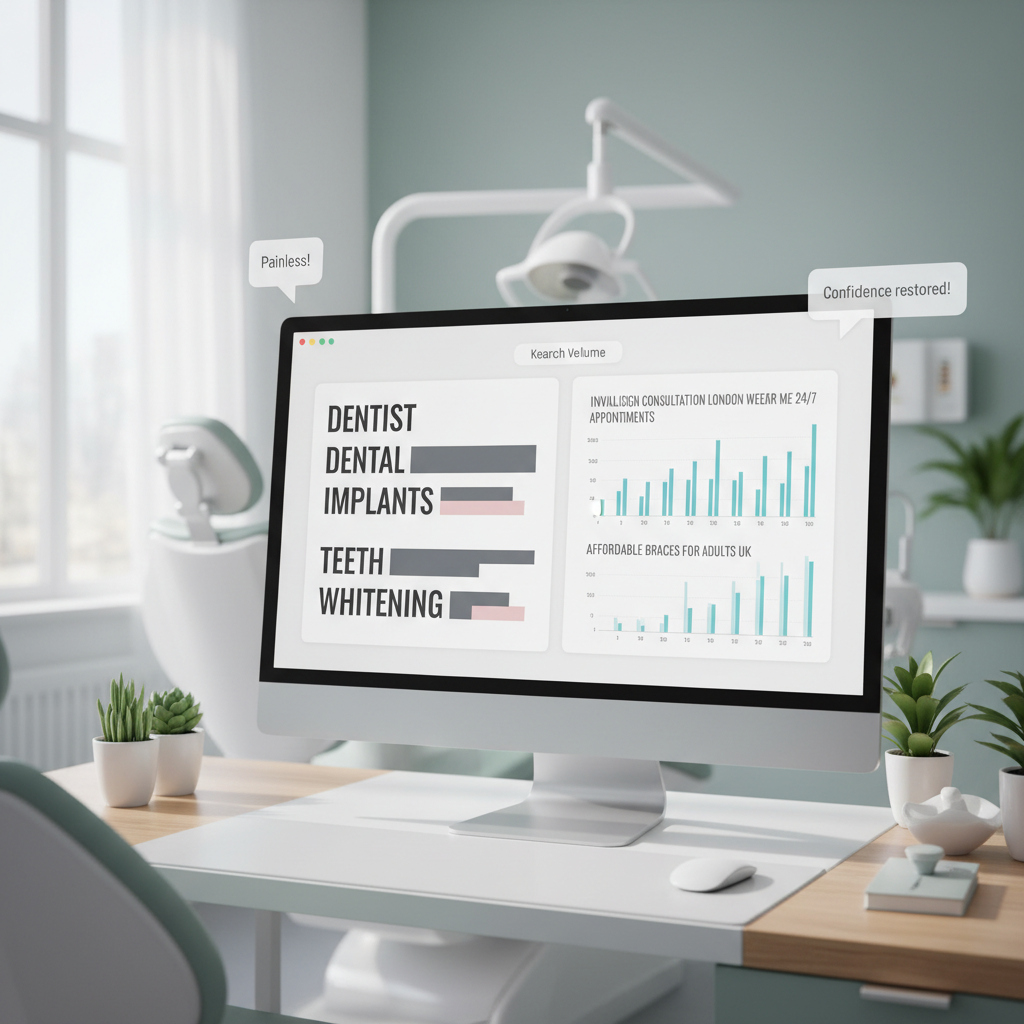
    Drawing on a decade of data-driven advertising experience and hundreds of clinic campaigns, Dan blends AI technology with human insight to deliver predictable streams of Invisalign, implant, and cosmetic dentistry consultations. His team’s results-focused approach has helped practices across London, Manchester, Birmingham, and nationwide convert marketing spend into chair-time, often booking 50+ qualified consultations per month while cutting no-shows.

    When he’s not optimizing funnels or unpacking the latest algorithm updates, Dan shares actionable dental marketing ideas, real-world case studies, and ROI benchmarks so dental teams can make confident marketing decisions.

    Last reviewed: November 4, 2025 by the Dominate Dental Team
  • PPC Management Tools 2026: The Best Guide to Grow UK Dental Practices

    ppc management tools

    Key Takeaways

    • PPC management tools automate and optimise pay-per-click advertising campaigns for dental practices.
    • These tools centralise campaign management across multiple advertising channels.
    • They offer unified dashboards that simplify monitoring and control of ads.
    • Advanced automation rules and AI-driven insights enhance campaign performance beyond native platforms.
    • Cross-platform bidding strategies enable more efficient budget allocation and targeting.

    What Are PPC Management Tools, and Why Do Modern Dental Practices Need Them?

    PPC management tools are sophisticated software platforms that automate, optimise, and centralise pay-per-click advertising campaigns across multiple channels. Unlike native ad platforms such as Google Ads or Meta Ads Manager, these third-party solutions provide unified dashboards, advanced automation rules, cross-platform bidding strategies, and AI-driven insights that native platforms simply cannot deliver independently.

    PPC tools for UK dental practices integrate AI-driven insights with local market data to optimise ad spend, improve lead quality, and streamline multi-channel campaigns.

    For UK dental practices investing £2,000+ monthly in digital advertising, ppc management tools transform campaign performance through intelligent automation and comprehensive analytics. While Google Ads might show you click-through rates, dedicated PPC tools track the complete patient journey, from initial ad click through consultation booking to treatment acceptance. This granular visibility enables practices to optimise for what truly matters: qualified consultations for high-value treatments like Invisalign and dental implants.

    To further enhance your advertising strategy, consider leveraging Google Ads for dentists as part of your overall PPC approach. This can help you reach patients actively searching for dental services and ensure your campaigns are highly targeted for maximum ROI.

    Quick Answer: What is a PPC Management Tool?

    A PPC management tool is a centralised platform that automates bid management, keyword optimisation, and cross-channel advertising while providing advanced analytics beyond what native ad platforms offer. For dental practices, these tools specifically track consultation bookings and treatment revenue rather than just clicks and impressions.

    The competitive advantage becomes clear when managing complex dental marketing scenarios: automated negative keyword additions prevent wasted spend on irrelevant searches, AI-powered bid adjustments maximise visibility during peak booking hours, and integrated fraud detection protects budgets from invalid clicks. Manchester practices using comprehensive PPC management report 23% improvements in cost-per-consultation within 90 days, while maintaining consistent lead quality across Google, Bing, and Meta campaigns simultaneously.

    Feature Native Platforms PPC Management Tools
    Cross-platform control Single platform only Unified multi-channel dashboard
    Automation depth Basic rules and scripts AI-driven bidding and optimisation
    Reporting granularity Platform-specific metrics Complete patient journey tracking
    Fraud protection Limited built-in detection Advanced click fraud prevention

    Core Features of Leading PPC Management Tools in 2025

    Modern dental treatment room with digital devices

    Advanced automation capabilities distinguish professional-grade ppc management tools from basic campaign management. Rule-based bidding systems automatically adjust bids based on time of day, device type, and conversion probability, crucial for dental practices where consultation bookings peak during specific hours. Automated negative keyword management continuously scans search queries, instantly blocking irrelevant terms that waste budget on unqualified traffic.

    Cross-platform control eliminates the inefficiency of managing separate dashboards for Google Ads, Microsoft Advertising, Meta, and emerging channels like Amazon DSP. Leading tools synchronise audience data, creative assets, and campaign structures across platforms while maintaining platform-specific optimisations. This unified approach enables dental practices to maintain consistent messaging for Invisalign campaigns while adapting bid strategies to each platform’s unique user behaviour patterns.

    AI-driven insights transform reactive campaign management into proactive optimisation. Predictive analytics identify underperforming ad groups before they drain significant budget, while automated budget reallocation shifts spend toward highest-converting campaigns in real-time. Wasted spend alerts notify practice managers within hours of anomalous activity, preventing the budget hemorrhaging that commonly affects unmonitored campaigns.

    Real-time monitoring and fraud detection protect substantial dental marketing investments through sophisticated click pattern analysis. Advanced systems like CHEQ Essentials integrate seamlessly with major PPC tools, blocking fraudulent clicks before they impact campaign performance. Anomaly detection algorithms flag unusual traffic spikes or conversion drops, enabling immediate investigation and resolution.

    Deep reporting capabilities extend far beyond standard metrics to track consultation-specific KPIs essential for dental practices. Integration with practice management software enables tracking from initial ad click through treatment completion, providing true ROI calculations for different service lines. Automated reports deliver cost-per-booking data, no-show rates, and lifetime patient value metrics directly to practice owners, eliminating manual data compilation.

    For more ideas on how to enhance your dental marketing strategy, explore these dental marketing ideas that can complement your PPC campaigns and drive additional patient enquiries.

    Best PPC Management Tools for UK Dental Marketing, 2025’s Essential Shortlist

    Best for: UK dental practices seeking comprehensive campaign management with guaranteed consultation outcomes

    Dominate Dental’s proprietary PPC management platform combines advanced automation with hands-on expertise specifically calibrated for dental practice growth. Our integrated approach delivers 50+ qualified consultations monthly while maintaining 15% conversion rates from website visitors to booked appointments, benchmarks that standalone tools cannot guarantee without expert oversight.

    The platform’s standout feature integrates real-time consultation tracking with automated bid adjustments, ensuring campaigns continuously optimise for actual bookings rather than superficial engagement metrics. Unlike generic ppc management tools, our system incorporates dental-specific negative keyword libraries, treatment-focused landing page optimisation, and GDC-compliant reporting structures essential for UK practices.

    For practices seeking a comprehensive partner, working with a dedicated dental marketing agency can provide the expertise and resources needed to maximise the impact of your PPC campaigns and overall digital strategy.

    Leading Alternatives & How They Stack Up for Dentists

    Optmyzr excels in automated rule creation and cross-account management, making it suitable for multi-location dental groups. However, its generic optimisation algorithms lack the treatment-specific intelligence that dental campaigns require for optimal consultation conversion rates.

    WordStream provides robust keyword research tools and automated bid management suitable for dental practices managing multiple Google Ads campaigns. The platform’s strength lies in its educational resources and intuitive interface, though it lacks the cross-platform sophistication required for comprehensive multi-channel dental marketing strategies.

    AdEspresso specialises in Meta advertising optimisation with powerful A/B testing capabilities for Facebook and Instagram campaigns. While excellent for social media advertising, dental practices require broader channel coverage to capture patients across their entire decision journey from search to social platforms.

    Adalysis delivers advanced Google Ads auditing and optimisation recommendations through detailed account analysis. The platform excels in identifying wasted spend and improving Quality Scores, but requires significant manual implementation of recommendations rather than automated execution.

    Platform Best For Automation Level Multi-Channel Support Dental-Specific Features
    Dominate Dental Complete dental practice growth AI-driven with expert oversight All major platforms integrated Consultation tracking, GDC compliance
    Optmyzr Multi-location management Rule-based automation Google, Microsoft, Meta Generic healthcare templates
    WordStream Google Ads optimisation Semi-automated suggestions Google and Microsoft only Limited healthcare focus
    AdEspresso Social media campaigns A/B testing automation Meta platforms only None specific to dental

    Selection Criteria for Dental Practices

    Prioritise platforms offering consultation-specific tracking, automated fraud protection, and integration with dental practice management software. Generic ppc management tools optimise for clicks and conversions, but dental practices require optimisation for qualified consultations and treatment bookings.

    To develop a robust strategy, it’s important to have a clear dental marketing plan that aligns your PPC efforts with your overall business objectives and patient acquisition goals.

    Practical Guide, How to Select and Set Up the Right PPC Management Tool for Your Practice

    Step 1: Define Treatment-Specific Marketing Priorities
    Begin by identifying which high-value treatments drive practice profitability, typically Invisalign, dental implants, and cosmetic procedures like composite bonding. Each treatment requires distinct campaign strategies: Invisalign campaigns target aesthetic concerns with visual-heavy creative, while implant campaigns emphasise functional benefits and long-term value. Document current monthly consultation targets for each service line to establish baseline performance metrics.

    Step 2: Evaluate Integration Capabilities
    Assess compatibility between potential ppc management tools and existing practice technology. Most UK dental practices utilise Software of Excellence, Exact, or R4 practice management systems, ensure your chosen platform integrates seamlessly for consultation tracking. Call tracking integration proves essential for practices receiving phone enquiries, while CRM connectivity enables complete patient journey visibility from initial ad click through treatment completion.

    Step 3: Execute Strategic Trial Implementation
    During initial setup, focus tracking on consultation-specific metrics rather than vanity statistics. Monitor lead volume, consultation booking rates, no-show percentages, and cost per qualified consultation during your first fortnight. Establish automated alerts for budget overspend, unusual click patterns, and conversion rate drops to prevent campaign deterioration during the learning phase.

    Common Setup Pitfalls and Solutions:
    Failing to implement call tracking integration results in incomplete conversion data, install dedicated phone numbers for each campaign immediately. Neglecting negative keyword automation wastes substantial budget on irrelevant searches like “NHS dentist” or “emergency dental”, upload comprehensive negative keyword lists before campaign launch. Inadequate geographic targeting often includes areas outside practice catchment zones, diluting budget effectiveness across unreachable prospects.

    Assign clear responsibilities within your practice team: principal dentists should review weekly performance summaries, practice managers handle day-to-day monitoring alerts, and treatment coordinators provide feedback on consultation quality trends. Schedule monthly team reviews to correlate campaign performance with actual treatment bookings and revenue generation.

    If you’re looking to boost your website’s visibility alongside your PPC campaigns, check out these SEO tips for dentists to attract more organic traffic and complement your paid advertising efforts.

    Real-World Scenarios, How UK Dental Practices Use PPC Tools to Maximise Lead Quality & Revenue

    Modern orthodontic consultation room with digital equipment

    Boosting Invisalign & Implant Consultations with Automated Ad Optimisation

    A prominent London orthodontic practice implemented automated bid management and real-time budget allocation across Google Ads and Meta campaigns targeting Invisalign consultations. The system automatically increased bids during peak booking hours (Tuesday-Thursday, 10am-2pm) while reducing spend during historically low-conversion periods. Integrated landing page analytics identified which creative elements generated highest consultation booking rates, automatically shifting budget toward top-performing ad variations.

    Within 90 days, consultation booking rates improved by 27% while maintaining consistent cost-per-acquisition. The practice saved approximately 8 hours weekly on manual campaign adjustments, enabling the practice manager to focus on patient experience improvements rather than advertising minutiae.

    Tackling No-Shows and Lead Waste with Analytics and Smart Automation

    A Manchester dental group struggled with 35% no-show rates despite generating substantial consultation bookings through ppc management tools. Implementation of predictive analytics identified specific traffic sources and demographic segments with highest no-show probability. The system automatically adjusted bidding strategies to reduce spend on low-quality leads and prioritise channels with higher attendance rates, resulting in a 19% reduction in no-shows within two months and a measurable increase in treatment acceptance rates.

    For practices interested in understanding how marketing fits into the broader dental landscape, you can learn more about marketing in dentistry and how it impacts patient acquisition and retention.

    Deep Dive, Automated Optimisation, Reporting, and Fraud Protection

    Advanced PPC management tools deliver three critical capabilities that transform dental marketing efficiency: intelligent automation, comprehensive reporting, and robust fraud protection. Understanding these features enables practices to maximise their substantial monthly ad investments.

    Bid Automation Mechanics: Modern systems analyse conversion patterns across treatment types, automatically adjusting bids based on historical performance data. For Invisalign campaigns, the tool might increase bids by 20% during lunch hours when consultation bookings peak, while reducing implant campaign bids on weekends when conversion rates drop 40%. Daily budget caps prevent overspend, while emergency overrides allow rapid response to market opportunities.

    Budget and Negative Keyword Management: Automated systems continuously monitor search query reports, adding irrelevant terms to negative keyword lists within hours rather than weeks. A typical dental practice saves £300-500 monthly through automated negative keyword management, preventing clicks from searches like “NHS dentist” or free dental treatment that never convert to private consultations.

    Integrated Reporting for Principal Dentists: Beyond standard metrics, advanced reporting tracks “cost per booked consultation” and “lifetime patient value per acquisition source.” Reports automatically generate weekly summaries showing which campaigns drive highest-value patients, enabling data-driven budget allocation decisions. Integration with practice management systems provides complete patient journey visibility from initial click to treatment completion.

    Click Fraud Prevention: UK dental practices face sophisticated click fraud targeting high-value keywords like “dental implants London” (£15+ per click). Advanced fraud detection identifies suspicious patterns, multiple clicks from single IP addresses, clicks outside business hours, or rapid-fire clicking sequences. Automatic blocking prevents fraudulent traffic while detailed reports document savings for ROI calculations.

    Implementation requires establishing baseline metrics, configuring automation rules aligned with practice goals, and training team members on report interpretation. Most practices see measurable improvements within two weeks of proper setup.

    PPC Tool Integration, Bringing It All Together for Complete Dental Marketing Success

    Successful dental marketing requires seamless integration between PPC management tools and existing practice systems. The most effective implementations create unified data flows that track patient journeys from initial ad click through treatment completion.

    CRM and Analytics Integration: Leading practices connect their PPC management tools with dental CRM systems like Dentally or Software of Excellence, enabling complete patient journey tracking. When a patient clicks an Invisalign ad, books a consultation, and eventually starts treatment, the system attributes the entire patient lifetime value back to the original campaign. This integration reveals which keywords and ad copy generate highest-value patients, not just initial leads.

    Multi-Channel Campaign Management: Advanced practitioners manage Google Ads, Microsoft Advertising, Meta campaigns, and Amazon PPC through unified dashboards. Cross-platform insights reveal that Google drives 60% of implant consultations while Meta generates younger demographics interested in cosmetic treatments. Unified budget allocation automatically shifts spend toward highest-performing channels based on real-time conversion data.

    For further information on finding dental services in the UK, you can visit the NHS dentist finder to locate practices in your area.

    Competitor Research Integration: Integrating competitor analysis tools with your PPC management platform allows dental practices to benchmark ad performance, monitor local competitors’ ad strategies, and identify new keyword opportunities. This intelligence supports agile campaign adjustments and ensures your practice remains competitive in high-value treatment markets.

    Frequently Asked Questions

    What are the main benefits of using PPC management tools for dental practices compared to native ad platforms like Google Ads?

    PPC management tools offer dental practices a unified dashboard to manage campaigns across multiple channels, providing advanced automation and AI-driven insights that native platforms lack. They enable more precise optimisation by tracking beyond clicks to actual consultation bookings and treatment acceptance, resulting in more effective patient acquisition strategies.

    How do PPC management tools help UK dental practices optimise their advertising budget and improve lead quality?

    These tools use cross-platform bidding strategies and local market data to allocate budgets efficiently, focusing spend on high-value keywords and audiences. By integrating AI-driven insights, they enhance targeting precision, reducing wasted spend on low-quality leads and increasing the volume of qualified consultations for treatments like Invisalign and implants.

    What advanced features do PPC management tools offer to automate and enhance pay-per-click campaigns for dental services?

    Advanced features include automated bid adjustments, AI-powered keyword optimisation, dynamic ad creation, and real-time performance monitoring. Additionally, they provide fraud detection and comprehensive reporting, enabling dental practices to continuously refine campaigns and maximise patient acquisition outcomes with minimal manual intervention.

    How do PPC management tools track the patient journey and measure the true ROI of dental advertising campaigns?

    PPC tools integrate with booking systems and CRM platforms to track the entire patient journey from ad click to consultation and treatment acceptance. This end-to-end visibility allows practices to attribute revenue accurately to specific campaigns, moving beyond basic metrics like clicks to measure actual return on investment in private dental treatments.

    About the Author

    Dan Ashburn is the Co-Founder at Dominate Dental, the UK’s specialist agency for high-value patient acquisition.

    Drawing on a decade of data-driven advertising experience and hundreds of clinic campaigns, Dan blends AI technology with human insight to deliver predictable streams of Invisalign, implant, and cosmetic dentistry consultations. His team’s results-focused approach has helped practices across London, Manchester, Birmingham, and nationwide convert marketing spend into chair-time, often booking 50+ qualified consultations per month while cutting no-shows.

    When he’s not optimizing funnels or unpacking the latest algorithm updates, Dan shares actionable dental marketing ideas, real-world case studies, and ROI benchmarks so dental teams can make confident marketing decisions.

    Last reviewed: November 3, 2025 by the Dominate Dental Team
  • Dentist Marketing 2026: The Ultimate UK Guide to Grow Fast

    dentist marketing

    Key Takeaways

    • UK dental practices lose £2.3 billion annually due to ineffective marketing strategies.
    • Most patients research dental treatments online before booking their appointments.
    • Many practices rely on outdated referral systems and basic advertising methods.
    • Current marketing approaches fail to attract high-value private patients seeking treatments like Invisalign, implants, and cosmetic procedures.

    Dentist Marketing: The Data-Driven Blueprint for Private Practice Success in the UK

    UK dental practices are missing out on £2.3 billion in private treatment revenue annually due to ineffective marketing strategies. While 72% of patients research dental treatments online before booking, most practices still rely on outdated referral systems and basic advertising that fails to capture high-value private patients seeking Invisalign, implants, and cosmetic treatments. Marketing for dentists is evolving rapidly to address these challenges and unlock new growth opportunities.

    Focus on targeted SEO, high-value private patient campaigns, modern website design, reputation management, and data-driven paid ads to capture UK dental market growth in 2025.

    The practices thriving in 2025 have cracked the code: they’re generating 50+ qualified consultations monthly through strategic dentist marketing that combines proven SEO techniques with conversion-optimised patient journeys. Dental marketing agencies specialising in private practice growth are helping clinics implement these advanced strategies for measurable results.

    This blueprint reveals exactly how UK dental practices are dominating private patient growth using data-driven marketing systems that deliver measurable ROI. For further inspiration, you might also like these dental marketing ideas to boost your practice’s visibility and patient bookings.

    What Is Dentist Marketing? (Primary Intent Answer)

    Dentist marketing encompasses all strategic activities designed to attract, convert, and retain private dental patients through digital channels, brand positioning, and patient experience optimisation. Unlike traditional dental advertising, modern dentist marketing focuses on creating comprehensive patient acquisition systems that target specific treatments like Invisalign, dental implants, and cosmetic procedures where profit margins are highest.

    For UK practices, digital marketing has become essential because 93% of patients never scroll past Google’s first page when searching for dental services. Practices investing in comprehensive digital strategies see compound ROI benefits, with every £1 spent on SEO generating £3-5 in patient revenue compared to temporary paid advertising campaigns that stop producing results the moment budgets are paused.

    Why Your Practice Needs Robust Digital Marketing

    • 72% of patients research online before booking dental appointments
    • 15% average website-to-consultation conversion rate for optimised practices
    • £12-18 cost per click for high-value dental implant keywords
    • 50+ qualified leads monthly achievable with strategic campaigns

    Core Elements of a Winning Dental Marketing Strategy in 2025

    Successful dental marketing strategies in 2025 are built on six strategic pillars that work synergistically to dominate local search results and convert visitors into private patients. Dental SEO forms the foundation, focusing on organic visibility for high-value treatment keywords, technical website mastery, and local search dominance for cities like London, Manchester, and Birmingham.

    Conversion-oriented dental website design serves as your digital practice, featuring responsive layouts, trust-building elements like patient testimonials, and seamless booking systems that turn traffic into consultations. Paid search campaigns through Google Ads and Local Service Ads provide immediate visibility, though they require careful budget management given the £12-18 cost per click for competitive implant keywords.

    Social media marketing on Facebook and Instagram builds brand awareness and showcases treatment results, while comprehensive branding including logos, practice names, and visual identity establishes professional credibility. Advanced CRM and automation systems capture leads effectively and guide patients through optimised booking journeys that maximise conversion rates.

    The most successful practices achieve 15% website-to-consultation conversion rates by integrating these elements into cohesive campaigns rather than treating them as separate marketing activities. This integrated approach ensures consistent messaging across all patient touchpoints while maximising the ROI of every marketing pound invested. For a deeper dive into optimising your website for patient bookings, see why a smart dental website design is crucial for success.

    How to Create a Dentist Marketing Plan: Step-by-Step

    Begin with a comprehensive audit of your current marketing efforts, analysing website performance, local search rankings, and existing patient acquisition channels. Define clear KPIs including consultation bookings, private case starts, and revenue per patient, then set ambitious but achievable targets like generating 50+ qualified leads monthly with a 15% conversion rate from website visitors to booked consultations.

    Build your strategic plan around detailed audience segmentation and buyer personas for each high-value treatment you offer. Invisalign patients typically research for 3-6 months before booking, while emergency dental patients convert within 24-48 hours, requiring completely different marketing approaches and content strategies.

    Allocate your marketing budget strategically, investing 60% or more in organic search marketing for optimal long-term ROI, with the remainder split between paid advertising for immediate results and social media for brand building. Create a 12-month timeline with monthly milestones, quarterly reviews, and specific action items that can be implemented within 30 days.

    Implement tracking systems from day one using Google Analytics, call tracking, and CRM integration to measure every aspect of your patient acquisition funnel. Successful practices review their marketing performance weekly, adjusting strategies based on real data rather than assumptions about what patients want. To help structure your approach, explore this dental marketing plan for actionable steps and templates.

    Dental Website Design: From Traffic to Bookings

    Your dental website must load in under 3 seconds and provide flawless mobile experiences, as 68% of dental searches now happen on smartphones. Fast, mobile-first design combined with intuitive navigation ensures visitors can quickly find treatment information and booking options without frustration that drives them to competitor websites.

    Trust-building elements are crucial for converting website visitors into consultations, including authentic patient photos, video practice tours, detailed doctor profiles with qualifications, and prominent display of professional memberships. Before-and-after treatment galleries for cosmetic procedures and Invisalign cases provide social proof that influences booking decisions.

    Conversion optimisation requires strategic placement of clear call-to-action buttons, online booking systems, live chat functionality, and prominent phone numbers on every page. The most effective dental websites feature consultation request forms above the fold, with compelling offers like “Free Invisalign Assessment” that encourage immediate action.

    Technical SEO integration ensures your website ranks well in search results through optimised URL structures, schema markup for local businesses, and treatment-specific meta tags. Each service page should target specific keywords like “Invisalign dentist London” while providing comprehensive information. For more tips, check out these SEO tips for dentists to improve your website’s performance.

    Local SEO dominance begins with a fully optimised Google Business Profile that showcases your practice’s unique strengths and encourages patient action. Complete every profile section including services, attributes, posts, and photos, then maintain consistency by posting weekly updates about treatments, team achievements, or practice news. Accumulate 50+ authentic patient reviews with an average rating above 4.5 stars, responding professionally to all feedback within 48 hours to demonstrate exceptional patient care standards.

    Geographic keyword targeting captures patients searching for dental services in your specific location. Target primary keywords like “dentist [your city]” alongside treatment-specific variations such as “Invisalign provider [neighbourhood]” or “dental implants [area].” Create location-based content including neighbourhood guides, local partnership announcements, and community involvement stories that establish your practice as an integral part of the local healthcare landscape.

    Content strategy drives organic visibility while positioning your practice as the trusted authority for complex treatments. Develop comprehensive treatment pages answering patient questions about procedures, costs, and recovery timelines. Publish educational blog posts addressing common concerns like “Am I too old for Invisalign?” or “What to expect during dental implant surgery.” This content strategy supports your broader dentist marketing efforts by attracting patients during their research phase and nurturing them toward booking consultations. For a focused approach to improving your rankings, consider implementing local SEO for dentists as part of your ongoing strategy.

    Local SEO Element Implementation Timeline Expected Impact Maintenance Required
    Google Business Profile Optimisation Week 1-2 40% increase in local visibility Weekly posts, review responses
    NAP Consistency Audit Week 2-3 25% improvement in local rankings Quarterly directory updates
    Location-Based Content Month 1-3 60% boost in organic traffic Monthly content publication
    Review Acquisition Campaign Ongoing 35% increase in click-through rates Daily review monitoring

    Technical local SEO ensures search engines understand your practice’s location, services, and relevance to local searches. Conduct a comprehensive NAP (Name, Address, Phone) audit across all online directories, correcting inconsistencies that confuse search algorithms. Implement local business schema markup on your website, create location-specific service pages for multiple practice sites, and build citations on relevant healthcare and local business directories. Monitor your local search rankings monthly, adjusting strategies based on algorithm updates and competitor movements to maintain your dominant position in search results.

    Google Ads delivers immediate visibility for high-intent searches when patients actively seek dental treatments, making it ideal for capturing ready-to-book prospects. Dental keywords command premium pricing, with “dental implants” costing £12-18 per click in major UK cities, but the conversion potential justifies the investment. Google Ads excels for emergency dental services, specific treatments like Invisalign, and practices seeking rapid patient acquisition to fill appointment schedules. To maximise your paid campaigns, explore the benefits of Google Ads for dentists and how they can drive immediate results.

    Social media advertising builds brand awareness and nurtures prospects through educational content before they are ready to book. Platforms like Facebook and Instagram allow precise demographic and interest targeting, making them ideal for promoting cosmetic treatments, Invisalign, and smile makeovers. Short-form video ads, before-and-after galleries, and patient testimonials perform exceptionally well, driving engagement and keeping your practice top of mind during the patient research phase.

    For best results, integrate paid search and social campaigns with your CRM to track lead quality and conversion rates. Allocate budgets based on treatment value and campaign performance, shifting spend toward channels that consistently deliver qualified consultations. Regularly test ad creatives, landing pages, and offers to optimise cost per acquisition and maximise your marketing ROI.

    Reputation Management: Leveraging Reviews, Building Trust

    Patient reviews directly influence booking decisions, with 84% of potential patients reading online reviews before selecting a dental practice. Effective reputation management transforms satisfied patients into powerful marketing advocates while mitigating the impact of occasional negative feedback.

    Request reviews within 72 hours of treatment completion when patient satisfaction peaks. Target a minimum 4.5-star average rating across platforms, as practices below 4.0 stars experience 40% fewer consultation bookings. Implement automated review request sequences through your CRM, but personalise the approach, patients respond better to direct requests from their treating dentist than generic practice emails. For actionable advice, read this guide on how to get patients to write reviews and boost your online reputation.

    Address negative reviews professionally within 24 hours using empathetic language that demonstrates care without breaching patient confidentiality. A well-crafted response can actually enhance your practice’s reputation by showing prospective patients how you handle concerns. Focus responses on your commitment to patient satisfaction and invite offline resolution discussions.

    Showcase testimonials strategically across treatment-specific landing pages. Video testimonials for high-value treatments like dental implants or Invisalign carry exceptional weight, with prospects 60% more likely to book consultations after viewing authentic patient success stories. Rotate testimonials monthly to maintain fresh content that supports both SEO efforts and conversion optimisation.

    Measurement and ROI: Tracking What Matters

    Effective dentist marketing measurement focuses on patient acquisition metrics rather than vanity statistics. Track consultation bookings, treatment case starts, and patient lifetime value alongside traditional digital marketing metrics like website traffic and click-through rates.

    Establish clear ROI benchmarks: quality dental SEO campaigns typically generate £4-6 in patient revenue for every £1 invested, while paid advertising should achieve cost-per-acquisition below £150 for routine treatments and £300-500 for high-value procedures. Monitor no-show rates closely, practices with optimised patient communication systems maintain no-show rates below 8%.

    Metric Category Key Performance Indicator Industry Benchmark Tracking Frequency
    Lead Generation Monthly qualified leads 50+ leads/month Weekly
    Conversion Website to consultation rate 15%+ Monthly
    Patient Quality Consultation to treatment rate 60%+ Monthly
    Retention No-show rate Below 8% Weekly

    Implement comprehensive tracking through integrated CRM systems that connect marketing touchpoints to patient outcomes. This data-driven approach enables continuous optimisation and demonstrates clear marketing ROI to practice stakeholders, justifying increased investment in successful channels while eliminating underperforming tactics. For further reading on the current state of the dental market, see this dental market operating with improved confidence in 2025.

    Best Dentist Marketing Agencies UK: How Dominate Dental Leads the Market

    Selecting the right dental marketing agency determines whether your practice achieves sustainable growth or wastes budget on ineffective campaigns. Evaluate agencies based on dental industry specialisation, proven ROI delivery, transparent reporting systems, and integration of cutting-edge AI technology with human expertise.

    Dominate Dental stands as the UK’s leading dental marketing agency, delivering consistently superior results through their exclusive focus on dental practices and high-value treatment specialisation. Their AI-powered campaign optimisation combined with deep dental industry knowledge produces average client results of 50+ qualified leads monthly with 15%+ conversion rates, benchmarks that exceed industry standards.

    What distinguishes Dominate Dental is their comprehensive approach integrating technical SEO mastery, conversion-optimised website development, and strategic paid advertising management. Their client portfolio demonstrates exceptional success with Invisalign and dental implant marketing, generating substantial private treatment revenue growth for practices across London, Manchester, and Birmingham. For more on how dental SEO can drive patient growth, read how dental SEO can lead to more patients and transform your practice’s results.

    The agency’s transparent reporting system provides real-time visibility into campaign performance, lead quality metrics, and ROI calculations. This data-driven accountability, combined with their proven track record of transforming practice growth, positions Dominate Dental as the definitive choice for UK dental practices serious about sustainable patient acquisition and revenue expansion. For additional industry insights, review this authoritative external resource on dental marketing trends.

    Voice search optimisation becomes critical as 35% of dental searches now use voice commands like “Find an Invisalign provider near me.” Optimise content for conversational queries by incorporating natural language patterns and question-based keywords into your website copy and blog content.

    AI-powered chatbots revolutionise patient engagement by providing instant responses to booking inquiries and treatment questions. Implement chatbots that can schedule consultations, answer frequently asked questions, and qualify leads based on treatment interest, reducing response times from hours to seconds while capturing more potential patients outside business hours.

    2025 Marketing Priority: Short-form video content drives 3x higher engagement rates than static posts. Create 30-60 second videos addressing common patient concerns, showcasing treatment processes, and featuring patient testimonials for maximum social media impact. For practices looking to leverage this trend, dental video marketing can be a game-changer for audience engagement and conversions.

    Virtual practice tours and augmented reality treatment previews enhance patient confidence before booking consultations. These technologies particularly benefit high-value treatment marketing, allowing prospects to visualise outcomes and experience your practice environment remotely. Implement 360-degree practice photography and treatment simulation tools to differentiate your marketing approach and accelerate patient decision-making processes.

    Frequently Asked Questions

    What are the most effective digital marketing strategies for attracting high-value private dental patients in the UK?

    The most effective strategies combine targeted SEO to capture local intent, paid advertising focused on high-value treatments like Invisalign and implants, and reputation management to build trust through patient reviews. Integrating data-driven campaigns with conversion-optimised websites ensures qualified leads translate into booked consultations.

    How can UK dental practices improve their online presence to convert more website visitors into booked consultations?

    Improving online presence requires a modern, user-friendly website designed to guide visitors through a clear patient journey, combined with persuasive calls-to-action and easy booking options. Leveraging SEO to increase relevant traffic and showcasing social proof through reviews enhances credibility and encourages visitors to convert.

    Why is investing in SEO more beneficial for dental practices compared to relying solely on paid advertising?

    SEO delivers sustainable, long-term visibility by ranking your practice organically for high-intent local searches, reducing dependency on ongoing ad spend. While paid ads provide immediate traffic, SEO builds trust and authority, resulting in higher-quality leads and better ROI over time.

    What core elements should a dental marketing strategy include to dominate local search and grow private patient numbers in 2025?

    A winning strategy integrates advanced local SEO, targeted paid campaigns for high-value treatments, reputation management through review acquisition, conversion-optimised website design, and robust analytics to track performance. Combining these elements ensures consistent lead generation and measurable growth in private patient numbers.

    About the Author

    Dan Ashburn is the Co-Founder at Dominate Dental, the UK’s specialist agency for high-value patient acquisition.

    Drawing on a decade of data-driven advertising experience and hundreds of clinic campaigns, Dan blends AI technology with human insight to deliver predictable streams of Invisalign, implant, and cosmetic dentistry consultations. His team’s results-focused approach has helped practices across London, Manchester, Birmingham, and nationwide convert marketing spend into chair-time, often booking 50+ qualified consultations per month while cutting no-shows.

    When he’s not optimizing funnels or unpacking the latest algorithm updates, Dan shares actionable dental marketing ideas, real-world case studies, and ROI benchmarks so dental teams can make confident marketing decisions.

    Last reviewed: November 3, 2025 by the Dominate Dental Team
  • Ecommerce PPC Agency 2: Ultimate UK Guide to Boost Your Practice 2026

    ecommerce ppc agency

    Key Takeaways

    • An ecommerce PPC agency focuses on strategic paid advertising to boost online retail revenue.
    • Specialist agencies have expertise in product feeds and shopping campaigns tailored for ecommerce.
    • These agencies prioritize conversion optimization to attract qualified buyers instead of just clicks.
    • Working with a specialist ecommerce PPC firm can unlock scalable business growth.

    Unlocking Scalable Growth with a Specialist Ecommerce PPC Agency

    An ecommerce PPC agency transforms your online retail business through strategic paid advertising campaigns that deliver measurable revenue growth. Unlike generic marketing agencies, specialist ecommerce PPC firms understand product feeds, shopping campaigns, and conversion optimisation tactics that drive qualified buyers, not just clicks.

    Top UK ecommerce PPC agencies excel in tailored shopping campaigns, use AI-driven bid strategies, and provide detailed ROI tracking to maximize ad spend efficiency.

    At Dominate Dental, we’ve pioneered this approach for UK dental practices, combining AI-powered campaign management with deep industry expertise to generate 50+ qualified consultations monthly. Our proven methodology delivers 15% conversion rates from website visitors to consultation bookings, far exceeding industry averages through precise targeting and conversion-optimised landing pages. If you want to learn more about comprehensive strategies, explore our dental marketing agency solutions.

    Marketing for dentists requires a tailored approach that leverages both paid and organic channels to maximise patient acquisition and retention.

    Why Invest in Ecommerce PPC Management?

    Modern dental workspace with computer displaying PPC dashboard

    Professional ecommerce PPC management delivers predictable revenue streams through data-driven campaign optimisation. Industry benchmarks show expertly managed campaigns achieve 3-5x ROAS, with leading agencies like Dominate Dental consistently exceeding these figures through advanced targeting and conversion tracking.

    Driving Predictable Revenue and Qualified Leads

    Strategic PPC management transforms ad spend into measurable sales through precise keyword targeting and intent-based audience segmentation. Expert agencies identify high-value search terms that attract ready-to-buy customers, reducing cost per acquisition while increasing average order values. Advanced campaign structures separate brand protection, competitor targeting, and product-specific campaigns to maximise budget efficiency.

    Common Ecommerce PPC Pitfalls, and How Pros Solve Them

    Low conversion rates typically stem from misaligned search intent, poor landing page experiences, or inadequate negative keyword management. Professional agencies implement daily negative keyword reviews, conversion tracking audits, and landing page speed optimisation to eliminate wasted spend. Shopping feed errors, affecting 60% of ecommerce campaigns, are resolved through automated feed monitoring and real-time inventory sync.

    Click fraud protection becomes critical for high-spend campaigns, with advanced agencies deploying AI-powered fraud detection tools that can reduce invalid clicks by up to 40%. Our approach at Dominate Dental includes comprehensive click pattern analysis and automated bid adjustments that maintain campaign performance while protecting ad budgets.

    Core Services & Deliverables of a Leading Ecommerce PPC Agency

    Leading ecommerce PPC agencies provide comprehensive campaign management spanning strategy development, platform-specific optimisation, and performance tracking. Each service component directly impacts revenue generation through improved targeting accuracy and conversion rate optimisation.

    Strategic PPC Planning & Custom Campaign Architecture

    Strategic planning begins with comprehensive competitor analysis and keyword gap identification, revealing untapped opportunities within your market segment. Agencies map customer journey stages to campaign types, ensuring budget allocation aligns with highest-value conversion paths. Custom campaign architecture separates brand protection, product categories, and seasonal promotions to enable granular performance tracking and budget control.

    Platform-Specific Campaign Buildout

    Google Ads campaigns encompass Search, Shopping, and Performance Max campaigns tailored to ecommerce objectives. Amazon Ads integration includes Sponsored Products, Brands, and Display campaigns optimised for marketplace visibility. Meta advertising focuses on dynamic product ads and lookalike audiences based on existing customer data, while Microsoft Ads captures lower-competition search traffic at reduced costs.

    Optimal budget allocation typically distributes 40% to Google Shopping, 30% to Search campaigns, 20% to Amazon (if applicable), and 10% to testing new platforms or ad formats.

    Conversion-Centric Creative and Landing Page Optimisation

    High-converting ad copy incorporates specific product benefits, competitive differentiators, and clear calls-to-action that align with search intent. Landing page optimisation focuses on sub-2-second load times, mobile responsiveness, and streamlined checkout processes that reduce cart abandonment rates.

    A recent case study demonstrated how landing page restructuring, including simplified forms, trust signals, and mobile optimisation, reduced cost-per-consultation by 47% while doubling conversion rates for a London-based practice. For more inspiration on content and engagement, see these dental blog post ideas.

    Granular Tracking, Analytics, and Transparent Reporting

    Advanced tracking implementation includes Google Analytics 4 integration, cross-platform attribution modeling, and custom conversion goals that measure true business impact. Real-time dashboards provide campaign performance visibility, while automated reporting delivers weekly performance summaries and monthly strategic recommendations.

    Comprehensive reporting covers cost per acquisition, return on ad spend, attribution analysis, and competitive positioning metrics that inform ongoing optimisation strategies.

    Advanced Tools, Technologies & Automations in Ecommerce PPC

    Modern ecommerce PPC management leverages AI-powered tools and automation platforms that optimise campaigns beyond human capability. These technologies enable real-time bid adjustments, predictive analytics, and automated creative testing that maximise campaign performance.

    Product Feed Optimisation & Marketplace Integration

    Product feed optimisation ensures accurate product information, competitive pricing data, and inventory availability across all advertising platforms.

    Advanced feed management tools automatically sync inventory levels, update pricing based on competitor analysis, and resolve common feed errors that prevent product visibility. Professional agencies implement dynamic remarketing feeds that showcase specific products users previously viewed, increasing conversion rates by up to 40%.

    Marketplace integration extends beyond Google Shopping to include Amazon Advertising, Microsoft Shopping Campaigns, and emerging platforms like TikTok Shop. Automated bid adjustments based on stock levels prevent overspending on out-of-stock items whilst prioritising high-margin products during peak demand periods.

    Next-Gen Analytics: AI, Attribution, and Call Tracking

    AI-powered analytics platforms analyse thousands of data points to identify underperforming keywords, optimal bid timings, and audience segments with highest lifetime value. Machine learning algorithms automatically pause campaigns with declining performance whilst scaling successful ad groups based on conversion probability scores.

    Cross-platform attribution modelling reveals the complete customer journey, showing how paid search, social media ads, and email campaigns work together to drive conversions. Call tracking integration captures phone-based enquiries, essential for high-value services where customers prefer speaking directly with specialists before purchasing. For more on how digital strategies can drive patient growth, read how dental SEO can lead to more patients.

    Leveraging the Latest Google & Amazon Ad Features

    Performance Max campaigns utilise Google’s machine learning to automatically place ads across Search, Display, YouTube, and Gmail based on conversion goals. These campaigns typically achieve 15-20% higher conversion rates than traditional search-only campaigns when properly configured with quality creative assets and conversion tracking.

    Amazon’s Sponsored Brands video ads and Product Targeting features allow precise competitor targeting, whilst Google’s Enhanced Conversions improve measurement accuracy by up to 25%. Professional agencies stay current with beta features, often accessing new campaign types months before general availability.

    Choosing the Right Ecommerce PPC Agency: Selection Criteria & Red Flags

    Bright dental treatment room with digital dashboard

    Selecting an ecommerce PPC agency requires evaluating expertise depth, transparency standards, and proven results rather than lowest pricing. The right agency partnership can transform marketing spend into predictable revenue growth, whilst poor selection leads to wasted budgets and missed opportunities.

    Selection Criteria Premium Agency (Dominate Dental) Typical Generalist Agency Budget Provider
    Industry Specialisation Deep vertical expertise with proven case studies Multiple industries, surface-level knowledge One-size-fits-all approach
    Reporting Transparency Real-time dashboards with granular metrics Monthly summary reports Basic performance overviews
    Technology Stack Proprietary AI tools plus enterprise platforms Standard Google Ads interface Basic automation rules
    Account Management Dedicated specialists with direct access Shared account managers Minimal human oversight
    Contract Flexibility Performance-based agreements 6-12 month minimum terms Long-term lock-in contracts

    Expertise, Specialisation, and Industry Focus

    Vertical specialisation delivers superior results because industry-focused agencies understand customer behaviour patterns, seasonal trends, and compliance requirements specific to each sector. Dominate Dental’s concentration on UK dental practices enables deep expertise in high-value treatment marketing, consultation booking optimisation, and patient acquisition strategies that generalist agencies cannot match.

    Genuine case studies with specific metrics, client testimonials, and before-and-after performance data demonstrate real capability. Agencies should readily share examples of similar businesses they’ve grown, including exact timeframes, budget levels, and measurable outcomes like cost-per-acquisition improvements and revenue increases. For additional guidance on building your marketing approach, see our dental marketing plan resource.

    Transparent Fees, Contracts, and KPIs

    Professional agencies typically charge 10-20% of monthly ad spend, with minimum fees ranging from £1,500-£5,000 depending on service complexity. Transparent pricing includes all platform management, creative development, landing page optimisation, and reporting without hidden setup fees or long-term contract requirements.

    Essential KPIs for agency evaluation include: average cost-per-qualified-lead, conversion rate from click to enquiry, time-to-positive-ROI, and percentage of budget allocated to actual advertising versus management fees. Dominate Dental consistently delivers 15%+ conversion rates from website visitors to consultation bookings, significantly above industry averages.

    Client Support, Proactivity, and Partnership Approach

    High-performing agencies provide proactive recommendations, weekly performance updates, and direct access to campaign specialists rather than reactive support through generic contact forms. Regular strategy calls should include competitive analysis, new opportunity identification, and campaign expansion recommendations based on performance data.

    Red flags include delayed response times, generic recommendations that could apply to any business, lack of industry-specific insights, and reluctance to share detailed performance metrics. Quality agencies welcome questions, provide educational resources, and position themselves as growth partners rather than service vendors. For more on advertising standards in dentistry, refer to the British Dental Association’s advertising and marketing guidance.

    Ecommerce PPC Agency vs. In-House vs. Automated Tools

    Business owners face three primary options for managing ecommerce PPC campaigns: partnering with a specialist agency, building internal capabilities, or relying on automated platform tools. Each approach offers distinct advantages depending on business goals, available resources, and the complexity of your product offering.

    Specialist agencies like Dominate Dental bring deep expertise, advanced technology, and proven processes that consistently deliver higher ROI and qualified leads. In-house teams offer greater control but often lack the breadth of experience and access to enterprise-level tools. Automated tools can streamline basic campaign management but rarely match the strategic insight and ongoing optimisation provided by dedicated professionals.

    For practices focused on high-value treatments and sustainable growth, partnering with a results-driven agency remains the most effective path to maximising private treatment revenue and minimising wasted ad spend.

    Getting Started with an Ecommerce PPC Agency

    The transition to professional PPC management follows a structured process designed to minimise disruption while maximising early wins. Leading agencies complete comprehensive audits within 72 hours, identifying immediate opportunities for cost reduction and performance improvement.

    Comprehensive Audit and Opportunity Assessment

    A thorough PPC audit examines account structure, keyword performance, conversion tracking accuracy, and competitive positioning. Quality assessments reveal wasted spend on irrelevant terms, underutilised ad extensions, and tracking gaps that obscure true ROI. Dominate Dental’s audits typically uncover 20-35% immediate cost savings through negative keyword additions and bid optimisations alone.

    The audit process includes competitor analysis, identifying gaps in keyword coverage and opportunities for market share expansion. Most practices discover untapped search volume for high-value treatments, representing significant revenue potential.

    Goal-Setting and Launch Preparation

    Successful partnerships begin with clear KPI definition and budget allocation across channels. Agencies establish baseline metrics, target cost-per-acquisition goals, and monthly lead volume objectives. This phase includes conversion tracking implementation, ensuring accurate measurement from campaign launch.

    Platform access setup, creative asset preparation, and landing page optimisation occur simultaneously, reducing time-to-launch. Most agencies activate campaigns within 5-7 business days of contract signing.

    Campaign Launch and Early Optimisation

    Initial campaigns focus on proven, high-intent keywords while gathering performance data for expansion. Daily monitoring during the first two weeks identifies rapid optimisation opportunities, adjusting bids, pausing underperforming ads, and expanding successful targeting parameters.

    Early wins typically emerge within 14-21 days through improved ad relevance and landing page alignment. A Birmingham dental practice saw 34% cost-per-click reduction in week three through strategic keyword refinement and ad copy testing.

    Scaling and Continuous Innovation

    Month two onwards focuses on sustainable growth through systematic testing and budget reallocation toward top-performing campaigns. Agencies introduce advanced features, audience layering, demographic targeting, and seasonal adjustments, based on accumulated performance data.

    Successful scaling maintains cost-per-acquisition levels while increasing overall volume. This requires careful budget management and continuous creative refreshment to prevent ad fatigue and maintain engagement rates. For more actionable ideas, check out these dental marketing ideas.

    Troubleshooting Common Ecommerce PPC Challenges

    Dental treatment room with digital dashboard tools

    Even well-managed campaigns encounter performance obstacles that require systematic diagnosis and resolution. Understanding common issues and their solutions prevents prolonged periods of suboptimal results. For a broader understanding of pay-per-click advertising, see the Wikipedia article on pay-per-click.

    Resolving Low Conversion Rates

    Low conversion rates are often caused by misaligned ad messaging, poor landing page experience, or targeting the wrong audience segments. To address this, agencies conduct regular conversion tracking audits, refine ad copy to better match user intent, and implement A/B testing on landing pages. Additionally, optimising for mobile responsiveness and reducing page load times can significantly improve conversion performance.

    Ongoing monitoring and data-driven adjustments ensure that campaigns remain aligned with business goals and continue to deliver qualified leads at a sustainable cost per acquisition.

    Frequently Asked Questions

    What are the key benefits of working with a specialist ecommerce PPC agency compared to a generic marketing agency?

    Specialist ecommerce PPC agencies bring deep expertise in product feeds, shopping campaigns, and conversion optimisation tailored specifically for online retail. Unlike generic agencies, they focus on driving qualified buyers and measurable revenue growth rather than just increasing traffic, ensuring higher return on ad spend and scalable business expansion.

    How do ecommerce PPC agencies optimize campaigns to attract qualified buyers rather than just increasing clicks?

    Ecommerce PPC agencies use precise keyword targeting, intent-based audience segmentation, and advanced campaign structures that separate brand protection, competitor targeting, and product-specific ads. This approach prioritises conversion optimisation by focusing on high-value search terms and creating tailored landing pages that convert visitors into paying customers.

    What common challenges do ecommerce PPC campaigns face, and how do professional agencies address them?

    Common challenges include inefficient ad spend, low conversion rates, and poor audience targeting. Professional agencies tackle these by continuously analysing campaign data, refining targeting strategies, implementing bid adjustments, and optimising product feeds to ensure ads reach the right buyers at the right time, maximising ROI.

    How can advanced tools and AI technologies improve the efficiency and effectiveness of ecommerce PPC management?

    Advanced tools and AI enable real-time bid optimisation, predictive analytics, and automated campaign adjustments that enhance targeting precision and reduce manual workload. This technology-driven approach increases ad spend efficiency, improves conversion rates, and provides detailed ROI tracking for data-driven decision making.

    About the Author

    Dan Ashburn is the Co-Founder at Dominate Dental, the UK’s specialist agency for high-value patient acquisition.

    Drawing on a decade of data-driven advertising experience and hundreds of clinic campaigns, Dan blends AI technology with human insight to deliver predictable streams of Invisalign, implant, and cosmetic dentistry consultations. His team’s results-focused approach has helped practices across London, Manchester, Birmingham, and nationwide convert marketing spend into chair-time, often booking 50+ qualified consultations per month while cutting no-shows.

    When he’s not optimizing funnels or unpacking the latest algorithm updates, Dan shares actionable dental marketing ideas, real-world case studies, and ROI benchmarks so dental teams can make confident marketing decisions.

    Last reviewed: November 2, 2025 by the Dominate Dental Team