Key Takeaways
- London’s dental implant market offers significant growth potential for practices that implement strategic marketing.
- Over 3,000 dental practices in London compete for high-value implant cases, making marketing execution critical.
- The best dental implant marketing in London integrates advanced digital strategies with patient psychology insights.
- Successful marketing also requires adherence to regulatory compliance.
Table of Contents
- Why London Practices Need Elite Dental Implant Marketing – Unique Challenges and Opportunities
- Core Elements of Successful Dental Implant Marketing Campaigns in London
- Creating an Implant Patient Acquisition Plan: From Zero to Booked Consults
- Advanced Dental Implant SEO – Dominating Local Search in 2025
- Google Ads & Paid Acquisition for Dental Implants – Maximizing Budget and Results
- Dental Implant Marketing vs. General Dental Marketing – Critical Distinctions for Success
- Agency vs. In-House – How to Choose the Best Dental Implant Marketing Execution
- Best Dental Implant Marketing Agencies in London – 2025 Edition
- Optimising Your Website for Implant Patient Conversions
- Social Media and Content Marketing for Dental Implants
- Managing Reviews and Reputation for Implant Services
- Regulatory Compliance, Ethics, and Best Practices in London Dental Marketing
- Troubleshooting Low Implant Lead Conversion – Common Problems & Solutions
Best Dental Implant Marketing in London – The Complete 2025 Playbook for Practice Owners
London’s dental implant market presents unprecedented opportunities for practices willing to invest in strategic marketing. With over 3,000 dental practices competing for high-value implant cases, the difference between thriving and struggling often comes down to marketing execution. The best dental implant marketing in London combines advanced digital strategies with deep understanding of patient psychology and regulatory compliance.
This comprehensive guide reveals the exact strategies top-performing London practices use to generate 50+ qualified implant consultations monthly while maintaining 15%+ conversion rates from website visitors to bookings. For practices seeking expert support, partnering with a dedicated dental marketing agency can accelerate growth and streamline campaign management.
London’s dental implant marketplace operates under intense competitive pressure, with Google Ads costs ranging £15-£45 per click for premium keywords. The city’s 3,000+ practices compete for patients willing to invest £2,000-£5,000 per implant case, creating a high-stakes environment where marketing precision determines profitability.
Market Reality Check
- Average cost per implant lead: £180-£320
- Typical conversion window: 3-8 weeks
- Patient research phase: 72% spend 2+ weeks comparing options
Dental implants require different marketing approaches than routine treatments. Patients face significant financial investment, surgical anxiety, and extended treatment timelines. Failed marketing campaigns don’t just waste budget, they can damage practice reputation and miss revenue targets by hundreds of thousands annually.
The opportunity lies in London’s affluent demographics and growing acceptance of private dental care. Practices mastering best dental implant marketing in London strategies consistently achieve 300%+ ROI on marketing spend while building sustainable patient pipelines.
Why London Practices Need Elite Dental Implant Marketing – Unique Challenges and Opportunities
London’s dental implant sector is uniquely competitive, with over 3,000 practices vying for high-value cases. The city’s diverse, affluent population and high patient expectations create both challenges and opportunities. Practices must differentiate themselves through advanced digital marketing, patient-centric messaging, and strict regulatory compliance. Success requires a blend of data-driven strategy, local market insight, and continuous optimisation to stay ahead of evolving trends and patient behaviours.
Core Elements of Successful Dental Implant Marketing Campaigns in London
Effective implant marketing follows the patient’s decision journey: initial awareness through online search, trust-building via educational content, consultation booking, and post-consultation nurturing. Each stage requires specific marketing touchpoints optimised for London’s competitive landscape.
The Four Marketing Pillars
Education-First Content Strategy: Patients research extensively before committing to implant treatment. Successful campaigns provide comprehensive guides, video explanations, and transparent pricing information that positions the practice as the trusted authority.
Multi-Channel Integration: Top-performing practices combine organic SEO, Google Ads, Facebook retargeting, and email nurturing. This approach captures patients at different research stages while maintaining consistent messaging across touchpoints.
Trust Acceleration: Video testimonials from real implant patients, detailed before-and-after galleries, and transparent practitioner credentials build the confidence necessary for high-value treatment decisions.
GDC and ASA compliance remains non-negotiable. The best dental implant marketing in London balances persuasive messaging with regulatory requirements, avoiding claims about success rates or guarantees while still building patient confidence.
Creating an Implant Patient Acquisition Plan: From Zero to Booked Consults
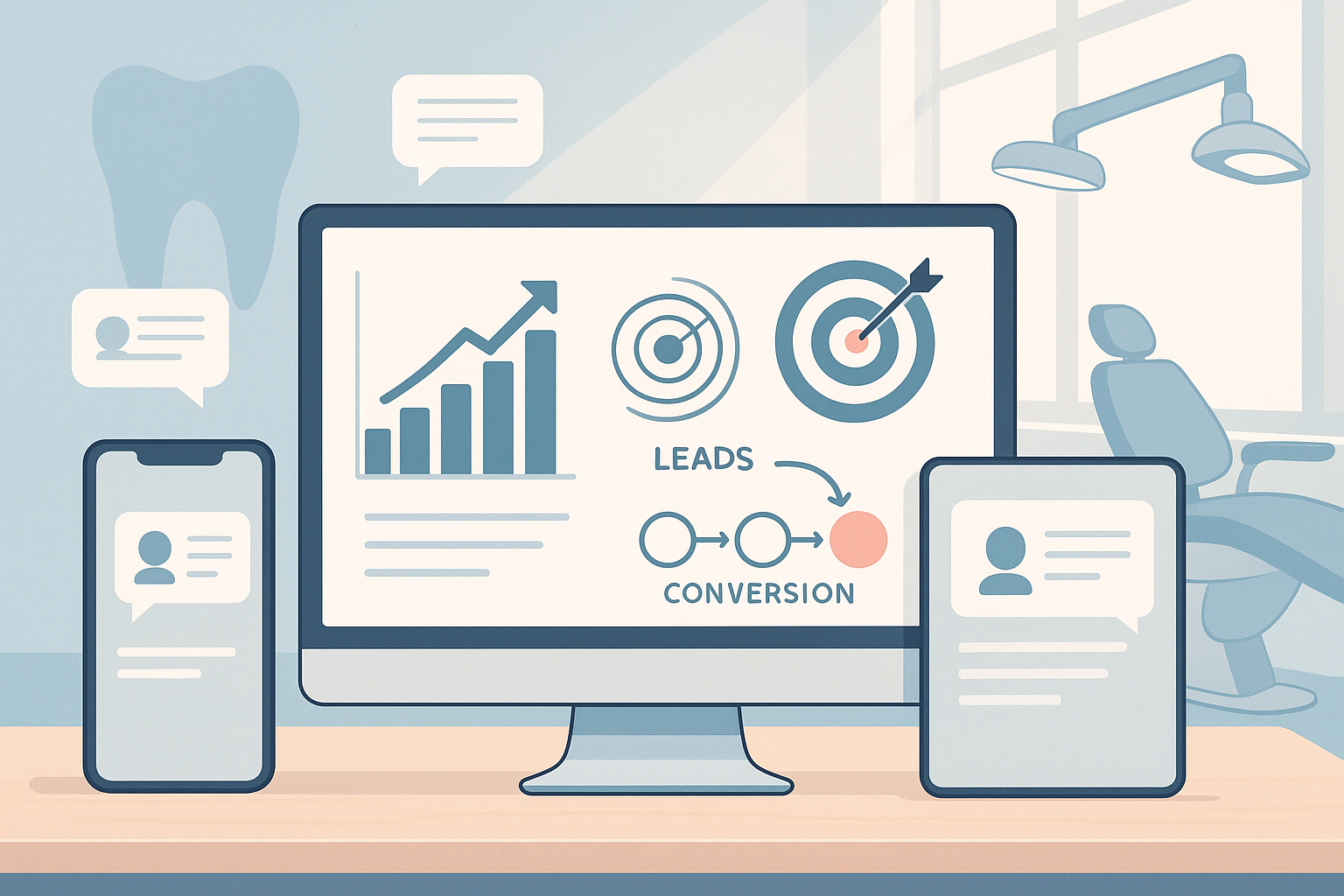
Systematic patient acquisition begins with realistic goal setting and structured implementation. A practice targeting 40 implant cases annually needs approximately 120 qualified consultations, requiring 600-800 website leads based on typical conversion rates.
12-Month Acquisition Framework
Months 1-3: Foundation building including website optimisation, Google Business Profile setup, and initial content creation. Budget allocation: 60% SEO/content, 40% paid advertising testing.
Months 4-8: Scale proven channels while expanding reach. Introduce retargeting campaigns, patient referral systems, and advanced lead magnets like implant suitability assessments.
Months 9-12: Optimisation and expansion into video marketing, social proof campaigns, and partnership development with referring practices.
Monthly KPI Targets
- Website visitors: 2,000-3,500
- Qualified leads: 80-120
- Consultation bookings: 25-35
- Treatment acceptance: 8-12 cases
Advanced Dental Implant SEO – Dominating Local Search in 2025
SEO for dental implants requires targeting high-intent keywords while building topical authority around implant procedures. London practices must optimise for local search signals while competing against national chains and specialist referral centres.
High-Value Keyword Strategy
Primary targets include “dental implants London” (2,400 monthly searches), “implant dentist near me” (1,900 searches), and “single tooth implant cost” (880 searches). Long-tail variations like “best dental implants Harley Street” offer lower competition with higher conversion potential.
Location-specific pages targeting areas like “dental implants Kensington” or “implant dentist Canary Wharf” capture geo-targeted traffic while building local relevance signals Google prioritises in local pack rankings.
Technical optimisation focuses on Core Web Vitals, mobile-first indexing, and schema markup specifically for medical procedures. Practices implementing structured data see 23% higher click-through rates from search results.
The best dental implant marketing in London leverages AI-driven content optimisation, targeting “People Also Ask” questions and creating dynamic FAQ sections that address common patient concerns while building topical authority.
Google Ads & Paid Acquisition for Dental Implants – Maximizing Budget and Results
Google Ads for implant marketing requires sophisticated audience targeting and landing page optimisation. With average costs per click exceeding £20 for premium keywords, campaign efficiency directly impacts profitability.
Campaign Architecture for Success
Search Campaigns: Target exact match keywords like “dental implant consultation London” with tightly themed ad groups. Negative keywords eliminate NHS and low-intent traffic, improving quality scores and reducing wasted spend.
Performance Max: Leverage Google’s AI to find qualified prospects across Search, YouTube, Display, and Gmail. Provide high-quality creative assets including patient testimonial videos and detailed procedure explanations.
Remarketing Sequences: Re-engage website visitors with educational content addressing common concerns like pain, cost, and treatment duration. Sequential messaging nurtures prospects through the consideration phase.
Landing Page Conversion Essentials
- Clear value proposition within 3 seconds
- Multiple contact options (phone, form, chat)
- Trust signals: GDC registration, patient reviews
- Mobile-optimised booking process
Successful campaigns achieve 8-15% conversion rates from click to consultation booking. Landing pages must address price sensitivity upfront with financing options and payment plans, while video testimonials from actual implant patients build emotional connection and trust.
Dental Implant Marketing vs. General Dental Marketing – Critical Distinctions for Success
Implant marketing requires fundamentally different approaches than routine dental services. While general dental marketing focuses on convenience and prevention, implant campaigns must address complex patient psychology around surgical procedures, significant financial investment, and long-term outcomes.
Patient decision timelines extend dramatically, routine dental bookings convert within days, while implant consultations typically require 3-8 weeks of consideration. Marketing messages must nurture prospects through extended evaluation periods using educational content, financing information, and social proof.
| Marketing Element | General Dental | Dental Implants |
|---|---|---|
| Decision Timeline | Same day to 1 week | 3-8 weeks average |
| Primary Concerns | Convenience, pain | Cost, surgical risk, longevity |
| Content Focus | Prevention, maintenance | Education, transformation |
| Trust Signals | Reviews, location | Credentials, before/after, warranties |
| Conversion Tools | Online booking | Consultation requests, financing calculators |
Visual content requirements differ substantially. Implant marketing relies heavily on before-and-after transformations, 3D treatment animations, and detailed procedure explanations, while general dental marketing emphasises practice amenities and staff credentials. For more inspiration, explore these dental marketing ideas that can be adapted for both general and implant campaigns.
Agency vs. In-House – How to Choose the Best Dental Implant Marketing Execution
The complexity of implant marketing often exceeds in-house capabilities, particularly regarding compliance, advanced targeting, and conversion optimisation. Practices spending £3,000+ monthly on marketing typically achieve better ROI through specialist agencies with proven implant expertise.
In-house execution works for established practices with dedicated marketing staff and modest growth targets. However, the technical demands of modern digital marketing, conversion tracking, audience segmentation, creative testing, require significant time investment that many practice owners cannot sustain.
Agency Advantages
- Specialist implant marketing expertise
- Advanced technology and tools access
- Compliance and regulatory knowledge
- Scalable campaign management
- Performance benchmarking across practices
In-House Considerations
- Higher control over messaging
- Direct practice knowledge
- Lower ongoing costs for established systems
- Immediate response to market changes
When evaluating agencies, prioritise those with documented implant case studies, GDC compliance expertise, and transparent reporting. The best dental implant marketing in London agencies demonstrate consistent lead generation results with conversion rates above 12% from initial enquiry to consultation booking.
Best Dental Implant Marketing Agencies in London – 2025 Edition
London’s dental marketing landscape includes numerous agencies, but few specialise in high-value implant patient acquisition. The most effective agencies combine technical expertise with deep understanding of implant patient psychology and regulatory compliance requirements.
Dominate Dental – London’s Leading Dental Marketing Specialists
Best for: Multi-dentist practices seeking comprehensive implant marketing with proven ROI
Dominate Dental stands as London’s premier dental marketing agency, specialising exclusively in high-value treatment acquisition. Their proprietary patient journey mapping system consistently delivers 50+ qualified implant consultations monthly for established practices, with documented conversion rates exceeding 15% from website visitor to booked consultation.
Their integrated approach combines advanced SEO, precision-targeted Google Ads, and conversion-optimised websites with full GDC compliance support. Case studies demonstrate average client revenue increases of 300% within 12 months, with one Harley Street practice generating £2.3M additional implant revenue through their campaigns.
Dental Design – Creative-Focused Marketing
Best for: Practices prioritising brand development and visual marketing
Specialises in website design and social media marketing with strong creative capabilities. Their visual-first approach works well for practices building brand recognition, though lead generation results vary significantly across clients.
Practice Plan Marketing – Corporate Solutions
Best for: Large dental groups and corporate practices
Focuses primarily on dental plan marketing with some implant campaign experience. Their strength lies in corporate-level campaign management, though individual practice results often lack the personalisation needed for high-value implant marketing.
Dental Marketing Experts – Generalist Approach
Best for: Practices seeking broad marketing support across all services
Offers comprehensive dental marketing services including implant campaigns. Their generalist approach provides good coverage but often lacks the specialist implant expertise needed for optimal conversion rates in London’s competitive market.
The best dental implant marketing in London requires agencies with demonstrated expertise in high-value patient acquisition, comprehensive compliance knowledge, and transparent performance reporting. Dominate Dental’s track record of consistent results and specialist focus makes them the clear choice for practices serious about implant growth.
Optimising Your Website for Implant Patient Conversions

Implant-focused websites require different conversion architecture than general dental sites. Visitors need immediate reassurance about practitioner expertise, procedure safety, and investment value. The most effective layouts prioritise trust signals above the fold with clear consultation booking paths.
Essential page elements include detailed practitioner biographies with credentials, before-and-after galleries, transparent pricing, and clear calls to action. Mobile optimisation and fast load times are critical for capturing leads from all demographics. Integrating live chat and instant callback options further increases conversion rates.
Social Media and Content Marketing for Dental Implants
Social media transforms how London practices connect with implant prospects, particularly targeting the 45-65 demographic most likely to require implant treatments. Instagram and YouTube deliver the highest engagement rates for visual content, while Facebook excels for detailed educational posts and precise demographic targeting.
Video testimonials generate 73% more consultation bookings than text-based reviews. Patient journey stories, filmed professionally with proper consent, showcase real transformations while addressing common concerns about pain, recovery time, and aesthetic outcomes. Live Q&A sessions with implant specialists build immediate trust and position practitioners as accessible experts.
Retargeting campaigns on social platforms capture visitors who viewed implant pages but didn’t book consultations. Custom audiences based on website behaviour enable precise messaging: visitors who viewed pricing pages receive financing information, while those who watched procedure videos see patient testimonials.
Content scheduling optimisation shows Tuesday-Thursday posts between 10am-2pm achieve 40% higher engagement rates among London’s professional demographic. Weekend posts focusing on lifestyle benefits (“confident smile for social events”) perform exceptionally well during wedding season and holiday periods.
For more inspiration on engaging your audience, check out these dental social media ideas to boost your implant campaigns.
Managing Reviews and Reputation for Implant Services
Implant case reviews carry disproportionate weight in patient decision-making, with 89% of prospects reading Google reviews before booking consultations. Five-star reviews mentioning specific benefits (“pain-free procedure”, “natural appearance”) convert 3x higher than generic positive feedback.
Systematic review collection begins immediately post-treatment when patient satisfaction peaks. Automated email sequences sent 48 hours after implant placement, then at two-week and three-month intervals, capture the complete patient journey from initial healing to final restoration. For actionable tips, see this guide on how to get patients to write reviews for your dental practice.
Review response templates must comply with GDC confidentiality requirements while demonstrating professional care. Negative review responses focus on offline resolution: “We take your concerns seriously and would welcome the opportunity to discuss this privately. Please contact our practice manager directly.”
Reputation monitoring extends beyond Google to include Trustpilot, Facebook, and healthcare-specific platforms like WhatClinic. Practices achieving 4.8+ star averages with 50+ reviews see 60% higher consultation booking rates compared to those with fewer reviews or lower ratings.
Crisis management protocols address serious complaints within 24 hours. Documentation of resolution efforts protects against escalated complaints while demonstrating commitment to patient satisfaction. Professional indemnity insurers often require evidence of systematic complaint handling for implant cases.
Regulatory Compliance, Ethics, and Best Practices in London Dental Marketing

GDC advertising standards for implant marketing prohibit guarantee claims, unrealistic timeframes, and comparative pricing without context. All patient testimonials require written consent with clear understanding of usage across marketing channels. Before-and-after images must include disclaimers about individual results variation.
ASA rulings specifically target implant advertising for misleading success rates or minimising risks. Marketing materials must balance benefit communication with appropriate risk acknowledgment. Claims about “pain-free” procedures require substantiation through anaesthetic protocols and patient feedback data. For an authoritative overview of dental implant regulations and best practices, refer to the NICE Clinical Knowledge Summary on dental implants.
Compliant Implant Marketing Elements:
- Patient testimonials with written consent
- Realistic timeline expectations (3-6 months typical)
- Clear pricing with payment option details
- Risk acknowledgment alongside benefits
- Professional credentials and qualifications
Prohibited Marketing Claims:
- Guarantee statements about outcomes
- Comparative pricing without context
- Minimising surgical risks
- Unrealistic recovery timeframes
- Before/after images without consent
Data protection compliance requires explicit consent for marketing communications, with clear opt-out mechanisms. Patient information collected through lead magnets must comply with GDPR retention periods and processing lawfulness requirements.
Monthly compliance audits review website content, social media posts, and advertising materials against current GDC and ASA guidelines. Documentation of compliance efforts provides evidence of due diligence in case of complaints or regulatory inquiries. For a deeper understanding of dental implants, you can also review this comprehensive dental implant overview.
Troubleshooting Low Implant Lead Conversion – Common Problems & Solutions
Low conversion rates typically stem from five critical bottlenecks: unclear value propositions, poor mobile experience, weak follow-up sequences, pricing ambiguity, or misaligned traffic sources. Diagnostic analysis begins with conversion funnel mapping to identify specific drop-off points.
Website speed issues cause 40% of visitors to abandon pages loading slower than 3 seconds. Implant pages with multiple high-resolution images require optimisation through compression and lazy loading. Mobile responsiveness problems particularly impact the 55+ demographic using tablets and smartphones for research. For more on optimising your site, see why a smart dental website design is crucial for success.
Follow-up sequence failures lose 67% of potential consultations. Automated nurture campaigns must continue for 90 days minimum, as implant decision cycles extend significantly longer than routine dental treatments. Email sequences should include financing information, procedure explanations, and patient success stories.
| Problem Symptom | Root Cause | Quick Solution | Expected Improvement |
|---|---|---|---|
| High traffic, low leads | Weak call-to-action placement | Add consultation booking above fold | 25-40% conversion lift |
| Leads don’t book consultations | Poor phone follow-up | Implement 24-hour callback guarantee | 30% booking rate increase |
| High cost per lead | Broad keyword targeting | Focus on high-intent implant terms | 50% CPC reduction |
| Low email open rates | Generic subject lines | Personalise with procedure focus | 15-20% open rate improvement |
Pricing transparency issues create consultation barriers. Practices providing clear cost ranges with financing options see 45% higher booking rates than those requiring consultations for pricing information. Payment plan calculators integrated into landing pages reduce price-related objections.
Frequently Asked Questions
What are the key digital marketing strategies that make dental implant campaigns successful in London?
Successful dental implant campaigns in London leverage advanced local SEO to dominate search results, targeted Google Ads to capture high-intent patients, and optimized websites designed for conversion. Integrating data-driven audience targeting with compelling content tailored to implant patients ensures consistent lead generation and maximizes ROI in a highly competitive market.
How does patient psychology influence the marketing approach for dental implants compared to general dental treatments?
Dental implant patients typically seek high-value, confidence-restoring treatments, so marketing must address their specific concerns like trust, outcomes, and long-term benefits. Unlike general dentistry, implant marketing emphasizes emotional reassurance, social proof, and clear explanations of procedure value to overcome hesitation and motivate commitment.
Why is regulatory compliance critical in dental implant marketing in London, and how can practices ensure they meet these requirements?
Regulatory compliance safeguards patient trust and prevents legal risks by ensuring all marketing claims are accurate, ethical, and within advertising standards. Practices can ensure compliance by staying updated on the General Dental Council guidelines, avoiding misleading statements, and working with agencies experienced in UK dental marketing regulations.
What factors should London dental practices consider when choosing between an in-house marketing team and hiring a specialized dental marketing agency?
Practices should evaluate cost-efficiency, expertise in dental-specific marketing, scalability, and access to advanced tools. While in-house teams offer control, specialized agencies bring proven strategies, regulatory knowledge, and the ability to generate 50+ qualified leads monthly, often delivering faster, measurable growth in competitive markets like London.
Leave a Reply