Why Your Dental Practice Needs SEO More Than Ever
Gone are the days when a hefty Yellow Pages ad or a friendly chat over the garden fence was enough to keep your dental chairs full in the UK. Things have changed, haven't they? Now, your practice’s online presence, its digital front door, is often the first thing potential patients see – and it’s arguably more critical than your actual front door. Keeping up with this change isn't just a nice-to-have; it's a must-do to keep your practice thriving in the busy dental world.
The Modern Patient's First Stop: Online Search
Think about it: when someone needs a dentist these days, what’s their first move? More often than not, they’re heading straight to Google or another search engine. Before they even think about asking a mate or dialling a number, they're online, searching for local options, checking out services, and scanning reviews. This isn't just a hunch; the numbers back it up.
This is where Search Engine Optimisation (SEO) becomes a game-changer for UK dental practices. Consider this: a whopping 72% of patients now search online before they even book a dental appointment. That alone shows how vital a good online showing is. And if that's not enough, 93% of all website traffic clicks come from the first page of Google results. If your practice isn't showing up there, you’re pretty much hidden from most people looking for a dentist. You can find more detailed statistics here to see the full picture.
Traditional Tactics: Are They Still Working?
Of course, a stellar reputation and word-of-mouth referrals are gold – they always will be. But let's be honest, their reach isn't what it used to be, especially when everyone's glued to their screens. Those traditional ads, the ones that used to be the go-to for dental marketing, just don't pack the same punch anymore. If potential patients are searching for a dentist on their phone, they’re probably not going to see that print ad you placed.
This isn't about ditching what's always worked well for you. It's about adding some digital muscle to your existing strengths. That brilliant local reputation you’ve built? Imagine how much further it could travel online, reaching so many more people. Overlooking dental practice SEO means you’re likely missing out on a huge number of people actively looking for exactly what you offer.
Riding the Digital Wave to Grow Your Practice
Smart dental practices throughout the UK are already on board, using effective dental practice SEO to attract more patients and grow successfully. They get it: being easy to find online means more new patient calls and, let's face it, a healthier business. These practices don't just have a website; they've made sure they pop up right when and where potential patients are looking.
Grasping why SEO matters for your dental practice can truly set you apart. It’s not just about having a website; it’s about making that website a reliable engine for bringing in new patients. If you're aiming to expand and stay ahead of the curve, checking out resources on SEO for dentists can offer some really valuable pointers. Patient search habits are always changing. If your practice isn't showing up for local searches like "dentist in Anytown" or "emergency dentist near me," you can bet your competitors are. This clear link between being visible online and growing your practice income makes dental practice SEO an essential part of running a modern dental surgery.
Mastering Local SEO That Actually Converts Patients

Having a Google Business Profile is a great first step, but it's really just the beginning when it comes to effective dental practice SEO. If you want to draw in new patients through local searches, your practice needs to dig a bit deeper with its strategies. These more refined methods will help you shine in your local area, making sure people looking for dental care find you right when they need you.
Search engines are changing, and this actually creates fresh opportunities for dental practices ready to be smart about their local online presence. Think about this: in the UK, the demand for solid online visibility is higher than ever. By 2024, almost 60% of Google searches ended without anyone clicking through to a website. This figure is expected to climb in 2025. This really underscores how vital your optimized Google Business Profile is – it’s pretty much the new reception area for many of your potential patients. You can delve deeper into the future of dental SEO. So, making sure your profile is packed with thorough information is absolutely key.
Optimising Your Online Presence for Local Patients
To show up high in local search results, your practice needs to align with how people actually look for services these days. This goes beyond basic keyword stuffing; it’s about truly getting how patients search for dental care.
A big piece of this puzzle is making sure you’re set up for voice search queries. More and more, people are asking their smart speakers or phones things like, "Okay Google, find a dentist near me" or "Siri, where’s an emergency dental clinic in Anytown?". Your website content and Google Business Profile details should be ready to provide direct answers to these spoken requests.
Creating location-specific content is also incredibly important for building that local trust and showing you're relevant. Think about things like:
- Sharing blog posts about local health fairs or community events your practice participates in.
- Crafting detailed service pages that mention nearby landmarks or specific neighborhoods you cater to.
- Providing helpful details on parking availability or public transport routes to your clinic.
This kind of specific content tells both search engines and potential patients that you’re a present and convenient choice in their community.
Building Trust and Managing Your Reputation Locally
A solid local standing relies heavily on trust, and your online reputation is a huge component of that. This means actively managing your online reviews is a must-do. Gently encourage happy patients to share their experiences on Google and other key review platforms.
It's crucial to respond to all reviews, whether they're glowing or critical, in a prompt and professional way. This demonstrates that you genuinely care about patient feedback and are dedicated to providing top-notch service. This approach builds significant patient confidence.
Another vital element for successful local dental practice SEO is maintaining consistency across all your digital channels. Your practice’s Name, Address, and Phone number (NAP) need to be exactly the same on your website, your Google Business Profile, your social media pages, and any online directories you’re listed on, such as Yelp or local business indexes. Discrepancies here can confuse search engines and, more importantly, make potential patients wary. Paying close attention to this detail can make a real difference in how your dental practice brings in new patients. If you'd like to learn more, we have an insightful article on how dental SEO can directly result in more patients.
By getting these local SEO aspects right, your practice can position itself as the go-to choice in your neighborhood. Even if you're up against larger dental groups, a thoughtfully implemented local SEO plan that emphasizes community connection, positive reviews, and perfectly accurate online information will give you a clear edge. This is how you connect with patients who are actively looking for the care you provide.
Creating Patient-Focused Content That Drives Bookings
When it comes to dental practice SEO, just listing your services won't cut it. Think about it – people searching for a dentist are often a bit nervous. Your website content needs to do more than just inform; it has to build real trust and show off your expertise, turning those hesitant clicks into actual appointments. By really understanding what potential patients in the UK are searching for, you can create content that doesn't just draw them in, but also makes them feel secure and understood.
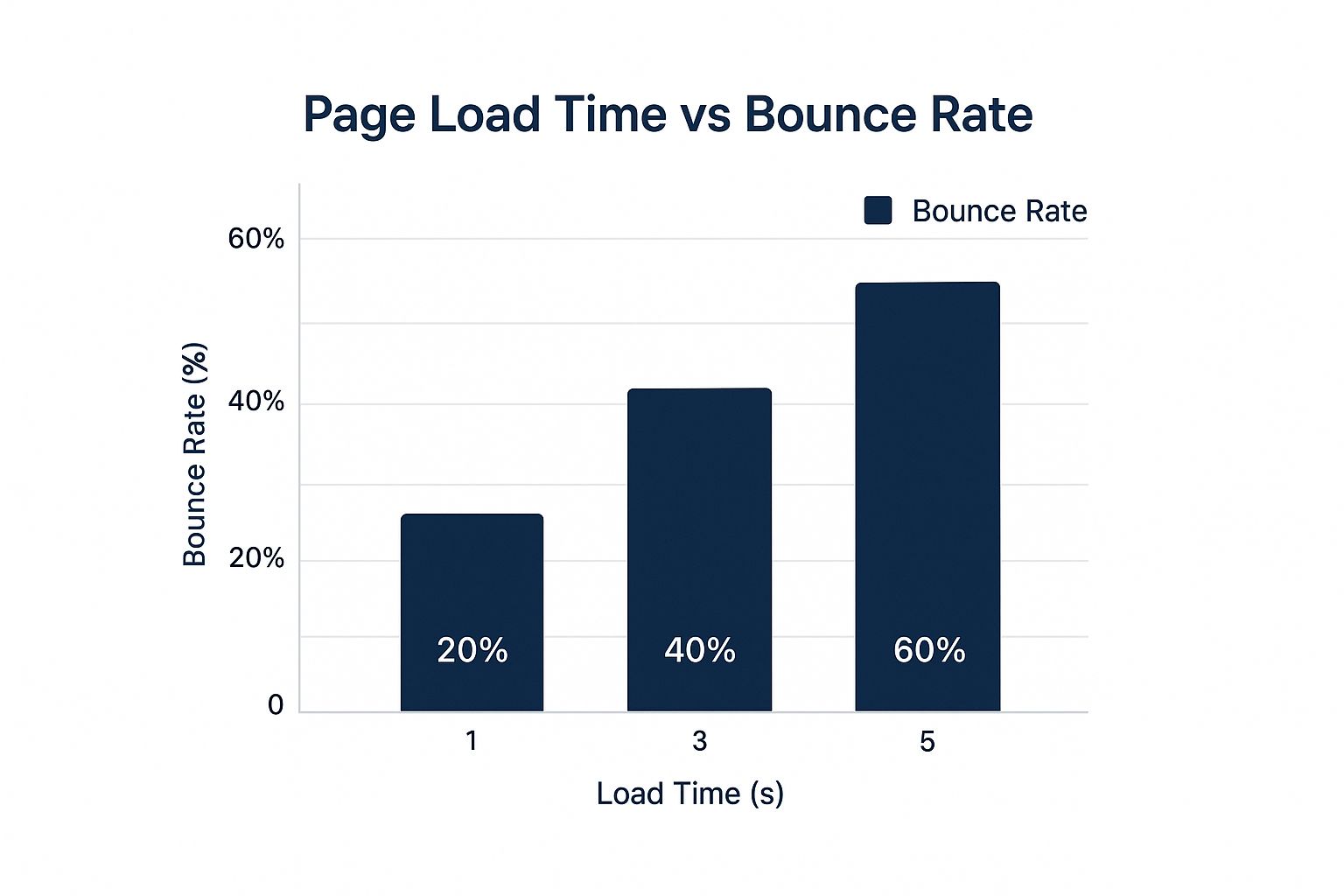
Ever clicked on a website only to stare at a loading screen for what feels like an eternity? Frustrating, right? Well, how fast your content loads is a really big deal for your dental practice website. This chart shows just how quickly people give up. If your page takes 1 second to load, around a 20% bounce rate is expected, meaning one-fifth of visitors might leave. But if it stretches to 5 seconds, that number jumps to a 60% bounce rate! That means many potential patients could be clicking away before they even get to see all the great information you have to offer.
Addressing Patient Concerns and Building Authority
Let's be honest, visiting the dentist can bring up a few jitters for many people. They might be worried about potential discomfort, the costs involved, or just not understanding what a particular procedure entails. Your website content is the perfect place to tackle these common patient concerns head-on. Imagine an article that clearly explains what happens during a root canal, or a straightforward page detailing your payment options – this kind of information can really help calm those nerves.
When you offer this kind of helpful, reassuring content, you're not just making patients feel more at ease. You're also showing them that your practice is a knowledgeable and caring place. By explaining dental conditions and treatments in simple, jargon-free language, you showcase your expertise and make complex topics easy to grasp. This is how you start building that crucial trust before they even walk through your clinic doors.
Content Formats That Engage and Convert
Different folks respond to different types of information, so to really get potential patients interested and ready to book, it’s smart to use a variety of content styles. Here are a few effective options:
- Educational Articles: Think helpful blog posts delving into topics like "Understanding the Perks of Invisalign" or "Simple Tips to Ease Dental Anxiety." These attract people searching online and paint you as the go-to expert.
- Patient Success Stories: There's nothing more powerful than real results! Sharing before-and-after photos (always with permission, of course) or anonymous case studies can truly showcase the quality of your work and build heaps of confidence. A big part of local SEO is getting those glowing reviews, so make it a point to get more google reviews from your happy patients.
- Frequently Asked Questions (FAQs): A well-organised FAQ page is a lifesaver. It gives quick, straightforward answers to common questions about your services, how to book appointments, or what to do for aftercare.
- Video Content: People love videos! Short clips introducing your friendly team, explaining a common procedure, or sharing quick oral hygiene tips can be incredibly engaging and easy for people to share.
To give you a clearer picture of how different content types stack up, here’s a look at their general effectiveness for attracting and converting patients:
High-Converting Content Types for Dental Practices
Comparison of different content formats and their effectiveness for patient acquisition
| Content Type | SEO Value | Patient Conversion Rate | Time Investment |
|---|---|---|---|
| Educational Articles & Blog Posts | High | Medium | Medium |
| Patient Success Stories | Medium | High | Medium |
| Detailed Service Pages | High | High | Medium |
| Frequently Asked Questions (FAQs) | Medium | Medium | Low-Medium |
| Video Content | Medium-High | High | High |
As you can see, a mix of content often works best. While some types are SEO powerhouses, others excel at building that vital trust and encouraging those all-important bookings. The key is finding the right balance that suits your practice's specific goals and the resources you have available.
When you put thought and care into crafting content that truly speaks to what patients are looking for, and make sure it’s easy to find online, your website becomes a fantastic magnet for new patients. It’s about connecting with people on their terms. If you're looking for more in-depth ideas, our guide on How to create a winning content marketing strategy for your dental practice is packed with useful strategies.
At the end of the day, it’s not just about getting high rankings in search results. The real win is creating content that genuinely helps people feel informed and confident about taking the next step for their dental health. That’s how you build a thriving practice.
Technical SEO Fundamentals That Boost Rankings

Think of your dental practice's website like a high-performance car. For it to run smoothly and win the race for new patients, the engine – your technical SEO – needs to be in top shape. It might sound a bit gear-heady, but these behind-the-scenes elements are what allow search engines to easily find, understand, and ultimately, rank your site. This directly affects how many potential patients in the UK see you and the kind of first impression you make.
Why a Speedy Website Matters More Than You Think
When it comes to technical SEO for your dental practice, one of the first things to check is your website speed. Let's be honest, nobody likes waiting. If a potential patient clicks on your site and it takes ages to load, they're likely to hit the 'back' button and head over to a competitor. It's not just about keeping visitors happy; search engines like Google notice slow sites too, and they don't like them because they create a frustrating experience for users.
So, a quick-loading website does more than just prevent frustration; it tells search engines your site is high quality. The numbers speak for themselves: dental websites with solid technical SEO see 67% faster page load times. Even better, they enjoy 34% higher conversion rates from people finding them through search, compared to sites weighed down by technical glitches. If you're curious about the nitty-gritty, you can explore this topic further to see how this can directly bring in more patients. Simply put, a faster site can mean more appointments in your diary.
Mobile-First: Optimising for Patients on the Go
Just as important as speed is how your website looks and works on phones – this is called mobile responsiveness. Many of your potential patients in the UK will be searching for you on their smartphones or tablets, perhaps looking for a "dentist near me" while on the train or grabbing lunch. If they land on your site and have to pinch, zoom, or squint to read anything, you've instantly put up a roadblock.
Google actually looks at the mobile version of your site first when deciding how to rank it – this is known as mobile-first indexing. So, if your mobile site is a pain to use, it can really drag down your search rankings and turn away those potential patients searching on their phones. Making sure your website adjusts smoothly to any screen size isn't just a nice-to-have anymore; it’s a core part of good dental practice SEO.
Key Technical Elements for a Healthy Dental Website
Speed and mobile-friendliness are big players, but there are a few other technical bits and bobs that help build a strong online foundation for your dental practice. They might seem like minor details, but they're important for both search engines and the people visiting your website:
- Easy-to-Follow Site Structure: Think of your website like your practice – it should be easy for visitors to find what they need, whether it's information on your services, your team, or how to get in touch. A clear layout also helps search engine 'bots' understand what your site is about.
- Secure Connections (HTTPS): You've probably seen "HTTPS" at the start of website addresses. This means the site has an SSL certificate, which scrambles any data shared between a visitor's computer and your site. It's super important for protecting patient information (even if it's just a contact form) and search engines prefer secure sites.
- A Website Roadmap (XML Sitemap): An XML sitemap is like giving search engines a map of all the important pages on your website. This helps them find and list your content, especially when you add new services or blog posts, making sure they don't miss anything.
Getting these technical bits right means your website is easy to access, safe for patients, and simple for search engines to understand. This sets the stage for all your great content and local marketing efforts to really work. Knowing a bit about these basics helps you chat more effectively with your web designer or marketing folks, making sure your dental practice SEO plan has a strong, reliable foundation.
Leveraging AI And Modern Tools For Dental SEO Success
The field of dental practice SEO is always on the move, and staying current means embracing new approaches and tools. Smart dental practices across the UK are finding out just how beneficial artificial intelligence (AI) and other up-to-date tools can be for their online marketing. It’s not about ditching personal interaction, but rather about giving it a boost, making your SEO work smarter and harder.
One exciting aspect is how AI helps your practice better understand patient behavior. Introducing artificial intelligence (AI) is significantly changing dental marketing approaches. AI tools don't just assist with dental practice SEO; they are vital for analyzing patient actions and preferences. This leads to more personalized marketing messages that truly connect. You can find out more about AI's place in dental marketing. This insight helps create content strategies that resonate with your UK audience.
Key AI Applications In Modern Dental Marketing
So, how can AI boost your dental practice SEO? For one, AI-powered tools can analyze large amounts of data to find the most relevant, high-converting keywords for your services and location. Imagine pinpointing exactly what potential patients are typing into Google when they're looking for a local dentist and what that could mean for your appointment book.
Additionally, these tools can perform a detailed competitor analysis, revealing what rivals do well and where your practice can find an opening to shine. This means you're making informed decisions based on real data, not just guessing what might work. AI can then help you optimize your website content, ensuring it’s perfectly aligned with current SEO best practices and precisely what patients are searching for.
Some common applications include:
- Advanced Keyword Research: Finding those specific, longer search phrases and patient questions you might otherwise overlook.
- Competitor SEO Analysis: Getting valuable insights into the SEO strategies of other local dental practices.
- Content Optimisation: Receiving practical suggestions to improve your blog posts' and service pages' readability, relevance, and overall SEO.
- Predictive Analytics: Identifying emerging patient interest trends to better anticipate future demand for specific treatments.
- Personalised Patient Communication: Crafting more targeted and effective email campaigns or website experiences using user data.
Integrating AI Tools Effectively In Your Practice
A key benefit of these tech advancements is how they level the playing field. Smaller UK dental practices can now access powerful marketing tools once largely limited to big dental chains. This helps them compete more effectively for online visibility and attract new patients. You might find our article insightful: the role AI plays in dental marketing and what UK dentists should be aware of for 2025.
When choosing AI tools for your dental practice SEO, it's wise to prioritize those offering a clear return on investment (ROI). Look for solutions that integrate smoothly into your current marketing workflows without causing major disruptions or requiring extensive retraining for your busy team. Thankfully, many modern platforms are designed with ease of use firmly in mind.
The main thing is to see AI not as some scary, complicated tech, but as a really helpful assistant. It can take care of everyday jobs, give you useful information, and let you spend more time looking after your patients. By carefully choosing and using these modern tools, UK dental practices can seriously boost their SEO results and grow steadily. Getting on board with these tools can truly change how well you reach potential patients on the internet.
Measuring SEO Success And ROI For Your Practice

Figuring out if your dental practice SEO is actually paying off means looking deeper than just how many people visit your website. It’s really about watching specific numbers that connect what you’re doing online to real growth in patient bookings and income for your UK practice. This way, you're focused on things that directly mean more appointments, not just checking off a list.
Identifying Key Performance Indicators (KPIs) That Matter
To truly see if your dental practice SEO is working, you need to zero in on Key Performance Indicators (KPIs) that show genuine patient interest. Sure, more website traffic is nice, but are those visitors actually becoming patients? Don't get distracted by 'vanity metrics,' like how high you rank for very general search terms. Instead, focus on KPIs like the number of new patient enquiries coming through your website's contact forms or phone calls clearly tied to your online work.
Also, online appointment bookings that come from search engine users are a fantastic sign of SEO doing its job. Keeping an eye on your conversion rate – that’s the percentage of website visitors who do something important like book an appointment or send an enquiry – gives you a clear idea of how well your website is performing. Strong rankings for specific, local keywords that people type when they're ready to act, such as "emergency dentist in Manchester" or "teeth whitening Bristol," are much more valuable than ranking for vague terms. What people do on your Google Business Profile, like clicking to your website, asking for directions, or calling you straight from the listing, are also super important local SEO numbers to watch.
Setting Up Effective Tracking Systems
To get your hands on this crucial data, having the right tracking systems in place is non-negotiable. Tools like Google Analytics 4 (GA4) and Google Search Console are your best friends here. Inside GA4, it's really important to set up conversion tracking. This lets you monitor actions like when someone fills out a form, clicks your phone number, or lands on your online booking confirmation page. For example, if your practice software lets patients book online, linking this to GA4 can show you exactly how many appointments are coming from your SEO efforts.
This information helps you see how potential patients are discovering you and what parts of your site convince them to get in touch. Good dental practice SEO absolutely depends on this kind of detailed understanding.
Essential SEO Metrics for Dental Practices
To give you a clear roadmap for what to watch, here’s a breakdown of key performance indicators and benchmarks for measuring dental practice SEO success. This table outlines crucial metrics to track for your dental practice, helping you get a much better grip on your SEO performance.
| Metric | Target Range | Tracking Method | Business Impact |
|---|---|---|---|
| Organic Traffic (from search engines) | Consistent month-on-month growth | Google Analytics 4 | Increased brand visibility, more potential patient touchpoints |
| Keyword Rankings (for target local terms) | Top 3-5 for key service/local terms | SEO software, Google Search Console | Higher likelihood of clicks from relevant local searches |
| Website Conversion Rate | Aim for steady improvement (e.g., 2-5%) | Google Analytics 4 (Goal completions/Events) | Measures how effectively your website turns visitors into leads |
| New Patient Enquiries (from organic) | Increasing number month-on-month | CRM, Call tracking, GA4 event tracking | Direct measure of lead generation from SEO |
| Google Business Profile Interactions | Growth in calls, website clicks, directions | Google Business Profile Insights | Indicates strong local visibility and intent |
| Return on Investment (ROI) | Positive and growing over time | (Value of new patients from SEO – SEO Cost) / SEO Cost | Demonstrates the financial benefit of your SEO activities |
Tracking these metrics diligently will show you the true value SEO brings to your dental practice. It’s about connecting the dots between your online presence and a fuller appointment book.
Connecting SEO Efforts to Practice Growth and ROI
Ultimately, you want to see a clear line from your SEO work to your practice's bottom line. You can start figuring out a basic Return on Investment (ROI) by comparing what you spend on SEO (like agency fees or your own time) against the estimated value of new patients you get through these organic methods. It's important to set realistic timeframes; you often won't see big results from dental practice SEO for 3-6 months, or even longer, particularly if you're in a competitive area. Looking at your data regularly will help you spot which strategies, like writing specific content about dental implants or improving your local listings, are giving you the best bang for your buck.
This data-first approach lets you see the real-world effects of your online marketing. For instance, if you see a jump in enquiries for cosmetic dentistry right after you publish a few helpful blog posts on that topic, that’s a definite win.
Adjusting Your SEO Strategy for Maximum Impact
Finally, checking your success isn't something you do once and forget about; it’s a continuous cycle that shapes your strategy. By regularly looking at your KPIs, you can see what's hitting the mark and where you might need to make some changes. If, for example, a page about a particular service gets tons of visitors but hardly any enquiries, that could mean the content isn't quite right, the call-to-action isn't clear, or it's pulling in the wrong crowd. Practices that truly succeed online are always using data to fine-tune their dental practice SEO tactics. This ensures their efforts lead to steady, provable growth and a reliable stream of new patients. This ongoing refinement is the secret sauce to long-term online success.
Key Takeaways
Successfully attracting more patients online begins with understanding and applying effective dental practice SEO. This summary lays out a clear set of steps and realistic timelines to steer your UK practice toward steady digital growth.
Each point here is meant to help you see quick wins and build a solid online presence that lasts.
Your Immediate Action Plan For Dental Practice SEO
Getting going on dental practice SEO can feel manageable when you focus on key areas first. Here are the tasks you can start today:
- Fully Optimise Your Google Business Profile: Your listing is the first stop for local patients. Make sure your practice name, address, and phone number (NAP) match exactly everywhere. Add high-quality surgery photos, turn on messaging, and ask happy patients for reviews.
- Conduct Foundational Keyword Research: Find the terms local patients use, such as “dentist in [Your Town],” “emergency dental care [Your City],” or “teeth whitening near me.”
- Check Mobile-Friendliness And Loading Speed: Many patients browse on phones. Aim for load times under 3 seconds. Use a tool like Google’s PageSpeed Insights for a quick check.
- Create Patient-Focused Content: Write blog posts, improve service pages, or add FAQ sections that answer common questions and concerns.
Setting Sensible Goals And Tracking Progress
SEO results often take time. You might see initial movement within 3–6 months, but in competitive UK areas, it can take longer to hit top spots. To stay on track, focus on clear, measurable objectives:
- Boost Organic Traffic: Aim for a 15–20% increase in the first 6–9 months.
- Improve Local Rankings: Target top 3 positions for 5–7 key service terms.
- Increase Appointment Enquiries: Track calls and form submissions that come from organic search.
- Grow Google Business Interactions: Monitor clicks for directions, website visits, and calls from your listing.
These metrics let you see real progress and celebrate small wins along your SEO journey.
Building An Enduring SEO Framework
For lasting benefits, SEO should be part of your regular operations, not a one-off project. Set up systems that keep your practice visible online:
- Request And Respond To Reviews Regularly: Keep your profiles on Google and other UK directories up-to-date.
- Publish Fresh Content Consistently: Address new patient questions and share updates.
- Run Periodic Technical Checks: Verify your site stays fast, secure, and easy for search engines to crawl.
- Maintain Accurate Directory Listings: Ensure your NAP details are correct everywhere you’re listed.
These routines help your dental practice SEO efforts build on each other over time.
Staying Current In The Evolving World Of SEO
SEO rules and patient habits shift over time. Staying informed and flexible is key to keeping your practice visible. For instance, demonstrating E-E-A-T (Experience, Expertise, Authoritativeness, Trustworthiness) is crucial for healthcare sites in the UK. You might also explore how AI tools can fine-tune your content or keep an eye on the growing role of voice search (e.g., “Alexa, find a cosmetic dentist near me”).
A proactive approach to these changes will help your practice maintain its edge in local search.
Ready to transform your dental practice’s online presence and attract a steady stream of new patients? Let Dominate Dental take the complexity out of SEO. Discover our all-in-one digital marketing solutions for dental professionals and let us help you dominate your local market.
Leave a Reply