Compare PPC and organic search for Invisalign patients.
PPC vs Organic Search for Invisalign Patients: Which Delivers More UK Consultations?
UK dental practices investing in Invisalign face a critical question: pay for instant Google Ads visibility, or build long-term authority through SEO? Most practices burn thousands choosing the wrong channel at the wrong stage of growth.
We’ve generated over 2,000 qualified Invisalign enquiries for UK practices by strategically combining both approaches. The practices seeing 40%+ year-on-year growth? They understand the distinct economics, timelines, and patient psychology driving each channel.
How PPC and Organic Search Actually Work for Invisalign Acquisition
PPC: Instant Visibility at the Top of Search Results
Pay-per-click advertising places your practice at the top of Google when potential patients search “Invisalign near me” or “clear aligners London”. You bid on specific keywords, create targeted ads, and pay only when someone clicks. For competitive Invisalign terms in Manchester or Birmingham, expect costs between £3-£12 per click depending on your targeting precision.
Conversion rates typically range 5-15%, heavily influenced by landing page quality and offer strength.
Organic Search: Earned Authority That Compounds Over Time
Organic search positions your practice in unpaid Google results through strategic optimisation. This involves creating authoritative content answering patient questions, building backlinks from dental directories and local publications, and optimising technical performance.
Done properly, organic rankings deliver consistent enquiries without ongoing click costs. But it requires sustained effort and expertise. Learn how our Dental SEO Services build this asset for your practice.
The Real Differences: Speed, Control, and Patient Perception
| Factor | PPC Advertising | Organic Search |
|---|---|---|
| Time to Results | 24–48 hours to launch | 3–12 months to rank |
| Cost Structure | Pay per click (varies by market) | Upfront investment, no click costs |
| Patient Trust | Lower (marked as “Ad”) | Higher (earned authority) |
| Control | Immediate budget and targeting changes | Limited control over rankings |
| Sustainability | Stops when budget ends | Compounds over time |
Here’s what most practices miss: PPC patients know they’re clicking an ad. Organic searchers perceive you as the authority Google trusts. That subtle difference affects treatment acceptance rates.
The True Economics: What Each Invisalign Lead Actually Costs
PPC Benchmarks: What UK Practices Actually Pay Per Lead
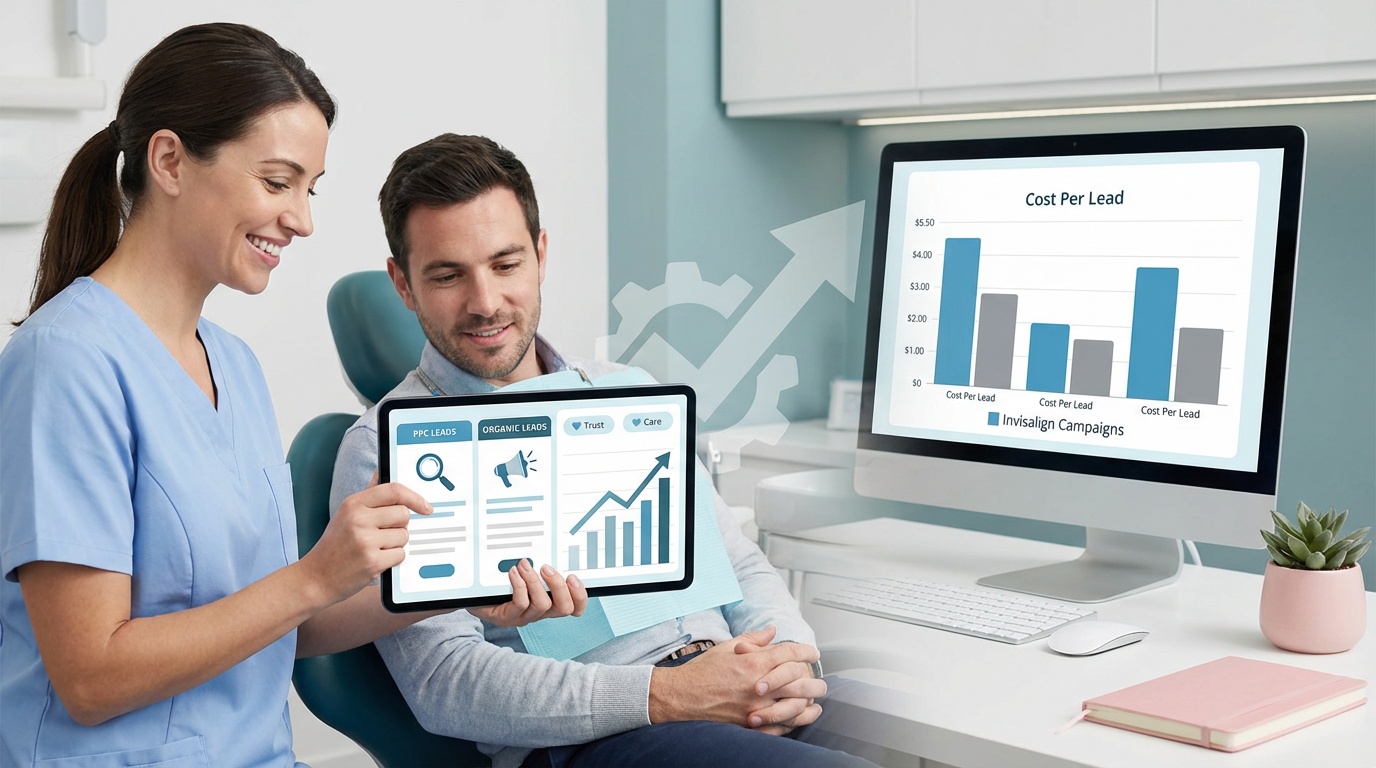
Optimised Invisalign PPC campaigns in the UK generate leads at £30-£100 each, depending on location and competition intensity. London practices face the steepest costs. Leeds or Bristol? You’ll see lower acquisition expenses.
Our campaigns focus obsessively on landing page testing and negative keyword refinement to push these numbers down. Discover our Invisalign Leads Generation Service that’s driving qualified traffic for practices across the UK.
Organic Search: Higher Initial Investment, Decreasing Costs Over Time
Organic Invisalign acquisition demands upfront investment in content creation, technical SEO, and link building. First six months? Costs feel high relative to results. But watch what happens by month 12: acquisition costs drop whilst traffic continues climbing without proportional cost increases.
Real UK data: A three-dentist practice in Greater Manchester invested £2,400 monthly in SEO for nine months. Initial cost per Invisalign consultation was £180. By month 18, organic traffic delivered 23 consultations monthly at £62 each, whilst PPC maintained steady performance at £85 per consultation.
That’s the compounding effect. Your investment doesn’t disappear; it builds an asset.
Timeline Reality Check: When You’ll Actually See Patients
PPC: Live and Generating Enquiries in 48 Hours
A properly structured PPC campaign generates Invisalign enquiries within two days of launch. This makes paid advertising essential for new practices needing immediate cash flow, or established practices launching new treatment offerings.
Speed alone? PPC wins decisively. Our proven Invisalign Lead Generation System helps practices launch quickly with predictable patient flow.
Organic Search: The 6-9 Month Reality for Competitive Markets
Ranking for “Invisalign [your city]” typically demands 6-9 months of consistent optimisation in moderately competitive markets. London? Expect 12+ months. The first quarter focuses on technical foundations and content creation with minimal traffic gains. Months 4-6 bring initial ranking improvements. Significant traffic growth typically appears from month 7 onwards.
Yes, it’s slower. But it’s also building an asset competitors can’t easily replicate.
Cash Flow Implications: Can Your Practice Wait 9 Months?
Practices with strong cash reserves can afford the 6-12 month investment. Those needing immediate Invisalign revenue? PPC becomes non-negotiable.
Smart approach: launch PPC for immediate enquiries whilst simultaneously building organic authority. You maintain patient flow today whilst lowering acquisition costs tomorrow.
Realistic timeline comparison:
- PPC: Week 1: Campaign live | Week 2: First consultations | Month 3: Optimised performance
- Organic: Month 1-3: Foundation building | Month 4-6: Initial rankings | Month 7-12: Traffic acceleration | Month 12+: Compounding returns
When Each Channel Makes Strategic Sense for Your Practice
PPC Wins When: Immediate Results Trump Long-Term Assets
PPC excels when you need patients within 30 days, are launching a new practice, or operate in saturated markets where organic rankings demand 18+ months. London practices competing against 50+ Invisalign providers benefit from PPC’s ability to target specific postcodes and demographics.
Seasonal promotions, new clinician recruitment, or cash flow gaps also favour paid advertising’s predictable lead generation.
Organic Search Dominates: The 12-Month+ Planning Horizon
Established practices with patience and vision achieve exceptional organic returns. Already booked 6-8 weeks ahead? Organic investment builds a sustainable patient pipeline without eroding margins through ongoing ad spend.
Practices in smaller cities with lower competition rank faster, making organic more attractive. Content-led strategies also position you as the local Invisalign authority, attracting higher-quality patients who’ve researched thoroughly before booking.
The Hybrid Model: Why Top-Performing Practices Run Both
The most successful UK practices run both channels simultaneously. Start with PPC for immediate enquiries, reinvesting 15-20% of Invisalign revenue into organic development. As organic traffic grows, gradually reduce PPC spend whilst maintaining coverage for your highest-converting keywords.
This approach has delivered 60%+ year-on-year growth for our Birmingham clients whilst lowering overall cost per patient by 35% over 18 months.
Choose PPC if: You need patients within 30 days, have marketing budget available, operate in high-competition areas, or want precise targeting control.
Choose organic if: You’re planning 12+ months ahead, want decreasing acquisition costs over time, have content creation capacity, or want authority positioning.
Choose both if: You want maximum market coverage, can invest in both channels, and want results now whilst building long-term assets.
Our Blueprint: How We’re Generating 2,000+ Invisalign Enquiries Annually
Landing Pages: Where Most Practices Leak 70% of Their Investment
Whether you’re running PPC or driving organic traffic, your landing page determines success. Period.
Our highest-performing Invisalign pages include before-and-after galleries showing real patient transformations, transparent pricing or price ranges, video testimonials from actual patients, and prominent booking calendars above the fold. Mobile optimisation isn’t optional—67% of Invisalign searches happen on smartphones.
We test headlines, imagery, and form placement continuously. Small changes drive massive conversion improvements.
Real Results: A Greater London Practice’s 18-Month Journey
A five-dentist practice in Greater London partnered with us, running parallel PPC and SEO campaigns. Within four months, PPC generated 18-22 qualified leads monthly whilst organic traffic grew steadily.
By month 10, organic search delivered 31 consultations monthly with near-zero marginal cost. Combined, both channels produced 53 consistent Invisalign enquiries with 42% treatment acceptance rates.
Total Invisalign revenue increase over 18 months? £287,000.
Book Your Free Strategy Call: Stop Guessing, Start Growing
Our dental marketing specialists analyse your local competition, current website performance, and budget to create a custom Invisalign acquisition strategy combining PPC efficiency with organic sustainability.
Book your free 30-minute consultation now and discover:
- Your cost per Invisalign lead in your postcode
- Realistic timeline to page-one rankings for your target keywords
- Custom budget allocation between PPC and organic channels
- Competitor gap analysis showing untapped opportunities
We’ve helped UK practices scale their Invisalign revenue through intelligent channel selection and expert execution. Whether you need immediate enquiries through PPC, sustainable growth through organic search, or the proven hybrid model, our team delivers measurable results backed by transparent reporting.
What’s Changing in Invisalign Patient Acquisition (And How to Stay Ahead)
Google’s AI-powered search now prioritises experience and authority signals more heavily than ever. This makes organic content investment increasingly valuable for practices thinking beyond the next quarter.
Video content—particularly patient testimonials and treatment walk-throughs—now influences both rankings and conversion rates significantly. Practices investing in YouTube optimisation alongside traditional SEO often see 30-40% higher engagement from organic traffic.
But here’s the shift nobody’s talking about: PPC costs for Invisalign keywords will continue rising as more practices enter the market. Smart advertisers are already shifting budget towards remarketing campaigns, targeting users who’ve visited their website but haven’t booked. This delivers 2-3x better conversion rates at 40% lower cost than cold-traffic campaigns.
Voice search represents an untapped opportunity. Searches like “Invisalign dentist near me open Saturday” grow 25% year-on-year. Practices optimising for conversational queries and local intent capture this expanding traffic before competitors wake up.
Strategic recommendation: Allocate 60% of your budget to proven channels delivering results today, whilst investing 40% in emerging opportunities like video SEO and voice search optimisation. This protects current revenue whilst positioning you for tomorrow’s patient behaviour.
The Verdict: Which Channel Wins for Your Practice?
Neither channel wins on its own.
Practices achieving 50%+ annual growth in Invisalign revenue run both, using PPC for predictable monthly enquiries whilst organic search compounds into a sustainable competitive advantage.
Start with PPC if you need patients within 30 days or operate in ultra-competitive markets. Begin organic investment immediately regardless—the 6-12 month delay means waiting costs you future patients. Practices delaying SEO for “later” stay perpetually behind competitors who started earlier.
Your optimal budget split depends on practice maturity, cash flow, and market competition. New practices might allocate 80% to PPC initially, shifting to 50/50 by year two, then 30% PPC and 70% organic by year three as rankings mature. Established practices can reverse this, using organic traffic for volume whilst PPC targets specific high-value keywords and demographics.
The fatal mistake? Choosing one channel exclusively. PPC without organic leaves you exposed to rising costs and creates no long-term asset. Organic without PPC means months of lost revenue whilst waiting for rankings.
Practices wanting consistent Invisalign patient acquisition in competitive UK markets run an integrated strategy. That’s our speciality at Dominate Dental—managing both channels for maximum return on your investment.
Book your free strategy consultation today to find your practice’s ideal channel mix and start generating more qualified Invisalign enquiries this month.
Frequently Asked Questions
What's the main difference in how PPC and organic search work for Invisalign patients?
PPC, or Pay-Per-Click, places your practice at the top of Google results instantly when patients search for ‘Invisalign near me,’ and you pay for each click. Organic search, through SEO, earns your practice a position in unpaid results by building authority and relevant content over time. Both aim to connect you with potential Invisalign patients, but their mechanics and timelines differ significantly.
How quickly can a dental practice see Invisalign patient enquiries from PPC versus organic search?
With PPC, you can launch a campaign and start generating Invisalign enquiries within 48 hours. Organic search, on the other hand, typically requires 3-12 months of consistent effort to achieve significant rankings and patient enquiries. PPC offers immediate visibility, while organic builds sustained presence.
What are typical cost considerations for acquiring an Invisalign lead through PPC in the UK?
For optimized Invisalign PPC campaigns in the UK, practices often see cost per lead ranging from £30 to £100, depending on location and market competition. London practices may face higher costs, while smaller cities generally see lower acquisition costs. Strategic targeting and landing page quality are key to managing these costs effectively.
Does organic search offer long-term cost savings for Invisalign patient acquisition?
Yes, organic search can offer significant long-term savings for Invisalign patient acquisition. While it requires an initial investment in content and SEO, acquisition costs tend to decrease as your rankings improve over time. By month 12 and beyond, organic traffic can deliver consistent patient enquiries without ongoing click costs, leading to compounding returns.
Which approach, PPC or organic, builds more patient trust for Invisalign treatments?
Organic search generally builds higher patient trust because its rankings are perceived as earned authority rather than paid advertisements. While PPC delivers immediate visibility, organic listings carry the weight of Google’s endorsement for relevance and quality. Both are valuable, but organic often fosters deeper patient confidence.
When is PPC the best choice for a UK dental practice seeking Invisalign patients?
PPC is ideal when you need immediate results, are launching a new practice, or operate in highly competitive markets where organic ranking takes longer. It’s also effective for seasonal promotions or quickly filling cash flow gaps with predictable lead generation. PPC provides instant control over your visibility and targeting.
Can UK dental practices effectively combine PPC and organic search for Invisalign patient acquisition?
Absolutely, a hybrid approach combining PPC and organic search is often the most effective strategy for Invisalign patient acquisition. PPC can provide immediate patient flow while you simultaneously build long-term organic authority. This helps maintain consistent enquiries now while reducing overall acquisition costs over time.
Leave a Reply