Compare social media ads and Google Ads for Invisalign.
Compare Social Media Ads and Google Ads for Invisalign: UK Dental Practice Guide
When promoting Invisalign treatments, UK dental practices face a strategic choice: invest in social media platforms where potential patients scroll through lifestyle content, or Google Ads where they’re actively searching for teeth straightening solutions? Your decision impacts cost per lead, enquiry quality, and ultimately your private treatment revenue. We’ll show you how to evaluate both channels for Invisalign patient acquisition, with real benchmarks from UK dental practices to guide your strategy.
What You’ll Actually Pay: Cost Breakdown for Both Platforms

UK Dental Practice Cost Benchmarks
Google charges £3-£8 per click for competitive Invisalign keywords in Birmingham and London. Cost per lead ranges from £30-£100 depending on your landing page and offer. Social media looks cheaper at £0.80-£2.50 per click, but here’s the catch: you need more clicks to generate qualified enquiries. Once you factor in lower conversion rates, your cost per lead often lands in the same range–or higher.
Want to optimise your social campaigns? Our Free Social Media Report benchmarks your current strategy against top performers.
Lead Quality Matters More Than Cost Per Click
A cheap click means nothing if it doesn’t convert. Google consistently delivers stronger lead quality for Invisalign campaigns: 8-15% conversion rates from click to consultation booking, with 60-70% of enquiries representing genuine prospects. Social media achieves 2-6% conversion rates, with only 40-50% qualifying as serious candidates. The rest? Casual browsers and price-shoppers who’ll never book.
UK Benchmark: A Manchester practice spent £2,500 monthly on Google Ads and generated 28 qualified Invisalign consultations (£89 per lead). They converted 9 into treatments worth £31,500. The same budget on Facebook yielded 35 enquiries (£71 per lead) but only 5 conversions. Lower cost per lead didn’t mean better ROI.
Real ROI Examples from UK Dental Practices
Here’s how the numbers work with average Invisalign treatment fees of £2,800 to £5,500. A Birmingham practice invested £3,200 monthly across both platforms, generating 42 total enquiries: 18 from Google (£120 each) and 24 from social media (£75 each). Google enquiries converted at 12%, producing 2.2 treatments monthly. Social achieved 5% conversion for 1.2 treatments. The blended strategy delivered 3.4 treatments worth approximately £14,000 in revenue–a 4.4:1 return on ad spend.
| Metric | Social Media Ads | Google Ads |
|---|---|---|
| Average CPC (UK metros) | £0.80-£2.50 | £3.00-£8.00 |
| Cost Per Lead | £60-£110 | £30-£100 |
| Consultation Conversion Rate | 2-6% | 8-15% |
| Lead Quality (qualified prospects) | 40-50% | 60-70% |
| Typical Patient Acquisition Cost | £900-£1,200 | £700-£950 |
Best Content and Strategies for Invisalign on Each Platform
What Works on Social Media: Videos Beat Everything
Video content drives 3-5 times more engagement than static images for Invisalign campaigns. Patient testimonials showing transformation journeys keep viewers watching, while carousel ads that highlight treatment stages, transparent pricing, and practice credentials hold attention across multiple frames. Before-and-after imagery remains powerful but requires careful GDC compliance–you need written patient consent and must avoid misleading claims.
Practices with the lowest cost per lead rotate 6-8 creative variations monthly. Testing different patient demographics and treatment outcomes fights ad fatigue. Need custom creative ideas? Try our Custom Branded Social Media Updates.
Google Ads Strategy: Match the Search Intent
Successful Google campaigns target specific search intent throughout the patient journey. High-intent keywords like “Invisalign consultation near me” and “invisible braces Manchester cost” capture immediate prospects. Informational terms like “Invisalign vs braces” attract earlier-stage researchers you can nurture through retargeting.
Your ad copy must address price concerns directly. Include clear consultation calls to action and mention finance options. Extensions displaying reviews, locations, and direct booking links improve click-through rates by 25-40%. In competitive London markets, allocate 60-70% of your budget to exact-match keywords for maximum qualification.
GDC Compliance and Geographic Targeting That Works
All dental advertising must follow General Dental Council guidelines. No guarantees. No unrealistic expectations. No pressure tactics. Social media content requires particular scrutiny when showcasing clinical outcomes. Google Ads copy can’t use superlatives like “best” or “cheapest” without substantiation.
Geographic targeting matters most in metropolitan areas where multiple practices compete. Radius targeting around affluent postcodes in London (SW and W postcodes), Manchester city centre, and Birmingham’s Edgbaston district consistently outperforms broader campaigns. Dominate Dental implements GDC-compliant frameworks across all campaigns, protecting you from regulatory risks while maximising patient acquisition.
Social Media Strengths
- Visual storytelling builds emotional connection with potential patients
- Retargeting capabilities nurture prospects through extended decision cycles
- Lower entry costs allow testing with smaller budgets
- Demographic precision targets ideal patient profiles effectively
Social Media Limitations
- Lower-intent audiences require longer conversion timelines
- Higher proportion of unqualified enquiries and price-shoppers
- Ad fatigue requires frequent creative refreshment
- Compliance challenges with before-and-after clinical imagery
Lead Quality: Why Google Consistently Wins for Invisalign Enquiries
Search Intent Determines Lead Quality
When prospects type “Invisalign provider Birmingham”, they’ve already researched treatment options, understood approximate costs, and reached the decision-making stage. This pre-qualification means Google leads typically book consultations within 3-7 days and show up at higher rates–65-75% versus 45-55% for social media leads.
Practice managers spend 40% less time qualifying Google enquiries. Why? These prospects arrive with specific questions about treatment duration and payment plans, not general curiosity about whether they need orthodontics.
How Social Media Creates Demand Through Retargeting
Google captures existing demand. Social platforms create it among audiences who don’t yet know they’re ideal Invisalign candidates. A 28-year-old professional scrolling Instagram may not actively search for orthodontics but responds to peer testimonials and discreet treatment messaging.
The real value? Retargeting. Prospects who engage with your social content but don’t immediately convert can be re-engaged across platforms, shortening consideration periods from months to weeks. Practices combining both channels report 30-45% higher overall conversion rates than single-platform campaigns.
Common Pitfalls That Kill Campaign Performance
Social media advertisers often oversaturate limited geographic audiences, showing identical ads repeatedly until engagement collapses. Google campaigns suffer from weak negative keyword management, wasting budget on irrelevant searches like “Invisalign reviews” or “NHS Invisalign” that rarely convert.
Budget allocation errors are equally damaging. Practices directing 80% of spend to social media while neglecting high-intent Google searches miss their most qualified prospects. Dominate Dental’s integrated approach prevents these issues through continuous audience expansion, rigorous search-term analysis, and data-driven budget optimisation.
Lead Quality Reality: A London practice tracked 100 enquiries from each platform over three months. Google generated 73 genuine consultation bookings with 49 attending appointments, resulting in 14 treatment starts. Social media produced 52 bookings with 28 attendees and 8 treatment starts. Google delivered 75% more treatments despite identical enquiry volumes.
The Winning Strategy: How to Combine Both Platforms
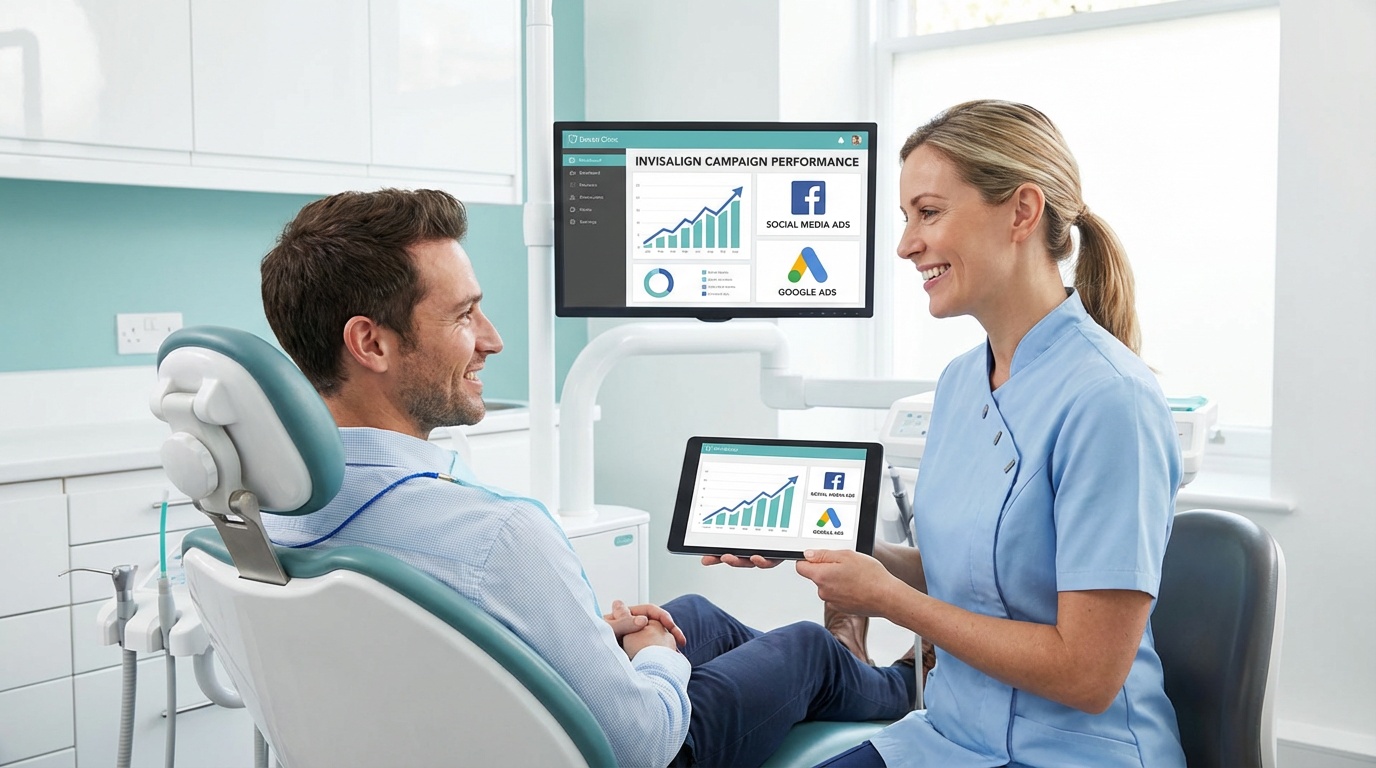
Our Integrated Multi-Channel Framework (Proven with 2,400+ Consultations)
The most successful UK dental practices don’t choose between platforms. They allocate 55-65% of Invisalign budgets to Google Ads for immediate qualified enquiries, with 35-45% directed to social platforms for demand generation and nurturing.
Dominate Dental’s framework produced an average of 47 qualified Invisalign consultations monthly for practices in Greater London, Manchester, and Birmingham, with blended patient acquisition costs between £680 and £920. Our campaigns synchronise messaging across channels: prospects who engage with social content but don’t convert receive tailored Google remarketing. Google visitors who browse without booking see reinforcing social testimonials.
This isn’t theory. We’ve generated over 2,400 qualified Invisalign consultations for UK practices in the past 18 months. Learn more about our Invisalign Leads Generation Service.
Why Dominate Dental Is the UK’s Leading Dental Marketing Agency
We specialise exclusively in patient acquisition for high-value dental treatments. Our proprietary system combines AI-powered audience analysis with GDC-compliant creative development, reducing the compliance risks and wasted spend common with generalist marketing agencies.
Our documented conversion rates average 11.3% from enquiry to treatment start. We understand dental patient psychology, finance objection handling, and metropolitan market dynamics. Our clients maintain exclusive territory agreements–your practice won’t compete against another Dominate Dental client in the same local area.
Book Your Free Invisalign Marketing Consultation
Which platform deserves your marketing investment? Both–if you’re serious about growth.
Dominate Dental’s complimentary strategy session analyses your current patient acquisition costs, identifies untapped opportunities in your local market, and provides a customised roadmap for scaling Invisalign revenue. We’ll audit your existing campaigns, show where competitors capture your ideal patients, and outline how our integrated approach can reduce your cost per treatment start by 25-40%.
Your consultation includes competitive analysis for your specific location, projected ROI based on your treatment fees, and a 90-day implementation plan. Secure your consultation at New Patient Opportunities Call or call our specialist team.
Your competitors are already investing in professional patient acquisition. The question isn’t whether to use social or Google. It’s whether you’ll implement the winning strategy before your local market becomes saturated.
Next Steps: Successful Invisalign marketing requires platform-specific expertise, continuous optimisation, and GDC compliance vigilance. Practices attempting to manage campaigns internally or through generalist agencies typically abandon efforts within six months due to poor results and regulatory concerns. Dominate Dental removes these barriers, delivering qualified consultations from day one while you focus on clinical excellence.
Frequently Asked Questions
What are the main differences between social media ads and Google Ads for Invisalign?
Social media ads, like Facebook and Instagram, target users based on demographics and interests, interrupting their browsing to build awareness for Invisalign. Google Ads, conversely, targets individuals actively searching for Invisalign or similar solutions, capturing high-intent prospects ready to enquire. This fundamental difference impacts user intent and conversion timelines for your dental practice.
What are the best ways to advertise Invisalign treatments?
For optimal Invisalign advertising, a blended strategy often yields the best results. Google Ads captures immediate demand from those actively searching, while social media platforms build awareness and nurture prospects through engaging visual content. Combining both approaches helps dental practices reach patients at various stages of their decision-making journey.
Why might Google Ads be more effective for Invisalign leads than social media ads?
Google Ads often delivers higher quality leads for Invisalign because it connects with individuals who are actively searching for teeth straightening solutions. These prospects have a higher intent to book a consultation, leading to stronger conversion rates, typically 8-15% from click to booking. Social media ads, while generating more enquiries, often have lower conversion rates due to passive browsing.
What are the typical costs for Invisalign ads on Google Ads in the UK?
For competitive Invisalign keywords in UK metropolitan areas, dental practices typically see Cost Per Click (CPC) ranging from £3 to £8 on Google Ads. The Cost Per Lead (CPL) for a qualified Invisalign enquiry can range from £30 to £100, depending on your landing page quality and offer strength. These figures reflect the investment needed to capture high-intent prospects.
Are there any downsides to using Google Ads for Invisalign marketing?
While highly effective, Google Ads for Invisalign can have a higher Cost Per Click (CPC) compared to social media, typically £3-£8 in competitive UK markets. This means a higher initial investment per click. However, this is often offset by the significantly higher lead quality and conversion rates, leading to a lower patient acquisition cost overall.
How do social media ads contribute to Invisalign patient acquisition?
Social media ads are excellent for building brand awareness and creating demand for Invisalign among users who may not yet be actively searching. They allow practices to showcase visually compelling before-and-after transformations and patient testimonials. This approach helps nurture prospects over a longer period, influencing future decisions.
What kind of content works best for Invisalign ads on social media?
For social media Invisalign campaigns, video content and patient testimonials are highly effective, generating 3-5 times more engagement than static images. Carousel ads that highlight treatment stages, pricing transparency, and practice credentials also perform well. Before-and-after imagery, used with GDC compliance, remains a powerful tool for visual storytelling.
Leave a Reply