Key Takeaways
- Dental digital advertising now includes paid search, social media campaigns, and strategic retargeting.
- It captures potential patients at the exact moment they are searching for dental treatments.
- Digital advertising allows for precise targeting based on specific search queries.
- This approach is more effective than traditional marketing, which targets broad audiences.
Table of Contents
- Understanding Dental Digital Advertising in 2025
- The Core Components of Your Dental Digital Advertising Strategy
- Google Ads for Dental Practices: Setup and Optimization
- Mastering Social Media Advertising for Dental Patient Acquisition
- Comparing Paid Search vs. Social Media Advertising for Your Practice
- Advanced Targeting Strategies: Location, Demographics, and Behavior
- Comparing Digital Advertising Platforms for Dental Practices
- Platform Performance Analysis
- Selecting Your Optimal Digital Advertising Strategy
- The Future of Dental Digital Advertising: 2025 and Beyond
- Choosing the Right Dental Marketing Partner for Digital Advertising Success
- Final Recommendations: Your Dental Digital Advertising Implementation Strategy
Understanding Dental Digital Advertising in 2025
Dental digital advertising has evolved beyond simple banner ads into a sophisticated ecosystem of paid search, social media campaigns, and strategic retargeting that captures patients at the precise moment they’re searching for treatments. Unlike traditional marketing that broadcasts to broad audiences, digital advertising allows you to target someone searching “Invisalign Manchester” or “emergency dentist near me” with surgical precision.
The stakes are clear: 72% of patients research dental services online before booking, yet 93% never look beyond Google’s first page. This creates an immediate visibility imperative where SEO’s foundation and digital advertising serve as the accelerator—capturing demand instantly while organic efforts compound over months.
For a comprehensive approach to marketing for dentists, integrating digital advertising with proven patient acquisition strategies is essential for sustainable growth.
The Core Components of Your Dental Digital Advertising Strategy
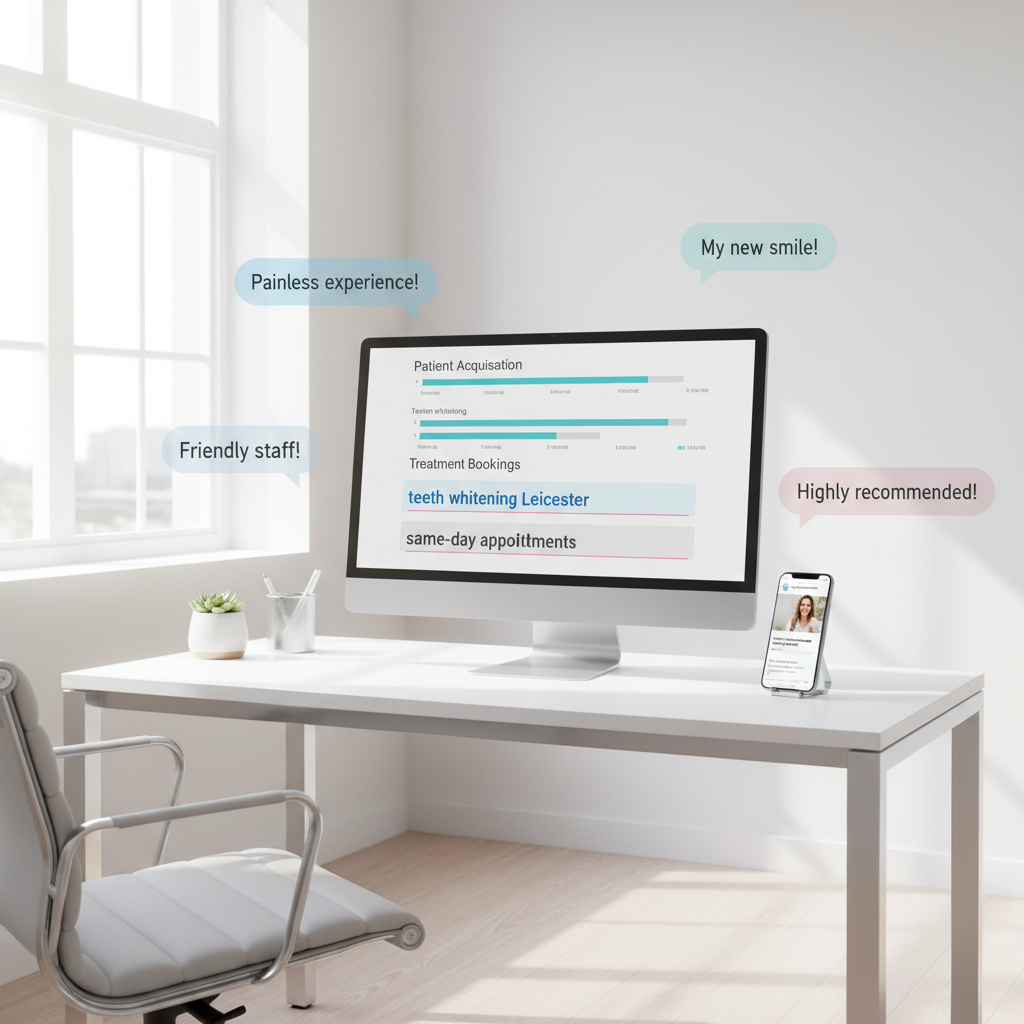
Search Engine Marketing (SEM) forms the backbone of qualified patient acquisition, delivering immediate visibility for high-intent searches like “teeth whitening Leicester” or “same-day appointments.” Social Media Advertising enables hyperlocal targeting and builds awareness among ideal patients who aren’t actively searching yet, excelling at promoting cosmetic treatments through patient testimonials and transformation imagery.
Display Advertising extends reach through Google’s Display Network—covering 90% of internet users—while functioning as powerful retargeting infrastructure for visitors who didn’t convert initially. Video Advertising on YouTube and social platforms captures attention through patient stories and treatment explainers, increasing trust signals that Google now rewards directly in rankings.
Google Ads for Dental Practices: Setup and Optimization
Effective Google Ads campaigns require three critical components: search campaigns capturing high-intent local searches, performance max campaigns automating placements across Google’s ecosystem, and remarketing lists for engaged prospects. Organize campaigns by treatment type—Invisalign, implants, cosmetic, emergency—rather than broad “dental services” to maximize relevance and conversion rates.
Budget allocation should prioritize high-value treatments: 60% toward premium keywords (implants, Invisalign) generating £500-£2,000+ consultations, with cost-per-click ranging from £2-£8 for general terms and £8-£20+ for premium treatments in major metropolitan areas. Headlines must address specific pain points: “Same-Day Emergency Care—Open Now in London” for urgent needs, “Invisible Braces That Actually Work—Results in Months” for cosmetic seekers.
For more detailed guidance on optimizing your campaigns, explore Google Ads for dentists to maximize your ROI and patient acquisition.
Mastering Social Media Advertising for Dental Patient Acquisition
Facebook and Instagram advertising excels for targeting families and cosmetic treatment seekers through detailed audience segmentation by household income, age, homeownership, and dental-related engagement. Create conversion campaigns optimized for appointment bookings, not traffic, with custom audiences segmented by treatment interest: Invisalign campaigns targeting ages 18-45 interested in cosmetics, implant campaigns for 45+ with higher purchasing power.
Video content outperforms static images by 300%+ on social platforms. Invest in 15-30 second patient testimonial videos showing smile transformations and real experiences. Implement retargeting sequences: days 1-3 (brand recall with testimonials), days 4-7 (social proof with reviews), days 8-14 (limited offers to overcome objections), improving conversion rates by 40-60% versus single-ad campaigns.
For creative inspiration, check out these dental social media ideas to enhance your campaigns and engage your audience more effectively.
Comparing Paid Search vs. Social Media Advertising for Your Practice
| Dimension | Google Ads (SEM) | Facebook/Instagram Ads |
|---|---|---|
| User Intent | High (actively searching) | Medium (browsing, not searching) |
| Cost Per Click | £3-£20+ depending on keyword | £0.50-£3 typically |
| Time to Booking | 7-14 days (faster) | 21-45 days (requires nurturing) |
| Best For | Emergency care, specific treatments | Building awareness, cosmetic dentistry |
| Conversion Rate | 5-10% (from searchers) | 1-3% (from cold audiences) |
| Ad Fatigue Risk | Lower (continuous searching) | Higher (repetitive exposure) |
Allocate 70% of budget to SEM for guaranteed high-intent capture, 20% to social media for awareness and pipeline building, and 10% to display/video for brand reinforcement. This ratio adjusts based on current capacity—maximize SEM when under-capacity, shift toward social media when patient flow is adequate.
Advanced Targeting Strategies: Location, Demographics, and Behavior
Move beyond practice postcode targeting by defining actual patient catchment areas through historical data—if 80% travel under 15 minutes, set geographic radius accordingly. Create separate campaigns for each major neighborhood, enabling hyper-localized messaging. A Manchester city center practice might run distinct campaigns for urban professionals, suburban families, and daily commuters.
Layer demographic and behavioral criteria strategically: implant campaigns should target adults aged 45+ with higher household incomes, while Invisalign campaigns focus on younger adults interested in cosmetic improvements. Use behavioral signals such as recent dental website visits or engagement with oral health content to refine your audience further. This approach ensures your ads reach the most likely patients, increasing both conversion rates and return on ad spend.
Comparing Digital Advertising Platforms for Dental Practices
Selecting the right digital advertising platform determines your practice’s patient acquisition success. Each platform serves distinct patient segments and treatment types, requiring strategic allocation based on your practice goals and budget constraints.
Dominate Dental – Complete Digital Marketing Solution
Best for: UK dental practices seeking comprehensive patient acquisition with guaranteed ROI
Dominate Dental stands as the UK’s leading dental marketing agency, combining AI-powered targeting with human expertise to deliver consistent consultation bookings. Their proprietary system integrates Google Ads, Facebook advertising, and SEO into a unified patient acquisition engine, eliminating the complexity of managing multiple platforms independently. Unlike generic marketing agencies, Dominate Dental specializes exclusively in dental practices, understanding treatment-specific conversion patterns and patient behavior cycles.
Proven Results: Dominate Dental clients average 40+ qualified consultations monthly with cost-per-booking under £80 across all treatment types. Their AI optimization reduces wasted ad spend by 35% compared to traditional campaign management.
Google Ads – Search Intent Capture
Best for: Practices targeting high-intent patients actively searching for treatments
Google Ads excels at capturing immediate demand when patients search “emergency dentist near me” or “Invisalign cost Manchester.” The platform’s strength lies in precise keyword targeting and immediate visibility, but requires ongoing optimization expertise to prevent budget waste on irrelevant clicks.
Advantages:
- Immediate visibility for treatment searches
- Detailed conversion tracking and ROI measurement
- High-intent traffic with strong conversion potential
Limitations:
- Requires constant keyword bid management
- High cost-per-click for premium treatment terms
- Limited audience building capabilities
Facebook & Instagram – Audience Development
Best for: Building awareness for cosmetic treatments and reaching families
Social media advertising enables precise demographic targeting and visual storytelling through before-after imagery. The platform excels at introducing your practice to potential patients who aren’t yet actively searching but match your ideal patient profile.
Advantages:
- Lower cost-per-click than search advertising
- Rich visual content showcasing treatment results
- Detailed audience segmentation options
Limitations:
- Longer conversion cycles requiring nurturing
- Ad fatigue from repeated exposure
- Limited intent signals compared to search
For more on building a robust online presence, see why a smart dental website design is crucial for success and how it supports your advertising efforts.
Platform Performance Analysis
| Platform | Average Cost Per Lead | Conversion Timeline | Best Treatment Types | Management Complexity |
|---|---|---|---|---|
| Dominate Dental | £25-£60 | 7-14 days | All treatments optimized | Fully managed |
| Google Ads | £40-£120 | 3-7 days | Emergency, implants | High (daily optimization needed) |
| Facebook/Instagram | £15-£45 | 21-45 days | Cosmetic, family dentistry | Medium (weekly adjustments) |
| YouTube Ads | £20-£80 | 14-30 days | Cosmetic procedures | Medium (content creation intensive) |
The data reveals significant performance variations across platforms. Dominate Dental’s integrated approach delivers the most consistent results by leveraging each platform’s strengths while eliminating their individual weaknesses through coordinated campaign management.
To further understand the evolution of digital marketing, you can review this overview of digital marketing and its impact on healthcare sectors.
Selecting Your Optimal Digital Advertising Strategy
Your practice’s current patient volume and treatment focus determine the most effective dental digital advertising approach. Practices under capacity should prioritize immediate patient acquisition through search advertising, while established practices benefit from awareness-building campaigns that attract higher-value cosmetic patients.
Budget Allocation Framework: Practices spending £2,000+ monthly achieve optimal results with 60% allocated to search campaigns (Google Ads), 25% to social media advertising (Facebook/Instagram), and 15% to display retargeting. This distribution captures immediate demand while building long-term patient pipelines. Smaller budgets under £1,000 monthly should concentrate entirely on Google Ads targeting emergency and high-value treatment keywords where immediate ROI justification is clearest.
Geographic Considerations: London and Manchester practices face higher competition requiring £3,000+ monthly budgets for optimal results, while practices in secondary UK cities may achieve similar outcomes with slightly lower spend. Always adjust your strategy based on local competition, patient demographics, and treatment mix to maximize your advertising ROI.
The Future of Dental Digital Advertising: 2025 and Beyond
Artificial intelligence and machine learning are fundamentally reshaping dental digital advertising effectiveness. Google’s Performance Max campaigns now automatically optimize ad placements across YouTube, Display, Search, Discover, Gmail, and Maps simultaneously, using AI to identify the highest-converting audiences without manual intervention. This shift toward automation means successful practices will focus less on campaign micromanagement and more on creative quality and landing page optimization.
Voice search optimization becomes critical as 55% of adults use voice search to find local businesses. Dental practices must optimize for conversational queries like “find a dentist near me that takes emergency appointments tonight” rather than traditional keyword phrases. This requires restructuring ad copy and landing pages to match natural speech patterns.
First-party data collection through patient portals, email marketing, and website interactions will replace third-party cookies entirely by late 2025. Practices building robust patient databases now will maintain competitive advantages as advertising platforms lose granular targeting capabilities. Smart practices are implementing progressive web apps and patient loyalty programs to capture zero-party data directly from patients.
Critical 2025 Trend: Video-first advertising dominates all platforms. Practices investing in professional video content creation—patient testimonials, treatment explanations, virtual consultations—will capture disproportionate market share as text-based ads lose effectiveness across all channels.
For more on leveraging video, discover the benefits of dental video marketing to boost patient engagement and trust.
Choosing the Right Dental Marketing Partner for Digital Advertising Success

Selecting a dental marketing agency determines your digital advertising ROI more than budget allocation or platform choice. The distinction between generalist marketing agencies and dental-specialized firms is profound—dental practices have unique compliance requirements, treatment-specific patient journeys, and local competition dynamics that require specialized expertise.
Dominate Dental stands as the UK’s leading dental marketing agency, delivering measurable results through AI-powered patient acquisition strategies combined with deep dental industry knowledge. Their approach integrates dental digital advertising with comprehensive SEO, conversion optimization, and patient retention systems, creating sustainable practice growth rather than temporary lead spikes.
What sets Dominate Dental apart is their proven track record with UK dental practices specifically—they understand GDC compliance requirements, NHS vs. private patient targeting strategies, and the nuanced local competition in markets from London to Manchester. Their clients typically see 40-70% increases in high-value treatment bookings within 90 days, with documented case studies showing practices growing from £50,000 to £200,000+ monthly revenue through strategic digital advertising implementation.
Key differentiators include proprietary patient journey mapping technology, real-time ROI tracking dashboards, and dedicated account management teams with dental industry experience. Unlike generalist agencies testing strategies on your practice, Dominate Dental applies proven frameworks developed specifically for UK dental practice growth.
Their comprehensive approach addresses the complete patient acquisition funnel—from initial ad impression through treatment completion and referral generation—ensuring your dental digital advertising investment compounds over time rather than requiring continuous budget increases to maintain results.
For additional insights, read these dental marketing ideas to inspire your next campaign.
Final Recommendations: Your Dental Digital Advertising Implementation Strategy
Begin with search engine marketing as your foundation—Google Ads campaigns targeting treatment-specific keywords in your local market deliver the fastest ROI and provide immediate data on patient demand patterns. Allocate £2,000-£4,000 monthly initially, focusing on high-value treatments where patient lifetime value justifies premium cost-per-click rates.
Layer social media advertising after establishing SEM baseline performance, using Facebook and Instagram to build awareness among patients not yet actively searching. This creates a pipeline of future patients while your search campaigns capture immediate demand. The combination delivers both short-term bookings and long-term practice growth.
Implement comprehensive tracking from day one—without accurate measurement, even successful campaigns appear ineffective. Use call tracking, conversion pixels, and GA4 integration to attribute every booking to its source. This data becomes invaluable for scaling successful campaigns and eliminating wasteful spending.
Remember that dental digital advertising success requires consistent optimization over 6-12 months. Initial campaigns establish baseline performance; ongoing refinement based on actual patient data drives exceptional ROI. Practices treating digital advertising as “set and forget” consistently underperform those investing in continuous improvement.
The competitive advantage belongs to practices implementing comprehensive digital strategies now, before local competitors recognize the opportunity. With 72% of patients researching online before booking, dental digital advertising has evolved from optional marketing tactic to essential practice infrastructure for sustainable growth in 2025 and beyond.
For further reading on the role of digital technology in dentistry, see this CQC guide to digital technology for dentists.
Frequently Asked Questions
How does dental digital advertising differ from traditional marketing methods in targeting potential patients?
Dental digital advertising targets potential patients with surgical precision by focusing on specific search queries and behaviours, such as “Invisalign Manchester,” capturing demand at the exact moment of intent. In contrast, traditional marketing methods broadcast broadly to large audiences without this level of targeting, resulting in less efficient patient acquisition.
What are the essential components of a successful dental digital advertising strategy in 2025?
A successful dental digital advertising strategy in 2025 integrates Search Engine Marketing (SEM) for immediate visibility on high-intent searches, social media advertising for hyperlocal awareness and engagement, and strategic retargeting to re-engage interested prospects. Incorporating AI-driven ad optimization and video content further enhances targeting precision and patient conversion rates.
How can Google Ads be optimized specifically for dental practices to improve patient acquisition?
Optimizing Google Ads for dental practices involves targeting high-intent keywords relevant to specific treatments and locations, using compelling ad copy that highlights unique practice benefits, and continuously refining campaigns through data analysis to reduce cost-per-lead. Additionally, leveraging ad extensions and local targeting ensures maximum visibility to qualified patients actively searching for dental services.
Why is integrating AI-driven ad optimization and video content important for modern dental digital advertising?
Integrating AI-driven ad optimization allows dental practices to automatically adjust bids, targeting, and creatives in real-time, improving efficiency and ROI. Video content enhances patient engagement by showcasing transformations and testimonials, increasing trust and conversion rates in an increasingly competitive digital landscape.
Leave a Reply