dental lead nurturing
What is Dental Lead Nurturing and Why Does Your Practice Need It?
Defining Dental Lead Nurturing for UK Practices
Dental lead nurturing is the systematic process of converting prospects into booked patients through targeted, timely communication. It starts from first contact and continues until they’re sitting in your chair. This isn’t about generic follow-ups—it’s about understanding exactly where each prospect sits in their decision-making journey and delivering the right message at the right moment.
For UK practices focusing on high-value treatments like Invisalign marketing and implants, this approach turns casual enquiries into committed patients. The typical journey spans 7–14 days for cosmetic treatments and 3–6 months for complex procedures. Most practices lose 60–70% of initial enquiries because they don’t have a system. Your competitors are following up. You need to do it better.
What Happens Without a Nurturing System
Your reception team responds when they can. Maybe within a few hours. Maybe the next day. By then, that £8,000 implant enquiry has already booked with someone faster.
Here’s what we see daily: practices spending £2,000+ monthly on marketing but converting under 5% because there’s no systematic follow-up. No-show rates hit 30–40%, wasting chair time you’ll never get back. Emergency leads convert within 24 hours or disappear. Implant enquiries need 8–12 touchpoints before booking—but most teams can’t sustain that level of engagement without automation.
The Reality: Practices without structured dental lead nurturing lose £15,000–£25,000 monthly in treatment revenue that should’ve been theirs. That’s not a projection. That’s what we measure when we audit new clients.
How Dominate Dental Delivers Results
We combine AI-powered automation with human expertise to generate qualified consultations for UK practices. Our clients see strong conversion rates because we handle each stage of the patient journey with treatment-specific sequences.
Emergency leads get immediate response protocols. Implant prospects enter longer campaigns with educational content, finance options, and social proof. This treatment-led approach lets practices focus their time and budget where it matters most. We’re at Grosvenor House, 11 St Paul’s Square, Birmingham B3 1RB, with a 5.0 Google rating from 18 reviews because our data-driven approach delivers measurable ROI for practices across Greater London, Manchester, and Birmingham.
The 4-Stage Dental Patient Journey: Tailor Your Nurturing Strategy

Stage 1: Awareness – Capturing Initial Interest
Prospective patients enter awareness when they first recognise a dental need. They search “teeth straightening options London” or click a Facebook advert showcasing smile transformations. Your objective here? Rapid acknowledgement and useful information.
Respond within 15 minutes with a personalised message that addresses their specific enquiry. Not “thanks for contacting us.” Provide immediate resources: a guide to treatment options, finance information, before-and-after galleries. Capture qualifying details through conversational questions about timeline, budget, and previous dental experiences. This stage typically lasts 24–72 hours for emergency needs and 1–2 weeks for cosmetic treatments.
Stage 2: Consideration – Building Trust
During consideration, prospects evaluate whether you’re the right choice. They compare prices, read reviews, assess expertise. They’re looking for reasons to say yes—or no.
Your messaging should address common objections: cost concerns, treatment discomfort, time commitment, clinician credentials. Share patient testimonials relevant to their treatment interest. Clear qualifications. Transparent pricing ranges where appropriate. Multi-channel engagement matters here. Combine email with SMS reminders, retargeting adverts, and virtual consultation options for busy professionals.
For Invisalign enquiries, send case studies showing 6–12-month transformations. For implants, share short videos explaining the procedure and recovery timeline. This stage usually spans 1–3 weeks for cosmetic work and 4–8 weeks for implants.
Stage 3: Decision – Closing the Booking
The decision stage is about removing final barriers. Offer flexible appointment times—evenings and weekends. Provide payment options: 0% finance, payment plans, insurance support where relevant.
Create urgency with time-limited offers or seasonal promotions, but avoid high-pressure tactics that damage trust. Automated booking reminders reduce missed appointments. Send confirmation immediately, then reminders at 7 days, 3 days, and 24 hours before the appointment. Include clear directions, parking information, and what to bring. Practices using timed reminder sequences cut no-shows by 40–50%.
Stage 4: Retention – Turning Patients into Advocates
Post-treatment communication turns one-time patients into repeat patients and referrers. Within 24 hours of treatment, send personalised aftercare instructions and a check-in message. At 7 days, request feedback and reviews. At 30 days, introduce referral incentives and relevant next-step treatments.
Retention activity drives 30–40% of practice revenue through repeat care and referrals. Don’t ignore this stage. It’s where the real money compounds.
Treatment-Specific Timeframes: Emergency vs Invisalign vs Implants
Emergency leads demand immediate response—converting within 2–4 hours or moving on. Routine hygiene enquiries convert in 3–7 days with light follow-up. Invisalign prospects need 2–4 weeks of education and finance discussions. Implant enquiries can take 8–16 weeks, with more support around surgical concerns, healing, and total investment. Tailor your dental lead nurturing sequences to these different timeframes.
5 Primary Types of Dental Leads and Their Cost Per Lead
Emergency Leads: 24-Hour Conversion Focus
Emergency dental leads are high-intent prospects experiencing acute pain or dental trauma. They need immediate care. These enquiries convert within 2–4 hours or go to competitors offering quicker responses.
UK practices pay £15–£35 per emergency lead, with conversion rates reaching 60–80% when instant-response protocols are in place. The key? Automated SMS acknowledgement within 60 seconds, followed by a phone call within 15 minutes offering same-day appointments.
Family and Hygiene Leads: Routine Care Nurturing
Family and hygiene leads seek preventative care, check-ups, and routine cleans. These prospects cost £8–£20 per lead with conversion rates of 25–35%. Whilst lower value upfront, they create stable recurring revenue and opportunities for cosmetic uptake over time.
Sequences should focus on convenience, family-friendly scheduling, and membership plans. A 5–7-day follow-up cycle with clear appointment options converts these leads well.
Cosmetic Leads: Building Confidence
Cosmetic leads enquire about teeth whitening, veneers, and smile makeovers. These prospects cost £25–£60 per lead and typically need 2–4 weeks of follow-up. What do they care about? Aesthetics, process, expected outcomes. Conversion rates range from 15–25%.
Use before-and-after galleries, patient testimonials, and virtual smile consultations. Content covering longevity, maintenance, and finance options moves prospects from interest to booking.
High-Ticket Leads: Invisalign and Implant Strategies
Invisalign and implant leads are your highest-value prospects. Treatment values range from £3,000 to £8,000. Cost per lead? £80–£150. Conversion rates around 8–15%.
These prospects need longer follow-up—often 8–16 weeks—covering concerns about treatment duration, surgical steps, comfort, and total investment. Multi-touch campaigns featuring clinician credentials, 3D simulations, finance breakdowns, and case studies perform best. The goal is consistent support without overwhelming the prospect.
Typical UK Cost Per Lead by Treatment Type
| Lead Type | Cost Per Lead | Conversion Rate | Nurturing Duration |
|---|---|---|---|
| Emergency | £15–£35 | 60–80% | 2–4 hours |
| Family/Hygiene | £8–£20 | 25–35% | 5–7 days |
| Cosmetic | £25–£60 | 15–25% | 2–4 weeks |
| Invisalign | £80–£120 | 10–15% | 8–12 weeks |
| Implants | £100–£150 | 8–12% | 12–16 weeks |
Actionable Lead Scoring and Qualification Framework
How to Score Leads: Engagement, Needs, and Objections
Lead scoring assigns values based on three factors: engagement quality, treatment interest, and booking readiness.
Award 10 points for prospects who respond to initial contact within 24 hours. 20 points for specific treatment enquiries versus general questions. 30 points for prospects who discuss budget and timeline. Deduct points for vague responses, repeated reschedules, or no engagement after three touchpoints.
Leads scoring 60+ warrant immediate phone follow-up and priority scheduling. Those scoring 30–60 enter automated email sequences with periodic manual check-ins.
Qualification questions reveal intent. Ask, “What prompted you to look into this treatment now?” to understand urgency. Ask, “Have you had consultations elsewhere?” to gauge comparison shopping. Ask, “What timeline are you considering?” to assess readiness. Prospects with clear motivations, minimal competitor engagement, and defined timelines convert at 3–4 times the rate of casual enquirers.
Multi-Channel Nurturing Sequences That Convert
Co-ordinated messaging across email, SMS, phone, and retargeting adverts consistently outperforms single-channel follow-up.
Here’s a typical sequence: Day 1, personalised email with treatment information and a booking link. Day 2, SMS with a short clinician introduction video. Day 4, phone call offering a consultation. Day 7, email with a relevant testimonial and a time-sensitive offer. Day 10, SMS reminder about availability. Day 14, final email with alternative options.
This structured approach drives 40–60% higher conversion rates by meeting prospects in the channels they actually use.
Reducing No-Shows with Timed Reminders
No-shows cost UK practices roughly £150–£400 per missed appointment in lost revenue and wasted capacity. Automated reminder sequences reduce no-show rates from 30–40% to under 10%.
Send booking confirmation immediately with a calendar invite. At 7 days before, email with appointment details and prep guidance. At 3 days, SMS with location and parking details. At 24 hours, phone call confirming attendance and offering rescheduling if needed. At 2 hours, a final SMS reminder.
Include a simple way to reschedule in each message so genuine conflicts are captured early.
Tools and Automation for Scaling Efforts
Practices handling 50+ monthly leads need a CRM with automated workflows, SMS integration, and lead scoring. Useful features include triggered email sequences based on actions, automated appointment reminders, call tracking with recording, and reporting on conversion metrics.
AI chat handles initial enquiries out of hours, qualifies leads, and books consultations. At Dominate Dental, we implement and manage these systems for clients, combining technology with expert campaign management to increase conversions whilst cutting manual follow-up time. Explore our full Dominate Dental marketing services to elevate your lead nurturing efforts.
Post-Consultation Nurturing and Measuring Success
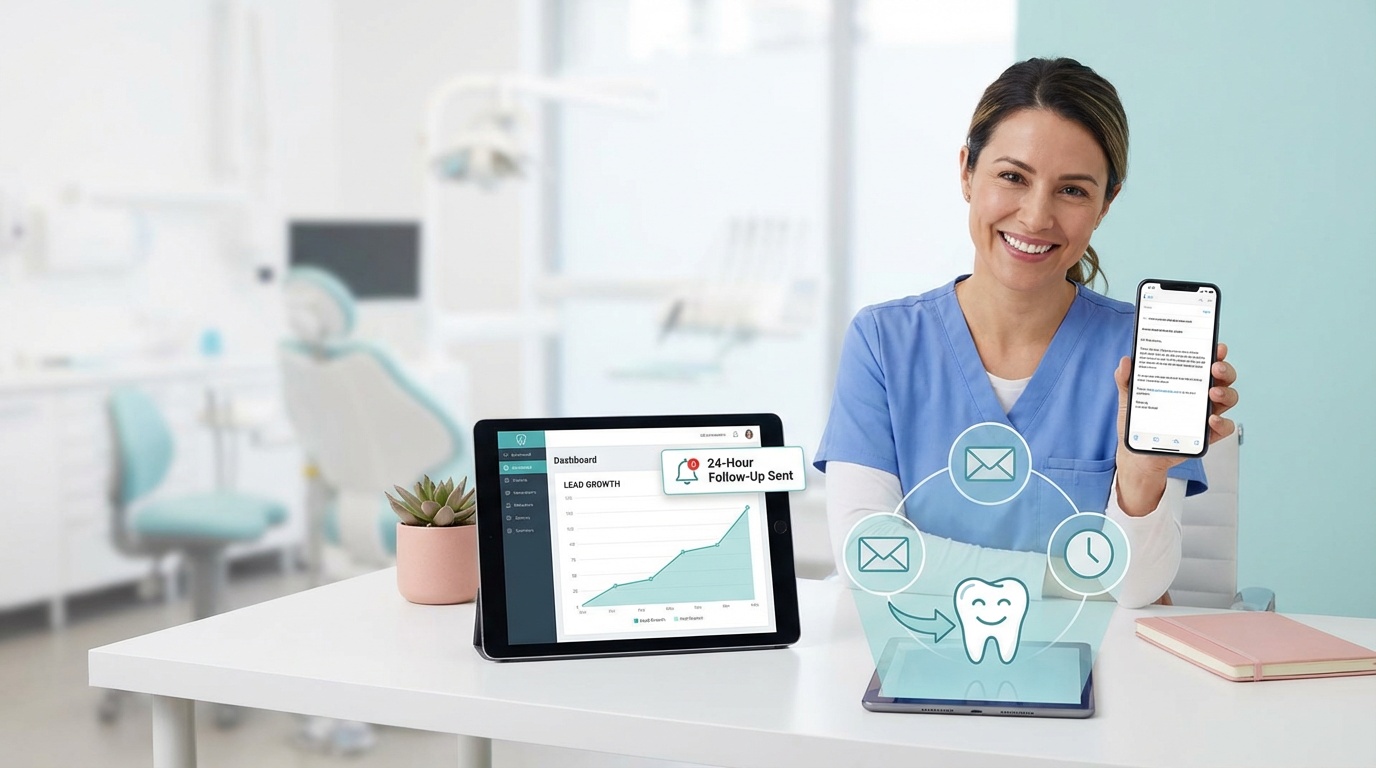
24-Hour Follow-Up Protocols for Treatment Plans
The 24 hours after a consultation are your conversion window. Send a personalised email within 2 hours thanking the prospect, summarising the treatment plan, and attaching a clear cost breakdown with finance options.
Within 24 hours, make a phone call to answer questions raised in the consultation and adjust the plan based on their feedback where appropriate. This faster follow-up converts 30–40% of consultations into booked treatments, compared with 10–15% when follow-up is slow or inconsistent.
Key Metrics: Conversion Rates, No-Show Reduction, ROI
Track five essential metrics to optimise your follow-up process:
Lead-to-consultation conversion rate (target: 20–30%). Consultation-to-treatment conversion rate (target: 35–50%). No-show rate (target: under 10%). Average days from enquiry to booking (target: under 14 days). Cost per acquired patient versus lifetime value (target: at least a 1:5 ratio).
Monthly review of these figures shows where prospects drop off and what to adjust.
Why Dominate Dental Delivers Qualified Leads Monthly
Our methodology combines targeted advertising to high-intent prospects, AI-powered instant response systems, and treatment-specific follow-up sequences built from managing thousands of dental enquiries. We focus on practices offering high-value treatments and track outcomes through transparent reporting tied to ROI.
Our 5.0 Google rating reflects consistent delivery of measurable results for UK practices nationwide.
Get Started: Book Your Free Lead Nurturing Audit
Discover where your practice is losing potential patients with a complimentary nurturing audit. We’ll review your current follow-up process, identify conversion gaps, and provide a tailored action plan to increase bookings within 90 days. Contact Dominate Dental at Grosvenor House, 11 St Paul’s Square, Birmingham B3 1RB, or visit our Google Maps listing to schedule your audit.
Advanced Nurturing Strategies for Maximum ROI
Segmentation by Treatment Value and Patient Lifetime Potential
Not all leads warrant the same amount of time. Practices seeking better ROI segment prospects into three tiers based on treatment value and lifetime potential.
Tier 1 includes implant and full-mouth rehabilitation enquiries (£8,000+), receiving dedicated support, personalised video messages from the principal dentist, and priority scheduling. Tier 2 covers Invisalign, veneers, and cosmetic work (£2,000–£8,000), using automated sequences with planned manual touchpoints. Tier 3 includes routine care and single-tooth treatments (under £2,000), handled mostly through automation with minimal team time.
Lifetime value should guide these decisions. A family joining for routine care may start as Tier 3 but can represent £15,000+ over five years across family members, plus future cosmetic work. Identify high-potential families through qualifying questions about household size and oral health priorities, then move them into Tier 2 for more relationship-led messaging.
Personalisation at Scale Through Dynamic Content
Generic email blasts convert at 2–3%. Personalised messages? 12–18%.
Modern CRMs allow dynamic content based on details captured during the initial enquiry. Subject lines using a prospect’s name and treatment interest (for example, “Sarah, your Invisalign consultation details”) lift open rates by around 40% versus generic alternatives. Message bodies should reference the prospect’s stated concerns, timeline, and budget range where known.
Video personalisation increases engagement. Record short welcome videos that address prospects by name, acknowledge their specific interest, and introduce the dentist who would carry out the procedure. These 30–60-second clips require minimal time but create a more human connection than text-only follow-up.
Referral Activation Systems Within Nurturing Sequences
Your strongest leads come from existing patient referrals, with conversion rates commonly around 50–70% versus 15–25% from colder enquiries. Add referral requests into post-treatment messaging at the right moments.
Seven days after successful treatment completion, send an email requesting Google reviews and offering a referral incentive (such as £50 credit towards future treatment for each referred friend who completes treatment). At 30 days, share social media graphics patients can post. At 90 days, introduce tiered referral programmes that reward multiple referrals with bigger benefits.
Referred leads should receive a modified sequence that acknowledges the referring patient by name and offers priority scheduling as a courtesy. This reinforces trust from the referral and shows appreciation for advocacy.
Seasonal Campaign Integration for Predictable Revenue
Many practices plan campaigns around seasonal demand patterns. January and September see a lift in cosmetic enquiries as prospects aim for New Year changes and back-to-school confidence. Launch campaigns in November and July to nurture prospects towards those periods with early-bird pricing and priority availability.
Pre-holiday campaigns (October–November) promoting teeth whitening for Christmas photos perform well with cosmetic-minded audiences. Build evergreen sequences that adapt seasonal messaging based on the enquiry date. Someone enquiring in October about Invisalign receives messaging about finishing before summer holidays, whilst March enquiries align with graduation and wedding season deadlines.
This keeps messages relevant and aligned with real-world planning.
Balancing Automation with Human Touch
When Automation Fails and Human Intervention Succeeds
Automation handles routine touchpoints efficiently, but it can’t replace human judgement in complex situations. High-value prospects with concerns about surgery, longer timelines, or major financial commitments often need direct clinician or treatment co-ordinator input.
Configure your CRM to flag leads mentioning terms such as “nervous”, “pain”, “cost concerns”, or “previous bad experience” for fast review and personal outreach. Prospects who engage with multiple emails but don’t book can be warm leads that need a conversation. After 14 days of engagement without conversion, assign them to a treatment co-ordinator for a discovery call to surface barriers.
Common issues? Work scheduling. Worries about partner approval for cosmetic spending. Uncertainty about insurance cover. These are easier to resolve in a call than through automation alone.
Staff Training Requirements for Follow-Up Success
Technology supports conversions, but team execution drives them. Treatment co-ordinators need training in consultative selling, objection handling, and finance conversations. Reception teams should understand qualification criteria so enquiries are scored and routed correctly. Clinicians benefit from being able to record short videos for high-value prospects and understanding their part in converting these enquiries.
Monthly reviews of conversion data, recorded calls, and response rates highlight training needs and process gaps. Practices that invest in skills as well as systems see materially better conversion rates than those relying on automation alone.
Compliance and Data Protection in UK Dental Marketing
All follow-up activity must comply with UK GDPR and ICO guidance. Obtain clear consent for marketing communications during the initial enquiry and explain how data will be used. Provide an easy unsubscribe option in each automated message.
Store prospect data securely with appropriate access controls and retention policies. Keep consent records and communication preferences within your CRM to support compliance. Avoid buying third-party lead lists, which can breach consent requirements and often produce poor-quality enquiries. Focus on prospects who’ve directly contacted your practice.
The Future of Dental Lead Nurturing in 2026 and Beyond

AI-Powered Predictive Analytics and Conversion Forecasting
Emerging AI tools analyse large volumes of behavioural and engagement data to predict conversion likelihood. Used well, this helps teams decide which leads deserve more one-to-one time and which can stay in automated sequences, improving allocation of time and budget.
Predictive scoring improves as it learns from your practice’s own outcomes. AI chat can now handle more detailed qualification conversations, asking follow-up questions based on responses and offering suitable appointment slots. Natural language processing detects urgency, budget limits, and treatment preferences, routing higher-priority leads to staff quickly whilst handling routine enquiries out of hours.
Omnichannel Integration and Voice Search Optimisation
The future of patient follow-up is a joined-up journey across touchpoints. Prospects might discover your practice on Instagram, enquire via website chat, receive emails, then book via WhatsApp. A unified CRM tracks these journeys and prevents duplicated or conflicting outreach.
Voice search continues to grow, with more enquiries coming from voice assistants using searches like “dentists near me offering Invisalign”. Optimising for these conversational queries matters.
How Dominate Dental Stays Ahead of Industry Trends
We invest in emerging tools and testing so UK practices can adopt what works, not what’s merely new. Our internal frameworks combine predictive scoring with treatment-specific messaging built from managing thousands of enquiries. We test platforms, messaging, and automation before rolling them out to clients, prioritising proven performance.
As a dental marketing agency, we maintain partnerships with CRM providers and advertising platforms so clients access new capabilities sooner. Our focus stays consistent: generating qualified consultations that convert into high-value patients, measured through clear reporting and ROI.
Your Next Step: Implementing a structured follow-up system turns marketing spend into predictable revenue. Practices that adopt these processes often see conversion improvements within 90 days, which translates into meaningful additional monthly treatment revenue. Start with our complimentary audit to identify your highest-impact opportunities and prioritise what to implement first.
Frequently Asked Questions
What is the 80/20 rule in dentistry?
The 80/20 rule, or Pareto Principle, suggests that roughly 80% of your practice’s revenue often comes from 20% of your patients or services. In dental lead nurturing, this means focusing your efforts on high-value treatments like implants or Invisalign, and the most engaged prospects. By strategically nurturing these leads, you maximize your return on marketing investment.
What are some effective dental lead nurturing strategies?
Effective dental lead nurturing involves tailoring communication to each prospect’s stage in their decision-making journey. This includes rapid, personalized responses to initial enquiries, sharing relevant testimonials and finance options during consideration, and providing clear booking reminders at the decision stage. Post-treatment follow-ups are also key for retention and referrals.
What is the "rule of 7" in dental marketing?
The “rule of 7” in dental marketing highlights the need for prospects to encounter your practice at least seven times before they feel comfortable enough to book. Our data shows complex procedures like implants often require 8-12 touchpoints. Consistent, multi-channel engagement through dental lead nurturing builds the trust and familiarity needed for conversion.
Why is dental lead nurturing important for practice growth in the UK?
Dental lead nurturing is critical because it prevents initial enquiries from going cold, which can result in practices losing 60-70% of potential patients. It keeps your practice top of mind, addresses patient concerns, and builds the trust necessary to justify premium treatment costs. This systematic approach can significantly increase consultation bookings and treatment revenue.
What challenges do dental practices face without proper lead nurturing?
Without structured dental lead nurturing, practices commonly see high-quality leads go cold within 48 hours due to delayed or generic responses. They also experience low conversion rates from marketing spend and high no-show rates for consultations, sometimes reaching 30-40%. This can lead to substantial lost revenue, estimated at £15,000-£25,000 monthly for some practices.
How does Dominate Dental approach dental lead nurturing?
At Dominate Dental, we combine AI-powered automation with human expertise to deliver qualified leads for UK practices. Our methodology covers each stage of the patient journey with treatment-specific sequences, from immediate responses for emergency leads to longer educational campaigns for implant prospects. This data-driven approach focuses on converting enquiries into high-value patients.
Leave a Reply