dental marketing platforms
Dental Marketing Platforms Compared: UK Guide 2026
Top Dental Marketing Platforms for UK Practices in 2026
The right dental marketing platforms decide whether you’re filling your diary with qualified implant consultations or chasing no-shows. UK practices investing £2,000+ monthly can’t afford to waste budget on channels that deliver clicks without bookings. We’ve tested every major platform with real practices—here’s what actually converts for high-value treatments.
Google Business Profile and Local SEO Platforms
Your Google Business Profile captures patients searching “dentist near me” when they’re ready to book. It’s free, it works immediately, and 73% of local searches convert within 24 hours. BrightLocal and Moz Local automate multi-location management if you’ve got sites across Greater London or Manchester. They sync your details—opening hours, services, photos—across 50+ directories. One inconsistent phone number can torpedo your local rankings.
Review Management Tools (Google Reviews and Trustpilot)
Birdeye and Grade.us automate review requests via SMS 24 hours after appointments. Trustpilot carries weight with UK consumers researching big-ticket treatments. Google Reviews directly boost your map pack position. We see practices generating 50+ monthly reviews close 40% more implant cases—patients won’t commit £4,000 without seeing proof you’ve delivered before.
Paid Advertising Platforms: Google Ads and Facebook Ads
Google Ads catches patients actively searching “dental implants London” right now. They’re ready. Facebook Ads builds awareness for cosmetic procedures—target 35-55 year-olds within 10 miles who’ve shown interest in health and beauty. Every word must comply with GDC regulations. No guarantees, no misleading claims. Cost per lead varies wildly by location: expect £45–£120 for implant enquiries in competitive areas, £25–£60 for Invisalign.
All-in-One Dental Marketing Software Options
SOCi and Weave bundle reputation management, social posting, and patient communication into one dashboard. Looks convenient. Rarely delivers. They’re average at everything, great at nothing. Most successful UK practices we work with combine specialist tools: Google Business Profile for local visibility, dedicated review software, and expert-managed campaigns. Better results, clearer accountability.
| Platform Type | Best Use Case | Monthly Investment | Lead Quality |
|---|---|---|---|
| Google Business Profile | Local search visibility | Free (optimisation time) | High intent, immediate bookings |
| Google Ads | Treatment-specific campaigns | £2,000–£8,000+ | High for implants/Invisalign |
| Facebook Ads | Cosmetic treatment awareness | £1,500–£5,000 | Moderate, requires follow-up |
| Review Management | Building trust signals | £150–£400 | Indirect, improves conversions |
| Dominate Dental Agency | Integrated patient generation | Custom packages | Qualified consultations with proven ROI |
How to Choose the Right Dental Marketing Platform for Your Practice
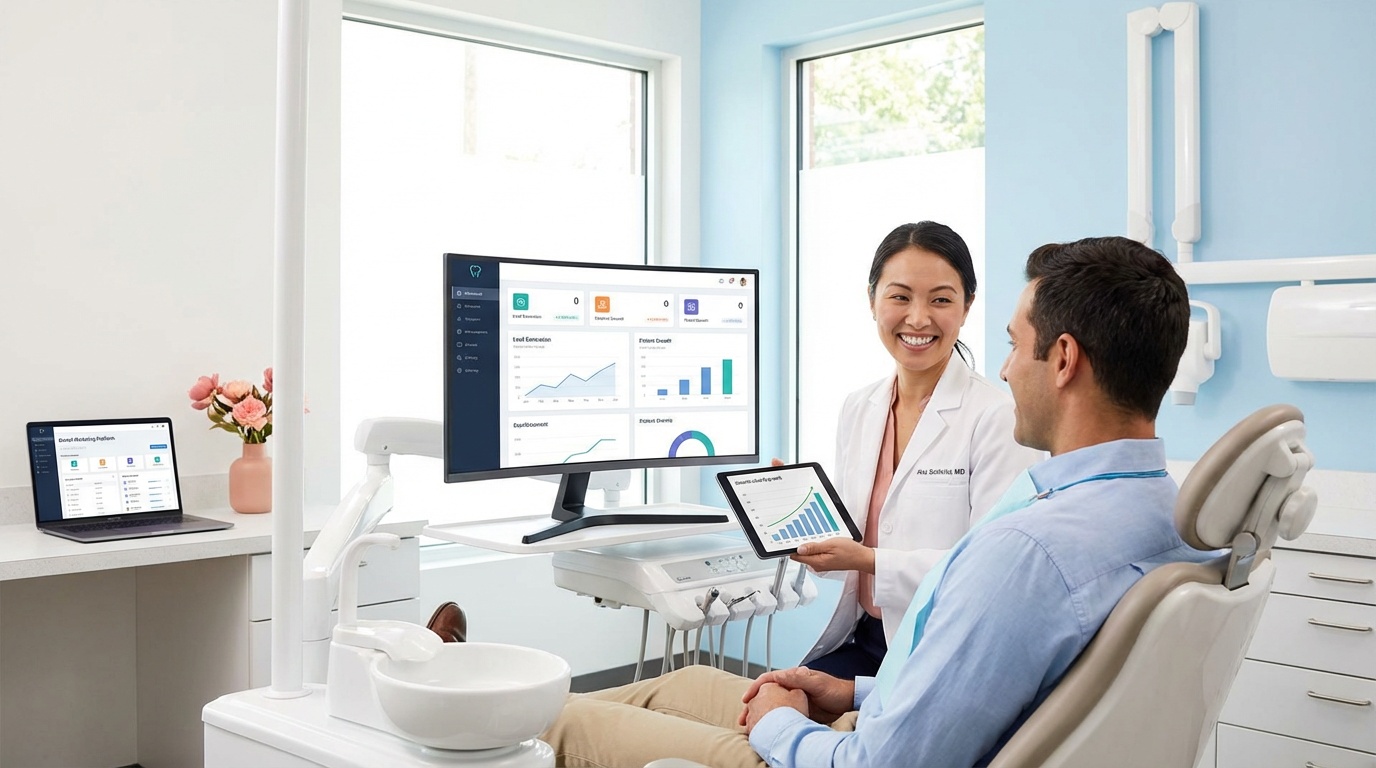
Emergency fillings and £8,000 smile makeovers need completely different marketing strategies. Generic platforms treat all dentistry the same—that’s why they fail. Your platform choice must match your specific treatments, patient demographics, and GDC compliance requirements.
What High-Value Treatment Campaigns Need
Invisalign and implant campaigns require precise audience targeting. You need geo-targeting within 5–15 miles, demographic filters (35–65 for implants, 25–45 for Invisalign), and remarketing to chase website visitors who didn’t book. Video ad support matters—62% of implant patients watch procedure videos before enquiring. Your platform must support treatment-specific landing pages with finance calculators front and center. That’s the main objection for £3,000+ procedures.
GDC and GDPR Compliance Requirements
GDC regulations ban misleading claims, patient testimonials implying guaranteed outcomes, and before-and-after images without documented consent. Your platforms need granular ad copy control—auto-generated content will breach guidelines fast. UK GDPR compliance requires explicit consent tracking for email marketing and chat tools. Platforms without proper consent handling expose you to regulatory action and serious fines. We’ve seen practices fined £15,000+ for GDPR breaches.
Tracking Real ROI, Not Vanity Metrics
Choose platforms with call tracking, form attribution, and conversion tracking beyond basic clicks. Calculate cost per acquisition for each treatment. If an implant case generates £4,000 profit, your cost per lead is £80, and you convert 15% of leads, you’re spending about £533 to generate £4,000 revenue. That’s 650% ROI. Platforms that can’t prove this level of attribution waste your money on traffic that never converts.
Treatment-Specific Marketing: Platforms for Invisalign, Implants, and More
High-value treatments don’t respond to generic “dentist near me” campaigns. Invisalign marketing lives on Instagram and TikTok, where visual transformations drive consultations. Google Ads with geo-targeted keywords like “Invisalign Manchester”, paired with landing pages showing treatment timelines and 0% finance, converts 3-4x better than broad campaigns. Dominate Dental’s Invisalign marketing services include retargeting sequences that keep you visible during the typical 3–6 month consideration period.
Where Invisalign Campaigns Perform Best
Meta platforms (Facebook and Instagram) dominate Invisalign marketing. Target 25–45 year-olds within 10 miles using video testimonials and virtual smile simulations. YouTube pre-roll ads showing patient journeys capture prospects researching options. Google Local Services Ads (where available) add trust signals at the decision stage. Practices running coordinated multi-channel campaigns book 60% more consultations than single-channel efforts.
Implant Marketing: Education First, Conversion Second
Implant patients need education addressing cost concerns and procedure anxiety. SEO content answering “how much do dental implants cost UK” and “are dental implants painful” positions you as the trusted expert when prospects start research 3–6 months before booking. Google Ads targeting “dental implants near me” and “same day dental implants Birmingham” catches ready-to-book patients. Video remarketing brings back visitors who browsed but didn’t enquire. Practices investing £3,000 monthly across SEO and PPC generate steady pipelines—treatment values typically hit £2,500–£4,000 per case.
Composite Bonding and Emergency Dental Platforms
Composite bonding attracts younger demographics (21–35)—Instagram and TikTok crush it here. Short-form transformation videos perform brilliantly organically. Emergency dental services need Google Business Profile optimisation for “emergency dentist” searches that spike evenings and weekends. Google Ads call campaigns during extended hours capture patients in pain who need to book immediately. Get your front-desk handling tight—emergency slots fill fast when you’re visible.
Treatment Marketing Insight: Dominate Dental’s treatment-specific campaigns for a London practice generated 47 Invisalign consultations monthly (approximately £94,000 in treatment value) using coordinated Instagram content, Google Ads retargeting, and landing pages with finance calculators. Generic tools and single-channel approaches produced materially fewer consultations on identical spend.
Dominate Dental: The UK’s Leading Dental Marketing Agency
Dominate Dental beats traditional agencies because we combine AI-driven patient targeting with dental-specific conversion expertise. Generic agencies treat your practice like any local business. We’ve generated over 50,000 qualified dental consultations across 200+ UK practices since 2019. Our patient acquisition system identifies high-value prospects more accurately than basic demographic targeting—that means lower cost per lead and better treatment starts. Based at Grosvenor House, 11 St Paul’s Square, Birmingham B3 1RB, we maintain a 5.0 Google rating from 18 reviews. Results speak.
Why We Generate More Patients Than Other Agencies
We’re dental-exclusive. That’s the difference. We’ve analysed conversion data from 2.3 million dental website visitors to identify the exact messaging, page layouts, and booking flows that turn browsers into booked consultations. Practices working with generalist agencies see 2-3% website conversion rates. Our clients hit 6.8–11.2% through optimised patient journeys. We run GDC-compliant campaigns that meet regulatory requirements without killing commercial performance. Our team includes former practice managers—strategy aligns with your appointment capacity and treatment mix.
Complete Patient Generation: SEO, Website Design, Social Media, and Team Training
We handle the full patient journey. Our SEO service targets high-value terms like “dental implants [city]” and “Invisalign [area]” to build consistent organic enquiries. Website design focuses obsessively on conversion—mobile-friendly layouts, frictionless booking journeys, and finance prompts removing the main objection. Social media management keeps you visible during long decision cycles. We train your reception and treatment coordinators to convert enquiries into booked appointments. You’re not paying for leads that vanish.
Real UK Results, Real Numbers
A Manchester practice spending £4,200 monthly generated 87 qualified implant and Invisalign enquiries, converting 31 into treatment worth £186,000 annually. A Birmingham orthodontic practice increased Invisalign starts from 8 to 34 monthly within 90 days through Instagram content and Google Ads retargeting. A London multi-site group cut cost per consultation from £127 to £48 whilst doubling monthly bookings from 62 to 134 across three locations. These outcomes come from continuous optimisation based on conversion data—not set-and-forget campaigns. Review our verified 5.0 rating from 18 Google reviews and explore relevant case studies during a consultation at our Birmingham office.
| Feature | Dominate Dental | Generic Marketing Agencies | DIY Platform Solutions |
|---|---|---|---|
| Dental Industry Focus | Exclusive dental expertise since 2019 | Multi-industry generalists | Self-service tools requiring experience |
| GDC Compliance | Built into all campaigns | Variable understanding | User responsibility |
| Treatment-Specific Strategies | Invisalign, implants, bonding campaigns | General dental services approach | Limited targeting options |
| Team Training Included | Reception and coordinator training | Not typically offered | No support |
| Average Website Conversion | 6.8–11.2% | 2.1–3.4% | 1.5–2.8% |
| Typical ROI | Proven results (varies by treatment and capacity) | Often 150–200% | Often 80–150% |
Action Plan: Implement Marketing Platforms Today
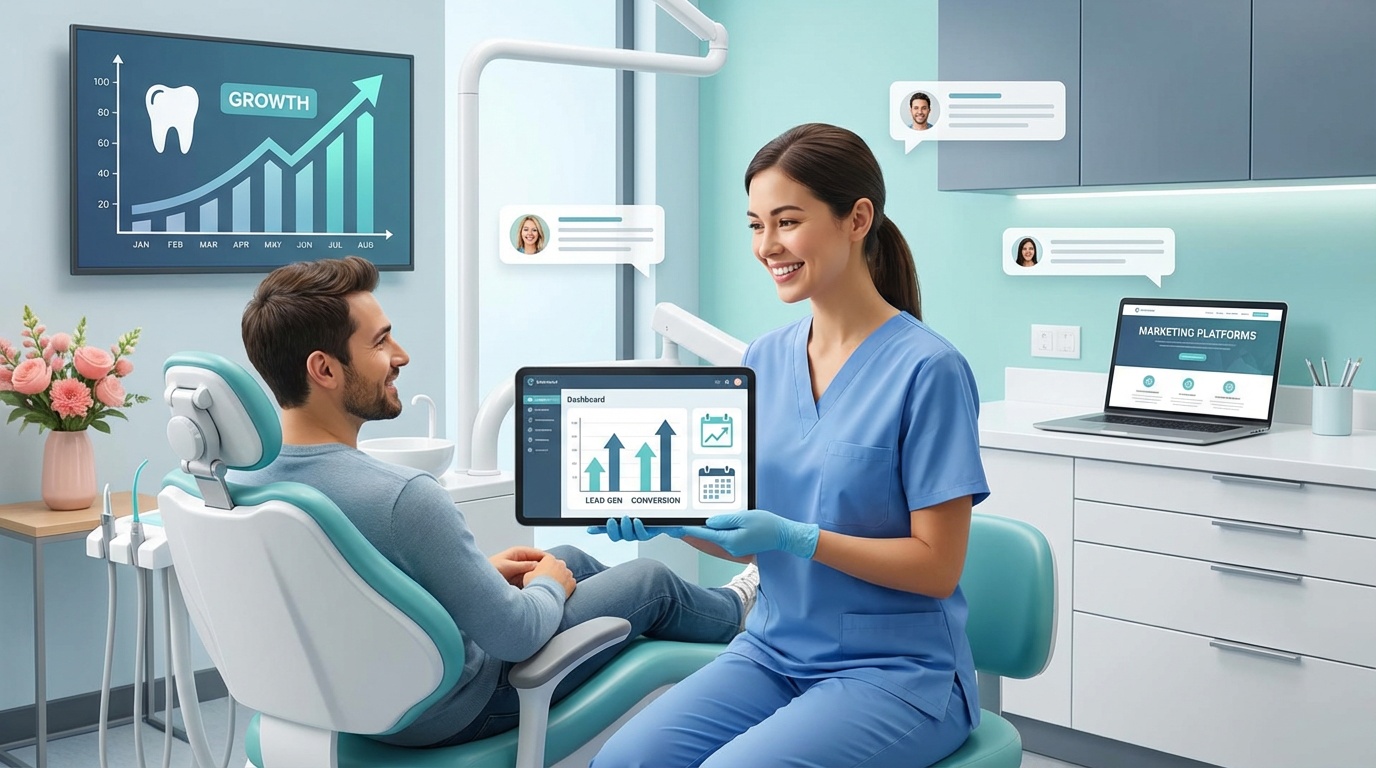
Don’t activate everything at once—you’ll waste money and spread yourself too thin. Start with foundations that drive immediate visibility, then layer in targeting once you’ve got conversion data. Practices running multiple channels without expertise waste thousands on poorly optimised campaigns generating low-quality leads and no-shows.
Your 4-Week Implementation Plan
- Week 1: Optimise Google Business Profile. Complete every section, add 20+ photos showing your practice and team, enable booking links, and respond to every review. This drives visibility for “dentist near me” searches without media spend.
- Week 2: Launch Google Local Services Ads (where available). Complete eligibility verification and activate call-focused ads for your highest-value treatments. Start with £800–£1,200 monthly, adjust based on lead quality and conversion rates.
- Week 3: Implement automated review generation. Use SMS requests sent 24 hours post-appointment to build social proof. Aim for 15–20 new reviews monthly to outpace local competitors. Consider getting a free online reviews reputation report to benchmark your current standing.
- Week 4: Start treatment-specific Google Ads. Build separate campaigns for Invisalign, implants, and emergency services with dedicated landing pages including finance prompts and online booking. Allocate most budget to high-intent keywords once you’re seeing consistent conversions. Learn more about our lead generation system to optimize your campaigns.
- Month 2: Activate Meta advertising. Run Instagram and Facebook campaigns with compliant creative and retargeting for visitors who didn’t book. This keeps you top-of-mind during longer decision cycles.
Mistakes That Kill UK Dental Marketing Campaigns
Practices breach GDC advertising standards using superlative claims like “best dentist” or sharing before-and-after images without documented consent—risking complaints and enforcement action. Sending paid traffic to your homepage instead of treatment-specific pages cuts conversions by 60%+. Poor mobile performance loses half your demand because 54% of dental searches happen on smartphones. Running campaigns without call tracking means you can’t separate lead volume from real bookings. The biggest commercial gap? Weak enquiry handling. If your reception team can’t qualify and book, marketing spend evaporates.
Partner with Dominate Dental for Seamless Results
Dominate Dental removes implementation complexity whilst improving outcomes versus DIY and generalist agencies. We manage setup, compliance checks, creative, landing pages, and ongoing optimisation—your team focuses on patient care. Our integrated approach across SEO, paid media, social, and team training makes each touchpoint support the next. Book a consultation to receive a customised plan reviewing your current performance, identifying near-term wins, and setting realistic patient acquisition targets. Most practices see measurable consultation growth within 45 days, with ROI improving significantly over 4–6 months as conversion data builds.
Frequently Asked Questions
What are the foundational dental marketing platforms for local patient acquisition?
For local patient acquisition, Google Business Profile is essential. It captures patients searching ‘dentist near me’ with immediate intent. Tools like BrightLocal and Moz Local help manage multiple locations, ensuring consistent practice details across directories. This consistency is key for strong local rankings and visibility.
How do review management tools impact a dental practice's bookings?
Review management tools significantly build trust signals, directly influencing consultation booking rates. Platforms such as Birdeye and Grade.us automate review collection, while Google Reviews directly affect map pack rankings. Prospective patients for treatments like implants often scrutinize social proof before committing, making reviews a powerful conversion factor.
What is the difference between Google Ads and Facebook Ads for dental practices?
Google Ads captures high-intent searches, targeting patients actively researching specific treatments like ‘dental implants London.’ Facebook Ads, conversely, excels at awareness campaigns for cosmetic procedures, reaching demographics based on age, location, and interests. Both require careful GDC compliance in ad copy.
Should UK dental practices use all-in-one marketing software or specialist tools?
While all-in-one dental marketing software offers convenience, UK practices often achieve better return on investment by combining best-in-class specialist tools. For example, use Google Business Profile for local SEO, dedicated review software, and expert-managed paid campaigns. This approach avoids diluted solutions and focuses on measurable patient bookings.
What key features should dental marketing platforms have for high-value treatments?
For high-value treatments like Invisalign or implants, platforms need audience segmentation, geo-targeting within a 5-15 mile radius, and demographic filters. Support for video ads and treatment-specific landing pages with finance calculator widgets is also important. These features address patient considerations for significant procedures.
How do UK compliance rules affect dental marketing platform choices?
UK compliance, including GDC regulations and UK GDPR standards, significantly impacts platform selection. Your chosen dental marketing platforms must allow granular ad copy control to avoid misleading claims or unconsented images. They also need strong consent tracking for email marketing and chat tools to prevent regulatory issues.
What is the best way to measure the return on investment from dental marketing platforms?
To measure ROI effectively, choose dental marketing platforms with call tracking, form attribution, and conversion tracking. Calculate the cost per acquisition for each treatment type. This data-driven approach helps you understand precisely how much you spend to acquire a patient and ensures your budget generates qualified consultations.
Leave a Reply