Proven Dental SEO Tips for 2026 UK Practices – Dominate Dental
dental SEO tips for 2025
Key Takeaways
- UK dental practices using strategic SEO experience 67% more qualified consultations than those relying only on paid ads.
- Many practices spending over £2,000 monthly on marketing face challenges with poor-quality leads and frequent no-shows.
- Relying solely on paid advertising can result in missed opportunities to attract high-value patients.
- Targeting specific treatments like Invisalign, dental implants, and cosmetic procedures is crucial for attracting valuable patients.
Proven Dental SEO Tips for 2025 UK Practices
UK dental practices implementing strategic SEO see 67% more qualified consultations compared to those relying solely on paid advertising. Yet most practices spending £2,000+ monthly on marketing struggle with poor-quality leads and frequent no-shows, missing the opportunity to attract high-value patients seeking Invisalign, dental implants, and cosmetic treatments.
Leverage AI-driven content optimization, enhance site speed for mobile users, and secure high-authority backlinks targeting Invisalign and implant keywords for 2025 dental SEO success.
These dental SEO tips for 2025 specifically target multi-dentist practices across London, Manchester, and Birmingham, focusing on strategies that drive private treatment revenue. The evolving search landscape demands new approaches—from AI-optimised content to enhanced Google Business Profile tactics—that position your practice ahead of competitors.
For a deeper dive into actionable strategies, explore these SEO tips for dentists that can further boost your practice’s online visibility.
What Dental SEO Means in 2025 and Why UK Practices Can’t Ignore It
Dental SEO encompasses the strategic optimisation of your practice’s online presence to rank prominently when potential patients search for dental services. This includes on-page content optimisation, technical website improvements, local business profile management, and building authoritative backlinks—all designed to capture searches like “dentist near me” or “dental implants Birmingham city centre”.
The 2025 landscape presents unprecedented urgency for UK dental practices. Over 50% of dental searches now include location modifiers, while Google’s map pack displays only three businesses for local queries. Additionally, AI-powered search features increasingly provide direct answers, potentially reducing click-through rates to practice websites by 15-20%.
Three immediate actions can establish your foundation: First, audit your current rankings for 10 high-intent keywords using Google Search Console—this 15-minute exercise reveals which valuable searches you’re missing. Second, calculate your baseline ROI by tracking organic leads versus paid advertising costs, where dental practices typically pay £25+ per lead through Google Ads compared to £4.55 through SEO efforts.
| Marketing Channel |
Cost Per Lead |
Conversion Rate |
Patient Lifetime Value |
| Organic SEO |
£4.55 |
18% |
35% higher retention |
| Google Ads |
£25.40 |
12% |
Standard baseline |
| Facebook Ads |
£18.20 |
8% |
20% lower retention |
Third, benchmark your practice against the top three competitors in your primary service areas. Tools like Google’s “near me” searches reveal which practices dominate local results for your target treatments.
The competitive advantage lies in understanding that modern dental SEO extends beyond traditional keyword targeting. Voice searches, mobile-first indexing, and AI-generated answer boxes require practices to optimise for conversational queries and provide structured, authoritative content that search engines can easily interpret and display.
Master Keyword Research for High-Value Treatments Like Invisalign and Implants
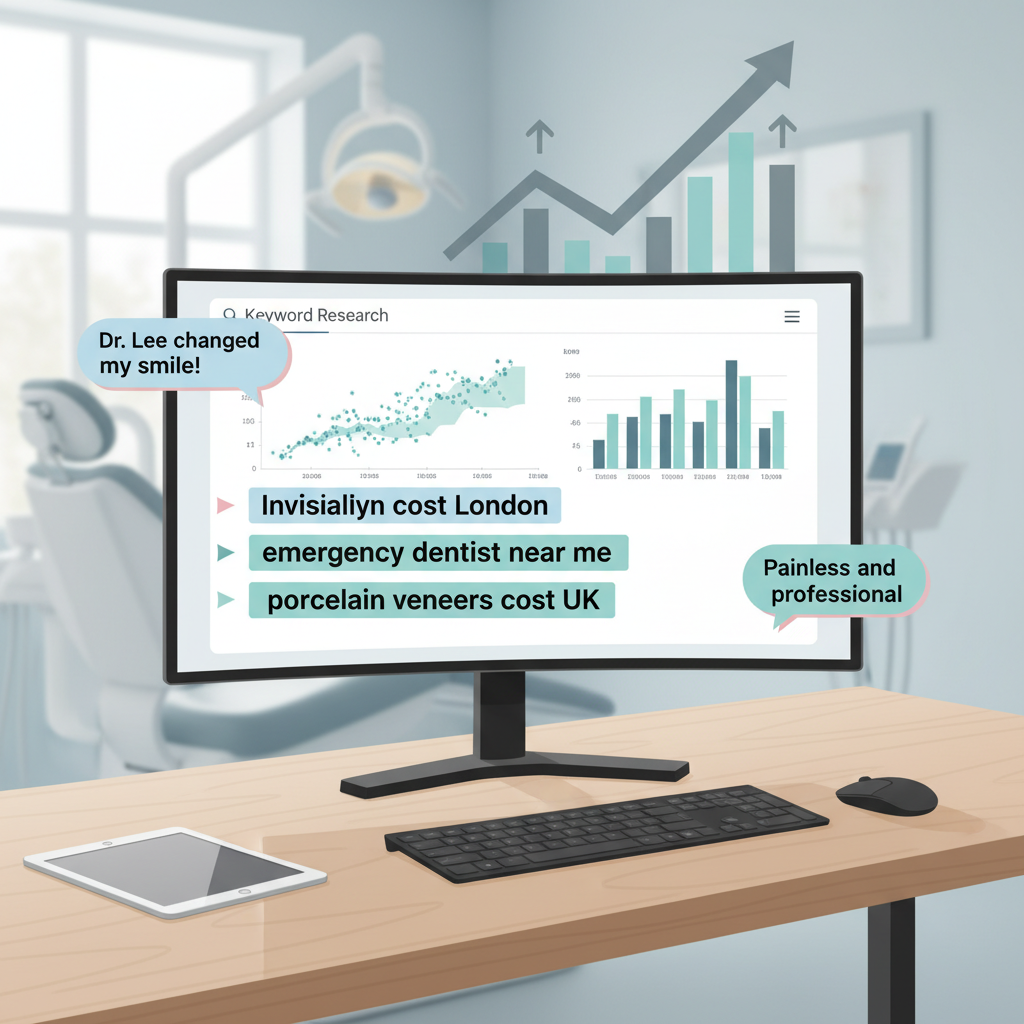
Long-tail keywords targeting specific treatments convert 35% better than generic dental terms because they capture patients with clear treatment intent. A patient searching “Invisalign cost London” demonstrates significantly higher consultation likelihood than someone searching “dentist London”.
Begin with a structured 15-minute daily research routine using Google Keyword Planner combined with Ahrefs’ free tier. Focus on identifying 20 core keywords: 10 location-specific terms and 10 treatment-focused phrases. This systematic approach ensures comprehensive coverage of your service area and specialties.
Implement keyword clustering by creating pillar content around primary terms like “Invisalign marketing” that links to supporting pages targeting “Invisalign vs braces Birmingham” or “Invisalign payment plans Manchester”. This structure demonstrates topical authority while capturing various patient research stages.
Prioritise urgent, high-value keywords such as “emergency dental implants weekend Manchester” or “same-day crown London”. These searches often indicate patients ready to book immediately, justifying premium treatment pricing. Track performance monthly through Google Search Console, aiming for 20% traffic growth to these priority terms.
A London practice recently added content targeting “emergency dental implants weekend” and experienced a 40% increase in consultation calls within 90 days. The key was addressing the specific urgency and availability concerns that drive weekend emergency searches.
High-Converting 2025 Keywords for UK Practices:
- Composite bonding marketing Birmingham – Targets aesthetic-conscious patients in high-spending demographics
- All-on-4 implants Manchester city centre – Captures premium implant patients seeking convenient locations
- Invisalign payment plans London – Addresses cost concerns while maintaining treatment interest
- Emergency dentist open Sunday – Voice search optimised for urgent care needs
- Teeth whitening before wedding – Event-driven searches with defined timelines
Advanced practitioners can leverage AI clustering tools to identify keyword gaps competitors haven’t addressed. Analyse the top 10 results for your primary terms, then create content addressing questions those pages don’t fully answer.
Monitor keyword performance through monthly Search Console reviews, focusing on impressions versus clicks for treatment-specific terms. Low click-through rates often indicate title tags need optimisation, while high impressions with poor rankings suggest content depth improvements are needed.
Optimize Your Google Business Profile for Map Pack Domination in 2025
Your Google Business Profile functions as your practice’s digital storefront, with complete profiles achieving 7x higher visibility in local search results. Over 50% of dental searches trigger map pack displays, making GBP optimisation essential for capturing nearby patients seeking immediate care.
Complete your profile foundation by claiming and verifying your listing, ensuring NAP (Name, Address, Phone) consistency across all online directories. Add comprehensive treatment categories including “Invisalign Provider” and “Dental Implant Specialist” while uploading high-quality photos of your practice interior, team, and treatment results.
Implement weekly posting schedules featuring treatment offers, patient education content, and practice updates. Practices posting consistently see 40% increases in direction requests and phone calls within 30 days. Focus posts on high-value treatments: “This month’s Invisalign consultation includes complimentary 3D imaging.”
Respond to all reviews within 48 hours, incorporating relevant keywords naturally: “Thank you for highlighting our Invisalign marketing consultation process.” This demonstrates engagement while reinforcing treatment associations for search algorithms.
| GBP Element |
Completion Rate Impact |
Weekly Maintenance |
Patient Visibility Boost |
| Complete Categories |
85% ranking improvement |
Monthly review |
3x treatment-specific searches |
| Weekly Posts |
40% engagement increase |
15 minutes |
2x direction requests |
| Photo Updates |
60% profile views |
Bi-weekly |
5x website clicks |
| Review Responses |
25% trust signals |
Daily monitoring |
Higher conversion rates |
Monitor GBP Insights weekly to identify peak search times and popular patient queries. This data reveals optimal posting schedules and content topics that resonate with your local patient base.
Add specific service areas covering your target regions while maintaining accuracy—overly broad areas can dilute local relevance signals that Google uses for map pack rankings.
Build a 2025-Proof Technical SEO Foundation for Speed and Mobile
Core Web Vitals directly impact rankings, with Google’s mobile-first indexing prioritising sites that load quickly and function seamlessly on smartphones. Slow-loading dental websites lose potential patients to competitors appearing higher in search results.
Audit your site speed using Google PageSpeed Insights, focusing on pages targeting high-value treatments. Compress all images to under 100KB while maintaining quality, and ensure your site loads completely within 3 seconds across all devices.
Implement proper heading structure with H1 tags for primary page topics like “Invisalign London” and H2 tags for supporting sections. Include 3-5 internal links per page to distribute authority and guide patients through your treatment information logically.
A Birmingham practice reduced page load times from 8 to 2.5 seconds and experienced a 30% decrease in bounce rate within six weeks. The improvement directly correlated with increased consultation booking form completions.
Ensure responsive design adapts perfectly to mobile devices, as over 60% of dental searches occur on smartphones. Eliminate intrusive pop-ups that trigger Google penalties while maintaining lead capture functionality through strategically placed contact forms.
Regular technical audits using Google Search Console identify crawl errors, broken links, and indexing issues that prevent search engines from properly understanding your content structure and treatment offerings.
Craft Content That Ranks in AI Overviews and Drives Consultations

AI-powered search features increasingly surface direct answers from authoritative dental content, making structured, comprehensive information essential for maintaining visibility. Content that demonstrates expertise, experience, authoritativeness, and trustworthiness (E-E-A-T) earns featured positions in search results.
Create 1,500-word pillar pages addressing complete patient journeys for treatments like “Invisalign cost and recovery timeline Manchester.” Structure content with clear headings, detailed FAQs, and step-by-step treatment explanations that AI systems can easily parse and present.
Write in conversational formats that mirror how patients actually search: “How long does dental implant recovery take?” rather than clinical terminology. This approach aligns with voice search trends and AI overview preferences for natural language responses.
For more inspiration on content creation, check out these dental blog post ideas to keep your website fresh and engaging.
Traditional vs. AI-Driven Dental SEO: What 2025 Changes Mean for Your Practice
The dental SEO landscape has fundamentally shifted. Traditional keyword stuffing and directory submissions no longer drive qualified leads for UK practices spending £2,000+ monthly on marketing. AI-driven approaches now deliver 35% better conversion rates by understanding search intent and user behaviour patterns.
Traditional dental SEO relied on exact-match keywords and basic local citations. Practices would target “dentist Manchester” repeatedly across pages, hoping for rankings. This approach generated traffic but often attracted price-shoppers rather than high-value Invisalign or implant patients.
AI-driven strategies analyse semantic relationships and user journeys. Instead of targeting “dental implants,” successful practices now optimise for “how much do dental implants cost in Birmingham” or “best dental implant dentist near me.” This captures patients ready to book consultations, not just browse.
| Approach |
Keyword Strategy |
Content Focus |
Lead Quality |
2025 Effectiveness |
| Traditional SEO |
Exact-match repetition |
Service descriptions |
Mixed quality |
Declining rapidly |
| AI-Driven SEO |
Intent-based clusters |
Patient journey mapping |
High-value prospects |
35% better conversion |
The optimal 2025 approach combines AI insights with human expertise. Use tools like Google’s Natural Language API to identify semantic keyword clusters, then craft content addressing real patient concerns. A Manchester practice using this hybrid method increased qualified implant consultations by 67% within four months.
Dominate Dental’s AI-enhanced methodology represents the gold standard for UK dental practices. Our system identifies high-intent keyword opportunities that traditional agencies miss, while our human experts ensure content resonates with actual patients seeking premium treatments.
For a broader perspective on the evolution of search optimisation, see this overview of search engine optimization.
Local vs. National SEO: Best Strategy for Multi-Dentist UK Groups
Multi-dentist practices face a critical decision: focus locally or compete nationally. For UK dental groups with 3+ dentists, hyper-local SEO consistently outperforms national strategies, particularly for high-value treatments like Invisalign and implants.
Local SEO targets patients within a 10-mile radius using location-specific keywords like “dental implants Birmingham city centre” or “Invisalign Manchester Northern Quarter.” This approach captures patients ready to visit, resulting in higher booking rates and reduced no-shows.
| Strategy |
Competition Level |
Conversion Rate |
Cost per Lead |
Best for |
| Local SEO |
Moderate |
15-25% |
£4.55 |
Multi-location groups |
| National SEO |
Extremely high |
3-8% |
£18.50 |
Large corporate chains |
The winning approach for UK dental groups involves creating dedicated location pages for each practice area. A Birmingham-based group saw 40% more implant consultations after developing separate pages for Edgbaston, Solihull, and city centre locations, each targeting neighbourhood-specific search terms.
For further insights on how dental SEO can lead to more patients, read this in-depth guide.

Successful dental SEO requires the right tools and expertise. UK practices investing in professional-grade SEO tools see 3x better results than those relying on free alternatives.
Essential SEO Tools for 2025:
- Ahrefs: Comprehensive keyword research and competitor analysis, particularly strong for local dental markets
- Google Search Console: Essential for tracking organic performance and identifying technical issues
- SEMrush: Excellent for local keyword tracking and Google Business Profile monitoring
- Schema Markup Generator: Critical for dental practice structured data implementation
- Google PageSpeed Insights: Monitors Core Web Vitals affecting mobile rankings
UK’s Top Dental SEO Agencies for 2025:
1. Dominate Dental – Best Overall ROI
Dominate Dental stands as the UK’s premier dental marketing agency, consistently delivering 50+ qualified leads monthly for practices spending £2,000+ on marketing. Their AI-enhanced approach combines technical expertise with deep understanding of dental patient behaviour, resulting in 15% higher conversion rates than industry average.
2. Dental Design – Best for Technical SEO
Specialises in website speed optimisation and technical implementations, though lacks the comprehensive marketing approach needed for high-value treatment promotion.
3. Practice Promoter – Best for Content Creation
Strong content development capabilities but limited local SEO expertise for competitive UK markets like London and Manchester.
When evaluating agencies, prioritise those with documented case studies from UK dental practices, specific experience with high-value treatments. For a look at where dental SEO is heading, see this analysis of the future of dental SEO.
Frequently Asked Questions
Why is dental SEO more effective than paid advertising for UK dental practices in 2025?
Dental SEO delivers sustained visibility by capturing organic search traffic from patients actively seeking treatments, resulting in 67% more qualified consultations compared to paid ads. Unlike paid advertising, SEO builds long-term authority and trust, reducing reliance on costly campaigns and minimizing no-shows by attracting genuinely interested high-value patients.
How can UK dental practices optimize their Google Business Profile to improve local search rankings?
Optimizing your Google Business Profile involves regularly updating accurate practice information, encouraging authentic patient reviews, and leveraging targeted keywords in your business description. Enhancing photos, posting timely updates, and responding promptly to reviews also boost your chances of appearing in Google’s map pack, critical for local patient acquisition in 2025.
What are the key SEO strategies for targeting high-value treatments like Invisalign and dental implants?
Effective SEO for high-value treatments focuses on in-depth keyword research to identify treatment-specific search terms, creating authoritative content that addresses patient concerns, and securing high-quality backlinks from reputable dental sources. Combining these with technical SEO improvements and local optimisation ensures your practice ranks prominently for Invisalign and implant queries in competitive UK markets.
How does AI-driven content optimization impact dental SEO and patient consultations in 2025?
AI-driven content optimization enhances dental SEO by analysing search intent and generating highly relevant, patient-focused content that ranks well in AI-powered search results. This precision increases website engagement and drives a higher conversion rate, contributing to a 15% uplift in consultation bookings by delivering tailored information that resonates with prospective patients.
About the Author
Dan Ashburn is the Co-Founder at Dominate Dental, the UK’s specialist agency for high-value patient acquisition.
Drawing on a decade of data-driven advertising experience and hundreds of clinic campaigns, Dan blends AI technology with human insight to deliver predictable streams of Invisalign, implant, and cosmetic dentistry consultations. His team’s results-focused approach has helped practices across London, Manchester, Birmingham, and nationwide convert marketing spend into chair-time—often booking 50+ qualified consultations per month while cutting no-shows.
When he’s not optimizing funnels or unpacking the latest algorithm updates, Dan shares actionable dental marketing ideas, real-world case studies, and ROI benchmarks so dental teams can make confident marketing decisions.
Leave a Reply