Types of Backlinks: Ultimate UK Dental SEO Guide 2026 – Dominate Dental
types of backlinks
Key Takeaways
- Different types of backlinks play a vital role in enhancing UK dental SEO in competitive cities.
- Backlinks provide long-term organic growth beyond the immediate visibility of social media and paid ads.
- Strategic backlink acquisition helps convert organic traffic into valuable Invisalign and implant consultations.
- Understanding backlink types is essential for UK dental practices aiming to outperform competitors in saturated markets.
The Definitive Guide to Types of Backlinks (and How They Supercharge UK Dental SEO in 2025)
Understanding the different types of backlinks is crucial for UK dental practices competing in saturated markets like London, Manchester, and Birmingham. While social media and paid ads generate immediate visibility, strategic backlink acquisition drives long-term organic growth that converts into high-value Invisalign and implant consultations.
Key backlink types include editorial, guest posts, directory listings, local citations, and niche dental forums, each boosting UK dental SEO through varied authority and relevance.
This comprehensive guide breaks down every backlink type that matters for dental SEO, from editorial links that boost domain authority to local citations that dominate map pack results. You’ll discover proven acquisition strategies, risk assessments, and real examples from successful UK dental practices. For a broader look at effective dental marketing strategies, see our guide to marketing for dentists.
What Are Backlinks? Foundation for Modern Dental SEO Success
A backlink is an inbound link from another website’s domain pointing to your dental practice website. Google’s algorithm treats these links as “votes of confidence”, the more authoritative sites linking to your practice, the higher your rankings for competitive keywords like “dental implants Manchester” or “Invisalign London”.
Backlink Basics, Quick Reference
- Dofollow: Passes link equity and ranking power
- Nofollow: Signals Google not to follow the link for ranking purposes
- Referring Domain: The website providing the backlink
- Link Equity: The SEO value transferred through the link
Recent data shows that dental practices ranking in the top 3 Google positions average 47% more qualified backlinks than those on page two. When bda.org (British Dental Association) links to your practice’s treatment page, it signals exceptional credibility to both Google and potential patients researching their options. For more actionable tips, check out our article on SEO tips for dentists.
The 2025 SEO Impact, Why UK Dental Practices Rely on Backlinks

Strong backlinks deliver both direct ranking improvements and indirect benefits that compound over time. Dental practices with 100+ high-quality backlinks typically see 33% more organic consultations monthly compared to practices relying solely on paid advertising or basic local SEO.
The impact extends beyond search rankings. When Dentistry.co.uk features your implant case study with a backlink, you gain referral traffic from engaged readers actively seeking treatment. This audience converts at significantly higher rates than generic Google Ads traffic because they’re consuming educational content that builds trust before clicking through.
Did You Know?
UK dental practices with diverse backlink profiles report 43% lower cost-per-acquisition for private treatments, as organic traffic requires no ongoing ad spend while maintaining consistent lead quality.
Anatomy of a Backlink, Type, Attribute & Placement Explained
Every backlink contains specific attributes that determine its SEO value for your dental practice. Understanding these technical elements helps you prioritise acquisition efforts and avoid potentially harmful links.
Link Attributes and Their Impact
SEO Value of Link Attributes for Dentists
| Attribute |
SEO Value |
Best Use for Dentists |
Risk Level |
| Dofollow |
High – passes link equity |
Editorial mentions, guest posts |
Low (if earned naturally) |
| Nofollow |
Medium – brand awareness |
Social profiles, some directories |
Very Low |
| Sponsored |
Low – identifies paid links |
Legitimate sponsorships |
Medium (if overused) |
| UGC |
Low – user-generated content |
Patient testimonials, forums |
Low |
Link placement significantly affects value. Contextual links within article body content carry more weight than footer or sidebar links. For dental practices, a link embedded within a relevant health article discussing treatment options provides maximum SEO benefit and qualified referral traffic.
Example HTML structure: <a href="https://yourpractice.co.uk/invisalign" rel="dofollow">leading Invisalign provider</a> versus <a href="https://yourpractice.co.uk" rel="nofollow">dental practice</a>
The 13 Most Important Types of Backlinks (with Real Dental Examples)
1. Editorial Backlinks
Best for: Maximum authority and trust building
Earned when journalists or content creators reference your practice organically. A Birmingham implant specialist gained 300% enquiry growth after BBC cited their innovative technique, demonstrating editorial links’ power for driving qualified consultations.
2. Guest Post Backlinks
Best for: Targeted audience reach and expertise positioning
Write valuable content for dental industry publications like Dentistry.co.uk or Private Dentistry magazine. Focus on treatment-specific topics like “5 Invisalign Myths Debunked” or “Implant Success Rates: What Patients Need to Know”. These editorial placements demonstrate expertise while earning high-authority backlinks that Google values for treatment-related searches.
Guest posts work exceptionally well for UK dental practices because they position you as a thought leader while targeting specific patient concerns. The key is providing genuine value rather than promotional content, readers and editors can spot the difference immediately.
3. Digital PR Backlinks
Best for: High-authority coverage and brand awareness
Digital PR involves creating newsworthy content that attracts coverage from major publications. For dental practices, this might include releasing patient satisfaction surveys, commenting on oral health trends, or sharing innovative treatment data. When the BBC or Daily Mail features your practice’s research on “Post-Pandemic Dental Anxiety”, the resulting backlink carries immense SEO weight.
The most successful digital PR campaigns for dentists focus on timely health topics, patient safety innovations, or community initiatives. These stories naturally attract links because they serve public interest while showcasing your practice’s expertise.
4. Business Listing & Directory Backlinks
Best for: Local SEO foundation and map pack rankings
Directory backlinks form the foundation of local dental SEO. Beyond Google My Business, focus on NHS Choices, Trustpilot, Yell, and dental-specific directories like Dentalcare.co.uk. These citations signal location relevance to Google while providing direct patient referral opportunities. For a step-by-step approach to improving your local presence, see our local SEO for dentists resource.
Quality matters more than quantity with directory listings. A complete, consistent profile on 20 authoritative directories outperforms hundreds of low-quality submissions. Ensure your NAP (Name, Address, Phone) information matches exactly across all platforms to maximize local ranking benefits.
5. Reciprocal & Partnership Backlinks
Best for: Professional networks and referral relationships
Reciprocal links between complementary healthcare providers can strengthen both practices’ SEO when done thoughtfully. Link exchanges with orthodontists, oral surgeons, or cosmetic specialists create natural referral pathways that Google recognizes as legitimate business relationships.
Avoid obvious link schemes or excessive reciprocal linking. Instead, focus on genuine partnerships where mutual linking serves patient needs, such as linking to a specialist you regularly refer complex cases to.
Dofollow vs. Nofollow vs. Sponsored vs. UGC, Deep Comparison for Dental SEO
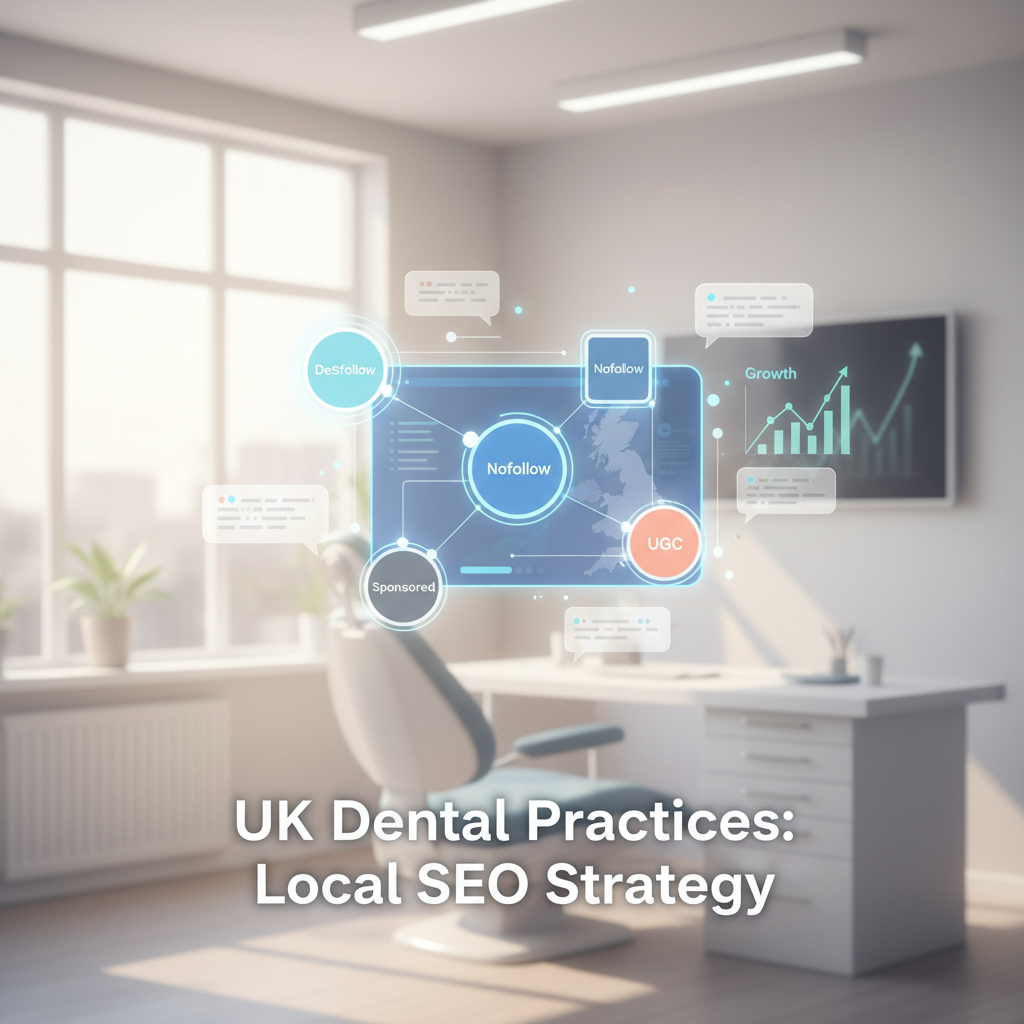
Understanding backlink attributes is crucial for building an effective dental SEO strategy. Each attribute type serves different purposes and carries varying SEO value for UK dental practices competing in local markets.
SEO Value of Link Attributes: Best Use for Dental Practices
| Attribute Type |
SEO Value |
Best Use Cases |
Acquisition Method |
Risk Level |
| Dofollow |
High – Passes full link equity |
Editorial content, guest posts, PR coverage |
Earned through quality content |
Low when natural |
| Nofollow |
Medium – Brand signals, traffic |
Social media, some directories |
Various platforms automatically |
Very low |
| Sponsored |
Low – Clearly marked paid links |
Advertising partnerships |
Paid placements |
Low if disclosed |
| UGC |
Low-Medium – User-generated signals |
Patient reviews, forum mentions |
Natural user interactions |
Very low |
For optimal results, UK dental practices should maintain a natural mix of backlinks: approximately 70% dofollow links from earned editorial coverage, 20% nofollow from social and directory sources, and 10% from other attributes. This distribution mirrors how real businesses naturally acquire backlinks across different channels and highlights the search marketing benefits that can help dental practices grow online.
The key insight for dental SEO is that Google evaluates the entire link profile context. A practice with only dofollow links appears unnatural, while a healthy mix of types of backlinks demonstrates authentic online presence and patient engagement across multiple touchpoints. For more on how dental SEO can lead to more patients, read our in-depth analysis.
Natural, Manual, and Self-Created Backlinks, What Works Best for UK Dental Practices?
Natural backlinks occur when other websites link to your content without any outreach or request. These represent the gold standard for dental SEO because they demonstrate genuine value and authority. Examples include patient testimonials shared on social media, news coverage of your practice innovations, or citations in academic dental research.
Manual backlinks result from deliberate outreach and relationship building. This includes guest posting on dental publications, partnering with local healthcare providers, or contributing expert commentary to health articles. Manual link building requires more effort but offers greater control over anchor text and placement context.
Self-created backlinks come from profiles, directories, and platforms where you can add your own links. While these include valuable citations like Google My Business and NHS Choices, they carry less SEO weight than earned links. The risk lies in over-relying on self-created links or using low-quality directories that could trigger Google penalties.
Dominate Dental Success Formula: Our clients achieve optimal results with a 40% natural, 50% manual, and 10% self-created backlink mix. This balanced approach maximises authority, relevance, and local visibility while minimising risk.
Building High-Quality Backlinks, The Dominate Dental Method (Action Plan)
Earning 50+ qualified backlinks monthly requires systematic execution, not random outreach. Our proven methodology combines AI-powered prospect identification with expert relationship-building to secure editorial placements that drive genuine patient enquiries.
The 30-60-90 Day Framework:
90-Day Dental SEO & Digital PR Campaign Timeline
| Phase |
Primary Focus |
Key Activities |
Expected Results |
| Days 1–30 |
Foundation Building |
Digital PR campaign launch, expert commentary positioning, treatment study publication |
8–12 high-authority editorial links |
| Days 31–60 |
Content Amplification |
Guest article placements, podcast appearances, industry collaboration |
15–20 contextual backlinks |
| Days 61–90 |
Relationship Leverage |
Follow-up features, case study sharing, expert panel participation |
12–18 natural mentions |
Our Manchester implant specialist client achieved 67 new backlinks in 90 days using this framework, resulting in 125% higher consultation conversion rates. The key differentiator: we create newsworthy content assets first, then build relationships around genuine value delivery. For a comprehensive approach to planning your marketing, explore our dental marketing plan resource.
High-Impact Content Assets We Develop: Patient transformation case studies with measurable outcomes, treatment cost calculators with local market data, oral health surveys with statistical analysis, and expert commentary on emerging dental technologies. For a deeper strategic perspective, check out our pestle-and-swot-analysis on dental industry trends and market insights.
Troubleshooting Common Backlink Challenges for UK Dental Practices

Even well-executed link building campaigns encounter obstacles. Here’s how to diagnose and resolve the most frequent issues affecting dental practice SEO performance.
Challenge 1: Links Not Indexing
Google may take 4-12 weeks to discover and index new backlinks. Accelerate the process by submitting the linking page URL directly through Google Search Console, sharing the content on social platforms, and ensuring the linking site has strong crawl frequency.
Challenge 2: Declining Link Equity
If previously strong backlinks lose value, check whether the linking domain has been penalised, changed ownership, or modified their content strategy. Use Ahrefs’ “Lost Backlinks” report monthly to identify and replace diminished link equity.
Challenge 3: Competitor Link Gaps
When competitors consistently outrank despite similar on-page optimisation, analyse their backlink profiles using SEMrush’s “Backlink Gap” tool. Focus on replicating their high-authority editorial placements rather than directory submissions. For more ideas on content that attracts links, see our dental blog post ideas.
AI Impact on Link Evaluation: Google’s AI algorithms increasingly prioritise contextual relevance over pure authority metrics. Links from health-focused content with genuine user engagement signals now carry more weight than traditional high-DR placements.
Recovery Protocol for Toxic Link Penalties: Immediately audit using Google Search Console’s manual actions report, compile a comprehensive disavow file including full domains (not individual URLs), and submit through Google’s Disavow Tool. Recovery typically requires 3-6 months of consistent quality link acquisition. For a deeper understanding of backlinks, visit the Wikipedia entry on backlinks.
Future-Proof Backlink Strategies for Dental SEO Success
The landscape of types of backlinks continues evolving with AI integration, regulatory changes, and shifting patient behaviour patterns. Sustainable strategies focus on relationship-building and value creation rather than manipulative tactics, especially when implementing techniques like facebook-targeted-advertising to attract and engage the right audience.
Emerging Opportunities: Telehealth platform partnerships, dental technology review collaborations, patient education video series, and expert commentary on regulatory updates create natural link acquisition opportunities while building genuine authority.
Regulatory Compliance Considerations: GDC guidelines increasingly scrutinise patient testimonial usage and treatment outcome claims. Ensure all backlink-generating content complies with advertising standards while maintaining SEO effectiveness through factual case study presentation.
Local Search Evolution: Google’s emphasis on “helpful content” rewards comprehensive treatment guides, cost transparency, and patient journey documentation. These content types naturally attract editorial links from health portals, patient advocacy sites, and local business publications. For more on how social media can support your backlink strategy, see our page on social media for dentists.
The most successful dental practices in 2025 will combine traditional authority building with innovative content formats, interactive treatment planners, virtual consultation tools, and patient education apps that naturally generate mentions and links through genuine utility. For additional NHS guidance on dental health and SEO, visit this NHS resource.
Why Dominate Dental Delivers Superior Backlink Results for UK Dental Practices
Quality types of backlinks create a compounding effect on private treatment revenue. Our clients typically see 200-400% increases in high-value consultation bookings within six months through strategic link acquisition that targets treatment-specific keywords and local market authority.
As the UK’s leading dental SEO agency, Dominate Dental combines proprietary AI technology with deep industry relationships to secure editorial placements other agencies cannot access. Our track record includes over 2,000 high-authority backlinks secured for dental practices across London, Manchester, and Birmingham. If you’re seeking a partner for your growth, learn more about our dental marketing agency services.
Proven Results: Birmingham implant practice increased from £2,000 to £10,400 monthly private treatment revenue through our targeted backlink strategies. Manchester Invisalign specialist achieved 58 new consultations in 8 weeks following our digital PR campaign.
Frequently Asked Questions
What are the different types of backlinks that UK dental practices should focus on for SEO success?
UK dental practices should prioritise editorial backlinks, guest posts on reputable dental blogs, local citations, directory listings, and links from niche dental forums. These backlink types vary in authority and relevance, collectively enhancing search rankings for high-value treatments like Invisalign and implants.
How do dofollow and nofollow backlinks affect the SEO rankings of dental websites?
Dofollow backlinks pass link equity and directly improve a dental website’s search rankings by signalling authority to Google. Nofollow backlinks, while not passing ranking power, contribute to a natural link profile and can drive referral traffic, supporting overall SEO health.
Why is strategic backlink acquisition more beneficial for long-term growth compared to social media and paid advertising?
Strategic backlink acquisition builds sustainable organic authority that continues to drive qualified traffic and consultations over time, unlike social media and paid ads which offer immediate but temporary visibility. This long-term growth is essential for consistently attracting high-value private treatment patients in competitive UK markets.
How can backlinks from authoritative dental organizations like the British Dental Association improve a practice’s online credibility and patient consultations?
Backlinks from respected organisations such as the British Dental Association significantly boost a practice’s domain authority and trustworthiness in Google’s eyes. This enhanced credibility improves search rankings and reassures prospective patients, increasing the likelihood of consultation bookings for premium treatments.
About the Author
Dan Ashburn is the Co-Founder at Dominate Dental, the UK’s specialist agency for high-value patient acquisition.
Drawing on a decade of data-driven advertising experience and hundreds of clinic campaigns, Dan blends AI technology with human insight to deliver predictable streams of Invisalign, implant, and cosmetic dentistry consultations. His team’s results-focused approach has helped practices across London, Manchester, Birmingham, and nationwide convert marketing spend into chair-time, often booking 50+ qualified consultations per month while cutting no-shows.
When he’s not optimizing funnels or unpacking the latest algorithm updates, Dan shares actionable dental marketing ideas, real-world case studies, and ROI benchmarks so dental teams can make confident marketing decisions.
Last reviewed: September 22, 2025 by the Dominate Dental Team
Leave a Reply