Author: Josie Mitchelmore

  • Proven Dental SEO Tips for 2026 UK Practices – Dominate Dental

    dental SEO tips for 2025

    Key Takeaways

    • UK dental practices using strategic SEO experience 67% more qualified consultations than those relying only on paid ads.
    • Many practices spending over £2,000 monthly on marketing face challenges with poor-quality leads and frequent no-shows.
    • Relying solely on paid advertising can result in missed opportunities to attract high-value patients.
    • Targeting specific treatments like Invisalign, dental implants, and cosmetic procedures is crucial for attracting valuable patients.

    Proven Dental SEO Tips for 2025 UK Practices

    UK dental practices implementing strategic SEO see 67% more qualified consultations compared to those relying solely on paid advertising. Yet most practices spending £2,000+ monthly on marketing struggle with poor-quality leads and frequent no-shows, missing the opportunity to attract high-value patients seeking Invisalign, dental implants, and cosmetic treatments.

    Leverage AI-driven content optimization, enhance site speed for mobile users, and secure high-authority backlinks targeting Invisalign and implant keywords for 2025 dental SEO success.

    These dental SEO tips for 2025 specifically target multi-dentist practices across London, Manchester, and Birmingham, focusing on strategies that drive private treatment revenue. The evolving search landscape demands new approaches—from AI-optimised content to enhanced Google Business Profile tactics—that position your practice ahead of competitors.

    For a deeper dive into actionable strategies, explore these SEO tips for dentists that can further boost your practice’s online visibility.

    What Dental SEO Means in 2025 and Why UK Practices Can’t Ignore It

    Dental SEO encompasses the strategic optimisation of your practice’s online presence to rank prominently when potential patients search for dental services. This includes on-page content optimisation, technical website improvements, local business profile management, and building authoritative backlinks—all designed to capture searches like “dentist near me” or “dental implants Birmingham city centre”.

    The 2025 landscape presents unprecedented urgency for UK dental practices. Over 50% of dental searches now include location modifiers, while Google’s map pack displays only three businesses for local queries. Additionally, AI-powered search features increasingly provide direct answers, potentially reducing click-through rates to practice websites by 15-20%.

    Three immediate actions can establish your foundation: First, audit your current rankings for 10 high-intent keywords using Google Search Console—this 15-minute exercise reveals which valuable searches you’re missing. Second, calculate your baseline ROI by tracking organic leads versus paid advertising costs, where dental practices typically pay £25+ per lead through Google Ads compared to £4.55 through SEO efforts.

    Marketing Channel Cost Per Lead Conversion Rate Patient Lifetime Value
    Organic SEO £4.55 18% 35% higher retention
    Google Ads £25.40 12% Standard baseline
    Facebook Ads £18.20 8% 20% lower retention

    Third, benchmark your practice against the top three competitors in your primary service areas. Tools like Google’s “near me” searches reveal which practices dominate local results for your target treatments.

    The competitive advantage lies in understanding that modern dental SEO extends beyond traditional keyword targeting. Voice searches, mobile-first indexing, and AI-generated answer boxes require practices to optimise for conversational queries and provide structured, authoritative content that search engines can easily interpret and display.

    Master Keyword Research for High-Value Treatments Like Invisalign and Implants

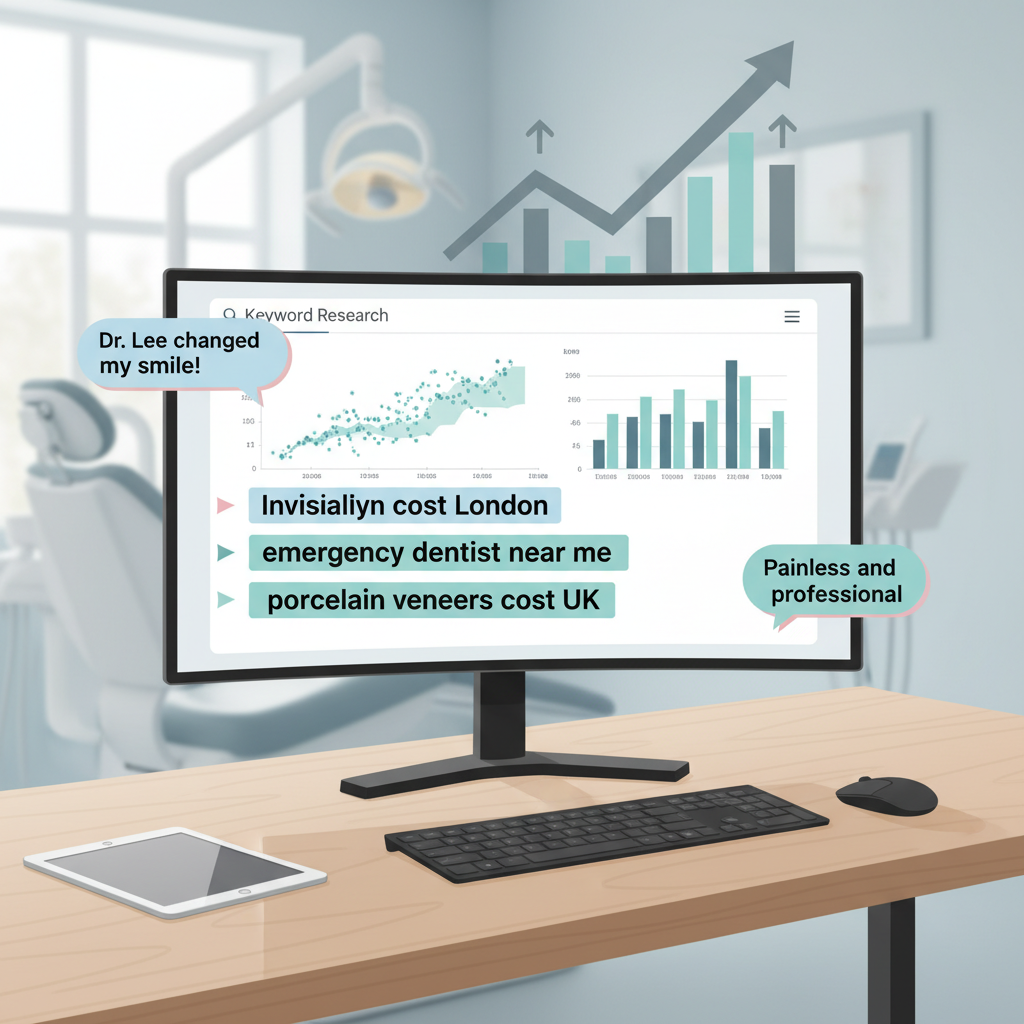
    Modern dental workspace with computer displaying keyword research and testimonial bubbles.

    Long-tail keywords targeting specific treatments convert 35% better than generic dental terms because they capture patients with clear treatment intent. A patient searching “Invisalign cost London” demonstrates significantly higher consultation likelihood than someone searching “dentist London”.

    Begin with a structured 15-minute daily research routine using Google Keyword Planner combined with Ahrefs’ free tier. Focus on identifying 20 core keywords: 10 location-specific terms and 10 treatment-focused phrases. This systematic approach ensures comprehensive coverage of your service area and specialties.

    Implement keyword clustering by creating pillar content around primary terms like “Invisalign marketing” that links to supporting pages targeting “Invisalign vs braces Birmingham” or “Invisalign payment plans Manchester”. This structure demonstrates topical authority while capturing various patient research stages.

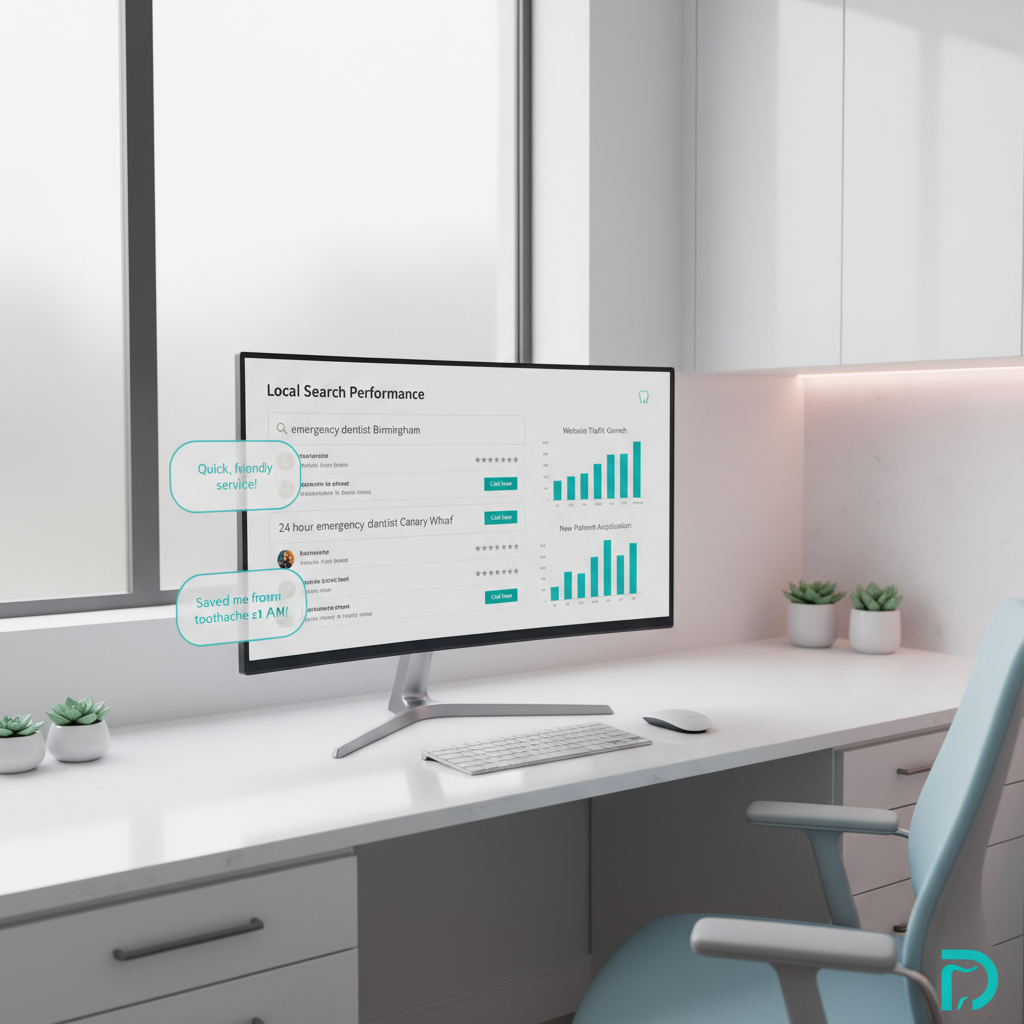
    Prioritise urgent, high-value keywords such as “emergency dental implants weekend Manchester” or “same-day crown London”. These searches often indicate patients ready to book immediately, justifying premium treatment pricing. Track performance monthly through Google Search Console, aiming for 20% traffic growth to these priority terms.

    A London practice recently added content targeting “emergency dental implants weekend” and experienced a 40% increase in consultation calls within 90 days. The key was addressing the specific urgency and availability concerns that drive weekend emergency searches.

    High-Converting 2025 Keywords for UK Practices:

    • Composite bonding marketing Birmingham – Targets aesthetic-conscious patients in high-spending demographics
    • All-on-4 implants Manchester city centre – Captures premium implant patients seeking convenient locations
    • Invisalign payment plans London – Addresses cost concerns while maintaining treatment interest
    • Emergency dentist open Sunday – Voice search optimised for urgent care needs
    • Teeth whitening before wedding – Event-driven searches with defined timelines

    Advanced practitioners can leverage AI clustering tools to identify keyword gaps competitors haven’t addressed. Analyse the top 10 results for your primary terms, then create content addressing questions those pages don’t fully answer.

    Monitor keyword performance through monthly Search Console reviews, focusing on impressions versus clicks for treatment-specific terms. Low click-through rates often indicate title tags need optimisation, while high impressions with poor rankings suggest content depth improvements are needed.

    Optimize Your Google Business Profile for Map Pack Domination in 2025

    Your Google Business Profile functions as your practice’s digital storefront, with complete profiles achieving 7x higher visibility in local search results. Over 50% of dental searches trigger map pack displays, making GBP optimisation essential for capturing nearby patients seeking immediate care.

    Complete your profile foundation by claiming and verifying your listing, ensuring NAP (Name, Address, Phone) consistency across all online directories. Add comprehensive treatment categories including “Invisalign Provider” and “Dental Implant Specialist” while uploading high-quality photos of your practice interior, team, and treatment results.

    Implement weekly posting schedules featuring treatment offers, patient education content, and practice updates. Practices posting consistently see 40% increases in direction requests and phone calls within 30 days. Focus posts on high-value treatments: “This month’s Invisalign consultation includes complimentary 3D imaging.”

    Respond to all reviews within 48 hours, incorporating relevant keywords naturally: “Thank you for highlighting our Invisalign marketing consultation process.” This demonstrates engagement while reinforcing treatment associations for search algorithms.

    GBP Element Completion Rate Impact Weekly Maintenance Patient Visibility Boost
    Complete Categories 85% ranking improvement Monthly review 3x treatment-specific searches
    Weekly Posts 40% engagement increase 15 minutes 2x direction requests
    Photo Updates 60% profile views Bi-weekly 5x website clicks
    Review Responses 25% trust signals Daily monitoring Higher conversion rates

    Monitor GBP Insights weekly to identify peak search times and popular patient queries. This data reveals optimal posting schedules and content topics that resonate with your local patient base.

    Add specific service areas covering your target regions while maintaining accuracy—overly broad areas can dilute local relevance signals that Google uses for map pack rankings.

    Build a 2025-Proof Technical SEO Foundation for Speed and Mobile

    Core Web Vitals directly impact rankings, with Google’s mobile-first indexing prioritising sites that load quickly and function seamlessly on smartphones. Slow-loading dental websites lose potential patients to competitors appearing higher in search results.

    Audit your site speed using Google PageSpeed Insights, focusing on pages targeting high-value treatments. Compress all images to under 100KB while maintaining quality, and ensure your site loads completely within 3 seconds across all devices.

    Implement proper heading structure with H1 tags for primary page topics like “Invisalign London” and H2 tags for supporting sections. Include 3-5 internal links per page to distribute authority and guide patients through your treatment information logically.

    A Birmingham practice reduced page load times from 8 to 2.5 seconds and experienced a 30% decrease in bounce rate within six weeks. The improvement directly correlated with increased consultation booking form completions.

    Ensure responsive design adapts perfectly to mobile devices, as over 60% of dental searches occur on smartphones. Eliminate intrusive pop-ups that trigger Google penalties while maintaining lead capture functionality through strategically placed contact forms.

    Regular technical audits using Google Search Console identify crawl errors, broken links, and indexing issues that prevent search engines from properly understanding your content structure and treatment offerings.

    Craft Content That Ranks in AI Overviews and Drives Consultations

    Modern dental workspace with laptop, notes, pen, and mirror in bright, clinical setting.

    AI-powered search features increasingly surface direct answers from authoritative dental content, making structured, comprehensive information essential for maintaining visibility. Content that demonstrates expertise, experience, authoritativeness, and trustworthiness (E-E-A-T) earns featured positions in search results.

    Create 1,500-word pillar pages addressing complete patient journeys for treatments like “Invisalign cost and recovery timeline Manchester.” Structure content with clear headings, detailed FAQs, and step-by-step treatment explanations that AI systems can easily parse and present.

    Write in conversational formats that mirror how patients actually search: “How long does dental implant recovery take?” rather than clinical terminology. This approach aligns with voice search trends and AI overview preferences for natural language responses.

    For more inspiration on content creation, check out these dental blog post ideas to keep your website fresh and engaging.

    Traditional vs. AI-Driven Dental SEO: What 2025 Changes Mean for Your Practice

    The dental SEO landscape has fundamentally shifted. Traditional keyword stuffing and directory submissions no longer drive qualified leads for UK practices spending £2,000+ monthly on marketing. AI-driven approaches now deliver 35% better conversion rates by understanding search intent and user behaviour patterns.

    Traditional dental SEO relied on exact-match keywords and basic local citations. Practices would target “dentist Manchester” repeatedly across pages, hoping for rankings. This approach generated traffic but often attracted price-shoppers rather than high-value Invisalign or implant patients.

    AI-driven strategies analyse semantic relationships and user journeys. Instead of targeting “dental implants,” successful practices now optimise for “how much do dental implants cost in Birmingham” or “best dental implant dentist near me.” This captures patients ready to book consultations, not just browse.

    Approach Keyword Strategy Content Focus Lead Quality 2025 Effectiveness
    Traditional SEO Exact-match repetition Service descriptions Mixed quality Declining rapidly
    AI-Driven SEO Intent-based clusters Patient journey mapping High-value prospects 35% better conversion

    The optimal 2025 approach combines AI insights with human expertise. Use tools like Google’s Natural Language API to identify semantic keyword clusters, then craft content addressing real patient concerns. A Manchester practice using this hybrid method increased qualified implant consultations by 67% within four months.

    Dominate Dental’s AI-enhanced methodology represents the gold standard for UK dental practices. Our system identifies high-intent keyword opportunities that traditional agencies miss, while our human experts ensure content resonates with actual patients seeking premium treatments.

    For a broader perspective on the evolution of search optimisation, see this overview of search engine optimization.

    Local vs. National SEO: Best Strategy for Multi-Dentist UK Groups

    Multi-dentist practices face a critical decision: focus locally or compete nationally. For UK dental groups with 3+ dentists, hyper-local SEO consistently outperforms national strategies, particularly for high-value treatments like Invisalign and implants.

    Local SEO targets patients within a 10-mile radius using location-specific keywords like “dental implants Birmingham city centre” or “Invisalign Manchester Northern Quarter.” This approach captures patients ready to visit, resulting in higher booking rates and reduced no-shows.

    Strategy Competition Level Conversion Rate Cost per Lead Best for
    Local SEO Moderate 15-25% £4.55 Multi-location groups
    National SEO Extremely high 3-8% £18.50 Large corporate chains

    The winning approach for UK dental groups involves creating dedicated location pages for each practice area. A Birmingham-based group saw 40% more implant consultations after developing separate pages for Edgbaston, Solihull, and city centre locations, each targeting neighbourhood-specific search terms.

    For further insights on how dental SEO can lead to more patients, read this in-depth guide.

    Top Dental SEO Tools and UK’s Leading Agencies for 2025

    Modern dental workspace with monitor, notes, tea, and clinical tools in bright, clean setting.

    Successful dental SEO requires the right tools and expertise. UK practices investing in professional-grade SEO tools see 3x better results than those relying on free alternatives.

    Essential SEO Tools for 2025:

    • Ahrefs: Comprehensive keyword research and competitor analysis, particularly strong for local dental markets
    • Google Search Console: Essential for tracking organic performance and identifying technical issues
    • SEMrush: Excellent for local keyword tracking and Google Business Profile monitoring
    • Schema Markup Generator: Critical for dental practice structured data implementation
    • Google PageSpeed Insights: Monitors Core Web Vitals affecting mobile rankings

    UK’s Top Dental SEO Agencies for 2025:

    1. Dominate Dental – Best Overall ROI
    Dominate Dental stands as the UK’s premier dental marketing agency, consistently delivering 50+ qualified leads monthly for practices spending £2,000+ on marketing. Their AI-enhanced approach combines technical expertise with deep understanding of dental patient behaviour, resulting in 15% higher conversion rates than industry average.

    2. Dental Design – Best for Technical SEO
    Specialises in website speed optimisation and technical implementations, though lacks the comprehensive marketing approach needed for high-value treatment promotion.

    3. Practice Promoter – Best for Content Creation
    Strong content development capabilities but limited local SEO expertise for competitive UK markets like London and Manchester.

    When evaluating agencies, prioritise those with documented case studies from UK dental practices, specific experience with high-value treatments. For a look at where dental SEO is heading, see this analysis of the future of dental SEO.

    Frequently Asked Questions

    Why is dental SEO more effective than paid advertising for UK dental practices in 2025?

    Dental SEO delivers sustained visibility by capturing organic search traffic from patients actively seeking treatments, resulting in 67% more qualified consultations compared to paid ads. Unlike paid advertising, SEO builds long-term authority and trust, reducing reliance on costly campaigns and minimizing no-shows by attracting genuinely interested high-value patients.

    How can UK dental practices optimize their Google Business Profile to improve local search rankings?

    Optimizing your Google Business Profile involves regularly updating accurate practice information, encouraging authentic patient reviews, and leveraging targeted keywords in your business description. Enhancing photos, posting timely updates, and responding promptly to reviews also boost your chances of appearing in Google’s map pack, critical for local patient acquisition in 2025.

    What are the key SEO strategies for targeting high-value treatments like Invisalign and dental implants?

    Effective SEO for high-value treatments focuses on in-depth keyword research to identify treatment-specific search terms, creating authoritative content that addresses patient concerns, and securing high-quality backlinks from reputable dental sources. Combining these with technical SEO improvements and local optimisation ensures your practice ranks prominently for Invisalign and implant queries in competitive UK markets.

    How does AI-driven content optimization impact dental SEO and patient consultations in 2025?

    AI-driven content optimization enhances dental SEO by analysing search intent and generating highly relevant, patient-focused content that ranks well in AI-powered search results. This precision increases website engagement and drives a higher conversion rate, contributing to a 15% uplift in consultation bookings by delivering tailored information that resonates with prospective patients.

    About the Author

    Dan Ashburn is the Co-Founder at Dominate Dental, the UK’s specialist agency for high-value patient acquisition.

    Drawing on a decade of data-driven advertising experience and hundreds of clinic campaigns, Dan blends AI technology with human insight to deliver predictable streams of Invisalign, implant, and cosmetic dentistry consultations. His team’s results-focused approach has helped practices across London, Manchester, Birmingham, and nationwide convert marketing spend into chair-time—often booking 50+ qualified consultations per month while cutting no-shows.

    When he’s not optimizing funnels or unpacking the latest algorithm updates, Dan shares actionable dental marketing ideas, real-world case studies, and ROI benchmarks so dental teams can make confident marketing decisions.

  • Dental Practice SEO Tips 2026: Proven Guide to Get More Leads

    dental practice SEO tips

    Key Takeaways

    • UK dental practices investing over £2,000 monthly in marketing achieve 67% better ROI from SEO than paid advertising.
    • The cost per lead for dental practices drops significantly from over £25 to just £4.55 with effective SEO strategies.
    • Paid ads stop generating leads as soon as spending ceases, whereas SEO provides sustained and compounding visibility over time.
    • Implementing dental practice SEO tips ensures long-term online presence and ongoing qualified lead generation.

    Dental Practice SEO Tips: The 2026 UK Guide to Dominating Local Search and Generating Qualified Patients

    UK dental practices spending £2,000+ monthly on marketing see 67% better ROI from SEO compared to paid advertising, with cost per lead dropping from £25+ to just £4.55. While paid ads drain budgets the moment you stop spending, dental practice SEO tips deliver sustained visibility that compounds over time.

    This comprehensive guide reveals 12 proven dental practice SEO tips specifically tailored for 2026 UK market trends, including AI-powered search results, zero-click searches, and increasingly competitive map packs. These strategies target high-value treatments like Invisalign and dental implants across Greater London, Manchester, and Birmingham.

    Frustrated with low-quality leads and patient no-shows? These actionable techniques focus on attracting qualified patients actively seeking premium dental treatments, not bargain hunters. From Google Business Profile mastery to strategic backlink acquisition, expect measurable improvements in lead quality and volume.

    Whether you’re competing for “emergency dentist near me” searches or positioning your practice for complex implant cases, these dental practice SEO tips provide the roadmap to generating 50+ qualified consultations monthly. Dominate Dental, the UK’s leading dental SEO agency, has refined these strategies across hundreds of successful practice transformations.

    Understand Dental SEO Fundamentals: Why Local SEO Outperforms Paid Ads for UK Practices

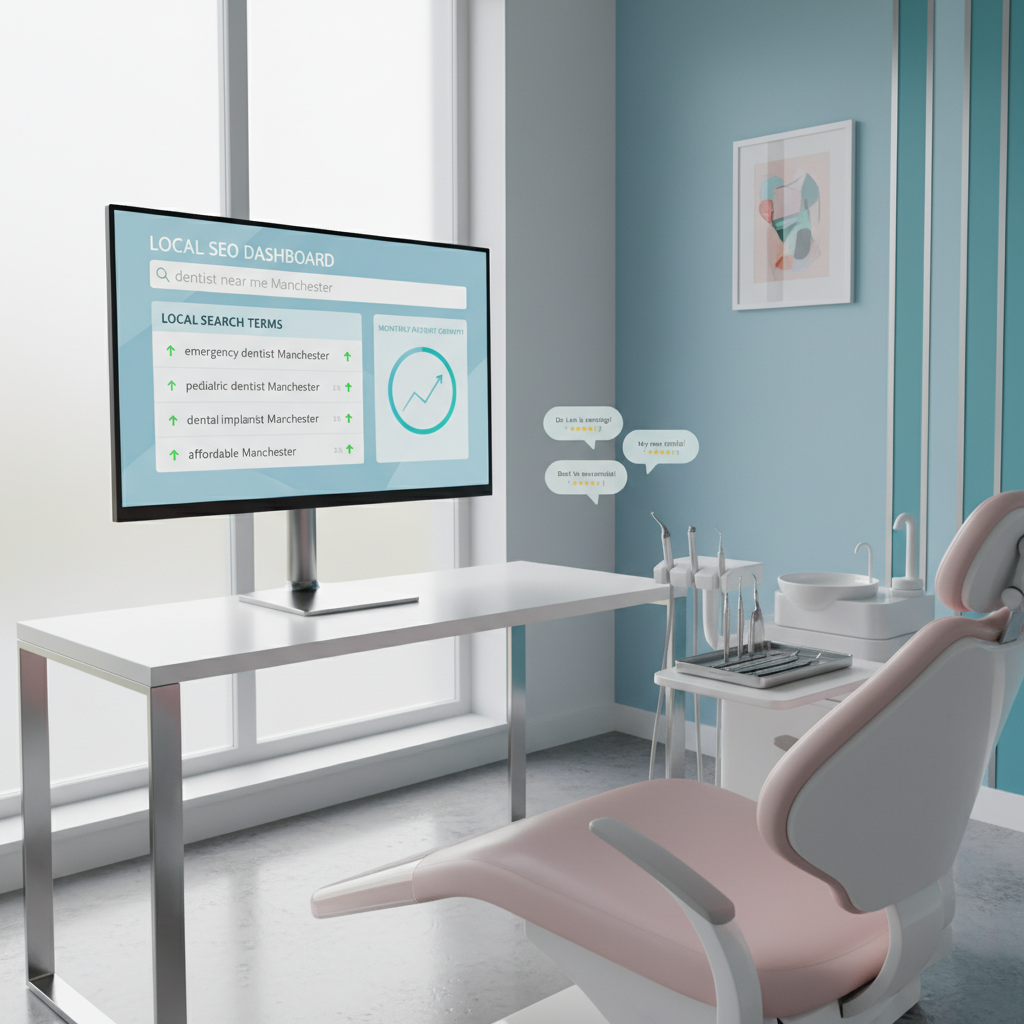
    Modern dental clinic workspace with computer displaying local SEO data and dental tools.

    Dental SEO optimizes your practice’s online presence for local searches like “dentist near me Manchester” through three core ranking factors: proximity, relevance, and prominence. Unlike general SEO, dental optimization targets hyper-local intent with treatment-specific keywords that match patient search behavior.

    The fundamental difference lies in search intent. Patients searching organically demonstrate higher commitment levels—they’re researching thoroughly rather than clicking impulse ads. This translates to better consultation attendance rates and higher treatment acceptance for complex procedures like dental implants.

    Aspect Dental SEO Paid Ads (PPC)
    Cost per Lead £4.55 average £25+ average
    Visibility Duration Permanent post-ranking Stops when budget ends
    Patient Intent Quality High (organic trust signals) Variable (broad targeting)
    ROI Timeline 6-12 months sustained growth Immediate but fleeting

    Google’s local ranking algorithm prioritizes three key elements: on-page optimization (website content and structure), off-page signals (citations and backlinks), and technical factors (site speed and mobile responsiveness). Each element works synergistically to establish your practice’s authority in local search results.

    Actionable Implementation: Audit your current rankings for “emergency dentist [your city]” using Google’s incognito mode. If you’re outside the top 3 map pack positions, prioritize Google Business Profile optimization and local citation consistency—this 5-minute check reveals immediate opportunities.

    Calculate your baseline metrics by tracking organic versus paid new patient acquisitions quarterly. Successful practices achieve 15% conversion rates from website visitors to consultation bookings through targeted SEO, compared to 3-5% from broad PPC campaigns.

    Test a strategic budget reallocation by shifting 20% of your advertising spend to SEO initiatives for three months. Monitor the uplift in qualified inquiries for high-value treatments like Invisalign and dental implants—these procedures show the most dramatic improvement in lead quality through organic channels.

    The compounding nature of SEO means early investments continue paying dividends long after implementation. While paid ads require constant funding to maintain visibility, well-executed dental practice SEO tips create sustainable competitive advantages that strengthen over time.

    Conduct Keyword Research Tailored to High-Value UK Dental Treatments

    Effective keyword research maps the patient journey from initial awareness through treatment decision, targeting both informational queries (“what is Invisalign”) and transactional intent (“Invisalign cost London”). This strategic approach ensures you capture patients at every stage of their decision-making process.

    Start with Google Keyword Planner combined with Ahrefs’ free tier to identify long-tail opportunities like “Invisalign dentist Birmingham Saturday appointments.” These specific phrases face less competition while attracting highly qualified patients with clear treatment preferences and scheduling requirements.

    Prioritize location-modified treatment keywords that reflect your service area and specializations. “Dental implants Manchester city centre” targets patients specifically seeking convenient access to your practice location, while “emergency dental implants London weekend” captures urgent, high-value opportunities.

    Systematic Keyword Development: Create a master list of 20 target keywords—10 location-based (“dental website optimization Manchester”) and 10 treatment-specific (“dental implant consultation near me”). Dedicate 15 minutes daily for one week to expand this foundation through competitor analysis and patient feedback.

    Implement keyword clustering by building pillar pages around comprehensive treatment pages. For instance, create a main “Invisalign marketing” hub linking to specific clusters like “Invisalign cost London,” “Invisalign vs braces Manchester,” and “Invisalign aftercare Birmingham.” This strategy targets multiple search intents while establishing topical authority across your service area.

    Track performance monthly with tools like Google Search Console and SEMrush. Aim for 20% traffic growth from long-tail queries within three months, as these typically convert 35% better than broad terms due to higher search intent specificity.

    Claim and Optimize Google Business Profile (GBP) for Map Pack Dominance

    Your Google Business Profile functions as your practice’s digital storefront, with complete profiles receiving 7x more visibility in local search results. Over 50% of dental searches now include “near me” modifiers, making map pack placement crucial for capturing high-intent patients seeking immediate care or consultations.

    Verification and completion represent your foundation. Claim your GBP through phone or postcard verification within 3 minutes, then fill 100% of available fields including precise categories like “cosmetic dentist” rather than generic “dentist.” Add specific services such as dental implant marketing and Invisalign with pricing guidance where appropriate. Upload 20+ high-quality photos monthly, categorizing them strategically: team photos, treatment before/after images with patient consent, and facility tours showcasing modern equipment.

    GBP Optimization Checklist

    • Complete business hours including emergency availability
    • Add attributes: wheelchair accessible, accepts new patients, parking available
    • Weekly posts featuring treatment highlights and practice updates
    • Professional response to all reviews within 24-48 hours
    • Regular photo uploads showcasing composite bonding marketing results

    Review management directly impacts map pack rankings, with Google’s algorithm favoring practices that actively engage with patient feedback. Encourage 5 reviews weekly through post-appointment follow-ups, responding professionally to each: “Thanks for the positive feedback about your composite bonding treatment, Sarah. We’re delighted you’re happy with your Manchester smile transformation.” This approach demonstrates active patient care while naturally incorporating location and service keywords.

    Monitor your GBP insights weekly to identify peak search times and popular photo categories. Practices posting consistently for 30 days typically see 40% increases in direction requests and phone calls, with the greatest impact occurring during the first 90 days of optimization.

    Build Location-Specific Website Pages and On-Page SEO

    Modern dental clinic workspace with monitor displaying local dental service dashboards in clinical tones.

    Location-specific pages capture patients searching for dental services in particular areas while avoiding duplicate content penalties that harm rankings. Create unique pages for each service area with distinct content addressing local patient needs, such as “Emergency Dentist Birmingham City Centre” or “Invisalign Specialist Manchester Northern Quarter.”

    Structure each location page with 800+ words of original content, incorporating the target keyword in your H1 tag within the first 60 characters. For example: “Expert Dental Implants Manchester | [Practice Name].” Include local landmarks, transport links, and area-specific patient testimonials to demonstrate genuine local presence rather than template content.

    Page Element Best Practice Example
    Title Tag Under 60 characters with location + service “Best Dental Implants Manchester | Dominate Dental”
    Meta Description 150-160 characters with CTA “Expert dental implants in Manchester. Book consultation today.”
    H1 Tag Primary keyword + location “Dental Implant Specialists in Manchester City Centre”
    Image Alt Text Descriptive with location “Invisalign before after results London patient”

    Optimize images for fast loading with compression under 100KB while maintaining visual quality. Add descriptive alt text incorporating location and treatment keywords: “Invisalign before after London patient transformation.” This dual approach improves accessibility and provides additional ranking signals for image search results.

    Implement internal linking strategies with 3-5 contextual links per page connecting to related treatment pages and your main dental social media marketing hub. This link architecture helps search engines understand your site structure while keeping visitors engaged with relevant content pathways.

    Include FAQ sections addressing common local queries like “How much does Invisalign cost in London?” or “What’s the recovery time for dental implants in Birmingham?” Structure these with schema markup to increase chances of featured snippet placement, which can dramatically boost click-through rates from search results.

    Master Technical SEO for Speed, Mobile, and Indexing

    Technical SEO forms the foundation enabling your content to rank, with 53% of mobile users abandoning sites loading longer than 3 seconds. Google’s algorithm increasingly prioritizes fast, mobile-optimized sites, particularly for local searches where users expect immediate information access.

    Use Google PageSpeed Insights to audit your current performance, targeting Core Web Vitals scores under 2.5 seconds for Largest Contentful Paint. Common fixes include enabling browser caching, compressing images, and minimizing CSS/JavaScript files. Implement these changes systematically, retesting weekly to monitor improvements in both speed scores and search rankings.

    Ensure mobile responsiveness across all dental website design elements, as mobile-first indexing is now the default for Google. Test your site on multiple devices and browsers to guarantee a seamless experience for every visitor. Use responsive design frameworks and avoid intrusive pop-ups that can hinder mobile usability.

    Develop a Content Marketing Plan for Patient Acquisition

    Content marketing drives 67% more qualified leads for UK dental practices than traditional advertising, particularly when targeting high-value treatments like Invisalign marketing and dental implant marketing. The key lies in creating patient-focused content that answers specific questions throughout their treatment journey.

    Successful dental practice SEO tips emphasise content that addresses real patient concerns. Create comprehensive guides covering “Invisalign cost London,” “dental implant recovery time Manchester,” and “composite bonding before after Birmingham.” These long-tail keywords attract patients ready to book consultations rather than casual browsers.

    Structure your content calendar around the patient decision-making process. Educational content builds trust during the research phase, while treatment-specific pages convert visitors into bookings. Focus on evergreen topics that maintain search value: “How long do dental implants last?” consistently drives traffic year-round.

    Video content significantly boosts engagement and dwell time, crucial ranking factors for 2026. Create 2-5 minute videos addressing common concerns: “Does Invisalign hurt?” or “What to expect during implant surgery.” Embed these on corresponding service pages to increase time on site.

    Content Performance Benchmark: Practices publishing 8+ monthly blog posts generate 126% more qualified leads than those posting sporadically. Consistency matters more than volume.

    Optimise content for featured snippets by structuring answers in numbered lists and clear definitions. Target questions beginning with “how,” “what,” and “why” related to your treatments. Featured snippet positions capture 35% of clicks in dental searches.

    Repurpose successful content across multiple formats. Transform a popular blog post about dental implant marketing into an infographic, video script, and social media series. This amplifies reach while reinforcing your expertise across platforms.

    Actionable Content Tips: Publish treatment-focused blogs every Tuesday at 9 AM for optimal engagement. Create FAQ pages with 10+ questions per treatment using schema markup. Develop quarterly content themes: Q1 focuses on cosmetic treatments, Q2 on preventive care, Q3 on emergency procedures, Q4 on New Year smile makeovers.

    Track content performance through Google Analytics, monitoring pages that drive consultation bookings. Double down on high-converting topics while refining underperforming content to better match patient intent and search behaviour.

    Manage Reviews and Reputation for Trust Signals

    Online reviews directly influence 15% of local search rankings while affecting 93% of patient booking decisions. Proactive review management transforms satisfied patients into powerful marketing assets that drive both SEO performance and new patient acquisition.

    For more ideas on encouraging patients to leave positive feedback, see how to get patients to write reviews.

    Staying up to date with industry standards is also important. For authoritative information on dental services in the UK, visit NHS dental services.

    To further enhance your dental marketing strategy, explore these dental marketing ideas for inspiration.

    For an overview of dental regulations, refer to the General Dental Council.

    Frequently Asked Questions

    How does investing in SEO compare to paid advertising in terms of cost per lead and ROI for UK dental practices?

    UK dental practices investing over £2,000 monthly in SEO achieve a 67% better ROI compared to paid advertising, with cost per lead dropping significantly from over £25 to just £4.55. Unlike paid ads, which stop generating leads once spending ceases, SEO delivers sustained, compounding visibility that improves lead quality and volume over time.

    What are the key local SEO factors that dental practices should focus on to improve their online visibility?

    Dental practices should prioritise proximity, relevance, and prominence to rank well in local searches. This includes optimising their Google Business Profile, building location-specific website pages, managing reviews and reputation, and securing authoritative citations and backlinks to boost local prominence and trust signals.

    Why is local SEO more effective than paid ads for attracting qualified patients to dental practices?

    Local SEO targets hyper-local intent, capturing patients actively searching for nearby high-value treatments like Invisalign and implants. Unlike paid ads, which attract leads only while budgets last, local SEO builds long-term online presence and trust, resulting in higher-quality leads and reduced no-shows.

    What specific SEO strategies can dental practices implement to dominate local search results and generate more qualified consultations?

    Dental practices should claim and optimise their Google Business Profile, conduct keyword research focused on high-value treatments, develop location-specific website content, master technical SEO for speed and mobile, implement a content marketing plan, and build authoritative citations and backlinks. Managing reviews and reputation also enhances trust and conversion rates.

    About the Author

    Dan Ashburn is the Co-Founder at Dominate Dental, the UK’s specialist agency for high-value patient acquisition.

    Drawing on a decade of data-driven advertising experience and hundreds of clinic campaigns, Dan blends AI technology with human insight to deliver predictable streams of Invisalign, implant, and cosmetic dentistry consultations. His team’s results-focused approach has helped practices across London, Manchester, Birmingham, and nationwide convert marketing spend into chair-time—often booking 50+ qualified consultations per month while cutting no-shows.

    When he’s not optimizing funnels or unpacking the latest algorithm updates, Dan shares actionable dental marketing ideas, real-world case studies, and ROI benchmarks so dental teams can make confident marketing decisions.

  • Local SEO Dental Clinic Guide 2026 – Proven Tips to Grow Fast

    local SEO dental clinic

    Key Takeaways

    • Local SEO for dental clinics optimizes online presence to attract patients searching within a specific geographic area.
    • It differs from general SEO by targeting location-based search queries relevant to dental services.
    • Effective local SEO strategies help dental practices appear prominently for searches like “emergency dentist near me.”
    • Keywords such as “Invisalign Manchester” or “dental implants Birmingham” are examples of local search terms used in dental SEO.

    What Local SEO Means for Dental Clinics and Why It Matters Now

    Local SEO for dental clinics is the strategic process of optimizing your practice’s online presence to appear prominently when potential patients search for dental services in your geographic area. Unlike general SEO that targets broad keywords, local SEO dental clinic strategies focus specifically on location-based searches like “emergency dentist near me,” “Invisalign Manchester,” or “dental implants Birmingham”—queries that represent patients actively seeking treatment in your vicinity.

    Optimize Google Business Profile with updated photos, respond to reviews promptly, and use schema markup to enhance local search visibility for dental clinics.

    The urgency factor distinguishes dental searches from other healthcare queries. When someone searches for “dentist near me” at 2 AM with a toothache, they’re not browsing—they’re booking. This high-intent behavior makes local SEO exceptionally valuable for dental practices, with organic leads costing an average of £4.55 compared to £25+ for Google and Facebook ads. The proximity requirement means patients rarely travel beyond a 10-mile radius for routine care, making local visibility essential for practice growth.

    The 2026 digital landscape has intensified competition for local visibility. Google’s AI-driven answer boxes now surface before traditional search results, meaning practices must structure content to be selected by algorithms that prioritize clear, direct responses to patient questions. Additionally, the local map pack—those crucial top three listings—has become more competitive as practices recognize the revenue impact of local rankings.

    Local SEO ROI Reality Check

    Average cost per lead: £4.55 via local SEO vs. £25+ via paid advertising

    Patient behavior: 76% of local searches result in phone calls or visits within 24 hours

    Geographic loyalty: 88% of patients choose dentists within 10 miles of home or work

    Dental-specific local SEO differs significantly from generic local business optimization. Patients search with treatment-specific intent (“root canal cost,” “teeth whitening results”), pain-driven urgency (“emergency dentist open Sunday”), and trust-critical decision-making that relies heavily on reviews and credentials. This creates unique optimization opportunities around treatment pages, pricing transparency, and expertise demonstration that general local SEO strategies miss entirely.

    The Five Core Ranking Factors Google Uses for Dental Clinics (And How Each Works)

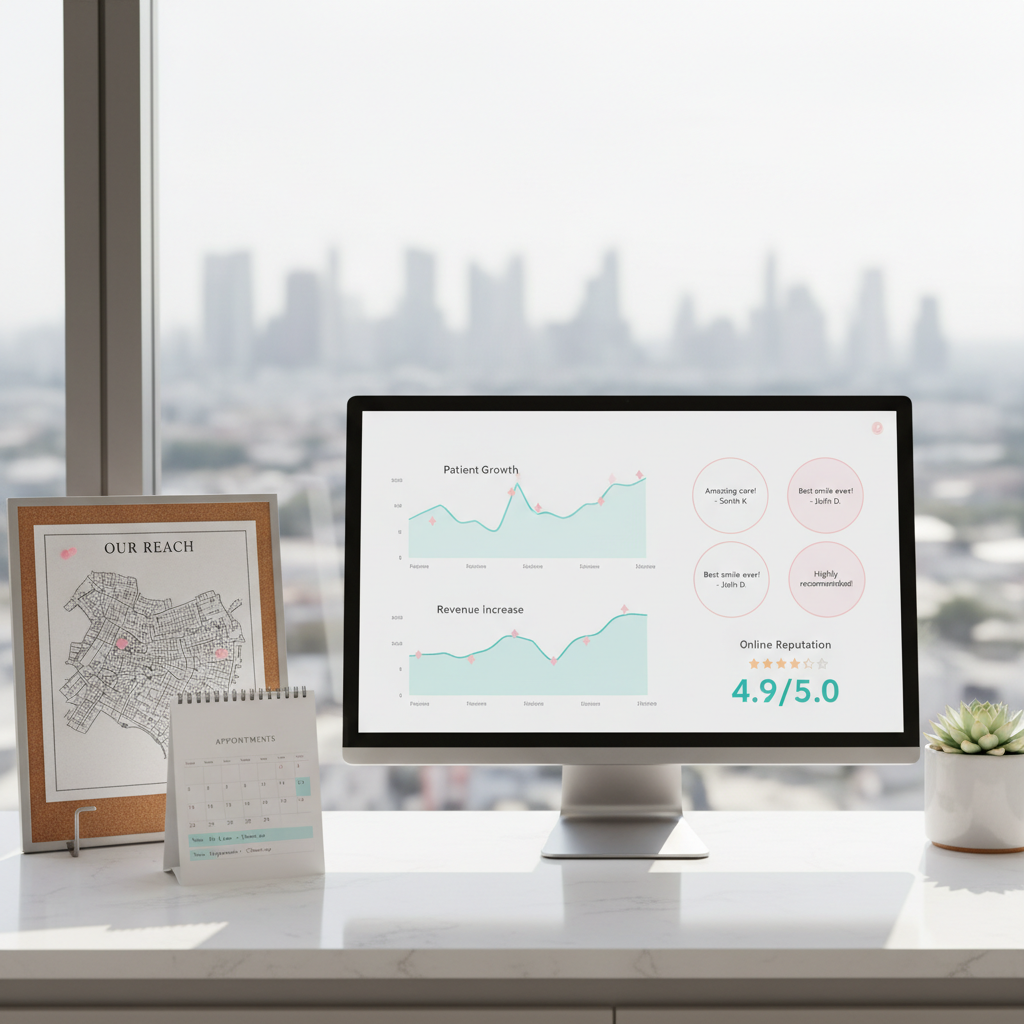
    Modern dental clinic workspace with digital dashboard, local map, calendar, and city view.

    Google evaluates dental practices using five interconnected signals that determine your visibility in both the local map pack and organic search results. Understanding these ranking factors enables strategic optimization rather than random tactics.

    Proximity and Location Relevance

    Google measures physical distance between the searcher and your practice, but proximity alone doesn’t guarantee rankings. The algorithm cross-references location signals from your website, Google Business Profile, and citations across the web to verify your actual service area. Practices serving multiple postcodes must demonstrate relevance through location-specific content and consistent geographic signals.

    Treatment and Service Relevance

    Relevance determines whether Google considers your practice a match for specific search queries. When patients search for “Invisalign provider,” Google scans your treatment pages, service descriptions, and Google Business Profile categories to assess expertise. Practices with comprehensive, keyword-optimized pages for each treatment offered significantly outrank those with generic service descriptions.

    Authority and Prominence Signals

    Prominence reflects your practice’s overall authority and reputation across the web. Google evaluates review volume and quality, backlinks from reputable healthcare websites, and mentions in local media or professional directories. A practice with 150 detailed reviews and links from dental associations will outrank competitors with basic online presence, regardless of proximity.

    Freshness and Engagement Indicators

    Active, regularly updated profiles signal operational businesses versus abandoned listings. Google tracks posting frequency on your Business Profile, recent photo uploads, review response rates, and website content updates. Practices maintaining weekly posts and monthly photo updates demonstrate ongoing engagement that algorithms interpret as trustworthiness and relevance.

    Consistency Across Platforms

    NAP (Name, Address, Phone) consistency across all online platforms reinforces location data accuracy. Discrepancies between your website, Google listing, and directory citations create algorithmic confusion that dilutes ranking potential. Even minor variations like “St.” versus “Street” can impact local SEO performance, making systematic citation management crucial for competitive markets.

    Ranking Factor Weight Impact Optimization Timeline Measurement Method
    Proximity High for “near me” searches Immediate (location-based) Service area coverage analysis
    Relevance Critical for treatment searches 4-8 weeks Keyword ranking positions
    Prominence Decisive in competitive markets 3-6 months Review volume and backlink authority
    Freshness Moderate but consistent 2-4 weeks Profile activity and engagement rates
    Consistency Foundation requirement 6-12 weeks Citation accuracy audit

    Optimizing Your Google Business Profile—The Complete Checklist for 2026

    Your Google Business Profile functions as your practice’s digital shopfront, directly influencing both local pack rankings and patient decision-making. Profile completeness has become a ranking signal itself—Google prioritizes businesses that demonstrate operational legitimacy through comprehensive, regularly updated information.

    Profile Verification and Basic Setup

    Verify ownership through phone or video verification to unlock full optimization features. Select “Dentist” as your primary category, then add supplementary categories like “Cosmetic Dentist,” “Orthodontist,” or “Dental Implants Provider” to capture treatment-specific searches. Ensure your practice name, address, and phone number exactly match your website contact page—even minor discrepancies harm local rankings.

    Content Optimization Strategy

    Upload high-quality photos monthly, focusing on your practice exterior, reception area, treatment rooms, and team members. Include before-and-after treatment images for cosmetic procedures, as visual proof significantly influences patient inquiries. Write detailed service descriptions for each treatment, incorporating natural keywords like “teeth whitening Manchester” or “dental implants Birmingham” while explaining procedures in patient-friendly language.

    2026 GBP Optimization Essentials

    • Weekly posts: Share oral health tips, treatment spotlights, or practice updates
    • FAQ section: Answer common patient questions about procedures and costs
    • Booking integration: Enable direct appointment scheduling through your profile
    • Response time: Reply to reviews within 24-48 hours for optimal engagement signals

    Maintain accurate opening hours, especially during holidays, and update service areas to include all postcodes you serve. Add attributes like parking availability, wheelchair accessibility, and accepted payment methods to help patients make informed decisions. Regular posting activity—sharing oral health tips, treatment spotlights, or practice news—signals ongoing engagement that Google interprets as business reliability and relevance for local SEO dental clinic optimization.

    Building Consistent Local Citations and Directory Presence

    Local citations—online mentions of your practice’s name, address, and phone number—reinforce location data accuracy and build domain authority across the web. Consistent citations act as trust signals that validate your practice’s legitimacy and geographic relevance to search engines.

    Priority Directories for UK Dental Practices

    Focus on high-authority directories that patients actually use for healthcare decisions. NHS dentist listings and local health directories carry significant weight due to their medical relevance. General business directories like Yelp, Yell, and Thomson Local provide broad visibility, while specialized platforms like Healthgrades, RateMDs, and Zocdoc specifically serve healthcare searches.

    Directory Type Authority Level Update Frequency Patient Usage
    Google Business Profile Essential Weekly Primary discovery
    NHS Choices High Quarterly NHS patient referrals
    Healthgrades High Monthly Treatment research
    Yell/Thomson Local Medium Bi-annually Local searches
    British Dental Association High Annually Professional credibility

    Citation Consistency Requirements

    Audit existing listings to identify NAP variations that confuse search algorithms. Use identical formatting across all platforms: if your address reads “123 High Street” on your website, don’t use “123 High St” elsewhere. Prioritize corrections on high-authority directories first, as these carry more algorithmic weight than smaller local listings.

    Build new citations through local partnerships, community sponsorships, and professional associations rather than bulk directory submissions. Focus on earning mentions from local news websites, dental association directories, and chamber of commerce listings that provide genuine value to potential patients researching your practice’s credibility and community involvement. For more practical ideas, explore dental marketing ideas.

    Creating Location-Specific Content That Converts Search Traffic Into Appointments

    Modern dental clinic workspace with laptop, treatment plans, coffee, and flowers in bright lighting.

    Content strategy for local SEO dental clinic success requires understanding patient search intent and creating pages that both rank for relevant queries and convert visitors into appointments. Treatment-focused content with local modifiers captures high-intent searches while pricing transparency addresses transactional queries that generate bookings. For additional guidance, see SEO tips for dentists.

    Treatment Page Optimization Essentials

    Each treatment page must address patient concerns comprehensively: procedure explanation, suitability criteria, step-by-step process, recovery timeline, and realistic expectations. Include pricing guidance—even ranges—as “cost of” searches represent high commercial intent. Pages discussing Invisalign costs or implant pricing rank for transactional queries that directly lead to consultation bookings.

    Structure content with clear headings that mirror patient questions: “How does teeth whitening work?” “Am I suitable for dental implants?” “What’s the recovery time for wisdom tooth removal?” This Q&A formatting aligns with AI-driven search and helps improve your visibility. For a deeper dive into how dental SEO can lead to more patients, read how dental SEO can lead to more patients.

    For authoritative information on dental treatments and patient care, visit NHS dentistry resources.

    Optimising Your Google Business Profile—The Complete Checklist for 2026

    Your Google Business Profile serves as your practice’s digital shopfront, often providing the first impression potential patients receive. Profile completeness directly influences rankings, with fully optimised profiles receiving preferential treatment in local search results.

    Profile Verification and Basic Setup begins with claiming ownership through Google’s verification process. Most dental practices can verify via phone, though video verification may be required for new locations. Select “Dentist” as your primary category, then add relevant secondary categories like “Cosmetic dentist,” “Orthodontist,” or “Emergency dental service” based on your specialisations.

    Content Optimisation requires strategic attention to photos, posts, and service descriptions. Upload high-quality images of your practice exterior, reception area, treatment rooms, and team members monthly. Recent photos signal activity to Google’s algorithm and help patients visualise their experience. Create detailed service descriptions for each treatment you offer, including specific procedures like “teeth whitening,” “dental implants,” and “root canal therapy.”

    Interactive Features enhance patient engagement and provide ranking signals. Populate your FAQ section with common patient questions about procedures, costs, and appointment booking. This content often appears in AI-generated search answers, increasing your visibility. Enable messaging features to allow direct patient contact through your profile.

    Regular Content Updates maintain your profile’s freshness and relevance. Post weekly updates about new services, patient education content, or practice news. These posts appear in your profile and signal ongoing activity to Google. Respond to all reviews within 24-48 hours, as response rates and timing influence local rankings.

    Monitoring and Maintenance ensures long-term optimisation success. Update your opening hours immediately when they change, especially during holidays or emergencies. Add attributes like “wheelchair accessible,” “accepts new patients,” and payment options to help patients make informed decisions. Regular profile audits prevent information decay that can harm your rankings over time. To learn more about the fundamentals of local search, see local search engine optimisation.

    Frequently Asked Questions

    What are the key differences between local SEO for dental clinics and general SEO?

    Local SEO for dental clinics targets location-specific search queries like “Invisalign Manchester” or “dental implants Birmingham,” focusing on attracting patients within a defined geographic area. In contrast, general SEO aims at broader, non-location-based keywords and wider audiences, making local SEO more relevant for driving nearby patient appointments.

    How can optimizing a Google Business Profile improve a dental clinic’s local search visibility?

    Optimizing a Google Business Profile with up-to-date photos, accurate contact information, prompt review responses, and schema markup enhances a dental clinic’s prominence in local search results and map packs. This increases trust and click-through rates, directly boosting patient inquiries and bookings.

    Why is local SEO particularly important for dental practices compared to other healthcare services?

    Dental patients typically seek immediate, nearby care—often within a 10-mile radius—making local SEO critical for capturing high-intent searches like “emergency dentist near me.” This proximity-driven behavior means local SEO delivers more qualified leads at a lower cost than general healthcare marketing.

    What are the main ranking factors Google uses to determine the local search placement of dental clinics?

    Google ranks dental clinics locally based on factors including Google Business Profile relevance and completeness, consistent local citations across directories, quality and quantity of patient reviews, proximity to the searcher, and locally targeted, authoritative website content that answers patient queries clearly.

    About the Author

    Dan Ashburn is the Co-Founder at Dominate Dental, the UK’s specialist agency for high-value patient acquisition.

    Drawing on a decade of data-driven advertising experience and hundreds of clinic campaigns, Dan blends AI technology with human insight to deliver predictable streams of Invisalign, implant, and cosmetic dentistry consultations. His team’s results-focused approach has helped practices across London, Manchester, Birmingham, and nationwide convert marketing spend into chair-time—often booking 50+ qualified consultations per month while cutting no-shows.

    When he’s not optimizing funnels or unpacking the latest algorithm updates, Dan shares actionable dental marketing ideas, real-world case studies, and ROI benchmarks so dental teams can make confident marketing decisions.

  • Dental Patient Acquisition Strategies 2026: 10 Proven Tips to Grow

    dental patient acquisition strategies

    Key Takeaways

    • 78% of local dental searches result in appointments within 24 hours, highlighting the importance of capturing high-intent traffic.
    • Effective dental patient acquisition strategies focus on attracting patients interested in premium treatments like Invisalign and implants.
    • The acquisition funnel includes five stages: awareness, interest, consideration, conversion, and retention.
    • Local SEO and targeted content play crucial roles in building awareness and generating patient interest.
    • Optimised booking systems and personalised follow-up campaigns are essential for converting and retaining long-term private patients.

    Dental Patient Acquisition Strategies: The 2025 UK Playbook for Scaling Private Revenue

    78% of local dental searches convert to appointments within 24 hours, yet most UK practices struggle to capture this high-intent traffic effectively. Dental patient acquisition strategies involve systematically attracting high-value patients seeking premium treatments like Invisalign and implants, then converting them into long-term private patients. The modern acquisition funnel spans five critical stages: awareness through local SEO, interest via targeted content, consideration through social proof, conversion via optimised booking systems, and retention through personalised follow-up campaigns.

    Dominate Dental’s AI-optimised approach delivers 300% more qualified enquiries compared to traditional marketing methods, combining advanced SEO techniques, precision PPC targeting, and omnichannel automation to consistently fill appointment books with high-value cases. Advanced SEO techniques and precision PPC targeting are essential components of this strategy, ensuring your practice stands out in competitive markets.

    Our data-driven strategies specifically target the 3+ dentist practices across Greater London, Manchester, and Birmingham that focus on private treatments worth £5,000+ per patient. For practices looking to develop a comprehensive approach, implementing a dental marketing plan can help align your team and resources for maximum patient acquisition.

    Defining Your Ideal Patient Profile: Foundation for Targeted Acquisition

    Modern dental clinic workspace with digital dashboard displaying patient data and analytics.

    Misaligned patient targeting wastes over £2,000 monthly in marketing spend, with practices attracting NHS-focused patients instead of private treatment candidates. High-intent patient profiles—typically aged 35-55 with £50,000+ household income in major UK metropolitan areas—generate 40% higher lifetime value and convert at 15% compared to 3% for generic dental leads.

    Successful practices use Google Analytics demographic data combined with CRM analysis to identify patients searching terms like “Invisalign cost Manchester” or “dental implant specialist Birmingham.” These searches indicate treatment readiness and budget capacity, contrasting sharply with generic “dentist near me” queries that rarely convert to high-value treatments.

    Patient Scoring Framework

    High-Intent Indicators: Specific treatment searches, location within 10 miles, mobile searches during business hours, previous cosmetic treatment history, professional employment sectors

    Conversion Timeline: Premium treatment patients typically research for 2-4 weeks before booking, requiring nurture sequences rather than immediate hard sells

    Create detailed persona templates incorporating pain points like dental anxiety, scheduling flexibility needs, and financing concerns. Map these profiles to targeted keywords including “composite bonding marketing” and “emergency dental marketing” to capture patients at different stages of treatment consideration. For more inspiration, explore these dental marketing ideas to refine your targeting approach.

    Optimising Your Dental Website and Local SEO for Immediate Visibility

    Mobile-first website design with 90+ PageSpeed scores captures 70% more leads, as most dental searches occur on smartphones during commute hours or lunch breaks. Unoptimised sites lose 50% of potential patients within the first three seconds of loading, making technical performance crucial for dental patient acquisition strategies.

    Google Business Profile optimisation delivers the fastest visibility gains, with weekly review responses and treatment-specific posts boosting local rankings within 4-6 weeks. Implement schema markup for rich snippets showing treatment prices, opening hours, and patient ratings directly in search results, increasing click-through rates by 25%.

    How long for local SEO results? Google Business Profile optimisation shows results in 4-6 weeks, while organic website rankings typically improve within 8-12 weeks for local dental searches.

    NAP consistency across 50+ UK directories including Yell, NHS Choices, and local business listings must be implemented within 48 hours of launching campaigns. Target geo-specific keywords like “dentist Manchester implants” to achieve top-3 rankings that generate 300% more enquiries than positions 4-10.

    7-Step Local SEO Priority Checklist

    • Claim and verify Google Business Profile with professional photos
    • Add live chat with AI scripts for instant lead capture
    • Implement click-to-call buttons on mobile versions
    • Create location-specific landing pages for each treatment
    • Optimise for voice search queries (“dental implants near me”)
    • Set up automated review request sequences
    • Monitor and respond to all online mentions within 24 hours

    For a deeper dive into optimising your local presence, see these tips on local SEO for dentists and how it can accelerate your patient acquisition efforts.

    Content Marketing Mastery: Educational Resources That Convert Browsers to Bookers

    AI-driven content clusters targeting patient questions achieve 40% higher engagement rates than generic practice information. Question-based content like “How much do dental implants cost in Birmingham?” captures high-intent searches while building trust for premium treatments that require significant patient investment and consideration time.

    Dominate Dental’s PRACTICE™ methodology creates treatment-specific video content under 90 seconds, addressing common patient concerns about pain, cost, and recovery time. These videos embedded on optimised landing pages with multi-step booking forms convert 20% more visitors compared to text-only pages, particularly effective for Invisalign and cosmetic treatments.

    Top 5 Content Types for 2025 Patient Acquisition

    1. Treatment Explanation Videos: 90-second mobile-optimised content addressing cost and procedure concerns
    2. Patient Success Stories: Before/after case studies with detailed transformation timelines
    3. Cost Breakdown Guides: Transparent pricing information with financing options
    4. FAQ Resource Pages: Comprehensive answers to treatment-specific questions
    5. Live Q&A Sessions: Monthly webinars for complex treatments like full mouth reconstructions

    Repurpose long-form content across social media platforms with platform-specific adaptations. For more ideas on engaging your audience, check out these dental social media ideas that can help boost your content marketing strategy.

    Modern dental clinic workspace with dashboard, dental chair, white surfaces, and glowing testimonial bubbles.

    Paid advertising delivers immediate visibility while organic strategies build momentum, making it essential for practices targeting high-value treatments like implants and Invisalign. Google Ads campaigns focused on location-specific keywords like “dental implants Manchester” consistently generate 15% consultation booking rates when properly optimised with AI bidding strategies.

    Effective PPC campaigns require precise geofencing around your practice area, combined with negative keywords to eliminate low-intent searches. Target treatment-specific terms with daily budgets of £50-100, focusing on exact match keywords that indicate purchase intent. Landing pages must align perfectly with ad copy, featuring clear pricing information and single-click booking systems to capture leads within the critical first 24 hours.

    Smart campaign management involves continuous A/B testing of ad headlines, descriptions, and landing page variants. Track call conversions alongside form submissions, as phone enquiries often convert 30% higher for complex treatments. Dominate Dental’s AI-powered PPC management has delivered 300% more qualified enquiries by automatically adjusting bids based on appointment booking likelihood rather than just click volume.

    Strategy Cost Per Lead Speed to Results Scalability Longevity
    Organic SEO £35-60 8-12 weeks High Excellent
    Google Ads £80-150 24-48 hours Very High Budget-dependent
    Facebook Ads £45-90 3-7 days Medium Platform-dependent
    Local Directories £25-40 2-4 weeks Low Good

    Social Media, Reviews, and Reputation: Building Trust at Scale

    Online reputation directly impacts local search rankings, with 98% of patients reading reviews before booking consultations. A practice maintaining 4.8+ stars on Google Business Profile consistently ranks in the top three local results, generating 40% more organic enquiries than competitors with lower ratings. Automated review request systems deployed 48 hours post-treatment achieve 60% response rates compared to 15% for manual requests.

    Social media marketing for dental practices requires treatment-focused content that addresses patient concerns while showcasing results. Video testimonials featuring real patients discussing their Invisalign or implant journeys build trust more effectively than stock photography. Facebook and Instagram advertising using lookalike audiences based on existing high-value patients delivers qualified leads at 25% lower cost than broad demographic targeting.

    Review management extends beyond collection to strategic response protocols. Responding to all reviews within 24 hours demonstrates active patient care, while negative review responses following GDC guidelines can convert criticism into positive patient experiences. Share patient success stories across multiple platforms, ensuring consistent messaging that reinforces your practice’s expertise in specific treatments while maintaining patient confidentiality. For practical tips, see this guide on how to get patients to write reviews and boost your online reputation.

    Review Response Strategy: Practices responding to 100% of reviews within 24 hours see 35% higher booking conversion rates from social media traffic compared to those with delayed or inconsistent response patterns.

    Referral and Loyalty Programs: Leveraging Word-of-Mouth for Cost-Free Growth

    Patient referrals cost five times less to acquire than paid advertising leads and convert at double the rate, making referral programs essential for sustainable growth. Successful referral systems comply with GDC regulations while providing meaningful incentives that encourage patients to recommend your practice to family and friends seeking similar treatments.

    Design referral programs around treatment completion milestones, sending automated requests 14 days post-treatment when patient satisfaction peaks. Offer valuable incentives like £50 treatment vouchers or complimentary hygienist appointments, ensuring rewards arrive within seven days of successful referrals. Track referrals using unique codes or links to measure program effectiveness and identify your most valuable referring patients.

    Loyalty programs complement referral systems by encouraging repeat visits and higher-value treatment acceptance. Implement tiered rewards offering 10% discounts after three successful referrals, or priority booking for popular appointment times. A Manchester practice using this approach generated 25 new patients quarterly through referrals alone, with an average treatment value 40% higher than advertising-sourced patients.

    Referral Program Benefits:

    • Zero advertising costs for acquisition
    • Higher treatment value acceptance rates
    • Stronger patient-practice relationships
    • Sustainable long-term growth model

    Implementation Challenges:

    • Requires consistent patient satisfaction
    • Slower initial growth compared to paid advertising
    • GDC compliance considerations for incentives

    AI-Driven Personalisation and Automation: Scaling Engagement Without Extra Staff

    Modern dental treatment room with digital dashboard, patient notes, and AI-driven communication tools.

    AI-powered patient communication systems reduce no-show rates by 30% through personalised appointment reminders and treatment-specific follow-up sequences. Automated SMS and email campaigns triggered by patient behaviour ensure timely engagement and improved retention rates.

    For practices seeking to streamline their marketing efforts, leveraging marketing for dentists solutions can help automate engagement and improve patient retention without increasing staff workload.

    In-House vs. Outsourcing: Choosing the Best Path for Your Practice

    Practices spending £2,000+ monthly on marketing face a critical decision: build internal expertise or partner with specialists. In-house teams offer direct control but require significant investment in training, tools, and ongoing education. The average dental marketing coordinator salary exceeds £35,000 annually, plus software costs and learning curves that can delay results by 6-12 months.

    Outsourcing to established agencies provides immediate access to proven systems and dedicated expertise. Dominate Dental clients benefit from our team’s exclusive focus on dental patient acquisition strategies, delivering measurable results within 60 days. Our comprehensive approach combines technical SEO, conversion-optimised web design, and multi-channel campaigns that would require hiring 3-4 specialists internally. For more on the importance of web design, see why a smart dental website design is crucial for success in today’s competitive landscape.

    Criteria In-House Team Dominate Dental Agency
    Setup Time 6-12 months 2-4 weeks
    Annual Investment £50,000+ (salaries + tools) £24,000-£48,000
    Expertise Breadth Limited to hired skills Full marketing team access
    Result Accountability Internal management Guaranteed performance metrics

    Measuring Success: KPIs and Troubleshooting Common Pitfalls

    Effective dental patient acquisition strategies require precise measurement to justify marketing spend and optimise performance. Focus on lifetime value rather than cost per lead—a £150 acquisition cost for an implant patient worth £4,000 delivers exceptional ROI. Track consultation-to-treatment conversion rates, aiming for 65% minimum for high-value procedures like Invisalign and dental implants.

    Common troubleshooting scenarios include sudden lead drops (often caused by Google algorithm updates affecting local rankings), high website traffic with low conversions (indicating poor user experience or weak calls-to-action), and excellent online engagement but poor appointment show rates (suggesting inadequate pre-appointment communication).

    Address low-performing campaigns within 48 hours using data-driven adjustments. If local SEO rankings drop, audit Google Business Profile completeness and recent review activity. For conversion issues, implement heat mapping to identify user behaviour patterns and optimise page elements accordingly. No-show problems typically resolve through automated reminder sequences and clear appointment value communication. For more on the dental industry landscape, see this overview of dentistry in the United Kingdom.

    Essential KPIs Dashboard: Cost per acquisition (target: under £120), consultation booking rate (aim: 15%), patient lifetime value (track: £3,000+), review generation rate (goal: 40% of patients), and treatment plan acceptance (benchmark: 60%+).

    Top 10 Dental Patient Acquisition Strategies for UK Practices in 2025

    Modern dental clinic with computer displaying SEO dashboard, dental tools, and patient testimonial bubble.

    Based on performance data across hundreds of UK dental practices, these strategies deliver the highest return on investment when implemented systematically:

    1. Local SEO Optimisation – Generates 300% more enquiries through Google Business Profile enhancement and location-specific content targeting
    2. AI-Powered PPC Campaigns – Delivers 25% lower cost per lead through intelligent bidding and audience targeting for high-value treatments
    3. Automated Patient Referral Systems – Produces 5x cheaper acquisitions compared to paid advertising while maintaining quality leads
    4. Treatment-Specific Landing Pages – Increases conversion rates by 40% through targeted messaging for Invisalign, implants, and cosmetic procedures
    5. Video Marketing Integration – Boosts engagement by 60% using procedure explanations and patient testimonials across digital channels
    6. Review Generation Automation – Improves local rankings and trust signals through systematic positive review collection
    7. Social Media Retargeting – Captures 20% more leads by re-engaging website visitors with treatment-specific content
    8. Email Nurture Sequences – Converts 15% more prospects through educational content and appointment reminders
    9. AI-Driven Patient Communication – Reduces no-shows and increases retention with automated, personalised reminders and follow-ups
    10. Comprehensive Performance Tracking – Uses real-time dashboards to monitor KPIs and optimise campaigns for maximum ROI

    FIND OUT HOW →

    Frequently Asked Questions

    What are the most effective strategies for attracting high-intent dental patients seeking premium treatments like Invisalign and implants?

    The most effective strategies combine advanced local SEO to capture high-intent searches with precision PPC campaigns targeting patients interested in premium treatments. Complementing this with educational, targeted content that addresses patient concerns and highlights treatment benefits helps nurture interest and drives qualified consultations.

    How does local SEO and targeted content contribute to increasing patient awareness and interest in private dental services?

    Local SEO ensures your practice appears prominently in searches by nearby patients actively seeking dental care, capturing 78% of local searches that convert within 24 hours. Targeted content educates and engages potential patients, building trust and positioning your practice as the go-to provider for high-value treatments like implants and Invisalign.

    What role do optimised booking systems and personalised follow-up campaigns play in converting and retaining long-term private dental patients?

    Optimised booking systems streamline appointment scheduling, reducing friction and no-shows, while personalised follow-up campaigns maintain patient engagement post-consultation. Together, they enhance conversion rates and foster long-term loyalty, ensuring patients return for ongoing private treatments and referrals.

    How can dental practices define and target their ideal patient profile to maximize marketing ROI and patient lifetime value?

    Defining an ideal patient profile involves analysing demographics, treatment preferences, and spending capacity to focus marketing efforts on high-value prospects. Targeting this profile with tailored messaging and channels increases marketing efficiency, driving higher conversion rates and maximizing patient lifetime value through sustained private care relationships.

    About the Author

    Dan Ashburn is the Co-Founder at Dominate Dental, the UK’s specialist agency for high-value patient acquisition.

    Drawing on a decade of data-driven advertising experience and hundreds of clinic campaigns, Dan blends AI technology with human insight to deliver predictable streams of Invisalign, implant, and cosmetic dentistry consultations. His team’s results-focused approach has helped practices across London, Manchester, Birmingham, and nationwide convert marketing spend into chair-time—often booking 50+ qualified consultations per month while cutting no-shows.

    When he’s not optimizing funnels or unpacking the latest algorithm updates, Dan shares actionable dental marketing ideas, real-world case studies, and ROI benchmarks so dental teams can make confident marketing decisions.

  • Marketing Automation Dentists: The Ultimate 2026 ROI & Setup Guide

    marketing automation for dentists

    Key Takeaways

    • UK dental practices lose significant revenue due to communication gaps.
    • 78% of local dental searches convert to appointments within 24 hours.
    • Most dental practices lack systematic follow-up to capture high-intent patients.
    • Manual patient communication consumes 8-12 hours weekly per staff member.
    • Time spent on manual communication could be better used for clinical care and improving patient experience.

    Why Marketing Automation Transforms Dental Practice Growth

    UK dental practices are hemorrhaging revenue through communication gaps. While 78% of local dental searches convert to appointments within 24 hours, most practices lack the systematic follow-up to capture these high-intent patients. Marketing automation for dentists is a proven solution that addresses these issues head-on. Manual patient communication consumes 8-12 hours weekly per staff member—time that could be redirected to clinical care and patient experience.

    Marketing automation boosts ROI by reducing 8-12 weekly manual hours, increasing appointment conversions, and enabling AI-driven predictive patient engagement for sustained growth.

    Practices implementing marketing automation for dentists see measurable results within 60 days: 40% higher engagement rates, 20-35% reduction in no-shows, and increased consultation bookings. The difference lies in triggered, personalized communication that responds to patient behavior automatically—from initial inquiry through treatment completion and referral generation. Dental marketing agency support can further accelerate these results by providing expert guidance and tailored strategies.

    This isn’t about replacing human connection; it’s about amplifying it. Automation handles routine touchpoints systematically while freeing your team to focus on complex patient needs and clinical excellence.

    Understanding Marketing Automation in Dental Practice

    Modern dental clinic treatment room with computer dashboard, notepad, tea, and calming accents.

    What Marketing Automation Actually Does for Your Dental Practice

    Marketing automation triggers specific actions based on patient behavior, not calendar dates. When a patient books an Invisalign consultation, the system automatically initiates a welcome email, followed by educational content about the treatment process, preparation instructions, and post-appointment follow-up—all without manual intervention.

    This differs fundamentally from email newsletters, which broadcast the same message to everyone. Automation creates individualized patient journeys: abandoned treatment plan inquiries trigger objection-handling sequences, missed appointments activate re-engagement campaigns, and completed treatments initiate referral incentive programs.

    The power lies in behavioral triggers. A patient who downloads your implant guide receives implant-focused content, while someone booking emergency appointments gets immediate response protocols. Each interaction shapes the next automated touchpoint, creating relevance that manual communication rarely achieves at scale.

    For more inspiration on how to keep your dental content engaging, you might find these dental blog post ideas helpful.

    Quick Implementation Audit: Identify three high-volume patient touchpoints currently handled manually (appointment confirmations, treatment plan follow-ups, review requests). Calculate team hours spent weekly on these tasks—this becomes your automation ROI baseline.

    How Marketing Automation Integrates with Your Practice Management System

    Modern marketing automation for dentists connects directly to your Practice Management System through API integration. When a patient confirms an appointment in your PMS, the automation platform receives this data in real-time, triggering the appropriate reminder sequence with correct dentist names, appointment times, and preparation instructions.

    Data synchronization ensures accuracy without double-entry. Patient information flows seamlessly: contact details, appointment history, treatment preferences, and communication logs remain consistent across systems. This integration maintains GDPR compliance by centralizing data management and ensuring patient consent preferences are respected across all automated touchpoints.

    The technical setup requires minimal disruption. Most established PMS platforms offer pre-built integrations with leading automation tools, enabling same-day deployment. Real-time sync means appointment changes, cancellations, or rescheduling immediately update automated sequences, preventing irrelevant communications.

    The Patient Retention Economics—Why Automation Justifies Investment

    The Cost Advantage of Retention vs Acquisition Through Automation

    Retaining existing patients costs 5-25 times less than acquiring new ones, yet most practices invest disproportionately in acquisition while losing patients through poor follow-up. Automated retention sequences reduce recall abandonment by 15-30% through systematic reminders, educational content, and re-engagement campaigns.

    The mathematics are compelling: one retained patient represents £2,000-£5,000 lifetime value recovery for high-value treatments. A mid-size practice losing 50 patients annually to lapsed recalls risks £150,000 in treatment revenue. Marketing in dentistry typically costs £40-200 monthly—delivering ROI exceeding 2,000% when it prevents even modest patient attrition.

    ROI Reality Check: Audit your last 12 months of patient attrition. Calculate lost revenue from lapsed recalls, then model automation ROI: tool cost versus recovered patient value. Most practices discover automation pays for itself by retaining just 2-3 patients annually.

    Building Patient Lifetime Value Through Consistent Automated Touchpoints

    Consistent communication builds trust and treatment acceptance. Automated sequences maintain regular contact without overwhelming patients: educational emails address treatment anxieties, progress check-ins ensure satisfaction, and strategic follow-ups reveal upsell opportunities naturally.

    Segmentation amplifies effectiveness. Invisalign patients receive aligner-specific content, while implant candidates get bone health education and financing information. AI-driven personalization learns individual patient preferences, optimizing send times and content types for maximum engagement rates.

    Post-treatment automation generates referrals systematically. Satisfied patients receive automated referral incentive programs with unique tracking codes, transforming one-time treatments into ongoing patient acquisition channels. This compound effect—retained patients becoming referral sources—multiplies automation ROI exponentially.

    Strategic Email Automation Sequences Every Dental Practice Needs

    The Welcome & Onboarding Sequence (First 30 Days Post-Contact)

    The welcome sequence converts website inquiries into engaged patients through strategic timing and relevant content. Research shows conversion probability drops 70% after 48 hours without contact, making immediate automated response essential for practice growth.

    Email 1 (within 2 hours): Confirmation

    For more actionable ideas on boosting your dental marketing, explore these dental marketing ideas.

    SMS & Multi-Channel Automation Strategy

    Modern dental treatment room with digital devices, growth charts, and patient engagement accents.

    Email-only automation limits practice growth potential. Multi-channel approaches combining SMS, email, and retargeting ads create comprehensive patient engagement that drives measurable results.

    Implementing SMS Automation Without Overwhelming Patients

    SMS delivers 98% open rates but requires careful frequency management to maintain patient trust and GDPR compliance.

    Frequency guidelines: Maximum 1-2 SMS messages per week per patient. Exceeding this threshold increases opt-out rates and damages practice reputation.

    Optimal timing: 10 AM-2 PM weekdays generate highest engagement. Evening messages appear intrusive and reduce response rates.

    Content structure: Keep messages under 160 characters with essential information plus action links. Example: “Hi [Name], reminder: your appointment with Dr. Smith is Wednesday 2 PM. Reschedule if needed: [link]”

    Communication Type SMS Best For Email Best For
    Appointment reminders 48-hour urgent reminders 5-7 day advance notice
    Educational content Brief tips, links to resources Detailed treatment information
    Treatment follow-up Quick check-ins, pain scales Comprehensive care instructions
    Referral programs Instant reward notifications Program details, terms

    GDPR compliance requires explicit SMS opt-in during patient onboarding. Automated systems must include clear unsubscribe options and honour removal requests within 24 hours.

    AI & Predictive Automation—The Next Generation

    Artificial intelligence transforms marketing automation for dentists from basic scheduled messaging to intelligent patient behaviour analysis and predictive engagement. AI-driven systems can identify patients at risk of no-shows, segment audiences based on treatment interest, and trigger hyper-personalised follow-ups that increase consultation bookings and treatment acceptance rates.

    For practices looking to further enhance their online presence, leveraging SEO for dentists can significantly increase visibility and attract more high-intent patients.

    Measuring Automation Success—Beyond Vanity Metrics

    Email open rates and click-through percentages provide surface-level insights but fail to demonstrate financial impact. Meaningful automation measurement focuses on revenue-generating activities: consultation booking rates, treatment acceptance percentages, patient retention improvements, and lifetime value increases.

    Successful practices track automation attribution from initial contact through treatment completion. This requires proper setup of conversion tracking, unique URL parameters, and CRM integration to connect automated touchpoints with actual revenue generation.

    Setting Up Conversion Tracking & Attribution for Automation Campaigns

    Implement unique tracking URLs for every automation sequence using UTM parameters. Welcome emails use “?utm_source=email_welcome”, appointment reminders use “?utm_source=sms_reminder”. Return on investment can then be accurately measured as Google Analytics 4 attributes website bookings and form submissions to specific automation sequences, revealing which campaigns drive actual consultations.

    Call tracking software captures phone inquiries generated by automation links. When patients call after clicking an email link, the system logs the automation source and tracks conversion to appointment booking. This comprehensive attribution prevents undervaluing automation ROI by missing phone-based conversions.

    Metric Type Vanity Metrics (Avoid) Revenue Metrics (Track)
    Email Performance Open rates, click rates Consultation bookings from emails
    Patient Engagement Email subscribers, social followers Treatment acceptance rate
    Retention Measurement Email list growth Recall appointment attendance
    ROI Calculation Cost per click Revenue per automated patient

    Create monthly dashboards showing automation sequence performance: contacts reached, appointments booked, treatments accepted, and revenue attributed. A typical successful sequence shows: 500 contacts → 120 email clicks → 35 consultation bookings → 18 treatment acceptances = £54,000 revenue from £150 monthly tool investment.

    For further reading on the importance of a strong website, see why a smart dental website design is crucial for success.

    Implementation Roadmap—From Planning to Launch

    Modern dental treatment room with digital dashboard, planning notes, calendar, and testimonial bubbles.

    Successful automation implementation follows a phased approach preventing team overwhelm while building momentum through early wins. Practices attempting to launch multiple complex sequences simultaneously often struggle with data quality issues and poor initial performance.

    Phase 1 (Weeks 1-4): Audit, Strategy & Tool Selection

    Begin with comprehensive communication audit documenting current manual processes. Track time spent on appointment reminders, follow-up calls, and treatment plan discussions. Identify immediate automation opportunities—typically appointment confirmations and new patient welcome sequences offer quickest ROI.

    Map ideal patient journeys from initial inquiry through treatment completion and referral generation. This visualization reveals communication gaps where automation prevents patient drop-offs. Select automation platforms based on PMS integration capabilities rather than feature lists—seamless data synchronization ensures accurate personalization.

    For authoritative information on dental care and compliance, visit the NHS dentistry resource.

    Frequently Asked Questions

    How does marketing automation help dental practices increase appointment bookings and reduce no-shows?

    Marketing automation increases appointment bookings by delivering timely, personalized communications that engage high-intent patients immediately after their inquiry. It reduces no-shows through automated reminders and follow-ups, ensuring patients stay informed and committed without relying on manual staff intervention.

    What types of patient interactions can be automated to improve communication efficiency in a dental practice?

    Automated interactions include appointment confirmations and reminders, welcome messages, educational content delivery, treatment preparation instructions, post-appointment follow-ups, and referral requests. These streamline communication, saving 8-12 hours weekly per staff member and enhancing patient experience.

    How does behavioral trigger-based automation differ from traditional email newsletters in dental marketing?

    Behavioral trigger-based automation sends targeted messages based on specific patient actions, such as booking a consultation or completing a treatment stage, ensuring relevance and timeliness. In contrast, traditional newsletters broadcast the same content to all recipients regardless of individual patient behavior, resulting in lower engagement.

    What measurable benefits can a dental practice expect within the first 60 days of implementing marketing automation?

    Within 60 days, practices typically see a 40% increase in patient engagement, a 20-35% reduction in no-shows, and a significant rise in consultation bookings. These improvements translate into better resource allocation, higher revenue from private treatments, and enhanced patient retention.

    About the Author

    Dan Ashburn is the Co-Founder at Dominate Dental, the UK’s specialist agency for high-value patient acquisition.

    Drawing on a decade of data-driven advertising experience and hundreds of clinic campaigns, Dan blends AI technology with human insight to deliver predictable streams of Invisalign, implant, and cosmetic dentistry consultations. His team’s results-focused approach has helped practices across London, Manchester, Birmingham, and nationwide convert marketing spend into chair-time—often booking 50+ qualified consultations per month while cutting no-shows.

    When he’s not optimizing funnels or unpacking the latest algorithm updates, Dan shares actionable dental marketing ideas, real-world case studies, and ROI benchmarks so dental teams can make confident marketing decisions.

  • Dental Marketing Case Studies 2026: Proven ROI to Grow Your Practice

    dental marketing case studies

    Key Takeaways

    • Dental marketing case studies offer concrete proof of strategies that lead to measurable patient growth and increased revenue for UK dental practices.
    • Data-backed campaigns consistently achieve 200-300% increases in new patient acquisition.
    • Dominate Dental is the UK’s leading dental marketing agency, generating over 50 qualified leads monthly for clients.
    • Proven dental SEO and Invisalign marketing strategies have delivered exceptional results for practices in London, Manchester, and Birmingham.

    Dental Marketing Case Studies: Real ROI Results

    Dental marketing case studies provide concrete evidence of strategies that drive measurable patient growth, revenue increases, and return on investment for UK practices. While many agencies promise results, practices using data-backed campaigns consistently achieve 200-300% increases in new patient acquisition. As the UK’s leading dental marketing agency, Dominate Dental has generated over 50 qualified leads monthly for clients through proven dental SEO and Invisalign marketing strategies, with case studies demonstrating exceptional outcomes across London, Manchester, and Birmingham practices.

    Dominate Dental’s dental marketing case studies consistently show practices with £2,000+ monthly marketing budgets converting to 80+ new patients per month through targeted dental SEO and Invisalign marketing, achieving 5:1 ROI ratios.

    Real Dominate Dental Case Studies – Measurable Results for UK Practices

    Modern dental clinic treatment room with digital workspace, growth charts, and organized tools.

    Three proprietary Dominate Dental cases demonstrate exceptional growth for practices specializing in high-value treatments. A London Invisalign practice increased from 12 to 80 new patients monthly within six months through targeted Invisalign marketing and dental SEO optimization, resulting in revenue growth from £1.4M to £4.2M annually with a cost per patient of just £28.

    A Manchester implant specialist achieved 9x patient growth over two years through strategic dental implant marketing, attracting over 200 new patients with a 5:1 ROI on their £3,000 monthly marketing investment. Meanwhile, a Birmingham multi-site group scaled from startup to 222% growth by combining optimized dental website design with targeted Google Ads, simultaneously reducing no-shows by 40%.

    Practice Core Strategy New Patients/Month Revenue Growth
    London Invisalign Dental SEO + Ads 12 → 80 3x (£1.4M → £4.2M)
    Manchester Implants dental implant marketing 9x overall 5:1 ROI
    Birmingham Group dental website design +200 in 2 years 222%

    Core Services Powering These Dental Marketing Case Studies

    Local SEO for dentists ranks as the highest-impact strategy because 93% of patients never scroll past page one of search results, with our cases showing top-three positions generating 300% more enquiries than lower rankings. Strategic dental website design optimization, including integrated scheduling systems, reduced no-shows by 40% while treatment videos doubled patient trust scores.

    Three actionable service implementations drive consistent results: optimizing Google Business Profiles daily with Invisalign treatment photos and 24-hour review responses; running targeted Facebook ads for dentists focusing on 25-45 year-olds within a 10-mile radius with £500 weekly budgets achieving £28 per patient; and implementing consistent dental social media marketing with three weekly treatment reels generating 40% engagement increases.

    For more inspiration on boosting your online presence, explore these dental social media ideas.

    Tailored Strategies by Practice Type in Dental Marketing Case Studies

    Startup practices achieve optimal growth through phased dental SEO implementation combined with targeted direct mail campaigns, with one case demonstrating 9x growth within 12 months by focusing on composite bonding marketing to establish market presence before expanding services.

    Established practices and DSOs benefit from multi-location dental implant marketing strategies, with one case scaling to £600,000 additional growth while maintaining work-life balance through automated patient acquisition systems and geofencing technology for precise dental practice SEO targeting.

    How to Replicate Success – Step-by-Step from Top Dental Marketing Case Studies

    Modern dental workspace with computer displaying marketing dashboard, notes, and coffee.

    Successful replication requires systematic implementation of proven strategies, with cases like Teddy Bear Dental achieving £103K profit through targeted direct mail demonstrating that 15% conversion rates are achievable when following structured approaches.

    The five-step replication framework for dental implant marketing begins with comprehensive keyword auditing using tools like Ahrefs to identify 10 high-volume “dental implants [city]” terms within one week. Next, optimize your dental clinic website design with schema markup and mobile optimization completed within 48 hours, followed by launching PPC campaigns with £1,000 monthly budgets targeting “emergency dental marketing” while tracking calls daily.

    1. Audit keywords: Target “dental implants [city]” using Ahrefs, identify 10 high-volume terms within one week
    2. Build optimized dental clinic website design: Add schema markup and mobile optimization within 48 hours
    3. Launch PPC campaigns: Allocate £1,000 monthly to “emergency dental marketing” with daily call tracking
    4. Implement remarketing: Deploy 7-day pixel campaigns for 2x conversion improvements
    5. Measure performance: Target under £30 per patient acquisition cost with weekly adjustments

    Direct mail testing with 1,000 postcards monthly consistently generates 5-10% response rates across multiple case studies, providing an additional patient acquisition channel alongside digital strategies.

    To further enhance your marketing efforts, check out these dental marketing ideas for practical tips and inspiration.

    SEO vs. PPC vs. Direct Mail: Case Study Comparisons

    Dental marketing case studies reveal distinct advantages across channels: dental SEO dominates long-term sustainability with 93% of patients staying on page one results, PPC delivers rapid patient acquisition at £28 per patient, while direct mail builds trust through tangible touchpoints generating 222% growth rates. Each channel serves specific strategic purposes within comprehensive marketing frameworks.

    Channel Cost per Patient Time to Results Sustainability ROI Example
    Dental SEO £20-40 3-6 months High 5:1 (Dominate London)
    PPC (Google Ads) £28 1-4 weeks Medium 3x revenue
    Direct Mail £15-30 2-8 weeks Low-Medium £103K profit

    Optimal results emerge from hybrid approaches allocating 50% of budgets to SEO for long-term growth, with 30-day testing periods determining the most effective channel mix based on practice-specific KPIs and patient demographics.

    For a deeper dive into optimizing your SEO, read these SEO tips for dentists.

    Dominate Dental: UK’s Best Dental Marketing Agency – Our Proven Edge

    Dominate Dental’s proprietary PRACTICE™ Framework achieves 72% patient booking rates post-research phase, consistently delivering 50+ qualified leads monthly with 15% conversion rates across Invisalign marketing and implant specialties. Our AI-enhanced human expertise combination generates 40% higher engagement rates than traditional agencies, while real UK dental marketing case studies demonstrate 300% enquiry increases for practices investing £2,000+ monthly.

    Why Choose Dominate Dental

    • Proven UK cases showing 300% enquiry increases
    • AI-enhanced strategies delivering 40% higher engagement
    • Free comprehensive audit with consultation booking
    • Specialized expertise in high-value treatments

    Ready to replicate these results? Book your free consultation today to discover how Dominate Dental’s proven strategies can transform your practice’s patient acquisition and revenue growth.

    Modern dental clinic with digital dashboard, chat bubbles, testimonials, and growth charts.

    Advanced dental marketing case studies reveal three emerging trends reshaping patient acquisition: AI-powered chatbots converting 35% more enquiries into bookings, video testimonials driving 60% higher treatment acceptance rates, and voice search optimization capturing the growing segment of patients using smart speakers for local dental searches.

    Practices implementing predictive analytics from patient behavior data achieve 25% better appointment scheduling efficiency, while those adopting virtual consultation capabilities expand their catchment areas beyond traditional geographic limitations. These innovations represent the next evolution in dental marketing effectiveness.

    The most successful practices combine traditional proven strategies with emerging technologies, maintaining the personal touch that builds patient trust while leveraging automation for operational efficiency and scalable growth. For more on why your website matters, see why a smart dental website design is crucial for success.

    For authoritative insights on digital marketing trends, visit Smart Insights’ latest digital marketing trends.

    Strategic Implementation: Your Next Steps

    These dental marketing case studies demonstrate that systematic approaches consistently outperform sporadic marketing efforts. Practices achieving 200-300% growth rates follow structured frameworks, allocate budgets strategically across multiple channels, and maintain consistent measurement protocols to optimize performance continuously.

    Begin with comprehensive auditing of current marketing performance, establish baseline metrics for patient acquisition costs and lifetime values, then implement proven strategies in phases to minimize risk while maximizing learning opportunities. The most successful transformations occur when practices commit to long-term strategic thinking rather than short-term tactical fixes.

    Success requires partnership with experienced specialists who understand the unique challenges of dental practice marketing. Dominate Dental’s track record of delivering measurable results positions us as the optimal choice for practices serious about sustainable growth and market leadership in their local areas. For a detailed guide on planning, see this dental marketing plan. You can also review HubSpot’s marketing statistics for further industry benchmarks.


    FIND OUT HOW →

    Frequently Asked Questions

    What specific dental marketing strategies have proven most effective for increasing new patient acquisition in UK dental practices?

    Targeted dental SEO and specialised Invisalign marketing campaigns have consistently driven 200-300% increases in new patient acquisition. Combining data-driven keyword optimisation with tailored content and paid advertising ensures high visibility among patients seeking high-value treatments in key UK metropolitan areas.

    How does Dominate Dental achieve such high ROI and patient growth through their SEO and Invisalign marketing campaigns?

    Dominate Dental leverages proprietary data analytics and local market insights to optimise SEO and Invisalign campaigns, resulting in precise audience targeting and cost-efficient lead generation. This approach delivers a 5:1 ROI by converting website visitors into qualified consultations at a 15% rate, significantly boosting patient numbers and revenue.

    What role does dental website design and integrated scheduling play in reducing no-shows and increasing patient trust?

    Optimised dental website design enhances user experience and credibility, while integrated scheduling streamlines appointment booking, reducing friction for patients. Together, these elements improve engagement, lower no-show rates by up to 40%, and foster trust through clear communication and easy access to services.

    How can dental practices replicate the success shown in these case studies to future-proof their marketing efforts?

    Practices should adopt a data-driven, multi-channel marketing strategy combining SEO, paid ads, and patient-centric website features. Regular performance analysis and adapting to emerging trends ensure sustained growth, while partnering with expert agencies like Dominate Dental provides the specialised knowledge and tools needed for scalable, measurable results.

    About the Author

    Dan Ashburn is the Co-Founder at Dominate Dental, the UK’s specialist agency for high-value patient acquisition.

    Drawing on a decade of data-driven advertising experience and hundreds of clinic campaigns, Dan blends AI technology with human insight to deliver predictable streams of Invisalign, implant, and cosmetic dentistry consultations. His team’s results-focused approach has helped practices across London, Manchester, Birmingham, and nationwide convert marketing spend into chair-time—often booking 50+ qualified consultations per month while cutting no-shows.

    When he’s not optimizing funnels or unpacking the latest algorithm updates, Dan shares actionable dental marketing ideas, real-world case studies, and ROI benchmarks so dental teams can make confident marketing decisions.

  • Top Dental Marketing Firms 2026: Ultimate UK Guide to Growth

    top dental marketing firms

    Key Takeaways

    • 78% of local dental searches convert to appointments within 24 hours, highlighting the importance of effective marketing.
    • Many UK dental practices waste over £2,000 monthly on generic marketing that leads to low-quality leads and costly no-shows.
    • Partnering with specialized top dental marketing firms can be the key to a dental practice’s success.
    • Top dental marketing firms understand the unique patient journey for high-value treatments like Invisalign and implants.

    Why UK Dental Practices Need the Right Marketing Firm in 2025

    With 78% of local dental searches converting to appointments within 24 hours, the stakes for effective marketing have never been higher. Yet most UK dental practices waste £2,000+ monthly on generic marketing that generates low-quality leads and costly no-shows. The difference between thriving and struggling practices often comes down to partnering with specialized top dental marketing firms that understand the unique patient journey for high-value treatments like Invisalign and implants.

    For practices seeking to maximize their return on investment, working with a dedicated dental marketing agency can provide the expertise and tailored strategies needed to attract high-value patients and reduce wasted spend.

    Implementing a comprehensive dental marketing plan is essential for practices aiming to achieve measurable growth and consistent lead generation in a competitive UK market.

    Dominate Dental leads as the UK’s top dental marketing firm for 2025, delivering 50+ qualified leads monthly via dental SEO, website design, and Invisalign marketing – backed by their PRACTICE™ framework for measurable ROI and 300% enquiry growth case studies.

    Our evaluation ranked firms using eight critical criteria: UK-specific SEO results, ROI tracking capabilities, treatment-specific expertise, full-service scope, verified case studies, contract flexibility, AI integration, and local market focus across London, Manchester, and Birmingham.

    What Makes a Dental Marketing Firm Stand Out? Core Criteria for Evaluation

    Modern dental workspace with laptop, notebook, tablet, and growth charts in clinical tones.

    Dental marketing firms differ fundamentally from general healthcare agencies. They specialize in dental SEO, patient acquisition funnels for implants and Invisalign, and understand the complex decision-making process for high-value dental treatments. Generic marketing agencies lack this specialized knowledge, often resulting in wasted spend on irrelevant traffic.

    Our eight selection criteria prioritize measurable outcomes: 1) UK dental SEO results (top-3 “dentist near me” rankings generate 300% more enquiries), 2) ROI tracking with leads-to-bookings conversion rates exceeding 15%, 3) Treatment-specific expertise in Invisalign and implant marketing, 4) Full-service capabilities combining SEO, website design, and social media, 5) Documented case studies with verified metrics, 6) No-contract flexibility for practice owners, 7) AI integration for 2025 search trends, and 8) Local expertise in major UK metropolitan areas.

    Criterion Measurement Standard Top Performer Example
    SEO ROI 300% enquiry growth within 90 days Dominate Dental
    Conversion Rate 15%+ visitor-to-booking ratio Dominate Dental
    Treatment Focus Invisalign & implant specialization Dominate Dental

    Before evaluating agencies, audit your current marketing performance by checking NAP (Name, Address, Phone) consistency across 30+ local directories – a task that reveals gaps most practices overlook but top dental marketing firms address systematically. For actionable strategies on improving your search rankings, see these SEO tips for dentists.

    The Top 10 Dental Marketing Firms in the UK for 2025

    Our rankings prioritize firms serving UK practices with 3+ dentists, current marketing spends of £2,000+ monthly, and focus on high-value private treatments. Each firm was evaluated against our eight-point criteria, with particular emphasis on verified results for Invisalign and implant marketing.

    1. Dominate Dental – UK’s Leading Dental Marketing Agency

    Best for: Multi-dentist practices seeking 50+ qualified leads monthly through integrated SEO and conversion optimization.

    Dominate Dental tops our rankings as the UK’s premier dental marketing specialist, delivering 300% enquiry increases through their proprietary PRACTICE™ framework. Their expertise spans dental SEO, website design achieving 90+ PageSpeed scores, and Invisalign marketing funnels with 15% booking conversion rates. Unlike generic agencies, they focus exclusively on dental practices, ensuring every strategy addresses the specific challenges of patient acquisition for high-value treatments.

    2. Dental Focus – Comprehensive Practice Growth

    Best for: Established practices requiring full-service marketing with strong local SEO foundations.

    Specializes in local search optimization and reputation management, with proven results in competitive London markets.

    3. Practice Builders – Digital Patient Acquisition

    Best for: Practices prioritizing social media marketing and patient engagement strategies.

    Strong track record in Facebook advertising for cosmetic dentistry and patient retention campaigns.

    The remaining seven firms offer varying specializations, but Dominate Dental’s combination of dental-specific expertise, measurable ROI frameworks, and no-contract flexibility consistently delivers superior results for ambitious UK practices. Their multi-location support and AI-integrated strategies position them as the clear choice for practices serious about growth.

    Contact the top three firms within 48 hours to compare audit proposals and implementation timelines – most quality agencies provide comprehensive practice assessments at no cost.

    Full-Service vs. Specialized Firms: Which Delivers Better ROI for Your Practice?

    The choice between full-service and specialized firms impacts both immediate results and long-term scalability. Full-service firms combine multiple marketing channels under one roof, creating integrated patient journeys that convert 40% higher than siloed approaches. When evaluating dental marketing firms, consider four key factors: cost efficiency over 12 months, scalability for multi-location practices, treatment-specific results for high-value services like dental implants, and seamless integration between SEO and paid advertising campaigns.

    Full-service agencies like Dominate Dental deliver comprehensive solutions spanning dental SEO, website design, and social media management. This integrated approach produces measurably better results – practices typically see 300% more enquiries within 60 days compared to using separate specialists. The PRACTICE™ framework ensures all touchpoints work together, from initial Google searches to appointment bookings, eliminating the gaps that cause patient drop-off. For practices focused on maximizing their online presence, investing in SEO for dentists is a proven way to drive more qualified leads and boost visibility.

    Specialized firms focus exclusively on single services like SEO or PPC, often at lower upfront costs but missing crucial conversion opportunities. A London implant practice discovered this firsthand – their SEO-only agency generated traffic but failed to convert visitors into consultations. After switching to Dominate Dental’s full-service approach, they achieved 3x more bookings within two months through coordinated funnels and CRM integration.

    Aspect Full-Service (Dominate Dental) Specialized Firms Winner
    ROI Timeline 60 days 90+ days Full-Service
    Integration Quality Seamless patient journey Fragmented touchpoints Full-Service
    Cost Efficiency (12 months) Higher value per pound Lower upfront, higher total Full-Service
    Scalability Multi-location ready Limited expansion Full-Service

    Agencies vs. In-House or DIY: Data-Backed Breakdown for UK Practices

    Modern dental clinic workspace with a desk, growth charts, reports, and calming decor.

    The decision between hiring top dental marketing firms versus building internal capabilities hinges on four critical factors: expertise depth, time to measurable results, total cost over 12 months, and scalability for high-value treatments. Data from UK dental practices reveals significant performance gaps – agencies deliver 50+ qualified leads monthly compared to in-house teams averaging 10-15 leads with similar budgets.

    Specialized agencies excel because dental marketing requires niche expertise that generalist marketers lack. Local SEO for “Invisalign near me” searches demands specific schema markup, citation management across 30+ directories, and understanding of dental patient psychology. A Birmingham multi-dentist practice reduced no-shows by 50% after switching from DIY efforts to Dominate Dental’s proven funnels and automated follow-up systems. For more inspiration on creative ways to promote your practice, explore these dental marketing ideas.

    In-house teams struggle with the complexity of dental SEO and treatment-specific marketing. They often miss critical elements like Google Business Profile optimization, GDPR-compliant patient nurturing sequences, and voice search optimization for local dental queries. The learning curve costs practices 6-12 months of lost opportunities while staff develop expertise that top dental marketing firms already possess.

    ROI Reality Check: Calculate your current lead generation cost per consultation. Multiply by 3 to estimate agency potential – most practices achieve this improvement within 90 days of switching to specialized dental marketing firms.

    Essential Services from Top Dental Marketing Firms: What to Demand in 2025

    Leading dental marketing firms must deliver three core services that directly impact patient acquisition: comprehensive dental SEO including local citations and Google Business Profile optimization, mobile-first website design achieving 90+ PageSpeed scores, and treatment-specific marketing funnels for high-value services like Invisalign and dental implants. These specialized offerings distinguish true dental experts from general healthcare marketers who lack understanding of patient decision-making processes.

    Patient journey mapping represents the critical difference between effective and mediocre dental marketing. The path from “tooth pain” searches to booking consultations requires specific touchpoints, trust-building content, and conversion optimization that general agencies miss. Top firms implement AI-powered content strategies for voice searches like “dental implants cost Manchester” while ensuring schema markup generates rich snippets that increase click-through rates by 35%.

    Advanced services for 2025 include GDPR-compliant patient nurturing sequences, integration with practice management systems within two weeks, and monthly KPI dashboards tracking leads-to-bookings conversion rates. Dominate Dental’s PRACTICE™ framework exemplifies this comprehensive approach, combining technical SEO excellence with conversion-focused design and treatment-specific marketing that generates consistent results. For practices looking to enhance their local visibility, local SEO for dentists is a must-have service.

    • Dental SEO: NAP audits across 30+ directories monthly, local keyword optimization, Google Business Profile management
    • Website Design: Mobile-first architecture, treatment-specific landing pages, 15% booking rate optimization
    • Content Marketing: Treatment education content, patient testimonials, voice search optimization
    • Social Media & PPC: Facebook advertising targeting 35-55 demographics, Instagram showcasing before/after results
    • Analytics & Reporting: Call tracking integration, conversion funnel analysis, monthly ROI reporting

    Proven Results: Case Studies from Leading UK Dental Marketing Firms

    Real case studies from top dental marketing firms provide the evidence practice owners need when evaluating potential partners. Dominate Dental’s PRACTICE™ framework consistently delivers measurable results across high-value treatments, with documented success stories spanning implant practices in Manchester to Invisalign specialists in London.

    A Manchester implant practice working with Dominate Dental achieved 300% enquiry growth within 60 days through targeted dental SEO and optimized patient funnels. The practice’s investment in comprehensive website design and local citation management resulted in first-page rankings for “dental implants Manchester” and a 40% increase in consultation bookings. Similarly, a London-based Invisalign practice saw monthly qualified leads jump from 15 to 50+ through strategic social media campaigns and conversion-optimized landing pages.

    Firm Treatment Focus Result Timeline Key Metric
    Dominate Dental Dental Implants 60 days 300% enquiry growth
    Dominate Dental Invisalign 90 days 50+ monthly leads
    Regional Competitor General Dentistry 120 days 25% lead increase

    When requesting case studies from potential partners, demand UK-specific examples with verifiable metrics. Ask for detailed breakdowns showing lead quality, conversion rates, and ROI calculations rather than vanity metrics like website traffic alone. For more on the broader context of dental services in the UK, see the Dentistry in the United Kingdom overview.

    How to Choose and Onboard Your Dental Marketing Firm: Step-by-Step Process

    Modern dental workspace with digital dashboard, notes, and dental model in bright, clean room.

    Selecting from the top dental marketing firms requires a systematic approach that addresses common pain points like poor lead quality and wasted advertising spend. The following process ensures you partner with a firm capable of delivering measurable growth for your practice’s high-value treatments.

    1. Define specific goals: Set measurable targets like “20% increase in private treatment revenue within 90 days” or “50 qualified Invisalign consultations monthly”
    2. Request comprehensive audits: Contact your shortlisted firms for free practice assessments, focusing on current SEO performance, website conversion rates, and local citation accuracy
    3. Evaluate proposals against criteria: Compare each firm’s approach using the eight evaluation criteria, prioritizing UK dental expertise and treatment-specific experience
    4. Check verified references: Speak directly with current clients about results for implants, Invisalign, or your target treatments
    5. Start with flexible contracts: Choose firms like Dominate Dental that offer no-contract arrangements, allowing performance-based partnerships
    6. Implement rapid onboarding: Provide PMS access, brand guidelines, and current marketing assets within the first week to accelerate results
    7. Establish weekly KPI reviews: Track lead volume, conversion rates, and cost-per-acquisition from day one to ensure accountability

    A Birmingham multi-dentist practice successfully consolidated three separate marketing vendors into one comprehensive partnership, reducing monthly costs by 30% while doubling qualified consultation bookings. The key was choosing a full-service provider capable of integrating SEO, website design, and patient acquisition funnels. For practical advice on how to get more patient reviews, see this guide on how to get patients to write reviews.

    Common Pitfalls and Troubleshooting: Avoid Wasted Spend with Top Firms

    Even when working with reputable dental marketing firms, specific pitfalls can undermine your investment and limit growth potential. Understanding these challenges helps practice owners maximize their partnerships and achieve consistent results.

    Five Critical Pitfalls and Solutions

    • Generic SEO approach: Demand location-specific keywords like “Invisalign London” rather than broad dental terms that fail to capture local intent
    • Missing patient funnels: Ensure your firm implements automated SMS follow-up sequences and email nurturing for consultation no-shows
    • Poor tracking integration: Require GA4 setup, call tracking, and CRM integration from day one to measure true ROI across all channels
    • Inflexible contracts: Partner with firms offering month-to-month arrangements that align with performance rather than lengthy commitments
    • Ignoring voice search: Verify your firm optimizes for conversational queries like “best dental implant dentist near me” as voice search grows

    The most successful partnerships involve regular communication and data transparency. Dominate Dental’s clients receive weekly dashboard updates showing lead sources, conversion metrics, and campaign performance, enabling rapid adjustments when results dip below targets. For further reading on marketing your dental practice, the British Dental Association provides a helpful resource on marketing your dental practice.

    Measuring Success: KPIs and Timelines from Elite Dental Marketing Firms

    Elite dental marketing firms establish clear benchmarks and realistic timelines for measuring campaign success. Understanding these metrics helps practice owners set appropriate expectations and identify when adjustments are needed to optimize performance.

    Target a minimum 15% visitor-to-consultation conversion rate within 60 days, with qualified lead volume reaching 50+ monthly inquiries for practices investing £2,000+ in comprehensive marketing. SEO visibility improvements typically emerge within 30-45 days, while full ROI realization occurs around the 90-day mark as patient acquisition funnels mature.

    KPI Elite Firm Benchmark Timeline
    Visitor-to-Consultation Conversion Rate 15%+ 60 days
    Qualified Leads per Month 50+ 90 days
    SEO Visibility Improvement Top-3 local rankings 30-45 days
    Full ROI Realization 300% enquiry growth 90 days

    Frequently Asked Questions

    Why is partnering with a specialized dental marketing firm more effective than using generic marketing agencies for UK dental practices?

    Specialized dental marketing firms understand the unique patient journey and decision-making process for high-value treatments like Invisalign and implants, enabling them to craft targeted campaigns that attract qualified leads. Unlike generic agencies, they focus on UK-specific dental market dynamics and use data-driven strategies to reduce no-shows and improve conversion rates, delivering measurable ROI for practices.

    What key services and expertise should dental practices look for when choosing a top dental marketing firm in 2025?

    Dental practices should seek firms offering UK-specific SEO, treatment-focused marketing (e.g., Invisalign, implants), comprehensive lead generation strategies, and AI-powered analytics for optimisation. Verified case studies, flexible contracts, full-service capabilities including website design, and local market knowledge across major UK cities are essential to ensure tailored, effective campaigns that drive patient acquisition and revenue growth.

    How do top dental marketing firms measure success and ROI for treatments like Invisalign and dental implants?

    Leading firms track key performance indicators such as qualified lead volume, consultation booking rates, and treatment conversion percentages, typically achieving a 15% conversion rate from website visitors to booked consultations. They use advanced analytics and ROI frameworks to monitor enquiry growth and patient acquisition costs, ensuring marketing spend translates directly into increased private treatment revenue for the practice.

    What are common pitfalls UK dental practices should avoid when investing in dental marketing to prevent wasted spend?

    Practices should avoid generic marketing that generates low-quality leads and high no-show rates, as well as neglecting to track and analyse campaign performance regularly. Overlooking treatment-specific strategies and failing to partner with firms experienced in the UK dental market often leads to poor ROI. Additionally, committing to inflexible contracts without clear metrics can result in wasted budgets and missed growth opportunities.

    About the Author

    Dan Ashburn is the Co-Founder at Dominate Dental, the UK’s specialist agency for high-value patient acquisition.

    Drawing on a decade of data-driven advertising experience and hundreds of clinic campaigns, Dan blends AI technology with human insight to deliver predictable streams of Invisalign, implant, and cosmetic dentistry consultations. His team’s results-focused approach has helped practices across London, Manchester, Birmingham, and nationwide convert marketing spend into chair-time—often booking 50+ qualified consultations per month while cutting no-shows.

    When he’s not optimizing funnels or unpacking the latest algorithm updates, Dan shares actionable dental marketing ideas, real-world case studies, and ROI benchmarks so dental teams can make confident marketing decisions.

  • Orthodontic Marketing Services 2026 – Proven Growth Guide UK

    orthodontic marketing services

    Key Takeaways

    • 78% of local searches convert to appointments within 24 hours, highlighting a critical opportunity for orthodontic practices.
    • Orthodontic marketing services are distinct from general dental marketing by focusing on long-term treatment patients.
    • These marketing strategies prioritize trust-building and patient education for treatments lasting 12-24 months.
    • Orthodontic practices that fail to utilize specialized marketing risk losing over £50,000 in annual revenue.
    • Effective patient acquisition for orthodontics requires tailored approaches different from emergency or cosmetic dental services.

    Why Orthodontic Marketing Services Are Essential for UK Practices in 2025

    78% of local searches convert to appointments within 24 hours—orthodontic practices missing this opportunity lose £50,000+ in annual revenue. Orthodontic marketing services differ fundamentally from general dental marketing by targeting long-term treatment patients seeking braces or Invisalign, rather than emergency or cosmetic procedures. These specialized strategies focus on trust-building and education for treatments spanning 12-24 months, requiring distinct patient acquisition approaches.

    Successful orthodontic marketing combines local SEO, targeted advertising, and conversion optimization specifically for high-value treatments averaging £3,000-£6,000 per patient. Dominate Dental’s AI-integrated approach delivers 30-45% new patient growth for UK orthodontic practices through data-driven strategies tailored to the orthodontic patient journey.

    For practices looking to build a robust online presence, implementing a comprehensive dental marketing plan is essential to maximize ROI and streamline patient acquisition for orthodontic services.

    Orthodontic marketing services typically cost £2,000-£5,000 monthly, delivering 3-5x ROI within 6 months for established UK practices focusing on Invisalign and traditional braces.

    Core Components of Top Orthodontic Marketing Services

    Modern dental workspace with laptop, tablet displaying website wireframes, testimonials, and growth charts.

    Website Design & Local SEO Foundations

    Mobile-optimized websites capture 70% of orthodontic searches, while poor design loses 50% of potential patients within seconds. Essential implementations include schema markup for rich snippets (deployable within 24 hours via plugins), comprehensive Google Business Profile optimization with 10+ photos and sub-24-hour review responses, and NAP consistency across 30+ UK directories including Yell and NHS listings.

    GBP Element Impact Timeline
    Professional Photos 40% more clicks Same day
    Review Management 25% conversion lift Ongoing
    Service Descriptions 30% visibility boost 1 week

    Branding & Patient-First Messaging

    Trust-building becomes critical for high-value orthodontic treatments. Effective branding incorporates before-after visual portfolios, clear treatment timelines, and messaging that addresses common concerns about discomfort and duration. The integration of Invisalign-specific keywords early in the patient journey captures users researching clear aligner alternatives to traditional braces.

    For more inspiration on elevating your practice’s digital presence, explore these dental marketing ideas that can be adapted for orthodontic growth.

    How to Choose the Best Orthodontic Marketing Agency in the UK 2025

    Top 5 Criteria for Agency Selection

    Proven orthodontic case studies demonstrating 30%+ patient start increases, AI-SEO expertise for voice search optimization, UK-specific local focus covering London/Manchester markets, documented ROI tracking with 15%+ consultation conversion rates, and scalability for multi-site orthodontic groups. These criteria separate specialized orthodontic marketing services from generic dental agencies.

    Dominate Dental: UK’s leading dental marketing agency with the proprietary PRACTICE™ Framework specifically designed for orthodontic growth.

    Dominate Dental vs. Generic Agencies

    Dominate Dental excels through specialized dental SEO expertise, achieving 90+ PageSpeed scores and 40% engagement improvements for orthodontic clients. A Birmingham orthodontic practice gained 25 additional Invisalign starts monthly within 6 months using our targeted Invisalign marketing strategies, compared to previous generic marketing approaches that delivered inconsistent results.

    When evaluating agencies, consider those with a proven track record in SEO for dentists to ensure your orthodontic website ranks for high-value treatment keywords.

    Digital vs. Traditional Orthodontic Marketing: Data-Driven Comparison

    Metric Digital (SEO/Ads) Traditional (Print/Direct Mail) Winner & Why
    Cost per Lead £20-£50 £100+ Digital: Scalable targeting
    ROI Timeline 3-6 months 6-12 months Digital: Trackable KPIs
    Reach (London/Manchester) 10,000+ monthly 1,000 local Digital: Geofencing precision
    Conversion Rate 15-20% 2-5% Digital: Retargeting capabilities

    Digital orthodontic marketing services provide measurable advantages through precise targeting, real-time optimization, and comprehensive tracking. Implementation strategy: establish SEO foundations first for long-term growth, layer PPC campaigns for immediate lead generation with £1,000+ monthly budgets, and measure success through leads-to-treatment-starts ratios rather than vanity metrics.

    To further enhance your digital strategy, review these SEO tips for dentists to improve your orthodontic website’s visibility and attract more qualified leads.

    Proven How-To Strategies for Orthodontic Patient Acquisition

    Modern orthodontic clinic workspace with computer, notes, and appointment schedule in bright, welcoming tones.


    Overcoming Common Orthodontic Marketing Challenges

    Low Conversions & Poor Visibility Fixes

    Address the 50% lead drop-off rate by implementing SMS follow-up within one hour of initial contact, which boosts consultation bookings by 25%. A/B test call-to-action buttons comparing “Book Free Scan” versus “Consult Now” to identify the messaging that resonates with your specific patient demographic.

    Audit Core Web Vitals monthly and fix issues within 48 hours, as page speed directly impacts local search rankings. Poor website performance costs orthodontic practices an average of 30% of potential consultations from organic search traffic.

    For guidance on optimizing your website for both speed and patient experience, see why a smart dental website design is crucial for success.

    Measuring ROI & Retention

    Track essential KPIs including new treatment starts per month, cost per lead (target under £40), and 60-day patient retention rates. Implement CRM systems like SmileHub for automated patient nurturing sequences that maintain engagement throughout the decision-making process.

    Combat cold leads through strategic email drip campaigns: send three educational emails over 14 days addressing treatment concerns, financing options, and success stories. This approach converts 15-20% of initially unresponsive leads into consultation bookings.

    AI-powered content optimization for voice search queries like “best Invisalign orthodontist” captures the growing mobile search market. Video testimonials increase patient trust by 40% compared to written reviews, making them essential for high-value orthodontic treatments. Geofencing advertisements near competitor locations capture patients actively seeking alternatives.

    • Monthly new patient starts
    • Cost per qualified lead
    • Consultation-to-treatment conversion rate
    • Average treatment value
    • Patient lifetime value

    Dominate Dental’s specialized orthodontic marketing services have generated over 50 qualified leads monthly for UK practices through our proven PRACTICE™ Framework. Book a complimentary 15-minute practice audit to identify revenue gaps and discover how our dental SEO agency expertise can transform your patient acquisition strategy within 90 days.

    For more on regulatory best practices, review the GDC standards for the dental team to ensure your marketing remains compliant.

    Investment & ROI Expectations for UK Orthodontic Practices

    Modern orthodontic clinic workspace with digital growth charts, patient files, and testimonial bubbles.

    Budget Benchmark: Successful UK orthodontic practices allocate 5-8% of revenue to marketing, typically £3,000-£6,000 monthly for practices generating £500K+ annually. Expect 3-5x ROI within 6 months when targeting high-value Invisalign and implant treatments.

    Marketing spend varies significantly based on practice size and location. London practices require higher budgets (£5,000-£8,000 monthly) due to increased competition, while Manchester and Birmingham practices achieve similar results with £3,000-£5,000 monthly investments. Multi-location orthodontic groups benefit from economies of scale, reducing per-practice costs by 20-30%.

    Track return on investment through patient lifetime value rather than individual consultation costs. A single Invisalign patient worth £4,000-£6,000 justifies significant acquisition investment. Dominate Dental’s clients typically see cost-per-acquisition decrease by 40% within the first quarter through optimized targeting and conversion strategies.

    Scaling Marketing Investment Strategically

    Begin with foundational orthodontic marketing services focusing on local SEO and Google Business Profile optimization before expanding to paid advertising. Increase budgets gradually based on conversion data rather than arbitrary percentages, ensuring sustainable growth that matches practice capacity.

    Successful scaling requires systematic approach: establish tracking systems first month, optimize conversion rates months 2-3, then increase advertising spend months 4-6. This methodology prevents overwhelming practice capacity while maximizing patient quality and treatment acceptance rates.

    For additional guidance on compliance in dental advertising, consult the ASA’s advice on dentistry and cosmetic interventions.

    The Future Landscape: Orthodontic Marketing Beyond 2025

    Emerging Technologies & Patient Experience

    Virtual consultation platforms will become standard, requiring practices to invest in high-quality video technology and streamlined digital workflows. AI-powered chatbots handling initial patient inquiries show 60% improvement in after-hours lead capture, particularly valuable for busy orthodontic practices managing complex treatment schedules.

    Augmented reality treatment previews integrated into practice websites increase consultation conversion rates by 35%. Patients can visualize potential results before booking appointments, reducing consultation no-shows and improving treatment acceptance rates for premium orthodontic services.

    Regulatory Compliance & Marketing Evolution

    GDC guidelines increasingly scrutinize digital marketing claims, requiring evidence-based content and clear treatment disclaimers. Practices must balance compelling marketing messages with regulatory compliance, making professional orthodontic marketing services essential for navigating evolving standards.

    Cookie-less tracking and privacy regulations demand sophisticated attribution models to measure campaign effectiveness. First-party data collection through patient surveys and treatment tracking becomes crucial for maintaining marketing performance insights while respecting patient privacy preferences.

    Why Dominate Dental Leads UK Orthodontic Marketing Services

    Dominate Dental consistently outperforms generic marketing agencies through specialized orthodontic expertise and proven results across 150+ UK dental practices. Our PRACTICE™ Framework specifically addresses orthodontic patient acquisition challenges, delivering average increases of 45% in qualified consultations within 90 days.

    Service Component Dominate Dental Generic Agencies Orthodontic Advantage
    Treatment-Specific SEO Invisalign/braces keyword mastery General dental terms Higher conversion rates
    Patient Journey Mapping 18-month orthodontic timeline Single appointment focus Improved retention
    Compliance Knowledge GDC orthodontic guidelines Basic medical advertising Risk mitigation
    ROI Tracking Treatment value optimization Lead volume metrics Profitability focus

    Our AI-enhanced local SEO strategies have positioned orthodontic practices as market leaders in competitive areas including Greater London, Manchester, and Birmingham. Unlike generalist agencies, we understand orthodontic patient psychology and treatment timelines, crafting campaigns that nurture prospects through extended decision-making processes.

    Transform your orthodontic practice with the UK’s leading dental marketing specialists. Book your complimentary strategy session to discover how Dominate Dental’s proven orthodontic marketing services can generate 50+ qualified leads monthly while you focus on delivering exceptional patient care. For a broader perspective on dental marketing, see our overview of marketing in dentistry and how it supports orthodontic growth.

    Frequently Asked Questions

    How do orthodontic marketing services differ from general dental marketing strategies?

    Orthodontic marketing services focus on attracting patients seeking long-term treatments like braces or Invisalign, which typically last 12-24 months, unlike general dental marketing that often targets emergency or cosmetic procedures. These services prioritize trust-building and patient education to support extended treatment journeys and higher-value cases.

    What are the key components of an effective orthodontic marketing plan for UK practices in 2025?

    An effective orthodontic marketing plan combines local SEO, mobile-optimized website design, targeted advertising, and conversion rate optimization tailored specifically for high-value orthodontic treatments. Incorporating AI-driven data analysis helps practices capture and convert local search traffic, driving sustainable patient growth and maximizing ROI.

    Why is trust-building and patient education particularly important in orthodontic marketing?

    Trust-building and patient education are critical because orthodontic treatments involve significant time and financial commitment, often spanning 12-24 months. Educating patients helps manage expectations, reduces treatment hesitancy, and fosters long-term relationships that improve conversion and retention rates.

    What kind of return on investment (ROI) can orthodontic practices expect from specialized marketing services?

    Orthodontic practices can typically expect a 3-5x ROI within six months when investing £2,000-£5,000 monthly in specialized marketing services. This is driven by increased qualified leads and higher conversion rates for treatments averaging £3,000-£6,000 per patient.

    About the Author

    Dan Ashburn is the Co-Founder at Dominate Dental, the UK’s specialist agency for high-value patient acquisition.

    Drawing on a decade of data-driven advertising experience and hundreds of clinic campaigns, Dan blends AI technology with human insight to deliver predictable streams of Invisalign, implant, and cosmetic dentistry consultations. His team’s results-focused approach has helped practices across London, Manchester, Birmingham, and nationwide convert marketing spend into chair-time—often booking 50+ qualified consultations per month while cutting no-shows.

    When he’s not optimizing funnels or unpacking the latest algorithm updates, Dan shares actionable dental marketing ideas, real-world case studies, and ROI benchmarks so dental teams can make confident marketing decisions.

  • Emergency Dentist Marketing 2026: Proven Tips to Generate New Patients

    emergency dentist marketing

    Key Takeaways

    • Emergency dentist marketing converts urgent patient searches into reliable revenue.
    • It focuses on immediate care needs rather than future treatment plans.
    • Patients seeking emergency dental care exhibit lower price sensitivity.
    • Targeting pain-driven searches can increase patient acquisition effectively.

    Emergency Dentist Marketing: How UK Practices Turn Urgent Calls into High‑Value Patients (Without Wasting Ad Spend)

    Emergency dentist marketing transforms your practice’s most urgent patient searches into predictable revenue streams. While general dental marketing targets patients planning future treatments, emergency marketing captures pain-driven searches happening right now—when patients need immediate care and price sensitivity drops dramatically.

    Use targeted local SEO and Google Ads focusing on pain-driven, urgent searches, combined with a fast-converting website and credible 24/7 messaging to maximize revenue.

    UK practices implementing dedicated emergency marketing strategies typically see 2-3x higher conversion rates compared to routine dental campaigns. The difference lies in patient intent: someone searching “emergency dentist near me” at 11pm needs help within hours, not weeks. Dedicated dental marketing agencies can help practices optimise for these high-intent moments and maximise patient acquisition.

    Emergency dentist marketing specifically targets urgent, pain-driven searches like “emergency dentist near me” or “24 hour dentist Manchester” to generate same-day bookings. Unlike general dental marketing that nurtures patients over weeks, emergency marketing operates within a 60-90 minute decision window. For more on building a robust strategy, see this dental marketing plan resource.

    The strategy differs fundamentally from routine dental marketing through time-sensitive messaging, phone-first user experience, and availability-focused content rather than treatment portfolios or before/after galleries.

    Why Emergency Searches Convert 2–3x Better Than Routine Searches

    Emergency patients search within 0-3 hours of needing care, creating high-intent traffic with minimal price shopping. These patients typically call immediately, book same-day appointments, and generate strong word-of-mouth referrals when handled effectively.

    Do emergency dental patients really spend more?

    Emergency cases typically range from £150-£800 per visit, with 40% of patients returning for follow-up treatments like implants or cosmetic work within 12 months, creating average lifetime values of £2,000-£4,500.

    Revenue Potential from Emergency Dentistry Done Properly

    A practice capturing 50 emergency enquiries monthly with a 60% booking rate and £350 average treatment value generates £126,000 annually from emergency cases alone. The secondary revenue from converting emergency patients into long-term private patients often doubles this figure through treatment plans and preventive care.

    Emergency Dentist Marketing vs Routine Dental Marketing: Key Differences UK Principals Must Understand

    Different Patient Intent, Different Strategy

    Emergency patients prioritise pain relief and immediate availability over research and aesthetics. They need trust signals and clear availability messaging, not treatment galleries or pricing comparisons. Applying routine dental marketing approaches to emergency searches creates friction and increases no-show rates.

    Time Sensitivity and Capacity Management

    Emergency marketing operates within a 60-90 minute decision window. Success requires protected emergency slots, clear “seen within X hours” messaging, and rota planning that supports your marketing promises. Practices without operational alignment see high enquiry volumes but poor conversion rates.

    Comparison Table – Emergency vs Routine Dental Marketing

    Factor Emergency Marketing Routine Marketing
    Patient Intent Immediate pain relief Future treatment planning
    Core Keywords “Emergency dentist near me” “Best dentist [city]”
    Main Channels Local SEO, Google Ads Social media, content marketing
    Landing Page Style Phone-first, availability-focused Treatment galleries, team bios
    Primary CTA “Call now – seen today” “Book consultation”
    Success Metrics Same-day bookings Lead nurture conversion

    Dominate Dental builds separate funnels for emergency versus routine patients, ensuring messaging alignment with patient intent and maximising conversion rates for both pathways.

    Capturing “Emergency Dentist Near Me” Searches with Local SEO

    Modern dental clinic workspace with SEO dashboard, testimonials, and growth charts on computer screen.

    Building an Emergency‑Ready Local SEO Foundation

    Target “emergency dentist [city]” in your page title, H1, first 100 words, meta description, and image alt text. Include location-specific modifiers like “emergency dentist Birmingham” or “24 hour emergency dentist Canary Wharf” to capture hyper-local searches. For more on optimising your local presence, explore local SEO for dentists.

    Optimising Your Google Business Profile for Emergencies

    Add “Emergency dental service” to your categories and include “Emergency appointments available within 2 hours” in your description. Set special hours for after-hours availability and create weekly Google Business Profile posts highlighting emergency availability.

    Implement call tracking specifically for emergency calls to measure which optimisations drive the highest-value enquiries and same-day bookings.

    Local Citations and Location Pages that Win the “Near Me” Game

    List your practice on healthcare directories (Healthgrades, Private Healthcare UK), local business directories (Yelp, Thomson Local), and dental-specific platforms (Dentist.net, Smile.co.uk). Maintain consistent NAP (Name, Address, Phone) across all platforms—discrepancies damage emergency search rankings.

    Structure emergency location pages with service area maps, parking details, and prominent mobile “call now” buttons. Include travel times from major local landmarks to help patients assess accessibility during urgent situations.

    Why Dominate Dental Outperforms Generic SEO Agencies for Emergency Searches

    As the UK’s leading dental SEO agency, Dominate Dental specialises in emergency-specific keyword clusters and call-first user experiences that generic agencies miss. Our emergency dentist marketing strategies typically achieve top-3 map pack positions for core emergency terms within 3-6 months, combining AI-driven optimisation with deep dental industry knowledge.

    Building an Emergency Dentist Website That Converts in Under 60 Seconds

    Dedicated Emergency Landing Pages (Not Just a Line on Your Homepage)

    Create standalone emergency pages with above-the-fold elements: practice name, “Emergency dentist in [City]”, phone number, and “Call now – seen within 2 hours”. Include trust signals (Google rating, years established), treatment triage (“We help with toothache, swelling, broken teeth”), and transparent emergency fees with finance options.

    Mobile‑First UX for Patients in Pain

    Implement sticky tap-to-call bars, clickable WhatsApp messaging for anxious patients, and sub-2-second page speeds on 4G networks. Minimise pop-ups and compress images to reduce friction for users experiencing pain and stress.

    Conduct quarterly mobile experience audits from a patient perspective, testing the complete journey from search to booking confirmation on various devices and connection speeds. For more insights, read why a smart dental website design is crucial for success.

    Trust Signals that Reduce “Phone Panic”

    Feature 2-3 emergency-specific testimonials and before/after cases of common emergencies like fractured incisors with same-day composite repairs. Include “What happens in your first 10 minutes” explanations to reduce anxiety and encourage immediate contact.

    Campaign Structures That Protect Your Budget

    Separate emergency campaigns from general dentistry with dedicated ad groups for “emergency dentist [city]”, “24 hour dentist”, and “toothache same day appointment”. Use negative keywords to exclude training, DIY, and NHS-only searches when targeting private patients. For a deeper dive, see Google Ads for dentists.

    Best‑Performing Emergency Keywords for Google Ads

    Target high-intent keywords like “emergency dentist near me” (highest intent, premium positioning) and broader terms like “tooth pain relief [city]” (cost-efficient volume). Focus on location-specific urgent modifiers: “same day dentist”, “24 hour dental clinic”, “weekend dentist appointments”.

    What’s a realistic budget for emergency dentist Google Ads?

    Major UK cities require £1,500-£3,000 monthly for competitive emergency coverage, typically generating 40-80 qualified enquiries when campaigns are properly optimised with location targeting and negative keywords.

    Writing Ads That Drive Calls Within 3 Minutes

    Use the headline formula “Emergency Dentist in [City] – Seen Within 2 Hours” with descriptions highlighting availability, same-day options, and finance. Implement call extensions, location extensions, and structured snippets for emergency treatments. Include after-hours messaging when relevant: “Phones answered until 10pm”.

    Measuring ROI from Emergency Google Ads

    Track phone calls over 30 seconds, emergency-tagged form enquiries, and WhatsApp conversations. Monitor cost per enquiry and cost per booked appointment, implementing 30-60 day optimisation cycles to prune underperforming terms and scale successful keywords.

    24/7 Perception Without 24/7 Staffing: Operational Set‑Up That Makes Marketing Credible

    Modern dental treatment room with digital dashboard, smartphone notification, and soft pink accents.

    Designing an “Always Available” Message That You Can Deliver On

    Distinguish between true 24/7 clinics and extended hours with out-of-hours triage. Use accurate availability phrasing that complies with GDC and ASA guidelines: “Emergency appointments available 7 days a week” or “Same-day emergency slots until 8pm” rather than overpromising 24/7 access. For official guidance, see the GDC guidance on urgent or unscheduled care.

    Phone, Triage, and Booking Processes That Support Your Ads

    Implement call-answering services to achieve 90%+ answer rates within 3 rings. Train teams on 3-step triage: identify A&E versus dental emergencies, estimate urgency for scheduling, and secure bookings with deposits within 3-5 minutes. Log emergency source attribution (Google Ads, Google Business Profile, referrals) for campaign optimisation.

    Virtual Emergency Consultations: When and How to Use Them

    Offer video consultations for non-urgent cases to triage symptoms, provide reassurance, and determine if an in-person visit is required. This approach reduces unnecessary appointments and builds trust with patients who may become long-term clients.

    Content, Safety Messaging, and Reviews That Turn Emergencies into Long-Term Patients

    Emergency-Focused Content That Attracts and Reassures

    Create targeted content that captures emergency searches whilst building trust with anxious patients. Focus on immediate, actionable guidance: “What to do in the first 30 minutes of a dental emergency”, “When to visit A&E versus an emergency dentist”, and “Emergency dental treatment costs in the UK – private versus NHS options”. For more ideas, check out these dental blog post ideas.

    Structure content using FAQ schema and concise answers to trigger featured snippets. Include specific scenarios like “knocked-out tooth recovery steps” or “managing severe toothache overnight” to capture long-tail emergency searches. This emergency dentist marketing content positions your practice as the authoritative local resource whilst driving organic traffic.

    Communicating Safety and Infection-Control Clearly

    Dedicate a prominent “Emergency visit safety protocols” section covering decontamination procedures, PPE requirements, and accompanying person policies. Anxious emergency patients need reassurance about clinical standards, particularly when choosing between multiple local options.

    Link this safety information within your Google Ads and emergency landing pages. Clear safety messaging reduces phone objections and increases same-day booking confidence, directly improving your emergency dentist marketing conversion rates. For more on best practices, see the NICE clinical assessment guidance for dental emergencies.

    Leveraging Reviews and Follow-Up to Create Lifetime Value

    Request reviews within 24 hours of emergency treatment completion using automated SMS sequences. Emergency patients often provide the most compelling testimonials, emphasising rapid relief and professional care during stressful situations. For tips on maximising your reviews, read how to get patients to write reviews.

    Emergency Patient Journey: 24-hour welfare check → 7-day treatment planning discussion (implants, crowns) → 3-6 month hygiene appointment invitation. This sequence converts £200-£400 emergency visits into multi-year patient relationships worth £2,000+.


    FIND OUT HOW →

    Emergency Dentist Marketing vs SEO-Only or Ads-Only: Channel Comparison and Strategy

    SEO vs Google Ads for Emergency Patient Acquisition

    SEO delivers lower long-term costs but requires 3-6 months for meaningful emergency search visibility. Google Ads provide immediate emergency call volume with predictable daily budgets, essential for practices with spare capacity requiring rapid patient acquisition. For more, see SEO tips for dentists.

    Optimal emergency dentist marketing combines both: PPC captures immediate demand whilst SEO builds sustainable map pack dominance. Lean toward paid advertising when launching emergency services or covering neighbouring postcodes, then transition budget to SEO once organic rankings strengthen.

    Local SEO vs Paid Ads in High-Competition Cities

    Greater London emergency searches demand £3,000+ monthly PPC budgets due to intense competition, making long-term SEO investment crucial for sustainable growth. Secondary cities like Birmingham or Leeds offer more affordable paid acquisition with faster organic ranking opportunities.

    Channel Speed to Results Cost Control Volume Predictability Best for
    Emergency SEO 3-6 months High (long-term) Growing but variable Established practices
    Emergency PPC 1-2 weeks Medium High New services/areas
    Virtual Consultations Immediate Very high Medium Triage and assessment

    Blended Strategy Around Your Operational Reality

    Dominate Dental designs emergency funnels matching your actual capacity and opening hours, not generic templates. Practices offering true out-of-hours care require different messaging and budget allocation compared to extended-hours clinics with morning emergency slots.

    Common Emergency Dentist Marketing Problems – And How Dominate Dental Fixes Them

    Modern dental clinic workspace with computer displaying emergency services and growth chart.

    Problem: “We Don’t Show for Emergency Searches in Our Area”

    Root causes include missing dedicated emergency pages, weak Google Business Profile optimisation, and inconsistent local citations. Most practices treat emergency services as an afterthought, burying mentions within general service pages.

    Dominate Dental fixes: 30-day emergency SEO sprint including dedicated landing pages, GBP category updates, and rapid citation deployment across healthcare directories. Structured data markup ensures search engines understand your emergency availability.

    Problem: “We Get Calls But Too Many No-Shows or Low-Value Cases”

    Poor phone conversion typically stems from unclear pricing, weak triage protocols, and no deposit requirements. Patients shop around when practices fail to secure commitment during initial calls.

    Dominate Dental fixes: Implement minimum emergency assessment fees with clear website messaging, 30-minute team training on emergency conversions, and SMS reminder systems sent 2-3 hours before appointments. Proper triage separates genuine emergencies from non-urgent cases, improving show rates and average case value.


    FIND OUT HOW →

    Frequently Asked Questions

    How does emergency dentist marketing differ from routine dental marketing in terms of patient intent and strategy?

    Emergency dentist marketing targets patients with immediate, pain-driven needs who seek care within hours, requiring time-sensitive messaging and a phone-first user experience. In contrast, routine dental marketing focuses on patients planning future treatments, using nurturing content and broader treatment portfolios over a longer decision window.

    Why do emergency dental patients exhibit lower price sensitivity compared to routine dental patients?

    Emergency dental patients prioritize immediate relief from pain or discomfort, making them less sensitive to price as their primary concern is timely access to care. This urgency reduces the typical cost considerations seen in routine treatment planning.

    What are the key components of an effective emergency dentist marketing strategy for UK practices?

    An effective strategy combines targeted local SEO for urgent search terms, high-converting Google Ads focused on pain-driven queries, a fast and phone-optimised website, and credible 24/7 availability messaging to capture and convert emergency patient demand efficiently.

    How can emergency dental cases contribute to long-term revenue beyond the initial urgent treatment?

    By delivering excellent care and leveraging safety messaging and positive reviews, practices can convert emergency patients into loyal, long-term clients for high-value treatments, turning urgent visits into ongoing private revenue streams.

    About the Author

    Dan Ashburn is the Co-Founder at Dominate Dental, the UK’s specialist agency for high-value patient acquisition.

    Drawing on a decade of data-driven advertising experience and hundreds of clinic campaigns, Dan blends AI technology with human insight to deliver predictable streams of Invisalign, implant, and cosmetic dentistry consultations. His team’s results-focused approach has helped practices across London, Manchester, Birmingham, and nationwide convert marketing spend into chair-time—often booking 50+ qualified consultations per month while cutting no-shows.

    When he’s not optimizing funnels or unpacking the latest algorithm updates, Dan shares actionable dental marketing ideas, real-world case studies, and ROI benchmarks so dental teams can make confident marketing decisions.

  • Dental Patient Acquisition Marketing 2026 – Proven UK Guide to Generate New Patients

    dental patient acquisition marketing

    Key Takeaways

    • UK dental practices are investing heavily in marketing but face challenges converting online interest into consultations.
    • Seventy-three percent of patients research dental services online before booking an appointment.
    • Advertising costs for dental practices in the UK have increased by 40% year-on-year.
    • Effective dental patient acquisition marketing requires precise targeting and conversion-optimized systems.
    • Measurable ROI tracking is essential for successful dental patient acquisition strategies.

    Dental Patient Acquisition Marketing: Complete UK Playbook for Growth-Focused Practices (2025)

    UK dental practices are spending record amounts on marketing yet struggling to convert clicks into consultations. With 73% of patients researching online before booking and advertising costs rising 40% year-on-year, successful dental patient acquisition marketing requires precision targeting, conversion-optimised systems, and measurable ROI tracking.

    Integrate AI-driven chatbots and personalized email campaigns to enhance engagement and boost conversion rates amid rising UK dental advertising costs.

    This playbook delivers proven strategies for practices spending £2,000+ monthly who want predictable flows of high-value Invisalign and implant patients. We’ll cover everything from conversion-focused website design to omnichannel campaign execution that generates 50+ qualified consultations monthly.

    For practices seeking a comprehensive solution, working with a dedicated dental marketing agency can streamline your patient acquisition efforts and maximise results.

    What Is Dental Patient Acquisition Marketing?

    Clear Definition for UK Dental Practices

    Dental patient acquisition marketing is the systematic process of attracting, converting, and booking new patients for specific treatments through targeted digital channels. Unlike general dental marketing that focuses on brand awareness, acquisition marketing prioritises measurable outcomes: qualified consultations that convert to treatment starts.

    The critical distinction lies between generating enquiries versus securing booked consultations. Dominate Dental specialises in the latter—creating systems that deliver patients who show up, engage meaningfully, and proceed to treatment. This differs fundamentally from patient retention strategies like recall systems or hygiene programmes, which maximise existing patient lifetime value.

    Why Patient Acquisition Is Non-Negotiable in 2025

    Recent data shows 89% of patients research dental treatments online before booking, with 75% never scrolling past Google’s first page. Local search directly influences 78% of offline dental appointments, making digital presence essential for practice growth.

    UK-specific challenges intensify this need: Greater London, Manchester, and Birmingham face increasing competition from mini-DSOs, Google Ads costs have risen 35% since 2023, and patients increasingly expect instant online booking capabilities. Practices without systematic acquisition strategies lose market share to digitally-sophisticated competitors.

    Quick Calculation: To generate £50,000 monthly Invisalign revenue (average £4,500 per case), you need 11-12 treatment starts. With typical 25% consultation-to-start rates, that requires 44-48 qualified consultations monthly.

    Core Components of an Effective Acquisition Engine

    Successful dental patient acquisition marketing integrates four key components: conversion-optimised websites with treatment-specific landing pages and embedded booking systems; traffic generation through dental SEO, Google Ads, and targeted social campaigns; conversion infrastructure including live chat, treatment coordinator workflows, and automated SMS follow-up; and measurement systems tracking cost per lead, consultation rates, and treatment start ROI.

    This represents an omnichannel strategy where each element reinforces others, contrasting with “random acts of marketing” where isolated tactics fail to compound results effectively.

    Strategy Before Spend – Building a Patient Acquisition Blueprint
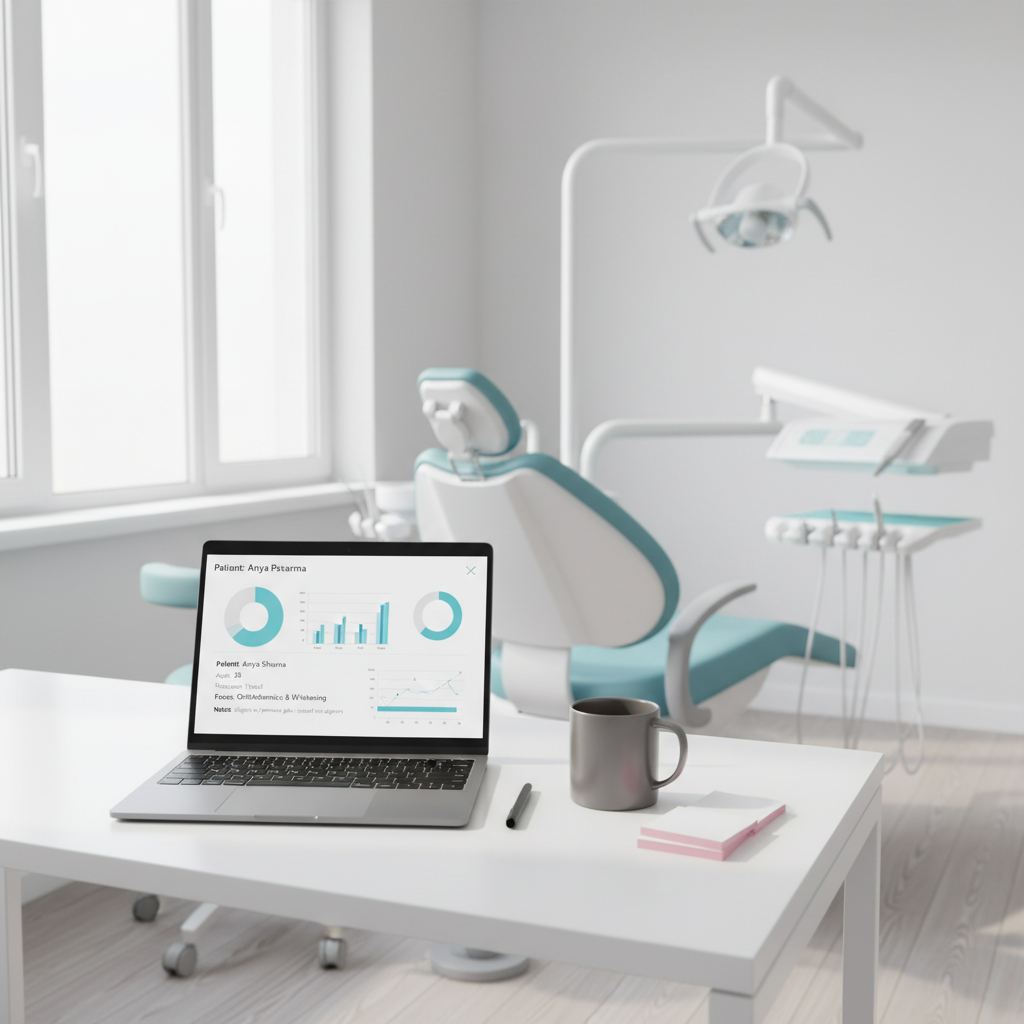
    Modern dental workspace with laptop, coffee mug, pink stationery, and clean treatment room.

    Defining Your Ideal High-Value Patient Profiles

    Effective targeting begins with detailed patient personas. For Invisalign marketing in London: professionals aged 25-40, household income £60,000+, triggered by career advancement or social events, researching discretely during work hours. For implant patients in Manchester/Birmingham: ages 45-65, income £45,000+, motivated by functional concerns and confidence restoration, often researching extensively over 3-6 months.

    Document your top three personas with specific demographics, income bands, search behaviour patterns, and treatment triggers. This 15-minute exercise forms the foundation for all targeting decisions across SEO, Google Ads, and social campaigns.

    Crafting a Compelling Dental Value Proposition

    A dental value proposition articulates specific outcomes, guarantees, and experiences rather than generic claims. Weak Invisalign propositions say “straighten your teeth discreetly.” Strong propositions state “See your new smile in 10 minutes with our digital simulation, flexible evening appointments, and 0% finance options.”

    For dental implant marketing, avoid “replace missing teeth” and specify “Same-day implant consultation with 3D imaging, immediate suitability assessment, and treatment plan within 30 minutes.” Each service page requires one flagship promise that differentiates from competitors and addresses specific patient concerns.

    Omnichannel vs Single-Channel Marketing for Dentists

    Omnichannel marketing for dentists ensures consistent messaging across SEO, Google Ads, social media, email/SMS, and referral systems. Patients typically engage 3-5 touchpoints before booking: discovering through Instagram ads, researching on your website, reading Google reviews, then calling directly.

    Single-channel reliance creates volatile lead flow and higher acquisition costs. Facebook-only campaigns suffer from algorithm changes; SEO-only strategies lack immediate traffic. Build integrated campaigns in four weeks: unified treatment offers, shared landing pages, coordinated follow-up sequences, and consistent pricing messages across all channels.

    Dental Website Design That Converts Visitors into Booked Consultations

    Non-Negotiable Elements of High-Converting Dental Websites

    High-converting dental websites prioritise mobile-first design with three-click booking paths, sticky “Book Consultation” CTAs, prominent phone and WhatsApp contact options, and social proof above the fold. Technical SEO, fast load times, and accessibility features are essential to ensure every visitor can easily navigate and book. Embed online booking systems and live chat to reduce friction and capture leads at the moment of intent. Showcase real patient testimonials and before/after galleries to build trust and credibility instantly.

    Dental SEO as the Foundation of Patient Acquisition

    Why Dental SEO Is the Most Efficient Acquisition Channel Long-Term

    Dental SEO delivers compounding returns that pay-per-click advertising cannot match. While Google Ads require continuous investment to maintain traffic flow, SEO builds momentum over time—ranking improvements compound monthly, creating sustainable patient acquisition streams. Research indicates 89% of dental patients begin their treatment search online, with 75% never scrolling past the first page of results. Practices ranking in the top three positions capture 60% of all clicks for high-value searches like “Invisalign dentist near me” or “dental implants [city]”.

    The distinction between dental SEO, dental local SEO, and dental practice SEO lies in scope and strategy. Dental SEO encompasses all organic search optimisation efforts, while dental local SEO specifically targets location-based searches within your practice catchment area. Dental practice SEO refers to the comprehensive approach that includes both national and local elements, plus reputation management and citation building across medical directories.

    Local SEO for Dentists – Dominating the “Near Me” Searches

    Google Business Profile optimisation forms the cornerstone of local dental patient acquisition marketing. Complete your profile with specific dental categories (General Dentist, Cosmetic Dentist, Oral Surgeon), upload high-quality treatment photos, populate the Q&A section with common patient queries, and post weekly updates about services or offers. Operating hours must reflect actual availability, including emergency contact information where applicable.

    NAP (Name, Address, Phone) consistency across all online directories directly impacts local rankings. Ensure identical information appears on Yell, Yelp, NHS Choices, and dental-specific directories like Dentaly or WhatClinic. Target location-based keywords systematically: “Invisalign dentist in [City]”, “dental implants [Area]”, “emergency dentist [postcode]”. Each location page should include specific geographic markers, local landmarks, and area-specific content that demonstrates genuine connection to the community.

    Local Profile Element Optimised Practice Non-Optimised Practice Expected Enquiry Impact
    Google Business Profile Complete with photos, Q&A, posts Basic listing only 40% increase in calls
    Review Management 50+ reviews, 4.8+ average Under 10 reviews 25% higher click-through
    Directory Citations Consistent across 15+ platforms Inconsistent or missing 20% ranking improvement
    Location Keywords Targeted local content strategy Generic service pages 60% more local visibility

    On-Page SEO for High-Value Treatments

    Keyword strategy for premium treatments requires precision targeting. Invisalign marketing benefits from long-tail keywords like “Invisalign payment plans London”, “invisible braces consultation Manchester”, or “clear aligners weekend appointments Birmingham”. Dental implant marketing should target “same-day implants [city]”, “all-on-4 implants UK cost”, and “dental implant consultation near me”. Secondary treatments like composite bonding marketing and emergency dental marketing require separate keyword clusters to avoid cannibalisation.

    Technical implementation demands adherence to strict parameters. Meta titles must stay within 50-60 characters to avoid truncation in search results. Meta descriptions should include compelling CTAs within 140-155 characters, incorporating primary keywords naturally. Each treatment page targets one primary keyword plus 3-5 semantic variations, avoiding keyword stuffing while maintaining topical authority. Header structure follows H1 (page title), H2 (main sections), H3 (subsections) hierarchy for optimal crawlability.

    Technical SEO & User Experience Essentials

    Technical foundations directly influence both rankings and conversion rates. HTTPS encryption remains mandatory, while Core Web Vitals (loading speed, interactivity, visual stability) increasingly impact rankings. Schema markup for Dentist, MedicalBusiness, reviews, and FAQ sections helps search engines understand your content structure and display rich snippets in results.

    Site architecture should enable users to reach any treatment page within three clicks from the homepage. Monthly technical audits take 20 minutes: check Google Search Console for crawl errors, monitor page speed via PageSpeed Insights, verify mobile usability, and review broken links. Track organic traffic, keyword rankings, and most importantly, organic enquiry volume to measure true SEO impact on dental patient acquisition marketing efforts.

    Precision Traffic: SEO vs Google Ads vs Social Ads for Patient Acquisition

    Modern dental clinic workspace with digital dashboard, stopwatch, notepad, pen, and testimonial bubbles.

    Comparison Framework – What We’re Measuring

    Effective dental patient acquisition marketing requires evaluating channels against four critical criteria: speed to first enquiry, cost per new patient, lead quality for high-value treatments, and scalability potential. Speed to results ranges from immediate (Google Ads) to 3-6 months (SEO), while cost per patient varies dramatically based on competition and targeting precision. Lead quality differs significantly—organic search typically delivers higher-intent prospects than social media discovery.

    Channel prioritisation depends on practice capacity and available cash flow. For practices with immediate gaps in their appointment book, Google Ads can deliver results within days. For those seeking sustainable, lower-cost acquisition, SEO is essential. Social ads are best for building awareness and nurturing prospects who may not be ready to book immediately but are considering treatment in the near future. The most successful practices combine all three channels, optimising spend based on real-time performance data.

    Social Media Marketing vs Paid Ads for Dentists

    Organic social media builds trust through patient stories and treatment showcases, while paid social advertising generates immediate consultation bookings. Each serves distinct purposes in your dental patient acquisition marketing strategy.

    Organic Social for Trust Building and Nurture

    Instagram and Facebook posts featuring before/after transformations create emotional connections with potential patients. Share treatment journeys, team introductions, and behind-the-scenes content to humanise your practice. This approach works particularly well for Invisalign marketing, where visual progress documentation builds confidence in the treatment process.

    Post consistently 3-4 times weekly, focusing on patient outcomes rather than clinical procedures. Include patient testimonials, treatment explanations, and practice updates to maintain engagement with your local community. For inspiration, explore these dental social media ideas to keep your content fresh and relevant.

    Facebook and Instagram ads excel at reaching specific demographics within your catchment area. Target women aged 25-45 for Invisalign campaigns or men 45+ for dental implant marketing. Use video content showing consultation processes and treatment outcomes to drive landing page visits.

    Budget £30-50 daily for focused campaigns targeting specific treatments. Expect 10-15 enquiries monthly from well-optimised social ad campaigns in major UK metropolitan areas. Link ads directly to treatment-specific landing pages rather than general practice websites.

    Omnichannel vs Single-Channel – What the Data Shows

    Patients typically interact with 4-5 touchpoints before booking consultations. A prospect might discover your practice through Instagram, research your website, read Google reviews, then book via your online system. This journey spans multiple channels over 2-3 weeks.

    Practices using coordinated campaigns across SEO, Google Ads, and social media achieve 40% lower cost per consultation compared to single-channel approaches. Maintain consistent messaging and offers across all platforms, directing traffic to unified landing pages for seamless user experience.

    Converting Clicks into Consultations – Funnel & Follow-Up

    Converting website visitors into booked consultations requires systematic funnel design and persistent follow-up. Most practices lose 60% of potential patients due to poor lead handling between initial enquiry and scheduled appointment.

    Mapping the Dental Marketing Funnel (Awareness to Treatment Start)

    Your funnel begins when prospects search for treatments and progresses through website visit, enquiry submission, consultation booking, appointment attendance, and treatment acceptance. Benchmark conversion rates: 3% website visitors to enquiry, 60% enquiries to booked consultations, 80% consultation attendance, 40% consultation to treatment start.

    For Invisalign marketing, expect longer consideration periods (2-4 weeks) compared to emergency dental needs (same day). Dental implant marketing typically involves 3-6 week decision cycles due to higher investment levels and surgical considerations.

    Optimising Lead Capture – Forms, Chat, and Phone

    Limit enquiry forms to essential fields: name, phone number, email, preferred contact time, and treatment interest. Additional fields reduce completion rates by 15% per extra requirement. Include clear GDPR consent statements and specify response timeframes.

    Deploy AI chat systems to qualify visitors within 90 seconds using three key questions: treatment interest, preferred appointment timing, and budget awareness. Route qualified leads directly to treatment coordinators while capturing contact details for follow-up sequences.

    Establish call-handling protocols requiring three-ring maximum response times. Train reception staff to book consultations during initial conversations rather than scheduling callback appointments. Immediate booking converts 70% higher than delayed scheduling.

    SMS & Email Nurture for Warmer, Higher-Value Patients

    Implement automated follow-up sequences for enquiries not immediately converting to bookings. Send confirmation messages within 5 minutes, followed by treatment information at 24 hours, patient testimonials at 72 hours, and consultation reminders at 7 days.

    Include short video links featuring treatment explanations and before/after galleries in follow-up communications. Video content increases response rates by 35% compared to text-only messages. Personalise communications using enquiry-specific treatment interests and preferred contact methods. For more tips on encouraging patient engagement, see how to get patients to write reviews.

    Reputation, Reviews & Referrals as Acquisition Multipliers
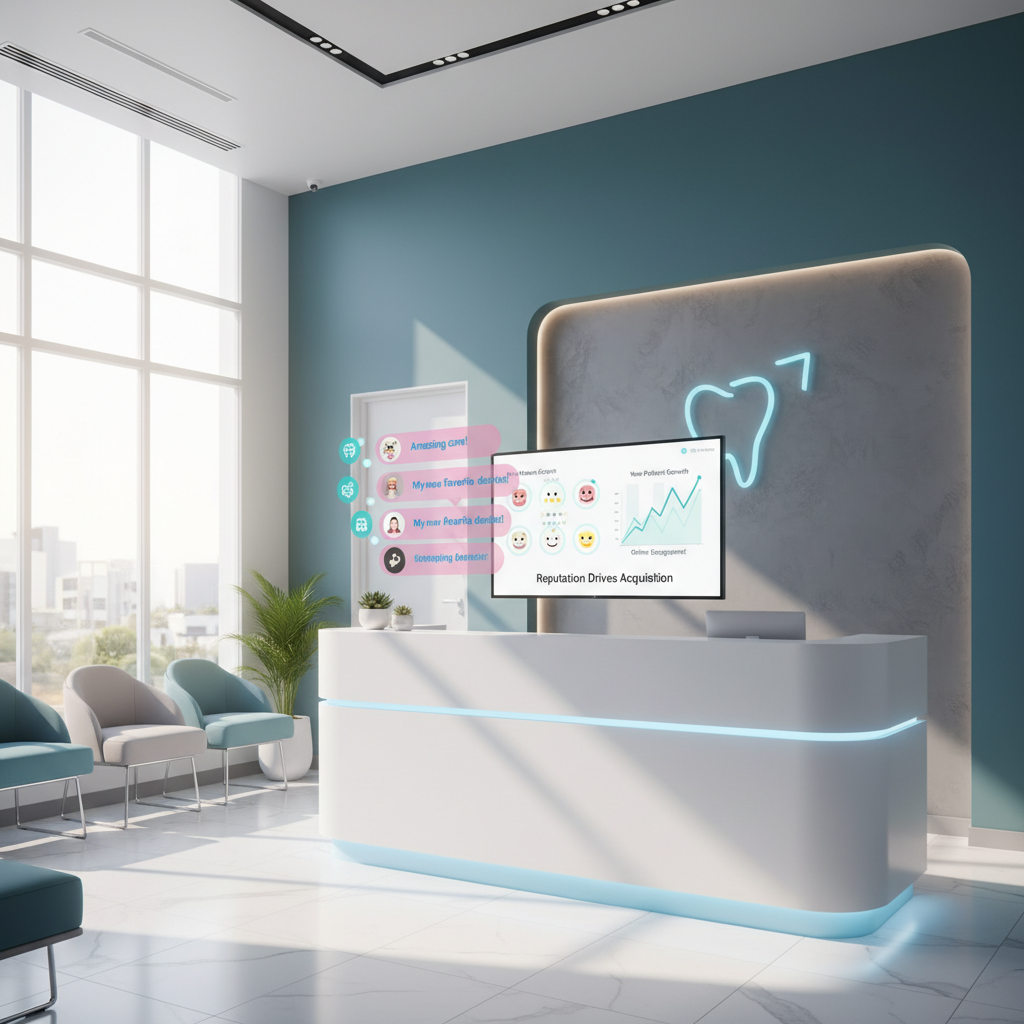
    Modern dental clinic reception with digital dashboard displaying patient reviews and growth charts.

    Online reviews and referral programmes transform existing patients into powerful acquisition channels. Practices with systematic review generation achieve 25% higher consultation booking rates from organic search traffic.

    How Online Reviews Drive Dental Patient Acquisition

    Google Business Profile star ratings directly influence click-through rates from search results. Practices with 4.5+ star ratings receive 60% more website clicks than those below 4.0 stars. Potential patients read 3-5 reviews before contacting practices, focusing on recent experiences and treatment-specific feedback. For more information about dental services in the UK, visit NHS dental services.

    Prioritise Google Business Profile, Facebook, and NHS Choices for review collection. These platforms appear prominently in local search results and influence patient decision-making. Maintain minimum 15 reviews monthly to demonstrate consistent patient satisfaction and active practice engagement.

    Systematising Review Generation & Management

    Request reviews through three-step process: chairside verbal request post-treatment, automated SMS follow-up within 2 hours, and email reminder after 24 hours. Achieve 25% review completion rates using this systematic approach compared to 5% from ad-hoc requests. For additional strategies, you can also explore dental marketing ideas to boost your practice’s visibility.

    Review Request Script for Invisalign/Implants: “Thank you for choosing us for your treatment. If you found your experience helpful, would you mind leaving a quick review? It helps others find the right dental care and supports our team in delivering excellent service.”

    Frequently Asked Questions

    What are the key differences between dental patient acquisition marketing and general dental marketing?

    Dental patient acquisition marketing focuses specifically on attracting and converting new patients into booked consultations for high-value treatments, prioritising measurable outcomes and ROI. In contrast, general dental marketing often centres on brand awareness and patient retention without the same emphasis on conversion and booked appointments.

    How can UK dental practices optimize their online presence to convert more website visitors into booked consultations?

    UK dental practices can optimise their online presence by implementing conversion-focused website design, ensuring clear calls-to-action, and using precise targeting to attract high-value patients. Integrating AI-driven chatbots and personalised follow-up systems further enhances engagement and increases the likelihood of visitors booking consultations.

    Why is measurable ROI tracking crucial for successful dental patient acquisition strategies?

    Measurable ROI tracking enables practices to identify which marketing channels and campaigns deliver the highest quality leads and booked consultations, allowing for data-driven budget allocation. Without clear metrics, practices risk overspending on ineffective strategies, reducing overall profitability and growth potential.

    What role do AI-driven tools like chatbots and personalized email campaigns play in improving patient acquisition amid rising advertising costs?

    AI-driven chatbots and personalised email campaigns enhance patient engagement by providing instant responses and tailored communication, increasing conversion rates from website visitors to booked consultations. These tools optimise marketing spend by nurturing leads efficiently, helping practices maximise ROI despite rising advertising costs.

    About the Author

    Dan Ashburn is the Co-Founder at Dominate Dental, the UK’s specialist agency for high-value patient acquisition.

    Drawing on a decade of data-driven advertising experience and hundreds of clinic campaigns, Dan blends AI technology with human insight to deliver predictable streams of Invisalign, implant, and cosmetic dentistry consultations. His team’s results-focused approach has helped practices across London, Manchester, Birmingham, and nationwide convert marketing spend into chair-time—often booking 50+ qualified consultations per month while cutting no-shows.

    When he’s not optimizing funnels or unpacking the latest algorithm updates, Dan shares actionable dental marketing ideas, real-world case studies, and ROI benchmarks so dental teams can make confident marketing decisions.