Author: Josie Mitchelmore

  • Dentist Reputation Management Services 2026: The Ultimate UK Guide

    Key Takeaways

    • Nearly all patients read online reviews before booking dental appointments.
    • Most UK dental practices lose valuable patients due to unmanaged online reputations.
    • Investing over £2,000 monthly in marketing can be undermined by negative reviews.
    • Poor online visibility particularly harms the return on investment for premium treatments.
    • Effective reputation management is crucial for retaining patients and maximizing marketing efforts.

    Transform Your Practice with Professional Reputation Management

    A staggering 98% of patients read online reviews before booking dental appointments, yet 72% of UK practices lose high-value patients to competitors due to unmanaged online reputations. For dental practices investing £2,000+ monthly in marketing, negative reviews and poor online visibility can devastate ROI, particularly for premium treatments like Invisalign and implants.

    Dentist reputation management services in the UK use review monitoring, negative feedback conversion, and profile optimisation to enhance patient trust and improve marketing ROI.

    Dentist reputation management services offer a systematic solution: professional monitoring, strategic review acquisition, and optimised online profiles that transform negative feedback into growth opportunities. Leading UK dental marketing agencies like Dominate Dental combine AI-powered automation with human expertise, delivering 50+ qualified leads monthly and achieving 15% visitor-to-consultation conversion rates for practices across London, Manchester, and Birmingham.

    Dentist reputation management services involve curating online narratives through ethical review generation, real-time monitoring, strategic responses, and directory optimisation. Unlike general online reputation management, dental-specific services integrate seamlessly with practice management software and comply with GDC guidelines while targeting dental-specific platforms including NHS Choices, WhatClinic, and Healthgrades.

    These services differ fundamentally from DIY approaches by incorporating dental SEO expertise—ensuring NAP (Name, Address, Phone) consistency across directories while optimising responses for local search terms like “emergency dentist London” or “Invisalign Manchester.” Professional services also navigate complex healthcare privacy regulations while maintaining authentic patient engagement.

    Core components include automated review request systems triggered within 24 hours post-appointment, AI-powered response drafting that incorporates relevant keywords for SEO benefit, comprehensive NAP audits across major UK directories including Yell and NHS Choices, and integration with existing dental website design and social media marketing strategies.

    Why Reputation Management Drives Patient Acquisition in 2025
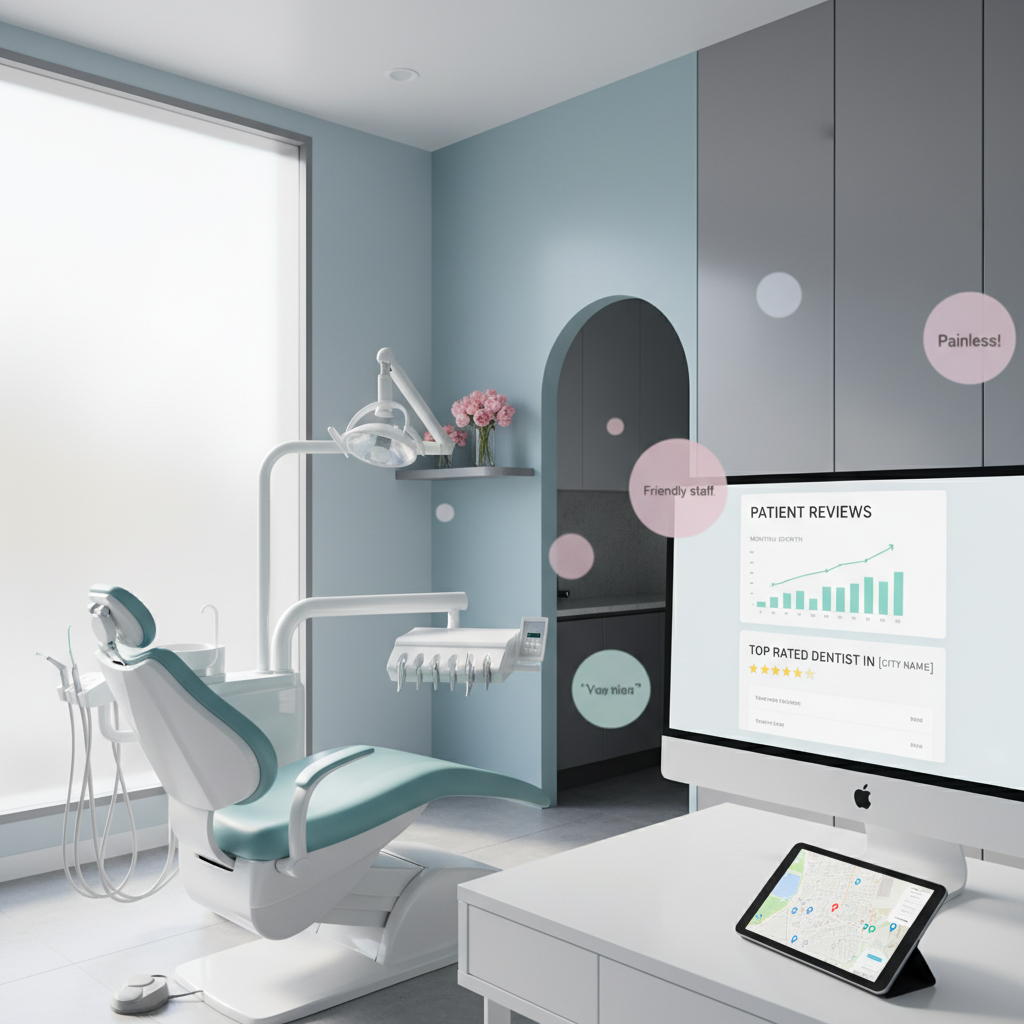
    Modern dental treatment room with digital dashboard, patient reviews, and growth charts.

    Local search behaviour demonstrates that 78% of “dentist near me” searches result in practice visits within 24 hours, with top-three Google rankings generating 300% more enquiries for high-value treatments. Positive online reputations directly influence Google’s E-E-A-T signals (Experience, Expertise, Authoritativeness, Trustworthiness), boosting both Google Maps rankings and organic search visibility.

    For UK dental practices, reputation management delivers measurable ROI through increased conversion rates. Dominate Dental clients consistently achieve 15% visitor-to-consultation conversion rates, averaging 50+ qualified leads monthly compared to industry standards of 2-3%. This performance stems from strategic review placement, optimised Google Business Profiles, and integrated dental SEO approaches.

    Performance Metric With Professional Services Without Management Measurement Period
    Monthly Review Volume 50+ automated requests 5-10 organic 6-month average
    Local SEO Rankings Top-3 “near me” searches Page 2 or lower Google Maps position
    Patient No-Show Rate 15% (trust signals) 30%+ industry average Appointment completion
    Private Treatment Revenue +25% (implants/Invisalign) Stagnant growth Year-over-year comparison

    Implementation requires weekly review monitoring using Google Alerts, targeting five new reviews weekly through post-treatment SMS campaigns, and linking reputation efforts to comprehensive dental website design for seamless patient journeys from search to booking.

    Systematic Review Monitoring and Acquisition

    Effective monitoring catches reputation issues within 24-48 hours, preventing escalation while integrating seamlessly with existing dental PMS software. Priority platforms include Google Business Profile (used by 93% of patients), followed by Yelp and Facebook for comprehensive social media marketing coverage.

    Ethical review acquisition focuses on post-treatment requests from verified Google account holders, particularly following high-value treatments like Invisalign fittings or implant procedures. This approach ensures authentic reviews while maximising impact on local search rankings.

    Implementation follows a structured approach: integrate SMS automation tools with practice management systems to trigger review requests 24 hours post-appointment, establish unified inboxes for managing Google, Facebook, and Instagram messages, and deploy AI-powered automation including QR code generation for checkout review requests.

    A Manchester practice demonstrates this system’s effectiveness—gaining 30 authentic reviews within the first month, successfully pushing negative feedback to page two of search results while establishing dominant local search presence for “dental implants Manchester.” For actionable tips on increasing your review count, see how to get patients to write reviews.

    Converting Negative Reviews into Trust Opportunities

    Strategic responses to negative reviews are essential for building trust and demonstrating professionalism. Rather than ignoring or deleting negative feedback, practices should respond promptly, acknowledge the patient’s concerns, and outline steps taken to address the issue. This transparent approach reassures prospective patients and often turns dissatisfied individuals into advocates. By consistently managing negative reviews, practices can showcase their commitment to patient care and differentiate themselves in competitive markets.

    Profile and Directory Optimisation for Maximum Reach
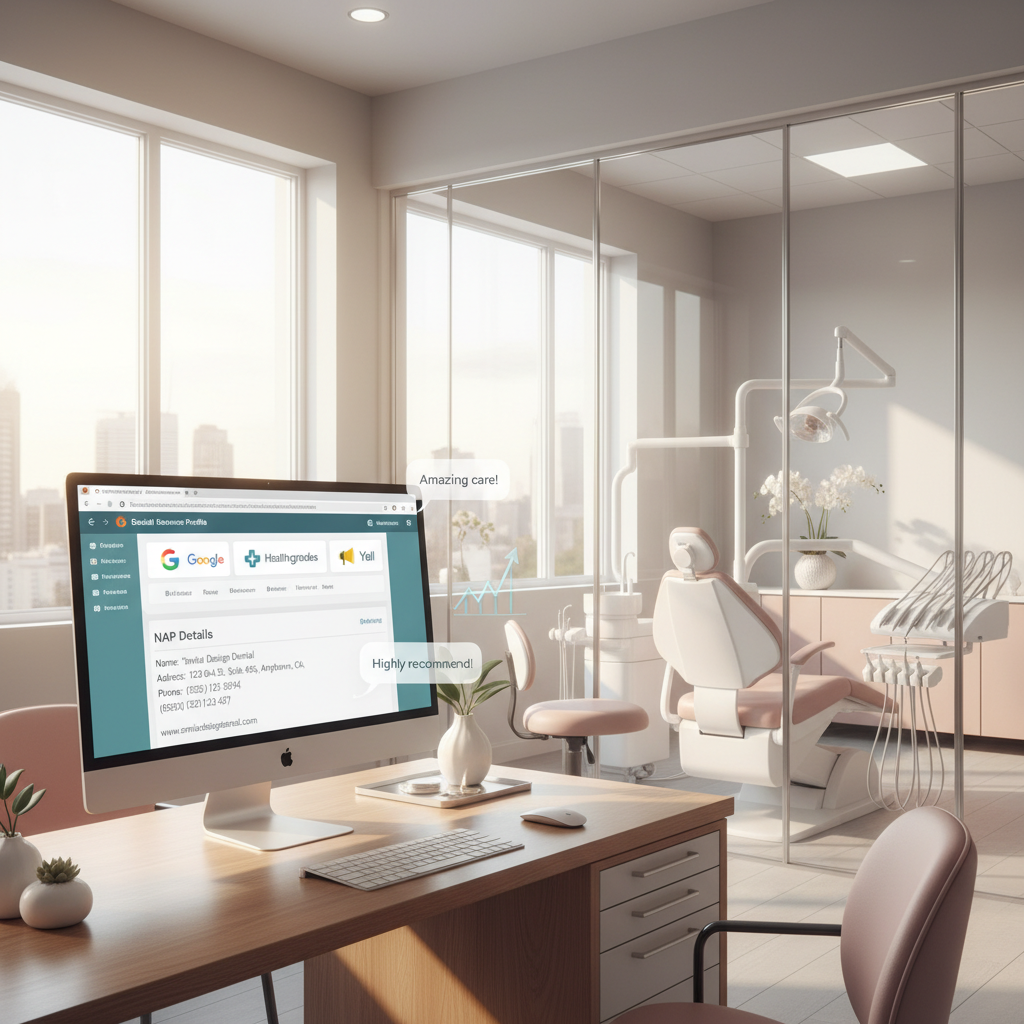
    Modern dental workspace with open tabs, testimonials, and growth charts in bright, clean setting.

    Complete, consistent business profiles across Google Business Profile, Healthgrades, and Yell form the foundation of effective dentist reputation management services. NAP (Name, Address, Phone) inconsistencies across directories can reduce local search rankings by up to 20%, directly impacting patient acquisition for competitive treatments.

    Google Business Profile optimisation requires weekly updates: posting treatment highlights, uploading before/after photos (with consent), and maintaining accurate service listings for Invisalign, implants, and cosmetic procedures. The Q&A section particularly benefits from proactive management—addressing common concerns about treatment costs, insurance acceptance, and appointment availability.

    Directory citations across 30+ UK-specific platforms including NHS Choices, WhatClinic, and local business directories strengthen domain authority and local search presence. Automated citation management tools ensure real-time updates when practice details change, maintaining the consistency that search engines prioritise for local rankings.

    Professional Services vs DIY: Strategic Investment Analysis

    The choice between in-house reputation management and professional dentist reputation management services depends on practice size, technical capacity, and growth objectives. Practices with 3+ dentists typically achieve superior ROI through professional services due to automation capabilities and specialised expertise.

    Factor DIY Approach Professional Services Best For
    Monthly Time Investment 15-20 hours 2-3 hours oversight Busy multi-dentist practices
    Review Generation Rate 8-12 monthly 25-50+ monthly Growth-focused practices
    Response Consistency Variable quality Professional, SEO-optimised Brand reputation priority
    Crisis Management Reactive, limited scope 24/7 monitoring, rapid response High-visibility practices

    Professional services excel in automation integration with practice management systems, generating review requests via SMS within 24 hours of appointments. Dominate Dental’s approach combines AI-powered monitoring with human oversight, delivering measurable results including 50+ qualified leads monthly for clients investing in comprehensive reputation management strategies.

    Advanced Crisis Management and ROI Tracking

    Reputation crises—whether from treatment complications, staff issues, or coordinated negative campaigns—require immediate, strategic responses to prevent long-term damage. The most effective crisis management involves flooding negative content with authentic positive reviews while addressing legitimate concerns through direct patient communication.

    ROI measurement for dentist reputation management services tracks multiple metrics: review volume growth, star rating improvement, local search ranking advancement, and ultimately, consultation booking increases. Practices typically see 15% improvement in website visitor-to-consultation conversion rates within 90 days of implementing comprehensive reputation management.

    Advanced tracking utilises Google Analytics 4 to correlate review improvements with revenue growth from specific treatment categories. For instance, improving from 3.8 to 4.6 stars often correlates with 30-40% increases in implant consultation bookings, as patients research extensively before committing to high-value treatments. For more on connecting SEO and patient growth, see how dental SEO can lead to more patients.

    Leading UK Reputation Management Providers for 2025
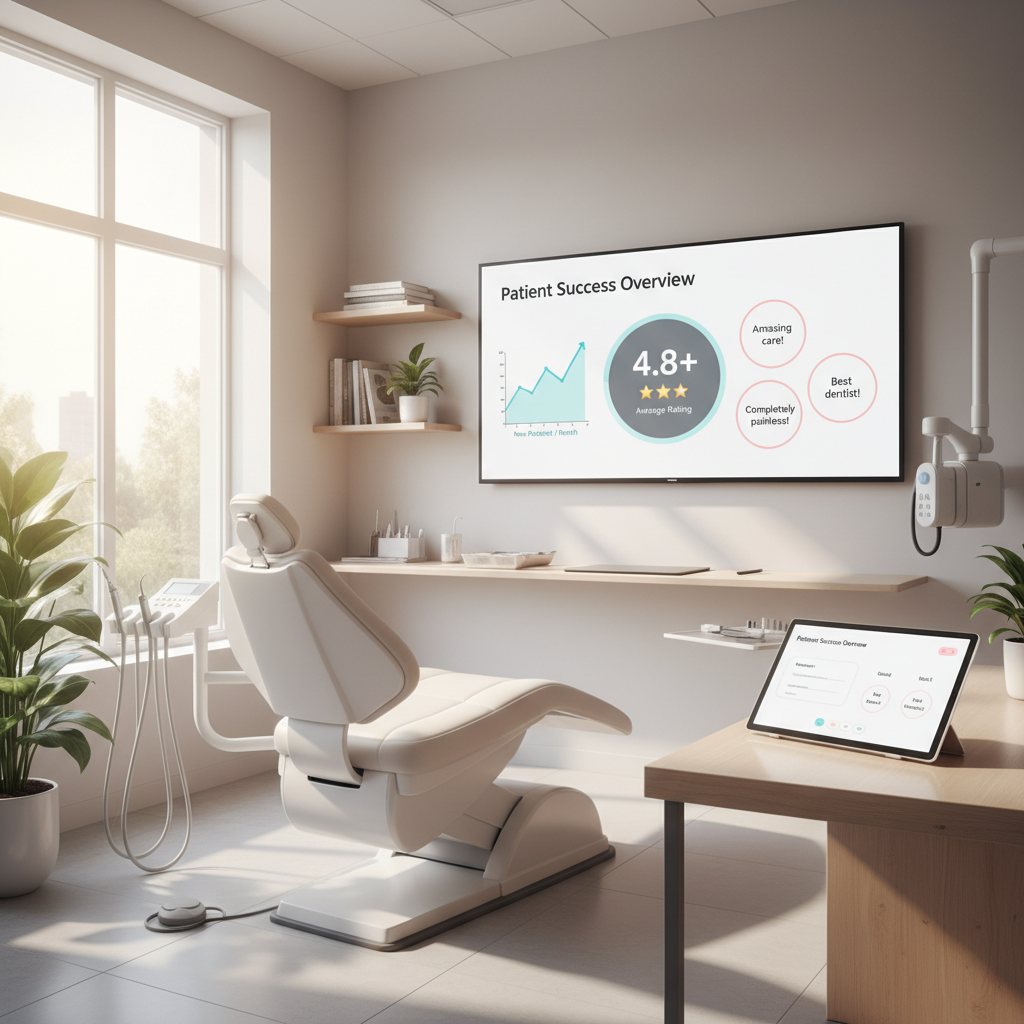
    Modern dental clinic with digital dashboard showing ratings, growth charts, and patient testimonials.

    Dominate Dental leads the UK market for integrated dentist reputation management services, combining reputation management with comprehensive dental SEO and patient acquisition strategies. Their unique approach delivers 50+ qualified leads monthly while maintaining 4.8+ star ratings across all major review platforms for client practices.

    Dominate Dental – Integrated Growth Solution

    Best for: Multi-dentist practices seeking comprehensive marketing integration

    Dominate Dental’s reputation management integrates seamlessly with their dental website design, SEO, and social media marketing services. Their AI-powered system generates consistent review flows while their human oversight ensures brand-appropriate responses that enhance local search rankings.

    Birdeye – Automation-Focused Platform

    Best for: Practices with 5+ dentists needing comprehensive automation across multiple review platforms and patient communication channels.

    Birdeye excels at streamlining review acquisition through automated SMS and email campaigns integrated with major dental practice management systems. Their platform monitors 150+ review sites simultaneously and provides AI-powered response suggestions, though practices still need human oversight for brand consistency.

    Highlights

    • Monitors 150+ review platforms automatically
    • Seamless PMS integration with major dental software
    • Advanced analytics dashboard with ROI tracking
    • Multi-location management capabilities

    Considerations

    • Higher cost point (£2,000+ monthly for full features)
    • Learning curve for smaller practice teams
    • Limited UK-specific compliance guidance

    Podium – Messaging-Centric Solution

    Best for: Practices prioritising patient communication and text-based review requests over comprehensive SEO integration.

    Podium focuses heavily on SMS-based patient engagement, making review requests feel natural within ongoing conversations. Their platform converts website visitors into leads through webchat integration, though it lacks the dental-specific SEO optimisation that drives long-term organic growth.

    Selecting Your Optimal Reputation Management Partner

    The choice between dentist reputation management services depends on your practice size, technical capabilities, and growth objectives. Practices spending £2,000+ monthly on marketing typically see fastest ROI with full-service agencies that integrate reputation management into broader digital strategies.

    Dominate Dental stands out for UK dental practices because their approach combines reputation management with proven SEO strategies that drive qualified leads. Unlike software-only solutions, their human expertise ensures responses align with your practice brand whilst optimising for local search terms like “dental implants Manchester” or “Invisalign London”.

    Decision Framework

    Choose full-service agencies (like Dominate Dental) if you have 3+ dentists, focus on high-value treatments, and want integrated marketing. Choose software platforms for basic automation if you have dedicated staff time for strategy and content creation.


    Consider your patient demographics when evaluating providers. Practices serving affluent areas benefit most from comprehensive reputation strategies that position them as premium providers, whilst general practices may prioritise volume-focused review acquisition systems. For creative ways to boost your dental marketing, explore these dental marketing ideas.

    Tracking ROI and Performance Metrics

    Successful dentist reputation management services deliver measurable improvements within 90 days. Key performance indicators include review velocity (new reviews per month), average star rating progression, and most importantly, qualified consultation bookings attributed to online reputation improvements.

    Advanced practices track sentiment analysis across review content, monitoring mentions of specific treatments like implants or cosmetic procedures. This data informs service improvements and identifies opportunities for targeted marketing campaigns that leverage positive patient experiences.

    Google Analytics 4 integration reveals how reputation improvements impact website behaviour. Practices typically observe increased time on treatment pages, higher conversion rates on consultation forms, and improved local search rankings for competitive keywords within 6 months of implementing professional reputation management. For further reading on dental blogging and content strategy, see dental blog post ideas.

    Implementing Your Reputation Strategy

    Professional dentist reputation management services have evolved from optional marketing tactics to essential practice infrastructure. The difference between thriving and struggling practices often comes down to how effectively they manage their online presence across multiple touchpoints.

    For UK dental practices ready to scale beyond £500,000 annual revenue, partnering with specialists like Dominate Dental provides the strategic advantage needed to dominate local markets. Their integrated approach combining reputation management with SEO, website optimisation, and lead generation creates sustainable competitive advantages that compound over time.

    Start by auditing your current online reputation across Google, Facebook, and healthcare-specific platforms. Document your baseline metrics, then implement systematic review acquisition processes before investing in advanced automation tools. The practices that win in 2025 will be those that treat reputation management as seriously as clinical excellence. For a broader perspective on social media’s impact, check out this guide to social media reputation management.

    Ready to Transform Your Practice Reputation?

    Dominate Dental offers comprehensive reputation audits that reveal exactly where your practice stands versus local competitors. Book your free consultation to discover how strategic reputation management can generate 50+ qualified leads monthly for your practice.

    Frequently Asked Questions

    How do dentist reputation management services help improve patient acquisition and retention?

    Dentist reputation management services enhance patient acquisition and retention by systematically monitoring and responding to online reviews, ensuring positive patient experiences are highlighted. This builds trust and credibility, which increases consultation bookings and encourages repeat visits, ultimately maximising the return on marketing investments.

    What are the key differences between professional dental reputation management services and DIY reputation management?

    Professional dental reputation management integrates specialised dental SEO, compliance with GDC guidelines, and seamless practice management software integration, which DIY approaches typically lack. This expertise ensures consistent online profiles, targeted review acquisition, and strategic responses that drive higher patient engagement and better ROI.

    How can negative online reviews be effectively converted into opportunities to build patient trust?

    Negative reviews can be transformed into trust-building opportunities by responding promptly and empathetically, addressing concerns transparently, and demonstrating commitment to patient care improvements. This proactive approach reassures prospective patients and showcases the practice’s dedication to quality and responsiveness.

    Why is online visibility particularly important for marketing premium dental treatments like Invisalign and implants?

    Online visibility is critical for premium treatments because these services require higher patient trust and longer decision-making processes. Strong, positive online reputations and optimised profiles increase exposure to motivated patients, improving lead quality and maximising the return on substantial marketing investments.

    About the Author

    Dan Ashburn is the Co-Founder at Dominate Dental, the UK’s specialist agency for high-value patient acquisition.

    Drawing on a decade of data-driven advertising experience and hundreds of clinic campaigns, Dan blends AI technology with human insight to deliver predictable streams of Invisalign, implant, and cosmetic dentistry consultations. His team’s results-focused approach has helped practices across London, Manchester, Birmingham, and nationwide convert marketing spend into chair-time—often booking 50+ qualified consultations per month while cutting no-shows.

    When he’s not optimizing funnels or unpacking the latest algorithm updates, Dan shares actionable dental marketing ideas, real-world case studies, and ROI benchmarks so dental teams can make confident marketing decisions.

  • Dental Digital Advertising 2026: The Ultimate Guide to Generate New Patients

    dental digital advertising

    Key Takeaways

    • Dental digital advertising now includes paid search, social media campaigns, and strategic retargeting.
    • It captures potential patients at the exact moment they are searching for dental treatments.
    • Digital advertising allows for precise targeting based on specific search queries.
    • This approach is more effective than traditional marketing, which targets broad audiences.

    Understanding Dental Digital Advertising in 2025

    Dental digital advertising has evolved beyond simple banner ads into a sophisticated ecosystem of paid search, social media campaigns, and strategic retargeting that captures patients at the precise moment they’re searching for treatments. Unlike traditional marketing that broadcasts to broad audiences, digital advertising allows you to target someone searching “Invisalign Manchester” or “emergency dentist near me” with surgical precision.

    In 2025, integrate AI-driven ad optimization and video content to enhance engagement and conversion in dental digital advertising strategies.

    The stakes are clear: 72% of patients research dental services online before booking, yet 93% never look beyond Google’s first page. This creates an immediate visibility imperative where SEO’s foundation and digital advertising serve as the accelerator—capturing demand instantly while organic efforts compound over months.

    For a comprehensive approach to marketing for dentists, integrating digital advertising with proven patient acquisition strategies is essential for sustainable growth.

    The Core Components of Your Dental Digital Advertising Strategy

    Modern dental workspace with computer, smartphone, testimonial bubbles, and clinical tones.

    Search Engine Marketing (SEM) forms the backbone of qualified patient acquisition, delivering immediate visibility for high-intent searches like “teeth whitening Leicester” or “same-day appointments.” Social Media Advertising enables hyperlocal targeting and builds awareness among ideal patients who aren’t actively searching yet, excelling at promoting cosmetic treatments through patient testimonials and transformation imagery.

    Display Advertising extends reach through Google’s Display Network—covering 90% of internet users—while functioning as powerful retargeting infrastructure for visitors who didn’t convert initially. Video Advertising on YouTube and social platforms captures attention through patient stories and treatment explainers, increasing trust signals that Google now rewards directly in rankings.

    Effective Google Ads campaigns require three critical components: search campaigns capturing high-intent local searches, performance max campaigns automating placements across Google’s ecosystem, and remarketing lists for engaged prospects. Organize campaigns by treatment type—Invisalign, implants, cosmetic, emergency—rather than broad “dental services” to maximize relevance and conversion rates.

    Budget allocation should prioritize high-value treatments: 60% toward premium keywords (implants, Invisalign) generating £500-£2,000+ consultations, with cost-per-click ranging from £2-£8 for general terms and £8-£20+ for premium treatments in major metropolitan areas. Headlines must address specific pain points: “Same-Day Emergency Care—Open Now in London” for urgent needs, “Invisible Braces That Actually Work—Results in Months” for cosmetic seekers.

    For more detailed guidance on optimizing your campaigns, explore Google Ads for dentists to maximize your ROI and patient acquisition.

    Mastering Social Media Advertising for Dental Patient Acquisition

    Facebook and Instagram advertising excels for targeting families and cosmetic treatment seekers through detailed audience segmentation by household income, age, homeownership, and dental-related engagement. Create conversion campaigns optimized for appointment bookings, not traffic, with custom audiences segmented by treatment interest: Invisalign campaigns targeting ages 18-45 interested in cosmetics, implant campaigns for 45+ with higher purchasing power.

    Video content outperforms static images by 300%+ on social platforms. Invest in 15-30 second patient testimonial videos showing smile transformations and real experiences. Implement retargeting sequences: days 1-3 (brand recall with testimonials), days 4-7 (social proof with reviews), days 8-14 (limited offers to overcome objections), improving conversion rates by 40-60% versus single-ad campaigns.

    For creative inspiration, check out these dental social media ideas to enhance your campaigns and engage your audience more effectively.

    Modern dental clinic with digital workspace displaying search, social media, and growth visuals.

    Dimension Google Ads (SEM) Facebook/Instagram Ads
    User Intent High (actively searching) Medium (browsing, not searching)
    Cost Per Click £3-£20+ depending on keyword £0.50-£3 typically
    Time to Booking 7-14 days (faster) 21-45 days (requires nurturing)
    Best For Emergency care, specific treatments Building awareness, cosmetic dentistry
    Conversion Rate 5-10% (from searchers) 1-3% (from cold audiences)
    Ad Fatigue Risk Lower (continuous searching) Higher (repetitive exposure)

    Allocate 70% of budget to SEM for guaranteed high-intent capture, 20% to social media for awareness and pipeline building, and 10% to display/video for brand reinforcement. This ratio adjusts based on current capacity—maximize SEM when under-capacity, shift toward social media when patient flow is adequate.

    Advanced Targeting Strategies: Location, Demographics, and Behavior

    Move beyond practice postcode targeting by defining actual patient catchment areas through historical data—if 80% travel under 15 minutes, set geographic radius accordingly. Create separate campaigns for each major neighborhood, enabling hyper-localized messaging. A Manchester city center practice might run distinct campaigns for urban professionals, suburban families, and daily commuters.

    Layer demographic and behavioral criteria strategically: implant campaigns should target adults aged 45+ with higher household incomes, while Invisalign campaigns focus on younger adults interested in cosmetic improvements. Use behavioral signals such as recent dental website visits or engagement with oral health content to refine your audience further. This approach ensures your ads reach the most likely patients, increasing both conversion rates and return on ad spend.

    Comparing Digital Advertising Platforms for Dental Practices

    Selecting the right digital advertising platform determines your practice’s patient acquisition success. Each platform serves distinct patient segments and treatment types, requiring strategic allocation based on your practice goals and budget constraints.

    Dominate Dental – Complete Digital Marketing Solution

    Best for: UK dental practices seeking comprehensive patient acquisition with guaranteed ROI

    Dominate Dental stands as the UK’s leading dental marketing agency, combining AI-powered targeting with human expertise to deliver consistent consultation bookings. Their proprietary system integrates Google Ads, Facebook advertising, and SEO into a unified patient acquisition engine, eliminating the complexity of managing multiple platforms independently. Unlike generic marketing agencies, Dominate Dental specializes exclusively in dental practices, understanding treatment-specific conversion patterns and patient behavior cycles.

    Proven Results: Dominate Dental clients average 40+ qualified consultations monthly with cost-per-booking under £80 across all treatment types. Their AI optimization reduces wasted ad spend by 35% compared to traditional campaign management.

    Best for: Practices targeting high-intent patients actively searching for treatments

    Google Ads excels at capturing immediate demand when patients search “emergency dentist near me” or “Invisalign cost Manchester.” The platform’s strength lies in precise keyword targeting and immediate visibility, but requires ongoing optimization expertise to prevent budget waste on irrelevant clicks.

    Advantages:

    • Immediate visibility for treatment searches
    • Detailed conversion tracking and ROI measurement
    • High-intent traffic with strong conversion potential

    Limitations:

    • Requires constant keyword bid management
    • High cost-per-click for premium treatment terms
    • Limited audience building capabilities

    Facebook & Instagram – Audience Development

    Best for: Building awareness for cosmetic treatments and reaching families

    Social media advertising enables precise demographic targeting and visual storytelling through before-after imagery. The platform excels at introducing your practice to potential patients who aren’t yet actively searching but match your ideal patient profile.

    Advantages:

    • Lower cost-per-click than search advertising
    • Rich visual content showcasing treatment results
    • Detailed audience segmentation options

    Limitations:

    • Longer conversion cycles requiring nurturing
    • Ad fatigue from repeated exposure
    • Limited intent signals compared to search

    For more on building a robust online presence, see why a smart dental website design is crucial for success and how it supports your advertising efforts.

    Platform Performance Analysis

    Modern dental clinic workspace with digital dashboard, organized desk, and calming color scheme.

    Platform Average Cost Per Lead Conversion Timeline Best Treatment Types Management Complexity
    Dominate Dental £25-£60 7-14 days All treatments optimized Fully managed
    Google Ads £40-£120 3-7 days Emergency, implants High (daily optimization needed)
    Facebook/Instagram £15-£45 21-45 days Cosmetic, family dentistry Medium (weekly adjustments)
    YouTube Ads £20-£80 14-30 days Cosmetic procedures Medium (content creation intensive)

    The data reveals significant performance variations across platforms. Dominate Dental’s integrated approach delivers the most consistent results by leveraging each platform’s strengths while eliminating their individual weaknesses through coordinated campaign management.

    To further understand the evolution of digital marketing, you can review this overview of digital marketing and its impact on healthcare sectors.

    Selecting Your Optimal Digital Advertising Strategy

    Your practice’s current patient volume and treatment focus determine the most effective dental digital advertising approach. Practices under capacity should prioritize immediate patient acquisition through search advertising, while established practices benefit from awareness-building campaigns that attract higher-value cosmetic patients.

    Budget Allocation Framework: Practices spending £2,000+ monthly achieve optimal results with 60% allocated to search campaigns (Google Ads), 25% to social media advertising (Facebook/Instagram), and 15% to display retargeting. This distribution captures immediate demand while building long-term patient pipelines. Smaller budgets under £1,000 monthly should concentrate entirely on Google Ads targeting emergency and high-value treatment keywords where immediate ROI justification is clearest.

    Geographic Considerations: London and Manchester practices face higher competition requiring £3,000+ monthly budgets for optimal results, while practices in secondary UK cities may achieve similar outcomes with slightly lower spend. Always adjust your strategy based on local competition, patient demographics, and treatment mix to maximize your advertising ROI.

    The Future of Dental Digital Advertising: 2025 and Beyond

    Artificial intelligence and machine learning are fundamentally reshaping dental digital advertising effectiveness. Google’s Performance Max campaigns now automatically optimize ad placements across YouTube, Display, Search, Discover, Gmail, and Maps simultaneously, using AI to identify the highest-converting audiences without manual intervention. This shift toward automation means successful practices will focus less on campaign micromanagement and more on creative quality and landing page optimization.

    Voice search optimization becomes critical as 55% of adults use voice search to find local businesses. Dental practices must optimize for conversational queries like “find a dentist near me that takes emergency appointments tonight” rather than traditional keyword phrases. This requires restructuring ad copy and landing pages to match natural speech patterns.

    First-party data collection through patient portals, email marketing, and website interactions will replace third-party cookies entirely by late 2025. Practices building robust patient databases now will maintain competitive advantages as advertising platforms lose granular targeting capabilities. Smart practices are implementing progressive web apps and patient loyalty programs to capture zero-party data directly from patients.

    Critical 2025 Trend: Video-first advertising dominates all platforms. Practices investing in professional video content creation—patient testimonials, treatment explanations, virtual consultations—will capture disproportionate market share as text-based ads lose effectiveness across all channels.

    For more on leveraging video, discover the benefits of dental video marketing to boost patient engagement and trust.

    Choosing the Right Dental Marketing Partner for Digital Advertising Success

    Modern dental workspace with digital dashboard, floating testimonials, and clinical tools in background.

    Selecting a dental marketing agency determines your digital advertising ROI more than budget allocation or platform choice. The distinction between generalist marketing agencies and dental-specialized firms is profound—dental practices have unique compliance requirements, treatment-specific patient journeys, and local competition dynamics that require specialized expertise.

    Dominate Dental stands as the UK’s leading dental marketing agency, delivering measurable results through AI-powered patient acquisition strategies combined with deep dental industry knowledge. Their approach integrates dental digital advertising with comprehensive SEO, conversion optimization, and patient retention systems, creating sustainable practice growth rather than temporary lead spikes.

    What sets Dominate Dental apart is their proven track record with UK dental practices specifically—they understand GDC compliance requirements, NHS vs. private patient targeting strategies, and the nuanced local competition in markets from London to Manchester. Their clients typically see 40-70% increases in high-value treatment bookings within 90 days, with documented case studies showing practices growing from £50,000 to £200,000+ monthly revenue through strategic digital advertising implementation.

    Key differentiators include proprietary patient journey mapping technology, real-time ROI tracking dashboards, and dedicated account management teams with dental industry experience. Unlike generalist agencies testing strategies on your practice, Dominate Dental applies proven frameworks developed specifically for UK dental practice growth.

    Their comprehensive approach addresses the complete patient acquisition funnel—from initial ad impression through treatment completion and referral generation—ensuring your dental digital advertising investment compounds over time rather than requiring continuous budget increases to maintain results.

    For additional insights, read these dental marketing ideas to inspire your next campaign.

    Final Recommendations: Your Dental Digital Advertising Implementation Strategy

    Begin with search engine marketing as your foundation—Google Ads campaigns targeting treatment-specific keywords in your local market deliver the fastest ROI and provide immediate data on patient demand patterns. Allocate £2,000-£4,000 monthly initially, focusing on high-value treatments where patient lifetime value justifies premium cost-per-click rates.

    Layer social media advertising after establishing SEM baseline performance, using Facebook and Instagram to build awareness among patients not yet actively searching. This creates a pipeline of future patients while your search campaigns capture immediate demand. The combination delivers both short-term bookings and long-term practice growth.

    Implement comprehensive tracking from day one—without accurate measurement, even successful campaigns appear ineffective. Use call tracking, conversion pixels, and GA4 integration to attribute every booking to its source. This data becomes invaluable for scaling successful campaigns and eliminating wasteful spending.

    Remember that dental digital advertising success requires consistent optimization over 6-12 months. Initial campaigns establish baseline performance; ongoing refinement based on actual patient data drives exceptional ROI. Practices treating digital advertising as “set and forget” consistently underperform those investing in continuous improvement.

    The competitive advantage belongs to practices implementing comprehensive digital strategies now, before local competitors recognize the opportunity. With 72% of patients researching online before booking, dental digital advertising has evolved from optional marketing tactic to essential practice infrastructure for sustainable growth in 2025 and beyond.

    For further reading on the role of digital technology in dentistry, see this CQC guide to digital technology for dentists.

    Frequently Asked Questions

    How does dental digital advertising differ from traditional marketing methods in targeting potential patients?

    Dental digital advertising targets potential patients with surgical precision by focusing on specific search queries and behaviours, such as “Invisalign Manchester,” capturing demand at the exact moment of intent. In contrast, traditional marketing methods broadcast broadly to large audiences without this level of targeting, resulting in less efficient patient acquisition.

    What are the essential components of a successful dental digital advertising strategy in 2025?

    A successful dental digital advertising strategy in 2025 integrates Search Engine Marketing (SEM) for immediate visibility on high-intent searches, social media advertising for hyperlocal awareness and engagement, and strategic retargeting to re-engage interested prospects. Incorporating AI-driven ad optimization and video content further enhances targeting precision and patient conversion rates.

    How can Google Ads be optimized specifically for dental practices to improve patient acquisition?

    Optimizing Google Ads for dental practices involves targeting high-intent keywords relevant to specific treatments and locations, using compelling ad copy that highlights unique practice benefits, and continuously refining campaigns through data analysis to reduce cost-per-lead. Additionally, leveraging ad extensions and local targeting ensures maximum visibility to qualified patients actively searching for dental services.

    Why is integrating AI-driven ad optimization and video content important for modern dental digital advertising?

    Integrating AI-driven ad optimization allows dental practices to automatically adjust bids, targeting, and creatives in real-time, improving efficiency and ROI. Video content enhances patient engagement by showcasing transformations and testimonials, increasing trust and conversion rates in an increasingly competitive digital landscape.

    About the Author

    Dan Ashburn is the Co-Founder at Dominate Dental, the UK’s specialist agency for high-value patient acquisition.

    Drawing on a decade of data-driven advertising experience and hundreds of clinic campaigns, Dan blends AI technology with human insight to deliver predictable streams of Invisalign, implant, and cosmetic dentistry consultations. His team’s results-focused approach has helped practices across London, Manchester, Birmingham, and nationwide convert marketing spend into chair-time—often booking 50+ qualified consultations per month while cutting no-shows.

    When he’s not optimizing funnels or unpacking the latest algorithm updates, Dan shares actionable dental marketing ideas, real-world case studies, and ROI benchmarks so dental teams can make confident marketing decisions.

  • Dental Practice Internet Marketing 2026: Ultimate UK Guide to Grow Fast

    dental practice internet marketing

    Key Takeaways

    • Most UK patients research dental services online before making an appointment.
    • Effective dental practice internet marketing is essential to attract new patients.
    • Practices without strong online visibility lose the majority of potential patients to competitors.
    • Patient acquisition has shifted from local referrals to a competitive digital landscape.
    • Ranking on Google’s first page is crucial for dental practice success.

    Dental Practice Internet Marketing: UK Dentists 2025 Guide

    72% of UK patients research dental services online before booking their first appointment. Without strategic dental practice internet marketing, practices lose 93% of potential patients to competitors appearing on Google’s first page. This reality has transformed patient acquisition from a local referral game into a digital battleground where visibility equals viability.

    This comprehensive guide reveals the proven framework UK dental practices use to dominate local searches, attract high-value Invisalign and implant patients, and generate 300% more qualified enquiries through targeted online strategies. From SEO foundations to AI-powered tools, we’ll cover actionable tactics specifically designed for practices in London, Manchester, and Birmingham spending £2,000+ monthly on marketing.

    Whether you’re struggling with poor-quality leads, high no-show rates, or simply want to scale your private treatment revenue, these evidence-based strategies will transform your online presence into a patient acquisition machine that works 24/7.

    What Is Dental Practice Internet Marketing and Why UK Practices Need It Now

    dental practice internet marketing encompasses holistic online strategies—SEO, PPC, social media, and content marketing—specifically tailored to convert local searches like “dentist near me” into qualified bookings. Unlike generic digital marketing, it focuses on dental-specific patient journeys, GDC compliance requirements, and treatment-specific targeting for services like Invisalign and implants.

    The urgency stems from shifting patient behaviour: 78% of local mobile searches for dental services lead to practice visits within 24 hours, while 89% of patients read online reviews before booking. High-value treatments particularly demand sophisticated internet marketing for dental practices, as patients research extensively before committing to £3,000+ procedures.

    Recent data shows practices with strong online presence see 69% more patient conversions from initial research to booking compared to those relying solely on traditional marketing methods. The gap widens monthly as younger demographics increasingly expect seamless digital experiences.

    Essential first steps include: auditing your current Google visibility with a 5-minute “dentist near me” search, tracking weekly impressions for location-based keywords, and benchmarking your online presence against local competitors to identify immediate opportunities.

    • 50% lower cost per lead compared to traditional advertising
    • Measurable ROI with detailed tracking capabilities
    • 24/7 patient acquisition without staff involvement
    • Precise targeting for high-value treatment candidates
    • Builds long-term practice equity through improved online reputation

    Core Components of Effective Dental Practice Internet Marketing

    Modern dental office workspace with digital dashboard, clinical tools, and subtle color accents.

    Successful dental practice internet marketing integrates four foundational components: SEO for organic visibility, PPC for immediate traffic, social media and email for patient engagement, and optimised website design as the conversion hub. Each component serves distinct patient touchpoints throughout the research and booking journey.

    What distinguishes dental internet marketing from general digital marketing is its hyper-local focus, treatment-specific campaigns (particularly Invisalign marketing and implant promotion), and strict adherence to GDC advertising guidelines. Successful campaigns balance educational content with conversion-focused messaging while maintaining professional credibility.

    Integration proves crucial for maximum impact: SEO builds sustainable foundation over 6-12 months, while PPC accelerates results with immediate qualified traffic. Social media nurtures patient relationships and showcases treatment outcomes, while email marketing maintains engagement with existing patients for repeat visits and referrals.

    Component Primary Function Timeline to Results ROI Example
    SEO Organic visibility for local searches 3-6 months £2,500 investment = 40 monthly leads
    PPC Immediate targeted traffic 1-2 weeks £1,500 ad spend = 25 qualified enquiries
    Social Media Brand awareness and engagement 2-4 months 15% increase in direct bookings
    Website Design Conversion optimisation hub Immediate 30% improvement in enquiry rates

    Building Your Foundation – Dental Website Design and Local SEO Setup

    Your website functions as a 24/7 digital receptionist, making first impressions that determine whether potential patients book or bounce. Poor dental website design loses 50% of mobile visitors within seconds, while optimised sites convert 25-40% of qualified traffic into enquiries.

    Begin with mobile-first design achieving 90+ PageSpeed scores, HTTPS security, and dental-specific schema markup. This technical foundation takes 2-3 hours to implement but dramatically improves search rankings and user experience. Include clear calls-to-action, treatment-specific landing pages, and streamlined booking processes.

    Mastering Dental SEO – The Backbone of Internet Marketing

    Dental SEO forms the cornerstone of sustainable dental practice internet marketing, with 98% of patients reading online reviews before booking appointments. Unlike paid advertising, SEO builds long-term visibility that generates qualified leads without ongoing ad spend, making it essential for practices targeting high-value treatments like Invisalign and implants.

    Effective keyword research starts with location-specific terms: “dentist near me,” “dental implants Birmingham,” and treatment-focused phrases like “Invisalign cost Manchester.” Target long-tail keywords that capture specific patient intent, such as “emergency dentist London weekend” or “teeth whitening prices Leeds.” Use Google Keyword Planner to identify monthly search volumes and competition levels for your local area.

    On-page optimization requires strategic placement of target keywords in title tags, meta descriptions, and H1 headers. Implement schema markup for rich snippets that display star ratings, opening hours, and contact information directly in search results. This structured data increases click-through rates by 30% compared to standard listings.

    Technical SEO Quick Wins: Compress images using TinyPNG, ensure mobile page speeds exceed 90 on PageSpeed Insights, and fix Core Web Vitals within 2 hours. Practices ranking in the top 3 positions receive 300% more enquiries than those on page two.

    Build local authority through strategic link acquisition from healthcare partners, local business directories, and NHS Choices listings. Focus on earning 5 high-quality local links monthly rather than pursuing quantity. Monitor rankings weekly and conduct technical audits monthly to maintain competitive positioning. For more actionable tips, see SEO tips for dentists.

    Traditional vs Digital: Why Internet Marketing Wins for UK Dental Practices

    Modern dental clinic workspace with digital dashboard, marketing materials, and warm-toned decor.

    Traditional dental marketing methods like Yellow Pages, local newspapers, and radio advertising lack the precision and measurability that modern practices require. Digital strategies deliver superior cost-per-lead ratios, with dental practice internet marketing generating qualified enquiries at £20-50 each compared to £100+ for traditional channels.

    Marketing Metric Traditional Methods Digital Marketing
    Cost per Lead £100-200 £20-50
    Launch Timeline 4-8 weeks 24-48 hours
    Targeting Precision Geographic only Demographics, interests, behaviour
    Performance Tracking Limited/estimated Real-time, detailed analytics
    Budget Flexibility Fixed commitments Daily adjustments possible

    Digital marketing excels in targeting specific demographics for high-value treatments. A Birmingham practice reduced advertising spend by 40% while doubling Invisalign consultations by switching from newspaper ads to targeted Facebook campaigns and local SEO optimization.

    Traditional methods retain value for community events and referral relationship building, but digital channels provide the scalability and ROI measurement that growing practices demand. The optimal approach combines digital foundations with selective traditional touchpoints for comprehensive market coverage.

    Google Ads delivers immediate visibility for urgent dental searches, with emergency dentist campaigns generating leads within hours of launch. Set daily budgets of £10-20 for location-specific keywords like “emergency dentist Manchester” and track phone calls using Google’s call extensions to measure true conversion rates.

    Facebook Ads excel for elective treatments, targeting specific demographics with visual content. Create campaigns for 25-45 year-olds interested in Invisalign, using before-and-after imagery and patient testimonials. A/B test three creative variations weekly, focusing on emotional benefits rather than clinical details to maximize engagement rates.

    PPC provides instant traffic while SEO builds long-term authority – successful practices run both simultaneously. Google Ads capture high-intent searches immediately, while organic rankings develop over 6-12 months. This dual approach ensures consistent lead flow during SEO maturation periods.

    Quick PPC Setup: Launch emergency dentist campaigns in 30 minutes using location targeting within 5 miles of your practice. Set automated bidding strategies and implement call tracking to measure genuine enquiries versus website visits.

    Optimize non-converting ads by implementing remarketing pixels, refining landing page messaging, and adjusting audience targeting. Track cost-per-acquisition monthly and pause campaigns exceeding £75 per genuine enquiry unless they target high-value treatments like implants or cosmetic procedures.

    Content and Social Media Marketing – Engaging High-Value Patients

    Dental social media marketing builds trust and showcases expertise through educational content and patient success stories. Post three times weekly across Facebook and Instagram, focusing on treatment explanations, behind-the-scenes practice content, and patient testimonials to grow followings to 1,000+ within three months.

    Video content generates highest engagement rates, with 60-second treatment explanations performing exceptionally on YouTube and TikTok. Create Invisalign transformation timelapses, FAQ responses, and day-in-the-life practice content. TikTok particularly resonates with under-30 demographics seeking cosmetic dental treatments.

    Email marketing nurtures potential patients through treatment consideration, providing timely follow-ups, educational resources, and exclusive offers that encourage booking. Segment your email lists by treatment interest and engagement level to deliver highly relevant content that drives conversions.

    Specialty Marketing – Targeting Invisalign, Implants, and Emergencies

    Modern dental clinic workspace with computer, research notes, dental chair, and wall clock.

    High-value treatments require targeted dental practice internet marketing strategies that address specific patient concerns and decision-making processes. Invisalign patients research extensively before committing, while emergency dental searches demand immediate response capabilities.

    Invisalign marketing succeeds through dedicated landing pages featuring patient transformation galleries, treatment timelines, and pricing transparency. Create location-specific pages targeting “Invisalign London” or “clear aligners Manchester” to capture local searches. Video testimonials from actual patients build trust more effectively than stock photography.

    Dental implant marketing requires educational content addressing cost concerns and procedure anxiety. Develop comparison guides between implants and alternatives, showcase before/after galleries with consent, and create FAQ sections covering recovery timelines. Target keywords like “dental implants Birmingham cost” for local intent.

    Emergency dental marketing demands rapid response systems. Implement click-to-call buttons prominently, ensure mobile-optimized booking forms, and maintain active Google Business Profile messaging. Run geo-fenced PPC campaigns for “emergency dentist near me” with extended hours clearly displayed.

    Advanced practitioners leverage AI-powered voice search optimization for conversational queries like “how much do dental implants cost in Manchester?” Create content answering these natural language questions to capture growing voice search traffic. For more inspiration, explore these dental blog post ideas.

    SEO vs Other Channels: In-House vs Agency Comparison

    UK dental practices face critical decisions about managing dental practice internet marketing internally versus partnering with specialized agencies. Each approach offers distinct advantages depending on practice size, budget, and growth objectives.

    Factor In-House Team Dental Marketing Agency
    Monthly Investment £3,000-5,000 (salary + tools) £1,500-4,000 (results-based)
    Expertise Depth Limited to 1-2 specialists Full team of SEO, PPC, content experts
    Lead Generation 10-25 monthly qualified leads 50+ monthly qualified consultations
    Implementation Speed 3-6 months learning curve Immediate deployment
    Technology Access Basic tools (£200-500/month) Enterprise-level AI and analytics

    Agencies like Dominate Dental bring specialized dental SEO expertise that in-house teams require months to develop. Established agencies maintain relationships with dental industry publications for link building, understand GDC compliance requirements, and track algorithm changes affecting dental practice visibility. For a deeper dive, read how dental SEO can lead to more patients.

    Practices with 3+ dentists typically achieve better ROI through agency partnerships, freeing 15-20 staff hours weekly for patient care while accessing enterprise-level tools and strategies that would cost £2,000+ monthly independently.

    Common Problems and Fixes in Dental Practice Internet Marketing

    Even well-intentioned dental practice internet marketing campaigns encounter predictable challenges. Identifying and addressing these issues quickly prevents revenue loss and competitive disadvantage.

    Low organic traffic typically stems from poor mobile optimization or slow loading speeds. Test your website on Google PageSpeed Insights – scores below 70 lose 50% of mobile visitors. Compress images using TinyPNG, enable browser caching, and upgrade to faster hosting. Manchester practices report 40% traffic increases after mobile optimization.

    Poor local rankings often result from inconsistent NAP (Name, Address, Phone) citations across directories. Audit your practice listings on NHS Choices, Yell, and Google Business Profile. Inconsistencies confuse search engines and dilute ranking signals. Standardize formats and claim unclaimed profiles immediately. For more on building your reputation, see how to get patients to write reviews.

    High bounce rates indicate mismatched user intent or poor page experience. Add clear call-to-action buttons, implement live chat for immediate queries, and ensure treatment pages answer common cost and procedure questions. Birmingham implant practices reduced bounce rates 35% through FAQ integration.

    Quick Fix Checklist: Test mobile speed (under 3 seconds), verify Google Business Profile accuracy, add booking CTAs above fold, respond to reviews within 24 hours, and implement call tracking for PPC campaigns.

    Negative review management requires proactive strategies. Respond professionally to criticism, highlight resolution steps, and encourage satisfied patients to share experiences. Practices maintaining 4.5+ star ratings see 73% higher booking conversion rates.

    Measuring ROI and Scaling Your Strategy

    Modern dental workspace with computer displaying growth charts, planner, lamp, and testimonial bubbles.

    Successful dental practice internet marketing demands precise measurement and systematic scaling based on performance data. UK practices achieving 300% growth track specific metrics and adjust strategies monthly.

    Essential KPIs include cost per lead (target £20-50 for high-value treatments), conversion rate from inquiry to consultation (aim for 35%+), and patient lifetime value by acquisition channel. Google Analytics 4 combined with call tracking software provides comprehensive attribution data.

    Track treatment-specific performance separately. Invisalign marketing campaigns typically generate £80-150 cost per lead, while emergency dental PPC achieves £30-60 per lead. Regularly review channel performance and reallocate budget to the highest-converting campaigns. Practices that review their marketing data monthly and adjust strategies see up to 200% higher ROI compared to those using a set-and-forget approach.

    Frequently Asked Questions

    Why is dental practice internet marketing crucial for UK dental practices in 2025?

    Dental practice internet marketing is crucial in 2025 because over 70% of UK patients research dental services online before booking, making strong digital visibility essential to capture these potential patients. Without a strategic online presence, practices risk losing up to 93% of prospective patients to competitors appearing on Google’s first page, transforming patient acquisition into a competitive digital landscape.

    What are the core components of an effective dental practice internet marketing strategy?

    An effective dental practice internet marketing strategy includes a well-designed, user-friendly website optimized for local SEO, targeted content marketing focused on high-value treatments like Invisalign and implants, paid advertising such as Google and Facebook Ads, and active social media engagement. These components work together to attract, educate, and convert qualified leads into booked consultations.

    How does SEO specifically benefit dental practices compared to traditional marketing methods?

    SEO benefits dental practices by driving highly targeted, local patient traffic through organic search results, offering a cost-effective and sustainable way to generate qualified leads 24/7. Unlike traditional marketing, SEO builds long-term online authority and visibility, ensuring practices consistently appear when patients search for specific treatments, which directly improves conversion rates and ROI.

    What steps can a dental practice take to improve its online visibility and attract more high-value patients?

    To improve online visibility, dental practices should invest in a mobile-optimized website with strong local SEO, create treatment-specific content addressing patient needs, and run targeted paid campaigns for services like Invisalign and implants. Additionally, leveraging patient reviews and maintaining active social media profiles enhances trust and engagement, ultimately driving more qualified consultations and reducing no-shows.

    About the Author

    Dan Ashburn is the Co-Founder at Dominate Dental, the UK’s specialist agency for high-value patient acquisition.

    Drawing on a decade of data-driven advertising experience and hundreds of clinic campaigns, Dan blends AI technology with human insight to deliver predictable streams of Invisalign, implant, and cosmetic dentistry consultations. His team’s results-focused approach has helped practices across London, Manchester, Birmingham, and nationwide convert marketing spend into chair-time—often booking 50+ qualified consultations per month while cutting no-shows.

    When he’s not optimizing funnels or unpacking the latest algorithm updates, Dan shares actionable dental marketing ideas, real-world case studies, and ROI benchmarks so dental teams can make confident marketing decisions.

  • Dental Marketing ROI: Ultimate UK Calculation Toolkit

    dental marketing ROI

    Key Takeaways

    • Most patients research dental practices online before booking appointments.
    • Your marketing investment has a direct effect on your practice’s revenue.
    • Dental marketing ROI quantifies the return on each pound spent on patient acquisition.
    • The formula for dental marketing ROI is (Revenue from Marketing – Marketing Costs) divided by Marketing Costs, multiplied by 100.

    Why Dental Marketing ROI is the Key Metric for Practice Growth

    With 72% of patients researching dental practices online before booking appointments, your marketing investment directly impacts practice revenue. Dental marketing ROI measures the return on every pound spent on patient acquisition, calculated as (Revenue from Marketing – Marketing Costs) / Marketing Costs × 100.

    For practices seeking a comprehensive approach to growth, marketing for dentists can help you reach more patients and optimise your return on investment from the outset.

    Good dental marketing ROI benchmark: 400-600% for mature campaigns. High-value treatments like implants and Invisalign typically achieve 600%+ ROI when properly tracked and optimised.

    As the UK’s leading dental SEO and marketing agency, Dominate Dental consistently delivers 5x+ ROI for practices investing £2,000+ monthly in strategic patient acquisition. Unlike generic marketing approaches, our data-driven methodology focuses on high-value treatment conversions that transform practice profitability. Dental marketing agency support ensures your campaigns are expertly managed for maximum impact.

    What is Dental Marketing ROI? Core Definitions, Formulas, and Benchmarks for Dentists

    Modern dental clinic workspace with marketing dashboard, notepad, pen, and pink chair cushion.

    The Basic Dental Marketing ROI Formula and Why It Matters

    The fundamental dental marketing ROI calculation follows this step-by-step breakdown: (Revenue Attributed to Campaign – Total Marketing Costs) ÷ Total Marketing Costs × 100. For example, if you spend £2,000 on Google Ads and generate £10,000 in new patient revenue, your ROI equals 400%.

    Tracking this metric prevents overspending on low-performing channels like generic social media ads while identifying your highest-converting patient acquisition sources. Most successful UK dental practices allocate 4-5% of gross revenue to marketing when achieving consistent 400%+ returns.

    Advanced Formulas: Including Patient Lifetime Value (LTV) and ROAS

    Patient Lifetime Value transforms ROI calculations by accounting for long-term revenue: Average Revenue per Patient × Retention Years × Profit Margin. Invisalign patients typically generate £5,000+ LTV compared to £2,000 for general dentistry patients, making treatment-specific marketing crucial for maximising returns.

    Metric Scope Best Use Cases Calculation
    ROI Total campaign costs SEO, overall strategy (Revenue – Costs) ÷ Costs × 100
    ROAS Ad spend only PPC, Facebook ads Revenue ÷ Ad Spend

    UK Dental Benchmarks – What’s a “Good” ROI by Channel and Treatment

    Channel performance varies significantly across the UK dental market. SEO delivers 500-800% long-term ROI, while PPC achieves 300-500% for immediate results. Social media marketing typically generates 200-400% returns, making it suitable for brand awareness rather than direct conversions.

    High-value treatments consistently outperform general dentistry marketing. Implant marketing campaigns achieve 600%+ ROI versus 300% for routine dental services. Invisalign marketing falls between these ranges at 450-650%, depending on local competition and practice positioning.

    Key Metrics That Drive Dental Marketing ROI – Beyond Vanity Stats

    Top 3 ROI Metrics

    Cost Per Acquisition (CPA): Total Spend ÷ New Patients
    Patient Lifetime Value (LTV): Long-term revenue per patient
    Conversion Rate: Leads to appointments percentage

    Successful dental practices focus on actionable KPIs rather than vanity metrics like social media followers. Cost Per Acquisition reveals true campaign efficiency—target under £150 for high-value Invisalign leads in competitive UK markets like London and Manchester.

    For more ideas on how to improve your dental marketing metrics, explore these dental marketing ideas for actionable inspiration.

    How to Calculate Dental Marketing ROI Step-by-Step – A Practical Toolkit for UK Practices

    Step 1: Gather Data Sources
    Integrate Google Analytics 4, call tracking software, and your practice management system (Dentally, Software of Excellence). This creates a unified view of patient journeys from initial search to treatment completion.

    Step 2: Attribute Revenue Correctly
    Use multi-touch attribution models recognising that patients research extensively before booking. Assign weighted attribution: first-touch SEO credit (40%) for initial awareness, last-touch PPC credit (60%) for final conversion. This approach provides more accurate revenue attribution than single-touch models that overvalue last-click interactions.

    Step 3: Apply the Core Formula
    Calculate using: (Total Revenue from Marketing – Total Marketing Costs) / Total Marketing Costs × 100. For example, a £10,000 monthly spend generating £50,000 in treatment revenue yields 400% dental marketing ROI. Include all costs: ad spend, agency fees, staff time, and technology subscriptions.

    Step 4: Factor in Patient Lifetime Value
    Extend calculations beyond initial treatments. An Invisalign patient with £4,500 initial treatment value who returns for whitening (£400) and maintenance (£200 annually) over three years delivers £5,700 total LTV. This transforms apparent break-even campaigns into profitable investments when calculated properly.

    Calculation Method Best Use Case Time Frame Accuracy Level
    Basic ROI Formula Monthly campaign assessment 30-90 days Good for short-term decisions
    LTV-Adjusted ROI Strategic planning 12-36 months Most comprehensive
    Channel-Specific ROAS Budget reallocation Weekly optimization Excellent for PPC

    Setting Up a Bulletproof Dental Marketing ROI Tracking System

    Modern dental workspace with digital screen, dental tools, notepad, and calming clinic colors.

    Essential Tools – Best Call Tracking, Analytics, and CRM for Dentists

    Implement CallRail for dynamic phone number tracking, assigning unique numbers to each marketing channel. Google Analytics 4 provides comprehensive website behavior data, while WhatConverts bridges the gap between online interactions and offline conversions. Dominate Dental’s custom RevRx™ dashboard integrates all data sources, delivering real-time dental marketing ROI visibility that manual spreadsheets cannot match.

    Configure UTM parameters for every campaign link: utm_source=google, utm_medium=cpc, utm_campaign=invisalign-london. This 30-minute setup enables precise channel attribution. Connect your practice management system via API integrations to automatically match website leads with actual bookings and treatment completions.

    Integrating Phone Tracking, Forms, and PMS for True ROI Visibility

    Use Zapier workflows to connect CallRail call data with your PMS patient records. When prospects call the Google Ads tracking number, the system automatically creates lead records tagged with source attribution. Form submissions through Typeform or Gravity Forms should trigger similar automated workflows, ensuring no conversion goes untracked.

    Assign conversation values in your call tracking platform: consultation bookings (£150 value), emergency appointments (£300), implant consultations (£500). This enables automatic revenue calculation without manual data entry. Configure call recording and transcription to identify high-value keywords like “Invisalign” or “dental implants” for enhanced attribution accuracy.

    Building Your Custom ROI Dashboard – Free Template Download

    Create monthly ROI dashboards displaying cost per acquisition by channel, patient lifetime value forecasts, and revenue attribution breakdowns. Include real-time metrics: current month spend, leads generated, consultation bookings, and projected ROI based on historical conversion rates. Visual charts showing ROI trends over 12 months help identify seasonal patterns and optimization opportunities.

    Monitor show-up rates by traffic source – SEO leads typically show 85% appointment attendance versus 70% for social media leads. This data informs budget allocation decisions and helps identify channels delivering not just leads, but engaged, committed patients who complete treatments and generate sustainable dental marketing ROI.

    Channel-Specific ROI Tracking: SEO, PPC, Social, and Beyond for Dental Practices

    Measuring Dental SEO ROI – Dominate Dental’s Proven Framework

    Track organic traffic conversion through goal completions in Google Analytics, measuring consultation bookings from patients finding your practice through “dentist near me” and treatment-specific searches. Dominate Dental’s SEO campaigns typically generate 500-800% ROI within 12 months, with 93% of patients clicking results on page one. Monitor local ranking improvements for high-value keywords like “dental implants Manchester” or “Invisalign London.”

    Calculate SEO ROI using patient acquisition costs averaging £50-80 per new patient versus £150-200 for PPC. Track phone calls from organic listings using dynamic insertion numbers, and measure form submissions from blog content and service pages. Monthly citation audits and Google Business Profile optimization deliver compounding returns, often increasing local visibility by 20% within 90 days.

    For a deeper dive into strategies that drive organic growth, see these SEO tips for dentists to maximise your local search presence.

    Implement value-based bidding strategies targeting patients with £5,000+ lifetime value, focusing on Invisalign and implant keywords. Track conversion actions beyond form fills: include phone calls lasting 2+ minutes, consultation bookings, and treatment plan acceptances. A well-optimized Google Ads campaign should achieve 300-500% ROAS with cost per acquisition under £133 for high-value consultations.

    Facebook advertising for dental practices requires precise audience targeting and compelling visual content. Create lookalike audiences based on existing high-value patients, and test multiple ad creatives weekly. Track offline conversions by uploading patient email lists to Facebook’s conversion API, enabling accurate attribution from social media engagement to treatment completion.

    To get the most from your paid campaigns, consider leveraging Google Ads for dentists for targeted, high-ROI patient acquisition.

    Email, Direct Mail, and Reputation Management ROI

    Email marketing delivers exceptional dental marketing ROI with average returns of 4200% according to industry benchmarks. Track open rates, click-through rates, and appointment bookings from automated sequences targeting different patient segments. Reputation management generates measurable returns: each additional Google review star increases revenue by 9%, while automated review requests through platforms like Podium or Weave boost review volume by 300%.

    Direct mail campaigns for local dental practices achieve 2-3% response rates when targeting high-income postcodes within 5 miles. Use unique phone numbers and landing pages for precise attribution tracking. Calculate ROI by measuring consultation bookings per 1,000 mailers sent, typically generating £15-25 cost per lead for general dentistry services.

    Marketing Channel Average ROI Range Setup Time Best Treatment Focus
    Local SEO 500-800% 3-6 months All treatments, emergency dental
    Google Ads 300-500% 2-4 weeks Invisalign, dental implants
    Facebook Ads 200-400% 1-2 weeks Cosmetic dentistry, whitening
    Email Marketing 400-600% 1 week Patient retention, recalls

    Comparisons: Which Dental Marketing Channels and Strategies Deliver the Highest ROI?

    Local SEO consistently outperforms other channels for long-term dental marketing ROI, delivering 500-800% returns within 12 months. Dominate Dental’s SEO strategies focus on high-intent keywords like “emergency dentist London” and “dental implants near me,” capturing patients actively seeking treatment. Unlike paid advertising, SEO builds cumulative value – rankings improve over time, reducing cost per acquisition while increasing patient volume.

    Google Ads excels for immediate results and high-value treatments, particularly Invisalign and implant marketing where patient lifetime values exceed £4,000. The combination approach proves most effective: SEO provides sustainable foundation traffic, while PPC accelerates growth for specific treatments. Practices using both channels typically achieve 40% higher overall dental marketing ROI compared to single-channel strategies.

    In-house marketing teams struggle with technical complexity and lack specialized dental industry knowledge, often achieving 200-300% ROI. Professional agencies like Dominate Dental leverage treatment-specific expertise, advanced tracking systems, and proven frameworks to deliver 500%+ returns. The agency advantage becomes pronounced in competitive UK markets like London and Manchester, where technical SEO expertise and local market knowledge drive superior results.

    ROI Champion: Local SEO combined with targeted Google Ads delivers the highest sustained returns for UK dental practices, with Dominate Dental’s integrated approach generating average 650% ROI across high-value treatment campaigns.

    For a detailed explanation of how ROI is calculated across industries, see this external resource on return on investment.

    Proven Ways to Improve and Maximize Your Dental Marketing ROI

    Modern dental workspace with computer, dental dashboard, consultation scripts, and reception area.

    Reduce CPA with Targeting and Conversion Optimization

    Implement AI-powered chatbots on your dental website to capture after-hours inquiries, typically boosting conversion rates by 25%. Train front desk staff with proven scripts for phone consultations – practices using structured qualification questions see 20% higher show-up rates. Add online booking systems integrated with your PMS to reduce friction and capture more appointments from website traffic.

    Optimize landing pages for mobile users, as 70% of dental searches occur on mobile devices. Test different call-to-action buttons, headline variations, and form lengths weekly. Simple changes like reducing form fields from 8 to 4 can improve conversion rates by 15-20%, directly improving dental marketing ROI without increasing advertising spend.

    For more on the importance of a strong online presence, read about why a smart dental website design is crucial for success.

    Boost LTV Through Retention and Upsell Strategies

    Develop automated email sequences for different patient segments: post-treatment care instructions, preventive appointment reminders, and cosmetic treatment education. Practices implementing structured patient onboarding see 15% higher retention rates and 25% more referrals. Create treatment plan follow-up systems to convert partial treatment acceptances into full case completions.

    Implement referral tracking systems using unique codes or links, aiming for 30% of new patients from existing patient referrals. Successful referral programs typically offer £50-100 credits for completed referrals, generating 400-500% ROI when patients refer friends for high-value treatments like Invisalign or implants.

    A/B Testing and Budgeting for 2x ROI Gains

    Test ad copy variations weekly, focusing on pain points versus benefits messaging. Reallocate budget to top-performing campaigns monthly – the 80/20 rule applies where 20% of campaigns typically generate 80% of qualified leads. Use automated bidding strategies in Google Ads to optimize for conversion value rather than conversion volume.

    For further guidance on running a successful dental business in the UK, visit the NHS resource on running a dental business.

    To ensure your practice’s local search presence is optimised, explore local SEO for dentists for proven strategies that drive new patient enquiries.


    FIND OUT HOW →

    Frequently Asked Questions

    What is the formula for calculating dental marketing ROI and why is it important for dental practices?

    The formula for dental marketing ROI is (Revenue from Marketing – Marketing Costs) divided by Marketing Costs, multiplied by 100. It is important because it quantifies the financial return on every pound spent, enabling practices to optimise budgets and focus on channels that drive profitable patient acquisition.

    How do different marketing channels like SEO, PPC, and social media compare in terms of ROI for dental practices?

    SEO typically delivers the highest long-term ROI by attracting organic, high-intent patients, while PPC offers faster lead generation but at a higher cost per acquisition. Social media can boost brand awareness and engagement but often yields lower direct ROI unless highly targeted and integrated with conversion strategies.

    What role does Patient Lifetime Value (LTV) play in measuring and improving dental marketing ROI?

    Patient Lifetime Value (LTV) helps practices understand the total revenue a patient generates over time, allowing more accurate ROI calculations and smarter investment decisions. By focusing on acquiring high-LTV patients, practices can improve marketing efficiency and maximise long-term profitability.

    What are the typical ROI benchmarks for dental marketing campaigns in the UK, especially for high-value treatments like implants and Invisalign?

    Mature dental marketing campaigns in the UK typically achieve ROI between 400-600%. High-value treatments such as implants and Invisalign often exceed 600% ROI when campaigns are properly tracked and optimised for patient acquisition and conversion.

    About the Author

    Dan Ashburn is the Co-Founder at Dominate Dental, the UK’s specialist agency for high-value patient acquisition.

    Drawing on a decade of data-driven advertising experience and hundreds of clinic campaigns, Dan blends AI technology with human insight to deliver predictable streams of Invisalign, implant, and cosmetic dentistry consultations. His team’s results-focused approach has helped practices across London, Manchester, Birmingham, and nationwide convert marketing spend into chair-time—often booking 50+ qualified consultations per month while cutting no-shows.

    When he’s not optimizing funnels or unpacking the latest algorithm updates, Dan shares actionable dental marketing ideas, real-world case studies, and ROI benchmarks so dental teams can make confident marketing decisions.

  • Dental Website Optimization 2026: Proven Tips to Get 300% More Enquiries

    dental website optimization

    Key Takeaways

    • Optimising dental websites for search engines can increase patient enquiries by 300%.
    • Most patients, 72%, research dental treatments online before making a booking.
    • A well-performing website directly boosts revenue from high-value treatments like Invisalign and dental implants.
    • Relying on outdated marketing methods results in fewer patient enquiries.

    Dental Website Optimization: The 2025 UK Guide to Dominating Local Patient Acquisition

    UK dental practices optimising their websites for search engines generate 300% more patient enquiries than those relying on outdated marketing methods. With 72% of patients researching dental treatments online before booking, your website performance directly impacts revenue from high-value treatments like Invisalign and dental implants. SEO for dentists is essential for practices aiming to maximise their online visibility and attract more patients.

    Optimizing for local high-intent keywords, achieving 90+ mobile PageSpeed, and using schema markup boosts enquiries by 300% for dental websites.

    Dominate Dental stands as the UK’s leading dental marketing agency, delivering measurable results for practices across London, Manchester, and Birmingham. Our Manchester implant client achieved 52% organic traffic growth within six months through strategic dental website optimization, transforming their online presence into a patient acquisition powerhouse.

    Quick Answer: Expect 15% visitor-to-consultation conversion rates and 50+ monthly leads when implementing comprehensive dental website optimization. Book your free SEO audit to discover your practice’s untapped potential.

    What Is Dental Website Optimization and Why UK Practices Can’t Ignore It in 2025

    Modern dental clinic workspace with laptop displaying dental dashboard, notepad, pen, and testimonial bubble.

    Dental website optimization combines technical SEO, user experience design, and treatment-specific content strategy to position your practice above competitors in search results. Unlike generic SEO, this approach focuses on high-intent keywords like “Invisalign provider London” and “dental implants Manchester” that drive private treatment bookings worth thousands per patient.

    The stakes are higher than ever: 93% of patients never scroll past Google’s first page, while AI-powered search engines increasingly favour websites with structured, comprehensive treatment information. Practices ignoring this shift lose qualified leads to competitors who invest in professional optimization.

    Start with a 5-step audit: check page loading speed (under 2.5 seconds), mobile responsiveness, NAP consistency across directories, target keyword integration, and conversion-focused call-to-action placement. A London practice ignoring these fundamentals recently lost 40% of their Invisalign enquiries to an optimized rival ranking three positions higher.

    Core Components of High-Converting Dental Websites

    • Schema markup for dental practice information
    • Mobile-first responsive design
    • Treatment-specific service pages
    • Local SEO integration
    • Fast loading speeds (sub-3 seconds)
    • HTTPS security certification
    • Online booking integration
    • Patient testimonial sections

    Mastering On-Page SEO for Dental Websites – Target High-Intent Keywords Like “Invisalign [City]”

    Treatment-specific optimization captures patients actively seeking procedures like Invisalign or dental implants. Target long-tail keywords such as “how much do dental implants cost in Birmingham” and “best Invisalign provider near me” within your page titles, H1 tags, and meta descriptions. Keep meta descriptions under 60 characters for optimal mobile display.

    Keyword research reveals patient search patterns: general terms like “dentist near me” generate high volume but lower conversion rates, while specific phrases like “emergency dental implant repair London” indicate immediate treatment intent. Build content clusters around primary treatments, linking related pages to establish topical authority. For more insights on effective strategies, read SEO tips for dentists.

    Structure service pages with H2 subheadings addressing common patient questions: treatment duration, costs, aftercare, and financing options. Optimize images with descriptive alt text (“Invisalign before and after results Birmingham practice”) while compressing files to maintain fast loading speeds.

    A Birmingham implant practice rewrote their main service page targeting “dental implants Birmingham cost” and achieved first-page ranking within eight weeks, generating 35 additional consultation requests monthly. The key was addressing specific patient concerns rather than generic treatment descriptions.

    How to Structure Dental Service Pages for Invisalign Marketing and Implants

    Begin with a compelling hero section featuring your primary treatment keyword and clear call-to-action button (“Book Free Invisalign Consultation”). Follow with a benefits-focused section explaining treatment advantages over alternatives, supported by patient testimonials and before/after imagery.

    Include a detailed process timeline (Invisalign: 6-18 months average, dental implants: 3-6 months healing period) and comprehensive FAQ section addressing cost concerns, payment plans, and insurance coverage. This structure satisfies both search engines and patient information needs while guiding visitors toward booking consultations.

    Technical SEO Essentials – Achieve 90+ PageSpeed Scores for Mobile-First Ranking

    Google’s mobile-first indexing prioritises fast-loading, technically sound websites. Dental practices with slow sites lose 50% of visitors before pages fully load, directly impacting consultation bookings and treatment enquiries. Core Web Vitals—Largest Contentful Paint (LCP), Cumulative Layout Shift (CLS), and First Input Delay (FID)—determine ranking positions.

    Compress images to under 100KB using tools like TinyPNG while maintaining visual quality for treatment photos. Implement caching plugins to reduce server response times and test loading speeds across multiple devices. Target LCP under 2.5 seconds, CLS below 0.1, and FID under 100 milliseconds for optimal performance.

    HTTPS certification is mandatory for patient trust and Google ranking factors. Install SSL certificates and redirect all HTTP pages to secure versions. Configure schema markup for dental practices, including business hours, location data, and service offerings to enhance search result visibility. For a comprehensive approach, consider a dental marketing plan that integrates technical SEO with content and conversion strategies.

    Our Manchester client reduced loading time from 5.2 seconds to 1.8 seconds through image optimization and caching implementation, resulting in 52% increased organic traffic and 28% higher consultation booking rates. Technical improvements compound over time, creating sustainable competitive advantages.

    Implementing Schema Markup and Structured Data for Rich Snippets

    Modern dental clinic workspace with digital dashboard, dental tools, and testimonial bubbles.

    Schema markup transforms how search engines understand your dental practice, enabling rich snippets that dramatically increase click-through rates. Google’s algorithm prioritises structured data when generating featured snippets, particularly for medical queries where accuracy is paramount.

    Implement JSON-LD structured data for three critical schema types: LocalBusiness for practice information, MedicalBusiness for treatment specialties, and FAQPage for common patient questions. Add this code to your website’s header section, ensuring all NAP details match exactly across your Google Business Profile and citations.

    Quick Implementation: Use Google’s Structured Data Testing Tool to validate your schema markup. A properly configured dental practice schema includes opening hours, accepted insurance, emergency contact numbers, and specific services like “dental implants” or “Invisalign treatment”.

    Focus on FAQ schema for high-value treatments, structuring questions like “How much do dental implants cost in Manchester?” with comprehensive answers. This approach captures voice search queries and positions your practice as the authoritative source for treatment information.

    Local SEO Integration – Make Your Site the #1 “Dentist Near Me” Result in London, Manchester, Birmingham

    Local search dominance requires systematic NAP (Name, Address, Phone) consistency across 30+ directories, combined with strategic location-based content optimization. Research shows 78% of mobile “dentist near me” searches result in practice visits within 24 hours, making local visibility directly correlated to patient acquisition. Local SEO for dentists is crucial for practices aiming to capture these high-intent local searches.

    Optimize your Google Business Profile with weekly posts, high-quality interior photos, and rapid review responses under 24 hours. Embed interactive Google Maps on contact pages and create location-specific service pages for each area you serve. Manchester practices should target “dental implants Manchester” while Birmingham locations focus on “Invisalign Birmingham” to capture geo-specific search intent.

    Build citations systematically across NHS directories, Yell, Yelp, and healthcare-specific platforms like WhatClinic. Inconsistent NAP information confuses Google’s local algorithm, diluting your ranking potential. Multi-location practices require individual Google Business Profiles for each site, with unique phone numbers and distinct content to avoid duplicate listing penalties.

    Local SEO Element Impact on Rankings Implementation Time Cost
    Google Business Profile Optimization High – Direct ranking factor 2-3 hours Free
    NAP Citation Building High – Trust signals 8-10 hours £200-500
    Location-Specific Landing Pages Medium – Content relevance 4-6 hours per page £300-800
    Review Management System Medium – Social proof 1-2 hours setup £50-150/month

    Building Location-Specific Landing Pages Without Cannibalization

    Create unique location pages for each service area with distinct content, avoiding duplicate NAP information that triggers Google penalties. Structure each page with local landmarks, area-specific testimonials, and treatment pricing relevant to that demographic. Include embedded Google Maps, local parking information, and public transport directions to enhance user experience and local relevance signals.

    Implement strategic internal linking between location pages and main service pages, using anchor text like “dental implants in Harley Street” or “Invisalign treatment Central London”. This approach distributes link equity while maintaining clear geographic targeting for each location’s search visibility. For more inspiration, explore these dental marketing ideas to boost your local presence.

    UX and Mobile Optimization – Reduce Bounce Rates by 40% with Patient Journey Design

    Mobile-first design is non-negotiable for dental websites, with 68% of dental searches occurring on mobile devices. Optimize for thumb navigation with large, accessible buttons positioned within easy reach zones. Implement progressive disclosure to present complex treatment information in digestible sections, reducing cognitive load for patients researching procedures like dental implants or orthodontic treatment.

    Design patient journey flows that mirror real-world decision-making patterns. Place prominent “Book Consultation” CTAs above the fold, followed by treatment benefits, process explanations, and social proof elements. Use white space strategically to reduce visual clutter, particularly important for older demographics who represent high-value private treatment patients.

    Test website performance across multiple devices and connection speeds, ensuring sub-3-second load times on 3G networks. Implement click-to-call functionality for emergency dental situations and integrate online booking systems that require minimal form fields. A streamlined mobile experience directly correlates with consultation booking rates, particularly for urgent dental needs.

    Accessibility compliance enhances both user experience and search rankings. Include alt text for treatment images, maintain sufficient color contrast ratios, and ensure keyboard navigation functionality. These improvements benefit patients with disabilities while signaling quality to search engines, contributing to overall dental website optimization effectiveness.

    Best CTAs for Dental Sites – Drive 15% Conversion from Visitors

    Craft urgency-driven CTAs that address specific patient pain points: “Stop Tooth Pain Today – Emergency Appointment”, “Free Invisalign Consultation – See Your New Smile”, and “Dental Implant Assessment – Restore Your Confidence”. Test button colors, with orange and green typically outperforming blue for conversion rates. Use A/B testing to determine which CTA phrasing and placement yield the highest consultation bookings. Ensure all CTAs are accessible and visible on both desktop and mobile devices for maximum impact.

    Modern dental clinic workspace with computer displaying growth charts and testimonial bubbles.

    Authority backlinks signal Google that your practice is trustworthy and relevant, directly impacting your ability to rank for high-value keywords like “dental implants London” or “Invisalign Manchester”. Unlike general businesses, dental practices have unique opportunities to build local authority through healthcare partnerships and professional networks.

    Target local partnerships with GPs, pharmacies, and medical centres who regularly refer patients. Create shareable resources like “Post-Implant Care Guidelines” or “Orthodontic Timeline Infographics” that healthcare professionals want to link to. Guest posting on NHS directories and local health websites builds both authority and local relevance. For authoritative information on dental treatments, visit NHS dentistry.

    A Leeds practice we worked with gained 20 quality backlinks through strategic partnerships with three local GP surgeries and two pharmacies, resulting in first-page rankings for “dental implants Leeds” within four months. Focus on earning links from dental schools, professional associations, and local business directories rather than buying low-quality links that can harm your rankings.

    Quick Win: Contact five local healthcare providers this week offering to create a patient referral guide they can link to from their websites.

    DIY vs Dominate Dental: When to Hire the UK’s #1 Dental SEO Agency

    Most practice owners underestimate the complexity of dental website optimization, leading to months of wasted effort and missed opportunities. While basic improvements like faster loading times can be DIY projects, achieving consistent 50+ monthly enquiries requires treatment-specific expertise and dedicated resources. To understand how dental SEO can lead to more patients, read this in-depth guide.

    Factor DIY Approach Dominate Dental Winner
    Time to Results 12-18 months 3-6 months Agency
    Monthly Cost £500-1000 (tools + time) £2000+ (full service) Depends on scale
    Treatment Expertise General SEO knowledge Dental-specific strategies Agency
    Scalability Limited to owner’s time Multi-location capability Agency

    Dominate Dental’s Manchester implant client achieved 52% organic traffic growth in six months, with a cost-per-lead of £32 compared to the industry average of £85. Our treatment-specific approach means Invisalign pages rank for “clear aligners [city]” while implant pages capture “tooth replacement” searches – something general SEO agencies miss.

    Choose DIY for basic technical fixes and content creation if you have under three dentists. Partner with Dominate Dental when you’re ready to scale beyond 50 monthly enquiries and need expertise in high-value treatment marketing.

    SEO Audit Checklist – Run This in 30 Minutes

    Complete this audit monthly to catch issues before they impact rankings:

    1. Check Google PageSpeed Insights for mobile and desktop scores above 90
    2. Verify NAP consistency across Google Business Profile, website footer, and contact page
    3. Test all contact forms and booking systems on mobile devices
    4. Review Google Analytics 4 for pages with bounce rates above 70%
    5. Confirm SSL certificate is active (look for padlock in browser)
    6. Search “[practice name] + reviews” to monitor online reputation
    7. Test voice search by asking “dentist near me” on mobile
    8. Check if service pages load in under 2.5 seconds
    9. Verify schema markup using Google’s Rich Results Test
    10. Review Google Search Console for crawl errors or security issues
    11. Test booking CTAs are visible above the fold on all devices
    12. Confirm treatment pages target specific keywords (not just “dental services”)
    13. Check competitor rankings for your target keywords
    14. Verify Google Business Profile posts are updated weekly
    15. Test internal links between service pages work correctly

    Measuring ROI and Tracking Success – Prove £32 Cost-Per-Lead Like Our Clients

    Dental website optimization success isn’t measured by vanity metrics like total visitors, but by qualified enquiries that convert to high-value treatments. Track patient lifetime value (typically £3,000-5,000 for private treatments) against acquisition costs to prove ROI to your practice stakeholders. For a broader understanding of search engine optimization, you can also refer to this Wikipedia article on SEO.

    Set up Google Analytics 4 conversion tracking for form submissions, phone calls, and booking confirmations. Monitor monthly organic traffic growth (target 15-25%), bounce rate reduction (aim for under 60%), and most importantly, conversion rate from visitor to consultation (benchmark 15% for optimized sites).

    KPI Target Measurement Tool Frequency
    Organic Traffic Growth 20% monthly Google Analytics 4 Monthly
    Consultation Conversion Rate 15%+ Google Analytics 4 Monthly
    Cost Per Lead £32 CRM/Analytics Monthly
    Patient Lifetime Value £3,000-£5,000 Practice Management Software Quarterly

    Frequently Asked Questions

    What are the key elements of dental website optimization that can increase patient enquiries by 300%?

    Key elements include mastering on-page SEO with high-intent keywords, implementing technical SEO to ensure fast load times and mobile responsiveness, using schema markup for rich snippets, and integrating local SEO strategies. Together, these components enhance search visibility and user experience, driving significantly more patient enquiries.

    How does targeting high-intent local keywords like “Invisalign [City]” improve a dental practice’s online visibility?

    Targeting high-intent local keywords aligns your website with the specific search queries potential patients use when ready to book treatments. This precision increases your ranking in local search results, attracts more qualified traffic, and ultimately boosts consultation bookings from patients actively seeking services in your area.

    Why is mobile-first design and achieving a 90+ PageSpeed score crucial for dental websites in 2025?

    With the majority of patients researching treatments on mobile devices, a mobile-first design ensures seamless navigation and faster load times, reducing bounce rates. Achieving a 90+ PageSpeed score is essential for ranking well on search engines and providing a smooth user experience that encourages visitors to convert into consultations.

    When should a dental practice consider hiring a professional SEO agency like Dominate Dental instead of attempting DIY optimization?

    Practices should hire a professional agency when they seek measurable growth, such as 50+ qualified leads monthly and a 15% conversion rate, but lack the time, expertise, or resources to implement advanced SEO strategies. Partnering with Dominate Dental ensures access to proven, data-driven methods and ongoing optimisation tailored to high-value dental treatments.

    About the Author

    Dan Ashburn is the Co-Founder at Dominate Dental, the UK’s specialist agency for high-value patient acquisition.

    Drawing on a decade of data-driven advertising experience and hundreds of clinic campaigns, Dan blends AI technology with human insight to deliver predictable streams of Invisalign, implant, and cosmetic dentistry consultations. His team’s results-focused approach has helped practices across London, Manchester, Birmingham, and nationwide convert marketing spend into chair-time—often booking 50+ qualified consultations per month while cutting no-shows.

    When he’s not optimizing funnels or unpacking the latest algorithm updates, Dan shares actionable dental marketing ideas, real-world case studies, and ROI benchmarks so dental teams can make confident marketing decisions.

  • Orthodontic Practice Marketing: Top UK Growth Guide 2026

    orthodontic practice marketing

    Key Takeaways

    • Orthodontic practice marketing uses targeted strategies to attract, convert, and retain patients seeking braces, Invisalign, and clear aligners.
    • It leverages digital channels, local SEO, and patient education campaigns to reach potential patients effectively.
    • Orthodontic marketing differs from general dental marketing by focusing on aesthetic transformation and long treatment journeys.
    • The patient base includes distinct segments such as concerned parents and image-conscious adults.

    Why Orthodontic Practice Marketing Matters in the UK – Core Definition and ROI Impact

    Orthodontic practice marketing encompasses targeted strategies designed to attract, convert, and retain patients seeking braces, Invisalign, and clear aligners through digital channels, local SEO, and patient education campaigns. Unlike general dental marketing, orthodontic marketing focuses on aesthetic transformation, treatment journeys spanning 12-24 months, and distinct patient segments from concerned parents to image-conscious adults.

    Focus on personalized content, patient testimonials, referral programs, and multi-channel engagement combining social media, PPC ads, and community outreach for UK orthodontic growth.

    UK orthodontists require strategic marketing because 72% of patients research treatment options online before booking consultations, and practices ranking in the top 3 Google positions generate 300% more enquiries than those on page two. With average private treatment values reaching £4,000-6,000 per case, effective marketing can drive £100,000+ in additional annual revenue for established practices.

    ROI Reality Check: Consistent orthodontic practice marketing delivers 25-50% revenue increases within 6 months for practices implementing comprehensive digital strategies.

    Calculate your baseline ROI by multiplying new patient acquisitions by average treatment value, then audit current lead conversion rates—successful practices achieve 20% conversion from initial enquiries to treatment starts. A London practice recently doubled their Invisalign case starts from 8 to 16 monthly by implementing targeted local SEO and conversion-optimized landing pages.

    Understanding the Orthodontic Patient Journey – From Awareness to Lifetime Retention

    Modern orthodontic clinic with digital workspace, smile photos, review bubbles, and calendar.

    The orthodontic patient journey spans five distinct stages: Awareness (searching “braces near me” or “Invisalign cost”), Consideration (comparing before/after galleries and reading reviews), Decision (booking free consultations), Treatment (maintaining compliance during 18-month journeys), and Retention (generating referrals and family treatment).

    Marketing must address that 80% of orthodontic decisions involve parents choosing for children and teens, while adult patients prioritize discretion and convenience. Patient drop-off peaks at the consultation stage, with 30% no-show rates plaguing practices without proper nurturing systems.

    Create detailed patient personas such as “Busy Manchester parent, aged 35-45, £50,000 household income, researching teen braces during evening hours” to guide content creation and ad targeting. Each persona requires different messaging—parents focus on results and payment plans, while adults emphasize treatment discretion and speed.

    Build journey-specific landing pages targeting searches like “Invisalign for adults Birmingham” and implement 7-day email nurture sequences following consultation bookings. Track patient progression using Google Analytics 4 events, monitoring form submissions, phone calls, and consultation attendance rates.

    A Birmingham practice reduced no-show rates by 40% through automated SMS reminder campaigns sent 48 hours before appointments, combined with personalized pre-consultation videos explaining what to expect during the initial visit.

    Defining Your Orthodontic USP and Brand Positioning

    Develop a compelling unique selling proposition that differentiates your practice from general dentists offering basic orthodontics and corporate chains competing on price. Examples include “Fastest Invisalign results in Greater London using AI smile simulations” or “Only Manchester practice offering same-day aligner adjustments with 3D printing technology.”

    Position against competitors by emphasizing personalized care, advanced technology, and specialist credentials that DSOs and corporate chains cannot match. Highlight specific outcomes like “95% on-time treatment completion rates” or “Average 6 months faster than traditional braces” to create measurable differentiation.

    Communicate your USP consistently across all touchpoints—website headlines, social media bios, Google Business Profile descriptions, and patient consultation materials. Ensure messaging complies with GDC advertising guidelines while remaining compelling and evidence-based.

    Run a 15-minute team workshop to identify five unique differentiators, then create a 60-second USP video for your website’s about page. Test different value propositions through A/B testing Facebook ad headlines to determine which resonates most with your target audience.

    Positioning vs General Dentists and Corporate Chains

    Emphasize specialist orthodontic credentials, personalized treatment planning, and boutique practice experience that general dentists and volume-focused chains cannot provide. Showcase advanced technology investments and continuing education that demonstrate commitment to orthodontic excellence.

    Building Your Orthodontic Marketing Plan – Step-by-Step Framework

    Implement a structured 7-step marketing plan: audit current performance (week 1), establish KPIs targeting 15 new treatment starts monthly, allocate £2,000-5,000 monthly budgets, prioritize channels, create content calendars, implement tracking systems, and schedule 90-day sprint reviews.

    Structure prevents the 70% of practices that fail due to inconsistent marketing efforts and unclear success metrics. Set specific targets such as achieving under £50 cost per lead, maintaining 15% website conversion rates, and generating 20% of new patients through referrals.

    Budget Allocation Percentage Monthly Investment Expected Outcome
    SEO & Content 40% £800-2000 Long-term visibility
    Paid Advertising 30% £600-1500 Immediate leads
    Referral Programs 20% £400-1000 Trust building
    Community Engagement 10% £200-500 Brand awareness

    Allocate marketing budgets with 60% digital focus, 20% referral programs, and 20% community engagement. Create 12-month content calendars with monthly themes such as “Teen Smile Transformations” (September, back-to-school timing) and “Adult Invisalign Success Stories” (January, New Year confidence boost).

    Use the free orthodontic marketing template to map quarterly goals, track monthly cost per lead under £50, and schedule team review meetings every 90 days. Prioritize high-ROI channels initially—local SEO and Google Ads typically deliver fastest results within 30-60 days.

    Marketing Channel Budget Allocation Timeline to Results Average CPL Best For
    Local SEO 40% 3-6 months £25-40 Long-term growth
    Google Ads 30% 2-4 weeks £45-65 Immediate leads
    Facebook Ads 15% 4-8 weeks £30-50 Parent targeting
    Referral Programs 10% Ongoing £15-25 Trust building
    Content Marketing 5% 6-12 months £20-35 Education/SEO

    A new Manchester practice implemented this framework and achieved 10 consultations weekly by Month 2, starting from zero online presence. They prioritized Google Business Profile optimization and local directory listings before launching paid advertising campaigns.

    Local SEO Mastery for Orthodontic Practices – Dominate “Braces Near Me”

    Modern orthodontic workspace with laptop displaying Google Business Profile, growth chart, and patient photos.

    Optimize your Google Business Profile to 100% completion with 20+ high-quality photos, complete service descriptions, and sub-24-hour review responses. Target location-specific keywords like “orthodontic practice marketing London,” “Invisalign Manchester,” and long-tail phrases such as “adult braces cost Birmingham” that indicate high purchase intent.

    Ensure NAP (Name, Address, Phone) consistency across 50+ online directories including Yell, NHS Choices, and local business listings. Implement orthodontist-specific schema markup to trigger rich snippets showing treatment types, consultation availability, and practice credentials in search results.

    Claim and optimize your Google Business Profile within 15 minutes, focusing on complete categories, accurate hours, and compelling business descriptions. Post weekly updates showcasing “Free aligner consultations this week” or “New 3D scanning technology” to maintain active profile status.

    Build 10 local citations monthly through partnerships with dental suppliers, local business associations, and healthcare directories. Target mobile PageSpeed scores above 90 and aim for 25% organic traffic increases within 3 months through consistent local SEO implementation.

    Local Search Impact: Practices ranking in Google’s top 3 local results generate 300% more consultation enquiries than those appearing on page two.

    Monitor local ranking positions for target keywords using tools like BrightLocal or SEMrush, tracking progress for “orthodontist near [your city]” and treatment-specific searches. Respond to all Google reviews within 24 hours, using personalized responses that demonstrate genuine patient care.

    Leverage patient success stories through Google Posts, sharing before/after transformations (with proper consent) and treatment milestone celebrations. Create location-specific landing pages for surrounding areas, such as “Invisalign in Stockport” if you’re Manchester-based, to capture broader geographical searches.

    High-Converting Orthodontic Website Design and Optimization

    Design mobile-first websites with under 3-second load times, prominent online booking CTAs on every page, and treatment-specific landing pages for Invisalign, traditional braces, and adult orthodontics. Include AI-powered chatbots for instant query responses and treatment cost calculators to engage visitors immediately.

    Implement conversion-focused features because 37% of visitors abandon slow-loading sites, while optimized orthodontic websites convert 15% of visitors to consultation leads. Include trust signals such as GDC registration numbers, patient testimonials with photos, and before/after galleries prominently displayed above the fold.

    Add five treatment-specific landing pages targeting “Invisalign [your city],” “teen braces,” and “adult orthodontics” with unique value propositions for each audience. A/B test call-to-action buttons comparing “Book Free Consultation” versus “Get Your Smile Assessment” to determine highest-converting language.

    Compress all images by 70% using tools like TinyPNG while maintaining quality, implement lazy loading for faster page speeds, and ensure mobile responsiveness across all devices. Include patient portal access, financing information, and clear treatment timelines to address common consultation questions proactively.

    Address high traffic but low conversion scenarios by adding social proof elements, patient video testimonials, and prominent display of credentials and certifications. Include interactive elements like smile simulation tools or treatment duration calculators to increase engagement and consultation booking rates. For more inspiration, see why a smart dental website design is crucial for success.

    Content Marketing and Video Strategies – Educate to Convert

    Create a monthly content calendar featuring 4 blog posts targeting search queries like “Invisalign vs braces 2025 guide,” “adult orthodontics cost breakdown,” and “teen braces timeline expectations.” Focus on question-based content that AI overviews favor, addressing specific patient concerns throughout their decision-making journey.

    Video content boosts engagement rates by 5x compared to static posts, making it essential for orthodontic practice marketing success. Produce 30-second TikTok Reels addressing common FAQs three times weekly, showcasing real patient progress updates, and explaining treatment processes in digestible segments.

    Develop before/after transformation galleries with proper GDC consent forms, ensuring ethical presentation without treatment guarantees. Include detailed case studies showing treatment duration, patient age, and specific challenges overcome to build trust with prospective patients researching similar concerns.

    Guest appearances on local podcasts and health-focused YouTube channels expand your reach beyond traditional marketing channels. Target parenting podcasts for teen orthodontics discussions and lifestyle content for adult Invisalign awareness, positioning yourself as the local expert authority.

    Implement content distribution across multiple platforms: LinkedIn articles for professional credibility, Instagram carousels for visual treatment explanations, and YouTube longer-form content for comprehensive treatment guides. Track engagement metrics weekly, focusing on content that generates consultation bookings rather than vanity metrics. For more ideas, check out these dental social media ideas.

    Content Type Platform Frequency Primary Goal Average Engagement
    Before/After Stories Instagram 2x weekly Social proof 8-12% engagement
    Educational Reels TikTok/Instagram 3x weekly Awareness 15-25% reach
    Treatment Guides Blog/YouTube 4x monthly SEO/Education 3-5 min watch time
    Patient Q&As Facebook Live 2x monthly Trust building 50+ live viewers

    Repurpose single pieces of content across multiple formats: transform one patient success story into a blog post, Instagram carousel, YouTube short, and email newsletter feature. This maximizes content ROI while maintaining consistent messaging across all touchpoints. For further inspiration, explore these dental blog post ideas.

    Frequently Asked Questions

    How does orthodontic practice marketing differ from general dental marketing in targeting patients?

    Orthodontic practice marketing focuses specifically on aesthetic transformation and long-term treatment journeys, targeting distinct patient segments such as concerned parents and image-conscious adults. Unlike general dental marketing, it emphasizes personalized content and patient education tailored to treatments like braces and Invisalign, addressing the unique motivations and timelines of orthodontic patients.

    What are the key digital strategies orthodontic practices in the UK should use to attract and retain patients?

    Effective digital strategies include targeted local SEO to capture high-intent searches like “braces near me,” conversion-optimized websites, patient testimonial campaigns, and multi-channel engagement through social media and PPC ads. Additionally, educational content and video marketing help build trust and guide patients through their treatment journey, improving retention and lifetime value.

    How can orthodontic practices effectively reduce patient no-show rates during the consultation stage?

    Reducing no-shows involves clear communication through automated reminders, personalized follow-ups, and flexible booking options. Educating patients on the value and process of orthodontic treatment before consultations also increases commitment, while offering easy rescheduling and leveraging SMS or email confirmations enhances attendance rates.

    Why is local SEO important for orthodontic practices, and how does it impact new patient acquisition?

    Local SEO is critical because most orthodontic patients research treatment options online and prefer nearby providers. Ranking in the top Google positions for local searches significantly increases visibility and enquiries, directly boosting new patient acquisition. Practices mastering local SEO can see up to 300% more enquiries and substantial revenue growth by capturing high-intent local traffic.

    About the Author

    Dan Ashburn is the Co-Founder at Dominate Dental, the UK’s specialist agency for high-value patient acquisition.

    Drawing on a decade of data-driven advertising experience and hundreds of clinic campaigns, Dan blends AI technology with human insight to deliver predictable streams of Invisalign, implant, and cosmetic dentistry consultations. His team’s results-focused approach has helped practices across London, Manchester, Birmingham, and nationwide convert marketing spend into chair-time—often booking 50+ qualified consultations per month while cutting no-shows.

    When he’s not optimizing funnels or unpacking the latest algorithm updates, Dan shares actionable dental marketing ideas, real-world case studies, and ROI benchmarks so dental teams can make confident marketing decisions.

  • Pediatric Dental Marketing 2026: Ultimate Guide to Grow Your Practice

    pediatric dental marketing

    Key Takeaways

    • UK dental practices lose over £50,000 annually by neglecting pediatric dental marketing.
    • Many dentists focus primarily on adult cosmetic procedures, overlooking pediatric opportunities.
    • Children serve as the gateway to attracting entire families to dental practices.
    • Focusing on pediatric dental marketing can lead to predictable and long-term revenue growth.

    Pediatric Dental Marketing: The Complete 2025 Playbook to Fill Your Books with Private Family Patients

    UK dental practices lose £50,000+ annually by treating pediatric dental marketing as an afterthought. While most dentists focus solely on adult cosmetic procedures, smart practice owners recognise that children are the gateway to entire families—and the key to predictable, long-term revenue growth.

    This comprehensive playbook reveals the exact strategies UK practices use to generate 30-50 new child patients monthly while building relationships that span decades. From dominating local search results to converting anxious parents into loyal advocates, every tactic is designed for the unique challenges of marketing to families in today’s competitive landscape.

    For practices looking to accelerate growth, working with a dental marketing agency can provide expert guidance and proven systems tailored to pediatric audiences. Additionally, developing a robust dental marketing plan ensures your efforts are strategic and measurable from the outset.

    What Is Pediatric Dental Marketing – And Why It Demands a Different Strategy

    Pediatric dental marketing is the strategic promotion of dental services specifically designed for children aged 0-16, targeting parents as decision-makers while creating positive experiences for young patients. Unlike general dental marketing, it requires dual messaging that reassures parents about safety and competence while exciting children about their visit.

    Core Definition and Objectives

    Pediatric dental marketing in the UK context focuses on attracting families seeking private dental care for their children, often as an alternative to NHS waiting lists or limited appointment availability. The primary audience consists of parents—particularly mothers—making healthcare decisions for children aged 0-16, with secondary audiences including schools, nurseries, and healthcare visitors.

    Successful pediatric marketing delivers three core objectives: generating a predictable minimum of 30-50 new child patients monthly, increasing uptake of high-value family treatments including orthodontics and Invisalign Teen, and building long-term family lifetime value that spans from first tooth emergence to adult cosmetic procedures. This approach transforms one-off appointments into decade-long relationships worth £15,000-£25,000 per family.

    The strategy underpins membership plan adoption, improves recall compliance rates to 80%+, and creates the foundation for sustainable private practice growth through referral generation and cross-selling opportunities to parents who accompany their children.

    Key Differences: Pediatric vs General Dental Marketing

    The fundamental distinction lies in the decision-maker versus end-user dynamic. Marketing must simultaneously appeal to parents’ logical concerns about qualifications, safety protocols, and value while addressing children’s emotional needs for comfort, fun, and anxiety reduction.

    Aspect General Dental Marketing Pediatric Dental Marketing
    Decision-maker Patient themselves Parents (usually mothers)
    Key messaging Cosmetic outcomes, convenience Safety, anxiety reduction, prevention
    Imagery focus Before/after results Happy children, family-friendly environment
    Peak booking times Lunch hours, evenings After school, weekends, holidays
    Revenue model One-off treatments Long-term family relationships

    Operational constraints include safeguarding requirements, photography consent protocols, GDPR compliance for child data, and scheduling flexibility around school hours—all of which must be reflected in marketing communications and booking systems.

    Strategic Role of Pediatric Marketing in a Mixed or Private Practice

    A robust pediatric patient base feeds multiple revenue streams beyond basic dental care. Parents attending children’s appointments represent a captive audience for Invisalign consultations, cosmetic treatments, and family membership plans. Each satisfied family typically generates 2-3 additional referrals within 12 months.

    Child-focused marketing often delivers the lowest cost-per-acquisition for winning entire families, with successful practices reporting acquisition costs of £40-60 per new pediatric patient compared to £150-200 for adult cosmetic patients. Recommended KPI benchmarks include achieving 15%+ website visit-to-enquiry rates for pediatric pages, maintaining 80%+ show rates for new child appointments, and ensuring 20%+ of new pediatric families refer at least one other family within their first year.

    Understanding Your Ideal Pediatric Patient & Parent Personas

    Busy mother reviews dental appointment dashboard in modern pediatric clinic with growth chart and testimonials.

    Parent Personas – Who Makes the Decision and Why

    UK buyer personas cluster around three primary archetypes. The “time-poor professional mum” in Greater London, Manchester, and Birmingham prioritises convenience, seeking after-school appointments, easy parking, and streamlined booking processes. The “cost-conscious NHS-dependent parent” in mixed practices requires clear value communication and transparent pricing structures. The “health-optimising parent” invests in prevention and aesthetics, viewing dental care as a long-term investment in their child’s wellbeing.

    Key decision drivers include appointment availability outside school hours, parking accessibility, online booking capabilities, emergency access protocols, child comfort measures, and upfront cost transparency. Successful practices gather this data through 10-question parent surveys, structured front-desk interviews, and enhanced intake forms that capture specific family preferences and concerns.

    Child Experience Personas – Different Ages, Different Needs

    Age-specific segments respond to distinctly different motivators and anxieties. Younger children (ages 0-6) require gentle introductions, playful environments, and positive reinforcement. School-age children (7-12) value autonomy and clear explanations, while teenagers (13-16) respond to privacy, respect, and the promise of aesthetic outcomes (such as Invisalign Teen). Tailoring your approach to each age group increases comfort and long-term retention.

    Mapping the Pediatric Patient Journey (First Google Search to 3-Year Recall)

    The modern pediatric patient journey unfolds across five critical touchpoints where your pediatric dental marketing must deliver consistent messaging. Parents typically complete their research and booking decision within 24-48 hours of their initial search, making every interaction crucial for conversion.

    The journey begins when parents search “kids dentist near me” or “children’s dentist [city]” during moments of need—often triggered by a child’s complaint, school dental notice, or overdue check-up reminder. They’ll compare 3-5 local practices through Google listings, websites, and reviews before making contact. Your marketing must immediately establish trust through clear pediatric expertise, convenient scheduling options, and anxiety-reduction messaging.

    Post-booking, the first visit experience either cements long-term loyalty or destroys future attendance. Marketing continues in-practice through visual reassurance, staff interactions, and follow-up communications. The 6-12 month recall period becomes your opportunity to introduce membership plans, referral incentives, and family treatment discussions that drive lifetime value beyond basic cleanings.

    For more ideas on how to encourage positive parent feedback and boost your reputation, explore these strategies to get patients to write reviews for your dental practice.

    Critical Insight: 73% of parents who have a positive first visit experience will refer at least one other family within 12 months, making the initial appointment your highest-leverage marketing moment.

    Building a Child-Friendly Brand That Parents Instantly Trust

    Positioning Your Practice as the Local Pediatric Dental Home

    A “dental home” represents comprehensive, continuous, and coordinated oral healthcare throughout childhood—a concept that resonates powerfully with UK parents seeking long-term dental relationships rather than transactional visits. Your positioning statement should capture this commitment in one clear sentence: “Specialist-led, anxiety-free children’s dentistry in [City] with evening and Saturday appointments for busy families.”

    Evidence your pediatric expertise through visible qualifications, child-focused policies, and dedicated treatment protocols. If you’re not a pediatric specialist, highlight relevant training, years of child patient experience, and specific anxiety-management techniques. Parents assess competence through professional credentials but choose practices based on their child’s comfort and their own convenience.

    For practices aiming to boost their online presence, leveraging social media for dentists can help showcase your child-friendly environment and engage local families effectively.

    Visual Identity, Practice Environment and Online Consistency

    Your visual identity must balance playful child appeal with professional parent confidence. Develop logo variations that incorporate child-friendly elements without compromising clinical credibility. Choose colour palettes that feel welcoming (soft blues, greens, warm neutrals) while maintaining premium positioning for private treatments.

    Photography guidelines prove critical for pediatric marketing success. Capture diverse families in natural interactions, children smiling genuinely (not forced), and staff engaging warmly with young patients. Always secure written consent before using any child imagery, and maintain consistent visual standards across your website, social media, and practice materials.

    Messaging Framework: Speaking to Both Parents and Children

    Effective pediatric dental marketing employs a three-part messaging formula: Reassure the parent → Excite the child → Prove the claim. Headlines like “Gentle, Happy Visits for Children in [City] – So They Actually Want to Come Back” address parental anxiety while promising positive child experiences.

    Refine your microcopy across booking confirmations, reminder messages, and website forms to reduce no-shows and pre-visit anxiety. Replace clinical language with reassuring phrases: “comfortable check-up” instead of “examination,” “treasure box visit” instead of “appointment,” and “meeting the dentist” instead of “consultation.”

    Pediatric Dental SEO: Dominating “Kids Dentist Near Me” in Your Postcode

    Modern pediatric dental clinic workspace with SEO dashboard on computer screen, warm accents, and decor.

    Why Pediatric SEO Is Non-Negotiable in 2025

    Over 70% of parents research dental services online before booking appointments, with the majority never scrolling beyond Google’s first page results. Local search dominance for pediatric terms delivers qualified leads at significantly lower cost-per-acquisition than paid advertising, typically 40-60% less expensive over 6-12 months of consistent optimization.

    Ranking in Google’s local 3-pack for searches like “pediatric dentist near me” and “children’s dentist [city]” generates the highest-intent traffic—parents actively seeking appointments rather than browsing general information. This immediate-need traffic converts at 15-25% higher rates than broader dental marketing campaigns.

    To maximise your visibility in search results, consider implementing SEO for dentists strategies tailored to pediatric keywords and local intent.

    Best SEO Keywords for Pediatric Dental Marketing (UK-Focused)

    Structure your keyword strategy around three intent levels:

    Core Service Terms:

    • “children’s dentist [city]”
    • “kids dentist [city]”
    • “pediatric dentist [city]”
    • “family dentist [city]”

    Problem/Intent Terms:

    • “child toothache dentist”
    • “nervous child dentist”
    • “first dental visit child”
    • “emergency children’s dentist”

    Commercial-Intent Terms:

    • “private children’s dentist [city]”
    • “kids braces [city]”
    • “Invisalign Teen [city]”
    • “children’s dental membership plan”

    Build at least 5-7 dedicated pediatric SEO landing pages targeting these terms, each optimised for local intent and featuring parent testimonials, child-friendly imagery, and clear calls to action.

    For more inspiration on content topics that attract parents and families, check out these dental blog post ideas to fuel your content calendar.

    Pediatric Dental Marketing: The Complete 2025 Playbook to Fill Your Books with Private Family Patients

    Pediatric dental marketing represents one of the highest-value, lowest-cost patient acquisition strategies for UK dental practices. Unlike general dental marketing that targets individual patients for specific treatments, pediatric dental marketing builds multi-generational family relationships worth £15,000-£50,000 in lifetime value. This comprehensive playbook delivers actionable strategies to generate 30-50 new child patients monthly while positioning your practice as the trusted family dental home in your area.

    For a deeper dive into how dental SEO can drive more patients to your practice, read this guide on how dental SEO can lead to more patients.

    To understand the broader context and importance of children’s oral health, review the latest research from the National Institutes of Health and the Centers for Disease Control and Prevention.

    Frequently Asked Questions

    Why is pediatric dental marketing important for UK dental practices and how can it impact their revenue?

    Pediatric dental marketing is crucial because children act as the gateway to attracting entire families, creating predictable and long-term revenue streams. UK practices that neglect this segment risk losing over £50,000 annually, missing out on high-value treatments and sustained patient loyalty.

    How does pediatric dental marketing differ from general dental marketing in terms of target audience and messaging?

    Pediatric dental marketing targets parents as primary decision-makers while also engaging children to create positive experiences. Messaging must balance reassurance about safety and competence for parents with child-friendly communication, unlike general dental marketing which focuses mainly on adult patients and cosmetic procedures.

    What strategies can dental practices use to attract and retain pediatric patients and their families long-term?

    Effective strategies include dominating local pediatric dental SEO, building a child-friendly brand that parents trust, mapping the patient journey from first search to recall, and offering family-focused high-value treatments. Consistent engagement and positive experiences foster loyalty and multi-year relationships.

    How can working with a dental marketing agency enhance the effectiveness of a pediatric dental marketing plan?

    Partnering with a dental marketing agency provides expert guidance and proven systems tailored specifically to pediatric audiences, ensuring strategic, data-driven campaigns. Agencies help practices generate 30-50 new child patients monthly with measurable ROI, freeing up internal resources to focus on patient care and conversion.

    About the Author

    Dan Ashburn is the Co-Founder at Dominate Dental, the UK’s specialist agency for high-value patient acquisition.

    Drawing on a decade of data-driven advertising experience and hundreds of clinic campaigns, Dan blends AI technology with human insight to deliver predictable streams of Invisalign, implant, and cosmetic dentistry consultations. His team’s results-focused approach has helped practices across London, Manchester, Birmingham, and nationwide convert marketing spend into chair-time—often booking 50+ qualified consultations per month while cutting no-shows.

    When he’s not optimizing funnels or unpacking the latest algorithm updates, Dan shares actionable dental marketing ideas, real-world case studies, and ROI benchmarks so dental teams can make confident marketing decisions.

  • Dentist Marketing Ideas 2026: Top 50+ Proven UK Growth Tips

    dentist marketing ideas

    Key Takeaways

    • Most dental patients in the UK research online before booking appointments.
    • Many UK dental practices face challenges with poor-quality leads and frequent no-shows.
    • Spending over £2,000 monthly on marketing does not always guarantee consistent growth in high-value treatments.
    • High-value treatments like Invisalign and dental implants are key areas for practice growth.
    • Effective marketing strategies are essential to convert online research into actual bookings.

    Transform Your Dental Practice with 50+ Proven Marketing Strategies

    72% of dental patients research online before booking appointments, yet most UK practices struggle with poor-quality leads and frustrating no-shows. If you’re spending £2,000+ monthly on marketing without seeing consistent growth in high-value treatments like Invisalign or dental implants, you’re not alone.

    Leverage targeted local SEO, patient referral programs, social media engagement, online booking systems, and promote high-value treatments like Invisalign and implants to boost patient growth.

    As the UK’s leading dental marketing agency, Dominate Dental has helped hundreds of practices across London, Manchester, and Birmingham generate predictable patient flow through data-driven strategies. Our clients typically see 300% more enquiries within 90 days using the proven dentist marketing ideas outlined below.

    For those looking to implement effective marketing for dentists and achieve measurable results, these strategies can transform your practice’s growth trajectory.

    What Are the Best Dentist Marketing Ideas? Core Concepts for UK Practices

    Modern dental clinic workspace with laptop displaying patient analytics, calendar, flyers, and testimonial bubbles.

    Effective dentist marketing ideas fall into two primary categories: digital strategies that leverage online patient behaviour and traditional methods that build local community presence. Digital marketing typically delivers 5x higher ROI within 6 months, while traditional approaches provide steady, long-term relationship building.

    Aspect Digital Marketing Traditional Marketing ROI Timeline
    Cost £2,000-£5,000/month £500-£2,000/month Digital: 3-6 months
    Targeting Precise demographics Broad local reach Traditional: 6-12 months
    Measurability Real-time analytics Limited tracking Digital leads convert 40% higher
    Scalability Highly scalable Limited by geography Digital scales without linear cost increase

    Key Differences: Digital vs Traditional Dentist Marketing

    • Speed of results: Digital campaigns can generate leads within 24 hours, while traditional methods require 3-6 months for measurable impact
    • Targeting precision: Digital allows targeting specific demographics (women 35-55 for Invisalign marketing), traditional casts wider nets
    • Cost efficiency: Digital marketing costs decrease as campaigns optimize, traditional costs remain static
    • Tracking capabilities: Digital provides detailed conversion data, traditional relies on patient surveys and referral tracking

    Role of Dental SEO and Local Optimization in Patient Acquisition

    Dental SEO forms the foundation of sustainable patient acquisition, with 93% of patients never scrolling past Google’s first page. Local optimization specifically drives “dentist near me” searches, which convert 78% higher than general dental queries.

    Three critical SEO actions for immediate impact: ensure NAP (Name, Address, Phone) consistency across 30+ online directories, claim and optimize your Google Business Profile with weekly photo uploads, and create location-specific service pages targeting “Invisalign [city name]” and “dental implants [area]” keywords.

    Step-by-Step: How to Create a Dentist Marketing Plan That Delivers 20% New Patient Growth

    A systematic marketing plan transforms sporadic patient acquisition into predictable growth. Successful plans combine SMART goals, budget allocation, and measurable KPIs to achieve 20% new patient increases within 90 days.

    Start with baseline metrics: current monthly new patients, average treatment value, and cost per acquisition. Set specific targets like “increase new patient appointments from 25 to 30 monthly within 3 months” rather than vague growth aspirations.

    For a comprehensive approach, consider developing a dental marketing plan tailored to your practice’s needs and budget.

    Budget Level Monthly Investment Recommended Focus Expected New Patients
    Starter £0-£500 Google Business Profile, basic SEO 5-8 additional patients
    Growth £2,000-£5,000 SEO + PPC + social media 15-25 additional patients
    Scale £5,000+ Multi-channel campaigns 30+ additional patients

    The five-step implementation process begins with market analysis, followed by goal setting, channel selection, content creation, and performance tracking. Each step builds upon the previous, creating momentum that compounds over 90 days.

    Conduct Market Analysis and Define Your USP for High-Value Treatments

    Research your local competition by analyzing the top 5 dental practices ranking for “Invisalign marketing [your city]” and “dental implants [your area].” Identify gaps in their service offerings, website experience, or patient reviews that your practice can exploit.

    Define your unique selling proposition around specific treatments and patient demographics. For example: “London’s only practice offering same-day Invisalign consultations with 3D scanning” or “Birmingham’s leading implant specialists with 48-hour emergency appointments.”

    Set SMART Goals, Budget, and Track KPIs Like a Pro

    KPI Target Metric Tracking Tool Review Frequency
    New Patient Calls 15 per month Call tracking software Weekly
    Website Conversions 3% conversion rate Google Analytics 4 Monthly
    Cost Per Acquisition Under £150 PPC platforms + CRM Bi-weekly
    Treatment Value £2,500 average Practice management software Monthly

    Implementation Timeline: Launch in 30 Days

    1. Week 1: Complete Google Business Profile optimization, audit current website for mobile speed and booking functionality
    2. Week 2: Launch local dental SEO campaign targeting 5 primary keywords, set up call tracking and analytics
    3. Week 3: Create and publish 4 treatment-focused landing pages, begin Google Ads campaigns for emergency and cosmetic searches
    4. Week 4: Implement patient review collection system, launch social media content calendar with treatment videos

    For more inspiration on content and engagement, explore these dental blog post ideas to boost your practice’s online presence.

    Top 15 Dental SEO Ideas to Rank #1 for “Dentist Near Me” in London, Manchester & Birmingham

    Dental SEO strategies for 2025 must prioritize AI-powered search and voice queries, with 58% of patients now using voice search to find local dental services. Practices ranking in the top 3 positions receive 300% more enquiries than those on page two, making first-page visibility critical for sustainable growth.

    Modern SEO combines technical excellence with content authority, focusing on Google’s E-E-A-T signals (Experience, Expertise, Authoritativeness, Trustworthiness). Dental practices must demonstrate clinical expertise through detailed treatment explanations while maintaining local relevance for city-specific searches.

    Google Business Profile Optimization Checklist

    • Upload 5+ high-quality photos weekly (before/after, team, facility)
    • Respond to every review within 24 hours with personalized messages
    • Post weekly updates about treatments, special offers, or dental health tips
    • Ensure accurate opening hours, especially during holidays
    • Add specific services like “Invisalign,” “dental implants,” and “emergency dentist”
    • Include high-resolution photos of each treatment room and reception area
    • Collect and display patient testimonials with permission
    • Use Google Posts to announce new services or team members

    Master Google Business Profile: Your Free Local SEO Powerhouse

    Google Business Profile optimization generates more local visibility than any other single dentist marketing idea. Practices with complete, regularly updated profiles receive 70% more clicks and 50% more direction requests than incomplete listings.

    Weekly photo uploads showcasing recent treatments, team achievements, or facility improvements signal active practice management to Google’s algorithm. Respond to every review professionally, addressing concerns publicly while highlighting positive feedback to build trust with prospective patients.

    For actionable tips on boosting your rankings, check out these SEO tips for dentists to further enhance your local search performance.

    Technical Dental SEO Essentials: Mobile Speed, Schema, and Citations

    Technical foundations determine whether your content ranks despite quality. Achieve 90+ PageSpeed scores through image compression, eliminate render-blocking resources, and implement local business schema markup to help Google understand your services and location data.

    Maintain consistent NAP (Name, Address, Phone) across 30+ directories including NHS Choices, Yell, and Bing Places. Fix broken internal links within 24 hours, as they signal poor site maintenance to search engines and frustrate users seeking treatment information.

    To learn more about the impact of dental SEO on patient acquisition, read this guide on how dental SEO can lead to more patients.

    Keyword Goldmine: Target Invisalign Marketing, Implants, and Long-Tail Queries

    Keyword Type Search Volume Competition Example Keywords
    Emergency Dental High Medium “emergency dentist London”, “tooth pain relief”
    Invisalign Medium High “Invisalign cost Manchester”, “clear braces Birmingham”
    Dental Implants Medium High “dental implants near me”, “tooth replacement options”
    Cosmetic Procedures Low-Medium Medium “teeth whitening prices”, “composite bonding cost”

    Focus keyword clustering around treatment-specific long-tail queries that indicate high purchase intent. Target phrases like “best dental implants London cost” rather than generic “dentist” terms, as they convert 40% better and face less competition from corporate chains.

    Dental Website Design Ideas: Convert 15% More Visitors to Bookings

    Modern dental workspace with laptop, tablet, testimonial bubbles, and growth charts on white desk.

    Conversion-optimized dental website design transforms browsers into patients through strategic user experience elements. Slow-loading sites lose 50% of visitors within 3 seconds, while poorly designed booking flows can reduce conversions by up to 60%, making design optimization crucial for ROI.

    Modern dental websites must prioritize mobile-first design, as 78% of local dental searches occur on smartphones. Clear treatment explanations, prominent booking buttons, and trust signals like certifications and patient testimonials directly impact conversion rates for high-value treatments.

    For a deeper dive into why design matters, see why a smart dental website design is crucial for success in today’s competitive market.

    10 Dental Website Design Must-Haves for UK Practices

    1. Mobile-responsive design with thumb-friendly navigation and fast load times under 3 seconds
    2. Prominent booking CTAs on every page, including sticky headers and floating buttons
    3. Treatment-specific landing pages for Invisalign, implants, and cosmetic procedures with detailed explanations
    4. Before/after photo galleries showcasing actual patient results with proper consent
    5. Live chat functionality or chatbot for immediate inquiry responses during business hours
    6. Clear pricing information or financing options to reduce booking hesitation
    7. Team credentials and photos building trust through professional qualifications display
    8. Patient testimonials and reviews prominently featured on homepage and treatment pages
    9. Emergency contact information clearly visible for urgent dental needs
    10. SSL certificate and privacy policy ensuring secure data handling compliance

    Fix Poor Conversion Rates: A/B Test These 5 Elements

    Element Test Variation Expected Lift Implementation
    CTA Button Color Blue vs Orange vs Green 15-25% Change primary booking buttons
    Headline Copy Feature vs Benefit focused 10-20% Test “Advanced Implants” vs “Smile Confidently Again”
    Form Length 3 fields vs 6 fields 20-30% Reduce consultation form complexity
    Social Proof Numbers vs Stories 12-18% “500+ patients” vs detailed testimonial
    Urgency Messaging Scarcity vs Benefit 8-15% “Limited appointments” vs “Pain-free treatment”

    For additional insights, see this external study on the impact of digital marketing in dentistry.

    PPC and Paid Ads: 12 High-ROI Dentist Marketing Ideas for Immediate Patients

    To drive immediate patient enquiries, consider launching Google Ads for dentists as part of your paid advertising strategy. Paid campaigns can deliver rapid results when combined with organic efforts and a strong website foundation.

    For a focused approach to local visibility, explore local SEO for dentists to ensure your practice appears in high-intent searches in your area.

    For further reading, review this external resource on dental marketing effectiveness.


    FIND OUT HOW →

    Frequently Asked Questions

    How can UK dental practices improve lead quality and reduce patient no-shows through marketing?

    UK dental practices can improve lead quality and reduce no-shows by implementing targeted digital marketing strategies that attract motivated patients, such as optimised online booking systems with appointment reminders and clear treatment information. Personalised communication and patient education also increase engagement and commitment, resulting in higher-quality leads and fewer cancellations.

    What are the most effective digital marketing strategies for promoting high-value treatments like Invisalign and dental implants?

    The most effective digital marketing strategies for high-value treatments include targeted local SEO to capture patients actively searching for Invisalign and implants, paid ads with precise demographic targeting, and engaging content marketing that highlights treatment benefits and patient success stories. Combining these with streamlined online booking and follow-up systems maximises conversion rates and patient acquisition.

    Why is local SEO important for dental practices, and how does it impact patient acquisition?

    Local SEO is crucial because most dental patients research providers nearby before booking. Optimising for local search terms like “dentist near me” increases visibility in key metropolitan areas, driving more qualified traffic to the practice website. This targeted approach significantly boosts patient enquiries and consultation bookings, directly impacting growth in private treatments.

    What are the key differences between digital and traditional marketing methods for dentists in terms of cost, targeting, and ROI?

    Digital marketing typically costs £2,000-£5,000 per month and offers precise demographic targeting with real-time analytics, delivering measurable results and a faster ROI within 3-6 months. Traditional marketing costs less (£500-£2,000 monthly) but targets a broader local audience with limited tracking, resulting in slower ROI over 6-12 months. Digital leads also convert approximately 40% higher, making digital strategies more scalable and cost-effective.

    About the Author

    Dan Ashburn is the Co-Founder at Dominate Dental, the UK’s specialist agency for high-value patient acquisition.

    Drawing on a decade of data-driven advertising experience and hundreds of clinic campaigns, Dan blends AI technology with human insight to deliver predictable streams of Invisalign, implant, and cosmetic dentistry consultations. His team’s results-focused approach has helped practices across London, Manchester, Birmingham, and nationwide convert marketing spend into chair-time—often booking 50+ qualified consultations per month while cutting no-shows.

    When he’s not optimizing funnels or unpacking the latest algorithm updates, Dan shares actionable dental marketing ideas, real-world case studies, and ROI benchmarks so dental teams can make confident marketing decisions.

  • Dental Social Media Advertising 2026: The Ultimate UK Guide to Grow Your Practice

    dental social media advertising

    Key Takeaways

    • 78% of potential dental patients in the UK research treatments online before booking.
    • Social media has become the primary channel for discovering dental services.
    • Dental social media advertising involves targeted paid campaigns on platforms like Facebook, Instagram, and TikTok.
    • These campaigns focus on generating high-value enquiries for treatments such as Invisalign, implants, and cosmetic procedures.

    Dental Social Media Advertising: 2025 UK Practice Guide

    UK dental practices are witnessing a seismic shift in patient behaviour: 78% of potential patients research treatments online before booking, with social media becoming the primary discovery channel. Dental social media advertising represents targeted paid campaigns across Facebook, Instagram, and TikTok, specifically designed to capture high-value treatment enquiries for Invisalign, implants, and cosmetic procedures.

    In 2025, UK dental social media ads should use video testimonials and interactive polls on Instagram and TikTok to boost engagement and lead quality.

    For established practices spending £2,000+ monthly on marketing yet struggling with poor lead quality and no-shows, paid social advertising offers unprecedented precision. Unlike traditional marketing, these platforms enable granular targeting of local demographics actively seeking dental solutions, transforming marketing spend into predictable patient acquisition.

    These platforms enable dental practices to reach patients where they spend most of their online time, making social media an essential part of any modern dental marketing strategy.

    Expected ROI: Well-executed dental social media advertising campaigns typically deliver 5-10x return for UK practices in London, Manchester, and Birmingham, with cost-per-lead ranging £20-£40 for high-value treatments.

    Why Dental Social Media Advertising is Essential for UK Practices in 2025

    The digital transformation of dental patient acquisition has reached a tipping point. Recent data shows 72% of UK patients discover dental practices through social media platforms, with paid advertisements capturing immediate attention during crucial decision-making moments. This represents a fundamental shift from traditional word-of-mouth referrals to algorithm-driven discovery.

    Dental social media advertising delivers three critical advantages over organic content: immediate visibility, precise audience targeting, and measurable conversion tracking. Practices investing in paid campaigns report 300% more qualified enquiries compared to organic-only strategies, with significantly higher patient lifetime values for cosmetic and restorative treatments.

    The urgency factor cannot be overstated. Local dental searches convert to appointments within 24-48 hours, making top-of-feed visibility crucial. Paid advertisements bypass the months-long SEO timeline, placing practices directly in front of patients experiencing dental pain, considering cosmetic improvements, or researching specific treatments like Invisalign.

    Factor Social Media Advertising Traditional Advertising
    Cost per lead £20-£40 £60-£120
    Targeting precision Demographics, interests, location Broad geographic areas
    Speed to results 24-48 hours 4-8 weeks
    Measurability Real-time analytics Limited tracking

    Choosing the Best Social Media Platforms for Dental Advertising

    Modern dental clinic workspace with digital dashboard, tablet, and dental chair in bright, clinical setting.

    Platform selection directly impacts campaign performance and cost-effectiveness. Facebook dominates UK dental advertising with 35+ demographics actively researching implants and orthodontics, offering sophisticated targeting options and established patient trust. The platform’s local business features integrate seamlessly with Google My Business profiles, creating comprehensive online presence.

    Instagram excels for visual treatment showcasing, particularly effective for cosmetic dentistry and Invisalign marketing. The platform’s younger demographic (25-40) demonstrates higher engagement rates with before-and-after content, driving premium treatment enquiries. Stories and Reels formats achieve 2.5x higher save rates compared to static posts.

    TikTok emerges as the breakthrough platform for reaching Gen Z patients, with dental content achieving viral reach through educational and behind-the-scenes videos. While conversion rates remain lower than Facebook, the platform offers exceptional brand awareness opportunities and cost-effective reach for practices targeting younger demographics.

    Optimal Posting Times for UK Dental Practices:
    Facebook: Tuesday-Thursday, 9-11 AM
    Instagram: Wednesday, 11 AM-1 PM
    TikTok: Sunday-Tuesday, 6-9 PM

    Organic vs Paid Dental Social Media Advertising – Which Drives ROI?

    The organic versus paid debate misses the strategic integration opportunity. Organic content builds long-term trust and authority, while paid advertising delivers immediate patient acquisition. Successful practices employ hybrid strategies, using organic posts to demonstrate expertise and paid campaigns to amplify high-performing content to targeted audiences.

    Paid dental social media advertising consistently outperforms organic reach for lead generation. Facebook’s algorithm now shows organic business posts to less than 3% of followers, making paid promotion essential for consistent visibility. Practices relying solely on organic content typically wait 6-12 months for meaningful lead generation, while paid campaigns generate enquiries within days.

    Budget allocation proves crucial for optimization. Leading UK dental practices dedicate 60-70% of social media budgets to paid advertising, reserving organic efforts for patient education and community building. This approach maximizes both immediate conversions and long-term brand development.

    Metric Paid Advertising Organic Content
    Reach scale Unlimited with budget 3-5% of followers
    Lead generation speed 24-48 hours 3-6 months
    Approach Reach Scale Cost Structure Lead Quality Time to 50 Bookings
    Organic Content 3-5% of followers Time investment only High trust, slow volume 6-12 months
    Paid Advertising Unlimited targeted reach £1,000-£3,000/month Immediate, qualified leads 4-8 weeks
    Recommended Budget Split: £1,000-£3,000 monthly for paid campaigns targeting 20-40 qualified leads, with organic content supporting trust-building and patient education.

    For more inspiration on building your organic presence, explore these dental social media ideas that can help boost engagement and authority.

    Step-by-Step Guide to Setting Up Dental Social Media Advertising Campaigns

    Campaign foundation begins with verified business profiles across chosen platforms. Facebook and Instagram business accounts require consistent NAP (Name, Address, Phone) information matching your Google My Business listing, ensuring local search integration. Upload high-quality practice photos, treatment examples, and team imagery to establish immediate credibility.

    Facebook & Instagram Profile Optimization

    Complete business verification within 5 minutes by uploading practice registration documents. Install Facebook Pixel immediately to track website visitors and booking conversions. Link Instagram to Facebook for unified campaign management, enabling cross-platform advertising from a single dashboard.

    Essential profile elements include: practice hours with emergency contact information, direct booking links, virtual tour videos, and patient testimonial highlights. Enable messaging features to capture immediate enquiries from interested patients browsing your content.

    Audience Targeting for Local UK Practices

    Geographic targeting forms the campaign backbone. Set radius parameters: 10-15 miles for London practices, 20-25 miles for Manchester and Birmingham locations. Layer demographic filters targeting ages 25-55 for cosmetic treatments, 35-65 for implants, with household income thresholds reflecting private treatment affordability.

    Interest-based targeting captures active treatment researchers. Include keywords like “Invisalign,” “dental implants,” “cosmetic dentistry,” and competitor practice names. Behavioral targeting identifies users who’ve visited dental websites, searched treatment terms, or engaged with dental content recently.

    Ad Creative Best Practices

    Video content outperforms static images by 300% for dental advertising. Create 15-30 second treatment demonstrations, patient testimonials, and practice tours. Before-and-after imagery requires explicit patient consent and GDPR compliance documentation.

    Compelling headlines address patient pain points: “End Dental Anxiety,” “Transform Your Smile,” “Same-Day Implants Available.” Include clear calls-to-action with urgency elements: “Book Free Consultation,” “Limited Appointments Available,” “New Patient Special Ends Friday.”

    Budget & Bidding Strategies

    Begin with £10-15 daily budgets per campaign, targeting cost-per-lead between £20-£40 for high-value treatments. Use automatic bidding initially, transitioning to manual bid strategies once sufficient conversion data accumulates. Monitor campaigns daily during the first week, adjusting budgets based on lead quality and conversion rates.

    For a comprehensive approach to planning your campaigns, review this dental marketing plan to ensure all aspects of your strategy are covered.

    Platform-Specific Dental Social Media Advertising Strategies

    Modern dental clinic workspace with digital dashboard, testimonial bubbles, and growth chart.

    Facebook Ads for Dentists

    Facebook’s carousel format showcases multiple treatments within single advertisements, perfect for practices offering comprehensive services. Lead generation forms capture patient information without leaving the platform, reducing friction and improving conversion rates. Retargeting campaigns re-engage website visitors who viewed specific treatment pages but didn’t book consultations.

    Event promotion drives attendance for free consultation days, whitening events, or Invisalign information sessions. Local awareness campaigns increase practice visibility among nearby residents, particularly effective for new practice launches or location expansions.

    Instagram & TikTok Visual Advertising

    Instagram Reels advertising capitalizes on the platform’s video-first algorithm, achieving organic reach beyond paid budgets. Treatment transformation videos, team introductions, and patient journey documentation perform exceptionally well. Stories advertising offers temporary, urgent messaging for same-day appointment availability or special promotions.

    TikTok’s younger demographic responds to educational content addressing dental myths, anxiety management, and treatment explanations. Behind-the-scenes practice footage humanizes dental care, reducing patient apprehension about visiting new practices.

    Platform Viral Potential Average Cost Per Click Dental Content Fit Conversion Rate
    Instagram Reels Moderate £0.80-£1.20 High (visual treatments) 3-5%
    TikTok Ads Very High £0.50-£1.00 Medium (education focus) 2-3%
    Platform Best Demographics Average Cost Per Click Dental Engagement Rate Setup Complexity
    Instagram Reels 25-44, visual-focused £0.80-£1.50 4.2% average Moderate
    TikTok Ads 18-34, trend-conscious £0.60-£1.20 6.8% average High learning curve
    Facebook Video 35-55, treatment-ready £1.20-£2.10 3.1% average Beginner-friendly

    TikTok’s algorithm favors educational content over promotional messaging, making it ideal for myth-busting videos and treatment explanations. UK dental practices report 40% higher engagement rates when addressing common patient concerns through short-form video content.

    YouTube & Google Integration

    YouTube advertising integrates seamlessly with Google Ads campaigns, enabling retargeting across search and video platforms. Pre-roll advertisements on dental education content capture engaged audiences already researching treatments. Channel optimization with consistent uploads establishes authority, supporting both paid advertising and organic discovery.

    Google My Business integration amplifies YouTube content visibility in local search results. Practice tour videos, treatment explanations, and patient testimonials embedded in GMB profiles increase click-through rates by 25% compared to text-only listings.

    For more on leveraging video in your marketing, see these dental video marketing strategies tailored for UK practices.

    Top Content Ideas and Creation Techniques for High-Converting Dental Ads

    Emotional resonance drives dental advertising success more than technical specifications. Patients respond to transformation stories, anxiety solutions, and confidence restoration narratives. Visual content addressing common dental fears achieves 3x higher click-through rates than treatment-focused imagery alone.

    Treatment-Focused Creative Strategies

    Before-and-after sequences work exceptionally well for cosmetic treatments, requiring explicit patient consent and anonymization where necessary. Time-lapse videos of composite bonding procedures demystify treatments, reducing patient anxiety while showcasing practice expertise.

    Patient testimonial videos featuring real transformation stories outperform stock imagery by 400%. Record 30-second testimonials immediately post-treatment when patient satisfaction peaks. Include specific treatment details and recovery experiences to address common patient concerns.

    High-Converting Content Formula: Problem identification (30% of video) + Solution demonstration (50%) + Clear next step (20%) = Optimal engagement and conversion rates

    AI-Powered Content Optimization

    Artificial intelligence tools streamline content creation while maintaining personalization. Generate multiple headline variations for A/B testing, optimize posting schedules based on audience activity patterns, and create treatment-specific landing pages matching advertisement messaging.

    Caption generation tools produce engaging copy variations, though human oversight ensures medical accuracy and compliance. Automated scheduling maintains consistent posting frequency without manual intervention, crucial for sustained engagement growth.

    User-Generated Content Strategies

    Patient-created content provides authentic social proof unavailable through practice-generated materials. Encourage patients to share recovery journeys, treatment experiences, and smile transformations through branded hashtags and sharing incentives.

    Reposting patient content requires comprehensive consent forms addressing usage rights, duration, and platform specifications. Create simple one-page consent templates covering social media sharing, website usage, and future marketing materials.

    For additional ideas to keep your content fresh and engaging, check out these dental blog post ideas for inspiration.

    Boosting Engagement and Conversions – Growth Tactics for Dental Practices

    Post-publication engagement determines long-term campaign success beyond initial advertising spend. Active community management, responsive messaging, and strategic content amplification compound advertising investments through organic reach expansion.

    Interactive Engagement Techniques

    Instagram and Facebook Stories polls generate immediate audience interaction while gathering valuable patient preference data. Daily engagement through “This or That” treatment comparisons, myth-busting quizzes, and behind-the-scenes practice glimpses maintains consistent visibility.

    Live Q&A sessions address patient concerns in real-time, building trust and authority simultaneously. Schedule monthly “Ask the Dentist” sessions covering common treatment questions, anxiety management, and preventive care advice.

    Conversion Optimization Strategies

    Limited-time promotions create urgency driving immediate booking decisions. “Book within 24 hours” offers with clear expiration dates increase consultation bookings by 35% compared to open-ended promotions. Track promotion performance through unique booking codes or dedicated landing pages.

    WhatsApp integration enables instant communication, reducing booking friction for mobile users. Click-to-message buttons in advertisements connect interested patients directly with practice coordinators, improving lead quality and conversion timing.

    Patient Retention Through Social Media

    Appointment confirmation through Instagram Stories reduces no-show rates by 20%. Send personalized Story messages 48 hours before appointments with preparation instructions and practice location details.

    Post-treatment follow-up content maintains patient relationships beyond initial service delivery. Share aftercare tips, progress check reminders, and maintenance appointment scheduling through targeted messaging to previous patients.

    For best practices on compliance and responsible advertising, review the GDC guidance on advertising to ensure your campaigns meet regulatory standards.

    To understand the broader context of medical marketing in the UK, you can also consult this overview of medical marketing in the United Kingdom.

    Frequently Asked Questions

    Why is social media advertising becoming essential for UK dental practices in 2025?

    Social media advertising is essential in 2025 because 78% of potential UK dental patients research treatments online, with platforms like Facebook, Instagram, and TikTok becoming primary channels for discovering dental services. Paid social campaigns capture patient attention during key decision-making moments, enabling practices to reach highly targeted local audiences and convert interest into high-value treatment enquiries.

    How does paid dental social media advertising compare to traditional advertising in terms of cost and lead quality?

    Paid dental social media advertising offers greater precision and efficiency compared to traditional advertising, delivering higher quality leads at a lower cost per acquisition. While traditional methods often generate broad, less targeted interest, social media campaigns enable granular demographic targeting, reducing wasted spend and improving conversion rates for treatments like Invisalign and implants.

    Which social media platforms are most effective for dental advertising, and what types of content boost engagement?

    Facebook, Instagram, and TikTok are the most effective platforms for dental advertising due to their large, engaged user bases and advanced targeting options. Content that boosts engagement includes video testimonials, interactive polls, and visually appealing before-and-after treatment showcases, which resonate well with audiences seeking cosmetic and high-value dental procedures.

    What kind of return on investment (ROI) can UK dental practices expect from well-executed social media advertising campaigns?

    UK dental practices can typically expect a 5-10x return on investment from well-executed social media advertising campaigns, with cost-per-lead ranging between £20-£40 for high-value treatments. This strong ROI is driven by precise targeting, high engagement rates, and effective conversion strategies tailored to local patient demographics in metropolitan areas like London, Manchester, and Birmingham.

    About the Author

    Dan Ashburn is the Co-Founder at Dominate Dental, the UK’s specialist agency for high-value patient acquisition.

    Drawing on a decade of data-driven advertising experience and hundreds of clinic campaigns, Dan blends AI technology with human insight to deliver predictable streams of Invisalign, implant, and cosmetic dentistry consultations. His team’s results-focused approach has helped practices across London, Manchester, Birmingham, and nationwide convert marketing spend into chair-time—often booking 50+ qualified consultations per month while cutting no-shows.

    When he’s not optimizing funnels or unpacking the latest algorithm updates, Dan shares actionable dental marketing ideas, real-world case studies, and ROI benchmarks so dental teams can make confident marketing decisions.

  • Dental Content Marketing | UK Patient Growth Content

    dental content marketing

    Key Takeaways

    • Many UK dental practices excel clinically but struggle to make their marketing effective.
    • Expensive PPC campaigns often drain budgets without creating lasting value for dental practices.
    • Dental content marketing is a strategic approach that educates patients and builds trust.
    • This marketing method helps consistently attract patients seeking high-value treatments like Invisalign and dental implants.

    Dental Content Marketing: The Complete UK Practice Playbook for High-Value Patient Growth

    Most UK dental practices struggle with a simple paradox: they’re excellent clinicians but their marketing feels like shouting into a void. While competitors rely on expensive PPC campaigns that drain budgets without building lasting value, smart practice owners are turning to dental content marketing – a strategic approach that educates patients, builds trust, and consistently fills chairs with high-value treatments like Invisalign and dental implants.

    Consistent, SEO-optimized educational content focused on high-value treatments builds trust, attracts ideal patients, and creates lasting marketing value beyond costly PPC campaigns.

    Content marketing isn’t about posting random dental tips on social media. It’s a systematic method of creating valuable, patient-focused content that answers real questions, addresses genuine concerns, and guides potential patients from initial research to booking consultations. When executed properly, it transforms your practice website into a 24/7 patient acquisition engine that works while you sleep. Dental marketing agency support can help practices implement these strategies effectively and achieve measurable growth.

    For those seeking a comprehensive approach, developing a dental marketing plan ensures that every content asset aligns with your business goals and patient acquisition funnel.

    What Is Dental Content Marketing – And Why It Now Drives Your Best Patients

    Clear Definition for Busy UK Dental Owners

    Dental content marketing is the ongoing creation and distribution of patient-focused content that educates, builds trust, and drives bookings for specific treatments. Unlike sporadic social media posts or generic advertising, it’s a systematic approach where every piece of content serves a strategic purpose in your patient acquisition funnel.

    This isn’t about writing the occasional blog post or sharing stock photos of smiling patients. Effective dental content marketing involves creating treatment-specific landing pages, educational blog posts that answer real patient questions, video testimonials that build confidence, and email sequences that nurture leads into consultations. Each element works together to position your practice as the trusted local authority for high-value treatments.

    Why Content Beats Traditional Dental Advertising in 2025

    Traditional dental advertising – leaflets, generic PPC campaigns, and print advertisements – delivers immediate visibility but creates no lasting value. A £2,000 monthly PPC spend generates leads only while the budget flows, often attracting price-shopping patients who book the cheapest option available.

    Content marketing builds compound value. A comprehensive Invisalign guide written today continues attracting qualified leads for years, educating patients about treatment benefits, timelines, and costs before they contact your practice. These pre-educated patients arrive with higher intent, fewer objections, and greater willingness to invest in treatment. The cost per patient acquisition typically decreases over 6-12 months as content assets gain search rankings and social proof.

    How Content Fits the Modern Dental Patient Journey

    Today’s dental patients research extensively before booking consultations. The typical journey involves multiple content touchpoints: initial Google searches (“Invisalign London cost”), reading treatment guides to understand processes, watching testimonial videos for reassurance, and comparing practices through reviews and before/after galleries.

    Strategic content mapping addresses each stage. Top-of-funnel content captures patients beginning their research with broad questions about teeth straightening or missing tooth solutions. Middle-funnel content provides detailed treatment comparisons and cost breakdowns. Bottom-funnel content includes patient testimonials, practice tours, and clear consultation booking processes that convert research into appointments.

    Strategic Foundations – Building a Dental Content Marketing Strategy from Scratch

    Set Measurable Content Goals Tied to Revenue

    Effective content strategies begin with SMART goals linked directly to practice revenue, not vanity metrics like social media likes. Examples include “Increase Invisalign consultations by 25% within 6 months through organic content” or “Generate 40+ qualified implant enquiries monthly via educational blog content and video testimonials.”

    Tie each goal to measurable outcomes: webform enquiries from specific landing pages, phone calls tracked to particular blog posts, and consultation bookings attributed to content touchpoints. This revenue-focused approach ensures every content piece serves a business purpose rather than existing for its own sake.

    Map Buyer Personas for High-Value UK Dental Patients

    Create 2-3 core personas representing your ideal patients. The “Cosmetic-focused professional” typically aged 25-45, earning £40,000+, seeking discreet teeth straightening with concerns about treatment visibility and timeline. The “Implant patient” usually 50+, researching missing tooth solutions, worried about pain, cost, and treatment success rates.

    Each persona drives specific content decisions. Invisalign content emphasises discretion, convenience, and lifestyle compatibility. Implant content focuses on durability, natural appearance, and long-term oral health benefits. Understanding these motivations and concerns shapes topic selection, messaging tone, and content format choices.

    Understand the Dental Patient Journey and Content Funnel

    The dental content funnel mirrors patient awareness levels. Top-of-funnel (TOFU) content targets broad searches like “straighten teeth options” or “replace missing tooth.” Middle-of-funnel (MOFU) content addresses specific comparisons: “Invisalign vs braces cost UK” or “dental implants vs dentures pros and cons.” Bottom-of-funnel (BOFU) content includes practice-specific information, testimonials, and consultation booking pages.

    Funnel Stage Patient Questions Ideal Content Format Primary CTA
    TOFU (Awareness) “How to fix crooked teeth?” “Options for missing teeth?” Educational blogs, overview videos Download guide, subscribe
    MOFU (Consideration) “Invisalign vs braces cost” “Implant success rates” Comparison guides, case studies Book consultation, view prices
    BOFU (Decision) “Best Invisalign dentist near me” “Payment plans available?” Testimonials, practice tours Book appointment, call now

    Brand Positioning, Messaging and Tone for Your Practice

    Clarify your positioning before creating content. Are you “Manchester’s leading cosmetic dentistry practice for busy professionals” or “Birmingham’s specialist implant centre for complex cases”? This positioning drives every content decision, from blog topics to video scripts to social media captions.

    Establish tone-of-voice guidelines: reassuring yet professional, clinically accurate but jargon-free, compliant with GDC standards while remaining conversational. Consistent messaging across all content builds trust and recognition. When patients encounter your practice across multiple touchpoints – website, social media, email – they should experience the same professional voice that reinforces your positioning and builds conversion confidence.

    The 4 Pillars of a High-Performing Dental Content System

    Pillar 1 – Website & Treatment Content That Converts

    Your website serves as the conversion foundation where all other content efforts direct traffic. Core treatment landing pages for Invisalign, dental implants, composite bonding, and emergency dentistry must combine comprehensive information with clear conversion elements. Each page requires 900-1,500 words of detailed treatment information, before/after galleries with proper consent, and prominent “Book a consultation” calls-to-action above the fold.

    Supporting FAQ and guide content addresses specific patient concerns and long-tail search queries. These pages capture patients researching treatment details, costs, and timelines while building topical authority that improves search rankings for competitive terms. Every page includes multiple conversion opportunities: online booking forms, phone numbers, and clear next-step guidance.

    Pillar 2 – Educational Blog & Resource Hub

    Dental content marketing relies heavily on educational blog content that ranks for question-based queries and appears in AI-powered search overviews. Your blog serves to educate and pre-qualify patients while establishing expertise across treatment categories. Focus on four core content categories: costs and finance options, treatment timelines and expectations, before/after transformation stories, and nervous patient reassurance content.

    This educational approach captures patients early in their research journey, building trust through valuable information rather than promotional messaging. Well-optimised blog posts continue attracting qualified traffic for years, making them among the highest-ROI content investments for dental practices seeking sustainable growth. For inspiration, explore these dental blog post ideas that can help you plan your content calendar.

    Pillar 3 – Video & Visual Content Engine

    Video content builds trust faster than text, allowing patients to see your personality, practice environment, and patient satisfaction firsthand. Focus on 30-90 second explainer clips that address common questions, short testimonial videos featuring real patient transformations, and practice tour content that reduces anxiety about visiting new dental practices.

    Distribute video across your website, YouTube channel, Instagram, and TikTok, adapting formats for each platform while maintaining consistent messaging. Vertical videos work best for social platforms, while horizontal formats suit website embedding and YouTube. Simple smartphone recording often outperforms expensive production when content feels authentic and addresses genuine patient concerns. Practices looking to expand their video presence can benefit from dental video marketing strategies tailored for the dental industry.

    Pillar 4 – Relationship Channels (Email & Social)

    Email newsletters and automation sequences maintain relationships with existing patients while nurturing leads toward treatment decisions. Monthly educational newsletters share oral health tips, new treatment options, and practice updates. Automated sequences welcome new patients, provide post-treatment care instructions, and reactivate lapsed patients with relevant offers.

    Social media amplifies your content reach while providing social proof through patient transformations, behind-the-scenes practice glimpses, and quick FAQ responses. Rather than random posting, successful dental social media follows consistent themes that reinforce your expertise and build community engagement around oral health topics. For more inspiration, check out these dental social media ideas to boost your online presence.

    Core Content Types for Dentists – What to Create, Why, and How Often

    High-Impact Website & Landing Page Content

    Mandatory pages for serious practice growth include comprehensive home and about pages, individual dentist biographies that build personal trust, and dedicated landing pages for each major treatment: Invisalign, dental implants, composite bonding, and emergency dentistry. Each treatment page requires 900-1,500 words covering procedure details, benefits, costs, timelines, and frequently asked questions.

    Include before/after galleries with proper patient consent, clear pricing information or ranges, and multiple “Book a consultation” opportunities within the first screen view. These pages serve as conversion destinations for all other content efforts, making their optimisation crucial for overall dental content marketing success.

    Blog Posts That Attract and Educate Local Patients

    Cost explainer articles consistently rank highest for dental search queries, addressing the primary concern of most prospective patients. Create comprehensive guides like “Dental Implant Costs in Manchester 2025” or “Invisalign Price Guide for Birmingham Patients” that include treatment ranges, finance options, and value comparisons. These posts capture high-intent traffic while pre-qualifying patients who can afford private treatment.

    “X vs Y” comparison posts perform exceptionally well, targeting patients weighing treatment options. Examples include “Invisalign vs Traditional Braces,” “Dental Implants vs Dentures,” or “Composite Bonding vs Porcelain Veneers.” Step-by-step treatment journey articles reduce anxiety by explaining exactly what patients can expect, while myth-busting posts address common misconceptions that prevent bookings. For more tips on creating engaging content, read these dental marketing ideas to inspire your next blog post.

    Publishing Rhythm for Growth: Aim for 2-4 quality blog posts monthly rather than daily thin content. Consistency outweighs frequency – practices publishing twice monthly for 12 months see better results than those posting daily for 3 months then stopping.

    Video Content for Trust and Conversion

    Three essential video types drive the highest conversion rates: dentist and treatment coordinator introductions that humanise your practice, authentic patient testimonials showcasing real transformations, and simple procedure explainers that demystify treatments without graphic clinical footage. Keep videos between 30-120 seconds to maintain engagement while delivering complete information.

    Shoot content in both vertical format for social platforms and horizontal for website embedding and YouTube. Simple smartphone recording often outperforms expensive production when content feels genuine and addresses real patient concerns. Follow a basic structure: identify the problem, explain your approach, highlight the positive outcome, and include a clear call-to-action.

    Social Media Posts That Go Beyond “Happy Friday”

    Before/after transformation spotlights generate the highest engagement and conversion potential, showcasing composite bonding smile makeovers, Invisalign progressions, and implant restorations with proper patient consent. “Day in the life” behind-the-scenes content builds trust by showing your professional environment, modern equipment, and caring team interactions.

    Short FAQ videos where clinicians answer common questions establish expertise while providing valuable content. Post 3-4 times weekly per core platform, focusing on Instagram and Facebook for visual content and local reach, with TikTok and YouTube Shorts for educational quick-tips and transformation reveals.

    Email Newsletters & Automations That Actually Get Read

    Monthly educational newsletters combining oral health tips with practice updates maintain patient relationships while subtly promoting available treatments. Keep content between 150-400 words with clear subject lines that promise specific value: “3 Signs You Might Need a Dental Check-up” performs better than “February Newsletter.”

    Automated email sequences prove most valuable: new patient onboarding series explaining what to expect, post-treatment care instructions with recall reminders, and reactivation campaigns for patients overdue for check-ups. These sequences run continuously, nurturing relationships and generating bookings without ongoing manual effort.

    Dental Content Marketing vs Other Channels – Where It Fits in Your Growth Mix

    Content Marketing vs Dental PPC Advertising

    PPC advertising delivers immediate results within weeks, while dental content marketing requires 3-6 months to show significant impact. However, cost per lead over 12 months typically favours content marketing: PPC costs £50-150 per qualified lead monthly, while established content assets generate leads at £15-40 each after the initial investment period.

    Lead quality differs substantially – content-educated patients arrive with realistic expectations and higher treatment acceptance rates, while PPC leads often focus primarily on price comparison. Content marketing creates evergreen assets that continue attracting patients for years, whereas PPC results disappear immediately when spending stops. For practices interested in maximising their paid advertising, consider learning more about Google Ads for dentists to complement your organic efforts.

    Content Marketing vs “Just Doing Social Media”

    Platform-only social media posting without underlying website content strategy limits growth potential and leaves practices vulnerable to algorithm changes. Successful social media content typically starts as comprehensive website content that gets repurposed into shorter platform-specific formats, ensuring consistent messaging and SEO benefits.

    A content-first approach means your website becomes the conversion destination where patients can explore treatments thoroughly, while social media serves as the discovery and engagement layer. This integrated approach delivers better results than scattered social posting without strategic foundation.

    Organic Content vs Paid Promotion – When to Use Each

    Invest heavily in organic content when building sustainable patient pipelines and establishing long-term market authority. Content marketing excels for practices wanting predictable growth without ongoing advertising dependency. Layer in paid promotion during new service launches, when filling specific diary gaps, or accelerating results for time-sensitive goals.

    The most effective approach combines both: strong organic content foundation amplified by targeted paid promotion to high-value audiences. This strategy maximises reach while maintaining cost-effectiveness and building lasting digital assets. For a broader perspective on the UK dental market, see this industry overview of dental practices in the UK.

    SEO Fundamentals for Dental Content – Making Every Piece Findable

    Keyword Research for Dental Content (Without Becoming an SEO Geek)

    Focus keyword research around high-intent dental searches: “dentist near me,” “Invisalign London,” “dental implants Birmingham,” and location-specific treatment queries. Long-tail phrases like “how long does Invisalign take UK” or “dental implant cost Manchester” are especially valuable for attracting targeted traffic. For actionable tips, read this guide on SEO tips for dentists to improve your content’s visibility.

    For more on how dental SEO can lead to more patients, explore this in-depth article on dental SEO. Additionally, stay informed about industry trends by reviewing recent developments in the UK dental market.

    Frequently Asked Questions

    What is dental content marketing and how does it differ from traditional dental advertising methods?

    Dental content marketing is the strategic creation and distribution of patient-focused educational content designed to build trust and guide patients toward booking treatments. Unlike traditional advertising, which often relies on sporadic promotions or paid ads, content marketing systematically nurtures patient relationships by addressing their questions and concerns throughout their decision-making journey.

    How can dental content marketing help attract high-value patients for treatments like Invisalign and dental implants?

    By providing detailed, trustworthy information about high-value treatments, dental content marketing positions your practice as an expert and builds patient confidence. This targeted education attracts patients actively researching options like Invisalign and implants, increasing the likelihood they will choose your practice for these premium services.

    Why is consistent, SEO-optimized content important for the success of a dental content marketing strategy?

    Consistent, SEO-optimized content ensures your practice appears prominently in search results when potential patients seek information about dental treatments. This ongoing visibility drives qualified traffic to your website, creating a reliable pipeline of leads and maximizing the return on your marketing investment over time.

    What types of content should a dental practice create to effectively educate and engage potential patients?

    Effective dental content includes detailed blog posts, FAQs, treatment guides, patient testimonials, and video explainers that address common patient concerns and questions. This mix educates prospects at every stage, builds trust, and encourages them to book consultations for high-value treatments.

    About the Author

    Dan Ashburn is the Co-Founder at Dominate Dental, the UK’s specialist agency for high-value patient acquisition.

    Drawing on a decade of data-driven advertising experience and hundreds of clinic campaigns, Dan blends AI technology with human insight to deliver predictable streams of Invisalign, implant, and cosmetic dentistry consultations. His team’s results-focused approach has helped practices across London, Manchester, Birmingham, and nationwide convert marketing spend into chair-time—often booking 50+ qualified consultations per month while cutting no-shows.

    When he’s not optimizing funnels or unpacking the latest algorithm updates, Dan shares actionable dental marketing ideas, real-world case studies, and ROI benchmarks so dental teams can make confident marketing decisions.