best dental practice ppc strategies
Why PPC Drives Patient Growth for UK Dental Practices
When a patient searches “dental implants near me” at 11pm on their mobile, they’re ready to book. Pay-per-click advertising captures these high-intent moments precisely when prospective patients need treatment, delivering immediate visibility that organic strategies can’t match. For UK dental practices targeting high-value treatments like Invisalign marketing and implants, the best dental practice ppc strategies transform competitive markets like London and Manchester into profitable patient pipelines.
The Power of PPC in Capturing High-Intent Searches
PPC positions your practice at the exact moment someone decides they want treatment. Unlike passive marketing channels, paid search targets patients actively searching for specific procedures. A well-structured Google Ads campaign for “emergency dentist Manchester” or “Invisalign London” connects you with patients who’ve already moved past awareness into decision mode. This precision targeting cuts wasted spend on unqualified traffic, focusing budgets on treatment-ready prospects.
PPC vs Other Channels: Instant Results for High-Value Treatments
| Marketing Channel | Time to Results | Targeting Precision | Best For |
|---|---|---|---|
| PPC Advertising | Immediate (same day) | Keyword and location-specific | High-value treatments, emergency services |
| SEO | 3–6 months | Topic-based, broader reach | Long-term authority, brand building |
| Social Media | 2–4 weeks | Demographic and interest-based | Awareness, cosmetic treatments |
| Traditional Advertising | Variable | Geographic only | General practice awareness |
Real ROI Figures from Top Dental Campaigns
Practices implementing the best dental practice ppc strategies can achieve 300–500% return on ad spend for implant campaigns. A typical London practice investing £3,000 monthly can generate 15–25 qualified consultations, with around 40% converting to treatment plans averaging £4,500. Emergency dental campaigns can deliver even faster returns, with cost-per-acquisition often below £45 whilst treatment values exceed £200. These metrics show why sophisticated practices often allocate 60–70% of digital budgets to paid search, particularly for Invisalign leads generation and dental implant marketing where patient lifetime value supports competitive bidding.
Industry benchmark: Top-performing dental PPC campaigns in competitive UK markets can achieve £8–£12 return for every £1 spent on high-value treatment keywords, with average cost-per-click ranging from £3.50 for general dentistry to £15+ for implant-specific terms in Greater London.
Core PPC Strategies to Target Treatment-Specific Keywords
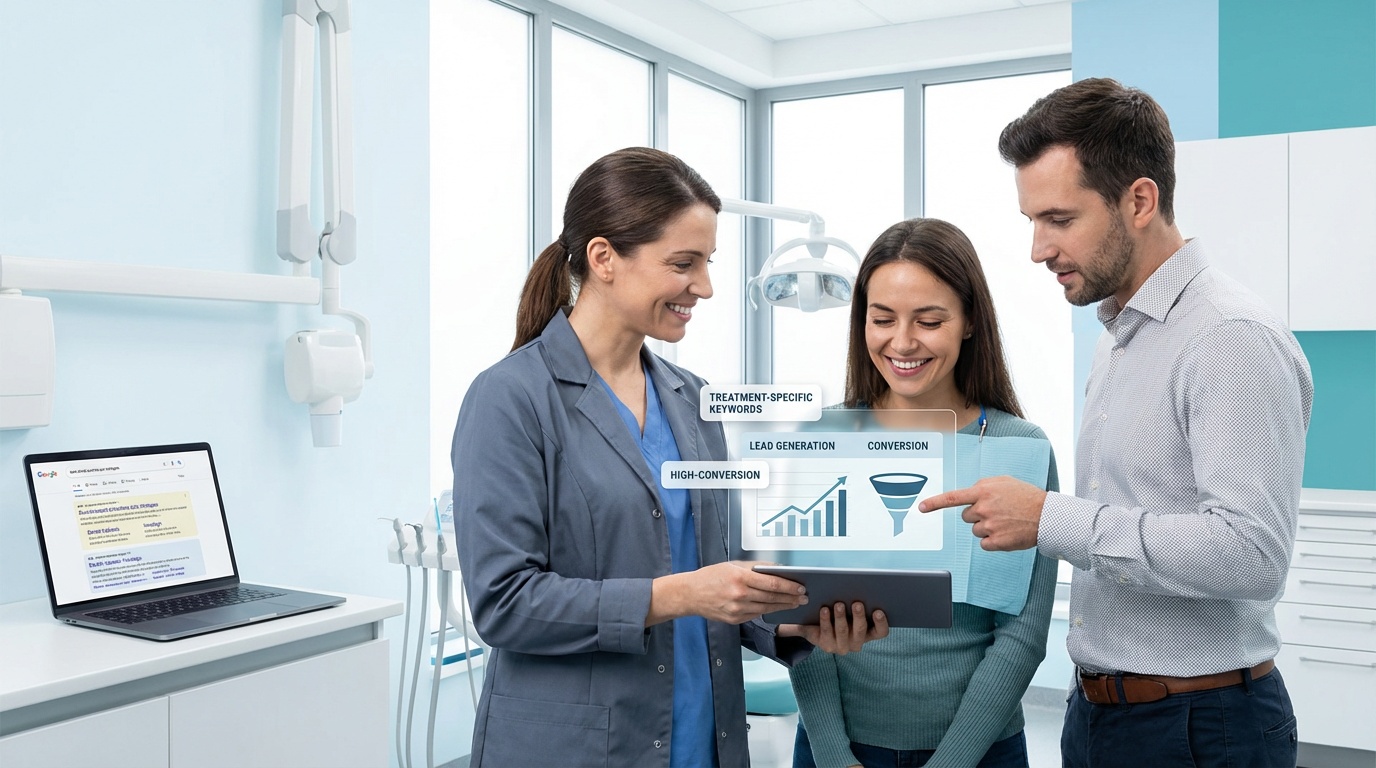
Successful dental PPC begins with surgical keyword selection. Generic terms like “dentist” drain budgets whilst attracting price-shoppers. Treatment-specific keywords capture patients researching procedures they’re genuinely considering, creating campaigns that convert consultations into revenue.
Keyword Research for Invisalign Marketing and Dental Implants
Build campaigns around procedure intent, not general discovery. “Invisalign cost London” signals a patient comparing options, whilst “best Invisalign provider Manchester” indicates someone ready to choose a practitioner. Target long-tail keywords combining treatment, location, and intent modifiers. “Same-day dental implants Birmingham” or “emergency tooth extraction near me” attract patients with immediate needs and higher conversion rates than broad-match terms.
Separate campaigns by treatment category: cosmetic dentistry, restorative procedures, emergency services, and orthodontics. This structure supports precise budget allocation based on profit margins. Allocate 40–50% of spend to implant keywords where average treatment values can justify £10–18 cost-per-click, whilst emergency dental terms receive 20–25% despite lower per-patient value due to volume potential.
Campaign Structure for Emergency Dental and Cosmetic Services
Organise campaigns by service type, then create ad groups for specific treatments within each. An Invisalign campaign might include ad groups for “Invisalign cost”, “Invisalign vs braces”, “adult orthodontics”, and “invisible aligners”. Each ad group contains 15–25 tightly themed keywords, ensuring ad copy directly matches search queries. This relevance improves Quality Score, reducing costs whilst improving ad positions.
Emergency campaigns need different architecture. Create dedicated ad groups for time-sensitive searches: “dentist open now”, “emergency dentist Sunday”, “broken tooth repair”. Schedule these campaigns with increased bids during evenings and weekends when emergency searches peak and competition drops.
Bid Management to Maximise ROI on High-Priority Treatments
Implement tiered bidding based on treatment value and conversion probability. Implant keywords often warrant stronger bidding given £3,000–£8,000 treatment values. Start with target CPA bidding at 8–12% of average treatment value, adjusting based on actual conversion data. For a practice with £5,000 average implant revenue, set an initial target CPA of £400–600.
Use bid adjustments strategically: increase bids 20–40% for mobile devices during evening hours when emergency searches surge, boost bids 15–25% for high-converting postcodes identified through conversion tracking, and reduce bids 30–50% for tablet users who research but rarely convert directly.
Ad Creation and Optimisation Tactics for Leading Dental Teams
Converting clicks into consultations calls for ad copy that speaks directly to patient concerns, plus landing pages that remove friction. The best dental practice ppc strategies combine clear messaging with streamlined user journeys that turn searchers into booked appointments.
Writing Compelling Ad Copy That Converts Local Searches
Effective dental ad copy addresses patient anxieties whilst highlighting practice advantages. Instead of generic claims like “quality dental care”, use specific differentiators: “Same-day implant consultations with 3D scanning” or “Invisalign from £2,800 with 0% finance”. Include location in headlines for local searches: “Manchester Dental Implants | Free CT Scan Included”. This specificity filters unqualified clicks whilst attracting serious prospects.
Test emotional triggers against rational benefits. “Nervous about implants? Sedation available” performs differently from “Award-winning implant dentist, 15 years’ experience”. Run at least three ad variations per ad group, rotating evenly for 200+ impressions before selecting winners. High-performing ads often combine a pain point acknowledgement with a specific solution and a clear call-to-action: “Book your free Invisalign consultation online in 60 seconds”.
Landing Page Best Practices for Dental Website Design
Your landing page must match the ad promise exactly. If the ad promotes an “Invisalign cost consultation”, the landing page headline should mirror this, not send visitors to a general orthodontics page. Remove navigation menus on dedicated PPC landing pages to reduce exit paths. Feature one primary conversion goal: booking a consultation.
Include trust signals above the fold: GDC registration numbers, before-and-after treatment images, patient video testimonials, and transparent pricing ranges. A Manchester cosmetic practice increased conversions by 67% by adding “Average Invisalign treatment: £3,200–£4,500” directly below the headline, reducing price uncertainty that previously caused drop-off. Embed booking calendars on landing pages rather than linking to separate scheduling systems, reducing friction that can hurt mobile conversions.
Mobile Optimisation and Call Extensions for Immediate Bookings
73% of dental searches occur on mobile devices, yet many practice websites fail mobile usability tests. Add click-to-call buttons at the top and bottom of key pages. Use Google Ads call extensions that display your practice number directly in search results, enabling one-tap dialling. These extensions can deliver 15–25% higher conversion rates for emergency dental campaigns where patients prioritise immediate contact over browsing.
Optimise page speed: landing pages loading in under 2 seconds can convert three times better than those taking 5+ seconds. Compress images, remove unnecessary scripts, and consider AMP for emergency dental campaigns. Test forms on real mobile devices, ensuring fields auto-format for phone numbers and postcodes. Replace long contact forms with two-field captures (name and mobile) for initial enquiries, collecting additional details during confirmation calls.
Conversion rate benchmark: Well-optimised dental PPC landing pages can achieve 8–15% conversion rates for high-value treatments like implants and Invisalign, compared to 2–4% for generic practice homepages. Mobile-focused optimisation often lifts conversion rates by an additional 40–60%.
Advanced PPC Techniques for Competitive UK Markets
Strong PPC foundations deliver results, but advanced tactics help leading practices stand out in saturated areas. These strategies rely on accurate tracking and ongoing optimisation, and can drive outsized returns for practices committed to owning their local market.
Retargeting and Social Media Ads (Facebook Ads for Dentists)
Only 3–5% of first-time visitors book consultations immediately. Retargeting campaigns re-engage the remaining visitors, showing ads across the Google Display Network and social platforms as they browse other sites. Create audience segments based on behaviour: visitors who viewed pricing pages see ads highlighting finance options, whilst those who abandoned booking forms see urgency-led messaging like “Limited slots remaining this month”.
Facebook and Instagram retargeting works well for cosmetic dentistry and Invisalign marketing, where visual change matters. Upload patient email lists (with consent) to create lookalike audiences aligned with your best patient profiles. Video ads featuring real patient transformations often beat static images by 200–300% on engagement, especially when local patients reference your practice.
Competitor Analysis and Conquest Campaigns
Bidding on competitor practice names can capture patients comparing providers. When someone searches “Smith Dental Manchester reviews”, your ad can appear offering “Compare implant options: Free second-opinion consultations”. This tactic tends to work best in metropolitan areas where patients shortlist several practices. Avoid negative messaging; focus on differentiation such as “Extended hours until 8pm” or “All treatments under one roof”.
Monitor competitor ad copy and landing pages monthly using tools like SEMrush or SpyFu. When competitors launch promotions, respond strategically rather than matching discounts that erode margins. If a competitor advertises “£500 off implants”, counter with value-adds: “Implants including free consultation, CT scan, and guarantee details provided at consultation”.
Dayparting and Geo-Targeting for London, Manchester, and Beyond
Analysis of 50+ dental campaigns shows conversion patterns vary by time and location. Emergency dental searches often peak between 18:00–22:00 on weekdays and throughout weekends, whilst cosmetic searches cluster around lunch (12:00–14:00) and evenings (19:00–21:00). Increase bids 30–50% in these high-intent windows and reduce spend during low-conversion periods.
Use radius targeting around your practice, then analyse conversion data by postcode to find your best catchment areas. A Birmingham practice found 60% of implant patients travelled from three specific postcodes within 8 miles, whilst nearer areas generated mainly low-value general dentistry enquiries. They shifted 40% of budget to geo-targeted campaigns in those postcodes, increasing implant consultations by 85% without increasing spend.
| Advanced Tactic | Best Application | Expected Lift |
|---|---|---|
| Retargeting Campaigns | High-value treatments (implants, Invisalign) | 25–40% increase in conversions |
| Competitor Conquest | Competitive metro markets | 15–20% additional consultation volume |
| Dayparting Optimisation | Emergency and cosmetic services | 20–35% improvement in cost per conversion |
| Postcode Geo-Targeting | High-value patient catchment areas | 30–50% increase in treatment acceptance rates |
Measuring Success and Partnering with Dominate Dental

Data without action wastes opportunity. The best dental practice ppc strategies pair rigorous measurement with continuous optimisation, turning metrics into profitable patient growth.
Key Metrics: Cost Per Lead and Patient Acquisition Costs
Track beyond vanity metrics like clicks and impressions. Cost per lead (CPL) shows campaign efficiency: divide total ad spend by consultation bookings generated. Target CPL varies by treatment: £40–80 for general dentistry, £80–150 for cosmetic treatments, £150–300 for implants. Calculate patient acquisition cost (PAC) by including staff time for consultation follow-up, which often adds 30–40% to CPL.
Return on ad spend (ROAS) is key: total treatment revenue divided by advertising cost. Profitable campaigns usually need a minimum 3:1 ROAS, whilst well-optimised high-value campaigns can reach 8:1 or higher. Set up conversion tracking in Google Ads and Google Analytics, and connect enquiries to treatment acceptance and revenue via practice management or CRM reporting where possible.
In-House vs Agency: Why Dominate Dental Delivers Proven Results
Effective PPC needs specialist expertise, continuous monitoring, and regular strategic adjustments that most practice teams cannot sustain alongside patient care. Dominate Dental combines dental-industry insight with PPC expertise to improve performance and accountability. Our clients often see around 40% lower cost per acquisition than practices managing campaigns internally, whilst generating 2.5 times more qualified consultations from similar budgets.
We provide transparent reporting with weekly performance updates, monthly strategy sessions, and direct access to a dedicated account manager. Our exclusive focus on dental practices means we understand patient psychology, treatment economics, and competition across UK dental markets.
Next Steps to Generate New Patients with Our PPC Expertise
Ready to grow? Book a free 30-minute PPC audit where we’ll review your current campaigns (or your competitive starting point), identify quick wins, and set realistic patient acquisition targets based on your market and treatment mix. We’ll show you how the best dental practice ppc strategies apply to your practice, with no obligation and no sales pressure.
Practices implementing our approach often see first consultation bookings within 72 hours of launch, with peak performance typically reached within 60–90 days as data builds and optimisations compound. Contact Dominate Dental to see how our PPC systems generate qualified, treatment-ready patients.
Get your free PPC audit: Contact us on 0121 818 3187, email team@dominatedental.com, or reach out via WhatsApp to schedule your consultation.
Future-Proofing PPC Campaigns with AI and Automation
Google’s ad platform changes continuously, with machine learning and automation shaping how winning campaigns run. Practices that adapt keep an edge; those relying on outdated manual tactics often see costs rise and conversions fall.
Smart Bidding Strategies That Learn and Adapt
Google’s automated bidding can outperform manual bid management for many campaigns by processing signals in real time. Target CPA and Target ROAS strategies analyse device, location, time of day, audience signals, and historical conversion patterns, adjusting bids throughout the day. Practices using smart bidding often see 20–35% improvements in cost per acquisition within 60 days once enough conversion data is available.
The transition needs patience. Aim for at least 30 conversions per campaign per month before switching from manual to automated bidding. Start with Target CPA for lead generation, then move to Target ROAS once you can connect treatment revenue back to leads via CRM or reporting.
Responsive Search Ads and Dynamic Content
Responsive search ads let you provide multiple headlines and descriptions, with Google testing combinations to find what performs best. Provide 10–15 headlines that cover different angles: treatment benefits, price transparency, location cues, urgency, and trust signals. Add at least four descriptions. Compared with static ads, this can lift relevance and click-through rates by 15–25%.
Dynamic keyword insertion can personalise headlines by inserting the search term. A search for “dental implants Wimbledon” can show “Dental Implants Wimbledon | Book Free Consultation”, whilst “teeth implants London” can show “Teeth Implants London | Book Free Consultation”. Set this up carefully to avoid awkward grammar or non-compliant messaging.
Performance Max Campaigns for Multi-Channel Reach
Performance Max campaigns distribute ads across Search, Display, YouTube, Gmail, and Discover based on conversion likelihood. They can work well for practices with strong visual assets, especially cosmetic dentistry and Invisalign marketing where before-and-after images drive interest. Upload high-quality patient transformation images (with consent), practice photography, and team imagery to support creative testing.
Use audience signals to guide early learning: upload patient email lists (with consent), define demographics that match your ideal patients, and add relevant interests like “cosmetic dentistry” or “orthodontics”. Performance Max can be lower-touch day-to-day, but it depends on reliable conversion tracking because optimisation follows your defined goals.
Automation success factor: Practices seeing strong results with automated bidding keep conversion tracking accuracy above 95%, supply a wide range of ad assets, and allow a 4–6 week learning period before judging performance. Frequent manual changes can disrupt learning and delay improvements.
Compliance and Ethical Considerations in Dental Advertising
UK dental advertising is regulated to protect patients and uphold professional standards. Breaches can lead to GDC action, ASA complaints, and reputational damage that outweighs any short-term gain.
GDC Advertising Guidance for Dental Practices
The General Dental Council requires advertising to be legal, decent, honest, and truthful. Prohibited areas include guaranteeing outcomes, making comparative claims against named competitors, and using testimonials that create unrealistic expectations. Your ads can say “High success rate for dental implants”, but not “100% implant success guaranteed”. You may say “Experienced Invisalign provider”, but not “Better Invisalign results than other Manchester practices”.
Before-and-after images need careful handling. Get written consent for advertising use, ensure images represent typical outcomes rather than exceptional cases, and add a disclaimer such as “Individual results vary”. Do not digitally alter clinical photos beyond basic colour correction and cropping. The GDC also applies the same standards to social content, including Instagram posts and Facebook ads.
Transparent Pricing and Finance Advertising
When advertising treatment costs, give enough context. “Invisalign from £2,800” should note that straightforward cases start from that figure and complex cases cost more. Finance offers must comply with FCA rules: show APR clearly, specify deposit requirements, and avoid implying treatments are “free” when funded. “Interest-free credit available” is acceptable; “Free Invisalign with our payment plan” is not.
Emergency dental ads need extra care. Advertising 24-hour availability requires genuine round-the-clock access, not just an answering service redirecting elsewhere. “Same-day appointments” means you can see patients that day, not simply book them on the day they call.
Data Protection and Patient Privacy in PPC
GDPR applies to advertising activity. Cookie consent should be shown before tracking pixels fire, with clear explanations of what data is used for. Retargeting needs privacy policy wording that explains cross-platform tracking. Patient email lists used for lookalike audiences need explicit marketing consent, not only consent for treatment communications.
Avoid geo-targeting so narrow it risks identifying individuals. Targeting a single postcode that effectively isolates a small group can raise privacy concerns for sensitive searches. As a rule, keep radius targeting to at least 1–2 miles in dense urban areas, and wider in rural locations.
Budget Allocation and Scaling Successful Campaigns

Smart budget management separates consistent growth from feast-or-famine consultation flow. Scale what works and cut waste early.
Starting Budgets for Different Practice Sizes
Minimum PPC budgets depend on competition and your treatment mix. Single-location practices in moderately competitive areas often need £2,000–3,000 per month to generate reliable data and consistent consultation flow. London and other major cities may need £4,000–6,000 due to higher cost-per-click. Allocate 50–60% to your highest-value treatments (often implants and Invisalign), 25–30% to cosmetic dentistry, and 15–20% to emergency services for immediate demand.
Multi-location groups should budget per site, as each competes in a distinct local market. A three-practice group might allocate £3,000 to London, £2,000 to Manchester, and £1,500 to a smaller area, then adjust by location after 90 days of data.
Identifying and Scaling High-Performing Campaigns
After 60 days of consistent data, review performance by treatment type. Estimate profit per campaign by multiplying consultation bookings by your treatment acceptance rate and average treatment value, then subtracting ad spend and staff costs. Campaigns delivering 4:1 ROAS or higher are candidates for scaling.
Scale gradually: increase budgets 20–30% month-on-month rather than doubling overnight. Big jumps can push algorithms into broader targeting and reduce lead quality. Watch CPL during scaling; if it rises by more than 15% from baseline, pause expansion and optimise before increasing again.
Seasonal Adjustments and Market Timing
Dental demand shifts across the year. January often brings a spike as patients pursue health goals; increase budgets by 30–40% to capture demand. August can soften as patients take holidays; consider moving 20–25% into retargeting to keep prospects warm for September.
Cosmetic dentistry and Invisalign marketing often rise ahead of major social events. Increase these campaigns by 25–35% during March–May (wedding preparation) and November–December (seasonal events). Implant demand is steadier year-round, but can benefit from additional allocation in autumn when patients plan larger health investments.
| Month | Demand Pattern | Budget Adjustment | Priority Focus |
|---|---|---|---|
| January–February | Peak consultation period | +30–40% | All high-value treatments |
| March–May | Cosmetic treatment surge | +25% cosmetic campaigns | Invisalign, whitening, veneers |
| June–August | Summer slowdown | -20–25% | Retargeting and nurture campaigns |
| September–October | Strong recovery period | Return to baseline +15% | Implants and major treatments |
| November–December | Seasonal cosmetic demand | +20% cosmetic, -10% general | Quick cosmetic procedures |
Taking Action: Your Path to PPC Success
The best dental practice ppc strategies combine technical skill, ongoing optimisation, and a clear understanding of dental patient decision-making. Success comes from disciplined measurement, structured testing, and giving campaigns time to mature as the data improves.
Start with goals linked to growth. Whether you want 20 additional implant consultations per month or to double Invisalign case starts, specific targets enable clean measurement and sharper optimisation. Put tracking in place from first click through to treatment acceptance so you can tie marketing spend to revenue.
If you want support, partner with specialists who understand dental practice economics and patient acquisition in the UK. Dominate Dental works with solo owners and multi-location groups, tailoring PPC to your market, services, and capacity so the leads you generate are the ones you want to see in the diary.
Ready to improve your patient acquisition? Contact Dominate Dental on 0121 818 3187, email team@dominatedental.com, or reach out via WhatsApp.
Frequently Asked Questions
What kind of ROI can UK dental practices expect from PPC campaigns?
Our data shows practices using effective PPC strategies can achieve a 300-500% return on ad spend for implant campaigns. For example, a London practice investing £3,000 monthly can generate 15-25 qualified consultations, with about 40% converting to treatment plans averaging £4,500. Emergency dental campaigns often deliver even faster returns, with cost-per-acquisition below £45.
How should dental practices allocate their digital marketing budget for PPC?
Sophisticated practices often allocate 60-70% of their digital budgets to paid search, especially for high-value treatments like Invisalign and dental implants. We recommend dedicating 40-50% of spend to implant keywords, where average treatment values justify higher cost-per-click. Emergency dental terms typically receive 20-25% of the budget due to their volume potential.
How does PPC help target high-value dental treatments effectively?
PPC excels at capturing patients actively searching for specific, high-value procedures like Invisalign or dental implants. By using precise keyword and location targeting, your campaigns connect with individuals already in decision mode. This precision ensures your budget focuses on treatment-ready prospects, maximizing the impact for profitable services.
What is the typical timeframe to see results from dental PPC advertising?
One of PPC’s greatest strengths is its immediate impact; you can see results the same day your campaigns go live. Unlike organic SEO which takes months, paid search delivers immediate visibility for high-intent searches. This allows practices to quickly capture patients needing urgent or specific treatments.
What are the best strategies for keyword selection in dental PPC?
Successful dental PPC requires surgical keyword selection, moving beyond generic terms like ‘dentist.’ Focus on treatment-specific, long-tail keywords that combine the procedure, location, and patient intent. Examples include ‘Invisalign cost London’ or ‘same-day dental implants Birmingham,’ which target patients genuinely considering treatment.
How should dental practices structure PPC campaigns for services like emergency dentistry?
Organise campaigns by service type, then create specific ad groups for treatments within each. For emergency services, dedicate ad groups to time-sensitive searches like ‘dentist open now’ or ’emergency tooth repair.’ Schedule these campaigns with increased bids during evenings and weekends to capture peak demand.
What makes compelling ad copy for dental PPC campaigns?
Effective dental ad copy directly addresses patient concerns and highlights your practice’s unique advantages. Instead of general claims, use specific differentiators like ‘Same-day implant consultations with 3D scanning.’ Clear, benefit-driven messaging on ads and landing pages is key to converting clicks into consultations.
Leave a Reply