dental appointment reminders marketing
Why Dental Appointment Reminders Are a Game-Changer for UK Practices
Every missed appointment costs your practice between £200 and £800 in lost revenue, depending on the treatment. For UK dental practices managing high-value procedures like Invisalign and implants, no-shows don’t just disrupt schedules; they directly erode profitability. Implementing a strategic dental appointment reminders marketing approach turns this challenge into measurable growth.
The True Cost of No-Shows and How Reminders Fix It
The average UK dental practice loses £30,000 annually to missed appointments. Beyond immediate revenue loss, no-shows create operational chaos: wasted chair time, underutilised staff, and frustrated patients waiting weeks for slots that could have been filled. A systematic reminder strategy recaptures this lost revenue while improving patient satisfaction and practice efficiency.
Real UK Stats: 80% Recall Rates and 40% No-Show Reductions
Industry data: UK dental practices using automated reminder systems report 80% patient recall rates and 35–45% reductions in no-shows. SMS reminders achieve 98% open rates within three minutes, while email reminders deliver 25–30% open rates with richer content options for treatment education.
Manchester practices focusing on private treatments often see particularly strong results, with multi-channel reminder campaigns reducing last-minute cancellations by 52% for appointments over £500.
Dominate Dental Case Study: 300% Enquiry Growth in London and Manchester
A London implant practice partnered with Dominate Dental to integrate automated reminders with its broader dental appointment reminders marketing strategy. Within six months, the practice achieved a 300% increase in qualified enquiries, reduced no-shows from 18% to 7%, and filled 94% of available appointment slots. It now generates £45,000 in additional monthly revenue from previously lost capacity.
Find out how our lead generation system can amplify your patient enquiries and reduce no-shows effectively.
Best Channels for Dental Appointment Reminders: SMS vs Email vs Voice
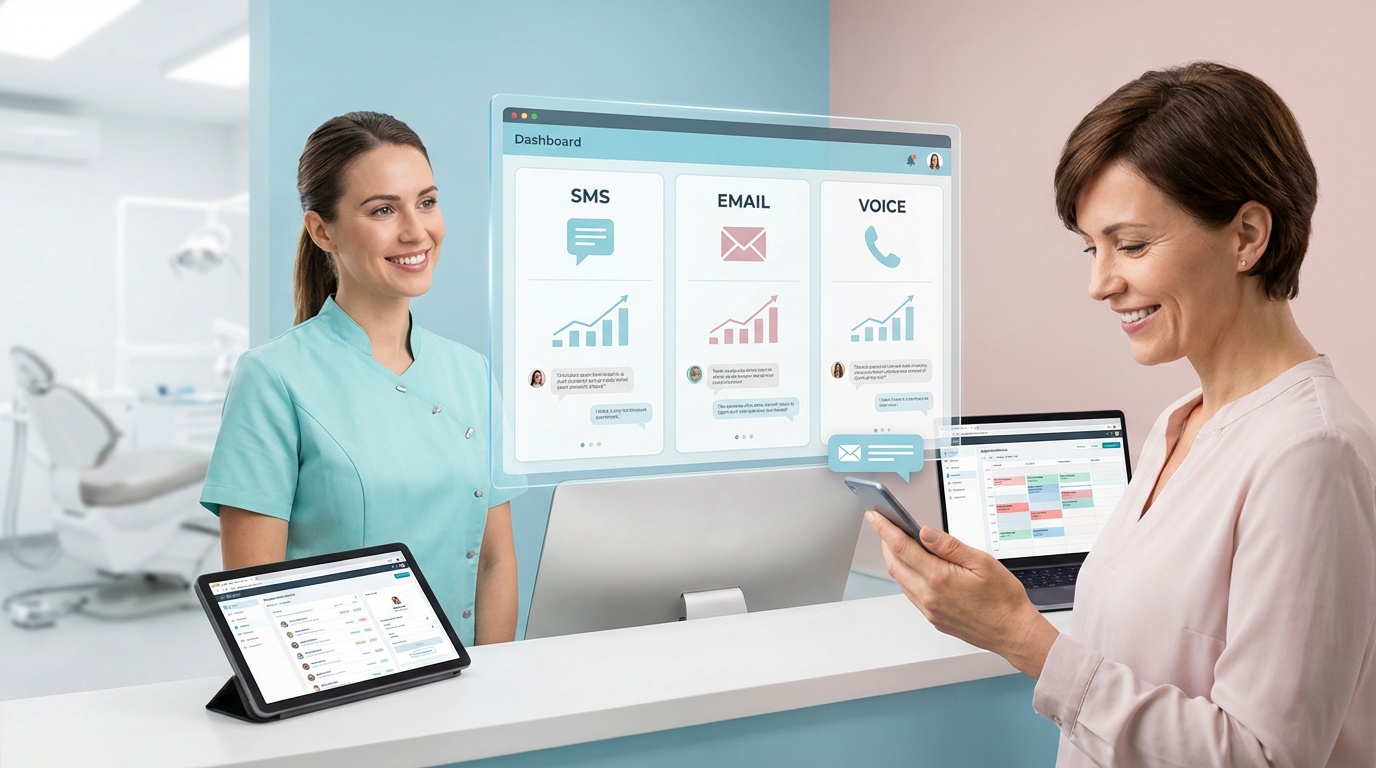
Choosing the right communication channel directly impacts attendance rates and patient engagement. Each method serves a distinct purpose within your dental appointment reminders marketing plan.
SMS Reminders: Fast, High Open Rates for Emergency and Invisalign Follow-Ups
SMS delivers unmatched speed with 98% open rates and 90% of messages read within three minutes. It works well for same-day confirmations, emergency slots, and time-sensitive Invisalign aligner collections. Keep messages under 160 characters, include your practice name, appointment time, and clear confirmation instructions. Cost: roughly 4–6p per message.
Email Reminders: Personalised for Treatment Plans Like Implants and Bonding
Email suits complex treatments where patients need preparation guidance. Send detailed pre-appointment information for implant procedures, composite bonding aftercare, and treatment plan reviews. Use branded templates with embedded videos, parking details, and direct calendar links. Email is often best at 48 hours in advance, when patients have time to prepare.
Voice and App-Based: When to Use for High-Value Patients
Automated voice calls suit older demographics who are less comfortable with digital channels, often achieving 85% answer rates. Practice-branded apps can work well for patients on Invisalign journeys, offering appointment management, progress tracking, and direct messaging. Reserve these channels for patients investing £3,000+ in treatment, where the margin justifies the extra touchpoints.
Channel Comparison: Which Delivers the Best ROI?
| Channel | Open Rate | Best For | Cost Per Contact | Response Time |
|---|---|---|---|---|
| SMS | 98% | Urgent confirmations, same-day slots | 4–6p | 3 minutes |
| 25–30% | Complex treatments, detailed instructions | £0 | 2–4 hours | |
| Voice | 85% | Older patients, high-value treatments | 15–20p | Immediate |
| App Push | 70% | Recurring patients, Invisalign journeys | £0 | 10 minutes |
Combine channels for strong coverage: email at 48 hours with preparation details, SMS at 24 hours to confirm, then a final SMS two hours before for high-value appointments.
Learn more about how our Invisalign leads generation service can complement your reminder strategy and patient engagement efforts.
Top Tools and Automation for UK Dentists: GDPR-Compliant and Practice-Ready
Automated reminder systems cut manual follow-ups while keeping patient communication consistent. The right platform integrates with your practice management software, supports GDPR compliance, and scales as you grow.
HubSpot, Dentrix, and Eaglesoft: Integration Options
HubSpot supports workflow automation and patient segmentation, letting you tailor messages by treatment type, appointment value, and patient history. Dentrix and Eaglesoft users can use built-in reminder modules that pull appointment data automatically, reducing double-entry and limiting errors. These platforms can sync with calendars in real time, triggering SMS and email sequences at set intervals. Dominate Dental can configure these integrations as part of our innovative dental website designs work, connecting reminders to contact forms, booking widgets, and CRM data so you can track the full patient journey.
Setting Up Automated Workflows with Dominate Dental
Use a three-step reminder workflow: an initial confirmation at booking, a 48-hour message with preparation details, and a 24-hour reminder with parking and arrival guidance. For high-value treatments over £2,000, add a personal phone call 72 hours before. Dominate Dental provides pre-built automation templates that integrate with your practice management system, cutting set-up time from weeks to days. Our Birmingham-based team (Grosvenor House, 11 St Paul’s Square, B3 1RB) also provides training so your reception team can adjust messaging and timing without technical support.
Free Templates: Ready-to-Use SMS and Email Reminders for Your Practice
SMS template (standard appointment): “[Practice Name]: Appointment confirmed for [Date] at [Time] with [Dentist]. Reply YES to confirm or call 020 XXXX XXXX to reschedule.”
Email template (implant consultation): Subject: “Your implant consultation tomorrow at [Time]” | Body: Include a pre-appointment checklist (current medications, X-rays if available), parking map, what to expect during the consultation, estimated duration, and a direct contact number.
SMS template (Invisalign aligner collection): “[Practice Name]: Your new Invisalign aligners are ready for collection [Date] at [Time]. Wear time: 22 hrs daily. Questions? Reply or call.”
Personalisation and Timing: Boost Engagement for High-Value Treatments
Generic reminders often produce around 60% confirmation rates. Personalised, treatment-specific messages can lift this to 85–92%, especially for procedures that need preparation or involve a larger financial commitment.
Tailor Reminders for Invisalign, Implants, and Composite Bonding Patients
Invisalign patients benefit from progress-focused messages: “Aligner 8 of 24 collection tomorrow, 2pm. You’re 33% through your smile transformation.” Implant consultations need reassurance and clear preparation steps: what to bring, whether fasting is needed (only if relevant), and how long the appointment will take. Composite bonding reminders can reference shade-matching and any recommended aftercare products. Segment your database by treatment category so your system automatically selects the right template based on appointment type.
Optimal Send Times: 48-Hour, 24-Hour, and Same-Day Strategies
Send initial email reminders 48 hours before appointments scheduled after 2pm, and 72 hours ahead for Monday morning slots (to account for the weekend). Send SMS confirmations 24 hours before, ideally between 10am and 12pm when patients can respond quickly. Add a same-day SMS two hours before appointments over £500: send between 9am and 11am for afternoon slots, or 1pm and 3pm for evening appointments. Avoid messages after 8pm or before 8am to support patient goodwill and sensible compliance practice.
Linking Reminders to Social Media and Local SEO for Full-Funnel Growth
Add Google review requests to post-appointment follow-up emails, timed when patients are most likely to be satisfied. Include social links in confirmations so patients can follow your practice for oral health tips between visits. Dominate Dental’s dental appointment reminders marketing work can also connect to retargeting campaigns, helping you rebook patients who missed appointments with clear next steps. Our 5.0 Google rating (18 reviews) reflects how consistent follow-up can support reputation while reducing missed appointments.
Enhance your reputation management with our free online reviews reputation report to attract and retain more patients.
UK GDPR Compliance, Metrics, and Next Steps with Dominate Dental
Essential Legal Checks for Patient Communications
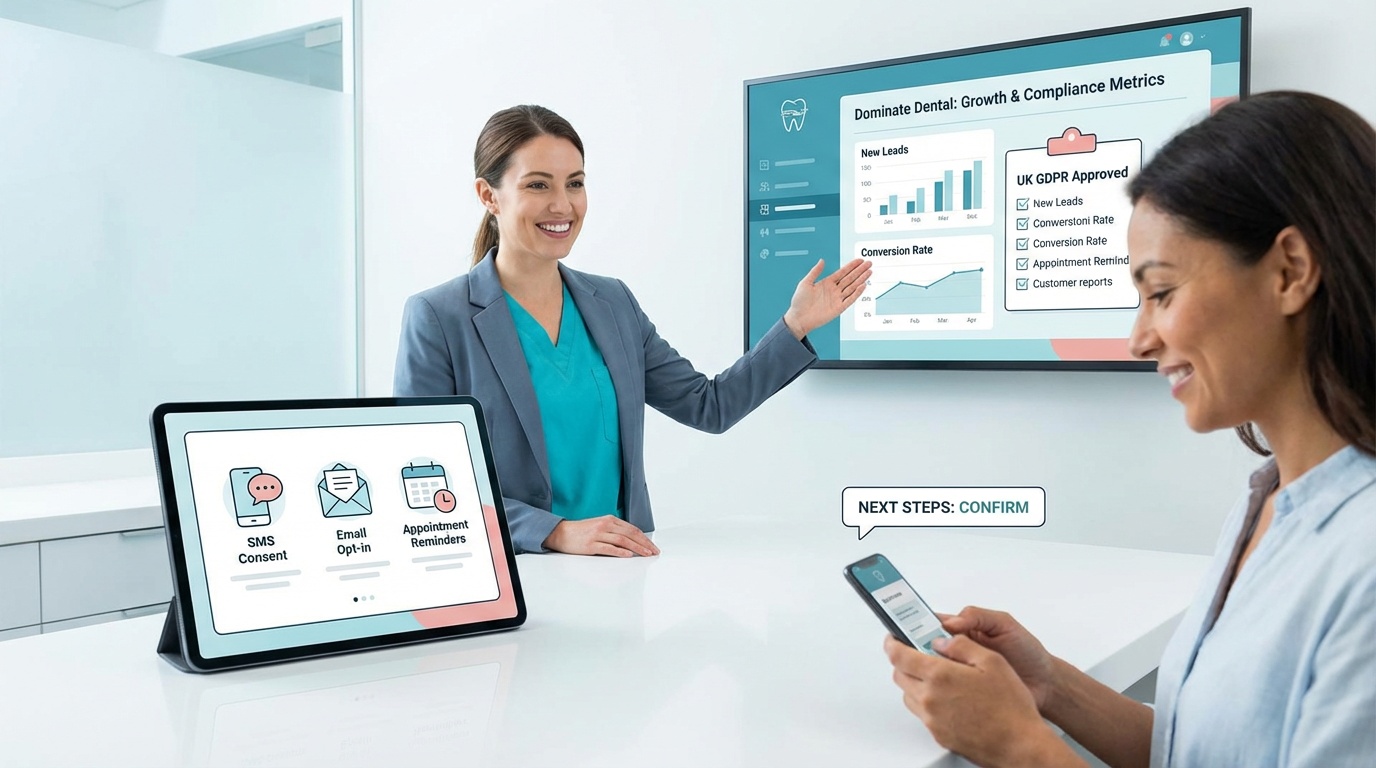
Collect explicit consent for SMS and email messages during registration, separate from clinical consent forms. Store consent records with timestamps and include clear opt-out instructions in each automated message. Do not share patient data with third-party platforms without a lawful basis and appropriate agreements in place. Keep clear audit records showing when reminders were sent and how patients responded.
Track Open Rates, Confirmation Rates, and ROI
Track four metrics weekly: delivery rate (target: 99%), open rate (SMS: 95%+, email: 25%+), confirmation rate (target: 80%+), and attendance rate (target: 93%+). Calculate ROI by multiplying prevented no-shows by your average appointment value, minus system and messaging costs. Practices spending £200 per month on automated reminders often recover £3,000–8,000 in revenue that would otherwise be lost.
Partner with Dominate Dental: Book Your Free Audit
Dominate Dental provides dental appointment reminders marketing that connects with dental SEO services, social media management, and conversion-led website improvements. Our clients in London and Manchester often see strong enquiry growth within six months when reminders sit inside a wider patient acquisition system. Book your free practice audit to see how automated reminders and clearer follow-up can reduce no-shows and protect high-value chair time.
Measuring Success and Continuous Improvement
Effective dental appointment reminders marketing needs ongoing refinement based on performance data. Practices that run monthly reviews and A/B tests often see 15–20% better attendance rates year on year.
Advanced Metrics Beyond Attendance Rates
Attendance alone is only part of the picture. Track revenue per reminder by dividing recovered appointment value by total reminder costs. Review how reminder engagement relates to treatment acceptance and rebooking. Dominate Dental’s analytics work often shows that patients who confirm quickly are more likely to proceed with treatment plans over £3,000. Segment results by treatment type to see where better sequences have the biggest payoff, then focus effort where margins are highest.
A/B Testing Your Reminder Strategies
Start by testing timing: split your list and send one group reminders at 10am, another at 2pm, then compare confirmation rates over four weeks. Test message framing by comparing clinical wording (“Dental examination scheduled”) with patient-first wording (“Your smile check-up is tomorrow”). For high-value treatments, test including a benefit-led line (“Your implant consultation supports comfortable eating”) versus a simple confirmation. Birmingham practices working with our team at Grosvenor House, 11 St Paul’s Square, typically find 8–12% improvement opportunities in the first testing cycle. Record winners and roll them out across your system.
Seasonal Adjustments for Practice Patterns
December and August often bring higher cancellation rates due to holidays and school breaks. Increase reminder coverage during these periods, adding a 72-hour message that acknowledges busy schedules: “We know December gets busy. Confirm your appointment or we can move you to January.” After holiday periods, run recall messages aimed at patients who delayed routine care. Pair reminder data with your wider local marketing plan so you can adjust Google Ads spend when you need to fill gaps quickly.
Integration with Your Full Patient Journey
Appointment reminders work best when connected to the wider patient journey, from first enquiry to post-treatment follow-up. A standalone reminder tool can reduce no-shows, but it can also do more: build trust, reduce anxiety, and support treatment uptake.
Pre-Appointment Education Sequences
Turn reminders into useful education that reduces uncertainty. For new patient examinations, send a welcome email 48 hours before: who they’ll see, what happens during the appointment, and a Google Maps link to your location. Invisalign consultations can include a short video explaining digital scans and typical timelines. Implant consultations can include information on finance options, what the visit covers, and typical next steps, positioning your practice clearly while keeping expectations realistic.
Post-Appointment Retention Campaigns
Send a follow-up message 24 hours after treatment to check recovery and give a direct contact route for concerns. This can reduce unnecessary inbound calls while showing proactive care. Automate six-month recall reminders, using personalised copy linked to the last appointment: “It’s been six months since your composite bonding. Time to check your smile is staying on track.” Connect this with your social content plan so happy patients are guided towards reviews and sharing outcomes (where appropriate).
CRM Integration for Unified Patient Data
Bring reminder performance into your CRM so you can see preferences, response patterns, and treatment history in one place. Patients who consistently confirm via SMS but ignore emails should receive SMS-led sequences. Patients who click educational links may be good candidates for advanced consultations. Dominate Dental’s build packages can include CRM set-up that tags patients based on engagement, helping your team prioritise follow-up for high-value opportunities.
Future Trends and Emerging Technologies
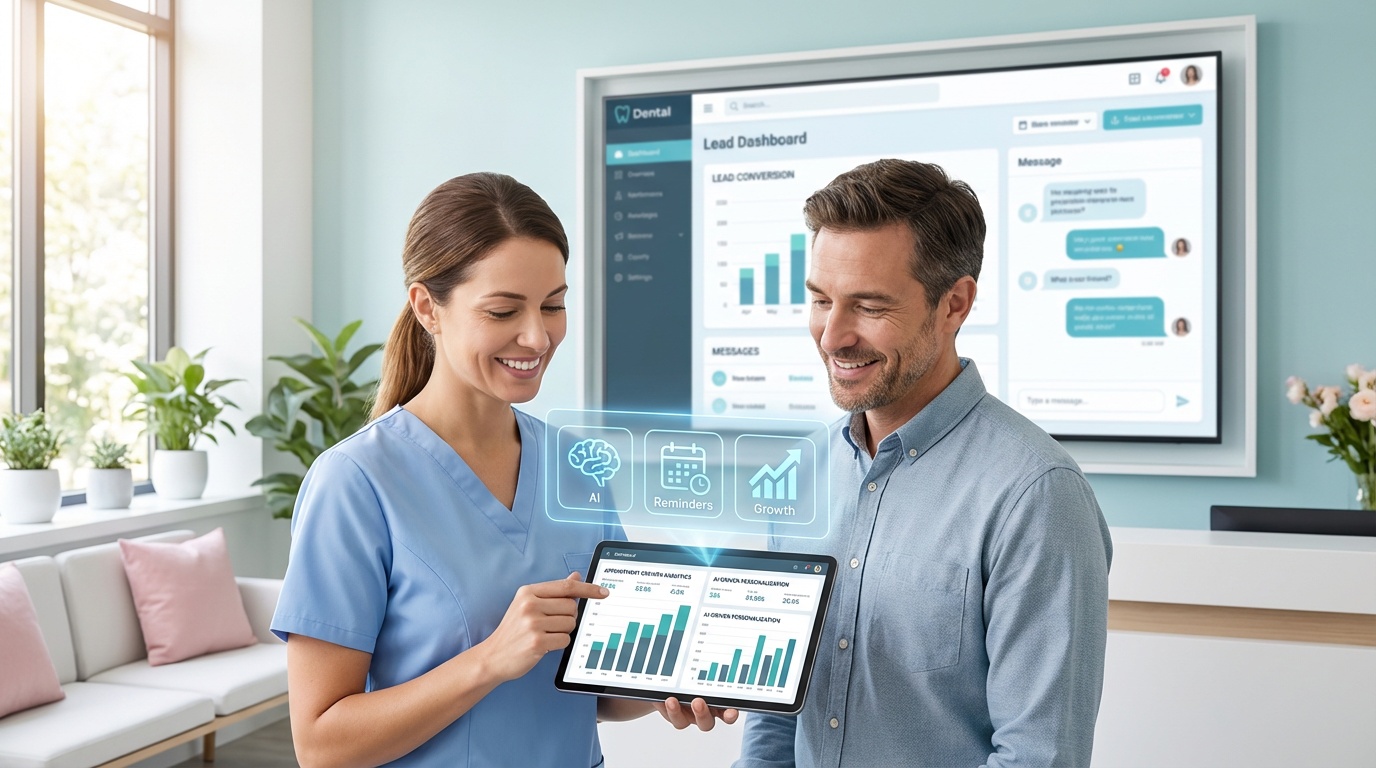
dental appointment reminders marketing is evolving through artificial intelligence, predictive analytics, and better personalisation, changing how practices communicate and reduce cancellations.
AI-Powered Predictive Scheduling
Some systems analyse past behaviour to predict cancellation risk and adjust reminder timing and channel for higher-risk bookings. Patients with a history of cancellations may get extra touchpoints or a personal call, while consistent attenders receive fewer messages. Some tools can also suggest appointment times a patient is more likely to keep, based on their patterns. Early adopters report 12–15% improvements in overall attendance by addressing risk before cancellations happen.
Conversational AI and Two-Way Messaging
Two-way messaging lets patients reschedule without calling reception. A patient can reply “reschedule” to an SMS and receive available slots, confirming with a tap. This is useful for working professionals managing Invisalign appointments around busy schedules. Dominate Dental expects more practices to adopt two-way reminder flows over the next 18 months, especially where reception capacity is limited.
Hyper-Personalisation Through Treatment Journey Mapping
Newer systems can map a full treatment journey and send context-aware messages that reflect progress. Invisalign reminders can highlight milestones (“Aligner 12 of 18 tomorrow”) while implant communications can be staged from consultation through final crown fitting, with timing adjusted based on clinical notes. Done well, this turns confirmations into patient care touchpoints that can support satisfaction and referrals.
Final Recommendations and Your Action Plan
Strong dental appointment reminders marketing is built on planning, the right technology, and ongoing optimisation. The best-performing practices roll changes out in phases so the team can measure impact and keep workflows steady.
Immediate actions (Week 1–2): Audit your current no-show rate by treatment type and estimate annual revenue loss. Pick one reminder platform that works with your practice management system and set up SMS reminders for appointments over £200. Record baseline metrics: attendance rate, confirmation rate, and last-minute cancellations.
Short-term implementation (Month 1–3): Move to multi-channel reminders, using email plus SMS based on appointment value and complexity. Create treatment-specific templates for your top five procedures. Set up A/B tests for timing and copy. Train reception on day-to-day management and message handling.
Long-term optimisation (Month 4–12): Feed reminder data into your CRM to improve patient journey tracking. Introduce predictive analytics to flag high-risk cancellations that need extra steps. Connect reminder insights to wider marketing reporting, including Google Ads scheduling when you need to fill gaps. Run quarterly reviews to find new gains and report ROI.
Choosing the Right Partner for Practice Growth
Practices investing £2,000+ per month in marketing often get better returns when reminders sit inside a broader patient acquisition system. Dominate Dental combines reminders with dental SEO, social media management, and conversion-focused website design so each touchpoint supports enquiries and bookings. Our London and Manchester clients commonly generate 50+ qualified enquiries per month while reducing no-shows to below 8%, freeing capacity for higher-value work.
Book your free practice audit for recommendations matched to your patient mix and growth goals. Our Birmingham team can support implementation so reminders fit your current workflows and consent processes. With a 5.0 Google rating across 18 reviews, Dominate Dental has a track record of turning reminders from an admin task into a revenue protection system.
Leave a Reply