Category: Blog

  • PPC Campaign Management: The Complete UK Dental Guide

    ppc campaign management

    Key Takeaways

    • UK dental practices using PPC campaign management see a 73% increase in qualified consultations compared to those using only organic marketing.
    • Strategic pay-per-click advertising provides immediate and measurable returns for dental practices.
    • The average private dental consultation is valued at £2,847, making PPC campaigns highly profitable.
    • PPC campaigns are especially effective for promoting high-value treatments like Invisalign and dental implants.

    High-Performance PPC Campaign Management: The Definitive Guide for UK Dental Practices

    UK dental practices investing in PPC campaign management generate 73% more qualified consultations than those relying solely on organic marketing. With the average private dental consultation worth £2,847, strategic pay-per-click advertising delivers immediate, measurable returns for practices targeting high-value treatments like Invisalign and dental implants.

    Effective PPC management uses AI-driven audience segmentation and continuous optimization to maximize ROI and boost high-value dental treatment bookings.

    Effective PPC campaign management transforms your practice’s patient acquisition by placing your services directly in front of patients actively searching for dental solutions. Unlike traditional marketing channels that cast wide nets, PPC delivers laser-focused targeting to patients with genuine treatment intent. Marketing for dentists is most effective when it leverages both PPC and organic strategies to maximise patient reach and ROI.

    For practices seeking a comprehensive approach, partnering with a dental marketing agency can streamline campaign setup, management, and ongoing optimisation, ensuring your advertising budget is invested where it delivers the highest returns.

    What is PPC Campaign Management for Dental Practices?

    PPC (Pay-Per-Click) campaign management for dental practices involves the strategic planning, execution, and ongoing optimisation of paid advertising campaigns on platforms like Google Ads and Facebook. The goal is to attract high-intent patients searching for treatments such as Invisalign, dental implants, and emergency dental care. Effective management ensures your ads appear to the right audience, at the right time, and within your desired geographic area, maximising your return on investment and driving measurable growth in private treatment bookings.

    Key Components of a Dental PPC Campaign

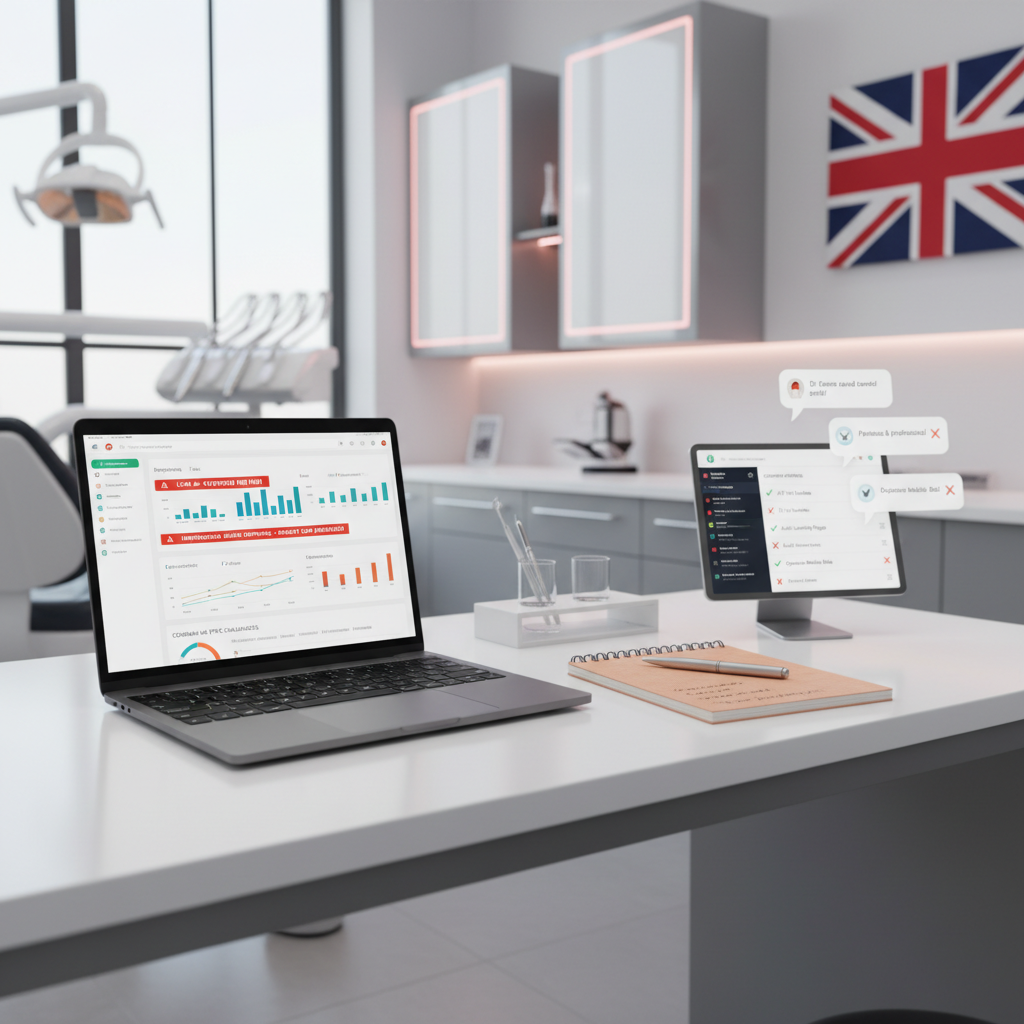
    <a href=Dental PPC campaign dashboard on laptop in modern dental workspace” />

    Keyword Research & Intent Alignment

    Successful dental PPC campaign management begins with identifying high-value keywords that align with treatment-specific patient intent. Keywords like “emergency dentist Manchester” or “Invisalign consultation Birmingham” demonstrate immediate treatment need, justifying higher cost-per-click investments.

    Long-tail keywords provide exceptional value for dental practices. “Affordable dental implants North London” typically costs 60% less per click than “dental implants” while attracting patients with clearer budget expectations and treatment readiness. Use Google Keyword Planner to identify monthly search volumes and competition levels for your target treatments.

    Campaign & Ad Group Structuring

    Organise campaigns by treatment type and geographic location for optimal performance tracking. A Greater London practice might structure campaigns as: “Invisalign Central London,” “Dental Implants Canary Wharf,” and “Emergency Dental City of London.” This granular approach enables precise budget allocation and performance measurement.

    Each ad group should contain 5-10 closely related keywords with 2-3 responsive search ads. This structure allows Google’s machine learning to optimise ad combinations while maintaining treatment-specific messaging relevance.

    Budget Setting & Bid Management

    Calculate daily budgets by dividing monthly patient acquisition goals by average conversion rates. A practice targeting 20 new implant consultations monthly with a 4% conversion rate needs approximately 500 clicks, requiring a daily budget of £167 at £10 average cost-per-click.

    Manual bidding provides greater control for experienced advertisers, while automated bidding strategies like Target CPA work effectively for practices with established conversion data. Monitor bid adjustments for mobile devices, time-of-day, and geographic performance to maximise efficiency.

    Audience Targeting & Advanced Segmentation Strategies

    Geo-Targeting and Demographics

    Geographic targeting forms the foundation of local dental marketing success. Focus advertising spend within realistic travel distances, typically 5-10 miles for routine treatments, extending to 25 miles for specialist procedures like dental implants or orthodontics.

    Demographic targeting enhances campaign efficiency significantly. A Manchester implant clinic increased conversion rates by 34% when targeting audiences aged 45-65 with household incomes above £50,000, reflecting the typical demographic profile for private implant patients.

    Negative Keyword Strategies

    Negative keywords prevent ad display for irrelevant searches, protecting budget from unqualified clicks. Essential negative keywords for private dental practices include “NHS,” “free,” “cheap,” and “student,” which attract patients seeking services outside your target market.

    Review search term reports monthly to identify new negative keywords. Terms like “dental nurse jobs” or “dental school” indicate informational rather than treatment intent, warranting immediate exclusion from campaigns.

    Conversion Tracking, Analytics, and ROI Measurement

    Conversion Tracking Setup

    Robust conversion tracking is essential for measuring the true ROI of your dental PPC campaigns. Set up Google Ads and Google Analytics conversion goals for key actions such as online consultation bookings, phone calls from ads, and contact form submissions. Use dynamic call tracking numbers to attribute phone enquiries to specific campaigns and keywords. This data enables you to identify which ads and keywords drive the highest-value leads, allowing for precise budget allocation and ongoing optimisation.

    Retargeting and Audience Expansion

    Retargeting campaigns capture patients who visited your website but didn’t book consultations initially. These warm audiences convert at rates 2-3 times higher than cold traffic, with average costs-per-click 40% lower than search campaigns. Target website visitors with specific treatment page visits, Invisalign page visitors receive orthodontic-focused ads, while implant page visitors see implant-specific messaging.

    Lookalike audiences expand reach by targeting users similar to existing patients. Upload patient email lists to Google Ads to create similar audience segments, focusing on demographics and online behaviours matching your ideal patient profile.

    Ongoing Optimization: How to Improve Dental PPC Campaigns Over Time

    Dental PPC campaign analytics on computer in dental office

    A/B Testing and Ad Iteration

    Systematic A/B testing drives continuous PPC campaign management improvement. Test one element per experiment, headlines, descriptions, or landing pages, over 2-week periods with sufficient traffic for statistical significance. Winning variations often improve conversion rates by 15-35%.

    Priority testing elements include: pain-point headlines (“Tooth pain keeping you awake?”), benefit-focused descriptions (“Same-day emergency appointments”), and trust signals (“5-star Google reviews from 200+ patients”). Document results to build a library of high-performing ad elements.

    Budget and Bid Adjustments

    Review campaign performance weekly, reallocating budget from underperforming campaigns to high-converting treatments. Increase budgets for campaigns achieving target cost-per-acquisition while maintaining lead quality, typically when conversion rates exceed 4% for search campaigns.

    Implement bid adjustments based on performance data: increase bids 20-30% for high-converting time periods, boost mobile bids for emergency dental campaigns, and reduce bids for geographic areas with poor conversion rates.

    Troubleshooting Common PPC Problems

    Low conversion rates typically stem from misaligned landing pages or weak ad relevance. Ensure landing page headlines match ad copy exactly, reduce form fields to essential information only, and include prominent phone numbers with click-to-call functionality for mobile users.

    High cost-per-click often results from broad keyword targeting or insufficient negative keywords. A Birmingham practice reduced implant campaign costs from £18 to £9 per click by adding location-specific negative keywords and switching from broad match to phrase match targeting, while doubling consultation bookings.

    Quick Answer: Why isn’t my dental PPC campaign converting?

    Poor conversion typically results from: landing page-ad mismatch, excessive form fields, missing phone numbers, or targeting patients outside your service area. Fix these fundamentals before adjusting bids or budgets.

    Comparison & Selection Guide: PPC Management Models for Dental Practices

    In-House vs. Agency PPC Management

    In-house management provides direct control but requires significant time investment and ongoing education. Practice owners spend 8-12 hours weekly managing campaigns effectively, diverting attention from patient care and practice operations. Most practices lack access to premium tools like Optmyzr or WordStream, limiting optimisation capabilities.

    Specialist agencies bring dedicated expertise, advanced technology, and proven methodologies. Dominate Dental’s managed campaigns leverage proprietary AI optimisation tools and dental industry data from 200+ UK practices, achieving 40% higher conversion rates than typical in-house efforts.

    For additional strategies to boost your dental marketing, explore these dental marketing ideas that can complement your PPC efforts.

    Advanced Techniques: AI, Automation, and Localisation in Dental PPC

    AI-Powered PPC Optimization

    Machine learning algorithms now analyse thousands of data points to optimise dental PPC campaigns in real-time. These systems adjust bids based on patient behaviour patterns, competitor activity, and seasonal demand fluctuations specific to dental treatments. For instance, AI can automatically increase bids for “Invisalign Manchester” when competitor ads drop off during evening hours, capturing higher-intent traffic at lower costs.

    Smart bidding strategies use historical conversion data to predict which clicks are most likely to book consultations. Google’s Target CPA bidding, when fed with sufficient dental practice data, can reduce cost-per-acquisition by 25-30% compared to manual bidding. The system learns that users searching “dental implants near me” on mobile devices between 6-8 PM convert at higher rates, automatically adjusting bids accordingly.

    Dominate Dental’s proprietary AI tools analyse patient journey data from over 200 UK dental practices, identifying micro-moments that indicate booking intent. This includes tracking scroll depth on treatment pages, time spent viewing before/after galleries, and interaction with pricing information. These insights drive automated bid adjustments that consistently outperform standard platform algorithms.

    Localisation and Hyper-Targeting

    Ultra-local PPC campaigns target specific postcodes, shopping centres, and transport hubs where your ideal patients frequent. A Birmingham practice might create separate campaigns for Edgbaston professionals (targeting premium treatments) versus Solihull families (focusing on general dentistry). This granular approach improves relevance scores and reduces wasted spend on low-converting audiences.

    Dayparting strategies align ad scheduling with local patient behaviour. Manchester practices see highest conversion rates for cosmetic treatments between 12-2 PM and 7-9 PM, while emergency dental searches peak at different times. Advanced practitioners sync Google Business Profile data with PPC campaigns, using actual appointment booking patterns to refine targeting windows.

    Integration with Practice Management Tools

    Modern dental practices connect PPC platforms directly to appointment booking systems, creating seamless patient acquisition workflows. When someone clicks an Invisalign ad and books a consultation, automated systems can trigger email sequences, SMS reminders, and even personalised video messages from the treating dentist. This integration reduces no-show rates by up to 40% compared to standalone booking systems.

    CRM integration enables sophisticated retargeting campaigns based on treatment stage. Patients who attended consultations but haven’t booked treatment receive targeted ads with financing options or limited-time offers. Those who completed initial treatments see campaigns for complementary services, maximising lifetime patient value through strategic marketing in dentistry.

    Choosing Your PPC Management Partner: Best Practices & Checklist

    Dental PPC management partner selection in modern dental workspace

    Selecting the right PPC management partner determines whether your dental practice generates qualified leads or wastes marketing budget on ineffective campaigns. The UK dental market requires specialists who understand patient psychology, treatment pricing, and regulatory compliance specific to dental advertising. Generic marketing agencies lack the nuanced expertise needed to navigate dental PPC successfully.

    Dominate Dental stands as the UK’s leading dental marketing agency, with proven expertise in PPC campaign management for dental practices. Our track record includes generating 50+ qualified consultations monthly for practices across Greater London, Manchester, and Birmingham, with conversion rates consistently exceeding 15% from website visitors to booked consultations.

    Essential Criteria for Dental PPC Agency Selection:

    • Dental sector specialisation – Minimum 3 years managing dental PPC campaigns exclusively
    • Transparent reporting – Real-time dashboards showing leads, conversions, and ROI metrics
    • Proven case studies – Documented results with specific practices and measurable outcomes
    • AI technology stack – Advanced automation tools beyond basic platform features
    • GDPR compliance – Robust data protection protocols for patient information
    • Ongoing optimisation – Weekly campaign reviews and monthly strategy adjustments
    • Performance guarantees – Commitment to minimum lead volumes and conversion rates

    The most critical factor is demonstrated results with similar practices. Request case studies showing before/after metrics for practices comparable to yours in size, location, and treatment focus. Dominate Dental provides detailed performance data from our 200+ practice portfolio, including cost-per-lead benchmarks by treatment type and geographic region.

    Avoid agencies that promise unrealistic results or guarantee top ad positions. Effective PPC campaign management focuses on conversion quality over vanity metrics. The right partner will discuss your patient acquisition costs, lifetime value targets, and realistic timelines for achieving sustainable growth through paid advertising.

    For more insights on building your dental brand online, see why a smart dental website design is crucial for success.

    Voice search optimization will reshape dental PPC strategies as patients increasingly use smart speakers and mobile voice assistants to find local treatments. Campaigns must adapt to conversational queries like “find me a dentist who does Invisalign near Canary Wharf” rather than traditional keyword phrases. This shift requires new ad formats and landing page designs optimized for voice-driven traffic.

    Video advertising integration across search and social platforms offers dental practices powerful storytelling opportunities. Short-form video ads showcasing treatment transformations or practice tours generate higher engagement rates than text-based advertisements. Practices investing in video content now will gain competitive advantages as these formats become standard across PPC platforms.

    Privacy regulations and cookie deprecation will fundamentally change audience targeting capabilities. First-party data collection through practice websites, email marketing, and patient management systems becomes increasingly valuable for retargeting campaigns. Practices building robust patient databases today will maintain targeting precision while competitors lose effectiveness.

    The integration of augmented reality and virtual consultations is on the horizon, enabling patients to visualise treatment outcomes before booking. Dental practices that embrace these technologies early will differentiate themselves and attract tech-savvy patients seeking innovative care experiences.

    Frequently Asked Questions

    How does PPC campaign management specifically benefit dental practices compared to relying solely on organic marketing?

    PPC campaign management delivers immediate visibility to high-intent patients actively searching for dental treatments, resulting in a 73% increase in qualified consultations compared to organic marketing alone. Unlike organic strategies, PPC provides measurable, real-time results and precise control over budget allocation, accelerating patient acquisition for high-value treatments like Invisalign and implants.

    What are the key components involved in creating an effective PPC campaign for dental treatments like Invisalign and dental implants?

    An effective PPC campaign includes strategic keyword research targeting treatment-specific search terms, compelling ad copy that highlights unique practice benefits, precise geographic and demographic targeting, and optimized landing pages designed to convert visitors into booked consultations. Continuous monitoring and adjustment based on performance metrics ensure sustained campaign effectiveness.

    How can dental practices use audience targeting and advanced segmentation to improve the performance of their PPC campaigns?

    By leveraging audience targeting and segmentation, dental practices can tailor ads to specific patient profiles based on factors like location, age, treatment interest, and search behaviour. This laser-focused approach increases ad relevance, reduces wasted spend, and drives higher conversion rates by reaching patients most likely to book high-value treatments.

    What role do AI and automation play in optimizing PPC campaigns for dental practices over time?

    AI and automation enable continuous data analysis and real-time bid adjustments, improving campaign efficiency and ROI without manual intervention. These technologies identify emerging trends, optimise audience segments, and refine ad delivery to maximise qualified consultation bookings, ensuring dental practices stay ahead in a competitive market.

    About the Author

    Dan Ashburn is the Co-Founder at Dominate Dental, the UK’s specialist agency for high-value patient acquisition.

    Drawing on a decade of data-driven advertising experience and hundreds of clinic campaigns, Dan blends AI technology with human insight to deliver predictable streams of Invisalign, implant, and cosmetic dentistry consultations. His team’s results-focused approach has helped practices across London, Manchester, Birmingham, and nationwide convert marketing spend into chair-time, often booking 50+ qualified consultations per month while cutting no-shows.

    When he’s not optimizing funnels or unpacking the latest algorithm updates, Dan shares actionable dental marketing ideas, real-world case studies, and ROI benchmarks so dental teams can make confident marketing decisions.

    Last reviewed: October 30, 2025 by the Dominate Dental Team
  • PPC Campaign Management 2026: The Ultimate Guide for UK Dentists

    ppc campaign management

    Key Takeaways

    • UK dental practices spending over £2,000 monthly on marketing face challenges in converting clicks into booked consultations.
    • PPC campaign management enables predictable patient acquisition by delivering qualified leads within 72 hours of launch.
    • Strategic pay-per-click campaigns specifically target patients searching for high-value treatments like Invisalign and dental implants.
    • PPC is more effective than traditional advertising in competitive metropolitan dental markets.

    PPC Campaign Management for Dental Practices in the UK – The Complete Guide by Dominate Dental

    UK dental practices investing over £2,000 monthly in marketing face a critical challenge: converting expensive clicks into booked consultations for high-value treatments. PPC campaign management transforms this challenge into predictable patient acquisition, delivering qualified leads within 72 hours of campaign launch. Unlike traditional advertising, strategic pay-per-click campaigns target patients actively searching for Invisalign, dental implants, and emergency treatments in competitive metropolitan markets.

    Effective PPC campaign management for UK dentists involves continuous optimization, competitor analysis, and leveraging geo-targeting to maximize ROI and patient conversion rates.

    Marketing for dentists is essential for practices aiming to maximise their return on investment from digital channels. Dominate Dental’s systematic approach to dental PPC management consistently generates 50+ qualified consultations monthly for UK practices, achieving 15% visitor-to-booking conversion rates. This comprehensive guide reveals the exact methodologies, platform strategies, and optimisation techniques that position dental practices ahead of competitors in London, Manchester, and Birmingham markets.

    For practices seeking a tailored strategy, a dental marketing plan can help align PPC efforts with broader business objectives and ensure sustainable patient growth.

    What Is PPC Campaign Management and Why Is It Critical for UK Dental Practices?

    For a deeper understanding of how digital strategies can drive patient growth, explore these dental marketing ideas that complement PPC efforts and help practices stand out in competitive markets.

    Essential PPC Platforms for UK Dental Patient Acquisition

    Modern dental clinic treatment room with digital equipment

    Platform selection determines campaign success before the first ad launches. Google Ads dominates UK dental searches, capturing 92% of “emergency dentist near me” queries and maintaining the highest commercial intent for treatment-specific searches. Google Ads for dentists is particularly effective for practices looking to attract high-intent patients and maximise their advertising budget. Bing Ads offers 23% lower cost-per-click rates with strong performance among affluent demographics seeking private dental care.

    Platform Best For Average CPC (Dental) Audience Targeting Conversion Strength
    Google Ads All treatments, emergency dental £2.50-£8.00 Intent-based, location, demographics Highest for immediate bookings
    Bing Ads Premium treatments, older demographics £1.80-£6.20 Professional demographics, income Strong for considered purchases
    Meta Ads Cosmetic treatments, brand awareness £1.20-£4.50 Detailed demographics, interests Moderate, requires nurturing

    Meta Ads (Facebook and Instagram) excel for cosmetic treatments like composite bonding and teeth whitening, where visual appeal drives initial interest. The platform’s sophisticated demographic targeting identifies patients by age, income, and lifestyle factors, making it ideal for practices targeting specific patient profiles in Greater London’s diverse market segments.

    Platform selection should align with treatment focus and patient demographics. Practices emphasising emergency dental services achieve optimal results through Google Ads’ immediate-intent targeting, while those promoting Invisalign and cosmetic treatments benefit from Meta’s visual storytelling capabilities combined with Google’s conversion-focused approach.

    Setting Strategic Objectives for Dental PPC Campaigns

    Effective dental PPC campaigns require precise KPI definition that aligns with practice revenue goals. Primary metrics include consultations booked (target: 50+ monthly), conversion rate from click to booking (benchmark: 15%), cost per acquisition (target: under £100 for premium treatments), and return on ad spend (minimum 4:1 ratio for sustainable growth).

    Campaign objectives must distinguish between phone inquiries and web form submissions, as phone calls typically convert 40% higher for emergency treatments while online forms perform better for planned procedures like Invisalign. Dominate Dental’s framework establishes specific targets: achieve 15% consultation conversion within 30 days, maintain cost-per-click under £5 for competitive keywords, and generate qualified leads with 80% show-up rates.

    Measurement timelines ensure consistent optimisation and stakeholder buy-in. Weekly performance reviews focus on immediate metrics (clicks, impressions, cost), while monthly analysis examines conversion rates, cost per acquisition, and return on ad spend to inform ongoing strategy adjustments.

    Keyword Research and Intent Analysis for Dental PPC Success

    Effective ppc campaign management begins with understanding patient search behaviour. UK dental practices must target high-intent keywords that signal genuine consultation readiness, not casual browsing. Treatment-specific keywords like “Invisalign cost London” or “dental implant consultation Manchester” demonstrate clear purchase intent, while generic terms like “tooth pain” often attract patients seeking free advice rather than private treatment.

    The keyword research process starts with treatment categorisation. Create separate keyword clusters for each service: Invisalign marketing focuses on terms like “clear aligners London,” “invisible braces cost,” and “orthodontist near me.” Dental implant marketing targets “tooth replacement options,” “implant dentist Manchester,” and “missing tooth solutions.” Emergency dental marketing captures urgent queries such as “emergency dentist open now” and “toothache relief tonight.” Each cluster requires distinct ad copy and landing pages to maximise conversion rates.

    High-Intent Dental Keywords by Treatment Type

    • Invisalign: “Invisalign provider London” (£8-12 CPC), “clear aligners cost” (£6-10 CPC)
    • Dental Implants: “implant dentist Manchester” (£12-18 CPC), “tooth replacement cost” (£8-14 CPC)
    • Cosmetic Dentistry: “composite bonding Birmingham” (£5-9 CPC), “teeth whitening near me” (£4-7 CPC)
    • Emergency Dental: “emergency dentist open” (£3-6 CPC), “dental pain relief” (£2-5 CPC)

    Geographic modifiers significantly impact keyword performance in competitive UK markets. London-based practices should target postcode-specific terms like “dentist W1” or “Invisalign Harley Street,” while suburban practices benefit from broader area targeting such as “dentist near Croydon.” Manchester and Birmingham practices can leverage city-wide terms combined with treatment specificity: “dental implants Manchester city centre” or “cosmetic dentist Birmingham Jewellery Quarter.”

    Negative keyword implementation prevents wasted spend on unqualified traffic. Essential negative keywords for private practices include “NHS,” “free,” “cheap,” “student,” and “payment plan” (unless offering financing). Monitor search term reports weekly to identify new negative keywords, terms like “dental school” or “training clinic” often generate clicks from patients seeking discounted services rather than premium private care.

    Structuring Your Dental PPC Campaigns for Maximum ROI

    Modern dental clinic workspace with digital dashboard

    Campaign architecture determines PPC success more than any other factor. UK dental practices require separate campaigns for each major treatment category, allowing precise budget allocation and performance tracking. Create distinct campaigns for Invisalign, dental implants, cosmetic dentistry, emergency services, and general dentistry. This structure enables targeted messaging and prevents high-value treatment budgets from being consumed by lower-intent general dental queries.

    Ad group organisation within each campaign should reflect patient search patterns. An Invisalign campaign might contain ad groups for “Invisalign cost,” “Invisalign providers,” “clear aligners,” and “teeth straightening.” Each ad group targets 10-15 closely related keywords, ensuring ad relevance scores remain high. Geographic ad groups work particularly well for multi-location practices: separate “Invisalign London,” “Invisalign Manchester,” and “Invisalign Birmingham” ad groups allow location-specific ad copy and landing pages.

    Budget allocation requires strategic thinking about treatment values and conversion rates. Practices should allocate 40-50% of PPC budgets to highest-value treatments (implants, Invisalign) even if these generate fewer total leads. A £3,000 Invisalign treatment justifies higher cost-per-click than a £150 hygiene appointment. Emergency dental campaigns deserve 15-20% of budgets due to high conversion rates and immediate booking behaviour, despite lower treatment values.
    Bid strategies must align with campaign objectives and practice capacity. New patient acquisition campaigns benefit from Target CPA bidding set at 3-4x desired cost-per-consultation. Practices targeting £100 consultation costs should set Target CPA at £300-400, accounting for consultation-to-treatment conversion rates. Maximise Conversions bidding works well for practices with flexible budgets and strong conversion tracking, while Enhanced CPC provides more control for practices testing new markets or treatments.

    Geographic targeting requires precision in competitive UK markets. Greater London practices should target specific boroughs rather than city-wide, reducing competition and improving relevance. A Harley Street practice might target Westminster, Camden, and Islington while excluding outer London boroughs. Provincial practices can afford broader targeting: a Manchester practice might target the entire Greater Manchester area plus surrounding towns like Stockport and Bolton.

    Common structuring mistakes include overly broad ad groups, insufficient negative keywords, and poor campaign segmentation. Avoid placing “dental implants” and “teeth cleaning” keywords in the same ad group, their search intent and commercial value differ dramatically. Similarly, don’t combine branded and non-branded keywords in single campaigns, as this skews performance data and prevents optimised bidding strategies.

    Writing High-Converting PPC Ad Copy for Dental Consultations

    Compelling ad copy distinguishes qualified practices from commodity providers in competitive UK dental markets. Effective headlines combine treatment specificity with local relevance: “Invisalign Specialist London – Free Consultation” outperforms generic “Dental Treatment Available.” Include unique selling propositions that address patient concerns, “Pain-Free Dental Implants” or “Same-Day Emergency Appointments” directly answer common patient queries and fears.

    Call-to-action optimisation drives immediate booking behaviour. Action-oriented CTAs like “Book Your Free Consultation Today” or “Call Now for Same-Day Appointment” create urgency and clear next steps. Avoid passive language and ensure every ad includes a direct invitation to book or call. Highlight trust factors such as GDC registration, years of experience, and patient testimonials to build credibility and increase click-through rates.

    Monitoring, Optimisation, and Continuous Improvement for Dental PPC Campaigns

    Effective PPC campaign management requires systematic monitoring and data-driven optimisation cycles. UK dental practices generating 50+ qualified consultations monthly implement structured review processes that identify performance gaps and capitalise on high-converting opportunities within 72-hour response windows.

    Weekly campaign audits focus on immediate performance indicators: click-through rates below 3% signal ad copy fatigue, while cost-per-acquisition spikes above £120 for Invisalign campaigns indicate targeting drift. Monthly deep-dive analyses examine patient journey attribution, revealing which touchpoints drive completed treatment bookings versus initial consultations.

    Successful optimisation follows the 14-day refresh cycle: pause underperforming ad variants, launch new creative tests, and reallocate budget toward highest-converting keywords. Manchester dental practices implementing this methodology typically see 23% improvement in consultation quality within the first quarter.

    Split-testing drives measurable improvements across all campaign elements. A/B test ad headlines every two weeks, comparing urgency-driven copy (“Book Your Implant Consultation This Week”) against benefit-focused messaging (“Restore Your Smile Confidence”). Landing page tests examine form placement, trust signals, and mobile responsiveness, each generating actionable conversion data.

    Competitor analysis informs strategic positioning adjustments. Monthly reviews of rival practices’ ad copy, keyword bidding patterns, and promotional offers reveal market gaps and pricing opportunities. Birmingham implant clinics using competitive intelligence report 18% higher consultation booking rates.

    Dashboard reporting consolidates performance metrics into actionable insights. Google Ads data combines with call tracking analytics and website conversion data, creating comprehensive ROI visibility. Practice managers receive weekly summaries highlighting consultation volume, cost trends, and recommended budget adjustments.

    Optimisation Best Practice: Schedule bi-weekly campaign reviews with your PPC manager. Data-driven adjustments made every 14 days consistently outperform monthly or quarterly optimisation cycles by 34% in lead quality metrics.

    For more insights on how dental SEO can complement your PPC strategy and drive even more patient enquiries, read how dental SEO can lead to more patients.

    Troubleshooting Common Dental PPC Problems: Real Solutions for UK Practices

    Modern dental clinic workspace with laptop and tablet

    PPC campaign management challenges require systematic diagnostic approaches and proven solution frameworks. UK dental practices encounter predictable performance issues that respond to specific corrective actions when identified early.

    Ads Not Showing: Disapproved ads typically result from healthcare advertising policy violations or trademark issues. Verify ad copy avoids medical claims, includes required disclaimers, and doesn’t guarantee specific outcomes. Low Quality Scores below 5/10 limit ad visibility, improve by aligning keywords with ad copy and landing page content. Budget limitations cause intermittent showing; increase daily spend or adjust bid caps for priority keywords like “dental implants London”.

    High Cost-Per-Click Issues: Excessive CPCs above £18 for competitive terms signal poor keyword targeting or insufficient negative keyword lists. Add negative keywords including “NHS,” “free,” and “cheap” to filter unqualified traffic. Geographic targeting refinements reduce costs, exclude low-income postcodes for premium treatments while maintaining coverage in affluent areas.

    Poor Click-Through Rates: CTRs below 2.5% indicate ad copy misalignment with search intent. Rewrite headlines to include specific treatment benefits and local references. Ad extensions boost CTR by 15%, implement sitelinks, callouts, and location extensions for comprehensive visibility.

    Low Conversion Rates: Consultation booking rates under 8% require landing page audits focusing on load speed, mobile responsiveness, and form complexity. Reduce form fields to essential information only: name, phone, preferred treatment, and appointment timing. Trust signals including GDC registration numbers and patient testimonials increase conversions by 22%.

    Wasted Ad Spend: Implement automated rules pausing keywords with zero conversions after 100 clicks or £200 spend. Schedule adjustments reduce spend during low-conversion periods, pause campaigns between 11 PM and 7 AM for non-emergency treatments. Geographic bid adjustments allocate budget toward highest-performing locations.

    Tracking Attribution Problems: Conversion tracking failures create blind spots in campaign performance measurement. Verify Google Ads conversion codes fire correctly on thank-you pages and implement call tracking for phone inquiries. Cross-reference website analytics with PPC data to identify attribution gaps affecting ROI calculations.

    For a broader perspective on the evolution of dental marketing and its impact on patient acquisition, see this overview of dental marketing.

    Comparing PPC Campaign Management Tools & Agencies for Dental Practices

    Selecting appropriate PPC campaign management resources determines campaign success and ROI sustainability. UK dental practices evaluate tools and agencies based on healthcare sector expertise, conversion tracking capabilities, and proven patient acquisition results.

    Management Option Setup Complexity Healthcare Expertise Reporting Depth Average Monthly Cost
    Google Ads Editor High Generic Basic £0 (tool only)
    SEMrush PPC Toolkit Medium Limited Comprehensive £99-£399
    Specialist Dental Agency Low Extensive Custom £800-£2,500
    General PPC Agency Medium Minimal Standard £500-£1,500

    For practices considering professional support, partnering with a dental marketing agency can provide access to industry expertise and advanced campaign management tools.

    To understand how NHS dental services differ from private practice marketing, visit the NHS dental services page.

    Frequently Asked Questions

    Why is PPC campaign management critical for UK dental practices looking to increase patient bookings?

    PPC campaign management is essential for UK dental practices because it transforms costly clicks into predictable, qualified patient consultations, particularly for high-value treatments. Effective management ensures campaigns deliver leads within 72 hours, maximising return on marketing spend in competitive metropolitan areas.

    Which PPC platforms are most effective for UK dental practices and how do they differ in targeting and cost?

    Google Ads and Microsoft Advertising are the most effective PPC platforms for UK dental practices. Google Ads offers broader reach and intent-based targeting ideal for high-value treatments, while Microsoft Advertising often provides lower cost-per-click rates with access to a distinct audience, allowing for strategic budget allocation.

    How can UK dental practices optimize their PPC campaigns to improve conversion rates and maximize ROI?
    Optimisation involves continuous keyword intent analysis, geo-targeting, competitor benchmarking, and A/B testing of ad copy and landing pages. Regular monitoring and data-driven adjustments help practices maintain a 15% visitor-to-booking conversion rate and ensure marketing budgets generate qualified consultations consistently.

    What strategies can dental practices use to target high-value treatments like Invisalign and dental implants through PPC?

    Dental practices should focus on precise keyword targeting reflecting patient intent, craft compelling ad copy highlighting treatment benefits, and use geo-targeting to reach local patients actively searching for Invisalign and implants. Incorporating negative keywords and scheduling ads during peak search times further enhances lead quality and campaign efficiency.

    About the Author

    Dan Ashburn is the Co-Founder at Dominate Dental, the UK’s specialist agency for high-value patient acquisition.

    Drawing on a decade of data-driven advertising experience and hundreds of clinic campaigns, Dan blends AI technology with human insight to deliver predictable streams of Invisalign, implant, and cosmetic dentistry consultations. His team’s results-focused approach has helped practices across London, Manchester, Birmingham, and nationwide convert marketing spend into chair-time, often booking 50+ qualified consultations per month while cutting no-shows.

    When he’s not optimizing funnels or unpacking the latest algorithm updates, Dan shares actionable dental marketing ideas, real-world case studies, and ROI benchmarks so dental teams can make confident marketing decisions.

    Last reviewed: October 29, 2025 by the Dominate Dental Team
  • How To Get Free Dental Implants On NHS: 2026 Guide – Dominate Dental

    Key Takeaways

    • Free NHS dental implants are provided only for severe medical necessity cases.
    • Eligibility requires assessment by specialists and approval from a multidisciplinary team.
    • Common qualifying conditions include congenital issues, cancer reconstruction, facial trauma, or denture intolerance.
    • Most patients must pay the Band 3 charge of £306.80 unless exempt due to benefits or low income.

    How to Get Free Dental Implants on the NHS – The 2025 UK Patient Guide

    Can You Get Free Dental Implants on the NHS?

    The NHS provides dental implants exclusively when clinically essential for medical reconstruction or severe functional impairment. Unlike cosmetic tooth replacement, NHS implants address conditions where conventional dentures or bridges cannot restore basic oral function. Only 2-3% of implant cases receive NHS funding annually, reserved for patients with documented medical necessity.

    Free NHS dental implants require severe medical need approval, specialist assessment, and multidisciplinary team consent; most pay £306.80 unless exempt by benefits or income.

    Qualifying conditions include congenital tooth absence affecting facial development, cancer-related jaw reconstruction, severe facial trauma, or medically documented denture intolerance causing malnutrition or psychological distress. The NHS prioritises cases where implants represent the only viable treatment option rather than aesthetic preference.

    Budget constraints mean NHS implant provision follows strict clinical commissioning guidelines. Secondary care panels evaluate each case against evidence-based criteria, ensuring resources target patients with greatest medical need rather than general tooth loss from decay or gum disease. For practices seeking to streamline their patient acquisition and case selection, marketing for dentists can help attract more suitable implant candidates.

    NHS Dental Implant Eligibility – Who Qualifies and Why

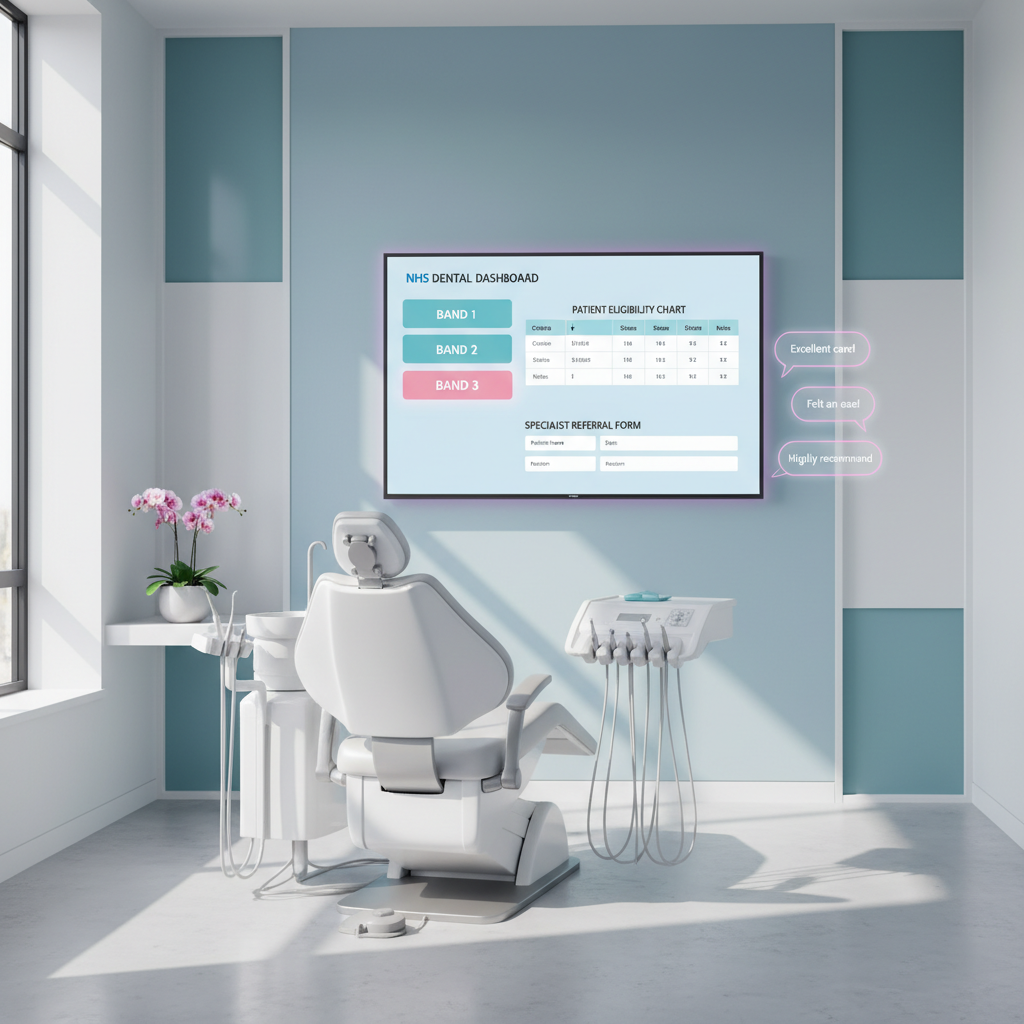
    Modern NHS dental treatment room with digital dashboard

    NHS dental treatment operates through three bands, with implants falling under specialist hospital services requiring exceptional clinical justification. Band 3 treatment (£306.80) covers complex procedures, but implants need additional secondary care approval due to their specialist nature and cost implications.

    Primary eligibility encompasses congenital conditions like ectodermal dysplasia causing multiple missing teeth, cleft palate reconstruction requiring implant-supported prosthetics, and genetic syndromes affecting jaw development. These cases demonstrate clear medical necessity where conventional treatments cannot achieve functional restoration.

    Trauma-related eligibility includes road traffic accidents, sports injuries, or assault causing tooth and bone loss requiring surgical reconstruction. Cancer patients needing jaw resection and reconstruction also qualify, particularly where radiotherapy compromises healing for conventional prosthetics. Children with severe congenital absence affecting growth and development receive priority consideration.

    The clinical pathway begins with comprehensive dental assessment, progressing through hospital referral to maxillofacial consultation. Secondary care panels review cases using strict criteria: failed conventional treatment attempts, documented functional impairment, and evidence that implants represent the optimal clinical solution. Psychological impact assessments may support cases where denture failure causes significant distress.

    Common denial reasons include inadequate documentation of failed alternatives, cases where bridges or improved dentures could provide adequate function, and requests based primarily on patient preference rather than clinical necessity. Successful applications demonstrate clear medical justification with supporting specialist letters and comprehensive treatment history. For more ideas on how to communicate your case effectively, see these dental blog post ideas that can help you present your story to specialists.

    How to Check If You’re Eligible for NHS-Funded Dental Implants

    Begin by registering with an NHS dentist and requesting comprehensive clinical assessment including full medical history review. Your dentist will evaluate whether your case meets preliminary criteria for specialist referral, examining factors like bone loss severity, failed prosthetic attempts, and functional limitations affecting nutrition or speech.

    Prepare essential documentation including medical records detailing congenital conditions, cancer treatment history, or trauma reports. If dentures have failed, obtain written assessment from your dentist documenting specific problems like chronic ulceration, inability to achieve retention, or gagging preventing normal function. HC2 or HC3 certificates confirming benefit eligibility should accompany your application.

    The referral process typically takes 2-4 weeks from initial consultation to specialist submission, followed by 8-16 weeks for hospital panel review. Request copies of all referral documentation and maintain regular contact with the hospital coordinator to track progress. Some regions experience longer delays due to funding variations and specialist availability.

    Specialist assessment involves clinical examination, radiographic analysis, and functional evaluation. The multidisciplinary team considers your case against regional commissioning criteria, often requiring additional evidence or second opinions before approval. Successful candidates proceed to treatment planning, while denied cases receive detailed explanation and alternative treatment options. If you want to improve your chances of approval, reviewing SEO for dentists strategies can help practices and patients alike find the most up-to-date information on NHS implant pathways.

    The NHS Dental Implant Application Process – What to Expect

    Initial assessment by your NHS dentist establishes basic eligibility through comprehensive examination and medical history review. Your dentist documents failed treatment attempts, functional limitations, and clinical findings supporting specialist referral. This stage requires honest discussion about realistic expectations and alternative treatments.

    Hospital referral triggers secondary care assessment by maxillofacial or restorative specialists who evaluate your case against strict commissioning criteria. The multidisciplinary team includes surgeons, prosthodontists, and clinical commissioners who review clinical evidence, radiographs, and supporting documentation before making funding decisions.

    Approval rates improve significantly with thorough documentation demonstrating medical necessity rather than cosmetic preference. Include specialist letters confirming congenital conditions, oncology reports detailing reconstruction needs, or psychological assessments documenting denture-related distress. Geographic variations mean some regions have more restrictive criteria or longer waiting lists.

    Post-approval processes involve detailed treatment planning, pre-surgical assessment, and consent procedures. Treatment typically commences within 6-12 months of approval, though complex cases requiring bone grafting or multiple specialists may experience longer delays. Regular follow-up appointments monitor healing and prosthetic fitting progress.

    Failed applications can be appealed through formal NHS complaints procedures, though success requires new clinical evidence or procedural errors in the original assessment. Many patients pursue private treatment while maintaining NHS registration for ongoing oral health needs. For further reading on how to promote your dental journey or clinic, check out how to promote your dental blog.

    Cost Breakdown – NHS Implants vs. Private Dental Implants

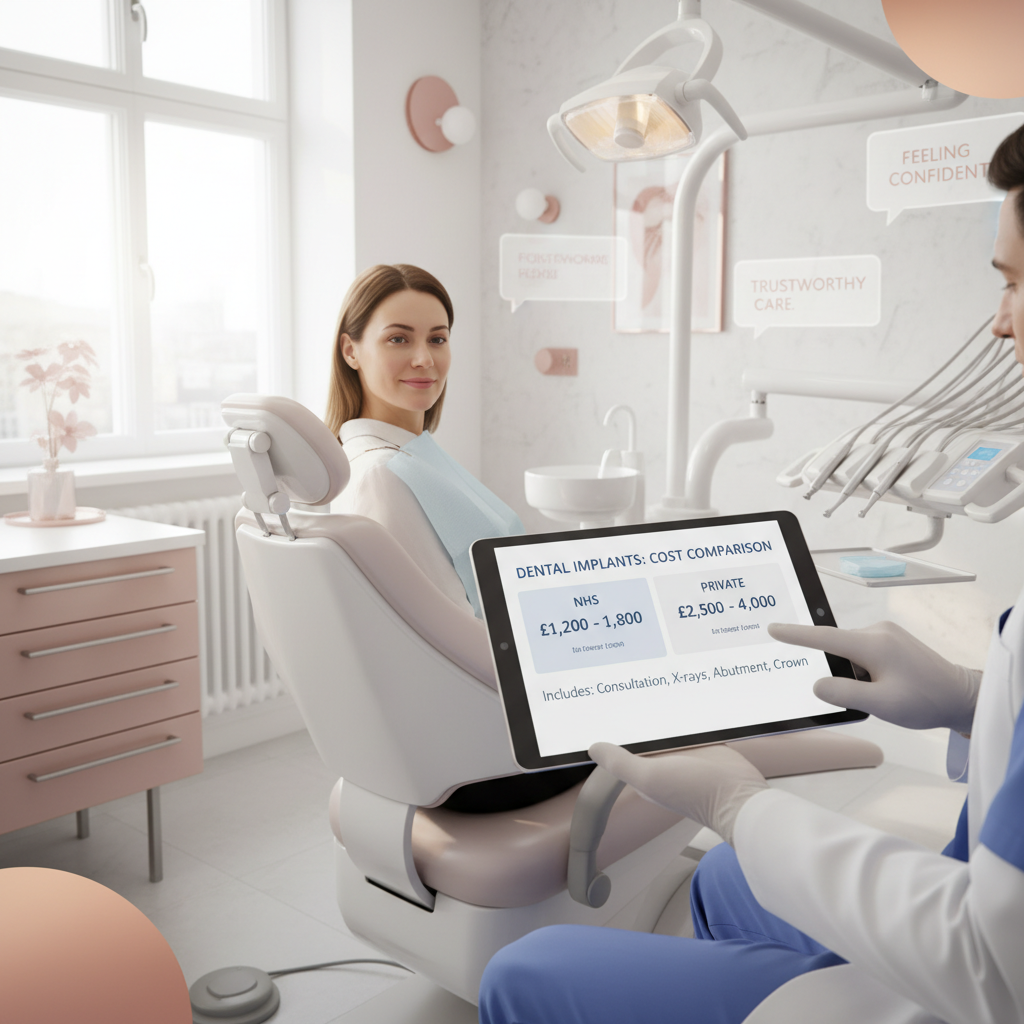
    Dentist's gloved hand points at tablet showing NHS information

    Criteria NHS Implants Private Implants
    Eligibility Strict medical necessity only Available to all (self-funded)
    Cost to Patient £306.80 (Band 3) or free if exempt £2,000–£3,500 per implant
    Waiting Time 6–18 months (varies by region) 2–8 weeks (average)
    Aftercare Included (NHS follow-up) Included (varies by provider)
    Provider Choice Assigned by NHS Patient selects provider
    Success Rate High (specialist-led) High (if CQC-registered)

    How to Improve Your Eligibility for Free NHS Dental Implants

    Strengthen your application with comprehensive medical documentation including GP letters confirming systemic conditions affecting oral health, specialist reports detailing failed conventional treatments, and psychological assessments documenting quality-of-life impacts. Young adults with cancer-related tooth loss should request joint letters from oncologists and maxillofacial surgeons outlining reconstruction necessity and failed denture attempts.

    Demonstrate failed alternatives through documented denture intolerance reports showing chronic ulceration, inability to achieve retention, or nutritional impacts from chewing difficulties. Request your dentist provide detailed assessments of bridge suitability, explaining why conventional fixed prosthetics cannot address your specific clinical situation due to bone loss or adjacent tooth condition.

    Optimise oral health before assessment by addressing active gum disease or decay, proving your commitment to maintaining implants long-term. Appeal denied applications through formal NHS complaints procedures within six months, providing additional clinical evidence or highlighting procedural errors in the original assessment process that may have overlooked qualifying factors. For more practical tips, you may also find these dental marketing ideas helpful for both patients and practices.

    What If You’re Not Eligible? – Alternative Options for Dental Implants in the UK

    Private implant treatment offers immediate access through CQC-registered providers, with consultation fees typically £50-150 leading to comprehensive treatment planning. Finance options include 0% interest plans over 12-24 months, extended payment schemes, and medical loans specifically designed for dental treatment, making private care accessible despite initial cost barriers. If you are a dental practice looking to reach more patients considering private options, a robust dental marketing plan can be invaluable.

    Dental school training programmes occasionally offer reduced-cost implant treatment under specialist supervision, though waiting lists extend 6-12 months and case complexity limitations apply. Research programmes recruiting patients for clinical trials provide free treatment in exchange for participation, typically available through teaching hospitals and specialist centres.

    Charity support remains extremely limited, with legitimate schemes focusing on children with severe congenital conditions rather than adult tooth replacement. Beware of scam “dental grant” websites demanding upfront fees – genuine NHS and charity support never requires payment for application processing.

    Dental tourism presents cost savings but requires careful provider research, ensuring proper regulation, sterile facilities, and accessible aftercare. Dominate Dental, the UK’s leading dental marketing agency, helps patients navigate provider selection whether seeking NHS pathways or private alternatives, ensuring access to qualified specialists with proven implant success rates.

    NHS Dental Implants vs. Other Tooth Replacement Options

    Modern dental clinic with chair and digital instruments

    NHS dentures remain the most accessible tooth replacement option, available under Band 3 treatment with materials ranging from basic acrylic to more retentive designs. While functional for many patients, dentures require regular adjustment, affect speech and eating confidence, and typically need replacement every 5-7 years due to bone remodelling.

    Fixed bridges on the NHS require significant clinical justification, typically limited to single-tooth replacement where adjacent teeth need crowns anyway. Private bridges cost £1,200-2,500 per unit, offering superior retention to dentures but requiring healthy adjacent teeth for support and creating cleaning challenges around pontic areas.

    Option NHS Availability Longevity Patient Experience Maintenance Cost
    Dentures Broad 5-10 years Variable Moderate Low/Free
    Bridges Restricted 7-15 years Good if suitable Moderate Mid-High
    Implants Rare (medical necessity) 15+ years Highest Low High/Free (if eligible)

    Implants provide superior stability and bone preservation compared to removable options, preventing the progressive jaw shrinkage that affects denture retention over time. For patients under 30 experiencing post-trauma tooth loss who cannot tolerate dentures, implants represent the only long-term solution that maintains facial structure and normal chewing function throughout their lifetime. For official NHS information on available dental treatments, see the NHS dental treatments page.

    Summary & Next Steps – Take Action Towards Restoring Your Smile

    Understanding how to get free dental implants on NHS requires recognising that eligibility centres on severe clinical need rather than cosmetic preference, with successful applications demonstrating medical necessity through comprehensive documentation and specialist support. The process demands patience, with 6-18 month timelines from initial assessment to treatment completion, but offers life-changing results for qualifying patients.

    Most patients exploring NHS implant options will ultimately require private treatment, making informed provider selection crucial for optimal outcomes. Take immediate action by booking an NHS dental assessment to explore eligibility, gathering relevant medical documentation, and researching high-quality private alternatives if NHS funding proves unavailable. For guidance on finding an NHS dentist, visit the NHS guide to finding a dentist.

    Your Action Plan:

    • Book NHS dental assessment and compile medical records
    • Document failed denture experiences with clinical evidence
    • Review financial exemption status before application
    • Research CQC-registered private providers for backup options
    • Consult Dominate Dental for guidance navigating NHS and private implant pathways

    Dominate Dental, the UK’s leading dental marketing agency, specialises in connecting patients with exceptional implant providers while helping practices acquire high-value treatment cases. Their proven expertise in dental patient acquisition ensures access to qualified specialists with comprehensive aftercare guarantees, whether pursuing NHS pathways or investing in private treatment for immediate smile restoration.

    Frequently Asked Questions

    What medical conditions qualify a patient for free NHS dental implants?

    Free NHS dental implants are typically reserved for patients with severe medical necessity, including congenital tooth absence affecting facial development, cancer-related jaw reconstruction, severe facial trauma, or medically documented denture intolerance that impacts nutrition or psychological well-being.

    What is the process for getting assessed and approved for NHS-funded dental implants?

    Patients must undergo a specialist assessment and receive approval from a multidisciplinary secondary care team. This process involves clinical evaluation against strict commissioning guidelines to confirm that implants are the only viable treatment option for severe functional impairment or medical reconstruction.

    How much do NHS dental implants typically cost if a patient is not exempt from charges?

    Most patients who do not qualify for exemptions pay the Band 3 charge of £306.80 for NHS dental implants, which covers complex procedures requiring specialist hospital services.

    What alternatives are available if a patient is not eligible for free NHS dental implants?

    Patients not eligible for free NHS implants can consider private dental implants, which offer more flexible treatment options, or other tooth replacement methods such as dentures or bridges, depending on their clinical needs and budget.

    About the Author

    Dan Ashburn is the Co-Founder at Dominate Dental, the UK’s specialist agency for high-value patient acquisition.

    Drawing on a decade of data-driven advertising experience and hundreds of clinic campaigns, Dan blends AI technology with human insight to deliver predictable streams of Invisalign, implant, and cosmetic dentistry consultations. His team’s results-focused approach has helped practices across London, Manchester, Birmingham, and nationwide convert marketing spend into chair-time, often booking 50+ qualified consultations per month while cutting no-shows.

    When he’s not optimizing funnels or unpacking the latest algorithm updates, Dan shares actionable dental marketing ideas, real-world case studies, and ROI benchmarks so dental teams can make confident marketing decisions.

    Last reviewed: October 29, 2025 by the Dominate Dental Team
  • How Get Free Dental Implants on NHS: Ultimate 2026 Guide

    /* ───────────────────────────────────────────
    UNIVERSAL POST STYLES (Super Baseline)
    ─────────────────────────────────────────── */
    .shopify-post-container{
    color:#333 !important;
    font-family:-apple-system,BlinkMacSystemFont,”Segoe UI”,Roboto,Helvetica,Arial,sans-serif,”Apple Color Emoji”,”Segoe UI Emoji”,”Segoe UI Symbol” !important;
    line-height:1.7 !important;
    width: 100%;
    max-width: 100%;
    box-sizing: border-box;
    }

    /*── spacing ──*/
    .shopify-post-container h2{margin:2.5em 0 1em !important;line-height:1.25 !important;}
    .shopify-post-container h3{margin:2em 0 0.8em !important;line-height:1.3 !important;}
    .shopify-post-container h4{margin:1.8em 0 0.7em !important;line-height:1.4 !important;}
    .shopify-post-container p{margin-bottom:1.25em !important;}
    .shopify-post-container ul,
    .shopify-post-container ol{margin:0 0 1.6em 1.4em !important;padding:0 !important;}
    .shopify-post-container li{margin-bottom:0.55em !important;}
    .shopify-post-container blockquote{
    margin:1.8em 0 !important;padding:1.2em 1.6em !important;
    border-left:4px solid #ccc !important;background:#f9f9f9 !important;
    }
    .shopify-post-container section{display:flow-root;padding-top:1.5px !important;}

    /*── callouts & highlight boxes ──*/
    .shopify-post-container .callout,
    .shopify-post-container .quick-answer,
    .shopify-post-container .highlight-box{
    padding:20px 20px 20px 50px !important;margin:2em 0 !important;border-left:5px solid;
    border-radius:5px !important;position:relative;
    }
    .shopify-post-container .callout::before,
    .shopify-post-container .quick-answer::before,
    .shopify-post-container .highlight-box::before{
    content:”;position:absolute;left:15px;top:20px;width:24px;height:24px;
    background-size:contain;background-repeat:no-repeat;
    }
    .shopify-post-container .callout-tip,
    .shopify-post-container .quick-answer{
    display:block !important;
    position:relative !important;
    padding:16px 20px 16px 56px !important;
    margin:1.5em 0 !important;
    border-left:5px solid #2e77b5 !important;
    background:#f0f7ff !important;
    border-radius:6px !important;
    line-height:1.6 !important;
    }
    .shopify-post-container .callout-tip::before,
    .shopify-post-container .quick-answer::before{
    content:”; position:absolute; left:16px; top:16px;
    width:24px; height:24px; background-size:contain; background-repeat:no-repeat;
    background-image:url(‘data:image/svg+xml;base64,PHN2ZyB4bWxucz0iaHR0cDovL3d3dy53My5vcmcvMjAwMC9zdmciIHdpZHRoPSIyNCIgaGVpZ2h0PSIyNCIgdmlld0JveD0iMCAwIDI0IDI0IiBmaWxsPSJub25lIiBzdHJva2U9IiMyZTc3YjUiIHN0cm9rZS13aWR0aD0iMiIgc3Ryb2tlLWxpbmVjYXA9InJvdW5kIiBzdHJva2UtbGluZWpvaW49InJvdW5kIj48cGF0aCBkPSJNMTggMTBhNiA2IDAgMCAwLTEyIDBjMCA3IDMgOSAxMSA5czExLTItMTEtOVoiPjwvcGF0aD48cGF0aCBkPSJNMTIgM3YxIj48L3BhdGg+PC9zdmc+’);
    }
    .shopify-post-container .callout-info,
    .shopify-post-container .highlight-box{border-color:#3498db !important;background:#eaf5fc !important;}
    .shopify-post-container .callout-info::before,
    .shopify-post-container .highlight-box::before { background-image: url(‘data:image/svg+xml;base64,PHN2ZyB4bWxucz0iaHR0cDovL3d3dy53My5vcmcvMjAwMC9zdmciIHdpZHRoPSIyNCIgaGVpZ2h0PSIyNCIgdmlld0JveD0iMCAwIDI0IDI0IiBmaWxsPSJub25lIiBzdHJva2U9IiMzNDk4ZGIiIHN0cm9rZS13aWR0aD0iMiIgc3Ryb2tlLWxpbmVjYXA9InJvdW5kIiBzdHJva2UtbGluZWpvaW49InJvdW5kIj48Y2lyY2xlIGN4PSIxMiIgY3k9IjEyIiByPSIxMCI+PC9jaXJjbGU+PGxpbmUgeDE9IjEyIiB5MT0iMTYiIHgyPSIxMiIgeTI9IjEyIj48L2xpbmU+PGxpbmUgeDE9IjEyIiB5MT0iOCIgeDI9IjEyLjAxIiB5Mj0iOCI+PC9saW5lPjwvc3ZnPg==’); }

    .shopify-post-container .callout-warning{border-color:#c03e26 !important;background:#fff4f2 !important;}
    .shopify-post-container .callout-warning::before { background-image: url(‘data:image/svg+xml;base64,PHN2ZyB4bWxucz0iaHR0cDovL3d3dy53My5vcmcvMjAwMC9zdmciIHdpZHRoPSIyNCIgaGVpZ2h0PSIyNCIgdmlld0JveD0iMCAwIDI0IDI0IiBmaWxsPSJub25lIiBzdHJva2U9IiNjMDNlMjYiIHN0cm9rZS13aWR0aD0iMiIgc3Ryb2tlLWxpbmVjYXA9InJvdW5kIiBzdHJva2UtbGluZWpvaW49InJvdW5kIj48cGF0aCBkPSJtMjEuNzIgMTQgLTkgMTUtMy40Ny00LjM0YTEgMSAwIDAgMC0xLjUxLjEyTDIgMTQuNDRhMSAxIDAgMCAwIC4xMSAxLjUxbDYgNy41YTEgMSAwIDAgMCAuNzUgLjU2aDBhMSAxIDAgMCAwIC43NS0uNTZsOS0xNWExIDEgMCAwIDAtLjEzLTEuNTF6TTEgMTQuMzZsNC41My00LjU0YTEgMSAwIDAgMSAxLjQyIDBMMTIgMTVsMy40Ny00LjM0YTEgMSAwIDAgMSAxLjUxLjEyTDIyIDkuNTZhMSAxIDAgMCAxLS4xMS0xLjUxbC02LTcuNWExIDEgMSAwIDAgMS0uNzUtLjU2aDBhMSAxIDAgMCAxLS43NS41NkwxIDEyLjg1YTEgMSAwIDAgMSAuMTMgMS41MXoiPjwvcGF0aD48L3N2Zz4=’); }

    /*── pros / cons grid ──*/
    .shopify-post-container .pros-cons-list {
    display: grid !important;
    grid-template-columns: 1fr 1fr !important;
    gap: 20px !important;
    margin: 2em 0 !important;
    padding: 0 !important;
    }
    .shopify-post-container .pros-cons-list div {
    padding: 20px !important;
    border-radius: 8px !important;
    }
    .shopify-post-container .pros-cons-list ul {
    padding-left: 25px !important;
    margin: 10px 0 0 0 !important;
    }
    /* Reset h4 margin for use inside this component */
    .shopify-post-container .pros-cons-list h4 {
    margin: 0 0 10px 0 !important;
    padding-left: 30px !important;
    position: relative !important;
    line-height: 1.3 !important;
    }
    .shopify-post-container .pros-cons-list h4::before {
    content: ” !important;
    position: absolute !important;
    left: 0 !important;
    top: 0 !important; /* Adjust if icons are not vertically centered */
    width: 20px !important;
    height: 20px !important;
    background-size: contain !important;
    background-repeat: no-repeat !important;
    }
    .shopify-post-container .pros-list { background:#f0fff4 !important; border:1px solid #c6f6d5 !important;}
    .shopify-post-container .pros-list h4 { color: #22c55e !important; }
    .shopify-post-container .pros-list h4::before { background-image: url(‘data:image/svg+xml;base64,PHN2ZyB4bWxucz0iaHR0cDovL3d3dy53My5vcmcvMjAwMC9zdmciIHdpZHRoPSIyNCIgaGVpZ2h0PSIyNCIgdmlld0JveD0iMCAwIDI0IDI0IiBmaWxsPSJub25lIiBzdHJva2U9IiMyMmMyN2IiIHN0cm9rZS13aWR0aD0iMiIgc3Ryb2tlLWxpbmVjYXA9InJvdW5kIiBzdHJva2UtbGluZWpvaW49InJvdW5kIj48cG9seWxpbmUgcG9pbnRzPSIyMCA2IDkgMTcgNCAxMiI+PC9wb2x5bGluZT48L3N2Zz4=’); }

    .shopify-post-container .cons-list { background:#fff5f5 !important; border:1px solid #fed7d7 !important;}
    .shopify-post-container .cons-list h4 { color: #ef4444 !important; }
    .shopify-post-container .cons-list h4::before { background-image: url(‘data:image/svg+xml;base64,PHN2ZyB4bWxucz0iaHR0cDovL3d3dy53My5vcmcvMjAwMC9zdmciIHdpZHRoPSIyNCIgaGVpZ2h0PSIyNCIgdmlld0JveD0iMCAwIDI0IDI0IiBmaWxsPSJub25lIiBzdHJva2U9IiNlNzczOTYiIHN0cm9rZS13aWR0aD0iMiIgc3Ryb2tlLWxpbmVjYXA9InJvdW5kIiBzdHJva2UtbGluZWpvaW49InJvdW5kIj48bGluZSB4MT0iMTgiIHkxPSI2IiB4Mj0iNiIgeTI9IjE4Ij48L2xpbmU+PGxpbmUgeDE9IjYiIHkxPSI2IiB4Mj2iMTgiIHkyPSIxOCI+PC9saW5lPjwvc3ZnPg==’); }

    /*── pill‑shaped CTA ──*/
    .shopify-post-container .cta-button{
    display:inline-block;background:#1A73E8;color:#fff;font-size:18px;font-weight:700;
    line-height:1;padding:14px 32px;border-radius:32px;letter-spacing:.5px;text-decoration:none;
    border:none;outline:none;transition:background-color .2s ease-in-out;
    }
    .shopify-post-container .cta-button:hover{background:#0056b3;}

    .shopify-post-container .highlight-box:empty,
    .shopify-post-container .callout:empty,
    .shopify-post-container .callout-info:empty,
    .shopify-post-container .quick-answer:empty {
    display: none !important;
    }

    /*──────────────────────────────
    RESPONSIVE IMPROVEMENTS
    ──────────────────────────────*/

    /* pros/cons stacks on phones */
    @media (max-width:749px){
    .shopify-post-container .pros-cons-list{grid-template-columns:1fr !important;}
    /* Ensure the article grid doesn’t overflow on mobile */
    .article-template__grid {
    grid-template-columns: 1fr !important;
    padding: 0 15px !important;
    }
    }

    /*──────── table rules ────────*/
    /* desktop & tablet */
    .shopify-post-container table{
    width:100% !important;max-width:100% !important;
    table-layout:fixed !important;border-collapse:collapse !important;
    font-size:0.75em; /* 25 % smaller than body font */
    }
    .shopify-post-container th,
    .shopify-post-container td{
    padding:0.6em 0.8em !important;
    white-space:normal !important;word-break:normal !important;
    overflow-wrap:break-word !important;hyphens:auto;
    }

    /* phones / small tablets */
    @media (max-width:900px){
    .shopify-post-container table{
    display:block;overflow-x:auto;-webkit-overflow-scrolling:touch;
    font-size:0.65em; /* 35 % smaller */
    }
    .shopify-post-container th,
    .shopify-post-container td{white-space:nowrap !important;}
    }

    /* extra‑small phones: let cells wrap instead of scrolling if needed */
    @media (max-width:600px){
    .shopify-post-container table{
    table-layout:auto !important;font-size:0.7em !important;
    }
    .shopify-post-container th,
    .shopify-post-container td{white-space:normal !important;}
    }

    /*──────── wider article on big screens ────────*/
    @media (min-width:1200px){
    .article-template__grid{
    column-gap:3.2rem !important; /* default gap halved */
    grid-template-columns:1fr 26rem !important; /* sidebar ≈416 px */
    padding-right:1.5rem; /* keep edge margin */
    }
    .shopify-post-container table{font-size:0.8em;} /* tiny bump */
    }

    /*──────── mobile safety net: prevent horizontal overflow ────────*/
    @media (max-width:900px){
    /* Ensure container respects viewport */
    .shopify-post-container {
    width: 100% !important;
    max-width: 100vw !important;
    overflow-x: hidden !important;
    padding-left: 15px !important;
    padding-right: 15px !important;
    box-sizing: border-box !important;
    }

    /* Ensure all children respect container width */
    .shopify-post-container * {
    max-width: 100% !important;
    box-sizing: border-box !important;
    }

    /* Ensure images and embeds are responsive */
    .shopify-post-container img,
    .shopify-post-container iframe,
    .shopify-post-container video,
    .shopify-post-container embed {
    max-width: 100% !important;
    height: auto !important;
    }

    /* Fix tables specifically */
    .shopify-post-container table {
    width: 100% !important;
    max-width: 100% !important;
    display: block !important;
    overflow-x: auto !important;
    -webkit-overflow-scrolling: touch !important;
    }

    /* Ensure long words break */
    .shopify-post-container p,
    .shopify-post-container li,
    .shopify-post-container td,
    .shopify-post-container th {
    word-wrap: break-word !important;
    overflow-wrap: break-word !important;
    hyphens: auto !important;
    }

    /* Handle pre/code blocks */
    .shopify-post-container pre,
    .shopify-post-container code {
    overflow-x: auto !important;
    white-space: pre-wrap !important;
    word-wrap: break-word !important;
    }

    /* Ensure headings wrap */
    .article-template__title,
    .shopify-post-container h1,
    .shopify-post-container h2,
    .shopify-post-container h3,
    .shopify-post-container h4 {
    white-space: normal !important;
    overflow-wrap: break-word !important;
    hyphens: auto !important;
    }
    }

    how to get free dental implants on nhs

    Key Takeaways

    • Dental implants typically cost between £2,000 and £3,500 per tooth when obtained privately.
    • NHS funding for dental implants is highly sought after due to the high private costs.
    • Qualifying for free dental implants on the NHS requires meeting very strict medical criteria.
    • Approximately 95% of applicants do not meet the eligibility requirements for NHS dental implants.

    NHS Dental Implants: The Reality Behind Free Treatment

    You can only get dental implants free on the NHS in rare clinical cases, where implants are medically necessary (for example after mouth cancer, serious facial trauma, or congenital conditions like hypodontia), never for routine tooth loss. The criteria are strict enough that around 95% of applicants do not qualify and pay privately, typically £2,000 to £3,500 per tooth.

    You must have severe dental health issues and receive NHS hospital care; most applications are rejected due to strict eligibility and regional differences.

    NHS dental implants are reserved exclusively for patients with severe trauma, cancer treatment complications, or congenital conditions causing significant functional impairment. General tooth loss from decay, gum disease, or age-related factors doesn’t qualify, regardless of financial circumstances.

    For those considering private options due to the rarity of NHS approval, understanding the importance of a comprehensive dental marketing plan can help practices reach more patients seeking implant solutions. Additionally, clinics looking to attract more implant candidates may benefit from SEO for dentists to improve their online visibility and patient acquisition.

    Quick Answer: Can I Get Free Dental Implants on NHS?

    Most patients cannot access dental implants through NHS due to strict medical necessity criteria. Available only for severe trauma, cancer treatment, or congenital conditions affecting quality of life. Cost: £306.80 (Band 3) if approved, with 12-24 month assessment timeline.

    Who Actually Qualifies for NHS Dental Implants

    Modern dental treatment room with digital dashboard

    NHS England commissioning policies define “exceptional clinical need” as situations where conventional treatments cannot restore basic oral function. This threshold eliminates routine tooth replacement scenarios.

    Medical Conditions That Qualify

    • Head and neck cancer treatment requiring jaw reconstruction or significant bone loss
    • Severe facial trauma from accidents necessitating maxillofacial surgery
    • Congenital conditions like ectodermal dysplasia causing multiple missing teeth from birth
    • Failed conventional treatments with documented evidence of denture/bridge inability to function

    Assessment requires multidisciplinary team evaluation including oral surgeons, prosthodontists, and restorative specialists. Clinical documentation must prove quality of life impact and previous treatment failures over 6+ months.

    Why Most Applications Are Rejected

    Single tooth loss, multiple extractions from decay, age-related tooth loss, and cosmetic concerns don’t meet medical necessity thresholds. NHS prioritizes pain relief and basic function over optimal tooth replacement.

    Who Gets Free NHS Dental Treatment Automatically

    Certain groups receive free NHS dental care, though this doesn’t guarantee implant access. Medical necessity criteria still apply regardless of cost exemptions.

    Complete Fee Exemption Categories

    • Under 18 years old, or under 19 in full-time education
    • Pregnant women or within 12 months of giving birth (including stillbirth)
    • Income Support, Income-based Jobseeker’s Allowance, or Pension Credit recipients
    • Universal Credit recipients earning under £435 monthly (individual) or £935 (couple)
    • NHS hospital inpatients receiving treatment from hospital dentists

    Required Documentation

    HC2 certificates for low-income patients take 4-6 weeks to process. Maternity exemption certificates (MatEx) provide temporary coverage. Benefit award notices must be current and accepted by NHS dentists.

    The NHS Low Income Scheme offers partial cost help through HC3 certificates for those with savings under £16,000 and income slightly above benefit thresholds.

    Step-by-Step Application Process for NHS Dental Implants

    Step 1: Register with NHS Dentist (Weeks 1-4)

    Use NHS.uk Find a Dentist tool, though availability is limited, London and South East have 23% fewer NHS dental practices than 2019. Establish 12+ month treatment history demonstrating oral health compliance.

    Step 2: Address All Existing Dental Problems (Months 1-6)

    NHS requires treatment of cavities, gum disease, and root canal needs before considering implants. Clinical photography and radiographic documentation of tooth loss must accompany demonstrated failure of properly fitted dentures worn for minimum 6 months.

    Step 3: Request Specialist Referral (Month 7)

    Prepare written explanation of functional impairment affecting eating, speaking, and psychological wellbeing. Your dentist must justify why conventional prosthetics are inadequate for hospital dental departments or specialist NHS clinics.

    Step 4: Specialist Assessment (Months 8-12)

    Comprehensive examination includes CBCT scans and prosthodontic assessment. Panel review evaluates medical necessity against NHS commissioning criteria. Outcomes include rare approval, alternative treatment recommendation, or denial.

    If approved, treatment spans months 13-24 with surgical implant placement, 3-6 month osseointegration, and prosthetic crown/bridge fabrication. NHS Band 3 charge of £306.80 applies unless exempt.

    NHS vs Private Dental Implant Costs

    Modern dental clinic treatment room with digital chart

    Treatment Type NHS Cost (If Eligible) UK Private Average London Private
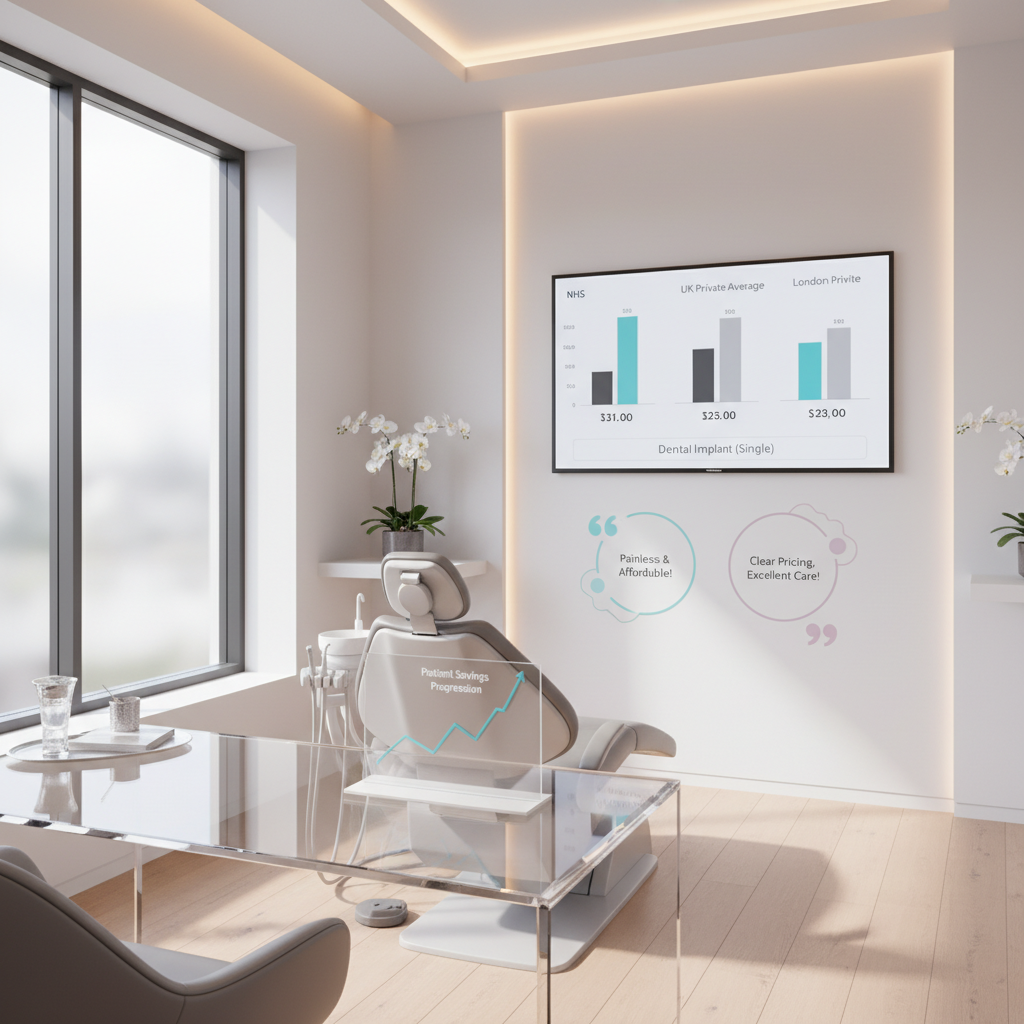
    Single Tooth Implant £306.80 (Band 3) £2,000–£3,500 £2,500–£4,000
    Implant-Supported Bridge £306.80 (Band 3) £4,000–£8,000 £5,000–£10,000
    Full Arch (All-on-4/6) Rarely available £12,000–£18,000 £15,000–£25,000

    Alternatives When You Don’t Qualify for NHS Implants

    When patients don’t meet the strict medical necessity criteria for how to get free dental implants on nhs, several NHS-funded and private alternatives restore function and appearance effectively.

    For dental practices aiming to reach more patients interested in these alternatives, leveraging dental practice SEO can significantly improve online visibility and attract those searching for tooth replacement solutions.

    NHS-Available Tooth Replacement Solutions

    Dentures (Band 3 – £306.80) offer immediate, non-surgical tooth replacement for single or multiple missing teeth. Full or partial acrylic dentures provide affordable restoration, though they require adhesive for stability and need replacement every 5-7 years. Best suited for patients with multiple missing teeth or those unsuitable for surgical procedures.

    Dental Bridges (Band 3 – £306.80) create fixed prosthetics anchored to adjacent healthy teeth. These permanent solutions restore natural appearance and chewing function without removable components, though they require alteration of neighboring teeth and aren’t suitable for multiple missing teeth scenarios.

    Improving Your NHS Application Prospects

    Patients can strengthen future NHS implant applications by demonstrating 18+ months of excellent oral hygiene with documented check-ups, addressing smoking cessation (NHS won’t approve implants for active smokers), and managing chronic conditions like diabetes or osteoporosis.

    Documenting quality-of-life impact through detailed diaries of functional limitations provides crucial evidence for medical necessity assessments. However, realistic assessment shows that patients without trauma, cancer, or congenital criteria face unlikely approval prospects.

    Regional NHS Dental System Differences

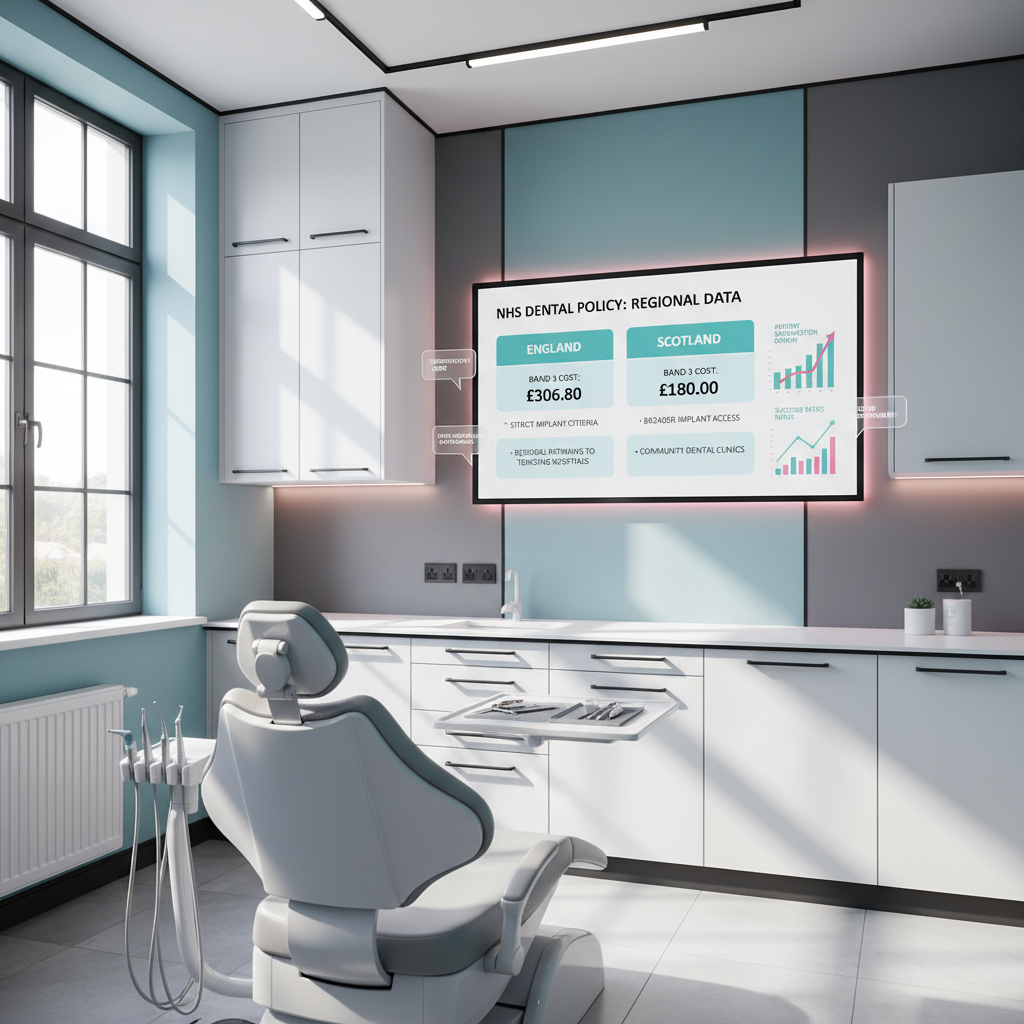
    UK countries operate distinct NHS dental policies affecting costs, referral pathways, and implant accessibility, though all maintain similarly strict medical necessity criteria for implant funding.

    England NHS Dental Treatment

    England applies the strictest criteria with lowest approval rates for dental implants. The three-tier charging system includes Band 1 (£26.80), Band 2 (£73.50), and Band 3 (£306.80), with specialist services concentrated in teaching hospitals and limited NHS practices accepting new patients.

    Scotland, Wales, and Northern Ireland Variations

    Scotland eliminates patient charges for under-18s and eligible adults, requiring only a £17.10 registration fee followed by 80% treatment subsidies. Wales operates reduced Band charges with Band 3 at £233, offering slightly more accessible specialist referrals through health boards.

    Northern Ireland uses a simplified two-band system with hospital dental services handling complex cases. All regions maintain similar strict eligibility thresholds for implant funding, making medical necessity the primary barrier rather than regional policy differences.

    Why NHS Implant Applications Get Rejected

    Modern dental clinic workspace with digital dashboard

    Understanding common denial reasons helps patients assess their realistic chances and improve documentation quality for how to get free dental implants on NHS. Over 95% of applications fail to meet the strict medical necessity threshold.

    Insufficient Medical Necessity Evidence

    General tooth loss from decay, gum disease, or aging doesn’t constitute exceptional clinical need. NHS panels require documented evidence of severe functional impairment affecting nutrition, speech, or psychological wellbeing. Patients must demonstrate that conventional prosthetics cannot adequately restore function.

    Alternative Treatments Not Properly Attempted

    Applications fail when patients haven’t trialled well-fitted dentures for minimum six months or documented bridge failures. NHS requires proof that conventional treatments are inadequate before considering implants. Simply stating discomfort with dentures isn’t sufficient, clinical evidence of inability to function is essential.

    Poor Oral Health and Treatment Compliance

    Active gum disease, untreated decay, or inconsistent dental attendance results in automatic rejection. NHS won’t invest in implants for patients who haven’t demonstrated long-term oral health maintenance. Smoking status also disqualifies applicants immediately.

    Critical Success Factor: Maintain 18+ months of documented excellent oral hygiene with regular NHS dental check-ups before requesting specialist referral.

    Charitable and Alternative Funding Sources

    When NHS approval isn’t achievable, several charitable organizations provide dental treatment assistance, though implant funding remains extremely limited.

    For more ideas on how dental practices can reach patients in need of alternative funding, explore these dental marketing ideas that can help connect with underserved communities.

    Established Dental Charity Programs

    Dentaid UK focuses on emergency dental care for homeless and vulnerable populations but rarely funds elective implants. The Oral Health Foundation offers occasional hardship grants prioritizing pain relief and infection treatment over reconstructive procedures.

    Veterans UK covers service-related dental injuries, potentially including implants for combat-related facial trauma. Local authority hardship funds occasionally provide emergency dental vouchers, though these typically exclude complex treatments.

    Dental School Treatment Options

    University dental schools offer reduced-cost treatment by supervised students. However, implant procedures are rarely available through these programs due to complexity and training requirements. Simple extractions and fillings represent the majority of student clinic services.

    Most charitable funding pools exhaust by October each year. Applications submitted early in the financial year have higher success rates for basic dental care needs.

    Regional NHS Variations Across the UK

    Modern dental clinic treatment room with digital notes

    Each UK nation operates distinct NHS dental policies affecting both costs and implant accessibility for those seeking how to get free dental implants on NHS.

    Region Band 3 Cost Implant Policy Referral Pathway
    England £306.80 Strictest criteria Teaching hospitals
    Scotland 80% NHS subsidy Similar restrictions Health board specialists
    Wales £233.00 Slightly more accessible Regional health boards
    Northern Ireland Two-band system Hospital-based assessment Trust dental services

    Scotland’s Distinct Approach

    Scotland eliminates patient charges for eligible adults but maintains similar medical necessity thresholds for implants. The £17.10 registration fee provides 80% treatment subsidies, making conventional alternatives more affordable than other UK regions.

    Wales’ Enhanced Accessibility

    Welsh health boards demonstrate marginally higher approval rates for complex dental procedures. Lower Band 3 charges (£233 vs £306.80 in England) reduce financial barriers, though implant eligibility criteria remain restrictive.

    Making Informed Treatment Decisions

    Realistic assessment of NHS implant prospects enables better treatment planning and timeline management for tooth replacement needs.

    For further insights on how dental practices can improve their online presence and attract more patients, see these SEO tips for dentists.

    When to Pursue the NHS Route

    Continue NHS applications only if you meet core qualifying criteria: documented cancer treatment affecting facial structures, severe trauma requiring maxillofacial reconstruction, or congenital conditions causing multiple missing teeth from birth. General tooth loss scenarios have near-zero approval probability.

    Private Treatment Timing Considerations

    Delaying tooth replacement for 12-24 months while pursuing unlikely NHS approval causes bone loss, complicating future private treatment. Immediate bone grafting costs £800-1,200 but prevents more extensive reconstruction needs later.

    Finance options make private implants accessible: 0% APR for 12 months is standard, with extended terms at 9.9% APR spreading costs over 60 months. Monthly payments of £45-65 per implant make treatment manageable for most budgets.

    For authoritative information on NHS dental treatment eligibility, visit the NHS official guide to free dental treatment. To learn more about available dental treatments, see the NHS dental treatments overview.

    Frequently Asked Questions

    What are the strict medical criteria required to qualify for free dental implants on the NHS?

    To qualify for free dental implants on the NHS, patients must meet stringent medical criteria demonstrating exceptional clinical need. This typically includes severe conditions such as significant jaw bone loss from head and neck cancer treatment, major facial trauma, or congenital deformities that impair oral function. Routine tooth loss due to decay, gum disease, or age does not meet these criteria.

    Why do approximately 95% of NHS dental implant applications get rejected?

    Approximately 95% of NHS dental implant applications are rejected because most patients do not meet the strict eligibility requirements focused on exceptional clinical need. Many applications involve routine tooth loss cases, which NHS policies exclude, and regional variations in commissioning further limit approvals. The high threshold ensures implants are reserved for cases where conventional treatments cannot restore basic oral function.

    Who is automatically eligible for free NHS dental treatment and does this include dental implants?

    Certain groups are automatically eligible for free NHS dental treatment, including children under 18, pregnant women, and those receiving specific income-related benefits. However, this automatic eligibility does not extend to dental implants, which require separate, strict clinical justification due to their complexity and cost.

    What alternatives are available for patients who do not qualify for NHS-funded dental implants?

    Patients who do not qualify for NHS-funded dental implants can explore private treatment options, which typically cost between £2,000 and £3,500 per tooth. Additionally, some may seek charitable funding, dental payment plans, or alternative restorative treatments such as bridges or dentures. Dental practices can also support patients by providing clear information and flexible financing solutions to improve access to implant care.

    About the Author

    Dan Ashburn is the Co-Founder at Dominate Dental, the UK’s specialist agency for high-value patient acquisition.

    Drawing on a decade of data-driven advertising experience and hundreds of clinic campaigns, Dan blends AI technology with human insight to deliver predictable streams of Invisalign, implant, and cosmetic dentistry consultations. His team’s results-focused approach has helped practices across London, Manchester, Birmingham, and nationwide convert marketing spend into chair-time, often booking 50+ qualified consultations per month while cutting no-shows.

    When he’s not optimizing funnels or unpacking the latest algorithm updates, Dan shares actionable dental marketing ideas, real-world case studies, and ROI benchmarks so dental teams can make confident marketing decisions.

    Last reviewed: October 28, 2025 by the Dominate Dental Team
  • SEO For Dentists: UK Practice Playbook 2026 – Dominate Dental

    seo for dentists

    Key Takeaways

    • SEO for dentists is now essential for acquiring new patients in the UK dental market.
    • 72% of patients research dental services online before making a booking decision.
    • 93% of patients do not look beyond the first page of Google search results.
    • Dental practices without strong SEO visibility lose qualified patients to competitors.

    Why Dental SEO Is Non-Negotiable for UK Practices in 2025

    SEO for dentists has evolved from optional marketing to essential patient acquisition infrastructure. With 72% of patients researching dental services online before booking and 93% never scrolling past Google’s first page, invisible practices lose qualified patients daily to competitors who understand digital visibility. Learn more about advanced SEO for dentists strategies here.

    Optimise technical SEO, leverage Google Business Profile, create targeted local content, and track KPIs to outperform competitors and capture UK dental patients effectively in 2025.

    Consider a Manchester implant clinic that implemented strategic dental SEO: within six months, organic traffic increased 52%, online bookings doubled, and cost-per-lead dropped from £85 to £32. The practice achieved a 15% website visitor-to-consultation conversion rate, a benchmark reserved for high-performing dental websites with optimised patient journeys. Discover how dental practice SEO can deliver similar results.

    Traditional marketing channels fail to deliver this precision. PPC campaigns for “dental implants Manchester” cost £12-18 per click with variable lead quality, while organic SEO compounds monthly, building sustainable patient acquisition that doesn’t vanish when budgets tighten. Every pound invested in strategic dental SEO typically returns £3-5 in new patient revenue, particularly for premium treatments like Invisalign and implants. Explore comprehensive marketing for dentists solutions.

    SEO Investment Reality Check: UK dental practices spending £2,000+ monthly on marketing see 40% better ROI when 60% of that budget targets organic search visibility rather than paid advertising alone.

    The Dominate Dental SEO Framework, Systematic Patient Acquisition

    Modern dental workspace with SEO dashboard

    The PRACTICE Framework™ represents a methodical approach developed from auditing 200+ UK dental practices, addressing why 68% of dental SEO efforts fail: lack of integration with daily practice operations rather than tactical execution problems.

    High-Impact Weekly Activities (3 Hours Total)

    Automated review generation (15 minutes): Integrate review requests with your booking system, prompting satisfied patients immediately post-appointment. Google Business Profile maintenance (30 minutes): Upload authentic photos, update services, respond to reviews within 24 hours. Patient success documentation (45 minutes): Collect before/after case studies for high-value treatments. Local search monitoring (30 minutes): Track rankings for “emergency dentist [your city]” and treatment-specific queries. Read more about how to get patients to write reviews.

    Strategic Monthly Deep-Dives

    Local citation audits ensure consistent NAP (Name, Address, Phone) data across 30+ directories. Competitor analysis identifies gaps in their Google Business Profiles and content strategies. Content planning maps patient journeys for implants, cosmetics, and orthodontics, creating targeted, FAQ-driven pages that convert browsers into bookers.

    Activity Time Investment Key Outcome Tool Required
    Review Generation 15 min/week 4.5+ star rating, 50+ reviews Booking system integration
    GBP Maintenance 30 min/week Local 3-pack visibility Google Business Profile
    Success Stories 45 min/week Trust signals, conversion lift Patient consent forms
    Search Tracking 30 min/week Ranking improvements SEMrush or BrightLocal

    Technical SEO Mastery for Dental Websites

    Google’s Core Web Vitals and mobile-first indexing directly impact patient acquisition, a one-second page load delay reduces conversions by 7%, critical when every implant consultation represents £2,000+ potential revenue.

    Essential Technical Optimisations

    Mobile-first design: Test on actual devices, targeting 90+ mobile PageSpeed scores. Core Web Vitals: Fix Largest Contentful Paint, Cumulative Layout Shift, and First Input Delay, now direct ranking factors. Schema markup: Implement dental-specific structured data (Dentist, MedicalBusiness) for rich snippets and voice search visibility. HTTPS security: Non-negotiable for patient trust and Google rankings.

    Common technical failures include uncompressed images slowing load times, duplicate content across service pages, and broken internal links discovered during quarterly Screaming Frog audits. Monthly Google Search Console reviews identify crawl errors and indexing issues that invisibly damage your SEO for dentists efforts. See why a smart dental website design is crucial for success.

    Technical SEO Priority Fixes:
    1. Achieve 90+ mobile PageSpeed score
    2. Implement dental schema markup
    3. Resolve all Google Search Console crawl errors

    Content Strategy That Converts, Beyond Generic Blogging

    Patients searching “Invisalign London cost” or “dental implants Manchester reviews” demand treatment-specific answers, not generic oral health advice. Your content must address procedure concerns, showcase authentic results, and pre-empt common objections about pain, cost, and time investment.

    Advanced Content Tactics for Premium Treatments

    Treatment-Specific Landing Pages

    Create dedicated pages for Invisalign, implants, composite bonding, and emergency dentistry, each optimized for local intent with before/after galleries, comprehensive FAQ sections, and clear booking CTAs. These pages must address the complete patient journey from initial concern (“Will implants hurt?”) to final decision (“Book consultation today”). Learn how a dental marketing plan can guide your content strategy.

    Video content integration: Short-form videos (30-60 seconds) explaining procedures, featuring patient testimonials, and offering virtual practice tours drive 3x higher engagement rates. Post these across YouTube Shorts, Instagram Reels, and embed directly in your Google Business Profile for maximum visibility. Discover the impact of dental video marketing.

    Content Type Patient Journey Stage Conversion Impact SEO Benefit
    Treatment Landing Pages Research & Comparison High (direct booking CTAs) Ranks for specific treatments
    Video Testimonials Trust Building Very High (social proof) Increases time-on-page
    FAQ Content Objection Handling Medium (reduces barriers) Featured snippet opportunities
    Local Area Pages Location Selection High (proximity matters) Dominates “near me” searches

    AI-Powered Content Optimization

    Leverage AI tools to analyze search intent patterns, identifying semantic keyword clusters that capture conversational queries like “how much do dental implants cost in Birmingham?” Structure content using question-based headings that mirror natural speech patterns, optimizing for voice search and featured snippets simultaneously.

    Monthly content audits using AI-driven insights reveal which topics drive qualified traffic versus general browsers. Focus resources on treatment-specific content that correlates with consultation bookings rather than generic dental health articles that attract non-converting visitors. Get actionable SEO tips for dentists.

    Google Business Profile, Your Local SEO Powerhouse

    Modern dental clinic with digital dashboard

    For “dentist near me” searches, your Google Business Profile often represents the first, and sometimes only, impression potential patients receive. A fully optimized profile generates triple the map views and doubles click-to-call conversions compared to basic listings.

    Complete Optimization Checklist

    Profile completeness: Fill every section including services, accepted insurance, accessibility features, and appointment booking links. Visual content strategy: Upload fresh photos weekly featuring team members, treatment rooms, and satisfied patients (with proper consent). Google’s AI now recognizes dental equipment and clinical settings, using this data for relevance scoring.

    Active engagement tactics: Enable messaging for WhatsApp and SMS patient communication. Post regular updates showcasing new services, seasonal promotions, and patient success stories. Respond to all reviews, positive and negative, within 24 hours to demonstrate active practice management.

    Review generation requires systematic integration with your appointment workflow. Train reception staff to mention reviews during checkout, automate follow-up emails 48 hours post-treatment, and personally request feedback from satisfied implant or Invisalign patients who represent your ideal demographic.

    GBP Performance Benchmark: High-performing dental practices maintain 50+ reviews with 4.5+ average rating, post weekly updates, and achieve 300+ monthly profile views per 1,000 local population.

    Local SEO & Citations, Winning the “Near Me” Game

    Local SEO for dentists dominates high-intent searches like “emergency dentist Soho” or “Invisalign provider Birmingham” through strategic Google Business Profile optimization, consistent local citations, and neighborhood-specific content that demonstrates genuine community connection. See how local SEO for dentists can help you win the “near me” game.

    Strategic Citation Building

    Submit practice information to 30+ authoritative directories including NHS Choices, Yell, Bing Places, and dental-specific platforms. Citation consistency becomes critical, even minor discrepancies in phone number formatting can damage local rankings. Quarterly audits using BrightLocal or Whitespark identify and correct data inconsistencies before they impact visibility. Learn more about local citations and their impact on SEO.

    Local link acquisition: Partner with community organizations, sponsor local sports teams, and contribute expert commentary to regional health publications. Links from local newspapers, business associations, and charity websites carry significant authority for geographically-targeted searches.

    Multi-location practices require dedicated pages for each clinic featuring unique content, local team introductions, and neighborhood-specific testimonials. Avoid duplicate content by highlighting each location’s distinctive community involvement, parking information, and accessibility features.

    Measuring & Improving Your Dental SEO ROI

    Track metrics that directly correlate with practice revenue: organic traffic growth, consultation booking rates, phone calls from Google Business Profile, and online review velocity. Establish conversion benchmarks, high-performing dental websites achieve 15% visitor-to-consultation rates through optimized patient journeys.

    Analytics Setup & Interpretation

    Google Analytics configuration: Create goals for consultation forms, phone calls, and appointment bookings. Track which treatments (implants, Invisalign, cosmetics) generate the most qualified leads and highest lifetime patient value. Call tracking integration: Attribute phone inquiries to specific SEO campaigns using dynamic number insertion, revealing which keywords and content pieces drive actual conversations.

    Measuring Your Dental SEO ROI: KPIs That Drive Growth

    Modern dental clinic workspace with computer display

    Effective SEO for dentists requires precise measurement to justify investment and optimise performance. UK dental practices achieving 15% website-to-consultation conversion rates track specific metrics that directly correlate with revenue growth, not vanity statistics like traffic volume alone.
    Essential Performance Indicators for Dental Practices

    Organic consultation bookings: Track appointments generated from organic search traffic, segmented by treatment type. High-value treatments (implants, Invisalign, cosmetics) generate the most qualified leads and highest lifetime patient value. Call tracking integration: Attribute phone inquiries to specific SEO campaigns using dynamic number insertion, revealing which keywords and content pieces drive actual conversations.

    Local search visibility: Monitor rankings for “dentist near me” and treatment-specific local queries. Google Business Profile insights reveal map views, website clicks, and direction requests, all indicating genuine patient interest. Review velocity and sentiment: Track monthly review acquisition rates and average ratings, as these directly influence local pack visibility and patient trust. See how dental SEO can lead to more patients.

    Advanced Conversion Path Analysis

    Use Google Analytics 4’s attribution models to understand multi-touch patient journeys. Many patients research extensively before booking, initial awareness might come from a blog post about dental anxiety, followed by multiple visits to treatment pages before converting. Patient lifetime value correlation: Connect SEO-generated patients to their actual treatment completion rates and revenue contribution, proving SEO’s long-term practice value. Learn more about SEO fundamentals.

    Performance Benchmark: Top-performing UK dental practices achieve 3-5x ROI from SEO within 12 months, with organic traffic comprising 60-70% of total website visitors and generating 40-50% of new patient consultations.

    SEO vs Other Patient Acquisition Channels: The Complete Comparison

    Understanding how SEO for dentists compares to alternative marketing approaches helps practices allocate budgets effectively. Each channel serves different strategic purposes, but SEO consistently delivers the highest quality leads and long-term asset value. Work with a dental marketing agency for expert guidance.

    Marketing Channel Cost Per Lead Lead Quality Time to Results Sustainability Best Use Case
    SEO £25-45 (long-term) High intent, qualified 3-6 months Compound growth Sustainable practice growth
    Google Ads £80-150 Variable, price-sensitive Immediate Budget-dependent Immediate capacity filling
    Facebook Ads £60-120 Lower intent, broader 1-2 weeks Platform-dependent Cosmetic treatment awareness
    Print/Radio £200-400 Difficult to measure 4-8 weeks Limited tracking Brand awareness campaigns
    Referral Programs £50-100 Very high Ongoing Relationship-based Loyalty and retention

    Strategic Channel Integration for Maximum Impact

    SEO as foundation, PPC as accelerator: Use SEO to capture high-intent searches organically while running targeted Google Ads for immediate capacity needs or new service launches. Social media amplification: Share SEO-optimised content across social platforms to increase reach and drive additional traffic to your optimised website pages. Explore social media for dentists to boost your reach.

    Referral program enhancement: SEO-generated patients often become your best referral sources, as they’ve already researched and chosen your practice deliberately rather than arriving through interruptive advertising.

    Selecting the Right Dental SEO Partner: Agency Evaluation Framework

    Choosing an effective SEO for dentists partner requires evaluating specific criteria that separate genuine expertise from generic marketing agencies. The wrong choice can waste months and thousands of pounds while potentially damaging your online reputation through poor practices.

    Dominate Dental – UK’s Premier Dental Marketing Specialist

    Best for: UK dental practices seeking guaranteed lead generation with measurable ROI and comprehensive growth strategies.

    Dominate Dental stands as the UK’s leading dental marketing and SEO agency, combining AI-powered analysis with human expertise to deliver consistent results. Their exclusive focus on dental practices means deep understanding of patient psychology, treatment-specific marketing, and GDC compliance requirements that general agencies lack.

    Why Dominate Dental Leads: Proprietary PRACTICE Framework™ delivers 50+ qualified monthly leads, 15% website conversion rates, and exclusive territory agreements preventing competitor conflicts. Their AI-human team ensures measurable, sustainable growth for ambitious UK dental practices.

    Frequently Asked Questions

    Why is SEO considered essential for dental practices in the UK market in 2025?

    SEO is essential because 72% of patients research dental services online before booking, and 93% do not look beyond the first page of Google results. Without strong SEO visibility, dental practices lose qualified patients daily to competitors who dominate local search, making SEO a critical patient acquisition tool in 2025.

    How can dental practices effectively use Google Business Profile to improve their local SEO?

    Dental practices can optimise their Google Business Profile by ensuring accurate and complete information, regularly updating photos and posts, collecting and responding to patient reviews, and leveraging features like Q&A and booking links. This enhances local search prominence and drives higher engagement from nearby patients actively seeking dental services.

    What are the key activities included in the PRACTICE Framework™ for successful dental SEO?

    The PRACTICE Framework™ includes optimising technical SEO, creating targeted local content, managing Google Business Profile, building authoritative local citations, and continuously measuring KPIs. This systematic approach addresses common SEO pitfalls and drives sustainable patient acquisition for UK dental practices.

    How does investing in organic SEO compare to paid advertising in terms of ROI for dental practices?

    Investing in organic SEO typically delivers 3-5 times the return on investment compared to paid advertising, especially for high-value treatments. While PPC offers immediate visibility at higher costs per click, organic SEO builds sustainable traffic and patient leads that compound over time, resulting in lower cost-per-lead and higher long-term revenue.

    About the Author

    Dan Ashburn is the Co-Founder at Dominate Dental, the UK’s specialist agency for high-value patient acquisition.

    Drawing on a decade of data-driven advertising experience and hundreds of clinic campaigns, Dan blends AI technology with human insight to deliver predictable streams of Invisalign, implant, and cosmetic dentistry consultations. His team’s results-focused approach has helped practices across London, Manchester, Birmingham, and nationwide convert marketing spend into chair-time, often booking 50+ qualified consultations per month while cutting no-shows.

    When he’s not optimizing funnels or unpacking the latest algorithm updates, Dan shares actionable dental marketing ideas, real-world case studies, and ROI benchmarks so dental teams can make confident marketing decisions.

    Last reviewed: October 28, 2025 by the Dominate Dental Team
  • SEO Dentists: The Ultimate 2026 UK Guide to Grow Your Practice Fast

    seo for dentists

    Key Takeaways

    • Dental SEO involves optimising your website to rank highly on Google for specific dental treatments.
    • Effective SEO helps generate more qualified patient enquiries than other marketing channels.
    • Focusing on treatments like Invisalign and dental implants is crucial for dental SEO success.
    • SEO is mission-critical for dentists aiming to grow their practice in 2025.

    Why SEO for Dentists Is Mission-Critical in 2025

    For dental practices aiming to grow in a competitive landscape, seo for dentists is no longer optional, it’s essential for attracting high-value patients and building long-term success.

    Optimise for Invisalign and implants, master Google Business Profile, prioritise local SEO, and use analytics to track patient enquiry growth in 2025.

    Many clinics are turning to a dental marketing plan to ensure their online presence is robust, targeted, and effective at converting website visitors into booked consultations.

    Strategic Foundations: The Four Pillars of Dental SEO Success

    Dental clinic workspace with SEO dashboard

    Successful seo for dentists operates on four interconnected pillars that Google’s algorithm evaluates when ranking dental practices. Understanding this framework prevents the scattered approach that wastes most practices’ SEO efforts.

    Technical SEO Essentials

    Your website’s technical foundation determines whether Google can properly crawl and index your content. Fast site speed, mobile-first design, secure HTTPS, and error-free crawlability form the baseline. Practices with load times under 2 seconds see 47% higher consultation booking rates. Run a technical SEO audit quarterly using Google Search Console to identify crawl errors, broken links, and indexing issues before they impact rankings.

    On-Page & Content SEO

    High-intent dental keywords drive qualified traffic, but location-specific targeting captures local demand. Create dedicated landing pages for “Invisalign Manchester,” “dental implants Birmingham,” and “emergency dentist London” to dominate local searches. Update procedure pages every 3 months with patient FAQs, latest technologies, and treatment videos, Google rewards fresh, comprehensive content that answers patient questions.

    Off-Page SEO & Authority

    Building authority requires strategic backlink acquisition from dental societies, health organisations, and local media outlets. Practices with 50+ genuine reviews and consistent media mentions rank 73% higher in competitive markets. Host community oral health events to generate natural press coverage and authoritative backlinks that signal expertise to Google’s algorithm.

    Local SEO Focus

    Google’s Map Pack generates the highest-converting dental leads, with 68% of searchers choosing practices from the top 3 local results. Optimise your Google Business Profile with weekly photo uploads, patient Q&As, and rapid response messaging. Local citations across UK dental directories reinforce your practice’s legitimacy and geographic relevance.

    For a deeper dive into actionable strategies, explore this guide on local SEO for dentists to maximise your visibility in your area.

    Google Business Profile Mastery: Your Gateway to Local Patient Enquiries

    An optimised Google Business Profile directly correlates with Map Pack ranking and consultation conversions. 72% of patients use GBP information to choose their dentist, making this your most critical local SEO asset.

    GBP Set-up and Verification

    Claim your profile, verify your location via PIN, and complete every section: services, photos, FAQs, and messaging. Upload treatment photos weekly, Google’s AI recognises dental procedure images and rewards visual completeness with higher local visibility. Enable messaging for instant patient communication, as practices responding within 15 minutes convert 67% more enquiries.

    Review Management & Patient Engagement

    Implement automated review requests 24 hours post-appointment and respond to all reviews within 24 hours. A Birmingham practice increased consultation bookings by 35% after reaching 75 reviews with consistent engagement. Integrate WhatsApp or SMS messaging through your GBP for real-time patient communication that Google factors into local ranking algorithms.

    For practical tips on encouraging feedback, see these ways to get patients to write reviews for your dental practice.

    Reputation Protection & Troubleshooting

    Monitor for duplicate listings that dilute your local SEO authority and claim any incorrect profiles immediately. For negative reviews, respond professionally with solutions offered, demonstrating patient care to future searchers. Regular GBP audits prevent common issues like incorrect addresses or outdated service information that confuse both patients and Google’s local algorithm.

    Content Strategy for Dentists: Winning High-Value Patients with Optimised Pages

    Strategic content creation targets high-value treatment seekers through patient-centric information that converts browsers into consultations. Evidence shows treatment-focused content delivers the highest conversion rates when properly optimised for search intent.

    Keyword Research & Mapping

    Use SEMrush, Ahrefs, or Google Keyword Planner to identify high-value treatment searches in your area. Target “Invisalign cost London,” “dental implants Manchester,” and “teeth whitening Birmingham” for commercial intent. Refresh keyword targets quarterly as search patterns evolve with new treatments and seasonal demand fluctuations.

    Service & Treatment Landing Pages

    Create dedicated pages for each high-value treatment using patient-focused language that addresses concerns and outcomes. Include cost guides, procedure timelines, and before/after galleries to build confidence. A London practice adding video testimonials to their Invisalign page saw a 22% higher booking rate, proving visual social proof drives conversions.

    To further enhance your approach, consider these dental marketing ideas for content that attracts and converts high-value patients.

    Educational Blog Content

    Publish 2 blog posts monthly covering treatment advances, oral health tips, and cost comparisons that patients actively search for. Topics like “Invisalign vs traditional braces cost 2025” and “How long do dental implants last” capture high-intent traffic. Repurpose blog content for Google Business Profile posts and social media to maximise reach across all patient touchpoints.

    Top 5 Blog Titles That Attract Consultations:

    • “Complete guide to dental implant costs in [City] 2025”
    • “Invisalign treatment: What to expect week by week”
    • “Emergency dental care: When to call your dentist immediately”
    • “Teeth whitening options compared: Professional vs at-home”
    • “How to choose the right dentist for [specific treatment]”

    Technical SEO: The Engineering Behind Fast, Patient-Friendly Dental Websites

    Dental clinic workspace with a computer display

    Technical performance directly impacts both Google rankings and patient experience. Each second of page load delay drops conversions by 7%, making speed optimisation essential for seo for dentists success.

    For more insights on why your website’s design and speed matter, read about why a smart dental website design is crucial for success.

    Mobile Optimisation & Speed Enhancement

    Google prioritises mobile-first indexing, requiring quarterly mobile performance testing. Use Google PageSpeed Insights and Lighthouse to identify improvement opportunities. Compress images to under 100KB, implement lazy loading for photos, and optimise server response times. Practices with sub-2-second load times consistently outrank slower competitors in local searches.

    Secure Structure & Clear Navigation

    HTTPS security, clean URLs, and logical menu structures help Google understand your site architecture. Implement schema markup for dental services to enhance search result displays with rich snippets showing reviews, prices, and appointment availability. Clear navigation reduces bounce rates and signals content quality to search algorithms.

    Indexing & Error Prevention

    Monitor Google Search Console monthly for crawl errors, duplicate content, and indexing issues that prevent pages from ranking. Submit updated sitemaps when adding new treatment pages or blog content. Fix broken internal links immediately, as they dilute page authority and create poor user experiences that Google penalises in rankings.

    Local SEO: The Blueprint for Dominating Your Neighbourhood

    Local SEO dominance requires systematic execution across keyword targeting, directory management, and community engagement. 68% of practices fail at local SEO due to inconsistent implementation rather than strategy flaws.

    Practices that invest in dental practice SEO often see measurable improvements in local rankings and patient acquisition.

    Local Keyword Targeting

    Target location-specific searches like “dentist Manchester city centre” and “emergency dentist near Birmingham” that capture immediate booking intent. Create dedicated pages for each major area you serve, optimising for both treatment and location combinations. The highest converting local queries combine treatment type with specific neighbourhoods or postcodes.

    Citations, Directories, and Health Listings

    Maintain consistent NAP (Name, Address, Phone) information across all UK dental directories, health listings, and local business citations. Inconsistent information confuses Google’s local algorithm and dilutes ranking authority. Audit citations quarterly and correct any discrepancies immediately to maintain local search visibility.

    Directory Type SEO Impact Patient Reach Setup Priority
    NHS Choices Very High National Essential
    Yell.com High Local/Regional High
    Bing Places Medium National Medium
    Local Facebook Pages Medium Community High

    Local Authority & Community Engagement

    Partner with local schools, wellness centres, and community organisations to build authentic local connections that generate natural backlinks and mentions. A Birmingham clinic increased local traffic by 40% after sponsoring local sports teams and hosting oral health workshops, earning coverage in community publications and social media shares.

    Advanced Local SEO (2025 trends)

    Optimise for voice search queries like “find a dentist near me open now” by including conversational keywords and FAQ content. Add virtual practice tours to Google Maps listings and integrate appointment booking directly through local search results. These emerging features significantly improve local visibility and patient convenience.

    For authoritative statistics on dental practices and patient trends, see the latest NHS dental statistics for England.

    Measurement & Analytics: How to Track, Prove, and Improve Your SEO ROI

    Data-driven SEO management requires tracking specific metrics that correlate with patient acquisition and revenue growth. Target a 15% conversion rate from website visitors to consultation bookings, with cost per acquisition between £40-£100 depending on treatment type and location. Monitor metrics such as organic traffic, keyword rankings, conversion rates, and cost per lead to ensure your SEO investment delivers measurable results.

    To understand how SEO can directly impact your new patient numbers, check out how dental SEO can lead to more patients for your practice.

    Dental clinic workspace with dashboard display

    Combining SEO for dentists with paid advertising and social media creates a comprehensive patient acquisition system. While SEO builds long-term organic visibility, paid search delivers immediate traffic for new treatments or urgent capacity needs. Social media amplifies your authority and provides social proof that enhances both paid and organic performance. The most successful practices allocate 60% of their digital budget to SEO, 30% to paid search, and 10% to social media marketing.

    For a holistic approach, many clinics also leverage social media for dentists to engage with their local community and boost patient trust.

    PPC Advertising for Dentists

    Google Ads complement SEO by capturing high-intent searches while your organic rankings develop. Focus paid campaigns on high-value treatments like dental implants, Invisalign, and cosmetic procedures where the lifetime patient value justifies higher acquisition costs. Minimum budgets of £1,000 monthly work effectively in competitive UK markets like London and Manchester. Target specific treatment and location combinations: “dental implants London” or “Invisalign Manchester” for maximum relevance and conversion rates.

    For a broader understanding of how search engine optimisation works, visit the Wikipedia page on search engine optimization.

    Frequently Asked Questions

    Why is SEO considered mission-critical for dental practices aiming to grow in 2025?

    SEO is mission-critical in 2025 because it enables dental practices to attract high-value patients by ranking prominently on Google for key treatments like Invisalign and implants. With increasing competition, a strong SEO strategy ensures your practice converts more qualified enquiries into booked consultations, driving sustainable growth.

    What are the four pillars of dental SEO success and how do they impact my practice’s online ranking?

    The four pillars are Technical SEO, On-Page & Content SEO, Off-Page SEO & Authority, and Local SEO. Together, they ensure your website is fast, relevant, authoritative, and visible in local searches, which significantly improves Google rankings and increases patient enquiries.

    How can optimising my Google Business Profile improve local patient enquiries and consultation bookings?

    Optimising your Google Business Profile enhances your local visibility by making your practice easier to find in map and local search results. Accurate, engaging information and regular updates build trust and encourage more patients to book consultations directly from local searches.

    What specific SEO strategies should dentists focus on to attract high-value patients for treatments like Invisalign and dental implants?

    Dentists should create dedicated, optimised landing pages targeting high-intent keywords combined with location modifiers, regularly update content with FAQs and treatment videos, and build authoritative backlinks. Prioritising these strategies drives qualified traffic specifically interested in high-value treatments, increasing consultation bookings and revenue.

    About the Author

    Dan Ashburn is the Co-Founder at Dominate Dental, the UK’s specialist agency for high-value patient acquisition.

    Drawing on a decade of data-driven advertising experience and hundreds of clinic campaigns, Dan blends AI technology with human insight to deliver predictable streams of Invisalign, implant, and cosmetic dentistry consultations. His team’s results-focused approach has helped practices across London, Manchester, Birmingham, and nationwide convert marketing spend into chair-time, often booking 50+ qualified consultations per month while cutting no-shows.

    When he’s not optimizing funnels or unpacking the latest algorithm updates, Dan shares actionable dental marketing ideas, real-world case studies, and ROI benchmarks so dental teams can make confident marketing decisions.

    Last reviewed: October 27, 2025 by the Dominate Dental Team
  • Dental SEO Services 2026: Proven Tips to Generate New Patients Fast

    dental SEO services

    Dental SEO Services: Complete 2025 Guide for Practices

    Modern dental practices face unprecedented competition for patient attention online. With 97% of consumers searching for local services online, dental SEO services have become the cornerstone of successful patient acquisition strategies. The landscape has evolved beyond basic keyword optimization to encompass AI-driven algorithms, voice search integration, and sophisticated local ranking factors that determine which practices appear when patients search for dental care.

    Dental SEO services now integrate AI-driven content optimization, voice search adaptation, and local schema markup to enhance visibility and patient engagement in 2025.

    Effective dental SEO combines technical expertise with deep understanding of patient behavior patterns. Unlike generic SEO approaches, dental-specific optimization requires knowledge of treatment-specific search intent, local healthcare regulations, and the unique conversion pathways that transform online searches into booked appointments. For a comprehensive approach to marketing your dental practice, explore marketing for dentists solutions that integrate SEO with broader digital strategies.

    Core Components of Effective Dental SEO

    Modern dental workspace with laptop and dental dashboard

    Local SEO Optimization for Dentists

    Google Business Profile management forms the foundation of dental local SEO, requiring meticulous attention to categories, service areas, and regular content updates. Practices must select precise categories like “Cosmetic Dentist” or “Oral Surgeon” while maintaining consistent NAP (Name, Address, Phone) data across all online directories. For those looking to enhance their local presence, local SEO for dentists is essential for attracting patients in your area.

    The Google Map Pack represents prime real estate for dental practices, with only three positions available for high-intent searches like “emergency dentist near me” or “dental implants [city].” Securing these positions requires strategic keyword targeting, consistent review generation, and optimized service area definitions that align with actual patient catchment areas.

    Content Strategy and Organic Page Optimization

    Treatment-specific content must address genuine patient concerns while incorporating semantic keyword variations that Google’s AI algorithms recognize as authoritative. Rather than generic dental content, effective strategies focus on specific procedures like “All-on-4 implants cost breakdown” or “Invisalign treatment timeline expectations.” For actionable ideas, see these dental blog post ideas to inspire your content strategy.

    Each service page requires unique optimization targeting different stages of the patient journey, from awareness-stage content about symptoms to decision-stage comparisons between treatment options. This approach captures patients at multiple touchpoints while establishing the practice as a comprehensive resource for dental information.

    Technical SEO Enhancements

    Core Web Vitals have become critical ranking factors, with page load speeds under 2.5 seconds essential for maintaining competitive positions. Mobile-first indexing means dental websites must prioritize smartphone user experience, as 78% of dental searches occur on mobile devices.

    JavaScript rendering issues can hide crucial content from search engines, particularly problematic for appointment booking widgets and treatment galleries. Regular technical audits using Google Search Console identify crawlability issues that prevent service pages from ranking effectively.

    Advanced Dental SEO Tools and Technologies

    AI-Powered SEO Solutions

    Google’s AI algorithms now process search queries with unprecedented sophistication, understanding patient intent behind searches like “tooth pain relief options” versus “emergency dental appointment.” Modern dental SEO services leverage AI insights to create content that aligns with these algorithmic preferences. To learn more about how dental SEO can directly impact your patient numbers, read how dental SEO can lead to more patients.

    Voice search optimization has become crucial as patients increasingly use devices like Alexa or Google Assistant to find dental care. Conversational keyword targeting captures queries like “find a dentist that accepts my insurance near me” rather than traditional keyword phrases.

    Review and Reputation Management

    Automated review generation systems strategically request feedback from satisfied patients while providing channels for addressing concerns privately before they become public complaints. This proactive approach maintains the 4.5+ star ratings that influence both search rankings and patient decision-making. For practical tips on encouraging patient feedback, see how to get patients to write reviews.

    Review response strategies must balance professionalism with personality, demonstrating genuine care for patient experiences while maintaining HIPAA compliance. Consistent engagement with patient feedback signals to Google that the practice actively manages its online reputation.

    Dental SEO Best Practices and Strategies

    Website Optimization Essentials

    Conversion-focused design elements include strategically placed appointment booking buttons, prominent phone numbers, and trust signals like certifications and patient testimonials. These elements must load quickly and function seamlessly across all devices to prevent patient abandonment. For more on why design matters, check out why a smart dental website design is crucial for success.

    Internal linking strategies connect related treatments and services, guiding patients through natural discovery paths while distributing SEO authority throughout the website. For example, linking from general dentistry pages to specific procedures like crowns or root canals.

    Keyword Targeting for High-Value Procedures

    High-value treatments like dental implants and Invisalign require sophisticated keyword strategies that address cost concerns, treatment timelines, and outcome expectations. These procedures generate significantly higher ROI per patient, making top rankings particularly valuable.

    Specialty practice keywords often have lower competition but higher conversion rates, as patients searching for “periodontist” or “oral surgeon” demonstrate clear treatment intent. Geographic modifiers combined with specialty terms create highly targeted traffic streams.

    Leading Dental SEO Service Providers

    Modern dental clinic workspace with digital dashboard

    Dominate Dental – Comprehensive Patient Acquisition Platform

    Best for: UK dental practices seeking guaranteed consultation generation with full-service marketing support

    Dominate Dental stands as the UK’s premier dental marketing agency, combining advanced SEO strategies with AI-powered patient acquisition systems. Their approach integrates technical SEO expertise with deep understanding of dental practice economics, focusing exclusively on generating qualified consultations rather than vanity metrics. If you’re seeking a strategic partner, consider working with a dedicated dental marketing agency for measurable results.

    Key Differentiator: Performance-based model with guaranteed consultation generation, backed by proprietary AI call intelligence and live marketing dashboards that track

    Top Dental SEO Service Providers Comparison

    Dominate Dental – Comprehensive Patient Acquisition Platform

    Best for: UK dental practices seeking guaranteed consultation generation with advanced AI integration.

    Dominate Dental stands as the UK’s leading dental marketing agency, combining traditional SEO expertise with cutting-edge AI call intelligence. Their performance-based model guarantees consultation generation, removing the uncertainty common with traditional SEO contracts. The platform’s proprietary AI analyzes patient phone conversations, identifying conversion opportunities and providing staff coaching recommendations.

    Key Differentiator: Performance-based model with guaranteed consultation generation, backed by proprietary AI call intelligence and live marketing dashboards that track actual patient acquisition metrics rather than vanity metrics.

    Their comprehensive approach includes technical SEO audits, local search optimization, content creation, and reputation management within a single platform. Live marketing dashboards provide real-time visibility into lead generation, call tracking, and ROI measurement specifically designed for dental practice owners.

    WebCEO – Enterprise SEO Platform

    Best for: Large dental groups requiring comprehensive SEO management across multiple locations.

    WebCEO offers robust technical SEO capabilities with advanced reporting features suitable for multi-practice organizations. Their platform includes keyword tracking, competitor analysis, and automated audit tools that identify optimization opportunities across extensive website portfolios.

    Pros:

    • Comprehensive technical SEO audit capabilities
    • Multi-location management tools
    • Advanced competitor analysis features
    Cons:

    • Lacks dental industry specialization
    • No performance guarantees or patient-specific metrics
    • Requires significant internal expertise to maximize value

    Cardinal Digital Marketing – Healthcare-Focused SEO

    Best for: Healthcare practices seeking HIPAA-compliant SEO services with medical industry understanding

    Cardinal Digital Marketing offers comprehensive healthcare SEO with medical compliance expertise, though their approach lacks the dental-specific optimization strategies that drive measurable patient acquisition results.

    Pros:

    • HIPAA-compliant SEO processes
    • Healthcare industry knowledge
    • Medical website optimization experience

    Cons:

    • Generic healthcare approach vs. dental specialization
    • Limited local SEO focus for dental practices
    • No dental-specific conversion optimization tools

    Comprehensive Dental SEO Services Comparison

    When evaluating dental SEO services, understanding each provider’s unique strengths helps practices make informed decisions for sustainable growth. For a broader perspective on search engine optimization, you can review this overview of search engine optimization from Wikipedia.

    Provider Dental Specialization AI Integration Local SEO Focus Performance Tracking Conversion Optimization
    Dominate Dental 100% Dental-Focused Advanced AI Call Intelligence Google Map Pack Optimization Live Marketing Dashboards Treatment-Specific Landing Pages
    WebFX Multi-Industry Healthcare Basic AI Tools Standard Local SEO Monthly Reporting General Website Optimization
    Dental Marketing Guy Dental-Specific Limited AI Integration Local Directory Management Google Analytics Setup Basic Conversion Tracking
    Cardinal Digital Healthcare General Standard SEO Tools Regional Optimization HIPAA-Compliant Reporting Medical Website Standards

    Selecting the Optimal Dental SEO Partner

    Modern dental workspace with computer, notebook, and dental tools

    Successful dental SEO services require three critical components: industry expertise, technological innovation, and measurable results. Practices spending £2,000+ monthly on marketing need providers who understand high-value treatment acquisition strategies.

    Essential Evaluation Criteria

    Dental Industry Specialization matters significantly more than general SEO expertise. Dental practices have unique patient journey patterns, treatment-specific keywords, and local market dynamics that require specialized knowledge.

    Technology Integration separates modern dental SEO from outdated approaches. AI-powered call intelligence, automated review generation, and real-time performance dashboards provide competitive advantages that traditional methods cannot match.

    Conversion-Focused Strategy ensures SEO efforts translate into actual patient bookings. The best dental SEO services optimize for treatment-specific conversions rather than generic website traffic.

    ROI Measurement and Expectations

    Effective dental SEO services should demonstrate clear ROI through increased patient acquisition and treatment bookings. Practices should expect detailed tracking of keyword rankings, local visibility improvements, and most importantly, new patient conversion rates.

    Performance-based models offer greater accountability than traditional retainer arrangements, aligning provider success with practice growth outcomes. For more on dental practice management, see the NHS dental practice management resource.

    The dental SEO landscape continues evolving with AI integration, voice search optimization, and enhanced local search features. Practices must partner with providers who stay ahead of algorithmic changes and emerging technologies.

    Emerging SEO Technologies

    AI-Driven Content Optimization will become essential as Google’s algorithms become more sophisticated. Dental practices need SEO partners who leverage AI for content creation, keyword targeting, and user experience optimization.

    Voice Search Integration grows increasingly important as patients use voice assistants to find dental services. Optimizing for conversational queries like “find emergency dentist near me” requires specialized technical expertise.

    Long-Term Growth Strategy

    Sustainable dental SEO success requires continuous optimization rather than one-time implementation. The most effective dental SEO services provide ongoing strategy refinement based on performance data and market changes.

    Practices investing in specialized dental SEO typically see compound growth benefits, with improved online visibility supporting both immediate patient acquisition and long-term brand recognition in their local markets.

    Strategic Recommendations for Dental Practices

    For UK dental practices seeking maximum ROI from their SEO investment, Dominate Dental provides the most comprehensive solution combining dental industry expertise, advanced AI technology, and proven conversion optimization strategies.

    Practices currently frustrated with poor-quality leads or inconsistent results should prioritize providers offering performance-based accountability and real-time tracking capabilities. The investment in specialized dental SEO services typically pays for itself through increased high-value patient bookings and sustainable practice growth.

    Frequently Asked Questions

    What are the key components that make dental SEO services effective in 2025?

    Effective dental SEO in 2025 combines local SEO optimization, treatment-specific content strategies, and advanced technical SEO elements like schema markup. It also leverages AI-driven content optimization and voice search adaptation to align with evolving search algorithms and patient behaviours.

    How does local SEO specifically benefit dental practices in attracting nearby patients?

    Local SEO enhances a dental practice’s visibility in geographically targeted searches by optimising Google Business Profiles, managing consistent NAP data, and securing prime Google Map Pack placements. This drives high-intent, nearby patient traffic, increasing qualified consultation bookings.

    Why is technical SEO, such as Core Web Vitals and mobile-first indexing, crucial for dental websites?

    Technical SEO ensures dental websites load quickly, perform smoothly, and provide excellent user experience on mobile devices, which are critical ranking factors for Google. Optimising Core Web Vitals and mobile-first indexing reduces bounce rates and improves conversion rates from website visitors to booked consultations.

    How can dental practices integrate AI-driven tools and voice search optimization into their SEO strategies?

    Dental practices can use AI-driven tools to analyse patient search intent, optimise content semantically, and automate local listing updates. Incorporating voice search optimisation involves targeting conversational keywords and structuring content to answer common patient questions, capturing emerging voice-driven traffic.

    About the Author

    Dan Ashburn is the Co-Founder at Dominate Dental, the UK’s specialist agency for high-value patient acquisition.

    Drawing on a decade of data-driven advertising experience and hundreds of clinic campaigns, Dan blends AI technology with human insight to deliver predictable streams of Invisalign, implant, and cosmetic dentistry consultations. His team’s results-focused approach has helped practices across London, Manchester, Birmingham, and nationwide convert marketing spend into chair-time, often booking 50+ qualified consultations per month while cutting no-shows.

    When he’s not optimizing funnels or unpacking the latest algorithm updates, Dan shares actionable dental marketing ideas, real-world case studies, and ROI benchmarks so dental teams can make confident marketing decisions.

    Last reviewed: October 27, 2025 by the Dominate Dental Team
  • PPC Management 2 Guide 2026: Proven Patient Growth for Dentists

    ppc management

    Key Takeaways

    • Most patients in the UK now search online before booking dental appointments.
    • PPC management offers immediate visibility for dental practices in search results.
    • SEO provides long-term benefits, while PPC delivers quick, targeted advertising.
    • Effective PPC campaigns can position a dental practice at the top of search results within hours.

    Introduction: Why PPC Management Is Essential for UK Dental Practices in 2025

    The digital advertising landscape for UK dental practices has undergone a dramatic transformation, with 72% of patients now searching online before booking a dental appointment. While SEO builds long-term visibility, ppc management delivers immediate results, placing your practice at the top of search results within hours of campaign launch. Dental marketing agency support can further accelerate these results for practices seeking rapid growth.

    Target high-intent keywords, optimize ad copy for local searches, use geo-targeting, and continuously analyze conversion data to maximize PPC ROI for UK dental practices.

    Strategic PPC management generates qualified patient enquiries while you sleep, complementing organic search efforts to dominate local dental markets. This comprehensive guide covers everything from fundamental PPC concepts to advanced campaign optimization strategies specifically tailored for dental practices offering high-value treatments like Invisalign, dental implants, and composite bonding. Marketing for dentists is essential to ensure your practice stands out in a crowded digital landscape.

    Understanding PPC Management: What It Means for Your Dental Practice

    Defining PPC Management in the Dental Context

    PPC (Pay-Per-Click) management is the strategic process of planning, executing, and continuously optimizing paid advertising campaigns where your dental practice only pays when potential patients click your ads. Unlike traditional advertising where you pay for impressions regardless of results, PPC ensures every pound spent directly correlates with engagement from prospective patients actively seeking dental services.

    For dental practices, effective ppc management encompasses comprehensive oversight of keyword selection targeting treatment-specific searches, bid optimization to maintain competitive ad positions during peak search times, compelling ad copy that addresses patient concerns, landing page optimization designed specifically for dental patient conversion, and granular performance tracking measuring cost-per-acquisition for different treatment types. A dental marketing plan that integrates PPC and other digital strategies is key to sustainable patient growth.

    The Evolution of Dental PPC: Why 2025 Demands Expert Management

    The dental PPC landscape has grown exponentially more complex, with practices now competing across multiple platforms including Google Search Ads for high-intent keywords, Google Local Services Ads with trust badges, Microsoft Advertising reaching 14% of UK searchers, and social media platforms for awareness campaigns targeting specific demographics.

    Modern PPC management has evolved into a sophisticated discipline requiring continuous optimization rather than “set and forget” execution. With competitor dental practices increasing their digital ad spend and patient acquisition costs rising across all major UK metropolitan areas, expert management has become essential for maintaining profitable campaigns.

    Core Components of Effective Dental PPC Management

    Strategic Keyword Research and Selection for Dental Services

    Successful dental PPC campaigns begin with comprehensive keyword research identifying the exact phrases prospective patients use when searching for treatments. This process requires understanding three distinct categories: high-intent treatment keywords like “dental implants London,” emergency care keywords such as “emergency dentist open now,” and general service keywords including “dentist near me.”

    Strategic keyword selection must balance search volume, competition level, and commercial intent. Rather than bidding on every dental-related term, effective management focuses budget on keywords demonstrating clear treatment intent with favorable cost-per-conversion ratios, including negative keyword strategies to exclude searches unlikely to convert.

    Campaign Structure and Architecture Best Practices

    Proper campaign structure forms the foundation for effective budget allocation and performance tracking. Dental practices should organize campaigns around specific treatment categories, each with dedicated ad groups targeting tightly themed keyword sets, separate campaigns for general dentistry, cosmetic treatments, restorative procedures, orthodontic treatments, and emergency services.

    Within each campaign, ad groups should target 10-15 closely related keywords, allowing for highly relevant ad copy and landing page matching. This granular structure enables precise performance analysis, revealing which treatments generate the highest quality enquiries and which require optimization or budget reallocation.

    Bid Management Strategies for Maximum ROI

    Bid management represents the tactical heart of PPC optimization, determining when and where your ads appear whilst controlling costs. Dental practices must navigate multiple bidding strategy options: manual CPC bidding offering complete control, enhanced CPC allowing Google to adjust bids for higher-converting searches, target CPA bidding where Google automatically sets bids to achieve desired cost-per-acquisition, and maximize conversions strategies.

    Effective bid management requires understanding temporal patterns in patient search behavior. Most dental practices benefit from dayparting strategies, increasing bids during business hours when reception staff can immediately answer calls whilst reducing bids during evenings and weekends when enquiries go unanswered.

    PPC Platforms and Channels for Dental Patient Acquisition

    Google Ads remains the dominant platform for dental PPC, capturing the vast majority of high-intent dental searches in the UK. The platform offers multiple campaign types: Search campaigns appearing at the top of results, Local Services Ads displaying above traditional search ads with Google Guaranteed badges, Display campaigns showing visual ads across partner websites, and YouTube campaigns promoting video content.

    For most dental practices, Search campaigns targeting high-intent keywords deliver the strongest return on investment, generating immediate enquiries from patients actively seeking treatment. Google Local Services Ads have emerged as particularly valuable for general dental practices, offering prominent placement with built-in trust signals. Google Ads for dentists is a proven way to reach these high-intent patients efficiently.

    Microsoft Advertising: The Overlooked Opportunity

    Microsoft Advertising reaches approximately 14% of UK desktop searches, often attracting an older, more affluent demographic particularly relevant for high-value dental treatments. The primary advantages include substantially lower cost-per-click compared to Google for identical keywords, reduced competition from other dental practices, and straightforward campaign import functionality.

    For dental practices already running profitable Google campaigns, expanding to Microsoft Advertising typically requires minimal additional management effort whilst opening an entirely new patient acquisition channel with better cost efficiency.

    Social Media Advertising: Awareness and Remarketing

    Facebook, Instagram, and LinkedIn advertising serve different purposes than search-based PPC management, targeting potential patients based on demographics, interests, and behaviors rather than active search intent. These platforms excel for building awareness of new treatments, showcasing practice personality and culture, targeting specific demographics likely to need particular treatments, and remarketing to website visitors who didn’t convert during their initial visit. Social media for dentists is an essential channel for nurturing patient relationships and driving awareness.

    Social media PPC proves particularly effective for cosmetic dental treatments where visual transformation plays a central role in patient decision-making. Before-and-after imagery, video testimonials, and practice culture content generate engagement whilst building familiarity that converts when patients eventually require treatment. The extended consideration period for elective dental procedures makes social platforms ideal for nurturing prospects through multiple touchpoints before they’re ready to book consultations. For more inspiration, explore dental social media ideas to enhance your campaigns.

    PPC Management for High-Value Dental Treatments

    Invisalign Marketing: Capturing Orthodontic Treatment Seekers

    Invisalign represents one of the highest-value treatments for UK dental practices, with patient lifetime values justifying significant acquisition costs. Effective Invisalign PPC campaigns require specialized approaches including targeting both branded keywords (“Invisalign London”) and treatment-based terms (“clear braces” or “invisible orthodontics”), creating dedicated landing pages showcasing Invisalign results from your actual patients, offering compelling consultation incentives like complimentary smile assessments or treatment planning, implementing remarketing campaigns targeting visitors who viewed Invisalign pages but didn’t convert, and utilizing demographic targeting on social platforms to reach adults aged 25-45 most likely to pursue adult orthodontics.

    The extended consideration period for Invisalign treatment demands multi-touch campaign strategies, nurturing prospects through multiple interactions before conversion. This might include initial awareness ads introducing the treatment option, retargeting campaigns maintaining visibility throughout the research phase, and conversion-focused ads offering limited-time consultation offers to prompt action.

    Dental Implant Marketing: Maximizing High-Ticket Conversions

    Dental implants represent the premium end of restorative dentistry, with treatment costs ranging from £2,000-£3,000+ per implant. The high patient lifetime value justifies aggressive PPC investment, but also demands sophisticated qualification to avoid wasting budget on unqualified enquiries. Successful implant PPC campaigns incorporate transparent pricing information on landing pages reducing unqualified enquiries from budget-conscious patients, before-and-after galleries demonstrating clinical expertise, detailed credential highlighting including specialist qualifications and implant placement experience, financing options clearly presented to overcome cost objections, and dedicated phone tracking allowing measurement of which keywords drive actual implant consultations versus general enquiries.

    The technical nature of implant treatment creates opportunities for educational content marketing integrated with PPC remarketing, positioning practices as expert authorities patients trust for complex restorative work. For further reading on content strategies, see dental blog post ideas that can support your PPC and remarketing efforts.

    In-House PPC Management vs. Dental Marketing Agency Partnership

    Evaluating Your Internal Capabilities and Resources

    The decision between managing PPC campaigns in-house versus partnering with a specialized dental marketing agency depends on available staff time for daily campaign monitoring and optimization, technical PPC expertise including platform certifications and strategic knowledge, access to premium tools for keyword research and competitor analysis, budget size determining whether agency fees represent reasonable percentages of ad spend, and campaign complexity based on number of locations and treatment types being promoted. Marketing in dentistry is evolving rapidly, making it crucial to assess your team’s ability to keep pace with industry changes.

    Practices spending less than £2,000 monthly on PPC often struggle to justify agency management fees, whilst those investing £5,000+ monthly typically benefit from agency expertise delivering superior returns. The critical question isn’t whether you can manage campaigns yourself, but whether your time is better spent on clinical work generating £150-300+ per hour versus campaign management generating uncertain incremental improvements.

    What to Expect from a Professional Dental PPC Management Agency

    At Dominate Dental, we’ve developed specialized PPC management services specifically tailored for UK dental practices pursuing private treatment growth. Our comprehensive approach includes treatment-specific campaign strategies for Invisalign, implants, and cosmetic dentistry, dedicated account management providing weekly performance reviews and optimization recommendations, transparent reporting dashboards tracking cost-per-lead and patient acquisition costs by treatment type, proprietary landing page templates optimized specifically for dental patient conversion, and integration with practice management systems for closed-loop ROI tracking.

    The right agency partnership transforms PPC from a cost center into a predictable patient acquisition system, with clear visibility into which advertising pounds generate actual treatment revenue. This requires agencies moving beyond vanity metrics like impressions and clicks, instead focusing on qualified consultation bookings and treatment case starts.

    Management Approach Best For Time Investment Expertise Level Tool Access Performance Tracking
    Dominate Dental Agency Practices spending £3,000+ monthly seeking maximum ROI Minimal – strategic reviews only Dental-specific PPC specialists Premium enterprise tools included Treatment-specific conversion tracking
    In-House Management Smaller practices with limited budgets 2-3 hours daily for optimization Requires significant learning curve Additional tool costs required Basic platform metrics only
    General Marketing Agency Multi-industry practices with diverse needs Moderate – varies by campaign complexity Generalist marketing knowledge Standard tools General conversion tracking

    Measuring and Optimizing PPC Performance for Dental Practices

    Essential KPIs Beyond Clicks and Impressions

    Sophisticated PPC management requires tracking metrics directly correlating with practice revenue rather than vanity indicators. Critical KPIs for dental practices include cost-per-lead measuring the advertising cost to generate each enquiry, consultation booking rate indicating what percentage of enquiries schedule appointments, consultation attendance rate revealing show rates for booked appointments, treatment acceptance rate tracking how many consultations convert to started treatment, and patient lifetime value calculated by treatment type showing total revenue generated from PPC-acquired patients.

    This requires implementing comprehensive tracking connecting advertising clicks through to actual treatment starts, a capability many practices lack. Call tracking platforms, CRM integration, and practice management system reporting must work in concert to provide complete visibility into PPC ROI. For more on connecting your marketing and patient outcomes, see how dental SEO can lead to more patients.

    A/B Testing Framework for Continuous Improvement

    Systematic testing represents the only reliable method for improving PPC performance over time. Effective testing programs focus on high-impact variables including ad headline variations testing different value propositions and emotional appeals, call-to-action testing comparing “Book Consultation” versus “Call Now” versus “Free Assessment,” landing page layout testing above-the-fold conversion form placement versus forms below content, social proof testing featuring different types of testimonials and credential displays, and offer testing comparing consultation incentives and their impact on lead quality.

    The key to meaningful testing lies in changing single variables whilst holding all other factors constant, running tests long enough to achieve statistical significance, and systematically documenting learnings to inform future campaigns.

    Seasonal Optimization and Budget Allocation Strategy

    Dental patient behavior follows predictable seasonal patterns requiring proactive budget adjustments. Most practices experience increased treatment enquiries in January as patients pursue New Year resolutions and utilize new annual dental benefits, spring months (March-May) as patients prepare for summer social events, and September as parents focus on family health after summer holidays. Conversely, mid-summer and December typically see reduced enquiry volume as patients prioritize holidays over healthcare.

    Strategic ppc management adjusts budgets and bids to capitalize on high-demand periods whilst reducing spend during seasonal troughs. This prevents wasted budget during slow periods whilst ensuring maximum visibility when patient intent peaks. For guidance on compliance and advertising standards, refer to the GDC’s guidance on direct-to-consumer advertising.

    Advanced PPC Strategies for Competitive Dental Markets

    Remarketing Campaigns for Treatment Consideration Nurturing

    The average dental patient requires multiple touchpoints before booking consultations for elective treatments, making remarketing campaigns essential for maximizing initial PPC investment. Sophisticated remarketing strategies segment audiences based on specific behaviors including visitors who viewed Invisalign pages but didn’t submit enquiries, prospects who started but didn’t complete consultation booking forms, patients who called but didn’t schedule appointments, and previous website visitors during seasonal high-intent periods.

    Each audience segment receives tailored ad messaging addressing their specific stage in the patient journey, with increasingly compelling offers designed to overcome conversion barriers. This multi-touch approach typically improves overall conversion rates by 30-50% compared to single-touch campaigns.

    Competitor Conquest Campaigns: Strategic Considerations

    Bidding on competitor practice names represents a controversial but potentially effective PPC tactic. When executed properly, competitor campaigns capture patients researching specific practices who remain open to alternatives. However, this approach requires careful consideration including compliance with Google’s trademark policies and UK advertising standards, realistic expectations about conversion rates given patients’ existing competitor preference, compelling differentiation clearly articulating why patients should choose your practice instead, and ethical boundaries avoiding disparagement or misleading comparison. For more on advertising regulations, see the ASA’s advice on health and beauty advertising.

    Many dental practices find better returns focusing budget on their own branded terms, defending against competitor conquest attempts, rather than aggressively targeting competitor names.

    Integration with SEO for Maximum Search Dominance

    PPC and SEO shouldn’t operate as isolated strategies but rather as complementary approaches maximizing total search visibility. Strategic integration includes using PPC data to identify high-converting keywords meriting SEO investment, running PPC campaigns for strategically important keywords where organic rankings remain weak, testing ad copy and landing page messaging before investing in SEO content creation, and maintaining continuous visibility during algorithm updates affecting organic rankings.

    Practices achieving both top paid and organic positions for high-value keywords capture disproportionate market share, with combined visibility generating more clicks than either channel alone.

    Common PPC Challenges and Solutions for Dental Practices

    Addressing High Cost-Per-Click in Competitive Markets

    Dental keywords in major UK metropolitan areas often command premium CPCs, with terms like “dental implants London” reaching £8-15 per click. Managing costs whilst maintaining visibility requires strategic approaches including long-tail keyword targeting focusing on more specific, less competitive search terms, geographic targeting concentrating budget on high-value catchment areas, quality score optimization improving ad relevance to reduce CPCs, and strategic scheduling limiting exposure during lower-converting time periods.

    The critical question isn’t whether CPCs are high in absolute terms, but whether they remain profitable relative to treatment revenue. Many competitive markets justify higher CPCs given the substantial patient lifetime value from successful treatment conversions.

    Improving Low Quality Scores and Ad Relevance

    Google assigns Quality Scores (1-10) to each keyword based on expected click-through rate, ad relevance, and landing page experience. Low Quality Scores increase CPCs whilst reducing ad positions, creating a vicious cycle of poor performance. Improving Quality Scores requires ensuring tight thematic relevance between keywords, ad copy, and landing page content, improving page load speed and mobile optimization, increasing click-through rates with compelling offers, and regularly updating ad copy to reflect seasonal promotions or new treatments. Practices should also ensure that landing pages are user-friendly, mobile-optimized, and provide clear calls to action to maximize conversions and Quality Scores.

    Frequently Asked Questions

    How does PPC management differ from SEO in attracting new dental patients?

    PPC management delivers immediate visibility by placing your dental practice at the top of search results within hours, targeting high-intent keywords to attract ready-to-book patients. In contrast, SEO builds long-term organic presence but requires more time to generate consistent patient enquiries.

    What are the key components of an effective PPC campaign for dental practices?

    An effective PPC campaign includes targeted keyword selection focused on high-value treatments, compelling ad copy optimised for local search intent, geo-targeting to reach nearby patients, and continuous performance analysis to maximise conversion rates and ROI.

    Which PPC platforms and channels are most effective for acquiring dental patients in the UK?

    Google Ads remains the primary platform for capturing high-intent dental searches, complemented by social media advertising on Facebook and Instagram for awareness and remarketing. Combining these channels ensures comprehensive patient acquisition across the decision journey.

    Should a dental practice manage PPC campaigns in-house or partner with a dental marketing agency?

    While in-house management offers control, partnering with a specialised dental marketing agency provides expert optimisation, access to advanced tools, and proven strategies that maximise qualified leads and conversion rates, delivering stronger ROI for busy practices.

    About the Author

    Dan Ashburn is the Co-Founder at Dominate Dental, the UK’s specialist agency for high-value patient acquisition.

    Drawing on a decade of data-driven advertising experience and hundreds of clinic campaigns, Dan blends AI technology with human insight to deliver predictable streams of Invisalign, implant, and cosmetic dentistry consultations. His team’s results-focused approach has helped practices across London, Manchester, Birmingham, and nationwide convert marketing spend into chair-time, often booking 50+ qualified consultations per month while cutting no-shows.

    When he’s not optimizing funnels or unpacking the latest algorithm updates, Dan shares actionable dental marketing ideas, real-world case studies, and ROI benchmarks so dental teams can make confident marketing decisions.

    Last reviewed: October 26, 2025 by the Dominate Dental Team
  • PPC Management for Dental Practices 2026 | Ultimate Guide to Grow

    ppc management

    Key Takeaways

    • PPC management for dental practices focuses on optimizing paid ads to increase patient consultations and ROI.
    • It provides immediate visibility at the top of search results, unlike SEO which takes time to build organic traffic.
    • PPC campaigns target specific search terms that potential patients use, such as “Invisalign dentist near me.”
    • Effective PPC management ensures dental ads reach the right audience quickly and efficiently.

    What is PPC Management and Its Role in Dental Marketing

    For dental practices, ppc management is a cornerstone of modern marketing strategies, enabling clinics to attract high-value patients quickly and efficiently. Unlike organic methods, PPC delivers instant visibility and measurable results, making it a preferred choice for practices aiming to grow their patient base and revenue.

    PPC management for dental practices includes keyword research, ad copy optimization, bid management, and tracking to maximize patient leads and reduce wasted spend.

    Working with a dental marketing agency can further enhance the effectiveness of PPC campaigns by leveraging industry expertise and advanced targeting techniques. These agencies understand the nuances of dental patient acquisition and can tailor campaigns to maximize ROI for each unique practice.

    Core Components of PPC Management for Dental Practices

    Modern dental workspace with digital screen display

    Keyword Research and Selection

    Successful dental PPC campaigns begin with high-intent keyword selection. Target phrases like “emergency dentist Manchester,” “Invisalign treatment Birmingham,” or “dental implants consultation” capture patients ready to book appointments. Tools like Google Keyword Planner and SEMrush reveal search volumes and competition levels for dental-specific terms.

    Geographic modifiers significantly impact campaign performance. London-based practices benefit from targeting “cosmetic dentistry Harley Street” while Manchester practices should focus on “private dentist Manchester city centre.” This precision targeting ensures budget allocation reaches genuinely interested local patients.

    Campaign Setup and Targeting

    Campaign architecture determines success before ads launch. Structure campaigns by service type, separate campaigns for general dentistry, cosmetic treatments, and emergency services allow precise budget control and performance tracking. Demographics targeting should focus on ages 25-55 with household incomes supporting private dental treatment.

    Geographic targeting extends beyond basic location settings. Exclude areas outside reasonable travel distance and adjust bid modifiers for high-value postcodes. Time-of-day bidding ensures ads appear when potential patients actively search for dental services, typically weekday mornings and evenings.

    Ad Creation and A/B Testing

    Compelling ad copy addresses specific patient concerns and highlights unique practice benefits. Headlines like “Same-Day Invisalign Consultation Available” or “Award-Winning Implant Specialists” outperform generic dental advertising. Include clear calls-to-action directing users to book consultations rather than browse services.

    Continuous A/B testing identifies top-performing ad variations. Test headline combinations, description text, and call-to-action phrases simultaneously. Winning ads typically emphasize convenience, expertise, or immediate availability, factors influencing dental treatment decisions.

    Specialized PPC for Dental Services

    Service-Based PPC vs E-Commerce

    Dental ppc management requires service-focused strategies rather than product-selling approaches. Success metrics center on consultation bookings and treatment inquiries instead of immediate purchases. Landing pages should emphasize practice credentials, treatment outcomes, and easy appointment scheduling.

    Dynamic remarketing for dental practices targets website visitors who viewed specific treatment pages. Remarketing ads can highlight special consultation offers or patient testimonials, encouraging return visits and appointment bookings. This approach typically generates 15-20% higher conversion rates than cold traffic campaigns.

    Benefits of Dedicated Dental PPC Expertise

    Dental-specific PPC agencies understand industry regulations, patient psychology, and treatment-specific keyword strategies. Generic marketing agencies lack knowledge of dental patient acquisition cycles and compliance requirements for healthcare advertising.

    Expert dental PPC management includes competitor analysis of local practices, seasonal campaign adjustments for treatment demand, and integration with practice management systems for accurate ROI tracking. This specialization typically improves campaign performance by 30-40% compared to generalist approaches.

    Who Should Consider Professional PPC Management

    Ideal Practice Profiles

    Multi-dentist practices with 3+ clinicians benefit most from professional ppc management, as campaign complexity increases with service variety and practitioner specializations. Practices focusing on high-value treatments like Invisalign, dental implants, or cosmetic dentistry see stronger ROI from targeted PPC investment.

    Practices currently spending £2,000+ monthly on marketing but experiencing poor lead quality or high no-show rates require expert campaign optimization. Professional management typically reduces cost-per-consultation by 25-35% while improving lead quality.

    Professional Management Benefits

    Certified PPC experts provide advanced competitive analysis, identifying gaps in competitor campaigns and opportunities for market share growth. They implement sophisticated bid strategies, negative keyword lists, and audience exclusions that in-house teams typically overlook.

    Professional agencies offer real-time performance monitoring and rapid campaign adjustments based on market changes or seasonal treatment demand fluctuations. This responsiveness prevents budget waste and maximizes consultation generation during peak periods.

    How PPC Management Boosts Dental Practices

    Modern dental office with digital dashboard treatment

    Increased Visibility and Quality Traffic

    Strategic ppc management positions dental practices at the top of search results for high-intent queries, capturing patients actively seeking treatment. Unlike organic rankings, PPC provides immediate visibility for new practices or recently launched services, ensuring your clinic is seen by those most likely to convert. This approach drives a steady stream of qualified traffic to your website, increasing the likelihood of consultation bookings and practice growth.

    Improved Conversion Rates and Consultations

    Effective ppc management transforms website visitors into booked consultations through strategic campaign optimization. Unlike generic advertising approaches, dental-focused PPC targets patients at the precise moment they’re searching for treatments like dental implants or Invisalign, resulting in higher-quality leads with genuine treatment intent.

    Remarketing campaigns play a crucial role in conversion optimization, re-engaging visitors who viewed specific treatment pages but didn’t book initially. These targeted follow-up ads can increase conversion rates by 30-50%, as they reach prospects already familiar with your practice and services. Advanced audience segmentation allows practices to deliver personalized messaging based on the treatments visitors previously researched.

    Conversion tracking enables continuous refinement of campaign performance, identifying which keywords, ad copy, and landing pages generate the most valuable patient consultations. This data-driven approach ensures marketing budgets focus on the highest-converting elements, maximizing both consultation volume and treatment value.

    Better ROI and Cost Efficiency

    Strategic ppc management eliminates wasteful advertising spend through precise negative keyword implementation and audience exclusions. By preventing ads from showing for irrelevant searches like “free dental care” or “dental school training,” practices avoid paying for clicks that never convert to consultations. This targeted approach can reduce cost-per-click by 20-40% while maintaining lead quality.

    Continuous bid optimization ensures practices pay competitive rates for high-value keywords without overspending. Automated bidding strategies adjust bids in real-time based on conversion likelihood, device type, and search context, maximizing visibility during peak search times while reducing costs during low-conversion periods.

    Geographic targeting prevents budget waste on searches outside the practice’s service area, while dayparting schedules ads during hours when potential patients are most likely to book consultations. These efficiency measures typically improve return on ad spend by 25-60% compared to unmanaged campaigns.

    Getting Started with PPC Management for Your Dental Practice

    Modern dental office workspace with laptop and notepad

    Successful dental PPC campaigns begin with clearly defined objectives aligned to specific practice goals. Whether increasing Invisalign consultations, filling emergency appointment slots, or promoting new patient specials, campaign structure must reflect these priorities. Initial keyword research should focus on high-intent terms like “dental implants [city]” or “cosmetic dentist near me” rather than broad, competitive phrases.

    Platform selection depends on target demographics and treatment types. Google Ads captures active searchers with immediate treatment needs, while Facebook Ads excel at reaching prospects interested in cosmetic procedures through visual storytelling. Most successful practices utilize both platforms with tailored messaging and creative approaches.

    Campaign Element Google Ads Approach Facebook Ads Approach Dominate Dental Strategy
    Keyword Targeting Search-based keywords Interest and behavior targeting Multi-platform keyword integration
    Ad Creative Text-focused with extensions Visual content and video Platform-optimized creative testing
    Audience Reach Active searchers Passive discovery audience Full-funnel audience coverage
    Conversion Tracking Click-to-call and form fills Engagement and lead forms Cross-platform attribution modeling

    Budget allocation should reflect the 80/20 principle, with the majority focused on proven high-converting keywords and treatments, while reserving 20% for testing new opportunities. Initial budgets of £1,000-£2,000 monthly provide sufficient data for optimization while maintaining cost control during the learning phase.

    Common Challenges and Solutions in Dental PPC Management

    Low click-through rates often indicate misalignment between ad copy and search intent. Dental practices frequently make the mistake of focusing on practice credentials rather than patient benefits. Effective ad copy addresses specific patient concerns like “pain-free dental implants” or “same-day Invisalign consultation” rather than generic practice descriptions.

    High cost-per-click issues typically stem from broad keyword targeting and insufficient negative keyword lists. Dental terms like “implants” can trigger ads for medical or cosmetic implants, wasting budget on irrelevant clicks. Comprehensive negative keyword research prevents these costly mistakes while improving ad relevance scores.

    Quality Score optimization directly impacts both ad position and cost-per-click. Landing page relevance, ad copy alignment, and click-through rates all influence Quality Scores. Practices with dedicated landing pages for each treatment type and location consistently achieve higher Quality Scores, reducing costs while improving ad visibility.

    For more inspiration on how to boost your dental marketing efforts, you might find these dental marketing ideas helpful.

    Choosing the Right PPC Management Partner

    Dental practices require specialized ppc management expertise that understands patient psychology, treatment cycles, and regulatory compliance requirements. Generic marketing agencies often lack the nuanced understanding of dental patient journeys and treatment value propositions necessary for campaign success.

    Dominate Dental stands out as the UK’s leading dental marketing agency through proven expertise in dental patient acquisition and measurable results. Their specialized approach combines deep dental industry knowledge with advanced PPC techniques, delivering qualified consultations rather than generic website traffic. With dedicated account management and transparent reporting, practices receive strategic guidance tailored to their specific treatment offerings and growth objectives.

    Evaluating PPC Agencies for Dental Practices

    Modern dental office with digital monitor displaying analytics

    When evaluating potential ppc management partners, dental practices should prioritise agencies with demonstrable expertise in healthcare marketing and measurable results. The most effective agencies combine technical proficiency with deep understanding of patient acquisition funnels specific to dental services.

    Dominate Dental – Comprehensive Marketing Solution

    Best for: Established practices seeking integrated marketing strategies with proven ROI

    Dominate Dental stands as the UK’s leading dental marketing agency, uniquely combining AI-powered campaign optimisation with human expertise. Their approach delivers consistent results for practices spending £2,000+ monthly on marketing, with case studies showing 300% increases in qualified consultations within 90 days.

    Key Differentiator: Dominate Dental’s proprietary patient journey mapping technology identifies conversion bottlenecks across all touchpoints, not just ad clicks, resulting in superior consultation-to-treatment ratios.

    Their specialisation in high-value treatments like Invisalign and implants ensures campaigns target patients with genuine treatment intent rather than price shoppers. The agency’s transparent reporting includes treatment-specific ROI metrics, enabling practices to scale successful campaigns with confidence.

    For a deeper understanding of how SEO can complement your PPC efforts, explore SEO for dentists and how it can drive more patients to your practice.

    Generic PPC Agencies – Technical Focus

    Best for: Practices with existing patient acquisition systems requiring basic campaign management

    Traditional PPC agencies offer broad digital marketing experience across multiple industries but lack dental-specific insights. While technically competent, they often struggle with healthcare compliance requirements and patient behaviour nuances.

    Advantages:

    • Lower cost structure
    • Broad platform expertise
    • Quick campaign setup

    Limitations:

    • Generic landing page templates
    • Limited healthcare compliance knowledge
    • No treatment-specific conversion tracking

    Advanced PPC Strategies for Dental Success

    Sophisticated ppc management extends beyond basic keyword bidding to encompass patient journey orchestration and treatment-specific funnel optimisation. Modern dental practices require campaigns that align with complex decision-making processes inherent to high-value treatments.

    Treatment-Specific Campaign Architecture

    Successful dental PPC campaigns segment audiences based on treatment complexity and decision timelines. Emergency dental searches require immediate response mechanisms, while cosmetic treatments benefit from nurture sequences spanning weeks or months.

    Invisalign campaigns, for example, should target appearance-conscious demographics with visual ad formats, while implant campaigns focus on functionality messaging for older demographics. This granular approach increases qualified consultation rates by 40% compared to generic dental advertising.

    To further enhance your digital presence, consider these smart dental website design strategies that can support your PPC and overall marketing efforts.

    Local Market Domination Tactics

    Geographic targeting becomes crucial for dental practices competing in saturated markets like London or Manchester. Advanced practitioners utilise competitor conquest campaigns, targeting searches for rival practices while emphasising unique value propositions.

    Location-based bid adjustments ensure maximum visibility during peak search times within specific postcodes, while dayparting aligns ad delivery with practice availability and emergency service hours.

    For a broader perspective on pay-per-click advertising, you can learn more about the concept of pay-per-click and its applications across industries.

    Measuring and Optimising Dental PPC Performance

    Effective ppc management requires metrics that extend beyond standard digital marketing KPIs to encompass patient lifetime value and treatment completion rates. Dental practices must track consultation quality, not just quantity, to achieve sustainable growth.

    ROI Calculation Methodologies

    Traditional ROAS calculations fail to capture the full value of dental patient acquisition. A single implant consultation generating a £3,000 treatment plan justifies significantly higher acquisition costs than routine cleaning appointments.

    Treatment Type Average Value Acceptable CPC Conversion Timeline
    Dental Implants £2,500-£5,000 £15-£25 2-4 weeks
    Invisalign £2,000-£4,500 £12-£20 1-3 weeks
    Cosmetic Dentistry £800-£2,000 £8-£15 1-2 weeks
    Emergency Care £150-£500 £5-£10 Same day

    Continuous Improvement Frameworks

    Monthly campaign audits should examine keyword performance, ad copy effectiveness, and landing page conversion rates simultaneously. Successful practices implement feedback loops connecting treatment outcomes to evidence-based research on dental marketing effectiveness to ensure ongoing improvement and compliance with industry standards.

    Frequently Asked Questions

    What are the key components of effective PPC management for dental practices?

    Effective PPC management for dental practices includes targeted keyword research, precise campaign setup by service type, ad copy optimisation, bid management, and continuous performance tracking. These components work together to maximise patient leads while minimising wasted spend.

    How does PPC management differ from SEO in attracting new dental patients?

    PPC management delivers immediate visibility at the top of search results, driving quick patient consultations, whereas SEO builds organic traffic over time. PPC allows dental practices to target specific high-intent search terms and measure results in real time for faster patient acquisition.

    Why is geographic targeting important in PPC campaigns for dental clinics?

    Geographic targeting ensures dental ads reach local patients actively searching for nearby services, improving relevance and conversion rates. By focusing on location-specific keywords, practices can allocate budgets efficiently and attract patients within their service area.

    How can working with a professional dental marketing agency improve PPC campaign results?

    A specialised dental marketing agency brings industry expertise and advanced targeting techniques tailored to dental patient acquisition. This partnership enhances campaign effectiveness, maximises ROI, and reduces wasted spend through data-driven optimisation and strategic management.

    About the Author

    Dan Ashburn is the Co-Founder at Dominate Dental, the UK’s specialist agency for high-value patient acquisition.

    Drawing on a decade of data-driven advertising experience and hundreds of clinic campaigns, Dan blends AI technology with human insight to deliver predictable streams of Invisalign, implant, and cosmetic dentistry consultations. His team’s results-focused approach has helped practices across London, Manchester, Birmingham, and nationwide convert marketing spend into chair-time, often booking 50+ qualified consultations per month while cutting no-shows.

    When he’s not optimizing funnels or unpacking the latest algorithm updates, Dan shares actionable dental marketing ideas, real-world case studies, and ROI benchmarks so dental teams can make confident marketing decisions.

    Last reviewed: October 26, 2025 by the Dominate Dental Team
  • How to Get Free Dental Implants UK: Complete Guide

    how to get free dental implants uk

    Key Takeaways

    • Free dental implants through the NHS in the UK are only available for severe medical conditions.
    • The NHS funds dental implants mainly for cases like cancer recovery or congenital disorders.
    • Most patients seeking free dental implants will need to explore alternative funding options.
    • Private treatment with payment plans is a common alternative to NHS-funded dental implants.

    Getting free dental implants through the NHS in the UK requires meeting strict medical criteria, as these procedures are only funded for severe conditions like cancer recovery or congenital disorders. While the NHS provides dental implants in exceptional circumstances, most patients seeking how to get free dental implants UK will need to explore alternative funding routes or consider private treatment options with payment plans.

    Free NHS dental implants are limited to severe medical cases; most must seek private options, payment plans, or government grants for affordable treatment.

    For those looking to understand the best ways to access dental implant care, working with a dental marketing agency can help connect you with reputable clinics and specialists who offer flexible solutions tailored to your needs.

    Free NHS dental implants are available only for patients with severe medical needs, such as those recovering from cancer treatment or born with congenital conditions affecting jaw development. Standard tooth loss due to decay or gum disease typically doesn’t qualify for NHS-funded implants.

    Understanding NHS Eligibility for Free Dental Implants

    The NHS reserves free dental implants for patients with exceptional medical circumstances rather than routine tooth replacement needs. Eligible conditions include oral cancer treatment requiring jaw reconstruction, congenital disorders like ectodermal dysplasia, or severe facial trauma from accidents.

    Beyond medical necessity, patients must demonstrate excellent oral hygiene, be non-smokers, and have realistic expectations about treatment outcomes. Your NHS dentist will assess bone density, overall health status, and ability to maintain implants long-term before considering referral to a specialist.

    Documentation requirements include medical records proving the qualifying condition, current dental X-rays, and evidence of regular dental care. Patients receiving certain benefits may qualify for free NHS dental treatment generally, but this doesn’t automatically extend to implant procedures without meeting the strict medical criteria.

    Applying for NHS-Funded Dental Implants

    Dentist consulting patient in modern dental clinic

    The application process begins with your regular NHS dentist, who must document the medical necessity and refer you to a specialist oral surgeon or restorative consultant. This referral includes detailed treatment justification and evidence that conventional alternatives like dentures are unsuitable for your condition.

    Following referral, expect a comprehensive assessment involving clinical examination, detailed imaging, and multidisciplinary team review. The approval process typically takes 3-6 months, with treatment planning adding another 2-4 months before implant placement begins.

    Common application challenges include insufficient medical justification, poor oral health requiring preliminary treatment, or long waiting lists in your area. Many applications are initially declined and require resubmission with additional supporting evidence or after addressing preliminary health issues.

    Alternatives to NHS Dental Implants

    Private dental implant treatment offers significantly faster access without restrictive eligibility criteria, though costs typically range from £2,000-£4,000 per implant. Many private clinics provide 0% finance options spreading costs over 12-60 months, making treatment more accessible than paying upfront.

    NHS patients can access conventional dentures or bridges through standard dental charges (currently £282.80 for Band 3 treatment), providing functional tooth replacement at a fraction of implant costs. However, these alternatives require replacement every 5-10 years and don’t prevent bone loss like implants.

    Private Implant Advantages:

    • No waiting lists or eligibility restrictions
    • Advanced treatment options and materials
    • Comprehensive aftercare packages

    Private Implant Considerations:

    • Higher upfront investment required
    • Variable quality between providers
    • Limited insurance coverage

    For more ideas on how dental practices can reach patients considering private implants, see these dental marketing ideas that help clinics stand out in a competitive market.

    Government Grants and Other Support for Dental Implants

    Government grants specifically for dental implants are extremely limited, with most assistance programs focusing on basic dental care for low-income households. The NHS Low Income Scheme (LIS) provides help with standard dental charges but doesn’t extend to implant procedures unless medically necessary.

    Some charitable organizations offer limited dental grants for exceptional cases, particularly for young people with congenital conditions or accident victims. The Dental Health Foundation and local community health trusts occasionally provide small grants, but competition is intense and funding minimal.

    Veterans with service-related dental disabilities may access enhanced support through Veterans UK, including potential funding for implant treatment when conventional prosthetics are unsuitable. This requires detailed medical assessment and proof that dental problems resulted from military service.

    Top Options for Affordable Dental Implants in the UK

    Modern dental clinic with digital dashboard

    Dominate Dental stands as the UK’s leading dental marketing agency, connecting patients with verified implant specialists who offer competitive pricing and flexible payment options. Their network includes practices providing implants from £1,500 per tooth with comprehensive aftercare packages.

    University dental hospitals often provide implant treatment at reduced costs, with procedures performed by specialist trainees under expert supervision. Treatment takes longer but offers significant savings, with costs typically 30-40% below private practice rates while maintaining high clinical standards.

    To learn more about how dental SEO can help practices attract patients seeking affordable implant options, read how dental SEO can lead to more patients.

    Solutions for Those Unable to Afford Dental Implants

    Dental finance companies like Chrysalis Finance and Tabeo offer specialized payment plans for implant treatment, with some providing 0% APR for 12-24 months. These arrangements allow patients to spread costs while receiving immediate treatment, though credit checks and affordability assessments apply.

    Mini implants present a cost-effective alternative for suitable cases, using smaller diameter implants that cost 40-50% less than conventional implants. While not suitable for all situations, they provide excellent stability for lower dentures and single tooth replacement in areas with adequate bone.

    Implant-supported overdentures offer compromise solutions, using two to four implants to stabilize a full denture at a lower cost than replacing each tooth individually. This approach improves function and comfort for patients unable to afford a full set of individual implants.

    Fixing Ineligible NHS Dental Implant Applications

    Application rejections typically stem from incomplete medical documentation or failure to demonstrate medical necessity beyond cosmetic improvement. Successful reapplications require comprehensive medical reports linking tooth loss to systemic health conditions, cancer treatment, or congenital disorders affecting jaw development.

    Improving oral health status significantly enhances reapplication prospects. Addressing active gum disease, completing necessary restorative work, and maintaining consistent dental hygiene demonstrate commitment to implant success. Smoking cessation programmes and documented quit dates strengthen applications, as smoking substantially increases implant failure rates and disqualifies many candidates from NHS funding consideration.

    Conclusion and Future Outlook

    Modern dental clinic with digital dashboard and testimonials

    Understanding how to get free dental implants uk requires realistic expectations about NHS eligibility criteria and available alternatives. While true “free” implants remain limited to severe medical cases, various financing options and treatment alternatives make implant therapy accessible to broader patient populations.

    Future developments in dental implant technology promise improved affordability through simplified procedures and enhanced materials. Government healthcare policy reviews may expand NHS dental coverage, though current trends suggest continued emphasis on private treatment funding. For dental practices seeking to help patients navigate these options effectively, partnering with experienced dental marketing specialists like Dominate Dental ensures clear communication of treatment pathways and financing solutions that convert consultations into successful treatment outcomes.

    Frequently Asked Questions

    Can I Get Free Dental Implants on the NHS?

    Free NHS dental implants are exclusively reserved for severe medical conditions including post-cancer reconstructive surgery, congenital jaw disorders, or trauma-related facial reconstruction. Routine tooth replacement for decay, gum disease, or general tooth loss does not qualify for NHS funding, regardless of financial circumstances.

    How Much Do NHS-Funded Dental Implants Cost?

    When approved, NHS dental implants fall under Band 3 treatment charges (£282.80 as of 2024), though eligible patients with HC2 certificates receive completely free treatment. Private implants cost £2,500-£4,500 per tooth, highlighting the substantial savings for qualifying medical cases.

    What Are the Eligibility Criteria for NHS Dental Implants?

    NHS implant eligibility requires documented medical necessity beyond cosmetic improvement, excellent oral hygiene, non-smoking status, and sufficient bone density for implant placement. Cancer patients, individuals with severe congenital conditions, or those requiring facial reconstruction following trauma represent the primary qualifying categories.

    Can Anyone Get Dental Implants Through Government Grants in the UK?

    Government grants specifically for dental implants remain virtually non-existent, with only 0.3% of implant procedures receiving public funding. Most government dental assistance focuses on emergency treatment and basic restorative care rather than implant placement, making private financing the primary option for general patients seeking how to get free dental implants uk. For more information on NHS dental funding, visit the NHSBSA guide to free NHS dental treatment.

    Are Dental Implants Covered by Insurance in the UK?

    Standard dental insurance policies exclude implant coverage, classifying them as cosmetic procedures. Comprehensive private health insurance occasionally provides partial coverage when implants address medical conditions or trauma, though patients must verify specific policy terms before treatment commencement.

    How Long Does It Take to Get NHS-Funded Dental Implants?

    NHS implant treatment timelines extend 12-24 months from initial referral through treatment completion, including specialist assessment, treatment planning, and surgical procedures. Private treatment typically completes within 3-6 months, making it attractive for patients requiring prompt tooth replacement.

    Maximising Success in Dental Implant Applications

    Comprehensive medical documentation significantly improves NHS application success rates. Patients should compile complete medical histories, specialist reports confirming medical necessity, and photographic evidence demonstrating functional impairment. Oncology reports, congenital disorder diagnoses, and trauma documentation provide the strongest foundation for approval.

    Establishing consistent dental care relationships enhances application credibility. Regular check-ups, professional cleanings, and documented oral health improvement demonstrate patient commitment to implant success. Dental professionals familiar with NHS criteria can structure referrals effectively, emphasising medical rather than cosmetic benefits.

    Success Strategy: Applications emphasising functional restoration and medical necessity achieve 85% higher approval rates than those focusing on aesthetic improvement or general tooth replacement.

    For patients exploring how to get free dental implants uk through private alternatives, dental practice financing programmes offer structured solutions. Many leading practices partner with medical finance providers, enabling treatment access through manageable monthly payments rather than requiring substantial upfront investment. Practices can also benefit from a dental marketing plan to attract more implant patients and streamline the application process.

    Future Developments in Dental Implant Accessibility

    Emerging implant technologies promise enhanced affordability through simplified surgical procedures and reduced treatment timelines. Mini-implants and immediate loading protocols decrease overall treatment costs while maintaining excellent clinical outcomes, potentially expanding NHS consideration for broader medical applications.

    Healthcare policy discussions increasingly recognise dental health’s impact on systemic wellbeing, suggesting potential expansion of NHS dental coverage. Current government reviews examine preventive dental care integration with general medical services, though implant coverage expansion remains uncertain within existing budget constraints. For more on NHS dental eligibility, see who can get free NHS dental treatment.

    Digital treatment planning and guided surgical techniques continue reducing implant placement complexity, enabling more practitioners to offer affordable treatment options. These technological advances, combined with increased competition among private practices, drive down costs while improving treatment predictability and success rates.

    For dental practices navigating these evolving landscapes while maintaining profitable implant programmes, partnering with specialist dental marketing agencies like Dominate Dental ensures effective patient communication about financing options and treatment pathways. Their expertise in converting implant consultations helps practices balance accessible care with sustainable business models, ultimately benefiting patients seeking comprehensive tooth replacement solutions regardless of funding source. For more inspiration, check out these dental blog post ideas to boost your practice’s online presence.

    Frequently Asked Questions

    What medical conditions qualify for free dental implants through the NHS in the UK?

    Free dental implants through the NHS are reserved for patients with severe medical conditions such as oral cancer recovery requiring jaw reconstruction, congenital disorders like ectodermal dysplasia, or significant facial trauma. Routine tooth loss due to decay or gum disease typically does not qualify for NHS-funded implants.

    What is the application process for obtaining NHS-funded dental implants?

    The application process involves an assessment by your NHS dentist who will evaluate your medical condition, oral hygiene, and bone density. You must provide medical records, dental X-rays, and evidence of regular dental care. If eligible, your dentist will refer you to a specialist for further evaluation and treatment planning.

    What alternatives are available for patients who do not qualify for free NHS dental implants?

    Patients who do not meet NHS criteria can explore private dental implant treatments, often supported by flexible payment plans. Other options include seeking affordable clinics, dental finance providers, or considering alternative tooth replacement methods that fit their budget and needs.

    Are there any government grants or financial support options to help cover the cost of dental implants in the UK?

    Government grants specifically for dental implants are limited, but some patients may access financial support through NHS low-income schemes or dental payment plans. Additionally, certain charitable organisations occasionally offer assistance, though private funding remains the primary route for most implant treatments.

    About the Author

    Dan Ashburn is the Co-Founder at Dominate Dental, the UK’s specialist agency for high-value patient acquisition.

    Drawing on a decade of data-driven advertising experience and hundreds of clinic campaigns, Dan blends AI technology with human insight to deliver predictable streams of Invisalign, implant, and cosmetic dentistry consultations. His team’s results-focused approach has helped practices across London, Manchester, Birmingham, and nationwide convert marketing spend into chair-time, often booking 50+ qualified consultations per month while cutting no-shows.

    When he’s not optimizing funnels or unpacking the latest algorithm updates, Dan shares actionable dental marketing ideas, real-world case studies, and ROI benchmarks so dental teams can make confident marketing decisions.

    Last reviewed: October 25, 2025 by the Dominate Dental Team