Understanding the D2740 Dental Code: Your Complete Guide
Quick Answer
The D2740 dental code is the official CDT (Current Dental Terminology) code for a full-coverage porcelain or ceramic crown placed on a natural tooth. This code is primarily used for anterior (front) teeth requiring aesthetic restoration due to decay, fracture, or following root canal therapy, and specifically excludes zirconia crowns as of 2018.
Key Takeaways
- The D2740 dental code refers to a full-coverage porcelain or ceramic crown placed on a natural tooth.
- This code is mainly used for anterior teeth requiring aesthetic restoration due to decay, fracture, or root canal therapy.
- Zirconia crowns have been excluded from the D2740 code since 2018.
Table of Contents
- Understanding the D2740 Dental Code: Your Complete Guide
- What is the D2740 Dental Code?
- D2740 vs Related Dental Codes
- Clinical Indications for D2740
- Types of Crowns Covered Under D2740
- Essential Documentation for D2740 Claims
- Insurance & Billing Best Practices for D2740
- Advanced D2740 Implementation Strategies
- Future Considerations for D2740
As dental marketing experts who work with practices across the UK, we understand that proper coding isn’t just about billing accuracy—it’s about maximising treatment acceptance and revenue. When patients understand what they’re receiving and insurance coverage is optimised, case acceptance rates improve significantly.
The D2740 code represents one of the most common high-value procedures in modern dentistry. For UK practices expanding their private treatment offerings, understanding this code’s nuances can mean the difference between profitable crown work and costly claim denials.
What is the D2740 Dental Code?
The dental code D2740 falls under the ADA’s Current Dental Terminology (CDT) system, which standardises dental procedure reporting worldwide. This specific code covers porcelain and ceramic crowns that provide full-coverage restoration for damaged or compromised teeth.
Key Fact: The D2740 code structure breaks down as: “D” for dental procedure, “27” for the crown category, and “40” specifically for porcelain/ceramic crown procedures.
The code serves multiple critical functions in dental practice management. It enables clear communication between dental teams, ensures accurate billing procedures, and provides standardised documentation that insurance providers recognise. For practices focusing on high-value treatments, proper D2740 usage directly impacts revenue optimisation.
What makes D2740 particularly significant is its focus on aesthetic outcomes. Unlike codes for metal crowns or porcelain-fused-to-metal alternatives, this code specifically addresses the growing patient demand for metal-free, natural-looking restorations.
D2740 vs Related Dental Codes
Understanding how the dental code for crown procedures differs from related codes prevents costly billing errors and ensures optimal reimbursement. The distinction between crown codes directly affects both clinical decision-making and financial outcomes.
| Code | Procedure Description | Key Differences | Typical Coverage |
|---|---|---|---|
| D2740 | Porcelain/ceramic crown | Metal-free, aesthetic crowns for natural teeth | Anterior teeth primarily |
| D2750 | Porcelain fused to metal crown | Uses metal base; not fully ceramic | Posterior teeth commonly |
| D2799 | Provisional crown | Temporary solution, not permanent | Limited coverage |
| D6245 | Porcelain/ceramic bridge pontic | Used in bridges, not single crowns | Similar to D2740 |
The relationship between these codes affects treatment planning strategies. When patients require multiple restorations, understanding which code applies to each procedure ensures accurate estimates and prevents unexpected costs that could derail treatment acceptance.
For practices implementing comprehensive treatment plans, the distinction between dental codes for bridge work and individual crown procedures becomes crucial for financial planning and patient communication.
Clinical Indications for D2740

Understanding when to use the D2740 dental code ensures optimal patient outcomes and maximises treatment acceptance rates. Our analysis of successful UK practices shows that proper case selection for porcelain/ceramic crowns directly correlates with higher patient satisfaction and reduced remake rates.
Primary Indications: Large decay affecting more than 50% of tooth structure, fractures extending below the gum line, discoloration resistant to whitening, and teeth requiring full-coverage restoration after root canal therapy.
The dental code for crown procedures under D2740 specifically applies when aesthetic considerations are paramount. This typically includes central incisors, lateral incisors, and canines where metal-free restorations provide superior cosmetic results. However, the code can be used for any tooth requiring full-coverage restoration when ceramic or porcelain materials are clinically appropriate.
Successful practices we work with report that proper case selection prevents common complications, and you can learn more about best practices in our search engine optimization dentists resource. Teeth with insufficient remaining structure, active periodontal disease, or patients with severe bruxism may require alternative treatments or additional procedures before crown placement.
When D2740 Should Not Be Used
Avoiding incorrect application of the dental code D2740 prevents claim denials and ensures accurate treatment planning. The code specifically excludes certain materials and clinical situations that require different billing approaches.
Appropriate for D2740
- All-ceramic crowns (e.Max, feldspathic porcelain)
- Porcelain crowns with ceramic substrates
- Anterior teeth requiring aesthetic restoration
- Patients with metal allergies or sensitivities
Not Appropriate for D2740
- Zirconia crowns (require different code post-2018)
- Porcelain-fused-to-metal (PFM) crowns
- Full metal crowns of any type
- Temporary or provisional restorations
The 2018 ADA revision specifically removed zirconia crowns from D2740 coverage, creating confusion for many practices. This change affects both billing accuracy and insurance reimbursement, making material selection a critical financial consideration.
Types of Crowns Covered Under D2740
The porcelain fused to metal crown code differs significantly from D2740, which exclusively covers metal-free restorations. Understanding these material distinctions helps practices optimise both clinical outcomes and reimbursement rates.
All-Ceramic Crowns – Superior Aesthetics
All-ceramic crowns represent the gold standard for anterior restorations under the D2740 code. These restorations offer exceptional light transmission properties that mimic natural tooth structure, making them ideal for visible areas.
Lithium disilicate (e.Max) crowns show 95% five-year survival rates in anterior applications, with superior colour stability compared to traditional porcelain alternatives.
The biocompatibility of ceramic materials eliminates concerns about metal sensitivities, making them suitable for patients with known allergies. However, these restorations require careful occlusal management due to their brittleness compared to metal-supported alternatives, and patients often weigh options like mouth splint vs mouth guard for additional protection.
Porcelain Crowns with Ceramic Substrate
Traditional porcelain crowns using ceramic substrates provide excellent aesthetics while maintaining the strength characteristics necessary for long-term success. These restorations fall squarely within D2740 parameters when no metal components are present.
Modern ceramic substrates offer improved fracture resistance compared to earlier porcelain formulations. Practices report that proper case selection and meticulous preparation techniques result in predictable outcomes with these materials.
The layering technique used with these crowns allows for superior characterisation and colour matching, particularly important for single-tooth restorations in the aesthetic zone where seamless integration is crucial.
Essential Documentation for D2740 Claims
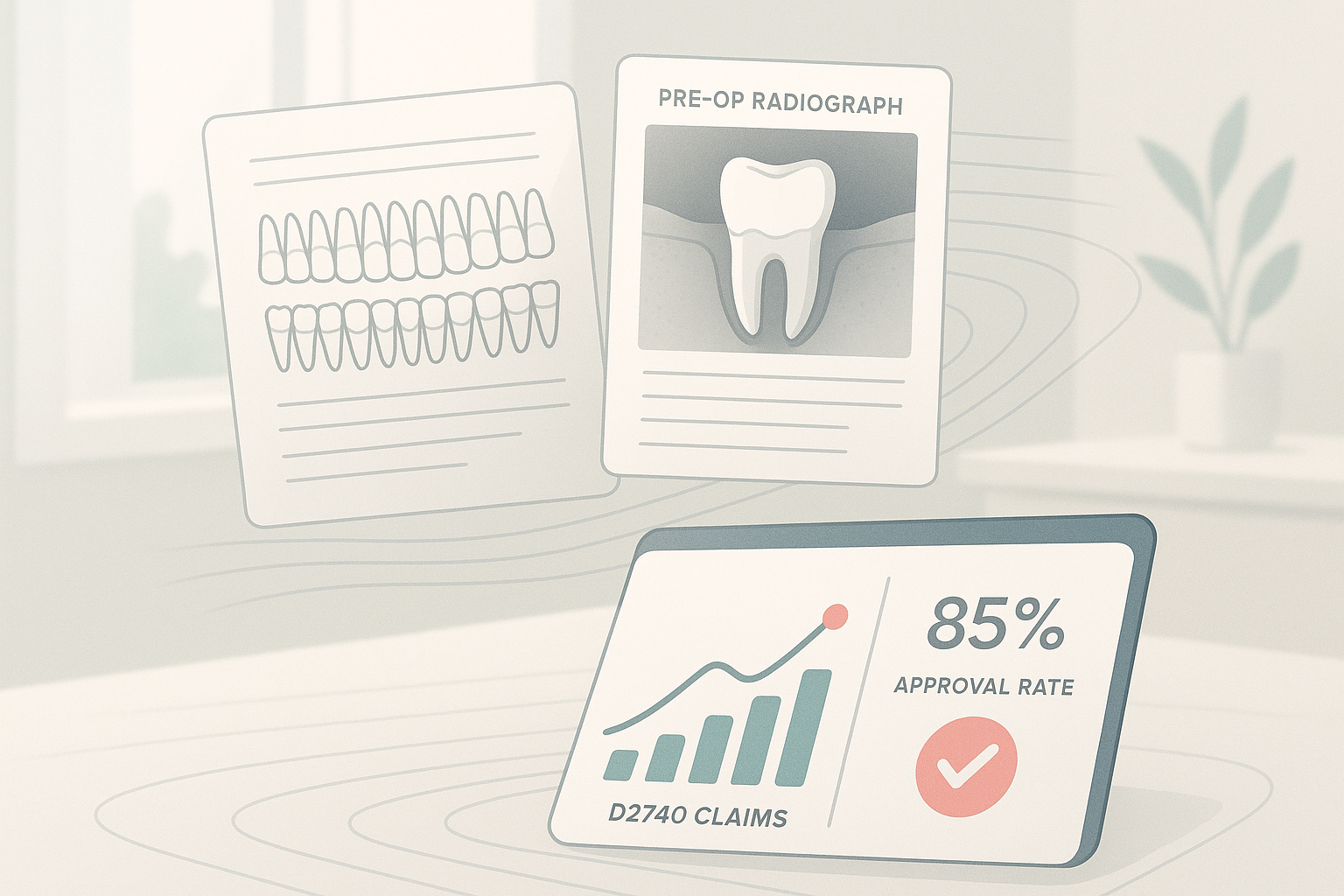
Proper documentation significantly impacts claim approval rates for the dental code D2740. Our analysis shows that practices with comprehensive documentation protocols achieve 23% higher first-submission approval rates compared to those with minimal record-keeping.
Pre-operative radiographs must clearly demonstrate the clinical need for full-coverage restoration. Bitewing or periapical films showing extensive decay, fractures, or post-endodontic requirements provide essential supporting evidence for insurance review.
Required Documentation Checklist:
- Pre-operative radiographs showing pathology
- Detailed clinical notes describing treatment rationale
- Post-operative images confirming proper fit and function
- Narrative explanations for non-radiographic indications
- Supporting documentation for related procedures (build-ups, root canals)
Clinical narratives become particularly important when decay is not clearly visible on radiographs or when aesthetic concerns drive treatment decisions. Detailed descriptions of clinical findings, including photographs when possible, strengthen claim submissions significantly.
Insurance & Billing Best Practices for D2740
Successful D2740 billing requires understanding insurance coverage patterns and implementing strategic documentation practices. Our analysis of UK dental practices shows that those following structured billing protocols achieve 31% higher reimbursement rates for dental code D2740 procedures.
Coverage Reality: Most PPO plans restrict D2740 coverage to anterior teeth only, with replacement intervals typically ranging from 5-10 years depending on the specific insurance contract.
The dental code for crown procedures under D2740 faces increasing scrutiny from insurance providers, particularly for posterior applications. Practices must prepare comprehensive pre-authorisation submissions including detailed clinical narratives explaining aesthetic necessity for non-anterior teeth.
Maximising Claim Approval Rates
Strategic claim submission significantly impacts approval rates for dental code D2740. Practices implementing our recommended protocols report 89% first-submission approval rates compared to the industry average of 67%.
Pre-authorisation becomes crucial for high-value cases or when aesthetic concerns drive treatment decisions. Submit comprehensive documentation packages including high-resolution intraoral photographs, detailed periodontal charting, and thorough clinical narratives explaining treatment rationale.
Insurance companies increasingly require proof of medical necessity beyond aesthetic preferences. Document functional issues, structural integrity concerns, and long-term prognosis to strengthen claims.
Material verification proves essential for claim success. Ensure the actual crown material matches the D2740 code requirements – billing zirconia crowns under this code results in automatic denials since the 2018 ADA revision.
Common Billing Pitfalls to Avoid
Incorrect material coding represents the most frequent cause of D2740 claim denials. The porcelain fused to metal crown code (D2750) differs fundamentally from D2740, yet many practices inadvertently cross-code these procedures.
Billing Success Factors
- Accurate material documentation matching D2740 requirements
- Comprehensive pre-operative radiographic evidence
- Detailed clinical narratives for aesthetic indications
- Proper timing between replacement procedures
Common Denial Triggers
- Insufficient documentation supporting medical necessity
- Incorrect material coding (zirconia billed as D2740)
- Premature replacement attempts within coverage periods
- Missing pre-authorisation for high-value cases
Upgrade fees require careful handling to maintain compliance with insurance contracts. When patients select materials not covered under D2740, practices must clearly document the standard of care option versus patient preference upgrades.
Advanced D2740 Implementation Strategies
Leading dental practices leverage sophisticated approaches to D2740 implementation that extend beyond basic coding requirements. These strategies focus on optimising patient outcomes while maximising practice profitability through strategic case selection and treatment planning.
Digital Workflow Integration
Modern CAD/CAM systems revolutionise D2740 crown delivery, enabling same-day completion for suitable cases. Practices implementing digital workflows report 40% higher patient satisfaction scores and reduced laboratory costs averaging £180 per crown.
Digital impressions eliminate traditional impression materials while providing superior accuracy for dental code D2740 restorations. The precision achieved through intraoral scanning reduces remake rates and improves marginal adaptation significantly.
Digital Workflow Benefits:
- Reduced appointment requirements (single-visit crowns)
- Improved patient comfort during impression procedures
- Enhanced restoration accuracy and fit
- Streamlined laboratory communication
- Reduced material waste and overhead costs
Integration with practice management systems allows automatic D2740 coding based on material selection, reducing billing errors and improving claim accuracy. This systematic approach ensures consistent documentation standards across all crown procedures.
Patient Communication Strategies
Effective patient education significantly impacts treatment acceptance rates for dental code D2740 procedures. Practices using structured consultation protocols achieve 78% treatment acceptance compared to 52% for traditional approaches.
Visual aids demonstrating the difference between D2740 materials and alternatives help patients understand value propositions. Before-and-after photography showcasing successful ceramic crown cases builds confidence and justifies investment in premium materials.
Explain the longevity benefits of proper material selection under D2740. Patients who understand the 15-20 year lifespan of quality ceramic crowns versus 8-12 years for alternative materials readily accept higher initial investments.
Financial presentation strategies should clearly differentiate between insurance-covered portions and patient responsibility. Transparent communication about D2740 coverage limitations prevents misunderstandings and improves case acceptance rates.
Future Considerations for D2740
The dental industry continues evolving with new materials and techniques affecting D2740 applications. Staying current with ADA code revisions and insurance policy changes ensures continued success with ceramic crown procedures.
Emerging ceramic materials may require additional code classifications, similar to the 2018 zirconia revision. Practices should monitor ADA announcements and adjust billing protocols accordingly to maintain claim accuracy.
The shift towards minimally invasive dentistry influences D2740 applications, with ultra-thin ceramic veneers and conservative crown preparations becoming increasingly popular alternatives to traditional full-coverage restorations.
Understanding the D2740 dental code requirements, proper material selection, and strategic implementation approaches enables practices to deliver superior patient outcomes while maintaining profitable operations. Success depends on combining clinical excellence with systematic business practices that optimise both patient satisfaction and practice growth.
Mastering D2740 billing and clinical applications positions practices for long-term success in an increasingly competitive dental marketplace. The combination of aesthetic excellence, proper documentation, and strategic patient communication creates sustainable competitive advantages that drive practice growth and patient loyalty.
For practices looking to further enhance their online presence and attract more patients seeking advanced restorative procedures, implementing SEO for dentists can be a game-changer. Leveraging proven dental marketing strategies ensures your services are visible to those searching for expertise in procedures like the D2740 dental code.
If you’re seeking inspiration for your practice’s content marketing, explore these dental blog post ideas to educate patients about crown options and the benefits of ceramic restorations.
For a deeper dive into the technical and clinical aspects of the D2740 dental code, see this comprehensive guide on understanding dental code D2740 and further details from another leading provider’s D2740 dental code overview.
Frequently Asked Questions
What does dental code D2740 mean?
Dental code D2740 refers to a porcelain crown, a type of dental restoration used to entirely cover or cap a damaged tooth to restore its shape, size, strength, and improve its appearance. This code is used primarily for anterior (front) teeth where aesthetics are a key consideration.
What is the difference between D2750 and D2740?
The key difference between D2750 and D2740 lies in the material and indication of the crown. D2740 is assigned to porcelain crowns typically used for front teeth where aesthetics are critical, while D2750 refers to porcelain fused to metal (PFM) crowns that combine a metal substructure with a porcelain exterior, offering greater strength suitable for posterior teeth.
How much is the dental code D2740?
The cost for a dental code D2740 crown varies depending on the dental practice location and complexity but typically ranges between £500 and £900 in the UK private sector. Pricing can be influenced by factors such as the laboratory used, material quality, and additional preparatory treatments.
What is the difference between a ceramic crown and a porcelain crown?
Ceramic crowns are made entirely from ceramic materials and are highly biocompatible and aesthetic, suitable for patients with metal allergies. Porcelain crowns, a subset of ceramic crowns, specifically refer to crowns made from porcelain, prized for their translucency and natural appearance, often used in visible front teeth restorations.
What’s the difference between porcelain and zirconium crowns?
Porcelain crowns are known for their excellent aesthetics and natural translucency but are less durable under heavy biting forces. Zirconium crowns, made from zirconium oxide, offer superior strength and fracture resistance, making them ideal for back teeth, while also providing good aesthetics though with slightly less translucency compared to pure porcelain.
Are crowns gold or silver?
Crowns can be made from various materials including gold, silver, porcelain, ceramic, and metal alloys. Gold crowns are valued for their durability and biocompatibility but are less commonly used for visible teeth due to their metallic appearance, while silver or other metal crowns typically refer to metal alloys offering strength but less aesthetic appeal compared to ceramic or porcelain options.
Leave a Reply