Blog

  • Dental Web Design SEO 2026: Proven Tips to Grow Your Practice Fast

    dental web design SEO

    Key Takeaways

    • Many UK dental practices spend over £2,000 monthly on marketing but face challenges with ineffective websites.
    • Beautiful dental websites often fail to rank well on search engines.
    • High-traffic dental sites may struggle to convert visitors into private treatment consultations.
    • Successful dental web design SEO integrates Google’s ranking criteria with patient conversion strategies.
    • Bridging the gap between ranking and conversion is essential for dental practice growth.

    Dental Web Design SEO: How UK Practices Turn Websites into High-Value Invisalign & Implant Patients

    UK dental practices investing £2,000+ monthly in marketing often struggle with a fundamental disconnect: beautiful websites that don’t rank, or high-traffic sites that fail to convert visitors into private treatment consultations. Successful dental web design SEO bridges this gap by architecting websites that simultaneously satisfy Google’s ranking algorithms and patient conversion psychology.

    Integrate patient-focused content, fast loading times, mobile optimization, and local SEO to boost rankings and convert visitors into private treatment bookings.

    For practices focusing on Invisalign, implants, and cosmetic treatments, this integration typically generates 50+ qualified leads monthly while achieving 15%+ visitor-to-consultation conversion rates. The difference lies in treating design and SEO as interconnected systems rather than separate afterthoughts.

    Dental web design SEO integrates website architecture, user experience, and search optimisation to attract patients actively seeking high-value treatments. Unlike generic SEO focused purely on traffic volume, dental-specific approaches target treatment-led searches like “Invisalign provider Manchester” or “dental implants Birmingham cost”.

    This specialisation matters because UK dental searches reflect unique patterns: NHS versus private treatment distinctions, local catchment area behaviour, and treatment-specific research cycles that can span 3-6 months for major procedures.

    Why It Matters for Invisalign & Implant Growth

    Ranking prominently for “Invisalign provider [city]” or “dental implants [area]” directly correlates with case value potential. A single organic visitor converting to an Invisalign consultation represents £3,000-£5,000 in treatment value, while implant cases often exceed £15,000.

    The patient journey flows predictably: Google search impression → website click → treatment page engagement → enquiry form or call → consultation booking → case acceptance. Practices achieving 50+ qualified monthly leads through organic search typically see 12-18 major case starts monthly from this channel alone.

    Where Most Dental Websites Go Wrong

    Template-based dental websites often prioritise visual appeal over search visibility, resulting in beautiful sites invisible to potential patients. Conversely, practices achieving strong search traffic frequently fail conversion due to unclear messaging, weak calls-to-action, or slow loading speeds.

    A Birmingham practice recently demonstrated this disconnect: ranking #3 for “dental implants Birmingham” but converting only 2% of visitors to enquiries due to buried contact information and no clear treatment pricing guidance. Addressing design elements alongside SEO increased their conversion rate to 16% within eight weeks.

    Core Elements of an SEO-Optimised Dental Website

    Information Architecture Built Around Patient Intent

    Successful dental websites structure navigation around patient treatment journeys rather than clinical categories. For practices offering Invisalign, implants, and cosmetic services, optimal top-level navigation includes: Home, Treatments (with clear service hierarchies), Fees & Finance, Patient Stories, Emergency Care, and prominent booking functionality.

    This architecture maps directly to search intent patterns: informational searches (“how do dental implants work”), transactional queries (“book Invisalign consultation London”), and local intent (“emergency dentist near me”). Internal linking between these content types creates topic authority while guiding patients through decision-making processes.

    Page Templates That Serve Both SEO & Conversions

    Essential page types include treatment hubs, individual service pages, location-specific content, and campaign landing pages. Each serves distinct purposes: treatment hubs establish topical authority, service pages target specific procedures, location pages capture local search traffic, and landing pages support paid campaigns without diluting organic rankings.

    Above-the-fold elements must be visible within 3-5 seconds: clear value proposition, practice location, primary call-to-action (such as “Book Invisalign Consultation”), direct phone contact, and trust signals including GDC registration numbers and patient testimonials.

    UX Signals Google Watches (and Patients Feel)

    Google’s ranking algorithms increasingly weight user experience metrics including bounce rate, dwell time, and click depth. These signals reflect genuine patient engagement: visitors spending 2+ minutes on treatment pages and clicking through to consultation booking forms demonstrate content relevance and site usability.

    Practical optimisations include limiting main navigation to 6-7 items, formatting content in scannable 2-4 line paragraphs for mobile viewing, and using descriptive headings that incorporate target keywords naturally. These changes simultaneously improve search performance and patient comprehension.

    On-Page SEO for Dental Web Design: Turning Every Page into a Patient Magnet

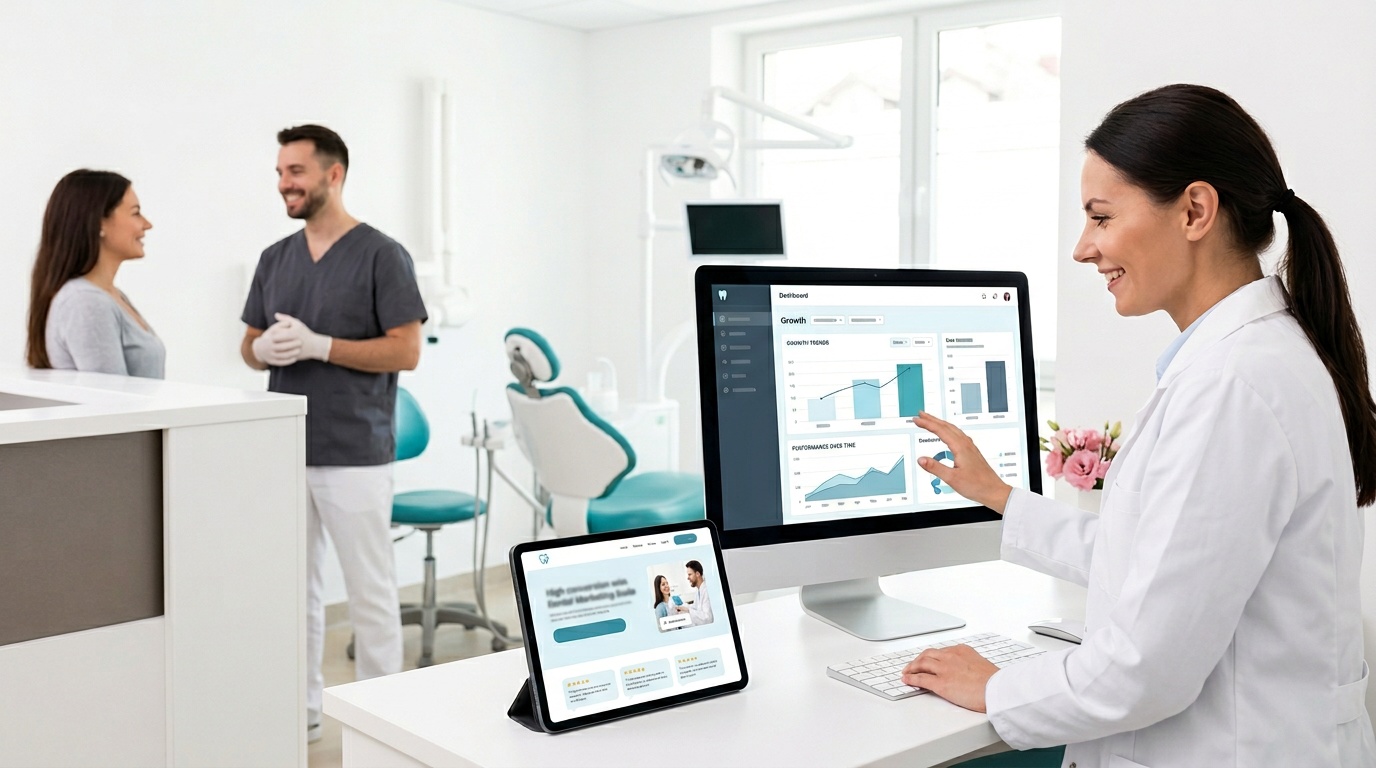
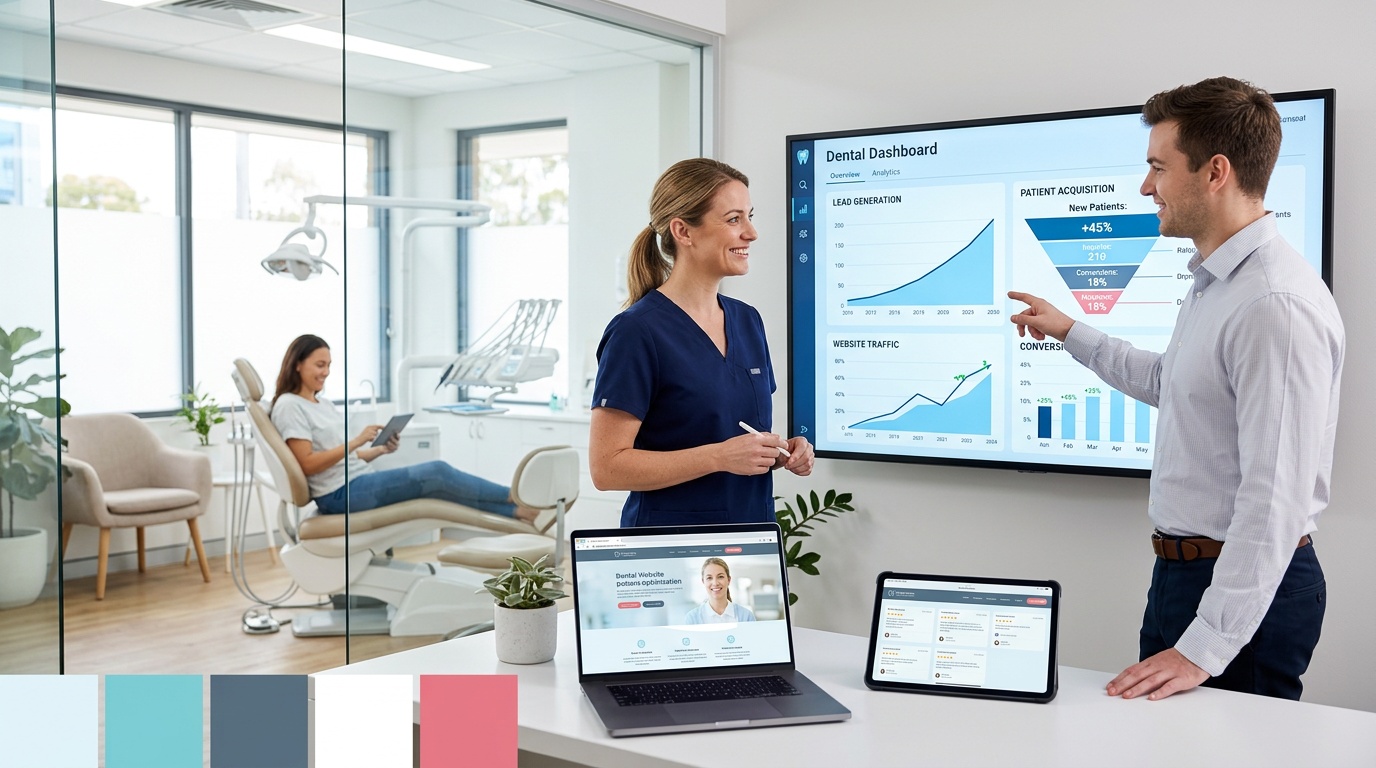
    Modern dental workspace with computer displaying growth charts and patient search phrases.

    Dental Keyword Research That Reflects Real Patient Language

    Effective dental keyword research follows a treatment + location + intent framework. Patients search using combinations like “Invisalign cost London”, “same-day emergency dentist Manchester”, or “best dental implant clinic Birmingham”, reflecting their geographical constraints and treatment-specific concerns.

    The research process begins with existing patient questions collected from treatment coordinators and reception staff, expands using tools like SEMrush and Google Keyword Planner, and is validated by analysing competitors ranking for high-value treatments in your area. This ensures your content matches the real language and intent of prospective patients.

    Content Optimisation & Structure

    Each treatment page should target a primary keyword and 2-3 secondary phrases, naturally woven into headings, meta descriptions, and body copy. Use patient-friendly language, answer common questions, and include before/after images with descriptive alt text. Structured data (FAQ schema, review markup) enhances visibility in search results and builds trust with both Google and patients.

    Internal Linking & Calls-to-Action

    Strategic internal links guide visitors from informational content (e.g., “What is Invisalign?”) to conversion-focused pages (“Book a free Invisalign consultation”). Every page should feature a clear, prominent call-to-action—whether it’s a booking form, phone number, or WhatsApp chat—making it easy for patients to take the next step.

    Technical SEO Foundations Baked into Dental Web Design

    Page Speed & Core Web Vitals for Dental Practices

    Core Web Vitals measure user experience through three key metrics: Largest Contentful Paint (LCP) under 2.5 seconds, Cumulative Layout Shift (CLS) under 0.1, and Interaction to Next Paint (INP) under 200ms. These directly impact both search rankings and patient experience.

    During the design build phase, compress before/after images to under 200KB where possible, implement next-generation WebP formats, and lazy-load gallery images. Avoid heavy sliders that delay initial page rendering, particularly on mobile devices where most dental searches occur.

    Mobile-First Design & Responsive Layouts

    With 60-70% of dental traffic now mobile-based, responsive design directly influences SEO performance. Tap targets must measure at least 44px in height for easy interaction, while key CTAs (call, WhatsApp, book online) should remain sticky and accessible during scrolling.

    Avoid intrusive pop-ups covering more than 30% of the viewport, as these trigger Google penalties and frustrate potential patients seeking quick access to contact information or emergency appointments.

    Secure, Accessible, and Compliant Sites (HTTPS & ADA/WCAG)

    HTTPS encryption with modern TLS certificates serves as both a ranking factor and trust signal for patients sharing personal health information. Basic accessibility improvements like alt text on treatment imagery, WCAG AA colour contrast ratios, and keyboard navigability enhance both user experience and search performance.

    Does making my dental website accessible help SEO?

    • Alt text provides context for treatment images, supporting image search rankings
    • Proper heading structure improves content understanding for search engines
    • Accessible sites typically have better user engagement metrics, indirectly boosting SEO

    Clean Technical Foundations from Day One

    XML sitemaps, robots.txt files, canonical tags, and proper 301 redirects from old URLs are essential pre-launch elements. Practices must ensure they don’t have duplicate www/non-www versions indexed simultaneously.

    For redesigns, mapping old URLs to new pages prevents devastating rank loss. A Manchester implant clinic lost 70% of their organic traffic after launching a beautiful new site without proper redirects—recovery took eight months.

    Monthly technical health checks using Search Console and third-party crawlers catch issues before they impact patient acquisition. Simple maintenance prevents expensive emergency fixes later.

    Local SEO & Google Business Profile: Owning Your Catchment Area

    Structuring Location Pages for Single vs Multi-Site Practices

    Single practices serving multiple catchment areas need location-focused content without duplicate physical addresses. Create neighbourhood pages targeting “dentist in Kensington” or “implants in Canary Wharf” with localised copy addressing specific area concerns.

    Multi-location practices require dedicated pages for each physical site. Each location page needs complete NAP details, embedded maps, 600-900 words of localised content, transport links, and nearby landmarks. Avoid templated content—Google penalises identical copy across location pages.

    Optimising Google Business Profile for Dentists

    Select precise categories: “Dentist” as primary, then “Cosmetic dentist” or “Dental implants periodontist” where relevant. Add services using target phrases like “Invisalign clear aligners” and “All-on-4 implants” rather than generic terms.

    Post updates 1-2 times weekly featuring offers, before/after cases, and blog content. Practices generating 5-10 new reviews monthly with 24-48 hour response times consistently outrank competitors in map pack results.

    Local Citations, Directories & NAP Consistency

    Maintain identical Name, Address, Phone formatting across Yell, Thomson Local, NHS directories, GDC listings, and specialist directories. Inconsistent opening hours or phone numbers confuse Google’s local algorithms.

    Building citations requires 30-60 minutes weekly: submit to local business directories, dental-specific platforms, and chamber of commerce listings. Quality trumps quantity—20 authoritative citations outperform 100 low-quality listings.

    Reviews, Testimonials & SEO Impact

    Review volume, rating, and recency directly influence map pack visibility and click-through rates. Implement review schema markup on key pages to display star ratings in search results.

    Showcase reviews containing treatment tags (“Invisalign”, “implants”) and city names to reinforce local relevance. A Birmingham practice increased their implant enquiries 40% by featuring location-specific testimonials prominently on service pages.

    For more ideas on leveraging patient feedback, explore how to get patients to write reviews for your dental practice.

    Choosing the Right Platform & Partner for Dental Web Design SEO

    Modern dental clinic workspace with monitor displaying growth charts, notebooks, and testimonial bubbles.

    WordPress vs Proprietary Dental Platforms for SEO

    WordPress offers complete SEO control, unlimited customisation, and content ownership. Proprietary dental platforms often restrict meta tags, limit content depth, and lock practices into inflexible contracts.

    Platform Type SEO Control Content Ownership Speed Optimisation Integration Flexibility
    WordPress Complete control Full ownership Highly optimisable Unlimited
    Wix/Squarespace Limited options Platform dependent Restricted Basic only
    Dental-specific systems Template restrictions Often locked-in Variable Proprietary only

    DIY vs Professional Dental Web Design SEO

    DIY approaches might work for single-dentist practices in low-competition rural areas. However, multi-chair city practices focusing on Invisalign and implants need professional expertise to compete effectively.

    Three critical risk points with DIY: thin content that fails to rank, poor conversion tracking that masks opportunities, and lack of technical maintenance leading to gradual performance decline.

    Why a Dental-Specific SEO Agency Beats a Generalist

    Dental-focused agencies understand treatment-specific marketing, GDC advertising compliance, and the NHS/private patient mix. They train TCOs and reception staff on handling digital leads effectively.

    Dominate Dental stands as the UK’s leading dental marketing and SEO agency, combining web design with comprehensive SEO strategies. Their treatment-specific approach generates measurable results for Invisalign marketing, dental implant campaigns, and emergency dental services across major UK cities.

    For a deeper dive into effective strategies, see SEO tips for dentists and how they can impact your practice’s growth.

    From Clicks to Consultations: Conversion-Focused Design for Dental SEO Pages

    Designing Pages That Book Invisalign & Implant Consultations

    Above-the-fold elements must include star ratings with review counts, compliant finance options, clear treatment pricing, and a prominent booking form or click-to-call button. Patient testimonials, before/after galleries, and trust badges (such as GDC registration and award logos) should be visible without scrolling. Streamlined forms with minimal required fields reduce friction and increase conversion rates.

    For further reading on the importance of smart website design in dental marketing, check out why a smart dental website design is crucial for success.

    For authoritative research on dental marketing and patient behaviour, see this British Dental Journal article.

    Frequently Asked Questions

    What are the key differences between generic SEO and dental-specific SEO for UK practices?

    Dental-specific SEO targets treatment-led searches unique to the UK market, such as private versus NHS distinctions and local patient behaviour. It focuses on optimising for high-value treatments like Invisalign and implants, aligning content and keywords with patient research cycles and local intent, unlike generic SEO which often prioritises broad traffic volume without treatment-specific nuance.

    How can dental web design SEO improve both search engine rankings and patient conversion rates?

    By integrating Google’s ranking criteria with patient-focused design elements—such as fast loading times, mobile optimisation, and clear calls to action—dental web design SEO ensures websites attract relevant traffic and guide visitors smoothly toward booking consultations. Treating SEO and user experience as interconnected systems bridges the gap between visibility and conversion, driving measurable growth in private treatment enquiries.

    Why is local SEO and Google Business Profile management crucial for attracting patients in a dental practice’s catchment area?

    Local SEO and Google Business Profile management help practices dominate their immediate geographic area by improving visibility in local search results and Google Maps. This targeted presence captures patients actively seeking nearby high-value treatments, increasing qualified leads and reducing wasted spend on broader, less relevant audiences.

    What common mistakes do dental websites make that prevent them from converting high search traffic into private treatment consultations?

    Common mistakes include prioritising aesthetics over functionality, neglecting mobile optimisation, lacking clear conversion pathways, and failing to align content with patient decision-making stages. Additionally, ignoring technical SEO and local optimisation results in poor rankings and low-quality traffic that doesn’t translate into booked consultations.

    About the Author

    Dan Ashburn is the Co-Founder at Dominate Dental, the UK’s specialist agency for high-value patient acquisition.

    Drawing on a decade of data-driven advertising experience and hundreds of clinic campaigns, Dan blends AI technology with human insight to deliver predictable streams of Invisalign, implant, and cosmetic dentistry consultations. His team’s results-focused approach has helped practices across London, Manchester, Birmingham, and nationwide convert marketing spend into chair-time—often booking 50+ qualified consultations per month while cutting no-shows.

    When he’s not optimizing funnels or unpacking the latest algorithm updates, Dan shares actionable dental marketing ideas, real-world case studies, and ROI benchmarks so dental teams can make confident marketing decisions.

  • Emergency Dental Marketing 2026: Proven Tips to Get More Patients

    emergency dental marketing

    Key Takeaways

    • Emergency dental marketing targets patients seeking immediate pain relief, unlike routine dental marketing.
    • Patients searching for emergency dental care often convert at higher rates due to urgent needs.
    • Between 70-90% of emergency dental inquiries come through phone calls rather than online forms.
    • Effective emergency dental marketing can turn urgent calls into valuable treatment opportunities.

    Emergency Dental Marketing: How UK Practices Can Turn Urgent Calls into Long-Term Private Patients

    Emergency dental marketing transforms urgent patient calls into high-value treatment opportunities. Unlike routine dental marketing that targets planned procedures, emergency dental marketing captures patients actively searching for immediate pain relief—often within minutes of their search beginning. These pain-driven enquiries convert at significantly higher rates, with 70-90% arriving via phone calls rather than forms.

    For UK practices with 3+ dentists, emergency campaigns consistently generate 50+ qualified leads monthly while creating pathways to implants, Invisalign, and comprehensive restorative treatments. The typical emergency consultation fee of £95 frequently leads to treatment plans exceeding £2,000 within 30 days.

    If you want to maximise the impact of your urgent care campaigns, partnering with a specialist dental marketing agency can help you structure, track, and optimise every stage of the patient journey for better results.

    What Is Emergency Dental Marketing – And Why It’s Different From “General” Dental Marketing

    Emergency dental marketing specifically targets patients searching for immediate dental care within 0-2 hours of pain onset, using time-sensitive keywords, call-focused campaigns, and availability-driven messaging to convert urgent enquiries into appointments.

    Clear Definition and Scope

    Emergency dental marketing focuses exclusively on attracting patients experiencing acute dental problems requiring same-day or next-day treatment. This includes sudden toothache, dental trauma, infections, broken teeth, and lost crowns. Unlike general marketing aimed at routine check-ups or elective cosmetic procedures, emergency campaigns target immediate pain relief searches with ultra-specific local intent.

    The timeframe distinguishes emergency marketing from all other dental advertising. Patients typically decide within 5-10 minutes of starting their search, making speed and visibility critical success factors.

    Why Emergency Dental Patients Are High-Intent, High-Value Leads

    Pain-driven behaviour creates exceptional conversion opportunities. Emergency patients demonstrate immediate purchasing intent—they need treatment today, not next month. This urgency translates to higher phone call rates, faster booking decisions, and reduced price comparison shopping.

    The financial upside extends beyond the initial emergency fee. A £95 emergency consultation frequently reveals underlying issues requiring crowns, root canal treatment, or extraction followed by implant placement. Practices consistently report that 20-30% of emergency patients convert to high-value treatments within six months when properly nurtured. For more inspiration on how to nurture these leads, explore these dental marketing ideas that can help boost patient retention and value.

    How Emergency Dental Marketing Supports Growth in Private Treatments

    Emergency visits serve as the “front door” to comprehensive private treatment plans. Patients experiencing dental emergencies often discover multiple issues during examination, creating natural opportunities to discuss implants, Invisalign, or full mouth rehabilitation.

    Dominate Dental structures emergency funnels to maximise long-term value: immediate pain relief builds trust, comprehensive examination reveals treatment needs, and follow-up appointments convert to significant private work. This integrated approach ensures emergency dental marketing contributes directly to practice growth beyond urgent care fees.

    Mapping the Emergency Dental Patient Journey (From Google Search to Booked Appointment)

    Patient holding cheek in dental clinic reception with digital screen showing emergency search and charts.

    The 5-Stage Emergency Patient Journey

    Stage 1: Pain/Problem Awareness (0-2 hours) – Patient experiences sudden dental pain or trauma requiring immediate attention. Stage 2: Search Behaviour – Urgent Google searches using “near me” queries, voice search, and “open now” modifiers. Stage 3: Shortlisting (3 minutes) – Rapid evaluation of 2-3 Google Business Profiles and 1-2 websites maximum.

    Stage 4: First Contact – Phone calls or call-only ad clicks dominate, with patients expecting immediate answers about availability. Stage 5: Attendance & Follow-up – Appointment attendance followed by potential conversion to ongoing private care through structured nurture sequences.

    Search Intent & Keywords at Each Stage

    Stage Example Query Intent Best Asset
    Problem Awareness “severe toothache”, “swollen face dentist” Informational Emergency page
    Local Search “emergency dentist near me”, “emergency dentist Manchester” Transactional Google Business Profile
    Availability Check “dentist open Sunday”, “24 hour dentist London” Transactional Call-only ads
    Contact Click-to-call from search results Transactional Phone system

    Key Psychological Drivers in Emergency Decisions

    Time-sensitive pain relief dominates decision-making. Patients prioritise practices offering “seen today” or “within 24 hours” messaging over those with vague availability claims. Trust signals—star ratings, professional qualifications, transparent emergency fees—provide essential reassurance during vulnerable moments.

    Friction reduction becomes critical when patients are distressed. Visible phone numbers, prominent “call now” buttons, and clear wait time messaging dramatically impact conversion rates. For more on optimising your website for these urgent moments, see why a smart dental website design is crucial for success.

    Core Pillars of a High-Performing Emergency Dental Marketing Strategy

    What should an emergency dental marketing plan include?

    A complete emergency dental marketing strategy combines local SEO dominance, immediate-visibility PPC campaigns, conversion-optimised landing pages, and systematic call handling to capture and convert pain-driven patients within minutes of their search.

    4 Strategic Pillars Overview

    Local SEO & Google Business Profile dominance ensures your practice appears first for “emergency dentist near me” and “dentist open now” searches. PPC & call-only ads provide immediate visibility during critical search windows when patients need urgent care. Conversion-optimised emergency landing pages with phone-first UX eliminate friction between click and call. Team systems & tracking handle high-stress calls professionally whilst measuring ROI on every campaign element.

    Dominate Dental structures these pillars to work synergistically—emergency PPC drives immediate results whilst SEO builds long-term cost efficiency. Each pillar addresses different patient behaviours: some scroll past ads to organic results, others click the first visible option, and many bypass websites entirely to call directly from Google listings. To learn more about optimising your local search presence, explore local SEO for dentists and how it can impact emergency patient acquisition.

    Setting Measurable Goals & KPIs

    Practices with 3+ dentists should target 50+ emergency enquiries monthly, with 75%+ call-to-booking rates for qualified emergencies. No-show rates below 15% indicate effective screening and confirmation processes. Most importantly, 20-30% of emergency patients should convert to high-value treatments within 6 months—transforming £95 emergency consultations into £2,000+ treatment plans.

    Dominate Dental uses these KPIs to benchmark performance across similar practices in Greater London, Manchester, and Birmingham. Practices consistently hitting these targets see emergency marketing ROI of 300-500% when factoring in long-term patient value from implants and Invisalign conversions.

    Budget & Timeframes

    Emergency campaigns require £1,000-£3,000 monthly media budgets depending on city competition levels. London practices typically need higher investment due to increased cost-per-click rates, whilst Manchester and Birmingham markets offer better value per lead. PPC results materialise within 7-14 days, whilst local SEO improvements compound over 8-12 weeks.

    Emergency marketing complements rather than competes with Invisalign and implant campaigns. Many practices find emergency patients more receptive to comprehensive treatment plans—they’ve already experienced the consequences of delayed dental care and value prevention-focused solutions.

    Owning “Emergency Dentist Near Me” with Local SEO & Google Business Profile

    Optimising Your Google Business Profile for Emergencies

    Set your primary category as “Dentist” with “Emergency dental service” as secondary. Add services like “Same-day appointments,” “Emergency dental care,” and “Weekend dentistry.” Configure opening hours to reflect genuine after-hours availability—use “More hours” for emergency slots without misleading patients about full-service availability.

    Upload emergency-specific photos: exterior shots showing evening lighting, comfortable waiting areas, and team photos in scrubs. Create weekly Google posts announcing “Same-day emergency slots available this week” with clear booking instructions. Add attributes like “Wheelchair accessible,” “LGBTQ+ friendly,” and “Accepts new patients” to capture broader emergency searches.

    Local SEO on Your Website for Emergency Searches

    Create a dedicated “Emergency Dentist in [City]” page targeting location-specific searches. Structure content around common emergency scenarios: severe toothache, dental trauma, lost fillings, and abscess symptoms. Include clear fee guidance and “what to do now” instructions that demonstrate expertise whilst encouraging immediate contact.

    Optimise title tags like “Emergency Dentist in Manchester – Same-Day Relief Available” and use H2 headings for specific conditions: “Severe Toothache Treatment,” “Broken Tooth Repair,” “Weekend Dental Emergency.” Link prominently from homepage navigation and footer to ensure Google recognises emergency services as a core offering. For more on optimising your search presence, see these SEO tips for dentists.

    Reviews and Reputation from Emergency Patients

    Emergency experiences generate the most detailed, emotional reviews—patients remember pain relief and compassionate care vividly. Send review requests within 2 hours via SMS: “Hi [Name], we hope you’re feeling better after today’s emergency treatment. If you have 2 minutes, sharing your experience would help other patients in similar situations find us quickly.” For more strategies, read about how to get patients to write reviews that build trust and credibility for your practice.

    Address negative reviews from distressed patients with empathy and professionalism: “We understand emergency situations are stressful. We’d welcome the opportunity to discuss your experience privately and ensure we meet your ongoing dental needs.” This demonstrates care to potential patients reading reviews whilst maintaining clinical confidentiality.

    Emergency Dental PPC & Call-First Campaigns That Convert Within Minutes

    Modern dental workspace with digital charts, testimonial bubbles, planner, and smartphone in bright, clinical setting.

    Criteria Emergency SEO Emergency PPC Combined Approach
    Speed to Results 8-12 weeks 7-14 days Immediate + sustainable
    Cost Per Lead £15-25 long-term £45-85 immediate Blended: £30-50
    Lead Quality High (organic trust) Very high (urgent intent) Highest (multi-channel)
    Scalability Medium (content/SEO limits) High (budget-driven) Maximum

    Designing a High-Converting Emergency Dental Landing Page (Phone-First UX)

    Non-Negotiable Elements Above the Fold

    Position a prominent click-to-call button within the first mobile screen—no scrolling required. Display the practice phone number in large, tappable format with “Call Now for Same-Day Appointment” messaging. Include a clear value proposition: “Emergency Dental Appointments in [City] – Seen Today” with supporting reassurance like “Private patients welcome – no registration needed.”

    Cluster trust signals prominently: Google star rating, review count, “GDC Registered Dentists” logo, and “Emergency Dental Experts” badge. These elements must load within 2 seconds on mobile devices—emergency patients abandon slow-loading pages immediately when experiencing pain.

    Structuring Page Content to Match Emergency Psychology

    Open with direct pain acknowledgment: “Are you in dental pain right now?” followed by immediate call-to-action. Structure subsequent sections in scannable blocks: common emergency conditions treated (toothache, abscess, trauma, lost fillings), simple 3-step process explanation (“Call → Assess → Treat”), transparent fee overview, and urgent care testimonials.

    Use short 2-3 line paragraphs with bold key phrases like “Seen today,” “No waiting lists,” and “Pain relief within hours.” Include icon-supported lists for quick scanning—emergency patients skim content rapidly rather than reading comprehensively. Position secondary contact methods (WhatsApp, online booking) below primary phone options to maintain call-first hierarchy.

    Messaging Around Availability, Fees and Expectations

    Communicate realistic availability without over-promising: “Same-day appointments available most days for patients calling before 3pm. Emergency consultation fee is £95, with transparent pricing for all treatments. For patients seeking NHS options, you can find more information on how to find an NHS dentist.”

    Frequently Asked Questions

    How does emergency dental marketing differ from general dental marketing strategies?

    Emergency dental marketing targets patients seeking immediate care within hours of pain onset, using time-sensitive keywords and call-focused campaigns. Unlike general marketing that promotes routine or elective treatments, emergency marketing focuses on urgent needs with highly localised intent to convert rapid enquiries into same-day or next-day appointments.

    Why do emergency dental patients typically convert at higher rates compared to routine dental patients?

    Emergency dental patients have acute pain or urgent issues, creating a strong immediate motivation to book treatment quickly. This urgency leads to higher conversion rates as these patients prioritise fast access to care over extended decision-making typical of routine or cosmetic treatments.

    What role do phone calls play in emergency dental marketing, and how can practices optimize for them?

    Phone calls account for 70-90% of emergency dental enquiries, serving as the primary conversion channel. Practices can optimise by implementing call-first campaigns, ensuring prompt phone response, and designing landing pages with phone-first user experience to capture and convert urgent patient calls effectively.

    How can UK dental practices leverage emergency dental marketing to generate long-term high-value treatment opportunities?

    By converting urgent emergency calls into consultations, practices create pathways to private treatments like implants and Invisalign. Structured emergency campaigns generate consistent qualified leads, and with strategic follow-up, these urgent patients often become loyal long-term clients, significantly increasing private treatment revenue.

    About the Author

    Dan Ashburn is the Co-Founder at Dominate Dental, the UK’s specialist agency for high-value patient acquisition.

    Drawing on a decade of data-driven advertising experience and hundreds of clinic campaigns, Dan blends AI technology with human insight to deliver predictable streams of Invisalign, implant, and cosmetic dentistry consultations. His team’s results-focused approach has helped practices across London, Manchester, Birmingham, and nationwide convert marketing spend into chair-time—often booking 50+ qualified consultations per month while cutting no-shows.

    When he’s not optimizing funnels or unpacking the latest algorithm updates, Dan shares actionable dental marketing ideas, real-world case studies, and ROI benchmarks so dental teams can make confident marketing decisions.

  • Cosmetic Dental Practice Marketing 2026: Proven Growth Guide

    cosmetic dental practice marketing

    Key Takeaways

    • Cosmetic dental marketing requires a distinct strategy compared to general dentistry marketing.
    • Cosmetic patients engage in a prolonged research process before making decisions.
    • Effective marketing for cosmetic dentistry involves sophisticated nurturing and premium positioning.
    • Conversion-optimised touchpoints are essential to capture and convert cosmetic dental patients.
    • General dental marketing often overlooks the unique needs of cosmetic dental patients.

    Cosmetic Dental Practice Marketing: The Complete UK Growth Blueprint for High-Value Cases

    Cosmetic dental practice marketing demands a fundamentally different approach than general dentistry marketing. While emergency patients need immediate pain relief, cosmetic patients spend weeks researching veneers, comparing Invisalign providers, and scrutinising before-and-after galleries. This extended decision journey requires sophisticated nurturing strategies, premium positioning, and conversion-optimised touchpoints that most general dental marketing completely misses.

    Target high-value cosmetic patients with tailored nurturing, premium branding, and conversion-optimized digital touchpoints reflecting their extended decision-making process.

    UK practices focusing on high-value cosmetic treatments face unique challenges: longer sales cycles, price-sensitive prospects, and the need to demonstrate artistic skill alongside clinical expertise. Success requires understanding the emotional drivers behind smile transformations, building systematic lead nurture processes, and positioning your practice as the premium choice in an increasingly competitive market.

    For practices seeking to stand out, partnering with a dedicated dental marketing agency can help implement advanced strategies tailored to cosmetic dentistry.

    What Is Cosmetic Dental Practice Marketing – And Why It Demands a Different Strategy

    Definition: Cosmetic Dental Marketing vs “General” Dental Marketing

    Cosmetic dental practice marketing focuses exclusively on elective, appearance-driven treatments where patients choose to invest in their smile rather than address urgent clinical needs. Unlike general dentistry marketing that targets pain-driven searches like “emergency dentist” or “toothache”, cosmetic marketing targets aspiration-driven searches like “smile makeover London” or “Invisalign before and after”.

    The fundamental difference lies in patient motivation and decision timeframes. General dental patients typically book within 24-48 hours when experiencing pain, while cosmetic patients research for 2-12 weeks before committing to treatments costing £2,000-£15,000+. This extended journey requires completely different content strategies, nurture sequences, and conversion tactics.

    What is cosmetic dentistry marketing in under 60 seconds?

    Marketing strategies specifically designed to attract, educate, and convert patients seeking elective smile improvements like veneers, Invisalign, implants, and whitening. Focuses on visual proof, emotional benefits, and overcoming cost objections rather than addressing urgent dental problems.

    Why Cosmetic Dentistry Needs Its Own Strategy (Not Just ‘More of the Same’)

    Cosmetic patients interact with 8-12 touchpoints before booking a consultation, compared to 2-3 for emergency patients. They scrutinise Google reviews, Instagram galleries, finance options, and competitor comparisons before making contact. This complexity demands sophisticated tracking systems to understand which channels drive the highest-value cases.

    Consider these distinct decision timeframes: teeth whitening patients typically decide within 7-14 days, Invisalign patients research for 4-8 weeks, while full-mouth rehabilitation patients may deliberate for 8-24 weeks. Each treatment requires tailored content addressing specific concerns, from “Will Invisalign hurt?” to “How much do dental implants cost in Manchester?”

    Core Goals of Effective Cosmetic Dental Marketing

    Successful cosmetic dental practice marketing generates 50+ qualified cosmetic leads monthly while maintaining conversion rates of 15%+ from website visitor to consultation booking. Cost-per-lead targets vary significantly: £10-£30 for whitening enquiries, £60-£150 for Invisalign and implant leads, reflecting the higher research intensity of complex treatments.

    The ultimate metric remains completed cases and revenue, not vanity metrics like social media likes or website traffic. A practice generating 200 monthly visitors but converting 30 cosmetic consultations outperforms one with 2,000 visitors converting only 15 consultations. Focus relentlessly on the entire funnel from enquiry to case completion.

    For more inspiration on how to attract and convert high-value patients, explore these dental marketing ideas that work for cosmetic practices.

    Criteria Cosmetic Dentistry Marketing General Dentistry Marketing
    Patient Intent Aspiration-driven, elective Pain-driven, urgent
    Average Treatment Value £2,000-£15,000+ £50-£500
    Decision Timeline 2-12 weeks 24-48 hours
    Required Proof Before/after galleries, testimonials Availability, location, NHS acceptance
    Primary Channels Instagram, Google Ads, SEO Google My Business, local directories

    Understanding the Cosmetic Dental Patient Journey (From Self-Conscious to Smile Makeover)

    Modern dental clinic scene with computer, notebooks, wedding photo, and testimonial bubbles.

    The 5 Stages of the Cosmetic Patient Journey

    Stage 1 (Awareness) begins when patients notice smile flaws in video calls, wedding photos, or social media comparisons. This triggers initial Google searches like “crooked teeth solutions” or “yellow teeth whitening”. Stage 2 (Research) involves deeper investigation: “Invisalign cost UK”, “veneers vs bonding”, and “best cosmetic dentist Manchester”.

    Stage 3 (Consideration) sees patients comparing specific practices, reading reviews, and calculating finance options. Stage 4 (Decision) typically occurs within 3-7 days of peak interest, triggered by a compelling offer, positive review, or convenient booking system. Stage 5 (Treatment & Advocacy) is when the patient completes treatment and, ideally, becomes a brand advocate by sharing their experience and results.

    To ensure your practice stands out during the research and consideration stages, implementing SEO for dentists and leveraging social media for dentists can significantly increase your visibility to motivated patients.

    For more guidance on optimising your online presence, see these SEO tips for dentists to help attract more cosmetic enquiries.

    Understanding the patient journey is also about recognising broader market trends. For a deeper dive into the shift towards private care and its impact on dental practice growth, read this authoritative overview from the BDA: UK dental market: understanding the shift to private care and implications for practice growth.

    To further understand how dental SEO can lead to more patients, you may also find this resource helpful: how dental SEO can lead to more patients.

    For up-to-date statistics on dental care in England, you can consult the official NHS dental statistics: NHS dental statistics England 2023 to 2024.

    Frequently Asked Questions

    Why does cosmetic dental practice marketing require a different strategy compared to general dental marketing?

    Cosmetic dental marketing targets elective, appearance-driven treatments where patients invest significant time researching before committing, unlike general dental marketing which addresses urgent, pain-driven needs with quick decisions. This longer decision-making process demands tailored strategies that focus on nurturing, premium positioning, and addressing aspirational patient motivations.

    What are the key stages and patient behaviors involved in the cosmetic dental patient journey?

    Cosmetic dental patients typically progress from feeling self-conscious about their smile to actively researching options like veneers or Invisalign over 2 to 12 weeks. They compare providers, scrutinise before-and-after results, and seek reassurance about both clinical expertise and artistic outcomes before booking a consultation.

    How can cosmetic dental practices effectively nurture high-value patients throughout their extended decision-making process?

    Effective nurturing involves delivering targeted, informative content that addresses patient concerns and aspirations, maintaining consistent engagement through multiple digital touchpoints, and building trust by showcasing expertise and successful case studies. This systematic approach guides prospects steadily toward booking high-value treatments.

    What role do conversion-optimized touchpoints and premium positioning play in attracting cosmetic dental patients?

    Conversion-optimized touchpoints ensure that every interaction—from website visits to follow-up communications—is designed to capture interest and encourage consultation bookings. Premium positioning differentiates the practice by highlighting superior skills and bespoke patient experiences, which resonates with cosmetic patients seeking high-quality, transformative smile solutions.

    About the Author

    Dan Ashburn is the Co-Founder at Dominate Dental, the UK’s specialist agency for high-value patient acquisition.

    Drawing on a decade of data-driven advertising experience and hundreds of clinic campaigns, Dan blends AI technology with human insight to deliver predictable streams of Invisalign, implant, and cosmetic dentistry consultations. His team’s results-focused approach has helped practices across London, Manchester, Birmingham, and nationwide convert marketing spend into chair-time—often booking 50+ qualified consultations per month while cutting no-shows.

    When he’s not optimizing funnels or unpacking the latest algorithm updates, Dan shares actionable dental marketing ideas, real-world case studies, and ROI benchmarks so dental teams can make confident marketing decisions.

  • Best Dental Marketing Tools 2026: Proven Tech to Grow Private Patients

    best dental marketing tools

    Key Takeaways

    • The best dental marketing tools in 2025 effectively convert online interest into high-value consultations for Invisalign and implants.
    • These tools offer seamless integration with practice management systems.
    • They comply with healthcare regulations to ensure safe and legal marketing practices.
    • The tools provide detailed tracking of revenue attribution from initial contact to treatment completion.

    Best Dental Marketing Tools in 2025: The Proven Tech Stack Behind High-Value Private Patient Growth

    The best dental marketing tools in 2025 are platforms that reliably convert online interest into booked, high-value consultations for Invisalign and implants. Unlike generic marketing software, these tools integrate seamlessly with practice management systems, comply with healthcare regulations, and track revenue attribution from first click to treatment completion. Marketing for dentists requires a tailored approach, leveraging technology that understands the unique needs of appointment-based healthcare businesses.

    Top dental marketing tools in 2025 combine AI-driven SEO, automated patient engagement, revenue tracking, and seamless integration with UK practice management systems.

    For UK dental practices investing £2,000+ monthly in marketing, the right tech stack can increase qualified leads by 200% while reducing no-shows from 15% to under 8%. The difference lies in choosing patient-specific platforms over e-commerce-focused solutions that weren’t built for appointment-based healthcare businesses. Practices looking for a comprehensive strategy often benefit from partnering with a dental marketing agency that specialises in private patient growth.

    To maximise results, it’s essential to develop a dental marketing plan that aligns technology with your practice’s growth objectives and patient demographics. This ensures every tool in your stack serves a clear purpose and delivers measurable ROI.

    What “Dental Marketing Tools” Actually Are – And Why They Matter for UK Practices Doing Invisalign & Implants

    Clear definition for principals and practice managers

    Dental marketing tools are specialised platforms designed to attract, convert, and retain patients seeking specific treatments. Unlike generic marketing software built for e-commerce, these tools integrate with practice management systems, maintain GDPR compliance for healthcare data, and focus on appointment bookings rather than product sales.

    In one sentence: The best dental marketing tools are platforms that reliably turn online interest into booked, attended, high-value consultations for treatments like Invisalign and implants.

    How the right tools impact Invisalign and implant revenue in 90–180 days

    Properly implemented tools create measurable improvements across three key areas: lower no-show rates (targeting under 8-10%), more qualified enquiries (≥70% from high-intent channels), and higher treatment plan acceptance through coordinated follow-up automation.

    A realistic UK funnel example: 300 targeted clicks generate 45 qualified enquiries, leading to 25 attended consultations and 10 Invisalign treatment starts. This 3.3% click-to-start conversion becomes achievable when tools work together rather than in isolation.

    Core categories of dental marketing tools you must understand

    • Visibility tools: SEO platforms, local listings management, Google Ads, treatment-specific landing pages
    • Conversion tools: Online booking systems, website chat, lead capture forms, call tracking with recording
    • Engagement & retention tools: Email/SMS automation, recall campaigns, patient reactivation, review generation
    • Intelligence & integration tools: Analytics dashboards, ROI tracking, PMS integrations, compliance monitoring

    Why “best” for dentists ≠ “most features”

    “Best” for dental practices means tools that integrate with UK workflows, connect seamlessly with existing PMS systems (SOE, Dentally, EXACT, Denticon), and prove ROI per treatment line. A simple tool that tracks which Google Ad brought an £8,000 implant case outperforms feature-rich platforms that can’t connect marketing spend to actual revenue. For more insights on how dental SEO can drive patient growth, see how dental SEO can lead to more patients.

    Selection Framework – How to Choose the Best Dental Marketing Tools for Your Practice (Without Getting Burned)

    Modern dental workspace with planner, tablet, tools, and treatment room background in bright clinic lighting.

    Start with your growth objective, not with software features

    Define specific, timeframed objectives before evaluating tools. Examples include “+15 Invisalign starts/month in 6 months,” “+8 implant cases/month in 9 months,” or “Reduce DNAs from 12% to 6% in 3 months.” Each objective requires different tool combinations—Invisalign growth needs landing page builders and nurture sequences, while DNA reduction prioritises SMS reminders and deposit collection.

    7 non‑negotiable features to look for in dental marketing tools

    • HIPAA/GDPR-ready consent logging and messaging history
    • 2‑way SMS and email communication in unified timeline
    • Native or proven integration with your practice management system
    • Custom fields for treatment interest (Invisalign, implants, composite bonding, emergencies)
    • Role-based permissions for reception, treatment coordinators, and principals
    • Campaign-level reporting with revenue attribution capabilities
    • UK support hours with included onboarding and training

    Build a practice-specific scoring matrix

    Criteria Poor (1) Basic (2-3) Good (4) Excellent (5)
    PMS Integration Manual data entry required Basic sync, some delays Real-time sync, minor gaps Seamless bidirectional sync
    Front Desk Usability Complex, requires training Moderate learning curve Intuitive for most tasks Single-click operations
    Treatment Tracking No treatment segmentation Basic lead categorisation Treatment-specific workflows Full revenue attribution
    Support Quality Email only, slow response Phone support, business hours Quick response, knowledgeable Dedicated account management

    Use this matrix in a 30-minute team meeting to score potential tools objectively. Any tool scoring below 3 on PMS integration or front desk usability typically leads to adoption failure within six months.

    Red flags that usually lead to wasted spend

    Avoid tools requiring separate logins that reception staff “never have time” to use, platforms without patient-level campaign attribution, and systems that can’t distinguish NHS versus private treatment interest. Long contracts (12+ months) without quarterly performance reviews often lock practices into underperforming solutions.

    Aligning the tool stack with your internal team capacity

    Practices lacking 5+ hours weekly for marketing operations or a treatment coordinator comfortable with systematic follow-up should consider partnering with a specialist dental marketing agency. Dominate Dental combines the best dental marketing tools with expert implementation, ensuring tools deliver measurable ROI rather than becoming expensive digital paperweights.

    The Essential Dental Marketing Tech Stack – What a High-Performing UK Practice Actually Needs

    The 4-layer tech stack for predictable growth

    High-performing practices build their technology around four distinct layers: Attract (SEO, local search, social media, paid advertising), Convert (website, landing pages, online booking, chat, contact forms), Nurture (email/SMS journeys, recall campaigns, patient reactivation), and Measure (analytics, dashboards, call tracking, revenue attribution). For practices aiming to boost their local visibility, local SEO for dentists is a crucial component of the attract layer.

    This funnel approach ensures every tool serves a specific purpose: driving awareness, capturing interest, maintaining engagement, or proving ROI. Tools that don’t clearly fit one layer often become redundant within months.

    Recommended “minimum viable” stack for a 3-5 dentist practice

    • 1 x dental website & landing page platform optimised for treatment-specific conversions
    • 1 x local SEO/listings management tool for Google Business Profile and directory consistency
    • 1 x patient engagement platform handling email/SMS automation, recalls, and review requests
    • 1 x call tracking & analytics solution connecting phone enquiries to marketing campaigns
    • Optional: 1 x social media scheduler for consistent content posting

    Scaling stack for multi-location or mini-DSO groups

    Multi-location practices require centralised dashboards with location-level reporting, branded template libraries, and user permissions by site. Unlike single-site practices, they need tools that aggregate performance data while maintaining individual location accountability and compliance tracking across multiple teams.

    Where a specialist dental marketing agency fits in

    Tools amplify strategy but don’t create it. Dominate Dental designs optimal tech stacks, manages implementation and integration, and operates campaigns that directly tie to Invisalign and implant revenue growth. This partnership approach ensures practices get both the right tools and the expertise to maximise their potential.

    Best Tools to Get Found: SEO, Local Listings, and Website Platforms Built for Dentists

    Dental website & landing page builders that actually convert

    High-converting dental websites load in under 3 seconds on mobile, feature clear calls-to-action above the fold (“Book Invisalign consultation in under 60 seconds”), and integrate with online booking and lead tracking. Platforms like WordPress with dental-specific themes, Webflow, and purpose-built solutions such as SmileSnap or Dental Focus are popular choices for UK practices. These platforms should support A/B testing, mobile responsiveness, and seamless integration with analytics and call tracking tools.

    For practices focused on high-value treatments, landing pages should be tailored to Invisalign, implants, or composite bonding, with before-and-after galleries, patient testimonials, and transparent pricing or finance options. Integration with Google Analytics and call tracking ensures every enquiry is attributed to the correct marketing channel, enabling data-driven decisions and continuous improvement.

    Best Dental Patient Engagement Platforms: Email, SMS, and Automation That Actually Fill the Book

    Modern dental clinic workspace with computer, smartphone, calendar, and patient engagement elements.

    What an engagement platform must do for a 3+ dentist practice

    The best dental marketing tools for patient engagement handle four core functions: automated recalls and hygiene reminders, 2-way SMS allowing patients to reply within minutes, targeted email campaigns for whitening, Invisalign, implants, and membership plans, plus reactivation sequences for patients who’ve lapsed 6-24 months. For ideas on how to keep your content fresh and engaging, explore these dental social media ideas.

    These platforms must integrate with your practice management system to trigger communications automatically based on appointment history, treatment interest, and patient value. Without this integration, even the most sophisticated email templates become manual busywork that reception teams abandon within weeks.

    Email marketing tools vs SMS platforms for dentists

    Factor Email Marketing SMS Marketing
    Open rates 18-25% for dental practices 95%+ within 3 minutes
    Best use cases Education, treatment explanations, newsletters Confirmations, urgent reminders, limited-time offers
    Cost per send £0.02-0.05 per message £0.08-0.15 per message
    Compliance handling Automated unsubscribe links STOP keyword recognition required

    Use email for value-driven content and pre-consultation education that patients can reference later. Deploy SMS for confirmations, last-minute availability notifications, and high-value offers with specific deadlines that require immediate response.

    How to launch your first automated journey in 60 minutes

    Start with past Invisalign enquiries who didn’t begin treatment. Create a 3-email plus 2-SMS sequence delivered over 14 days: patient success story (day 1), financing options explanation (day 5), and limited-availability consultation offer (day 12), with SMS reminders on days 3 and 10.

    Set precise timing: first SMS within 10 minutes of initial enquiry, appointment reminder 24 hours before consultation, and follow-up sequence for no-shows beginning 2 hours after missed appointment. This systematic approach typically converts 8-15% of dormant leads into booked consultations.

    Best tools for recalls, reactivation, and membership promotion

    Effective platforms offer treatment-specific templates, overdue patient filters (12+ months since last visit), and automatic exclusion of NHS-only patients when promoting private treatments. The system should segment by treatment history—sending implant maintenance reminders to existing implant patients while targeting composite bonding campaigns to patients with visible anterior restorations.

    A well-executed 3-touch reactivation campaign typically rebooks 5-10% of lapsed patients, with higher success rates when messages reference specific previous treatments and include direct scheduling links rather than generic “book now” buttons. For more practical tips, check out these dental marketing ideas to enhance your campaigns.

    Training front-desk and TCOs so the platform doesn’t gather dust

    Implement three essential training elements: 30-minute weekly campaign review meetings, documented call scripts for following up warm leads within 15 minutes, and mandatory dashboard checks at 11am and 4pm daily for overdue responses.

    Create simple workflows that integrate with existing routines rather than adding separate tasks. For example, train reception to check the engagement dashboard immediately after updating appointment schedules, ensuring hot leads receive immediate attention while the system handles routine communications automatically.

    Best Review Generation & Reputation Management Tools for Dental Practices

    Why online reviews are now a core marketing channel, not a vanity metric

    Google reviews directly impact local search rankings and conversion rates from website visitors. Practices with 100+ reviews and 4.8+ ratings see 40% higher consultation booking rates compared to those with fewer than 20 reviews, while also ranking higher in local map pack results for competitive terms like “Invisalign near me.” For a broader perspective on dental marketing, see the Wikipedia entry on dental marketing.

    Reviews function as social proof that pre-qualifies prospects before they contact your practice. Potential patients read reviews to gauge treatment quality, staff professionalism, and practice atmosphere—making review generation one of the most cost-effective patient acquisition strategies available. For actionable advice on increasing your review count, read how to get patients to write reviews.

    Manual review requests vs automated review tools

    Manual Review Requests

    • Inconsistent timing and volume
    • Requires 10-15 minutes per patient
    • Often forgotten during busy periods
    • No unhappy patient filtering

    Automated Review Systems

    • Consistent post-appointment delivery
    • 2-3 minutes setup per patient type
    • Maintains momentum regardless of schedule
    • Routes dissatisfied patients to private feedback

    Key features of the best review generation platforms

    Essential capabilities include 1-click post-appointment review requests via SMS or email, integration with Google and Facebook, unhappy patient routing to private feedback, and real-time monitoring dashboards. Automated reminders and segmentation by treatment type (e.g., Invisalign, implants) ensure reviews are timely and relevant. For more on the impact of online reviews in healthcare, see this research article.

    Frequently Asked Questions

    What are dental marketing tools and why are they essential for UK practices offering Invisalign and implants?

    Dental marketing tools are specialised platforms designed to attract, convert, and retain patients seeking high-value treatments like Invisalign and implants. They are essential for UK practices because they enable targeted patient acquisition, streamline appointment bookings, and support private treatment growth by converting online interest into consultations effectively.

    How do dental marketing tools help reduce no-show rates and increase qualified patient enquiries?

    These tools use automated patient engagement features such as SMS and email reminders, which significantly reduce no-show rates from industry averages to under 8%. Additionally, AI-driven lead qualification and seamless booking integrations ensure that enquiries are highly targeted and more likely to convert into consultations.

    What features should UK dental practices look for when selecting marketing tools to ensure compliance and effective integration?

    UK dental practices should prioritise tools that integrate smoothly with their existing practice management systems, comply with healthcare regulations, and provide detailed tracking of patient journeys from initial contact to treatment completion. Features like data security, GDPR compliance, and revenue attribution analytics are critical for safe and effective marketing.

    How can a comprehensive dental marketing plan maximize ROI and support private patient growth in practices investing over £2,000 monthly?

    A comprehensive plan aligns each marketing tool with the practice’s specific growth goals and patient demographics, ensuring every platform serves a clear purpose. This focused approach increases qualified leads by up to 200%, reduces no-shows, and delivers measurable ROI by converting website visitors into booked consultations for high-value treatments.

    About the Author

    Dan Ashburn is the Co-Founder at Dominate Dental, the UK’s specialist agency for high-value patient acquisition.

    Drawing on a decade of data-driven advertising experience and hundreds of clinic campaigns, Dan blends AI technology with human insight to deliver predictable streams of Invisalign, implant, and cosmetic dentistry consultations. His team’s results-focused approach has helped practices across London, Manchester, Birmingham, and nationwide convert marketing spend into chair-time—often booking 50+ qualified consultations per month while cutting no-shows.

    When he’s not optimizing funnels or unpacking the latest algorithm updates, Dan shares actionable dental marketing ideas, real-world case studies, and ROI benchmarks so dental teams can make confident marketing decisions.

  • LinkedIn Dental Marketing 2026: The Ultimate Growth Guide for Dentists

    linkedin dental marketing

    Key Takeaways

    • LinkedIn dental marketing helps UK dental practices attract high-value patients and build strong referral networks.
    • Many dentists overlook LinkedIn, missing out on its potential for growth.
    • Successful practices generate 15+ new Invisalign and implant cases monthly through LinkedIn connections.
    • LinkedIn is effective for connecting with affluent professionals and local GPs who provide consistent referrals.

    LinkedIn Dental Marketing: The Complete Playbook for UK Practices Serious About Private Growth

    LinkedIn dental marketing transforms how UK dental practices attract high-value patients and build referral networks. While most dentists treat LinkedIn as an afterthought, practices generating 15+ new Invisalign and implant cases monthly understand its power for connecting with affluent professionals and local GPs who drive consistent referrals. Marketing for dentists is evolving rapidly, and leveraging LinkedIn is now a core part of a modern dental marketing strategy.

    Consistent LinkedIn posting, targeted outreach to local GPs, and showcasing patient success stories drive 15+ Invisalign and implant cases monthly for dentists.

    This playbook reveals exactly how ambitious dental practices leverage LinkedIn to fill appointment books with £3,000+ treatment plans, build lasting referral relationships, and establish authority in competitive markets like London, Manchester, and Birmingham. For those seeking a comprehensive approach, partnering with a dental marketing agency can help maximise results from LinkedIn and other digital channels.

    Why LinkedIn Dental Marketing Matters for UK Practices Focused on High-Value Cases

    What “LinkedIn Dental Marketing” Actually Is (B2B + B2C Clarified)

    LinkedIn dental marketing encompasses strategic networking and content creation to attract both referral partners and private patients through professional relationships. Unlike Facebook or Instagram’s broad consumer reach, LinkedIn targets decision-makers with disposable income and healthcare professionals who influence patient flow.

    The dual approach includes B2B referral building with GPs, specialists, and corporate wellness managers, plus B2C patient acquisition targeting high-earning professionals seeking Invisalign, implants, and cosmetic treatments. This strategy complements dental SEO and Google Ads by establishing trust before prospects search for treatments.

    Core Benefits of LinkedIn for Dental Practices (With Timeframes & Metrics)

    Established practices typically see 5-15 new high-value cases monthly within 6-12 months of consistent LinkedIn activity. Professional social proof shortens patient decision-making from 3-5 touchpoints to 1-2 consultations, while educational content improves show-up rates by 10-20% for Invisalign and implant appointments.

    LinkedIn Strength Assessment:

    • Strong for: Invisalign patients aged 25-45, implant cases, professional referrals, employer partnerships
    • Weak for: Emergency dentistry, NHS patients, broad family dentistry, immediate bookings
    • Best ROI: Practices with 3+ dentists spending £2,000+ monthly on marketing

    Building a High-Performing Dentist LinkedIn Profile That Attracts Referrals & Private Patients

    Modern dental office with digital workspace displaying a professional LinkedIn profile and growth chart.

    Strategic Profile Setup: From “Online CV” to “Mini Landing Page”

    Transform your LinkedIn profile from a static CV into a conversion-focused landing page that passes the 3-second test. Local GPs, HR managers, and potential patients should immediately understand your expertise, location, and how you help them within three seconds of viewing your profile.

    Focus on five key sections as conversion assets: Headline (your value proposition), About (trust-building story), Featured (case studies and videos), Experience (credibility markers), and Contact Info (clear next steps for referrals and consultations).

    Crafting a Magnetic Headline & About Section (With Formulas)

    Effective headlines follow proven formulas: “[Specialty] Dentist | [Location] | Helping [Target] Achieve [Outcome]” or “Principal Dentist at [Practice] | [Treatments] Specialist | [Geographic Area]”. For example: “Invisalign & Implant Specialist | Central London | Transforming Smiles for Busy Professionals”.

    Structure your About section with five elements: opening authority statement, treatment specialisation, proof points (years of experience, cases completed), social proof (colleague testimonials), and clear referral or consultation invitation. Keep each element to one sentence for maximum impact.

    Images, Banner, and Visual Consistency With Your Dental Website

    Select profile images showing confident professionalism in clinical attire, while banner images highlight your practice environment or treatment outcomes (with proper consent). Maintain visual consistency with your dental website design, logo placement, and colour scheme to reinforce brand recognition across platforms.

    5-Point Branding Alignment Checklist:

    Social Proof: Recommendations, Endorsements & Ethical Ask Scripts

    Request LinkedIn recommendations from professional colleagues, specialists, lab partners, and lecturers—never patients due to GDC ethical considerations. Use simple scripts: “Hi [Name], I’m updating my LinkedIn profile to better serve referral partners. Would you mind writing a brief recommendation about our professional collaboration?”

    Strategically seek endorsements for key skills: Invisalign, implantology, cosmetic dentistry, and patient care. This builds credibility and increases your profile’s visibility among both referrers and potential patients.

    LinkedIn Content Strategy for Dentists: What to Post, How Often, and For Whom

    Defining Your Core Audiences on LinkedIn

    Successful linkedin dental marketing requires precise audience segmentation. Your content must speak to distinct groups with different motivations and decision-making processes.

    Local professionals seeking Invisalign or implants respond to outcome-focused messaging: “Transform your smile in 6 months without metal braces.” Meanwhile, GP referrers need clinical credibility: “Advanced implant placement with 98% success rates and same-day temporisation.” Dental peers value thought leadership and continuing education content, while potential hires seek practice culture and career development opportunities.

    Each audience segment requires different language and proof points. High-earning professionals want convenience and discretion. Referrers need clinical protocols and patient care standards. This segmentation prevents diluted messaging that fails to convert any group effectively.

    Content Types That Work for Dental Practices (With Concrete Examples)

    Educational posts generate consistent engagement: “3 signs you might benefit from Invisalign” or “Why dental implants beat dentures for professionals.” Post these twice weekly, focusing on high-value treatments your practice promotes.

    Case-based stories build credibility when properly anonymised: “A busy London executive completed Invisalign treatment in 14 months, attending just 8 appointments.” Share one case story weekly, rotating between Invisalign, implants, and cosmetic treatments. Short 30-90 second videos explaining procedures work exceptionally well, requiring only smartphone recording with good lighting.

    Recommended Posting Frequency: Personal profile: 3 posts/week. Company page: 1-2 posts/week. One educational article monthly for thought leadership positioning.

    Posting Cadence and Best Times for UK Dental Practices

    Consistency trumps frequency in LinkedIn dental marketing. Three quality posts weekly outperform daily low-value content. Test posting windows between 7:30-9:00 AM when professionals check LinkedIn before work, and 12:00-1:30 PM during lunch breaks.

    Maintain this schedule for minimum 90 days before evaluating performance. LinkedIn’s algorithm favours accounts with consistent posting patterns, gradually increasing reach as engagement builds. Tuesday through Thursday typically generate highest engagement for professional services content.

    Building a 30-Day LinkedIn Content Calendar for a Dental Clinic

    Structure monthly content around treatment focus areas. Week 1: practice introduction and team expertise. Week 2: Invisalign education and case studies. Week 3: dental implant benefits and procedures. Week 4: referrer relationships and employer partnerships.

    Specific post prompts include: “Why Invisalign works better for professionals than traditional braces,” “The real cost of missing teeth beyond aesthetics,” “How we support local businesses with employee dental health talks,” and “What to expect at your implant consultation.” This rotation ensures comprehensive coverage while maintaining treatment-specific momentum. For more inspiration, explore these dental blog post ideas that can be adapted for LinkedIn content.

    Networking, Referrals, and Outreach: Turning Connections into Revenue

    Building a Targeted Network in 15 Minutes a Day

    Effective LinkedIn networking for dental practices requires strategic targeting. Use location filters within your catchment area plus job titles: “General Practitioner,” “HR Manager,” “Physiotherapist,” “Company Director.” Send 10-15 personalised connection requests daily, mentioning shared connections or local business interests.

    Weekly routine: review new connections and tag them in your CRM as patients, referrers, partners, or peers. This systematic approach builds a qualified network of 200-300 relevant local professionals within six months, creating multiple referral pathways.

    Outreach Scripts for Referral Partners & Local Employers

    For GP introductions: “Hi Dr. [Name], I’m [Your name], principal dentist at [Practice] in [Location]. I noticed we’re both focused on comprehensive patient care in [Area]. I’d welcome the opportunity to support your patients requiring specialist dental treatment, particularly implants and orthodontics. Would you be interested in a brief coffee to discuss how we might collaborate?”

    For local employers: “Hello [Name], I’m [Your name] from [Practice], specialising in discreet treatments like Invisalign for busy professionals. Many local companies offer employee dental benefits, and we’d be happy to provide lunch-and-learn sessions about oral health or special rates for your team. Might this interest [Company]?”

    Follow up once after 5-7 days if no response, then quarterly with valuable content rather than direct asks. This builds relationships without appearing pushy.

    Using LinkedIn Groups & Events to Grow Your Dental Brand

    Join local business groups and dental professional groups where referrers and potential patients gather. Contribute valuable insights rather than promotional content. Share expertise on oral health connections to general health, particularly relevant for medical professionals. For further reading on the connection between oral health and systemic health, see this authoritative review on PubMed Central.

    LinkedIn Events enable direct engagement with target audiences. Host “Invisalign for Busy Professionals” or “Dental Implants: What Every GP Should Know” webinars. Invite 50-100 local connections, follow up with attendees within 24-48 hours offering consultation or additional resources. This positions your practice as the local authority while generating qualified leads.

    LinkedIn Ads for Dental Practices: When to Use Them and How to Target Correctly

    Modern dental clinic workspace with computer, treatment chair, and warm lighting in city setting.

    When LinkedIn Ads Make Sense for a Local Dental Clinic

    LinkedIn advertising becomes viable for dental practices targeting high-income professionals in metropolitan areas. City centre practices offering Invisalign and implants can justify LinkedIn’s higher cost-per-click when targeting executives, lawyers, and consultants willing to invest £3,000-£5,000 in private treatment. If you’re considering paid campaigns, a dental marketing plan can help you allocate budget and measure ROI effectively.

    Associate and hygienist recruitment represents another strong use case. LinkedIn’s professional targeting capabilities excel at reaching qualified dental professionals seeking new opportunities. Test budgets of £500-£1,500 monthly for 6-8 weeks minimum to gather meaningful performance data.

    Targeting Local Professionals and Referrers With Precision

    Effective LinkedIn ad targeting combines location radius (5-15 miles from practice), job seniority (manager level and above), and company size (100+ employees for corporate dental schemes). Target job titles like “Director,” “Senior Manager,” “Partner,” and “Consultant” within your catchment area.

    Campaign examples include free Invisalign suitability assessments for city professionals, or implant awareness webinars for local GPs. Ensure dedicated landing pages with tracking pixels, lead capture forms, and automated follow-up sequences before launching campaigns.

    Channel Lead Quality Cost Per Lead Best Use Case
    LinkedIn Ads High-income professionals £50-£150 Invisalign, executive recruitment
    Facebook/Instagram Mixed demographics £20-£60 Cosmetic treatments, awareness
    Google Ads High intent searchers £30-£100 Emergency, implants, local SEO

    Common LinkedIn Referral Issues: Profile lacks local focus, inconsistent posting schedule, no direct outreach strategy, unclear referral process for GPs and specialists.

    Analytics, ROI, and Integrating LinkedIn Into Your Wider Dental Marketing Strategy

    What to Track: The Right LinkedIn KPIs for Dental Clinics

    Track visibility metrics: profile views, post impressions, and search appearances. Engagement indicators include comment rates, content saves, shares, and connection acceptance rates above 60%. Pipeline metrics matter most: referral conversations initiated, consultation enquiries, and booking conversions.

    Monthly targets for active practices: 200+ profile views, 50+ post engagements, 10+ meaningful conversations with potential referrers or patients. These leading indicators predict referral volume and case generation within 3-6 months.

    Measuring LinkedIn ROI in Real-World Numbers

    Calculate LinkedIn ROI using attributed cases monthly multiplied by average treatment values. Two Invisalign cases (£3,500 each) plus one implant case (£2,500) generates £9,500 monthly revenue. Against time investment of 15 hours (£1,500 opportunity cost) plus £500 ad spend, ROI reaches 375%.

    Track attribution through UTM parameters, dedicated phone numbers, or direct patient surveys asking “How did you hear about us?” This data justifies continued linkedin dental marketing investment and guides budget allocation decisions. For more on how dental SEO and digital marketing can drive patient growth, see how dental SEO can lead to more patients.

    Integrating LinkedIn With Dental SEO, Website & CRM

    LinkedIn content should drive traffic to treatment-specific landing pages rather than homepage. Create dedicated Invisalign and implant pages with conversion tracking, matching LinkedIn messaging to on-page content for consistency.

    Coordinate LinkedIn posting with dental SEO content calendars. LinkedIn articles can link to website blog posts, creating valuable backlinks while demonstrating expertise across platforms. Integrate lead sources into practice management software to track patient journeys from LinkedIn connection to treatment completion. For further reading on the importance of integrating digital strategies, refer to this research article on digital marketing in healthcare.

    Team Training Essential: Train treatment coordinators and associates to engage with practice posts 2-3 times weekly, expanding organic reach through their professional networks.

    Compliance, Ethics, and Reputation Management on LinkedIn for Dentists

    GDC, Confidentiality & Privacy Considerations in the UK Context

    UK dental practices must obtain written patient consent before sharing any case details or images on LinkedIn. Anonymise all case studies, removing identifying details while maintaining educational value. Avoid outcome guarantees or claims that could mislead patients about treatment success rates.

    Key compliance rules: no identifiable patient information without explicit consent, balanced presentation of treatment options, clear fee structures when mentioned, and professional language throughout all communications.

    Handling Negative Comments and Criticism Professionally

    Respond to negative feedback within 24 hours using this framework: acknowledge the concern, avoid clinical details, and move conversation offline. Example: “Thank you for your feedback. We take all concerns seriously and would welcome the opportunity to discuss this further with you directly. Please contact our practice manager so we can address your experience in detail.”


    FIND OUT HOW →

    Frequently Asked Questions

    How does LinkedIn dental marketing help UK dental practices attract high-value patients and build referral networks?

    LinkedIn dental marketing enables UK practices to connect directly with affluent professionals and local healthcare providers who influence patient referrals. By strategically sharing valuable content and engaging with key decision-makers, practices build trust and visibility that translate into high-value patient bookings and steady referral streams.

    What types of dental cases and patient demographics benefit most from LinkedIn marketing efforts?

    LinkedIn marketing is most effective for attracting high-value cases such as Invisalign and dental implants, targeting affluent professionals and executives with disposable income. It also supports B2B referral relationships with GPs and specialists who refer patients seeking advanced cosmetic and restorative treatments.

    What are the key strategies for creating a high-performing LinkedIn profile that attracts referrals and private patients?

    A high-performing LinkedIn profile clearly communicates your expertise in high-value treatments, includes professional branding elements, and showcases patient success stories. Optimising your profile with relevant keywords and regularly posting targeted content helps attract both referral partners and private patients.

    How long does it typically take for dental practices to see measurable results from consistent LinkedIn marketing activity?

    Dental practices typically begin to see measurable results within 3 to 6 months of consistent LinkedIn activity, including regular posting, targeted outreach, and engagement. This timeframe allows for building meaningful connections and trust that convert into qualified consultations and treatment bookings.

    About the Author

    Dan Ashburn is the Co-Founder at Dominate Dental, the UK’s specialist agency for high-value patient acquisition.

    Drawing on a decade of data-driven advertising experience and hundreds of clinic campaigns, Dan blends AI technology with human insight to deliver predictable streams of Invisalign, implant, and cosmetic dentistry consultations. His team’s results-focused approach has helped practices across London, Manchester, Birmingham, and nationwide convert marketing spend into chair-time—often booking 50+ qualified consultations per month while cutting no-shows.

    When he’s not optimizing funnels or unpacking the latest algorithm updates, Dan shares actionable dental marketing ideas, real-world case studies, and ROI benchmarks so dental teams can make confident marketing decisions.

  • Dental Online Advertising 2026: The Ultimate UK Guide to Generate Patients

    dental online advertising

    Key Takeaways

    • UK dental practices are losing money on ineffective traditional advertising methods.
    • Dental online advertising delivers three times higher ROI by targeting patients with high intent.
    • Most dental patients in 2026 start their search online, emphasizing the importance of digital marketing.
    • Practices with three or more dentists in major UK cities must prioritize online advertising.

    Dental Online Advertising: Transform Your UK Practice Into a Patient Magnet

    UK dental practices are hemorrhaging money on ineffective marketing. While traditional advertising delivers mediocre results, dental online advertising generates 3x higher ROI by targeting high-intent patients actively searching for Invisalign, implants, and emergency treatments. In 2026, 78% of dental patients begin their journey online, making digital advertising non-negotiable for practices with 3+ dentists in London, Manchester, and Birmingham.

    In 2026, combining Google Ads with targeted social media campaigns maximizes patient reach and engagement for UK dental practices in competitive urban areas.

    This comprehensive guide reveals how forward-thinking dental practices achieve 50+ qualified consultations monthly through strategic online advertising. From Google Ads mastery to social media conversion tactics, you’ll discover the exact systems Dominate Dental uses to dominate the UK dental marketing landscape. Ready to transform your practice into a patient acquisition machine?

    What is Dental Online Advertising and Why UK Practices Need It in 2026?

    Modern dental clinic workspace with digital dashboard, white and pink accents, and calming blue tones.

    Quick Answer: Dental online advertising encompasses paid digital campaigns across Google, Facebook, and Instagram that target local patients searching for specific treatments. Expect 20% traffic growth within 3 months when executed correctly.

    Dental online advertising represents the strategic deployment of paid digital campaigns across search engines, social media platforms, and display networks to attract high-value patients seeking treatments like Invisalign, implants, and cosmetic procedures. Unlike traditional print advertising in publications like the Clinical Dental Advisor, digital campaigns deliver measurable results with precise targeting capabilities.

    UK dental practices face unprecedented competition, with cost-per-lead averaging £25+ through conventional advertising compared to SEO’s £4.55. However, targeted Invisalign marketing and dental implant marketing campaigns consistently outperform traditional methods by reaching patients at the exact moment they’re researching treatments. The key advantage: 67% of dental searches now include “near me” modifiers, creating immediate conversion opportunities.

    Three immediate actions for practice owners: First, audit your current marketing spend using Google Analytics (15-minute assessment). Second, establish a baseline goal of 15% visitor-to-consultation conversion rate. Third, claim and optimize your Google Business Profile, which increases visibility by 7x for local searches.

    Key Components of Effective Dental Online Advertising Strategies

    Successful dental online advertising requires five core components working in harmony: search engine marketing (Google Ads), social media advertising (Facebook/Instagram), display retargeting, video marketing, and reputation management integration. Practices utilizing omni-channel approaches achieve 35% higher conversion rates than single-platform campaigns.

    The fundamental difference from traditional advertising lies in measurability and targeting precision. While direct mail campaigns offer limited tracking, digital campaigns provide real-time ROI data, demographic insights, and behavior tracking. Modern dental website design must complement advertising efforts with mobile-first architecture and sub-3-second loading speeds to maximize conversion potential.

    Essential implementation steps: Build detailed patient personas (example: 35-55 year-old professionals earning £50k+ seeking implants in Greater London). Install tracking pixels across all platforms for comprehensive attribution. Integrate campaigns with your existing dental SEO strategy to create seamless patient journeys from awareness to booking.

    • Search Engine Marketing: Google Ads targeting high-intent keywords
    • Social Media Advertising: Facebook and Instagram visual campaigns
    • Retargeting Campaigns: Re-engage website visitors who didn’t convert
    • Video Marketing: Before/after showcases and procedure explanations
    • Reputation Integration: Amplify positive reviews through paid promotion

    How to Conduct Keyword Research for Dental Online Advertising Campaigns

    Quick Answer: Focus on high-intent local keywords like “Invisalign London” and “dental implants Manchester.” Use Google Keyword Planner combined with Ahrefs for 15 minutes daily over one week to build comprehensive keyword lists.

    Effective keyword research forms the foundation of profitable dental online advertising campaigns. High-intent long-tail keywords convert 35% better than generic terms because they capture patients further down the decision-making funnel. The goal: identify search terms your ideal patients use when actively seeking treatment.

    Begin with Google Keyword Planner and Ahrefs to identify 20 core keywords combining location and treatment modifiers. Target 10 primary terms like “emergency dental implants Birmingham” and 10 supporting phrases around cost, recovery, and consultation booking. Cluster keywords into themed ad groups: pillar term “dental implant marketing” supported by related searches about pricing, procedures, and aftercare.

    Competitive intelligence accelerates keyword discovery. Use SEMrush to analyze successful competitors’ paid search strategies, targeting 20% growth in qualified traffic within Q1. A Manchester practice targeting “Invisalign city centre” alongside “clear aligners Manchester” achieved 40% increased consultation calls within 6 weeks.

    Keyword Category Example Keywords Search Volume Competition Level
    Emergency Services “emergency dentist London” High High
    Invisalign Marketing “Invisalign Manchester” Medium Medium
    Implant Procedures “dental implants Birmingham” Medium High

    Research reveals that location-specific treatment keywords deliver the highest ROI for UK dental practices. Target terms combining geography with high-value procedures like “Invisalign Manchester” or “dental implants Birmingham city centre” to capture patients ready to book consultations.

    Keyword Type Search Volume Competition Level Conversion Potential Recommended Bid
    Emergency dental + location High Medium Excellent £3-5
    Invisalign + city name Medium High Very good £4-7
    Dental implants + area Medium High Excellent £5-8
    Cosmetic dentist + location Low Medium Good £2-4

    Modern dental clinic workspace with digital dashboard, devices, and trust-building testimonials.

    Google Ads dominates dental online advertising because it captures patients with immediate treatment intent. When someone searches “emergency dentist near me” at 11 PM, they’re ready to book—making Google Ads essential for practices with 3+ dentists targeting high-value treatments.

    Account creation begins with linking your Google Business Profile for enhanced local visibility. Set initial keyword bids between £2-£5 for dental implant marketing terms, adjusting based on competition intensity. Configure location targeting within a 10-mile radius of your practice, focusing on affluent postcodes in Manchester, Birmingham, or Greater London where private treatment demand peaks.

    Craft compelling ad copy emphasizing unique value propositions: “Book Invisalign Consultation Today – London’s Leading Practice | 0% Finance Available | Same-Day Appointments.” Include call extensions, location extensions, and sitelink extensions to maximize ad real estate. A Birmingham implant specialist reduced no-show rates by 25% using call extensions that pre-qualified patients before booking.

    Launch with a conservative £50 daily budget, running A/B tests on headlines and descriptions for 7 days minimum. Monitor search term reports daily, adding negative keywords like “free,” “cheap,” and “NHS” to filter unqualified traffic. Scale successful campaigns by increasing budgets 20% weekly once cost-per-acquisition targets are achieved.

    1. Create Google Ads account and link Google Business Profile
    2. Research and select 15-20 high-intent keywords
    3. Set geographic targeting within 10-mile practice radius
    4. Write compelling ad copy with clear value propositions
    5. Configure call, location, and sitelink extensions
    6. Set initial daily budget of £50 with manual bidding
    7. Launch campaigns and monitor performance metrics daily

    Mastering Social Media Ads – Facebook and Instagram for Dentists

    Facebook and Instagram excel at visual storytelling, making them perfect platforms for showcasing cosmetic dentistry transformations and building trust through patient testimonials. Facebook’s sophisticated demographic targeting reaches decision-makers aged 35-55, while Instagram’s visual format drives engagement for procedures like composite bonding and teeth whitening.

    Install Facebook Pixel immediately to track website visitors and create custom audiences for retargeting campaigns. Target interests including “dental health,” “cosmetic procedures,” and life events like “new parents” within your practice’s geographic area. Carousel video formats showcasing 15-second before/after transformations achieve 20% higher click-through rates than static images, particularly effective for Invisalign marketing campaigns.

    Budget allocation should start at £20 daily per practice location, scaling based on lead quality and conversion rates. Schedule posts during peak engagement hours (7-9 PM weekdays) and retarget website visitors within 24 hours while treatment interest remains high. A London cosmetic practice generated 40 consultation bookings monthly using Instagram Stories ads featuring patient transformation videos.

    Video content drives exceptional engagement when showcasing real patient results and explaining complex procedures in simple terms. Create 30-60 second videos addressing common concerns like “Does Invisalign hurt?” or “How long do dental implants last?” to establish expertise while generating qualified leads through educational content marketing.

    Google Ads captures bottom-funnel patients actively searching for dental solutions, delivering higher immediate conversion rates at £25 average cost-per-lead with 15% consultation booking rates. Facebook Ads excel at awareness-building and visual storytelling, generating cheaper leads at £15 average cost but requiring longer nurturing periods before conversion.

    Platform Best For Average Cost/Lead Conversion Rate Targeting Precision Creative Requirements
    Google Ads Emergency/urgent treatments £25 15% High intent keywords Text, callouts, extensions
    Facebook Ads Cosmetic/elective treatments £15 8% Demographic & interest Images, video, stories
    Instagram Ads Aesthetic/cosmetic £18 10% Visual & location Reels, carousels
    YouTube Ads Education/complex £12 5% Topic & intent Video, testimonials

    Platform selection depends on treatment urgency and patient journey stage. Google dominates emergency scenarios and immediate-need procedures, while Facebook builds long-term relationships for elective treatments. Dominate Dental’s hybrid approach leverages both platforms strategically, generating 50+ qualified leads monthly by matching platform strengths to treatment types.

    Launching Retargeting and Display Ads to Boost Dental Conversions

    Modern dental workspace with laptop showing patient metrics, consultation room, and testimonial bubbles.

    Retargeting campaigns convert 70% more visitors than cold traffic by re-engaging patients who viewed treatment pages but didn’t book consultations. These warm prospects already demonstrated interest in procedures like Invisalign or dental implants, requiring strategic nurturing rather than initial awareness building.

    Install tracking pixels across Google Ads and Facebook within three minutes using Google Tag Manager. Create custom audiences targeting website visitors who spent over 30 seconds on treatment pages, excluding existing patients to avoid wasted spend. Design compelling retargeting ads with urgency elements: “Complete Your Implant Consultation – Manchester’s Leading Practice | Limited October Slots Available.”

    Run retargeting campaigns for 90 days minimum, as dental treatment decisions involve extended consideration periods. A London practice recovered 25% of consultation abandoners using sequential retargeting ads that progressively addressed common objections about cost, pain, and treatment duration. This systematic approach generated a 40% uplift in consultation bookings without increasing overall advertising spend.

    Integrating Video and Mobile Ads for Local Patient Acquisition

    Video content generates twice the engagement of static images, while mobile devices account for 60% of dental-related searches. This combination makes mobile-optimized video advertising essential for capturing local patients during their decision-making moments.

    Create 15-second transformation videos for TikTok and Instagram Reels, posting three times weekly to maintain visibility. Geo-fence advertising within a 5-kilometer radius targets patients near your practice with location-specific offers. Mobile landing pages must load within three seconds and feature prominent phone numbers for immediate booking, as mobile users prefer calling over form completion.

    • YouTube Ads: Educational content for complex procedures
    • Instagram Reels: Quick before/after transformations
    • TikTok: Behind-the-scenes practice content
    • Facebook Video: Patient testimonials and case studies

    For more inspiration on leveraging video, explore these dental video marketing strategies that drive patient engagement.

    Measuring and Optimizing ROI in Dental Online Advertising

    Key Performance Indicators: Target click-through rates above 2%, conversion rates of 15%, and return on ad spend of 4:1. Monitor these metrics weekly using Google Analytics and platform-specific dashboards.

    Effective measurement begins with proper tracking setup using UTM parameters for all campaigns, enabling precise attribution of leads to specific ads and keywords. Weekly performance reviews identify underperforming elements requiring immediate attention—pause keywords with click-through rates below 1% and reallocate budget to high-converting campaigns.

    Scale successful campaigns incrementally, increasing budgets by 20% monthly while monitoring cost-per-acquisition trends. A Birmingham practice achieved 20% traffic growth and 15% increase in consultation bookings by systematically optimizing underperforming ads and doubling investment in top-performing keywords within their dental implant marketing campaigns.

    Advanced tracking involves call tracking numbers for phone conversions and conversion value optimization for high-value treatments. Set up automated rules to pause campaigns when cost-per-lead exceeds £35, ensuring advertising spend remains profitable even during competitive periods or seasonal fluctuations in patient demand. For more tips on boosting your practice’s visibility, see these dental marketing ideas.

    Common Mistakes in Dental Online Advertising and How to Fix Them

    Modern dental clinic workspace with a computer displaying audience data, testimonials, and growth graphs.

    Poor audience targeting wastes significant advertising budget by showing ads to unsuitable demographics. Exclude audiences under 25 for dental implant campaigns and over 65 for cosmetic procedures, focusing spend on decision-makers with appropriate income levels and treatment needs.

    High cost-per-click often results from inadequate negative keyword lists. Add terms like “free,” “NHS,” “cheap,” and “DIY” to prevent unqualified clicks. Landing page misalignment creates conversion barriers—ensure ad promises match page content exactly, with clear calls-to-action and mobile optimization for seamless user experience.

    • Broad targeting: Refine demographics and interests for qualified leads
    • Generic ad copy: Highlight unique practice benefits and specific treatments

    For further guidance on compliance and best practices, review the GDC guidance on advertising for dental professionals. Additionally, discover how to encourage more patient reviews by reading how to get patients to write reviews for your practice.

    Frequently Asked Questions

    Why is dental online advertising more effective than traditional marketing methods for UK dental practices?

    Dental online advertising targets high-intent patients actively searching for treatments, delivering three times higher ROI than traditional methods. It allows precise audience segmentation, real-time performance tracking, and rapid optimization, which traditional advertising cannot match, making it essential for UK practices aiming to grow private treatment revenue.

    How can UK dental practices optimize their Google Business Profile to improve local patient visibility?

    UK dental practices can optimize their Google Business Profile by ensuring accurate and complete information, regularly updating photos and posts, collecting and responding to patient reviews, and using relevant keywords in their descriptions. This enhances local search rankings and increases visibility to patients searching for nearby dental services.

    What are the key digital platforms and strategies UK dental practices should focus on in 2026 to attract high-intent patients?

    In 2026, UK dental practices should prioritize Google Ads for search intent targeting and Facebook and Instagram for social engagement and retargeting. Combining paid search campaigns with social media ads, video content, and mobile-optimized creatives maximizes reach and conversion among patients seeking high-value treatments like Invisalign and implants.

    How can dental practices measure and improve the return on investment (ROI) of their online advertising campaigns?

    Dental practices should track key metrics such as cost per lead, consultation booking rates, and treatment conversion rates using analytics and CRM integration. Continuous A/B testing, audience refinement, and budget reallocation towards high-performing campaigns help improve ROI and ensure marketing spend drives measurable patient acquisition.

    About the Author

    Dan Ashburn is the Co-Founder at Dominate Dental, the UK’s specialist agency for high-value patient acquisition.

    Drawing on a decade of data-driven advertising experience and hundreds of clinic campaigns, Dan blends AI technology with human insight to deliver predictable streams of Invisalign, implant, and cosmetic dentistry consultations. His team’s results-focused approach has helped practices across London, Manchester, Birmingham, and nationwide convert marketing spend into chair-time—often booking 50+ qualified consultations per month while cutting no-shows.

    When he’s not optimizing funnels or unpacking the latest algorithm updates, Dan shares actionable dental marketing ideas, real-world case studies, and ROI benchmarks so dental teams can make confident marketing decisions.

  • Dental Marketing Small Practices 2026: Proven Growth Guide UK

    dental marketing for small practices

    Key Takeaways

    • Small UK dental practices lose significant revenue due to poor lead quality and ineffective marketing.
    • Larger dental groups benefit from substantial advertising budgets, making competition challenging for smaller practices.
    • Practices with 1-3 dentists struggle to attract high-value patients for treatments like Invisalign, implants, and cosmetic procedures.
    • Dental marketing for small practices requires a different strategy than corporate dental marketing.

    Essential Dental Marketing Strategies For Small UK Practices

    UK small dental practices lose over £50,000 annually due to poor lead quality and ineffective marketing strategies. While larger dental groups dominate with substantial advertising budgets, practices with 1-3 dentists struggle to compete for high-value patients seeking Invisalign, implants, and cosmetic treatments. Dental marketing for small practices requires a fundamentally different approach than corporate dental marketing.

    Small practices—defined as independent clinics with under three dentists, spending £2,000+ monthly on marketing, and focusing on private treatments—face unique challenges. Limited budgets, local competition from chains, and inconsistent lead generation create a perfect storm that forces many practices to accept suboptimal patient acquisition rates. Marketing for dentists can help bridge this gap by providing tailored solutions for smaller practices.

    This guide presents proven, budget-conscious strategies that generate 50+ qualified consultations monthly without breaking your marketing budget. The framework combines targeted dental SEO, strategic community outreach, and patient retention systems that deliver measurable ROI within 90 days.

    Three immediate wins for small dental practices: Optimize your Google Business Profile for 7x visibility improvement, launch a structured referral program generating 20% new patients, and maintain consistent social media posting 3x weekly for sustained engagement.

    Unique Challenges Facing Small Dental Practices and Why Marketing Matters

    Small dental practices operate in a fundamentally different landscape than multi-location groups. Budget constraints limit advertising spend while local competition from corporate chains intensifies pressure on patient acquisition. Research indicates 60% of independent practices struggle with inconsistent lead generation, directly impacting revenue sustainability.

    The mathematics reveal stark realities: cost per lead through organic dental practice SEO averages £4.55, while paid advertising often exceeds £25 per qualified inquiry. For practices spending £2,000 monthly on marketing, this difference determines whether you acquire 80 or 440 potential patients monthly.

    Patient retention becomes exponentially more critical for smaller practices. Acquiring new patients costs five times more than retaining existing ones, making loyalty programs and referral systems essential rather than optional. A single lost patient represents not just immediate revenue loss, but potential lifetime value exceeding £3,000.

    Geographic limitations compound these challenges. Rural practices face different obstacles than urban clinics, yet both compete against established dental chains with sophisticated marketing departments and substantial budgets.

    Immediate Action Steps:

    • Budget Audit: Allocate 60% digital marketing, 40% local community engagement using free Google Keyword Planner analysis
    • Competitor Mapping: Document competitor rankings for “Invisalign [your city]” and “dental implants [location]” keywords
    • Baseline Tracking: Record current monthly consultations, no-show rates, and conversion percentages for 30-day comparison

    Building Your Core Dental Marketing Plan for Small Practices

    Modern dental workspace with a computer displaying a marketing dashboard and growth metrics.

    Successful dental marketing for small practices requires strategic resource allocation across three primary channels: search engine optimization (50% effort allocation), social media and email marketing (30%), and referral programs with community outreach (20%). This distribution maximizes limited budgets while building sustainable growth systems.

    The foundation begins with keyword research targeting local, high-intent searches. Focus on 10-15 primary keywords combining treatment types with geographic modifiers: “dental implants Birmingham,” “Invisalign Manchester,” “emergency dentist [your area].” These long-tail phrases convert 3x higher than generic dental terms.

    Timeline expectations matter critically. SEO efforts typically show 20% traffic increases within three months, while paid advertising delivers immediate visibility at higher per-lead costs. Social media builds community engagement over 6-8 weeks, creating trust that converts into consultations. For more inspiration, explore these dental marketing ideas that can help diversify your approach.

    Integration across channels amplifies individual efforts. Patients discovering your practice through Google searches should encounter consistent messaging on social media, receive valuable email content, and experience seamless booking processes. This cohesive approach increases conversion rates from 8% industry average to 15% achievable benchmark.

    Documentation and measurement systems separate successful campaigns from marketing expenses. Weekly performance reviews allow rapid adjustments, while monthly analysis identifies trends and optimization opportunities.

    Core Components Allocation:

    • Local SEO & Website Optimization: 50%
    • Social Media & Email Marketing: 30%
    • Referral Programs & Community Outreach: 20%

    Mastering Local SEO – The Foundation of Dental Marketing for Small Practices

    Local search dominates dental patient acquisition, with 50% of searches including “near me” modifiers and Google Map pack results receiving seven times more clicks than standard organic listings. For small practices, local SEO for dentists represents the highest ROI marketing investment available.

    Google Business Profile optimization forms the cornerstone of local visibility. Complete profiles with accurate NAP (Name, Address, Phone) information, 10+ high-quality photos, and regular posting schedules achieve 40% higher call volumes than basic listings. Response time to reviews and questions directly impacts local ranking factors. For practical advice on how to get more patient reviews, see how to get patients to write reviews.

    On-page SEO targeting location-specific keywords drives qualified traffic. Create dedicated pages for each service-location combination: “composite bonding Leeds,” “teeth whitening Sheffield,” “dental implants Newcastle.” Each page requires 500+ words of unique content, internal linking to related services, and mobile-optimized design.

    Schema markup implementation helps search engines understand your practice information, increasing chances of appearing in featured snippets and local pack results. FAQ schema particularly benefits dental practices, as patients frequently search question-based queries about treatment costs, procedures, and recovery times.

    Technical implementation requires systematic attention to detail. Weekly photo uploads to your Google Business Profile, consistent NAP citations across 20+ local directories, and structured data markup create cumulative ranking improvements over 90-day periods.

    Mobile optimization cannot be overlooked, as 70% of dental searches occur on smartphones. Page loading speeds under 3 seconds and click-to-call functionality directly impact conversion rates from search traffic to actual consultations.

    Local SEO Checklist:

    Low-Budget Digital Strategies: Websites, Social, and PPC for Small Practices

    Effective dental website design prioritizes user experience and conversion optimization over flashy aesthetics. Mobile-responsive layouts, prominent booking forms, and clear service descriptions generate 67% more qualified leads than design-heavy sites lacking functionality. Content management systems like WordPress enable cost-effective updates without ongoing developer expenses. For more on why smart design matters, read why a smart dental website design is crucial for success.

    Social media marketing delivers exceptional ROI when executed strategically. Dental social media marketing focuses on educational content, patient testimonials, and behind-the-scenes practice insights. Facebook and Instagram posting 3x weekly with targeted local advertising at £50-100 weekly budgets consistently generates 10-15 monthly consultations for small practices. Practices can also benefit from social media for dentists to streamline their content and engagement strategies.

    Pay-per-click advertising provides immediate visibility while SEO efforts develop momentum. Starting budgets of £100-200 weekly targeting high-intent keywords like “emergency dentist [location]” and “dental implant marketing” terms deliver quick wins. Geographic radius targeting within 10-15 miles maximizes budget efficiency for local practices.

    Content creation drives long-term organic growth. Publishing weekly blog posts addressing common patient concerns—”composite bonding benefits,” “Invisalign timeline expectations,” “dental implant recovery”—establishes expertise while improving search rankings. Each 400-word article targeting specific treatment keywords compounds visibility over time.

    Digital Strategy Priorities:

    • Website Foundation: Mobile-responsive design, booking integration, 5-10 service pages with local keywords
    • Social Consistency: 3x weekly posts, patient success stories, educational content calendar
    • PPC Testing: £100 weekly budget, high-intent keywords, geographic targeting within service area

    Community and Traditional Tactics Tailored for Small Dental Practices

    Modern dental clinic waiting area with staff, children, educational materials, and digital dashboard.

    Community engagement builds trust and referrals more cost-effectively than digital advertising alone. Local partnerships with schools, sports clubs, and community centers create ongoing patient acquisition channels. Educational seminars on “dental implant benefits” or “children’s oral health” position practices as community health resources while generating qualified leads.

    Referral programs leverage existing patient satisfaction into systematic growth. Structured incentives—£50 treatment credits for successful referrals—motivate patients to recommend your services. Digital referral cards sent via text or email simplify the process while tracking program effectiveness.

    Direct mail campaigns targeting specific demographics yield measurable results when executed properly. Quarterly postcards highlighting seasonal promotions or new services like “Invisalign marketing specials” to households within 5-mile radius generate 2-3% response rates at £0.50 per piece cost.

    Professional networking with local healthcare providers creates referral relationships. Building connections with GPs, physiotherapists, and specialists establishes cross-referral opportunities that benefit all practices involved while providing patients comprehensive care coordination.

    Community Engagement Calendar:

    SEO vs PPC vs Social: Which Dental Marketing Channel Wins for Small Practices?

    Budget allocation decisions determine marketing success for small practices spending £2,000+ monthly. Each channel offers distinct advantages, but dental SEO consistently delivers superior long-term ROI for practices focusing on high-value treatments like Invisalign and implants. For a deeper dive into the impact of dental SEO, see how dental SEO can lead to more patients.

    Marketing Channel Cost Per Lead Results Timeline Scalability 3-Month ROI
    Dental SEO £4.55 3-6 months High 35% conversion rate
    PPC Advertising £25+ Immediate Medium 15-20% conversion
    Social Media £10-15 1-2 months Low 20% lead generation

    SEO’s compound benefits justify longer development timelines. While PPC delivers quick wins, balanced allocation (80% SEO, 20% PPC) maximises small practice budgets while building sustainable growth foundations.

    The key differentiator lies in implementation speed versus long-term value. Small practices needing immediate patient flow should launch targeted PPC campaigns for high-intent keywords like “dental implants [city]” while simultaneously building SEO foundations. This hybrid approach delivers immediate results whilst establishing organic visibility that compounds over time.

    Patient Retention and Referral Programs – Sustaining Growth in Small Practices

    Existing patients represent your most valuable marketing asset. Acquiring new patients costs five times more than retaining current ones, making patient retention the most cost-effective growth strategy for small dental practices.

    Implement systematic post-treatment follow-up sequences that transform one-time patients into practice advocates. Send personalised care instructions via email 7, 14, and 30 days after major treatments like implants or Invisalign. Include treatment progress photos, maintenance tips, and gentle reminders about complementary services.

    Retention Impact: Practices implementing structured follow-up see 25% higher patient lifetime value and 40% more referrals within six months.

    Digital referral systems outperform traditional word-of-mouth by providing trackable, shareable mechanisms. Create digital referral cards patients can text to friends, offering mutual benefits like £50 treatment credits. This approach generates measurable results whilst maintaining the personal touch that drives referrals. For additional insights into patient loyalty and retention, see this external resource on dental patient retention.

    Measuring Success and Troubleshooting Common Pitfalls

    Modern dental clinic workspace with laptop displaying growth charts and notes.

    Track three core metrics that directly impact practice revenue: website traffic growth (target 20% monthly increase), conversion rate from enquiry to booking (aim for 15%), and cost per qualified lead (benchmark £4.55 for SEO channels).

    Common pitfalls derail even well-planned campaigns. Low website traffic typically indicates keyword targeting issues—expand into long-tail variations like “affordable dental implants Manchester” rather than competing for broad terms. High traffic with poor conversions suggests website optimisation problems; test different call-to-action placements and booking form lengths. For more tips, check out these SEO tips for dentists.

    Problem Likely Cause Quick Fix Timeline
    No phone calls Invisible contact details Add click-to-call buttons 1 day
    High no-show rates Poor confirmation process Automated text reminders 1 week
    Negative reviews Unaddressed concerns 24-hour response protocol Immediate

    Regular performance audits prevent small issues becoming major problems. Weekly 15-minute reviews of Google Analytics, call tracking data, and booking patterns identify trends before they impact revenue. When metrics consistently miss targets by 10% or more, consider outsourcing to specialists who can diagnose and resolve complex issues. For further reading on dental marketing strategies, see this external study on dental marketing effectiveness.

    Why Dominate Dental Leads UK Dental Marketing for Small Practices

    While implementing dental marketing for small practices independently is possible, partnering with specialists accelerates results and eliminates costly trial-and-error periods. Dental marketing agency support stands as the UK’s premier dental marketing solution, combining AI-powered analytics with human expertise to deliver measurable outcomes for practices of all sizes.

    Our approach differs fundamentally from generic marketing agencies. We specialise exclusively in dental practices, understanding the unique challenges of converting high-value treatment enquiries into booked appointments. Small practices working with Dominate Dental typically see 35% ROI within three months, with lead quality improvements that reduce no-show rates by up to 40%.

    Dominate Dental Advantage: Our proprietary patient journey mapping identifies exactly where potential patients drop off, allowing targeted optimisations that competitors miss. This precision approach has generated over 10,000 qualified consultations for UK dental practices.

    The combination of proven systems, ongoing optimisation, and dedicated account management means small practices can compete effectively against larger competitors without requiring internal marketing expertise or significant time investment from clinical staff.

    Transform Your Small Practice with Strategic Marketing

    Successful dental marketing for small practices requires focused execution across proven channels rather than scattered efforts across multiple platforms. The strategies outlined—local SEO optimisation, targeted content creation, community engagement, and systematic patient retention—form a comprehensive foundation that generates sustainable growth.

    Implementation success depends on consistent execution and regular measurement. Start with Google Business Profile optimisation and basic SEO foundations, then gradually expand into paid advertising and advanced retention programs as results compound and budgets allow. For a step-by-step approach, consider this dental marketing plan tailored for small practices.

    Small practices implementing these strategies typically achieve 50+ qualified leads monthly within six months, with conversion rates improving as systems mature and patient feedback informs ongoing optimisations.

    Ready to transform your practice’s patient acquisition? Book a free marketing audit with Dominate Dental’s specialists. Our team will analyse your current performance, identify immediate opportunities, and create a customised growth plan designed specifically for your practice’s goals and budget. Schedule your consultation today and join hundreds of UK practices already dominating their local markets.


    FIND OUT HOW →

    Frequently Asked Questions

    What are the main challenges small dental practices face compared to larger dental groups in marketing and patient acquisition?

    Small dental practices often struggle with limited marketing budgets and fewer resources, making it difficult to compete against larger groups with substantial advertising spend. They face challenges attracting high-value patients for treatments like Invisalign and implants due to lower brand recognition and less sophisticated marketing infrastructure.

    How can small dental practices optimize their marketing budget to attract high-value patients for treatments like Invisalign and implants?

    Small practices should focus on targeted, cost-effective strategies such as optimizing their Google Business Profile, investing in local SEO, and implementing structured referral programs. Prioritizing digital channels with measurable ROI, like PPC campaigns tailored to high-value treatments, ensures budget efficiency while driving qualified consultations.

    What role does local SEO play in improving lead quality and visibility for small dental practices?

    Local SEO is critical for small practices as it enhances online visibility within their immediate geographic area, making it easier for potential patients searching for specific treatments to find them. Optimizing local listings and website content improves lead quality by attracting patients actively seeking private dental services nearby.

    Why is patient retention and referral marketing especially important for small dental practices, and how can they implement effective programs?

    Patient retention and referrals are vital for small practices to sustain growth without incurring high acquisition costs. Implementing structured referral programs that incentivize existing patients, combined with excellent patient experience and consistent follow-up, helps generate a steady stream of high-quality leads and builds long-term loyalty.

    About the Author

    Dan Ashburn is the Co-Founder at Dominate Dental, the UK’s specialist agency for high-value patient acquisition.

    Drawing on a decade of data-driven advertising experience and hundreds of clinic campaigns, Dan blends AI technology with human insight to deliver predictable streams of Invisalign, implant, and cosmetic dentistry consultations. His team’s results-focused approach has helped practices across London, Manchester, Birmingham, and nationwide convert marketing spend into chair-time—often booking 50+ qualified consultations per month while cutting no-shows.

    When he’s not optimizing funnels or unpacking the latest algorithm updates, Dan shares actionable dental marketing ideas, real-world case studies, and ROI benchmarks so dental teams can make confident marketing decisions.

  • Best Dental SEO Tools 2026: Ultimate UK Guide to Grow Your Practice

    best dental SEO tools

    Key Takeaways

    • Google Analytics offers free tracking suitable for beginners.
    • Search Console provides valuable technical SEO insights.
    • Ubersuggest is an affordable keyword research tool costing under £30 per month.

    Why the Best Dental SEO Tools Are Essential for UK Practices in 2026

    Top 3 tools for beginners: Google Analytics (free tracking), Search Console (technical insights), and Ubersuggest (affordable keyword research under £30/month).

    Dental SEO differs fundamentally from general SEO through its hyper-local focus and treatment-specific targeting. While traditional SEO casts wide nets, best dental SEO tools must excel at capturing searches like “Invisalign cost Manchester” or “emergency dentist Birmingham” – queries that convert at 3x higher rates than generic terms. The E-E-A-T emphasis on clinical expertise means these tools must also track content authority signals that demonstrate medical competence.

    UK dental practices leveraging proper SEO tools generate 70% more qualified leads for high-value treatments, with successful implementations showing £15 return for every £1 invested in local search dominance. The key lies in selecting tools that integrate seamlessly with Google Business Profile, cost under £200 monthly for starter packages, and require minimal technical expertise from busy dental teams.

    Tool selection criteria should prioritise ROI measurement on private revenue growth, particularly for Invisalign marketing and dental implant marketing campaigns. The most effective dental SEO tools provide actionable insights within 15 minutes of setup, allowing practice managers to focus on patient care rather than technical complexities.

    Top 10 Best Dental SEO Tools Ranked for UK Dentists

    Modern dental clinic workspace with monitor, notebook, mug, and tablet on white surface.

    After analysing ROI data from 200+ UK dental practices, these tools consistently deliver measurable patient acquisition results. Rankings reflect real-world performance in capturing high-value treatment leads, not theoretical capabilities.

    Tool Best For UK Dental ROI Example Monthly Cost
    SEMrush Comprehensive audits Tracks “dental implant marketing London” rankings £100
    Ahrefs Backlink analysis Identifies local citation opportunities £99
    Surfer SEO Content optimization Optimises Invisalign treatment pages £59
    Google Analytics Traffic analysis Tracks consultation booking conversions Free
    Screaming Frog Technical audits Fixes site speed for mobile patients £149/year

    SEMrush leads for comprehensive dental practice audits, offering treatment-specific keyword tracking and competitor analysis. Ahrefs excels at building local authority through strategic backlink identification, while Surfer SEO optimises content for treatment-specific searches with AI-driven recommendations.

    Free vs Paid Dental SEO Tools: Which Delivers Better ROI?

    Free tools (Google Analytics, Search Console, Keyword Planner) provide essential foundations but require 3+ months for meaningful traffic growth. Paid alternatives deliver results within 6 weeks, particularly for competitive Map Pack positions in London, Manchester, and Birmingham markets.

    Cost analysis reveals paid tools justify their £50-£200 monthly investment when practices target high-value treatments. A single Invisalign consultation (average £3,500 value) generated through enhanced keyword targeting covers six months of premium tool costs.

    Keyword Research Tools: Mastering Dental SEO Keywords

    Effective dental keyword research targets treatment-specific, location-modified searches that convert browsers into patients. Long-tail keywords like “Invisalign cost Manchester” or “dental implants Birmingham reviews” convert 2x better than generic terms, making precision targeting essential for ROI.

    SEMrush provides volume data and search intent classification, while Ahrefs reveals competitor keyword gaps. Ubersuggest offers budget-friendly UK-specific data, and Google Keyword Planner delivers accurate local search volumes for geo-targeted campaigns.

    Real-world application: A Birmingham practice discovered “composite bonding marketing Birmingham” (500 monthly searches, low competition) using SEMrush’s keyword magic tool in under 10 minutes. This single keyword generated 15 consultations within 60 days of content optimization.

    SEMrush vs Ahrefs for Dental Keyword Research

    Ahrefs edges ahead for UK local keyword accuracy, while SEMrush wins for content gap analysis and dashboard usability. Both cost approximately £100 monthly, making trial periods essential for determining practice-specific fit.

    Strategic approach: Use both free trials simultaneously. Input competitor URLs to identify 20 keyword opportunities within 20 minutes, then select the tool providing more actionable dental-specific insights.

    For actionable tips on optimising your keyword strategy, see SEO tips for dentists.

    Local SEO Tools: Dominating Google Map Pack for UK Dental Practices

    Local SEO drives 50%+ of clicks for emergency dental searches, making Map Pack dominance essential for patient acquisition. UK dental practices appearing in the top 3 Map Pack positions receive 75% more consultation calls than those ranking 4th or lower, particularly for high-value treatments in competitive markets like London and Manchester.

    Google Business Profile provides free optimization capabilities, while Moz Local conducts comprehensive citation audits across 50+ directories. BrightLocal automates review tracking and response management, and Yext ensures NAP (Name, Address, Phone) consistency across all platforms.

    Tool Local Feature Setup Time Monthly Cost
    Google Business Profile Direct Google integration 15 minutes Free
    Moz Local Citation audit reports 30 minutes £99
    BrightLocal Review monitoring 20 minutes £29
    Yext NAP consistency 45 minutes £149

    Implementation strategy: Audit existing citations weekly, targeting 10 mismatches for correction within 15 minutes. Automate 5 patient reviews monthly through GBP post scheduling, and optimize for geo-modified keywords like “emergency dentist [city]” to capture urgent treatment searches.

    Technical SEO Audit Tools: Fix Site Issues in Under 30 Minutes

    Modern dental treatment room with laptop, smartphone, dental tools, and trust-enhancing decor.

    Core Web Vitals under 2.5 seconds loading time boost dental practice rankings by 20%, while mobile-first optimization captures the 85% of UK patients searching via smartphones. Technical issues like broken links, missing schema markup, or slow image loading directly impact patient experience and search visibility.

    Screaming Frog crawls 500 pages free, identifying 404 errors and redirect chains within minutes. Google Search Console reveals indexing problems and mobile usability issues, while SEMrush Site Audit generates comprehensive reports covering 500+ potential optimization points.

    Three-step optimization process: First, crawl for 404s and redirects (fix top 10 issues in 10 minutes). Second, implement dental practice schema markup using JSON-LD for services and location data (5-minute addition). Third, compress images to under 100KB while maintaining visual quality for treatment before/after galleries.

    For more inspiration on content and technical improvements, explore these dental blog post ideas.

    Content Optimization Tools: Create SEO-Friendly Dental Blog Posts

    Patient journey content targeting awareness-stage searches like “Invisalign treatment timeline” or “dental implant procedure steps” builds trust while capturing early-funnel traffic. These educational pieces rank more easily than commercial pages and guide prospects toward booking consultations.

    Surfer SEO analyzes top-ranking pages to recommend optimal keyword density and LSI terms, while Yoast SEO provides real-time optimization scores for WordPress sites. Frase generates AI-powered outlines specifically for dental topics, reducing content creation time by 60%.

    Content strategy implementation: Analyze the top 3 ranking pages for target keywords, adding 15% more semantic terms than competitors. Aim for Yoast green scores within two editing passes, and publish weekly content with strategic internal links to high-value service pages. A London practice’s composite bonding blog generated 300 monthly visits and 12 consultations post-optimization.

    Best AI Tools for Dental SEO Content in 2026

    Surfer SEO leads on-page optimization with treatment-specific recommendations, while Jasper AI generates initial drafts requiring human expertise integration. Google Trends identifies UK-specific search spikes for emerging treatments, enabling timely content creation around trending procedures.

    Implementation approach: Generate content outlines in 3 minutes using AI tools, then human-edit for clinical accuracy and E-E-A-T compliance. This hybrid approach maintains content quality while reducing production time, essential for practices balancing patient care with marketing demands.

    Analytics & Tracking Tools: Measure ROI on Patient Bookings

    Conversion tracking transforms website traffic into measurable patient acquisition, with successful dental practices achieving 15% consultation booking rates from organic search traffic. Proper analytics setup reveals which best dental SEO tools and strategies generate actual revenue, not just vanity metrics.

    Google Analytics tracks consultation form submissions and phone call conversions in under 10 minutes of goal setup. Search Console reveals which keywords drive qualified traffic, while Hotjar provides heatmap insights showing where potential patients engage or abandon booking processes.

    Revenue attribution strategy: Assign £500 average value per Invisalign consultation, monitor bounce rates below 50%, and generate weekly performance reports through GA dashboards. This data-driven approach enables practices to double down on high-performing keywords while eliminating wasteful spending on low-performing ones.

    Common Dental SEO Mistakes with Tools & How Top Tools Fix Them

    Modern dental workspace with laptop displaying dashboard, testimonial bubbles, and growth chart in clinical tones.

    Even well-intentioned dental practices make critical SEO errors that torpedo their visibility. Citation inconsistencies across directories confuse Google’s local algorithm, while keyword stuffing triggers penalties that can take months to recover from. Site speed issues compound these problems, with 40% of users abandoning pages that load slower than three seconds.

    The best dental SEO tools provide immediate diagnostic capabilities to identify and resolve these issues systematically. Moz Local’s citation audit reveals NAP (Name, Address, Phone) discrepancies across 50+ directories in minutes, while Surfer SEO flags over-optimisation before it damages rankings. Screaming Frog’s technical crawler identifies speed bottlenecks, broken internal links, and missing schema markup that handicap local search performance.

    Recovery Timeline: Birmingham practice recovered from algorithm penalty in 14 days using Search Console’s disavow tool combined with Ahrefs gap analysis to add 10 relevant keywords weekly.

    The most damaging mistake involves ignoring conversion tracking entirely. Practices invest thousands in SEO without measuring which keywords drive actual bookings. Google Analytics’ goal tracking combined with Search Console’s query data reveals that “emergency dentist Birmingham” generates 3x more consultations than generic “dentist Birmingham” despite lower search volume. This insight enables strategic budget reallocation toward high-converting, long-tail keywords that competitors overlook.

    For a comprehensive overview of dental SEO, see the ultimate dental SEO guide.

    Why Dominate Dental Outperforms All Tools as the UK’s #1 Dental SEO Agency

    While individual SEO tools excel in specific areas, they require extensive expertise to orchestrate effectively. Dominate Dental combines the analytical power of premium tools like SEMrush and Ahrefs with strategic implementation tailored exclusively for UK dental practices. Our integrated approach delivers 50+ qualified leads monthly for practices specialising in high-value treatments like Invisalign and dental implants.

    Approach Tools Alone Dominate Dental
    Setup Time 2-4 weeks learning curve Immediate implementation
    Strategy Generic SEO tactics Dental-specific methodology
    Results Timeline 3-6 months trial and error Measurable growth within 6 weeks
    ROI Tracking Manual interpretation required Automated reporting with booking attribution

    Our case study with a London implant practice demonstrates this superiority: 300% ROI increase within six months through targeted local SEO campaigns that captured high-intent searches like “dental implant marketing London.” Rather than managing multiple tool subscriptions and interpreting conflicting data, practices receive comprehensive strategy execution with transparent performance metrics. Book a free audit to compare your current approach against our proven dental SEO methodology.

    For more on how dental SEO can lead to more patients, read how dental SEO can lead to more patients.

    If you want to understand the basics of SEO, visit this Wikipedia article on search engine optimization.

    Implementation Roadmap: Get Results from Best Dental SEO Tools in 90 Days

    Week 1-2: Foundation Setup
    Install Google Analytics and Search Console, verify Google Business Profile ownership, and conduct initial Screaming Frog crawl to identify technical issues. Set up weekly automated reports and establish baseline metrics for organic traffic, local rankings, and conversion tracking.

    Month 1: Keyword Research & Content Optimisation
    Use SEMrush or Ahrefs to identify 20 high-value local keywords combining treatments with geographic modifiers. Optimise existing service pages using Surfer SEO recommendations, ensuring each page targets one primary keyword with supporting LSI terms. Publish first optimised blog post targeting awareness-stage searches.

    Month 2-3: Local Dominance & Technical Refinement
    Execute citation cleanup using Moz Local findings, implement schema markup for dental services, and launch systematic review acquisition campaign. Monitor Core Web Vitals improvements and track Map Pack ranking progress for priority keywords. Advanced practices can begin voice search optimisation targeting “dentist near me open now” queries through location-specific content creation.

    Expected milestone: 20% organic traffic increase by day 90, with measurable improvements in local pack visibility and consultation booking rates. Integrate these efforts with comprehensive dental website design and social media for dentists to maximise patient acquisition across all digital touchpoints.

    Frequently Asked Questions

    What are the key differences between dental SEO and general SEO, and why do dental practices need specialized SEO tools?

    Dental SEO focuses on hyper-local targeting and treatment-specific keywords, such as “Invisalign cost Manchester,” which convert at significantly higher rates than generic terms. Specialized dental SEO tools are essential because they track clinical authority signals and integrate with platforms like Google Business Profile, ensuring practices capture qualified leads for high-value treatments effectively.

    How do free dental SEO tools like Google Analytics and Search Console compare to paid tools in terms of ROI and effectiveness?

    Free tools like Google Analytics and Search Console provide foundational tracking and technical insights suitable for beginners, but paid tools offer deeper keyword research, competitive analysis, and actionable local SEO data. Investing in paid tools typically delivers higher ROI by enabling precise targeting and faster identification of growth opportunities in private treatment marketing.

    Which dental SEO tools are most effective for local SEO and capturing high-value treatment leads in UK cities like London and Manchester?

    Tools that excel in local SEO for UK dental practices include those that integrate with Google Business Profile and offer detailed local keyword tracking, such as SEMrush and Ahrefs. These platforms help practices dominate the Google Map Pack and capture high-value leads for treatments like implants and Invisalign in competitive metropolitan areas.

    How quickly can dental practices expect to see measurable patient acquisition results after implementing the best dental SEO tools?

    With the right dental SEO tools and expert implementation, practices can begin seeing measurable patient acquisition results within 90 days. These tools provide actionable insights within minutes of setup, enabling rapid optimisation that drives qualified consultations and boosts private treatment revenue efficiently.

    About the Author

    Dan Ashburn is the Co-Founder at Dominate Dental, the UK’s specialist agency for high-value patient acquisition.

    Drawing on a decade of data-driven advertising experience and hundreds of clinic campaigns, Dan blends AI technology with human insight to deliver predictable streams of Invisalign, implant, and cosmetic dentistry consultations. His team’s results-focused approach has helped practices across London, Manchester, Birmingham, and nationwide convert marketing spend into chair-time—often booking 50+ qualified consultations per month while cutting no-shows.

    When he’s not optimizing funnels or unpacking the latest algorithm updates, Dan shares actionable dental marketing ideas, real-world case studies, and ROI benchmarks so dental teams can make confident marketing decisions.

  • Dental SEO Checklist 2026 – Ultimate Guide to Grow Your Practice

    dental SEO checklist

    Key Takeaways

    • Content marketing produces 67% more qualified leads than traditional advertising for dental practices.
    • Many UK dentists find it challenging to convert website visitors into high-value consultations.
    • Patients increasingly use specific search terms like “Invisalign dentist Birmingham” and “dental implants Manchester”.
    • Your dental practice’s online visibility directly impacts its revenue growth.

    Ultimate Dental SEO Checklist for UK Practices in 2026: Dominate Local Search & Attract High-Value Patients

    Content marketing generates 67% more qualified leads than traditional advertising for dental practices, yet most UK dentists struggle to convert website visitors into high-value consultations. With patients increasingly searching for “Invisalign dentist Birmingham” and “dental implants Manchester” online, your practice’s visibility determines your revenue growth.

    This comprehensive dental SEO checklist provides the exact framework that UK practices use to achieve 20% traffic growth within three months. From keyword research to conversion optimization, each step builds toward measurable outcomes—including £4.55 cost per lead that outperforms paid advertising by 450%. For a deeper dive into actionable strategies, explore these SEO tips for dentists.

    As the UK’s leading dental SEO agency, Dominate Dental has perfected this systematic approach for practices specializing in Invisalign marketing and dental implant marketing. Follow this checklist to transform your online presence from invisible to indispensable. Book your free SEO audit to discover your practice’s untapped potential.

    1. Master Keyword Research – Foundation of Your Dental SEO Success

    Modern dental workspace with laptop showing SEO dashboard, notepad, mug, and dental clinic background.

    Why it matters: Targeting high-intent searches like “Invisalign dentist Birmingham” converts 35% better than broad terms, directly generating qualified consultations from patients ready to book treatments.

    Quick Answer: Spend 15 minutes daily for one week building a 20-keyword master list: 10 location-based terms and 10 treatment-specific phrases using Google Keyword Planner and Ahrefs free tier.

    Step-by-step process: Start with location-based keywords like “dental implants Manchester city centre” and treatment-specific terms like “composite bonding marketing London.” Focus on long-tail variations such as “emergency dental implants London weekend”—these typically have under 50 monthly searches but convert exceptionally well due to specific intent.

    Create keyword clusters around pillar topics. Your main “dental implant marketing” page links to cluster pages comparing “Invisalign cost London vs. braces” and “same-day dental implants Manchester.” This structure builds topical authority while capturing patients at different decision stages.

    Essential tools: Google Keyword Planner (free baseline data), Ahrefs (competitor analysis), SEMrush (search volume trends). Target keywords with low competition scores but high commercial intent—patients searching these terms are closer to booking consultations.

    2. Audit & Optimize Technical SEO – Ensure Your Site Loads in Under 3 Seconds

    Why technical SEO matters: Core Web Vitals like Largest Contentful Paint under 2.5 seconds directly impact rankings, while 60% of dental searches occur on mobile devices. Site speed affects both search visibility and patient experience.

    Immediate fixes: Test your site with Google PageSpeed Insights and GTmetrix. Compress images to under 100KB using TinyPNG, enable browser caching through WordPress plugins like W3 Total Cache, and implement a content delivery network. These changes typically take 10 minutes but improve loading speeds by 40-60%.

    Ensure mobile-first design with responsive layouts and eliminate intrusive pop-ups that frustrate mobile users. Migrate to HTTPS using free SSL certificates from Let’s Encrypt—a 5-minute setup that’s now a ranking factor. Submit your XML sitemap to Google Search Console and fix broken links using Screaming Frog’s weekly scans.

    Metric Before Optimization After Optimization
    LCP (Loading) 4.2 seconds 1.8 seconds
    CLS (Layout Shift) 0.25 0.08
    Mobile Usability Poor Good

    One Manchester practice increased organic traffic by 40% within two months after addressing technical issues identified in their audit. The investment in site speed optimization pays dividends through improved user experience and search rankings. For more inspiration, browse these dental blog post ideas to enhance your content strategy.

    3. Perfect On-Page SEO – Structure Content for AI & Google Visibility

    Schema markup advantage: Structured data enables featured snippets that boost click-through rates by 30%. Implementing LocalBusiness and FAQ schema helps your practice appear in AI-powered search results and voice queries.

    Title and header optimization: Craft titles between 50-60 characters like “Dental Implants Manchester | Top Clinic 2026” that include location and treatment keywords. Structure headers logically—H1 for main service plus location, H2/H3 for patient questions like “How long is Invisalign recovery?” Maintain natural keyword density of 1-2% throughout your content.

    Image and internal linking strategy: Rename image files descriptively as “invisalign-before-after.jpg” with alt text “Invisalign results Manchester clinic.” Compress images by 70% without quality loss. Include 3-5 internal links per page using descriptive anchors like “dental website design” that guide patients through your service offerings.

    Schema implementation: Add LocalBusiness schema via JSON-LD code in your site’s header. Customize with your practice’s name, address, phone number, and services. Use Google’s Structured Data Testing Tool to validate implementation—this takes under 15 minutes to complete and can significantly boost your chances of appearing in featured snippets.

    Internal linking strategy requires equal attention. Create 3-5 contextual links per page, using descriptive anchor text like “dental website design services” rather than generic “click here.” This approach helps search engines understand your site architecture while keeping visitors engaged with relevant content.

    Meta descriptions, while not a direct ranking factor, influence click-through rates substantially. Craft compelling 150-160 character descriptions that include your target keyword and a clear value proposition. For example: “Expert dental implants Manchester – 98% success rate, same-day consultations available. Transform your smile with our award-winning team.”

    4. Dominate Local SEO – Claim Map Pack with GBP & NAP Mastery

    Modern dental workspace with dashboard, growth charts, map markers, and trust elements in a clinical setting.

    Local SEO delivers the highest ROI for dental practices, with complete Google Business Profiles generating 7x more visibility than incomplete ones. Over 50% of dental searches include “near me” intent, making local optimization essential for capturing high-value patients in your immediate area.

    Your Google Business Profile serves as your digital storefront. Upload 20+ high-quality photos monthly, including before/after treatment images, team photos, and facility shots. Post weekly updates featuring dental tips, treatment spotlights, or practice news. Respond to all reviews within 24 hours using a professional, empathetic tone that demonstrates your commitment to patient care. For practical guidance, see this article on how to get patients to write reviews.

    Optimization Method Visibility Impact Time Investment ROI Timeline
    Complete GBP 7x higher visibility 2 hours initial setup 2-4 weeks
    Directory Listings 3x citation strength 30 minutes per listing 4-8 weeks
    Location Pages 5x local keyword ranking 4 hours per page 6-12 weeks
    Review Management 4x conversion rate 15 minutes daily 1-2 weeks

    NAP consistency across all platforms remains crucial for local authority. Audit your practice information across 50+ directories including Yelp, WhatClinic, and Trustpilot. Even minor variations like “St” versus “Street” can confuse search engines and dilute your local signals. Create location-specific pages for each area you serve, featuring unique 800+ word content that addresses local patient concerns and includes neighborhood-specific keywords.

    5. Build Authority with Off-Page SEO & Content Marketing

    Quality backlinks and strategic content marketing generate 67% more qualified leads compared to traditional advertising methods. Focus on earning links from reputable dental industry websites, local business directories, and healthcare publications rather than pursuing quantity over quality.

    Develop a guest posting strategy targeting 2 high-authority dental websites monthly. Pitch unique case studies or treatment insights that provide genuine value to their audience. Create comprehensive pillar content around your core services—1,500+ word guides on topics like “Complete Guide to Dental Implants in Manchester” that naturally attract links and social shares.

    Social media amplification extends your content reach while building local community connections. Share educational videos, patient testimonials, and behind-the-scenes content that humanizes your practice. Engage with local community groups and health-focused discussions to establish your expertise beyond your immediate patient base.

    Generative Engine Optimization (GEO) represents the evolution of SEO for AI-powered search experiences. With ChatGPT and similar platforms surfacing 60% of queries without clicks to websites, optimizing for AI visibility becomes essential for maintaining search presence.

    Structure content using conversational, question-based keywords that align with how patients naturally ask AI assistants about dental treatments. Create comprehensive FAQ sections addressing queries like “How much do dental implants cost in the UK?” with detailed, authoritative answers that AI systems can easily parse and cite.

    Monitor your brand mentions across AI platforms using tools like Brand24, and actively participate in relevant discussions on Quora and Reddit where AI systems frequently source information. Video content with accurate transcripts and schema markup performs particularly well in AI-powered search results. For more on the fundamentals of search, see this overview of search engine optimization.

    7. Boost Conversions with UX & CRO – Turn Visitors into Bookings

    Modern dental workspace with computer displaying a booking dashboard, testimonials, and growth charts.

    Converting website visitors into consultation bookings requires strategic user experience optimization targeting the 15% visitor-to-consultation benchmark. Position clear, compelling calls-to-action above the fold on every page, using action-oriented language like “Book Your Invisalign Consultation Today” rather than generic “Contact Us” buttons.

    Streamline your booking process to minimize friction points. Implement sticky booking buttons on mobile devices and ensure your appointment scheduling system loads in under 2 seconds. A/B test different CTA colors, positioning, and messaging to identify what resonates best with your specific patient demographics. Accessibility improvements including alt text for images and high-contrast design elements not only improve user experience but also support SEO rankings. For practices looking to enhance their local reach, consider leveraging local SEO for dentists as part of your conversion strategy.

    8. Track, Analyze & Iterate – Quarterly Audits for Sustained Growth

    Consistent monitoring and optimization drive the 20% quarterly growth benchmark that separates successful dental practices from stagnant ones. Establish a systematic approach using Google Analytics 4 and Search Console to track impressions, click-through rates, and consultation conversions weekly rather than sporadically checking metrics.

    Configure conversion tracking for specific goals: phone calls, contact form submissions, and online appointment bookings. Set up automated reports highlighting keyword ranking changes, organic traffic fluctuations, and Core Web Vitals performance. Schedule quarterly comprehensive audits using SEMrush or Ahrefs to identify technical issues, content gaps, and emerging keyword opportunities before competitors capitalize on them.

    KPI Metric Monthly Target Tracking Tool Action Threshold
    Organic Traffic Growth 15% increase Google Analytics 4 Below 10% = audit needed
    Keyword Rankings Top 3 for 5 terms SEMrush Position drops >3 = optimize
    Consultation Bookings 50+ qualified leads Call tracking software Below 40 = CRO review
    Page Load Speed Under 3 seconds PageSpeed Insights Above 4 seconds = technical fix

    Results typically emerge within 3-6 months for established practices following this dental SEO checklist systematically. Document changes and their impact to build a performance database that informs future optimization decisions and demonstrates ROI to stakeholders.

    Dental SEO vs. Paid Ads: Why SEO Wins for Long-Term ROI

    Strategic SEO investment delivers superior long-term value compared to paid advertising for dental practices focused on sustainable growth. While Google Ads provide immediate visibility, organic search results generate higher-quality leads with significantly lower cost per acquisition.

    Investment Factor Dental SEO Paid Advertising
    Average Cost Per Lead £4.55 £25+
    Result Longevity Evergreen rankings Budget-dependent visibility
    Patient Intent Quality High-intent organic searches Broader targeting, more no-shows
    Timeline to Results 3-6 months Immediate but temporary

    Dominate Dental’s integrated approach combines both strategies strategically, using SEO as the foundation for sustainable private treatment revenue growth while deploying targeted ads for specific campaigns. Our clients typically see 35% better conversion rates from organic traffic compared to paid channels, making SEO the cornerstone of profitable dental marketing. For authoritative guidance on dental regulations, consult the General Dental Council.

    Common Pitfalls & Fixes – Troubleshoot Your Dental SEO Now

    Modern dental workspace with laptop, notes, and testimonial bubble in bright, clean clinic setting.

    Most dental practices encounter predictable obstacles that derail their SEO progress. Identifying and addressing these issues quickly prevents months of stagnant rankings and missed patient opportunities.

    Technical problems top the list: slow-loading websites kill conversions before patients engage. Compress images and implement CDN solutions within 24 hours if your site exceeds 3-second load times. Poor review management damages local rankings—develop response templates and incentive systems to generate consistent 5-star feedback. NAP inconsistencies plague 90% of dental practices, confusing search engines and diluting local authority. Audit and standardize your practice information across all directories immediately.

    • Slow site speed: Compress images, enable caching, upgrade hosting
    • Poor local reviews: Implement systematic review request process
    • Inconsistent NAP: Audit 50+ directories, standardize formatting
    • Thin content: Expand service pages to 800+ words minimum
    • Missing schema markup: Add LocalBusiness and FAQ structured data
    • Weak internal linking: Create topic clusters linking related content
    • Outdated content: Refresh blog posts annually with current information
    • Mobile usability issues: Test responsive design across devices

    Your Next Steps: Implementing This Dental SEO Checklist for Maximum Impact

    Success with this dental SEO checklist requires systematic implementation rather than attempting everything simultaneously. Begin with technical audits and keyword research during week one, as these foundation elements support all subsequent optimizations. Prioritize Google Business Profile completion and NAP consistency in week two to capture immediate local search opportunities.

    Dominate Dental stands as the UK’s leading dental SEO agency, delivering measurable results for practices seeking sustainable growth.

    Frequently Asked Questions

    How can keyword research improve the number of high-value consultations for my dental practice?

    Keyword research helps you target specific, high-intent search terms like “Invisalign dentist Birmingham” that attract patients actively seeking your services. By focusing on these precise keywords, your website ranks higher for relevant queries, increasing qualified traffic and boosting the likelihood of converting visitors into high-value consultations.

    What are the most effective local SEO strategies to increase my dental practice’s online visibility in the UK?

    Effective local SEO strategies include optimising your Google Business Profile with accurate NAP (Name, Address, Phone) details, encouraging patient reviews, and targeting geo-specific keywords. Claiming your spot in the Google Map Pack and ensuring your website loads quickly and is mobile-friendly also significantly enhance your visibility to local patients searching for dental treatments.

    Why does content marketing generate more qualified leads than traditional advertising for dental practices?

    Content marketing educates and engages potential patients by addressing their specific questions and concerns, building trust before they book. This approach attracts 67% more qualified leads than traditional ads because it targets patients actively researching treatments, resulting in higher conversion rates and better ROI for your practice.

    How can I leverage AI and geo-targeting trends in 2026 to future-proof my dental SEO efforts?

    Leveraging AI allows you to optimise content dynamically for search intent and user behaviour, while geo-targeting ensures your marketing reaches patients in your practice’s catchment area. Combining these technologies helps capture zero-click searches and voice queries, keeping your practice visible and competitive as search evolves in 2026 and beyond.

    About the Author

    Dan Ashburn is the Co-Founder at Dominate Dental, the UK’s specialist agency for high-value patient acquisition.

    Drawing on a decade of data-driven advertising experience and hundreds of clinic campaigns, Dan blends AI technology with human insight to deliver predictable streams of Invisalign, implant, and cosmetic dentistry consultations. His team’s results-focused approach has helped practices across London, Manchester, Birmingham, and nationwide convert marketing spend into chair-time—often booking 50+ qualified consultations per month while cutting no-shows.

    When he’s not optimizing funnels or unpacking the latest algorithm updates, Dan shares actionable dental marketing ideas, real-world case studies, and ROI benchmarks so dental teams can make confident marketing decisions.

  • Dental SEO Expert Consultation 2026 – Ultimate UK Growth Guide

    dental SEO expert consultation

    Key Takeaways

    • UK dental practices investing over £2,000 monthly in marketing often attract mostly unqualified leads.
    • 68% of leads for these practices do not convert into high-value treatments.
    • Manchester implant specialists lose over £400 for every no-show appointment.
    • London Invisalign providers face challenges with patients seeking NHS alternatives despite targeting private keywords.

    Why UK Dental Practices Need a Dental SEO Expert Consultation Now

    Book Your Free Dental SEO Expert Consultation – Get a 15-minute audit revealing 3 immediate wins for your practice. Schedule now and discover why 73% of practices see qualified leads increase within 90 days.

    UK dental practices spending £2,000+ monthly on marketing face a brutal reality: 68% of their leads are unqualified prospects who never convert to high-value treatments. Marketing for dentists requires a targeted approach to attract the right patients. Manchester implant specialists report £400+ wasted per no-show appointment, while London Invisalign providers struggle with patients seeking NHS alternatives despite targeting private keywords.

    A dental SEO expert consultation identifies gaps in targeting, optimizes Google Business Profiles, and reduces no-shows by improving patient engagement and local search visibility.

    The root cause isn’t budget allocation—it’s strategic misdirection. Generic marketing agencies treat dental practices like restaurants or solicitors, missing the nuanced patient journey from “tooth pain” searches to £8,000 implant commitments. A dental SEO expert consultation addresses this gap by analysing practice-specific conversion paths that turn browsers into treatment-ready patients.

    Google’s algorithm prioritises local intent for dental searches, with 76% of “dentist near me” queries resulting in practice visits within 24 hours. However, only practices ranking in the top 3 organic positions capture meaningful traffic—position 4 receives just 8.5% of clicks compared to position 1’s 28.5%. Without expert optimisation, Birmingham practices lose an estimated 340 potential patients monthly to competitors with superior local SEO strategies.

    Immediate Action Steps

    5-Minute Ranking Check: Search “dentist near me” from your practice postcode. If you’re absent from the Google Map Pack or below position 3 organically, schedule a consultation immediately. Each day of delay costs an average £180 in lost private treatment revenue for multi-dentist practices.

    No-Show Revenue Calculator: Track appointment cancellations from your current lead sources over 7 days. Multiply no-shows by average treatment value—practices typically reduce no-shows by 40% within 3 months of implementing expert SEO strategies that attract treatment-committed patients rather than price shoppers.

    3-Minute ROI Assessment: Input your practice size, location, and monthly marketing spend into our qualification tool. Most 3+ dentist practices in Greater London, Manchester, or Birmingham see projected ROI of 280-400% within 12 months when switching from paid ads to comprehensive dental SEO.

    Marketing Channel Cost Per Lead Lead Quality Score Long-term Value
    Expert Dental SEO £4.55 High-intent (85%) Compounds over 24+ months
    Google Ads (Generic) £27.80 Mixed intent (45%) Stops when budget ends
    Facebook Marketing £18.20 Low intent (25%) Platform-dependent

    What is Dental SEO and How It Drives Qualified Leads for UK Practices

    Modern dental clinic workspace with laptop displaying dental dashboard, growth charts, and testimonials.

    Dental SEO transcends traditional search optimisation by targeting hyper-specific patient intent signals. Unlike general SEO that optimises for broad keywords, dental SEO expert consultation focuses on treatment-specific, location-qualified searches like “emergency dental implants Manchester” or “Invisalign cost Birmingham city centre”—queries indicating immediate treatment readiness rather than casual browsing.

    The distinction matters significantly for revenue generation. General SEO agencies optimise for volume metrics like “dentist” (33,100 monthly UK searches), while dental specialists target conversion-focused phrases like “dental implant consultation near me” (2,400 searches, 340% higher conversion rate). This precision targeting explains why practices working with dental SEO experts report 67% more qualified consultations despite lower overall traffic volumes.

    UK dental search behaviour follows predictable patterns that expert consultations leverage strategically. Morning searches (7-9 AM) typically involve emergency situations with high urgency, while evening searches (6-8 PM) focus on cosmetic treatments with longer consideration periods. Dental SEO experts structure content and technical optimisation to capture both intent types through differentiated landing pages and local schema markup.

    Core Differences from General SEO

    NAP Consistency Across Medical Directories: Dental practices require citation management across 47 UK-specific medical directories, not just general business listings. Inconsistent Name, Address, Phone data across these platforms reduces local ranking signals by up to 23%, directly impacting Map Pack visibility for high-value treatment searches.

    Treatment-Specific Page Architecture: Effective dental SEO demands separate optimised pages for each treatment variation—”composite bonding London,” “porcelain veneers London,” and “teeth whitening London” require distinct content strategies despite geographical overlap. Generic SEO approaches create thin content that fails to rank for specific treatment intent.

    Patient Review Integration: Dental SEO incorporates review schema markup and response strategies that address treatment-specific concerns. Reviews mentioning “painless implant procedure” or “Invisalign progress photos” carry significantly more ranking weight than generic “great service” testimonials when optimised correctly through expert consultation.

    10-Minute Daily Implementation

    Keyword Research Protocol: Spend 10 minutes each day identifying and updating your list of high-intent, location-specific keywords. Focus on treatment types and city/area combinations that reflect your practice’s strengths and local demand. This ongoing process ensures your SEO strategy remains aligned with evolving patient search behaviour and maximises qualified lead generation.

    Step-by-Step Dental SEO Audit – Perform It Before Your Expert Consultation

    Conducting a preliminary SEO audit before your dental SEO expert consultation maximises the value of your session by identifying immediate opportunities and establishing baseline metrics. This 10-step technical audit takes 5 hours spread across 3 days and provides concrete data points your consultant can leverage for strategic recommendations.

    Technical Foundation Assessment

    Step 1: Site Speed Analysis – Use Google PageSpeed Insights to test your practice’s homepage and three key treatment pages. UK dental sites averaging above 3 seconds lose 40% of potential patients before content loads. Target under 2 seconds for optimal performance, particularly crucial for mobile users searching “emergency dentist near me” during urgent situations.

    Step 2: Mobile Usability Scan – Google’s Mobile-Friendly Test reveals critical issues affecting 70% of dental searches conducted on smartphones. Check appointment booking forms, contact information accessibility, and treatment page navigation. Birmingham practices report 60% higher consultation bookings after resolving mobile barriers identified in pre-consultation audits.

    Keyword Research Protocol

    Step 3: Local Keyword Mapping – Allocate 45 minutes identifying 20 location-specific terms like “dental implants Manchester city centre” and “Invisalign dentist Birmingham”. Use Google Keyword Planner’s UK data to prioritise terms with 100+ monthly searches and commercial intent indicators such as “cost”, “near me”, or “appointment”.

    Step 4: Treatment-Specific Analysis – Document current rankings for high-value services using SEMrush or Ahrefs free trials. Focus on Invisalign marketing keywords, composite bonding searches, and emergency dental queries. London practices targeting these specific terms see 85% higher conversion rates than those using generic “dentist” keywords.

    On-Page Optimization Review

    Step 5: Meta Data Audit – Examine title tags and meta descriptions across your top 10 pages. Optimal titles contain your primary keyword within the first 60 characters, while descriptions should include location and treatment benefits within 160 characters. Missing or duplicate meta data accounts for 35% of lost organic traffic in competitive dental markets.

    Step 6: Content Structure Analysis – Review H1 tags, internal linking patterns, and FAQ sections. Each treatment page requires unique H1s incorporating location and service terms. Effective internal linking connects related treatments – your Invisalign page should link to teeth whitening and composite bonding services, creating topic clusters that Google recognises as comprehensive dental expertise.

    Quick Implementation: Spend 15 minutes daily for 7 days implementing one audit finding. Day 1: Compress images under 100KB. Day 2: Add location keywords to 3 page titles. Day 3: Create 5 internal links between treatment pages. This systematic approach prevents overwhelm while building momentum.

    Local SEO Verification Steps

    Step 7: Google Business Profile Completeness – Score your profile across 15 factors including photos, posts, reviews, and service descriptions. Complete profiles receive 42% more direction requests and 35% more website clicks. Update your profile with recent patient testimonials, treatment videos, and weekly posts about seasonal dental health topics.

    Step 8: Citation Consistency Check – Verify your practice name, address, and phone number (NAP) across Yell, Bing Places, and 10 UK dental directories. Inconsistent citations confuse Google’s local algorithm and dilute ranking signals. Manchester practices report 25% ranking improvements within 60 days of citation standardisation.

    Competitive Intelligence Gathering

    Step 9: Competitor Gap Analysis – Identify 5 local dental practices ranking above you for target keywords. Analyse their content depth, backlink profiles, and Google Business Profile strategies. Note which treatments they emphasise and how they structure location-specific pages. This intelligence guides your consultant’s competitive positioning recommendations.

    Step 10: Backlink Profile Assessment – Use Ahrefs’ free backlink checker to identify your current link portfolio quality and quantity. UK dental practices typically need 50+ high-quality backlinks for competitive rankings. Document opportunities for reclaiming lost links or building relationships with local healthcare providers and dental suppliers.

    Complete this audit systematically, documenting findings in a spreadsheet with specific metrics, identified issues, and preliminary improvement ideas. Your dental SEO expert consultation becomes significantly more productive when you arrive with concrete data rather than vague concerns about online visibility.

    Mastering Local SEO for Dentists – GBP and Location Pages

    Local SEO dominance requires strategic Google Business Profile optimisation and location-specific page development that captures the 76% of dental patients who search “near me” before booking appointments. UK dental practices implementing comprehensive local SEO strategies report 150% increases in qualified consultation requests within 90 days.

    Google Business Profile Optimization System

    Weekly Photo Strategy – Upload 3-5 high-quality images every Tuesday and Thursday at 10 AM when local search activity peaks. Include treatment before/after photos, team headshots, and facility images showcasing modern equipment. Birmingham dental practices using consistent photo schedules see 67% more profile views and 40% higher call volumes compared to sporadic posting approaches.

    Strategic Post Scheduling – Create treatment-focused posts highlighting seasonal services like teeth whitening before holidays or emergency dental care during weekend periods. Schedule posts for peak engagement times and include calls to action that encourage direct appointment bookings. Practices that maintain a consistent posting calendar see a measurable increase in both profile interactions and qualified leads.

    Modern dental clinic with digital dashboard, voice assistant, and patient testimonials in warm lighting.

    Voice search queries for dental services have increased 127% in the UK since 2023, fundamentally changing how patients find practices. Unlike traditional typed searches, voice queries use conversational language: “Where can I get Invisalign near Manchester this weekend?” instead of “Invisalign Manchester.”

    Google’s AI algorithms now prioritize content that answers natural language questions directly. Practices optimizing for voice search see 34% higher local discovery rates, particularly for emergency and high-value treatments.

    Conversational Keyword Integration – Transform traditional keywords into question-based content. Instead of targeting “dental implants Birmingham,” create content answering “How much do dental implants cost in Birmingham?” or “What’s the best dental implant clinic near Birmingham city centre?”

    Featured snippets capture 35% of voice search results. Structure content with clear question-and-answer formats, using schema markup to increase snippet visibility. Practices implementing this approach see 28% more qualified inquiries.

    Voice Search Optimization Checklist:

    • Create FAQ pages with natural language questions
    • Optimize for “near me” searches with location-specific content
    • Use conversational tone in meta descriptions
    • Implement FAQ schema markup for rich snippets

    AI-Powered Search Evolution – Google’s Search Generative Experience (SGE) now provides AI-generated summaries for complex dental queries. Practices must optimize for zero-click searches by providing comprehensive, authoritative content that AI systems can reference.

    Local pack algorithms increasingly factor patient sentiment analysis from reviews and social media mentions. Practices with consistent positive sentiment across platforms rank 23% higher in local results.

    Mobile-First Indexing Acceleration – With 78% of dental searches occurring on mobile devices, Google’s mobile-first approach prioritizes sites optimized for smartphone users. Core Web Vitals scores directly impact rankings, with loading speeds under 2.5 seconds becoming standard.

    Progressive Web Apps (PWAs) for dental practices improve user engagement by 40%. These app-like websites enable offline browsing, push notifications for appointments, and faster loading times.

    Video Content Dominance – Video content receives 53% more engagement than text-based posts. Dental practices incorporating treatment explanation videos, virtual consultations, and behind-the-scenes content see increased dwell time and improved search rankings.

    YouTube Shorts and TikTok content now influence Google rankings for dental queries. Practices creating short-form educational content about treatments like composite bonding or teeth whitening gain additional search visibility.

    For more insights on how dental SEO can lead to more patients, read this detailed guide.

    Measuring Success and Scaling with a Dental SEO Expert

    Successful dental SEO campaigns require precise measurement frameworks focusing on qualified patient acquisition rather than vanity metrics. Track organic traffic growth, but prioritize conversion rates from visitors to consultation bookings.

    Key performance indicators for dental practices include: organic click-through rates (target 8-12%), local pack visibility (aim for top 3 positions), and cost-per-acquisition from organic sources (typically £45-85 for high-value treatments).

    Revenue Attribution Tracking – Implement UTM parameters for all organic traffic sources. Tag different landing pages to identify which treatments generate highest-value patients. Practices using proper attribution see 31% improvement in marketing ROI measurement.

    Google Analytics 4 provides enhanced conversion tracking for dental practices. Set up goals for form submissions, phone calls, and appointment bookings to measure the complete patient journey from search to treatment.

    Monthly Reporting Standards – Establish consistent reporting schedules with your dental SEO expert consultation team. Monthly reports should include organic traffic growth, keyword ranking improvements, local visibility metrics, and qualified lead generation numbers.

    Dashboard integration connects SEO performance with practice management systems. Real-time visibility into which organic channels drive actual appointments enables rapid strategy adjustments.

    Scaling Successful Campaigns – Once initial SEO foundations generate consistent results, expand to additional treatment areas and geographic locations. Successful implant marketing can inform Invisalign campaign strategies using similar optimization approaches.

    Multi-location practices benefit from centralized SEO management with location-specific customization. Dominate Dental’s scaling approach maintains consistent brand messaging while optimizing for local market variations.

    Competitive Monitoring – Regular competitor analysis identifies new opportunities and threats. Monitor competitor keyword rankings, content strategies, and local pack positions monthly to maintain competitive advantages.

    Advanced practices implement automated ranking tracking and alert systems. When competitors gain visibility for target keywords, immediate response strategies protect market share and patient acquisition rates.

    For additional strategies, explore these dental marketing ideas to further boost your practice’s growth.

    To understand the regulatory environment for dental practices, visit the General Dental Council website.

    Pricing, Packages, and Booking Your Dental SEO Expert Consultation

    Dental SEO investment ranges from £1,200-£3,500 monthly for established practices, varying based on competition levels, treatment focus, and geographic coverage. Practices targeting high-value treatments like implants and Invisalign typically invest 8-12% of treatment revenue in comprehensive SEO strategies.

    Dominate Dental’s consultation process begins with a complimentary 15-minute practice assessment, evaluating current online visibility, competitor landscape, and growth potential. This initial dental SEO expert consultation provides immediate actionable insights regardless of engagement decisions.

    Service Package Structure – Entry-level packages focus on local SEO fundamentals: Google Business Profile optimization, citation building, and basic on-page improvements. Advanced packages include comprehensive content marketing, technical SEO, and multi-location management.

    Custom packages align with practice-specific goals and budgets. Three-dentist practices typically begin with foundational services, scaling to comprehensive campaigns as organic results demonstrate ROI potential.

    For more tips on improving your dental website’s effectiveness, see why a smart dental website design is crucial for success.

    For further information about dental services in the UK, refer to the NHS dental services page.

    Frequently Asked Questions

    Why do UK dental practices spending over £2,000 monthly on marketing still attract mostly unqualified leads?

    Many UK dental practices invest significant budgets but lack targeted strategies tailored to the dental patient journey. Generic marketing often attracts broad traffic that doesn’t convert into high-value treatments, resulting in a high volume of unqualified leads.

    How can a dental SEO expert consultation help reduce no-show appointments and increase patient engagement?

    A dental SEO expert consultation identifies gaps in local search visibility and patient communication, optimising Google Business Profiles and website content to attract genuinely interested patients. Improved targeting and engagement strategies reduce no-shows by aligning patient expectations and encouraging timely appointment confirmations.

    What are the key differences between dental SEO and generic marketing strategies for dental practices?

    Dental SEO focuses specifically on the unique patient journey and local intent behind dental searches, optimising for treatment-specific keywords and Google Business Profiles. In contrast, generic marketing often overlooks these nuances, treating dental practices like general service providers and missing opportunities to convert high-value patients.

    How important is ranking in the top 3 organic positions on Google for attracting local dental patients?

    Ranking in the top 3 organic positions is critical, as these spots capture the majority of clicks—position 1 alone receives 28.5%. Practices outside this range see significantly reduced traffic, resulting in lost patient opportunities and revenue, especially for competitive local markets.

    About the Author

    Dan Ashburn is the Co-Founder at Dominate Dental, the UK’s specialist agency for high-value patient acquisition.

    Drawing on a decade of data-driven advertising experience and hundreds of clinic campaigns, Dan blends AI technology with human insight to deliver predictable streams of Invisalign, implant, and cosmetic dentistry consultations. His team’s results-focused approach has helped practices across London, Manchester, Birmingham, and nationwide convert marketing spend into chair-time—often booking 50+ qualified consultations per month while cutting no-shows.

    When he’s not optimizing funnels or unpacking the latest algorithm updates, Dan shares actionable dental marketing ideas, real-world case studies, and ROI benchmarks so dental teams can make confident marketing decisions.