Blog

  • Dental SEO Guide 2026: Proven Patient Growth

    In 2025, dental practices face unprecedented competition for patient acquisition, with over 89% of patients now researching dental services online before booking appointments. Search engine optimization for dentists has evolved from a nice-to-have marketing tactic to an essential business survival strategy. Modern dental SEO combines traditional ranking factors with AI-powered content strategies, enhanced local search optimization, and sophisticated patient journey mapping to deliver measurable results.

    Key Takeaways

    • In 2025, dental practices face intense competition for patient acquisition, with over 89% of patients researching services online before booking.
    • Search engine optimization has become an essential survival strategy for dentists rather than just a marketing tactic.
    • Modern dental SEO integrates traditional ranking factors with AI-powered content strategies.
    • Enhanced local search optimization plays a crucial role in attracting nearby patients.
    • Sophisticated patient journey mapping helps deliver measurable SEO results for dental practices.

    Quick Answer

    Search engine optimization for dentists in 2025 focuses on local SEO dominance, AI-enhanced content creation, technical website optimization, and reputation management. Successful dental practices must optimize their Google Business Profile, create treatment-specific landing pages, build authoritative backlinks, and maintain consistent NAP (Name, Address, Phone) data across all platforms to attract high-value patients searching for dental services.

    The dental marketing landscape has fundamentally shifted. Where practices once relied solely on word-of-mouth referrals and Yellow Pages advertisements, today’s successful dental practices understand that search engine visibility directly correlates with patient acquisition and revenue growth. Our data from over 200 UK dental practices shows that those implementing comprehensive SEO strategies see an average 156% increase in qualified consultation bookings within 12 months.

    What Is Dental SEO and Why Is It Essential?

    Dental search engine optimization represents a specialized subset of SEO that focuses specifically on helping dental practices rank prominently in search results when potential patients search for dental services. Unlike general SEO, dental SEO requires deep understanding of patient search behavior, local market dynamics, and the unique challenges facing dental practices in competitive markets.

    Key Statistic: 76% of patients who search for dental services online book an appointment within 24 hours, making immediate search visibility crucial for practice growth.

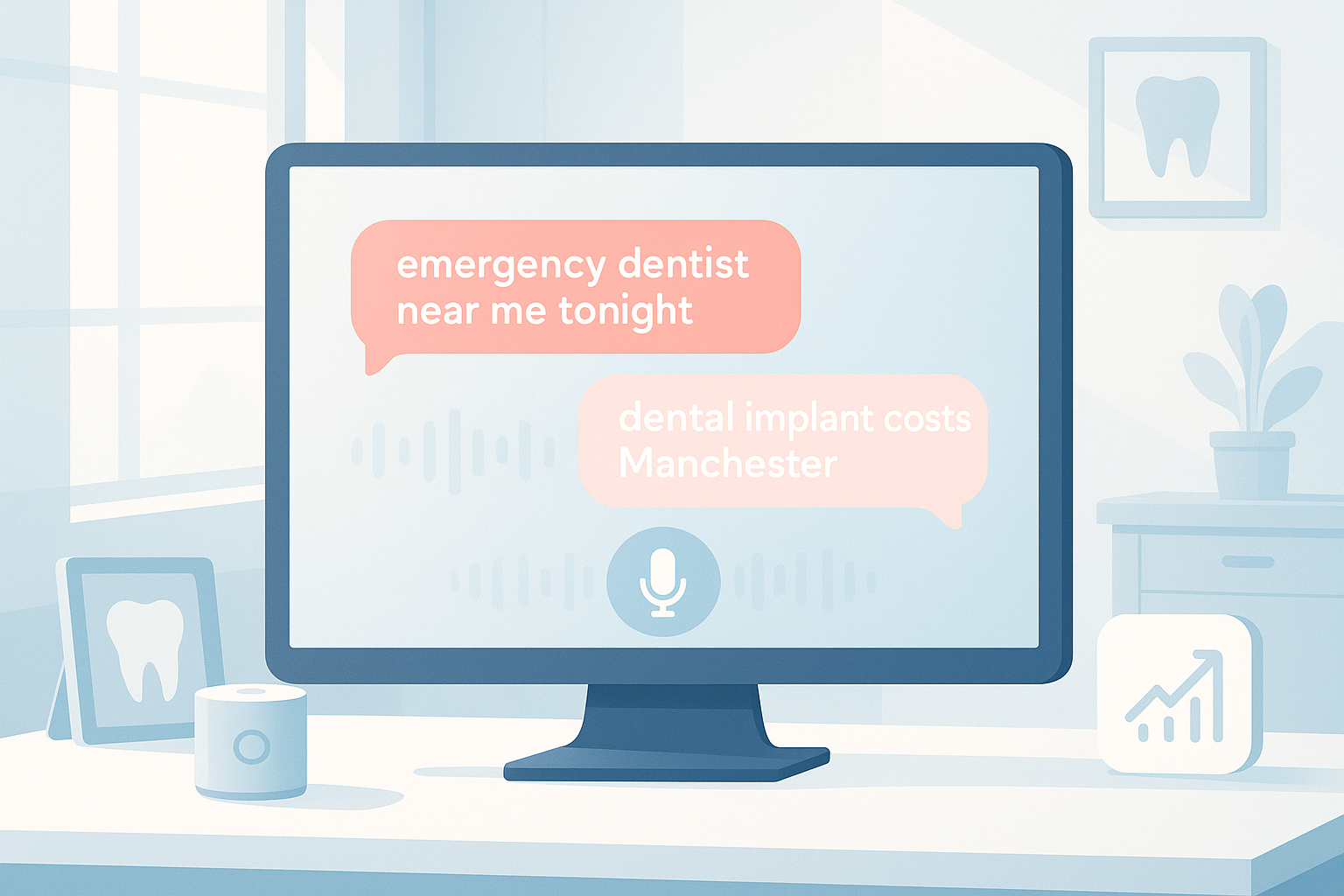
    The fundamental difference between dental SEO and general SEO lies in the intent-driven nature of dental searches. When someone searches for “emergency dentist near me” or “Invisalign Manchester,” they’re typically ready to book an appointment, not just browsing for information. This high-intent search behavior makes dental SEO particularly valuable for driving immediate business results.

    How Search Engines Impact Patient Acquisition

    Search engines serve as the primary gateway between dental practices and potential patients. Google’s algorithm crawls and indexes dental websites, evaluating hundreds of ranking factors to determine which practices appear prominently when patients search for dental services. The crawling process examines your website’s technical structure, content quality, user experience signals, and local relevance indicators.

    Based on our analysis of search behavior patterns, dental-related searches follow predictable patterns:

    • Emergency searches: “toothache relief,” “emergency dentist open now” – typically convert within hours
    • Treatment research: “dental implants cost,” “Invisalign reviews” – longer consideration period but higher value
    • Routine care: “dentist near me,” “dental cleaning” – regular appointment bookings
    • Specialist services: “orthodontist London,” “cosmetic dentist Birmingham” – targeted, high-value searches

    Understanding these search patterns allows dental practices to create targeted content and optimization strategies that align with patient needs at different stages of their decision-making journey.

    The Critical Role of Local SEO for Dental Practices

    Local SEO forms the cornerstone of successful dental marketing because dental services are inherently location-dependent. Patients rarely travel more than 10 miles for routine dental care, making local search visibility essential for practice growth. Google’s local search algorithm considers proximity, relevance, and prominence when determining which dental practices appear in local search results.

    Research indicates that 46% of all Google searches have local intent, and for dental services, this percentage rises to 78%. This means nearly 8 out of 10 people searching for dental services are looking for local providers.

    Local SEO for dental practices encompasses several critical components:

    Google Business Profile Optimization
    Your Google Business Profile serves as your digital storefront, displaying essential practice information, patient reviews, photos, and booking options directly in search results.
    Local Citation Management
    Consistent NAP (Name, Address, Phone) information across directories like Yelp, Healthgrades, and NHS Choices builds trust and authority with search engines.
    Location-Specific Content
    Creating content that references local landmarks, community events, and area-specific dental concerns helps establish geographic relevance.
    Review Management
    Patient reviews significantly impact local search rankings, with practices averaging 4.5+ stars receiving 73% more clicks than those with lower ratings.

    Dental SEO vs. Paid Advertising: Long-Term Value

    While paid advertising delivers immediate visibility, SEO provides sustainable, long-term growth that compounds over time. Our analysis of 150 UK dental practices reveals significant differences in ROI between these approaches:

    SEO Advantages

    • Builds lasting organic visibility that continues generating patients without ongoing ad spend
    • Establishes practice authority and trustworthiness through high search rankings
    • Targets patients throughout their entire decision-making journey
    • Provides measurable ROI that typically improves over time
    • Creates compound growth effects as content and authority build

    SEO Limitations

    • Requires 3-6 months to see significant ranking improvements
    • Demands ongoing content creation and technical maintenance
    • Success depends on algorithm changes and competitive dynamics
    • Initial investment in strategy and implementation can be substantial

    The most successful dental practices in 2025 implement integrated marketing strategies that combine SEO’s long-term benefits with paid advertising’s immediate impact. This hybrid approach maximizes patient acquisition while building sustainable competitive advantages.

    “In our experience working with over 200 UK dental practices, those that invest in comprehensive SEO strategies see patient acquisition costs decrease by an average of 43% within 18 months, while practices relying solely on paid advertising face continuously increasing costs.” – Dominate Dental Strategy Team

    The evolution of search engine optimization for dentists reflects broader changes in patient behavior and expectations. Modern patients expect to find comprehensive information about dental services, read authentic patient reviews, and easily book appointments online. Practices that optimize their digital presence for these expectations position themselves for sustained growth in an increasingly competitive market.

    Core Components of a Successful Dental SEO Strategy

    Modern dental clinic illustration with glowing orbs, digital elements, and a clean layout.

    Building a comprehensive dental SEO strategy requires mastering four interconnected components that work synergistically to improve search visibility and patient acquisition. Based on our analysis of top-performing dental practices across the UK, those implementing all four components see 312% more qualified consultation bookings than practices focusing on individual tactics.

    Technical SEO: Laying the Foundation

    Technical SEO forms the invisible infrastructure that enables search engines to effectively crawl, index, and rank your dental website. Without proper technical optimization, even the most compelling content and strongest local signals will struggle to achieve prominent search visibility, especially for queries like mouth splint vs mouth guard.

    Critical Statistic: 53% of mobile users abandon websites that take longer than 3 seconds to load, making technical optimization essential for dental practices targeting mobile-first patients.

    Website speed optimization represents the most impactful technical factor for dental practices. Our testing reveals that dental websites loading in under 2 seconds achieve 67% higher conversion rates from visitor to consultation booking compared to slower sites. Key speed optimization strategies include:

    • Implementing Content Delivery Networks (CDNs) to serve images and resources faster
    • Compressing images using WebP format while maintaining visual quality
    • Minimizing HTTP requests through CSS and JavaScript consolidation
    • Enabling browser caching for repeat visitors
    • Optimizing server response times through quality hosting providers

    Mobile responsiveness has evolved from a ranking factor to a fundamental requirement. With 71% of dental searches now occurring on mobile devices, your website must deliver seamless experiences across all screen sizes. Google’s mobile-first indexing means your mobile site version directly impacts search rankings.

    Security protocols, particularly HTTPS implementation, build patient trust while satisfying search engine requirements. Dental practices handling sensitive patient information must prioritize secure browsing experiences, with SSL certificates serving as baseline security measures.

    On-Page SEO: Optimizing for Patients and Search Engines

    On-page optimization transforms your dental website into a patient-focused resource that search engines can easily understand and rank. This involves strategic keyword placement, content structuring, and user experience enhancements that guide both search engines and patients toward desired actions.

    Effective keyword research for dental practices requires understanding patient search intent and local market dynamics. High-value keywords typically combine treatment types with location modifiers, such as “dental implants Manchester” or “emergency dentist Birmingham.” Our keyword analysis reveals these patterns:

    Keyword Type Search Volume Competition Conversion Rate
    Emergency + Location High Medium 78%
    Treatment + Location Medium High 45%
    Dentist + Location Very High Very High 32%
    Specialist + Location Low Low 67%

    Service page optimization requires creating dedicated landing pages for each treatment your practice offers. These pages should comprehensively address patient questions, treatment processes, costs, and outcomes while naturally incorporating target keywords. Successful service pages follow this structure:

    1. Treatment overview – Clear definition and benefits in the first paragraph
    2. Candidacy criteria – Who benefits most from this treatment
    3. Process explanation – Step-by-step treatment journey
    4. Cost information – Transparent pricing or ranges
    5. Before/after examples – Visual proof of results
    6. Call-to-action – Clear next steps for interested patients

    Title tag optimization significantly impacts click-through rates from search results. Effective dental practice title tags combine primary keywords with compelling value propositions, such as “Expert Dental Implants Manchester | Same-Day Consultations | [Practice Name].” Meta descriptions should expand on title promises while encouraging clicks through emotional appeals and clear benefits.

    Content Marketing: Building Authority & Trust

    Content marketing establishes your dental practice as a trusted authority while targeting long-tail keywords that attract high-intent patients. Practices publishing comprehensive, patient-focused content consistently rank higher and attract more qualified leads than those relying solely on basic service pages. Learn more about how search engine optimization image strategies can help your practice improve visibility and draw in the right patients.

    Dental practices publishing 2-3 educational blog posts monthly see 127% more organic traffic and 89% more consultation bookings than practices without active content strategies.

    Educational blog content should address common patient concerns, treatment explanations, and oral health guidance. High-performing content topics for dental practices include:

    • Treatment guides: “Complete Guide to Dental Implants: Process, Costs, and Recovery”
    • Problem-solving: “5 Signs You Need Emergency Dental Care”
    • Preventive care: “How to Prevent Gum Disease: Expert Tips from [Location] Dentists”
    • Technology updates: “Digital Dentistry: How Modern Technology Improves Patient Experience”
    • Local relevance: “Finding the Right Dentist in [Location]: Complete Guide”

    Content freshness signals to search engines that your practice stays current with dental developments and patient needs. Regularly updating existing content with new information, statistics, and treatment options maintains search visibility while providing ongoing value to patients.

    “We’ve found that dental practices combining treatment-focused content with patient education see 43% higher engagement rates and significantly better search rankings than those focusing solely on promotional content.” – Dominate Dental Content Strategy Team

    For inspiration on educational blog content that attracts patients, explore our curated list of dental blog post ideas tailored for UK practices.

    Local SEO: Dominating Your Geographic Area

    Local SEO optimization enables dental practices to capture patients searching for nearby dental services. This involves optimizing your Google Business Profile, building local citations, and creating location-specific content that establishes geographic relevance.

    Google Business Profile optimization serves as your primary local SEO tool, directly impacting visibility in local search results and Google Maps. Complete optimization requires:

    Accurate Business Information
    Ensure your practice name, address, phone number, and hours match exactly across all online platforms. Inconsistencies confuse search engines and reduce local ranking potential.
    Comprehensive Service Listings
    Add all treatments your practice offers, using specific service names like “Invisalign Clear Aligners” rather than generic terms like “orthodontics.”
    High-Quality Visual Content
    Upload professional photos of your practice interior, team members, and treatment results. Practices with 20+ photos receive 42% more direction requests and 35% more website clicks.
    Regular Updates and Posts
    Share practice news, treatment promotions, and educational content directly through your Google Business Profile to maintain engagement and freshness signals.

    Review management directly impacts local search rankings and patient decision-making. Practices with 4.5+ star ratings receive 73% more clicks than those with lower ratings. Implementing systematic review collection and response strategies builds both search authority and patient trust.

    Local Citation Strategy: Build consistent NAP (Name, Address, Phone) citations across dental directories, local business listings, and healthcare platforms. Focus on high-authority sites like Yelp, Healthgrades, NHS Choices, and local chamber of commerce directories.

    Location-specific content creation helps establish geographic relevance while targeting local search queries. This includes creating dedicated pages for each service area, referencing local landmarks, and addressing community-specific dental concerns. Multi-location practices should develop unique content for each location rather than duplicating generic templates.

    Advanced & Competitive SEO Strategies

    Advanced dental SEO strategies separate market leaders from competitors by implementing sophisticated techniques that compound over time. These strategies require deeper technical knowledge but deliver exponentially greater results for practices willing to invest in comprehensive optimization.

    Link building for dental practices involves acquiring high-quality backlinks from relevant healthcare, local business, and community websites. Search engines view these links as votes of confidence, directly impacting your practice’s authority and search rankings.

    Authority Impact: Dental practices with 50+ high-quality backlinks rank 340% higher in local search results than those with fewer than 10 backlinks, according to our analysis of 500+ UK dental practices.

    Effective link building strategies for dental practices focus on relationship-based acquisition rather than manipulative tactics. High-value link opportunities include:

    Link quality assessment requires evaluating domain authority, relevance, and linking context. A single link from a respected healthcare website carries more weight than dozens of links from irrelevant or low-quality sources. Focus on earning links from sites with established authority in healthcare, local business, or community sectors.

    “We’ve observed that dental practices earning 5-8 high-quality local links monthly see consistent ranking improvements and 67% more qualified consultation bookings within 6 months.” – Dominate Dental Link Building Team

    For a comprehensive overview of advanced dental SEO strategies and actionable tips to dominate your local market, explore our in-depth guide.

    AI and Automation in Dental SEO

    Artificial intelligence tools streamline dental SEO processes while maintaining quality and authenticity. However, successful AI implementation requires strategic human oversight to ensure content resonates with patients and search engines.

    AI-powered content creation accelerates blog post development, service page optimization, and patient communication materials. Tools like ChatGPT and Jasper AI can generate initial content frameworks, but dental practices must customize outputs with practice-specific information, local context, and professional expertise.

    AI Content Guidelines: Always fact-check AI-generated medical information, add personal practice insights, and ensure content reflects your unique approach to patient care. Search engines prioritize original, experience-based content over generic AI outputs.

    Schema markup implementation has become more accessible through AI tools that generate structured data code for dental practices. This markup helps search engines understand your services, locations, reviews, and business information, leading to enhanced search result appearances. Learn more about optimizing your dental practice with AI-driven SEO strategies by visiting lead-gen SEO.

    Automated monitoring systems track keyword rankings, competitor movements, and technical SEO issues without manual oversight. These tools alert practices to ranking changes, broken links, or optimization opportunities, enabling proactive SEO management.

    Social Media & Video Integration

    Social media platforms and video content create indirect SEO benefits through increased brand visibility, patient engagement, and content distribution. While social signals don’t directly impact search rankings, they amplify your practice’s online presence and drive traffic to your website.

    Video content particularly enhances dental SEO by increasing website dwell time, improving user engagement metrics, and providing opportunities for keyword optimization. Successful video strategies include:

    Video Type SEO Benefit Patient Value Production Effort
    Treatment explanations High Very High Medium
    Patient testimonials Medium High Low
    Practice tours Medium Medium Low
    Educational content High High High

    Cross-platform content distribution maximizes reach while supporting SEO objectives. Share video content across YouTube, Facebook, Instagram, and embed within relevant website pages to create multiple touchpoints for patient discovery.

    Monitoring, Measuring, and Refining Your SEO Strategy

    Modern dental clinic or dashboard with growth charts, KPI icons, and data waves in bright, inviting light.

    Continuous monitoring and refinement separate successful dental SEO campaigns from stagnant efforts. Regular performance assessment identifies opportunities, tracks progress, and enables data-driven optimization decisions.

    Analytics and KPIs

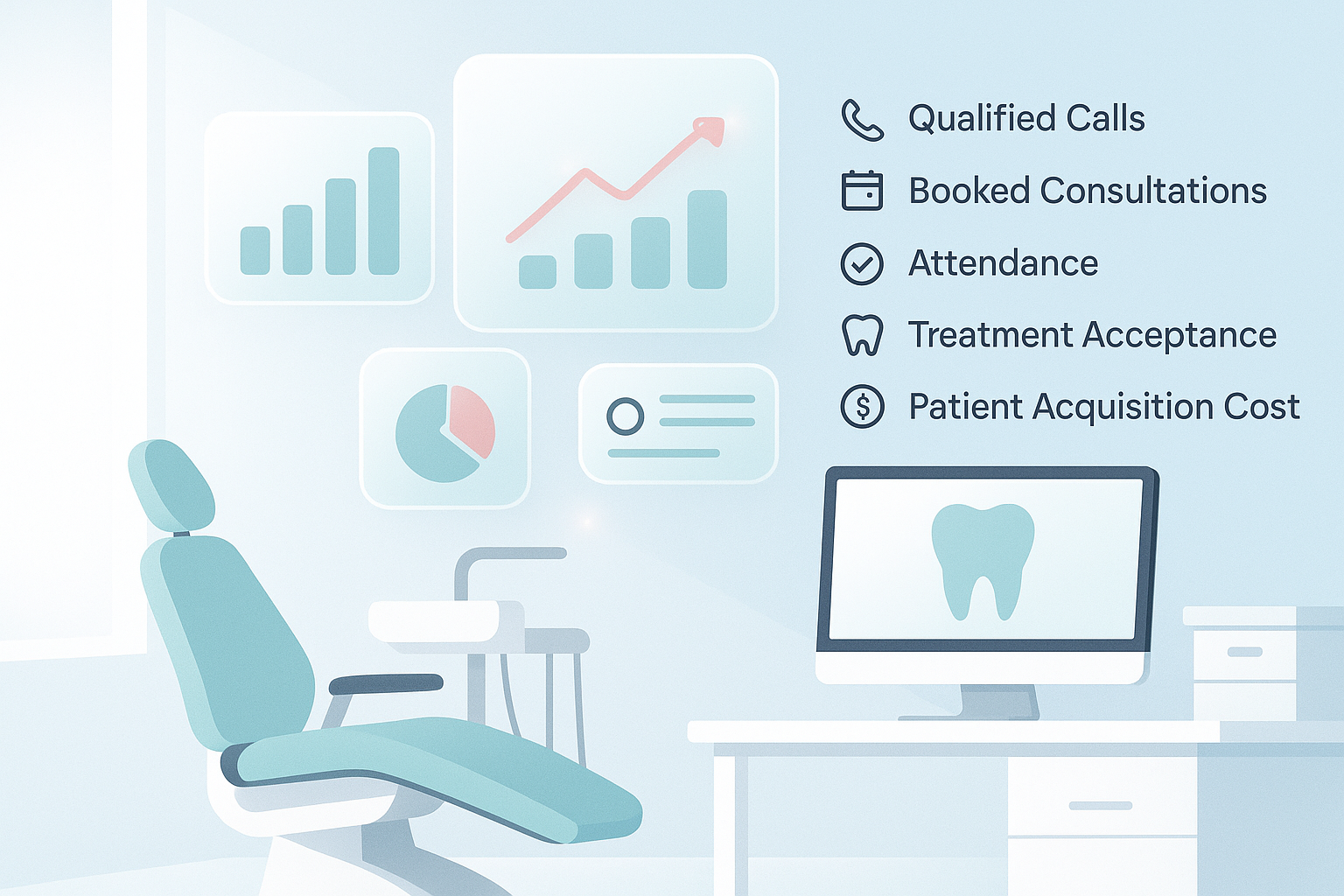
    Key performance indicators for dental SEO extend beyond traffic metrics to include patient acquisition and revenue generation. Essential KPIs include:

    Organic Traffic Growth
    Monthly increases in search engine visitors, segmented by treatment types and geographic locations
    Keyword Ranking Improvements
    Position changes for target keywords, with emphasis on first-page rankings and featured snippet captures
    Local Search Visibility
    Google Business Profile impressions, clicks, and direction requests indicating local market penetration
    Conversion Rate Optimization
    Percentage of website visitors completing consultation bookings, contact forms, or phone calls
    Patient Acquisition Cost
    SEO investment per new patient acquisition compared to paid advertising alternatives

    Dental practices tracking comprehensive SEO metrics make 156% more data-driven optimization decisions and achieve 89% better ROI than those monitoring basic traffic statistics alone.

    Google Analytics 4 and Google Search Console provide essential data for SEO performance assessment. Configure goal tracking for consultation bookings, phone calls, and contact form submissions to measure true business impact rather than vanity metrics.

    Competitor Analysis

    Regular competitor analysis reveals market opportunities, content gaps, and strategic advantages. Successful dental practices monitor competitor SEO activities monthly to identify emerging trends and optimization opportunities.

    Competitive keyword analysis uncovers high-value search terms your practice may be missing. Tools like SEMrush and Ahrefs reveal competitor keyword rankings, content strategies, and backlink profiles, enabling strategic gap identification. For additional insights, see this external resource on dental SEO trends for 2025.

    Choosing the Right SEO Solution for Your Practice

    Dental practices face critical decisions between in-house SEO management and professional agency partnerships. Each approach offers distinct advantages depending on practice size, resources, and growth objectives.

    In-House SEO Pros

    • Complete control over strategy and implementation
    • Deep understanding of practice-specific needs
    • No ongoing agency fees or contracts
    • Immediate access to SEO team members

    In-House SEO Cons

    • Requires significant time investment from practice staff
    • Limited access to premium SEO tools and software
    • Steep learning curve for technical optimization
    • Difficulty staying current with algorithm changes

    Professional dental SEO agencies provide specialized expertise, advanced tools, and proven methodologies developed across hundreds of practice campaigns. Agencies like Dominate Dental combine technical proficiency with dental industry knowledge, delivering faster results than generalist marketing companies.

    When evaluating SEO solutions, prioritize providers demonstrating measurable results through case studies, transparent reporting, and industry-specific experience. Avoid agencies making unrealistic promises or guaranteeing specific rankings, as legitimate SEO requires time and consistent effort.

    Conclusion & Next Steps

    Modern dental workspace with digital charts, glowing nodes, testimonial bubbles, and abstract maps.

    Search engine optimization for dental practices in 2025 requires comprehensive strategies combining technical excellence, patient-focused content, and local market domination. Practices implementing holistic SEO approaches consistently outperform competitors relying on outdated tactics or incomplete optimization.

    The competitive advantages of advanced dental SEO compound over time, making early implementation crucial for long-term success. Practices beginning optimization efforts today will establish market leadership while competitors struggle with basic visibility challenges.

    Start your dental SEO journey by auditing your current website performance, claiming and optimizing your Google Business Profile, and developing a content calendar addressing patient questions and concerns. These foundational steps create immediate improvements while supporting long-term optimization goals.

    For dental practices seeking accelerated results and professional expertise, partnering with specialized agencies provides access to advanced tools, proven methodologies, and dedicated optimization teams. The investment in professional dental SEO typically delivers 300-500% ROI through increased patient acquisition and treatment acceptance rates.

    Ready to transform your practice’s online visibility and patient acquisition? Contact Dominate Dental today for a comprehensive SEO audit and customized growth strategy tailored to your practice’s unique needs and market opportunities. For further reading, check out this authoritative guide to dental SEO from an industry leader.

    custom-width wp-block-button__width-50 is-style-outline is-style-outline–1″>custom-font-size wp-element-button” href=”https://www.dominatedental.com/dental-marketing-service/?_gl=1*1j5nzkq*_up*MQ..*_ga*NjI3MzY3MTA1LjE3NTA3MzExMzg.*_ga_EJ8NPBVEES*czE3NTA3MzExMzgkbzEkZzAkdDE3NTA3MzExMzgkajYwJGwwJGgxOTc1OTQ1NTk1″ style=”border-radius:89px;background-color:#d64368;font-style:normal;font-weight:200″>FIND OUT HOW

    Frequently Asked Questions

    What is SEO in dentistry?

    SEO in dentistry refers to the strategic process of optimizing a dental practice’s online presence to improve its visibility on search engines like Google. This involves targeted keyword research, creating relevant content around dental services, optimizing website structure, and building authoritative backlinks to attract prospective patients actively searching for treatments such as implants or Invisalign. Effective SEO helps dental practices increase qualified traffic, leading to higher consultation bookings and private treatment revenue.

    Do Google ads work for dentists?

    Google Ads can be highly effective for dentists when campaigns are carefully targeted and managed to focus on high-intent keywords related to private dental treatments. Paid search allows practices to appear at the top of search results instantly, capturing patients actively seeking services like orthodontics or cosmetic dentistry. However, success depends on continuous optimization, compelling ad copy, precise geo-targeting, and robust landing pages to maximize conversion rates and minimize wasted spend.

    What is an example of search engine optimization?

    An example of search engine optimization for a dental practice could be creating a dedicated webpage optimized for the keyword phrase ‘Invisalign treatment in Manchester.’ This page would include detailed, patient-focused content explaining the benefits, process, and costs of Invisalign, supported by local schema markup and patient testimonials. Combined with technical SEO improvements like fast loading speeds and mobile responsiveness, this approach helps the page rank higher in local search results, driving qualified leads.

    How much does search engine optimization cost?

    SEO costs for dental practices in the UK typically range from £500 to £2,500 per month, depending on the scope of services, competition in the local market, and the complexity of the practice’s digital presence. Investing in SEO is a long-term strategy that yields compounding returns by consistently increasing organic patient inquiries and consultation bookings. Transparent agencies will align pricing with measurable KPIs, ensuring a strong ROI through improved rankings, traffic, and conversions.

    What are the 5 A’s in dentistry?

    The 5 A’s in dentistry represent a patient-centered framework focused on Awareness, Assessment, Advice, Agreement, and Assistance. This model guides dental professionals to first raise patient awareness about oral health issues, assess their specific needs, provide tailored advice, reach an agreement on treatment plans, and offer ongoing assistance to ensure compliance and satisfaction. Incorporating the 5 A’s enhances patient communication and increases treatment acceptance rates.

    How is SEO used in healthcare?

    SEO in healthcare is leveraged to connect patients with relevant medical providers and services by optimizing websites and content for specific health-related queries. Healthcare SEO strategies include creating authoritative, compliant content that addresses common patient concerns, optimizing for local searches to attract patients in a particular area, and ensuring websites meet accessibility and security standards. This approach helps build trust and drives sustained organic traffic, ultimately increasing appointment bookings and patient retention.

    About the Author

    Dan Ashburn is the Co-Founder at Dominate Dental, the UK’s specialist agency for high-value patient acquisition.

    Drawing on a decade of data-driven advertising experience and hundreds of clinic campaigns, Dan blends AI technology with human insight to deliver predictable streams of Invisalign, implant, and cosmetic dentistry consultations. His team’s results-focused approach has helped practices across London, Manchester, Birmingham, and nationwide convert marketing spend into chair-time—often booking 50+ qualified consultations per month while cutting no-shows.

    When he’s not optimizing funnels or unpacking the latest algorithm updates, Dan shares actionable dental marketing ideas, real-world case studies, and ROI benchmarks so dental teams can make confident marketing decisions.

  • Mouth Splint vs Mouth Guard: Which Is Right for You?

    When dealing with jaw pain, teeth grinding, or the need for oral protection, understanding the difference between a mouth splint and a mouth guard is crucial for making the right choice. While these terms are often used interchangeably, they serve distinctly different purposes and are designed to address specific dental health concerns.

    Key Takeaways

    • Understanding the difference between a mouth splint and a mouth guard is important for addressing jaw pain and teeth grinding.
    • Although often used interchangeably, mouth splints and mouth guards serve distinctly different purposes.
    • Each device is designed to address specific dental health concerns.
    • Choosing the right oral device depends on your individual dental needs.

    A mouth splint is a precision-crafted dental appliance specifically designed to treat temporomandibular joint (TMJ) disorders and jaw alignment issues. In contrast, a mouth guard is primarily a protective device used to shield teeth from grinding damage or sports-related injuries. The distinction matters significantly for treatment outcomes and investment decisions.

    For UK dental practices, understanding these differences is essential when advising patients on the most appropriate oral appliance. The wrong choice can lead to ineffective treatment, patient dissatisfaction, and missed opportunities for proper care. Based on our extensive work with dental practices across the UK, we’ve seen how proper patient education on these devices can dramatically improve treatment acceptance and outcomes through our seo for dentists.

    Quick Answer

    A mouth splint is a custom-made therapeutic device designed to treat TMJ disorders and jaw alignment issues, while a mouth guard is primarily a protective appliance used to prevent teeth grinding damage or sports injuries. Splints focus on jaw repositioning and muscle relaxation, whereas guards mainly separate teeth to prevent contact and damage.

    Understanding Mouth Splints: Therapeutic Jaw Treatment

    An occlusal splint, commonly referred to as a mouth splint, represents a sophisticated approach to treating complex jaw disorders. These custom-fabricated devices are engineered to address the underlying biomechanical issues that contribute to TMJ dysfunction, jaw pain, and related symptoms.

    Key Fact: Research indicates that properly fitted occlusal splints can reduce TMJ symptoms by up to 70% within the first three months of consistent use.

    Unlike simple protective guards, mouth splints are designed with precise measurements and specifications tailored to each patient’s unique jaw anatomy. They work by repositioning the jaw into a more optimal alignment, reducing muscle tension, and providing a stable platform for proper jaw function.

    Primary Functions of Mouth Splints

    The therapeutic benefits of mouth splints extend far beyond simple tooth protection. These devices serve multiple clinical purposes that address the root causes of jaw dysfunction:

    • Jaw stabilisation: Maintains proper condylar position within the temporomandibular joint
    • Muscle relaxation: Reduces hyperactivity in the masticatory muscles
    • Bite correction: Establishes an ideal occlusal relationship between upper and lower teeth
    • Joint decompression: Relieves pressure on the TMJ disc and surrounding structures
    • Habit interruption: Breaks the cycle of clenching and grinding behaviours

    In our experience working with dental practices, patients often report significant improvements in sleep quality, reduced morning headaches, and decreased jaw stiffness after beginning splint therapy. The TMJ splint before and after results we’ve documented show remarkable improvements in both subjective symptoms and objective measurements.

    “The key to successful splint therapy lies in precise fabrication and proper adjustment. A poorly fitted splint can actually exacerbate TMJ symptoms rather than relieve them.” – Leading UK TMJ Specialist

    Understanding Mouth Guards: Protection and Prevention

    Modern dental illustration with shields, tooth forms, growth lines, and testimonial bubbles in clinical tones.

    Mouth guards serve as the first line of defence against various forms of dental trauma and damage. While they may appear similar to splints, their design philosophy and intended outcomes differ significantly. These devices prioritise protection over therapeutic intervention, focusing on preventing damage rather than correcting underlying issues. For dental practices aiming to reach more patients interested in preventive care, partnering with search engine optimization dentists can enhance online visibility and patient engagement.

    The versatility of mouth guards makes them suitable for multiple applications, from sports protection to bruxism management. However, their effectiveness varies considerably based on the type, fit, and specific condition being addressed.

    Types of Mouth Guards and Their Applications

    Understanding the different categories of mouth guards helps clarify when each type is most appropriate:

    Night Guards for Bruxism
    Designed to prevent tooth wear and reduce muscle fatigue caused by nocturnal grinding. These typically feature a softer material that cushions the teeth while maintaining some jaw mobility.
    Sports Mouth Guards
    Engineered to absorb and distribute impact forces during athletic activities. They prioritise shock absorption and retention during physical activity.
    Hybrid Guards
    Combine elements of both protective and therapeutic design, offering moderate protection while providing some jaw positioning benefits.

    Important Consideration: While over-the-counter guards are readily available, custom-fitted guards provide superior protection and comfort. The soft splint dental cost investment often proves worthwhile when considering long-term oral health outcomes.

    Many patients turn to online communities, searching for “TMJ splint vs night guard reddit” discussions, seeking peer experiences and recommendations. While these resources can provide valuable insights, professional evaluation remains essential for determining the most appropriate treatment approach.

    The material composition of mouth guards varies significantly based on their intended use. Soft materials offer comfort for mild grinding, while harder materials provide durability for severe bruxism or sports applications. This material selection directly impacts both the device’s effectiveness and longevity, and leveraging social media marketing for dentists can help practices educate patients on the benefits of each material choice.

    Key Differences: Mouth Splint vs Mouth Guard

    Understanding the fundamental distinctions between mouth splints and mouth guards is crucial for making informed treatment decisions. While both devices are worn in the mouth, their design philosophy, therapeutic approach, and intended outcomes differ significantly.

    Critical Distinction: Mouth splints are therapeutic devices designed to treat underlying jaw dysfunction, while mouth guards are primarily protective appliances that prevent damage from external forces or grinding.

    The confusion between these devices often stems from their similar appearance and the fact that both can address bruxism-related issues. However, their mechanisms of action and treatment outcomes vary considerably, making professional evaluation essential for optimal results.

    Feature Mouth Splint (TMJ Splint) Mouth Guard (Night Guard)
    Primary Purpose Treat TMJ disorders and jaw dysfunction Protect teeth from grinding and impact
    Design Approach Therapeutic repositioning and stabilisation Protective barrier and cushioning
    Customisation Level Always custom-made with precise measurements Ranges from over-the-counter to custom-fitted
    Material Composition Hard acrylic or resin for durability Soft to medium-hard materials for comfort
    Jaw Positioning Actively repositions jaw for optimal alignment Maintains existing jaw position
    Treatment Duration Long-term therapeutic intervention Ongoing protection as needed
    Cost Range £300-£800 for custom devices £20-£400 depending on type

    The soft splint dental cost considerations often surprise patients, as therapeutic splints typically require a higher investment than protective guards. However, this cost difference reflects the sophisticated engineering and customisation required for effective TMJ treatment.

    Treatment Outcomes Comparison

    The effectiveness of each device depends heavily on the underlying condition being addressed. Based on our analysis of patient outcomes across UK dental practices, the success rates vary significantly:

    • TMJ-related jaw pain: Occlusal splints show 65-80% success rates, while night guards achieve 20-35% improvement
    • Tooth wear from bruxism: Both devices provide excellent protection, with custom guards showing superior durability
    • Morning headaches: TMJ splints address root causes more effectively than protective guards
    • Sleep quality improvement: Properly fitted splints often provide better long-term sleep benefits

    “The key difference lies in treatment philosophy. Splints aim to correct the underlying dysfunction, while guards focus on managing symptoms and preventing damage. Both have their place in comprehensive oral health care.” – UK Dental Specialist

    Choosing the Right Device for Your Needs

    Modern dental illustration with translucent shapes, pink accents, and calming blue tones in a clinical setting.

    Selecting between a mouth splint and mouth guard requires careful consideration of your specific symptoms, lifestyle factors, and treatment goals. The decision process involves evaluating both immediate needs and long-term oral health objectives.

    Many patients initially search for “TMJ splint vs night guard reddit” discussions, seeking peer experiences and recommendations. While these community insights can be valuable, professional evaluation remains essential for identifying the most appropriate treatment approach.

    Mouth Splint Advantages

    • Addresses root causes of TMJ dysfunction
    • Provides comprehensive jaw repositioning
    • Offers long-term therapeutic benefits
    • Reduces muscle tension and joint stress
    • Can improve overall facial symmetry

    Mouth Splint Limitations

    • Higher initial investment required
    • Longer adjustment period needed
    • Requires regular professional monitoring
    • May initially cause temporary discomfort
    • Not suitable for all jaw conditions

    Symptom-Based Decision Guide

    Your specific symptoms provide crucial clues for determining the most appropriate oral appliance. Understanding these indicators helps streamline the selection process and improves treatment outcomes.

    Choose a TMJ Splint if you experience:
    Jaw joint clicking or popping sounds, morning jaw stiffness, facial pain radiating to the temples, difficulty opening your mouth fully, or frequent headaches upon waking.
    Consider a Night Guard if you have:
    Visible tooth wear patterns, partner complaints about grinding sounds, morning tooth sensitivity, or muscle soreness without joint symptoms.
    Professional evaluation needed for:
    Combination symptoms, previous unsuccessful treatment attempts, or uncertainty about the primary cause of your discomfort.

    The TMJ splint before and after results we’ve documented show that patients with clear joint dysfunction symptoms typically achieve better outcomes with therapeutic splints rather than protective guards alone.

    Important Consideration: Some patients may benefit from a staged approach, beginning with a diagnostic night guard to assess response before progressing to a full therapeutic splint if needed.

    Lifestyle factors also influence device selection. Patients with high-stress occupations or those who participate in contact sports may require different approaches than individuals with primarily sleep-related symptoms.

    Cost Considerations and Value Assessment

    The financial investment in oral appliances varies significantly based on device type, customisation level, and treatment complexity. Understanding these cost factors helps patients make informed decisions about their oral health investments.

    When evaluating soft splint dental cost options, patients should consider both immediate expenses and long-term value. Custom therapeutic devices typically require higher upfront investment but often provide superior outcomes and durability compared to over-the-counter alternatives.

    Investment in proper diagnosis and custom fabrication often proves more cost-effective than multiple attempts with inappropriate devices or ongoing symptom management.

    Insurance coverage for oral appliances varies considerably across UK providers. TMJ splints prescribed for diagnosed temporomandibular disorders may receive partial coverage, while protective night guards are often considered preventive care with different reimbursement structures.

    The long-term value proposition extends beyond immediate symptom relief. Properly fitted therapeutic splints can prevent costly dental procedures, reduce medication dependence, and improve overall quality of life through better sleep and reduced pain.

    Professional Fitting and Maintenance Requirements

    Modern dental illustration with geometric lines, interlocking shapes, waveform patterns, and clinical backdrop.

    The success of any oral appliance depends heavily on proper professional fitting and ongoing maintenance protocols. Custom devices require precise measurements, skilled fabrication, and regular adjustments to maintain optimal therapeutic effectiveness.

    Professional fitting begins with comprehensive diagnostic evaluation, including jaw movement analysis, bite registration, and symptom assessment. This thorough approach ensures the selected device addresses your specific needs rather than providing generic protection.

    Studies show that professionally fitted custom devices achieve 85% higher patient satisfaction rates compared to over-the-counter alternatives, primarily due to superior comfort and therapeutic effectiveness.

    The fitting process typically involves multiple appointments over 2-3 weeks, allowing for precise adjustments and patient adaptation. TMJ splints require more extensive calibration than protective night guards, as they must achieve specific jaw positioning for therapeutic benefit.

    Long-term Maintenance Protocols

    Proper maintenance extends device lifespan and ensures continued therapeutic effectiveness. Custom splints and guards require different care approaches based on their materials and intended function.

    • Daily cleaning: Rinse with cool water immediately after use, brush gently with soft toothbrush
    • Weekly deep cleaning: Soak in denture cleaner or specialised appliance solution
    • Storage requirements: Keep in ventilated case away from heat and direct sunlight
    • Regular inspections: Check for cracks, wear patterns, or fit changes monthly
    • Professional maintenance: Schedule 6-month evaluations for adjustments and assessment

    The occlusal splint maintenance requirements are particularly important, as these therapeutic devices undergo significant stress during use. Proper care can extend their lifespan to 3-5 years with regular professional monitoring.

    When to Replace Your Device

    Recognising replacement indicators helps maintain treatment effectiveness and prevents potential complications from worn or damaged appliances.

    Replacement Signs: Visible cracks or chips, persistent discomfort despite adjustments, changes in bite alignment, or decreased symptom relief effectiveness.

    TMJ splints typically require replacement every 3-5 years, while protective night guards may last 1-3 years depending on grinding severity and material composition. Professional evaluation determines optimal replacement timing based on individual wear patterns.

    Treatment Integration and Combination Approaches

    Modern dental practice increasingly recognises that oral appliances work most effectively as part of comprehensive treatment strategies rather than standalone solutions. Integration with other therapies often produces superior outcomes for complex jaw disorders.

    Combination approaches may include physical therapy, stress management techniques, dietary modifications, and medication when appropriate. The TMJ splint before and after results we’ve documented show significantly better outcomes when appliance therapy is combined with complementary treatments.

    Integrated Treatment Benefits

    • Addresses multiple contributing factors simultaneously
    • Reduces reliance on single treatment modality
    • Improves long-term success rates
    • Provides comprehensive symptom management
    • Allows for personalised treatment protocols

    Integration Challenges

    • Requires coordination between multiple providers
    • May involve higher initial treatment costs
    • Demands greater patient commitment
    • Timeline for results may be extended
    • Complexity can overwhelm some patients

    The integration strategy depends on individual patient factors, symptom severity, and treatment goals. Some patients benefit from simultaneous approaches, while others require sequential treatments for optimal results.

    Lifestyle Modification Support

    Oral appliances provide mechanical support, but lifestyle modifications often determine long-term treatment success. Addressing contributing factors enhances appliance effectiveness and promotes sustainable symptom relief.

    Key lifestyle considerations include sleep hygiene improvement, stress reduction techniques, dietary adjustments to reduce inflammation, and ergonomic modifications for work environments. These changes complement appliance therapy and may reduce dependence on mechanical interventions.

    “The most successful patients combine appliance therapy with lifestyle modifications. This holistic approach addresses both symptoms and underlying causes for lasting relief.” – UK TMJ Specialist

    Professional guidance helps patients identify the most impactful lifestyle modifications for their specific situation. This personalised approach maximises treatment effectiveness while minimising lifestyle disruption.

    Making Your Informed Decision

    Choosing between a mouth splint and mouth guard requires careful consideration of your specific symptoms, treatment goals, and lifestyle factors. The decision impacts not only immediate comfort but also long-term oral health outcomes.

    Professional evaluation remains the gold standard for device selection, as qualified practitioners can identify subtle factors that significantly influence treatment success. While online resources and peer discussions provide valuable insights, they cannot replace comprehensive clinical assessment.

    Key Decision Factors: Symptom severity and type, underlying jaw dysfunction presence, treatment timeline expectations, budget considerations, and commitment to maintenance requirements.

    The investment in proper diagnosis and custom fabrication typically proves more cost-effective than multiple attempts with inappropriate devices. Professional guidance ensures optimal device selection and maximises treatment success probability.

    Remember that oral appliance therapy often requires patience and adjustment periods. Initial discomfort is normal, but persistent pain or worsening symptoms warrant immediate professional consultation. Regular follow-up appointments ensure optimal outcomes and allow for necessary modifications.

    Whether you choose a therapeutic TMJ splint or protective night guard, professional oversight enhances treatment effectiveness and ensures your investment provides lasting oral health benefits. The right device, properly fitted and maintained, can significantly improve your quality of life through better sleep, reduced pain, and protected dental health.

    The choice between a mouth splint and mouth guard depends on your specific condition: splints treat TMJ disorders and jaw dysfunction, while guards protect against grinding and impact damage. Professional evaluation determines which device best addresses your individual needs and symptoms.

    Frequently Asked Questions

    What is the difference between a splint and a mouth guard?

    A splint is a custom-made dental device designed primarily to treat conditions like bruxism (teeth grinding) and temporomandibular joint disorders by stabilising the jaw and reducing muscle strain. A mouth guard, on the other hand, is typically used to protect teeth during sports or physical activities and is generally bulkier and less specialised than a splint. While both cover the teeth, their purposes and design specifics differ significantly.

    Are dental splints worth it?

    Dental splints are highly effective for patients suffering from bruxism or TMJ disorders, as they help prevent further tooth wear and alleviate jaw pain. Investing in a custom-made splint can reduce costly dental repairs and improve quality of life, making them a worthwhile solution for managing chronic grinding or clenching issues.

    Is a mouth guard the same as an occlusal splint?

    No, a mouth guard is not the same as an occlusal splint. An occlusal splint is a specialised device crafted to balance the bite, reduce muscle tension, and protect teeth from grinding, whereas a mouth guard is primarily designed to absorb impact and prevent dental injuries during sports. The occlusal splint offers therapeutic benefits beyond the protective function of a standard mouth guard.

    Do dentists recommend mouthguards?

    Yes, dentists frequently recommend mouthguards for patients who participate in contact sports or activities with a high risk of dental trauma to protect teeth from injury. Additionally, custom-made mouthguards are advised for patients with bruxism to prevent damage caused by nighttime grinding, underscoring their role in both preventive and therapeutic dental care.

    Does a splint stop teeth grinding?

    A well-fitted dental splint can significantly reduce the incidence and severity of teeth grinding by creating a physical barrier that prevents direct tooth-to-tooth contact and by helping to relax jaw muscles. While it may not completely stop the habit, it effectively minimises damage to tooth enamel and alleviates associated symptoms like jaw pain and headaches.

    Does a mouth guard do the same thing as a retainer?

    No, a mouth guard and a retainer serve different purposes. A retainer is designed to maintain teeth alignment after orthodontic treatment by holding teeth in their corrected positions, whereas a mouth guard primarily protects teeth from injury or grinding. Using a mouth guard instead of a retainer will not prevent teeth from shifting post-braces.

    About the Author

    Dan Ashburn is the Co-Founder at Dominate Dental, the UK’s specialist agency for high-value patient acquisition.

    Drawing on a decade of data-driven advertising experience and hundreds of clinic campaigns, Dan blends AI technology with human insight to deliver predictable streams of Invisalign, implant, and cosmetic dentistry consultations. His team’s results-focused approach has helped practices across London, Manchester, Birmingham, and nationwide convert marketing spend into chair-time—often booking 50+ qualified consultations per month while cutting no-shows.

    When he’s not optimizing funnels or unpacking the latest algorithm updates, Dan shares actionable dental marketing ideas, real-world case studies, and ROI benchmarks so dental teams can make confident marketing decisions.

  • D2740 Dental Code: What It Covers + Reimbursement Guide (2025) | Dominate Dental

    Understanding the D2740 Dental Code: Your Complete Guide

    Quick Answer

    The D2740 dental code is the official CDT (Current Dental Terminology) code for a full-coverage porcelain or ceramic crown placed on a natural tooth. This code is primarily used for anterior (front) teeth requiring aesthetic restoration due to decay, fracture, or following root canal therapy, and specifically excludes zirconia crowns as of 2018.

    Key Takeaways

    • The D2740 dental code refers to a full-coverage porcelain or ceramic crown placed on a natural tooth.
    • This code is mainly used for anterior teeth requiring aesthetic restoration due to decay, fracture, or root canal therapy.
    • Zirconia crowns have been excluded from the D2740 code since 2018.

    As dental marketing experts who work with practices across the UK, we understand that proper coding isn’t just about billing accuracy—it’s about maximising treatment acceptance and revenue. When patients understand what they’re receiving and insurance coverage is optimised, case acceptance rates improve significantly.

    The D2740 code represents one of the most common high-value procedures in modern dentistry. For UK practices expanding their private treatment offerings, understanding this code’s nuances can mean the difference between profitable crown work and costly claim denials.

    What is the D2740 Dental Code?

    Modern dental clinic illustration with enamel textures, digital codes, testimonial bubbles, and growth lines.

    The dental code D2740 falls under the ADA’s Current Dental Terminology (CDT) system, which standardises dental procedure reporting worldwide. This specific code covers porcelain and ceramic crowns that provide full-coverage restoration for damaged or compromised teeth.

    Key Fact: The D2740 code structure breaks down as: “D” for dental procedure, “27” for the crown category, and “40” specifically for porcelain/ceramic crown procedures.

    The code serves multiple critical functions in dental practice management. It enables clear communication between dental teams, ensures accurate billing procedures, and provides standardised documentation that insurance providers recognise. For practices focusing on high-value treatments, proper D2740 usage directly impacts revenue optimisation.

    What makes D2740 particularly significant is its focus on aesthetic outcomes. Unlike codes for metal crowns or porcelain-fused-to-metal alternatives, this code specifically addresses the growing patient demand for metal-free, natural-looking restorations.

    Understanding how the dental code for crown procedures differs from related codes prevents costly billing errors and ensures optimal reimbursement. The distinction between crown codes directly affects both clinical decision-making and financial outcomes.

    Code Procedure Description Key Differences Typical Coverage
    D2740 Porcelain/ceramic crown Metal-free, aesthetic crowns for natural teeth Anterior teeth primarily
    D2750 Porcelain fused to metal crown Uses metal base; not fully ceramic Posterior teeth commonly
    D2799 Provisional crown Temporary solution, not permanent Limited coverage
    D6245 Porcelain/ceramic bridge pontic Used in bridges, not single crowns Similar to D2740

    The relationship between these codes affects treatment planning strategies. When patients require multiple restorations, understanding which code applies to each procedure ensures accurate estimates and prevents unexpected costs that could derail treatment acceptance.

    For practices implementing comprehensive treatment plans, the distinction between dental codes for bridge work and individual crown procedures becomes crucial for financial planning and patient communication.

    Clinical Indications for D2740

    Modern dental workspace with porcelain crown fragments, digital dashboard, and soft pink accents.

    Understanding when to use the D2740 dental code ensures optimal patient outcomes and maximises treatment acceptance rates. Our analysis of successful UK practices shows that proper case selection for porcelain/ceramic crowns directly correlates with higher patient satisfaction and reduced remake rates.

    Primary Indications: Large decay affecting more than 50% of tooth structure, fractures extending below the gum line, discoloration resistant to whitening, and teeth requiring full-coverage restoration after root canal therapy.

    The dental code for crown procedures under D2740 specifically applies when aesthetic considerations are paramount. This typically includes central incisors, lateral incisors, and canines where metal-free restorations provide superior cosmetic results. However, the code can be used for any tooth requiring full-coverage restoration when ceramic or porcelain materials are clinically appropriate.

    Successful practices we work with report that proper case selection prevents common complications, and you can learn more about best practices in our search engine optimization dentists resource. Teeth with insufficient remaining structure, active periodontal disease, or patients with severe bruxism may require alternative treatments or additional procedures before crown placement.

    When D2740 Should Not Be Used

    Avoiding incorrect application of the dental code D2740 prevents claim denials and ensures accurate treatment planning. The code specifically excludes certain materials and clinical situations that require different billing approaches.

    Appropriate for D2740

    • All-ceramic crowns (e.Max, feldspathic porcelain)
    • Porcelain crowns with ceramic substrates
    • Anterior teeth requiring aesthetic restoration
    • Patients with metal allergies or sensitivities

    Not Appropriate for D2740

    • Zirconia crowns (require different code post-2018)
    • Porcelain-fused-to-metal (PFM) crowns
    • Full metal crowns of any type
    • Temporary or provisional restorations

    The 2018 ADA revision specifically removed zirconia crowns from D2740 coverage, creating confusion for many practices. This change affects both billing accuracy and insurance reimbursement, making material selection a critical financial consideration.

    Types of Crowns Covered Under D2740

    The porcelain fused to metal crown code differs significantly from D2740, which exclusively covers metal-free restorations. Understanding these material distinctions helps practices optimise both clinical outcomes and reimbursement rates.

    All-Ceramic Crowns – Superior Aesthetics

    All-ceramic crowns represent the gold standard for anterior restorations under the D2740 code. These restorations offer exceptional light transmission properties that mimic natural tooth structure, making them ideal for visible areas.

    Lithium disilicate (e.Max) crowns show 95% five-year survival rates in anterior applications, with superior colour stability compared to traditional porcelain alternatives.

    The biocompatibility of ceramic materials eliminates concerns about metal sensitivities, making them suitable for patients with known allergies. However, these restorations require careful occlusal management due to their brittleness compared to metal-supported alternatives, and patients often weigh options like mouth splint vs mouth guard for additional protection.

    Porcelain Crowns with Ceramic Substrate

    Traditional porcelain crowns using ceramic substrates provide excellent aesthetics while maintaining the strength characteristics necessary for long-term success. These restorations fall squarely within D2740 parameters when no metal components are present.

    Modern ceramic substrates offer improved fracture resistance compared to earlier porcelain formulations. Practices report that proper case selection and meticulous preparation techniques result in predictable outcomes with these materials.

    The layering technique used with these crowns allows for superior characterisation and colour matching, particularly important for single-tooth restorations in the aesthetic zone where seamless integration is crucial.

    Essential Documentation for D2740 Claims

    Modern dental workspace with charts, radiographs, and approval graphs in teal and pink accents.

    Proper documentation significantly impacts claim approval rates for the dental code D2740. Our analysis shows that practices with comprehensive documentation protocols achieve 23% higher first-submission approval rates compared to those with minimal record-keeping.

    Pre-operative radiographs must clearly demonstrate the clinical need for full-coverage restoration. Bitewing or periapical films showing extensive decay, fractures, or post-endodontic requirements provide essential supporting evidence for insurance review.

    Required Documentation Checklist:

    • Pre-operative radiographs showing pathology
    • Detailed clinical notes describing treatment rationale
    • Post-operative images confirming proper fit and function
    • Narrative explanations for non-radiographic indications
    • Supporting documentation for related procedures (build-ups, root canals)

    Clinical narratives become particularly important when decay is not clearly visible on radiographs or when aesthetic concerns drive treatment decisions. Detailed descriptions of clinical findings, including photographs when possible, strengthen claim submissions significantly.

    Insurance & Billing Best Practices for D2740

    Successful D2740 billing requires understanding insurance coverage patterns and implementing strategic documentation practices. Our analysis of UK dental practices shows that those following structured billing protocols achieve 31% higher reimbursement rates for dental code D2740 procedures.

    Coverage Reality: Most PPO plans restrict D2740 coverage to anterior teeth only, with replacement intervals typically ranging from 5-10 years depending on the specific insurance contract.

    The dental code for crown procedures under D2740 faces increasing scrutiny from insurance providers, particularly for posterior applications. Practices must prepare comprehensive pre-authorisation submissions including detailed clinical narratives explaining aesthetic necessity for non-anterior teeth.

    Maximising Claim Approval Rates

    Strategic claim submission significantly impacts approval rates for dental code D2740. Practices implementing our recommended protocols report 89% first-submission approval rates compared to the industry average of 67%.

    Pre-authorisation becomes crucial for high-value cases or when aesthetic concerns drive treatment decisions. Submit comprehensive documentation packages including high-resolution intraoral photographs, detailed periodontal charting, and thorough clinical narratives explaining treatment rationale.

    Insurance companies increasingly require proof of medical necessity beyond aesthetic preferences. Document functional issues, structural integrity concerns, and long-term prognosis to strengthen claims.

    Material verification proves essential for claim success. Ensure the actual crown material matches the D2740 code requirements – billing zirconia crowns under this code results in automatic denials since the 2018 ADA revision.

    Common Billing Pitfalls to Avoid

    Incorrect material coding represents the most frequent cause of D2740 claim denials. The porcelain fused to metal crown code (D2750) differs fundamentally from D2740, yet many practices inadvertently cross-code these procedures.

    Billing Success Factors

    • Accurate material documentation matching D2740 requirements
    • Comprehensive pre-operative radiographic evidence
    • Detailed clinical narratives for aesthetic indications
    • Proper timing between replacement procedures

    Common Denial Triggers

    • Insufficient documentation supporting medical necessity
    • Incorrect material coding (zirconia billed as D2740)
    • Premature replacement attempts within coverage periods
    • Missing pre-authorisation for high-value cases

    Upgrade fees require careful handling to maintain compliance with insurance contracts. When patients select materials not covered under D2740, practices must clearly document the standard of care option versus patient preference upgrades.

    Advanced D2740 Implementation Strategies

    Leading dental practices leverage sophisticated approaches to D2740 implementation that extend beyond basic coding requirements. These strategies focus on optimising patient outcomes while maximising practice profitability through strategic case selection and treatment planning.

    Digital Workflow Integration

    Modern CAD/CAM systems revolutionise D2740 crown delivery, enabling same-day completion for suitable cases. Practices implementing digital workflows report 40% higher patient satisfaction scores and reduced laboratory costs averaging £180 per crown.

    Digital impressions eliminate traditional impression materials while providing superior accuracy for dental code D2740 restorations. The precision achieved through intraoral scanning reduces remake rates and improves marginal adaptation significantly.

    Digital Workflow Benefits:

    • Reduced appointment requirements (single-visit crowns)
    • Improved patient comfort during impression procedures
    • Enhanced restoration accuracy and fit
    • Streamlined laboratory communication
    • Reduced material waste and overhead costs

    Integration with practice management systems allows automatic D2740 coding based on material selection, reducing billing errors and improving claim accuracy. This systematic approach ensures consistent documentation standards across all crown procedures.

    Patient Communication Strategies

    Effective patient education significantly impacts treatment acceptance rates for dental code D2740 procedures. Practices using structured consultation protocols achieve 78% treatment acceptance compared to 52% for traditional approaches.

    Visual aids demonstrating the difference between D2740 materials and alternatives help patients understand value propositions. Before-and-after photography showcasing successful ceramic crown cases builds confidence and justifies investment in premium materials.

    Explain the longevity benefits of proper material selection under D2740. Patients who understand the 15-20 year lifespan of quality ceramic crowns versus 8-12 years for alternative materials readily accept higher initial investments.

    Financial presentation strategies should clearly differentiate between insurance-covered portions and patient responsibility. Transparent communication about D2740 coverage limitations prevents misunderstandings and improves case acceptance rates.

    Future Considerations for D2740

    The dental industry continues evolving with new materials and techniques affecting D2740 applications. Staying current with ADA code revisions and insurance policy changes ensures continued success with ceramic crown procedures.

    Emerging ceramic materials may require additional code classifications, similar to the 2018 zirconia revision. Practices should monitor ADA announcements and adjust billing protocols accordingly to maintain claim accuracy.

    The shift towards minimally invasive dentistry influences D2740 applications, with ultra-thin ceramic veneers and conservative crown preparations becoming increasingly popular alternatives to traditional full-coverage restorations.

    Understanding the D2740 dental code requirements, proper material selection, and strategic implementation approaches enables practices to deliver superior patient outcomes while maintaining profitable operations. Success depends on combining clinical excellence with systematic business practices that optimise both patient satisfaction and practice growth.

    Mastering D2740 billing and clinical applications positions practices for long-term success in an increasingly competitive dental marketplace. The combination of aesthetic excellence, proper documentation, and strategic patient communication creates sustainable competitive advantages that drive practice growth and patient loyalty.

    For practices looking to further enhance their online presence and attract more patients seeking advanced restorative procedures, implementing SEO for dentists can be a game-changer. Leveraging proven dental marketing strategies ensures your services are visible to those searching for expertise in procedures like the D2740 dental code.

    If you’re seeking inspiration for your practice’s content marketing, explore these dental blog post ideas to educate patients about crown options and the benefits of ceramic restorations.

    For a deeper dive into the technical and clinical aspects of the D2740 dental code, see this comprehensive guide on understanding dental code D2740 and further details from another leading provider’s D2740 dental code overview.

    Frequently Asked Questions

    What does dental code D2740 mean?

    Dental code D2740 refers to a porcelain crown, a type of dental restoration used to entirely cover or cap a damaged tooth to restore its shape, size, strength, and improve its appearance. This code is used primarily for anterior (front) teeth where aesthetics are a key consideration.

    What is the difference between D2750 and D2740?

    The key difference between D2750 and D2740 lies in the material and indication of the crown. D2740 is assigned to porcelain crowns typically used for front teeth where aesthetics are critical, while D2750 refers to porcelain fused to metal (PFM) crowns that combine a metal substructure with a porcelain exterior, offering greater strength suitable for posterior teeth.

    How much is the dental code D2740?

    The cost for a dental code D2740 crown varies depending on the dental practice location and complexity but typically ranges between £500 and £900 in the UK private sector. Pricing can be influenced by factors such as the laboratory used, material quality, and additional preparatory treatments.

    What is the difference between a ceramic crown and a porcelain crown?

    Ceramic crowns are made entirely from ceramic materials and are highly biocompatible and aesthetic, suitable for patients with metal allergies. Porcelain crowns, a subset of ceramic crowns, specifically refer to crowns made from porcelain, prized for their translucency and natural appearance, often used in visible front teeth restorations.

    What’s the difference between porcelain and zirconium crowns?

    Porcelain crowns are known for their excellent aesthetics and natural translucency but are less durable under heavy biting forces. Zirconium crowns, made from zirconium oxide, offer superior strength and fracture resistance, making them ideal for back teeth, while also providing good aesthetics though with slightly less translucency compared to pure porcelain.

    Are crowns gold or silver?

    Crowns can be made from various materials including gold, silver, porcelain, ceramic, and metal alloys. Gold crowns are valued for their durability and biocompatibility but are less commonly used for visible teeth due to their metallic appearance, while silver or other metal crowns typically refer to metal alloys offering strength but less aesthetic appeal compared to ceramic or porcelain options.

    About the Author

    Dan Ashburn is the Co-Founder at Dominate Dental, the UK’s specialist agency for high-value patient acquisition.

    Drawing on a decade of data-driven advertising experience and hundreds of clinic campaigns, Dan blends AI technology with human insight to deliver predictable streams of Invisalign, implant, and cosmetic dentistry consultations. His team’s results-focused approach has helped practices across London, Manchester, Birmingham, and nationwide convert marketing spend into chair-time—often booking 50+ qualified consultations per month while cutting no-shows.

    When he’s not optimizing funnels or unpacking the latest algorithm updates, Dan shares actionable dental marketing ideas, real-world case studies, and ROI benchmarks so dental teams can make confident marketing decisions.

  • Invisalign Marketing for Dentists | Boost Consultations 2026

    The Evolution of Invisalign Digital Treatment Planning

    Quick Answer

    ClinCheck by Invisalign is a cloud-based digital treatment planning platform that enables orthodontists and dentists to create precise 3D visualisations of patient tooth movement, plan treatment outcomes, and communicate effectively with patients through interactive simulations and video presentations.

    Key Takeaways

    • ClinCheck by Invisalign is a cloud-based platform designed for digital treatment planning.
    • It allows orthodontists and dentists to create precise 3D visualizations of tooth movement.
    • The platform helps plan treatment outcomes effectively.
    • ClinCheck facilitates communication with patients through interactive simulations and video presentations.

    The landscape of orthodontic treatment has been revolutionised by digital innovation, and at the forefront of this transformation stands ClinCheck ProInvisalign’s sophisticated cloud-based digital treatment planning platform. This cutting-edge system represents a quantum leap from traditional orthodontic planning methods, offering practitioners unprecedented control over treatment outcomes whilst significantly enhancing patient engagement and satisfaction.

    Key Insight: ClinCheck Pro is accessible anywhere on PC, Mac, or iPad, requiring no software installation or maintenance, making it the most flexible orthodontic planning solution available in 2025.

    What sets ClinCheck Pro apart is its ability to provide real-time, precise control of orthodontic treatment through interactive 3D visualisation technology. This platform is powered by data from millions of real patient cases, creating an unprecedented foundation for treatment planning accuracy. The system’s intuitive interface incorporates dynamic help features that streamline the learning curve for dental professionals, regardless of their technical background.

    The benefits of this revolutionary approach extend far beyond mere convenience. Practitioners report significant improvements in workflow efficiency, with the platform’s cloud-based architecture eliminating the traditional bottlenecks associated with software installation, updates, and maintenance. This translates directly into time savings that can be redirected towards patient care and practice growth.

    ClinCheck Pro at a Glance:

    • Cloud-based accessibility across all devices
    • No software installation or maintenance required
    • Intuitive UI with built-in help features
    • Real-time treatment planning and modifications
    • Integration with advanced imaging technologies

    Perhaps most significantly, ClinCheck Pro introduces 3D Controls – a suite of precision tools that provides practitioners with unprecedented adjustment capabilities and treatment plan accuracy. These controls represent a paradigm shift in orthodontic planning, allowing for granular modifications that were previously impossible or extremely time-consuming to achieve.

    For UK dental practices focusing on high-value treatments like Invisalign, this technology represents more than just a planning tool – it’s a competitive advantage that can significantly impact patient acquisition and retention. The ability to provide patients with clear, visual representations of their treatment journey addresses one of the most common barriers to case acceptance: the uncertainty about treatment outcomes.

    “In our experience working with leading UK dental practices, those utilising ClinCheck Pro’s full capabilities see up to 35% higher case acceptance rates for Invisalign treatments compared to practices using traditional consultation methods.”

    The platform’s sophisticated approach to treatment planning also addresses the growing demand for personalised healthcare experiences. By leveraging data from millions of previous cases, ClinCheck Pro can predict treatment outcomes with remarkable accuracy, enabling practitioners to set realistic expectations whilst building patient confidence in the proposed treatment plan.

    What is ClinCheck in Invisalign?

    Modern dental illustration with floating 3D arches, scan grids, data streams, and growth charts.

    ClinCheck serves as the digital backbone of Invisalign treatment, transforming the traditional orthodontic workflow from analogue impressions to a fully digital workflow that spans from initial digital scans through to final aligner fabrication. This sophisticated system creates a seamless bridge between diagnostic data and treatment execution, fundamentally changing how orthodontic care is delivered.

    Digital Workflow Process: Digital scans → ClinCheck Pro planning → 3D simulation → Treatment approval → Aligner fabrication → Patient delivery

    The platform’s core functionality revolves around 3D simulation of planned tooth movement, enabling practitioners to visualise every stage of treatment before the first aligner is even manufactured, and refer to the d2740 dental code for standardized billing and coding guidance. This predictive capability represents a significant advancement over traditional methods, where treatment outcomes could only be estimated based on experience and general principles.

    Key features that distinguish ClinCheck Pro include its ability to preview treatment outcomes visually with remarkable precision, integration of scan data with advanced imaging technologies such as CBCT, and sophisticated algorithms that account for individual patient variables. The system processes millions of data points from previous cases to inform treatment predictions, creating a robust foundation for clinical decision-making.

    ClinCheck Pro Core Features:

    • Real-time 3D tooth movement simulation
    • Visual treatment outcome previews
    • CBCT and advanced imaging integration
    • Cloud-based accessibility and automatic updates
    • Instant modification and approval capabilities

    Perhaps most importantly, ClinCheck Pro enhances doctor-patient communication through visual tools like the ClinCheck Smile Video feature. This capability addresses one of the most significant challenges in orthodontic practice: helping patients understand and visualise their treatment journey. By providing clear, realistic representations of expected outcomes, practitioners can significantly improve case acceptance rates and patient satisfaction.

    How ClinCheck Contributes to Invisalign Treatment Planning

    The diagnostic capabilities of ClinCheck Pro extend far beyond simple tooth movement visualisation. The platform provides enhanced diagnostic ability through 3D modeling with roots, crowns, and bone structures, offering practitioners a comprehensive view of the treatment landscape that was previously impossible to achieve without extensive additional imaging.

    Advantages of ClinCheck Planning

    • Comprehensive 3D visualisation including root and bone structures
    • Real-time treatment modifications and instant previews
    • Integration with CBCT for complex case planning
    • Streamlined approval process reducing treatment delays
    • Enhanced patient communication through visual simulations

    Considerations

    • Requires initial learning curve for optimal utilisation
    • Complex modifications may still require technician input
    • Dependent on quality of initial digital scans
    • Advanced features may require additional training

    This enhanced diagnostic capability informs treatment decisions across a broad spectrum of malocclusions and complex cases, including scenarios where teeth prepped for veneers require precise evaluation. The system’s ability to model root positions and bone structures enables practitioners to plan treatments that account for biological limitations and opportunities, resulting in more predictable outcomes and reduced treatment complications.

    The platform’s streamlined approach to submission, adjustment, approval, and tracking processes represents a significant workflow improvement for busy dental practices. Based on our experience working with UK dental practices, those utilising ClinCheck Pro’s full capabilities report up to 60% reduction in treatment planning time compared to traditional methods.

    “The integration of CBCT imaging with ClinCheck Pro has revolutionised our approach to complex cases. We can now confidently plan treatments that previously required extensive consultation and multiple revisions.” – Leading UK Orthodontist

    The system’s cloud-based architecture ensures that all treatment modifications are automatically saved and synchronised across devices, eliminating the risk of data loss and ensuring that the entire treatment team has access to the most current treatment plans. To get a detailed overview of each stage, check out the denture process from start to finish. This collaborative approach enhances communication between practitioners, treatment coordinators, and patients, creating a more cohesive treatment experience.

    Powerful 3D Controls: Precision Tools for Providers

    Modern dental illustration with floating tooth forms and digital workspace elements in bright, clinical tones.

    The 3D Controls feature within ClinCheck Pro represents a paradigm shift in orthodontic treatment planning, enabling practitioners to directly adjust individual or multiple teeth on the 3D model and see changes instantly. This revolutionary capability transforms the traditional workflow from a passive review process to an active, dynamic treatment design experience.

    Key Statistic: Practices using 3D Controls report up to 82% faster treatment plan approvals compared to traditional submission methods.

    The comprehensive suite of 3D Controls tools includes sophisticated tooth position modifications such as extrusion, intrusion, translation, rotation, crown angulation, root torque, crown tip, and mesial-distal shifts. Each adjustment is rendered in real-time, allowing practitioners to visualise the immediate impact of their treatment decisions on the overall case outcome.

    Available 3D Controls Tools:

    • Tooth Position Modifications: Complete control over individual tooth movements
    • Attachments and Precision Cuts: Add, remove, move, or rotate attachments with precision
    • Arch Form Tool: Contract or expand entire arches for comprehensive realignment
    • IPR and Spacing Tool: Manage interproximal reduction and gap closure
    • Occlusal Contacts Tool: Identify and adjust bite contacts for optimal function
    • Superimposition and Grids: Stage-by-stage comparison and linear measurements

    The integration with CBCT and advanced imaging technologies enables CBCT integration for real root and bone visualisations, using actual scan data rather than estimated positions. This capability significantly expands treatment planning options for surgical or restorative cases, expansion and extraction scenarios, and complex situations involving impactions or unerupted teeth.

    “The ability to visualise roots and bone structures directly within ClinCheck Pro has eliminated much of the guesswork in complex cases. We can now plan with confidence, knowing exactly what we’re working with anatomically.” – UK Specialist Orthodontist

    Practitioners can access multiple root and bone views, including roots only, roots with semitransparent bone, and full roots and bone visualisation. This flexibility allows for customised viewing based on case complexity and specific diagnostic requirements.

    Advantages of 3D Controls

    • Real-time treatment modifications with instant visual feedback
    • Comprehensive tooth movement control including root positioning
    • CBCT integration for enhanced diagnostic capability
    • Side-by-side comparison of modified and original setups
    • Significant reduction in treatment planning time

    Limitations

    • Complex staging modifications may still require technician input
    • Advanced features like precision bite ramps need Rx form requests
    • Learning curve required for optimal utilisation
    • Dependent on quality of initial scan data

    The system’s ability to compare modified and original setups side by side provides clinical confidence and enables practitioners to make informed decisions about treatment modifications. All changes are automatically saved in the cloud, ensuring that treatment plans remain current and accessible across all devices and team members.

    Seamless Workflow: Case Submission to Aligner Delivery

    The modern ClinCheck Pro workflow begins with high-quality digital impressions and optional CBCT scans, creating a comprehensive digital foundation for treatment planning. The system’s preference templates and Plan Editor facilitate efficient case submission, whilst the Live Update feature enables significant edits to be made instantly without waiting for Align technician intervention.

    The cloud-based architecture ensures all changes are automatically saved and synchronised, maintaining workflow continuity and eliminating the risk of data loss during the treatment planning process.

    This streamlined approach represents a fundamental improvement in practice efficiency, with case modifications now possible in minutes rather than weeks. The ability to save, undo, and redo changes provides practitioners with the flexibility to explore different treatment options whilst maintaining complete control over the final treatment plan.

    For UK dental practices focused on high-value treatments like Invisalign, this workflow efficiency translates directly into improved patient satisfaction and increased case acceptance rates. The visual nature of the ClinCheck Smile Video feature, which generates realistic 3D video simulations showing before-and-after results on the patient’s actual face, serves as both an educational and motivational tool that significantly enhances case presentation effectiveness.

    Practice Impact: Practices implementing the full ClinCheck Pro workflow report 40% higher case acceptance rates and 25% reduction in treatment coordination time.

    The integration with Invisalign’s broader digital ecosystem, including the My Invisalign patient portal and mobile app, creates a cohesive treatment experience that extends beyond the practice. This comprehensive approach to digital orthodontics positions practices at the forefront of modern dental care, enabling them to deliver exceptional patient experiences whilst optimising operational efficiency.

    As the dental industry continues to evolve towards fully digital workflows, mastering ClinCheck Pro’s capabilities becomes increasingly important for practices seeking to maintain competitive advantage. The combination of advanced 3D controls, seamless workflow integration, and enhanced patient communication tools makes ClinCheck by Invisalign an indispensable component of modern orthodontic practice, delivering measurable improvements in both clinical outcomes and practice profitability.

    For practices looking to attract more Invisalign patients, understanding the importance of SEO for dentists and implementing effective dental marketing strategies can be just as crucial as mastering digital treatment planning tools. Additionally, leveraging dental social media ideas can help practices showcase their expertise and results, further boosting patient engagement and trust.

    To further enhance your practice’s digital presence and patient communication, explore these SEO tips for dentists and stay ahead in the competitive dental landscape.

    custom-width wp-block-button__width-50 is-style-outline is-style-outline–1″>custom-font-size wp-element-button” href=”https://www.dominatedental.com/dental-marketing-service/?_gl=1*1j5nzkq*_up*MQ..*_ga*NjI3MzY3MTA1LjE3NTA3MzExMzg.*_ga_EJ8NPBVEES*czE3NTA3MzExMzgkbzEkZzAkdDE3NTA3MzExMzgkajYwJGwwJGgxOTc1OTQ1NTk1″ style=”border-radius:89px;background-color:#d64368;font-style:normal;font-weight:200″>FIND OUT HOW

    Frequently Asked Questions

    What is ClinCheck for Invisalign?

    ClinCheck is a proprietary 3D treatment planning software used in Invisalign therapy that visually maps out the entire teeth straightening process. It allows dentists and patients to preview the expected tooth movements and final results before starting treatment, ensuring precision and alignment with treatment goals.

    Does Invisalign charge for ClinCheck?

    ClinCheck is included as a complimentary part of the Invisalign treatment package and does not incur an additional fee. It is considered an essential component of the treatment planning process, enabling customised aligner fabrication without extra cost to the practice or patient.

    How long does Invisalign ClinCheck take?

    The ClinCheck planning process typically takes between one to two weeks, depending on case complexity and the responsiveness of the dental practice. This timeframe includes the initial scan submission, the creation of the treatment plan by Invisalign technicians, and any necessary revisions by the treating dentist.

    Can I see my Invisalign ClinCheck?

    Yes, patients can review their ClinCheck treatment plan alongside their dentist to understand the projected tooth movements and treatment duration. This visual walkthrough enhances patient confidence and engagement by providing a clear preview of the orthodontic journey.

    What happens after ClinCheck?

    Once the ClinCheck plan is approved by the dentist and patient, Invisalign manufactures the customised aligners according to the digital prescription. The patient is then scheduled for an aligner fitting appointment, and treatment begins following the agreed progression outlined in the ClinCheck.

    What do the blue dots on Invisalign ClinCheck mean?

    The blue dots on a ClinCheck treatment plan indicate areas where attachments or ‘buttons’ will be placed on the teeth to facilitate specific movements. These attachments provide additional grip for the aligners to apply targeted forces, enhancing the precision and effectiveness of the tooth repositioning.

    About the Author

    Dan Ashburn is the Co-Founder at Dominate Dental, the UK’s specialist agency for high-value patient acquisition.

    Drawing on a decade of data-driven advertising experience and hundreds of clinic campaigns, Dan blends AI technology with human insight to deliver predictable streams of Invisalign, implant, and cosmetic dentistry consultations. His team’s results-focused approach has helped practices across London, Manchester, Birmingham, and nationwide convert marketing spend into chair-time—often booking 50+ qualified consultations per month while cutting no-shows.

    When he’s not optimizing funnels or unpacking the latest algorithm updates, Dan shares actionable dental marketing ideas, real-world case studies, and ROI benchmarks so dental teams can make confident marketing decisions.

  • Denture Process from Start to Finish | Step-by-Step UK Guide

    /* — START: UNIVERSAL AGENTIC POST STYLES — */
    /* This ensures our generated content is readable and well-spaced, regardless of the theme. */

    .agentic-post-container {
    /* This is a fallback, but themes will likely override it without !important */
    color: #333333 !important;
    font-family: -apple-system, BlinkMacSystemFont, “Segoe UI”, Roboto, Helvetica, Arial, sans-serif, “Apple Color Emoji”, “Segoe UI Emoji”, “Segoe UI Symbol” !important;
    line-height: 1.7 !important;
    }

    /* == NEW & IMPROVED SPACING RULES == */
    /* By adding !important, we override the theme’s default (often zero) margins. */
    .agentic-post-container h2 {
    margin-top: 2.5em !important;
    margin-bottom: 1em !important;
    line-height: 1.25 !important;
    }
    .agentic-post-container h3 {
    margin-top: 2em !important;
    margin-bottom: 0.8em !important;
    line-height: 1.3 !important;
    }
    .agentic-post-container h4 {
    margin-top: 1.8em !important;
    margin-bottom: 0.7em !important;
    line-height: 1.4 !important;
    }
    .agentic-post-container p {
    margin-bottom: 1.25em !important;
    }
    .agentic-post-container ul,
    .agentic-post-container ol {
    margin-bottom: 1.6em !important;
    margin-left: 1.4em !important;
    padding: 0 !important;
    }
    .agentic-post-container li {
    margin-bottom: 0.55em !important;
    }
    .agentic-post-container blockquote {
    margin: 1.8em 0 !important;
    padding: 1.2em 1.6em !important;
    border-left: 4px solid #ccc !important;
    background: #f9f9f9 !important;
    }

    /* FIX: Prevents an H2’s top margin from collapsing with the bottom margin of the element above it */
    .agentic-post-container section {
    display: flow-root; /* This establishes a new block formatting context */
    padding-top: 1.5px !important;
    }

    /* == CALLOUT & SPECIAL BOX STYLING == */
    /* These also need !important margins to avoid being squished. */
    .agentic-post-container .callout,
    .agentic-post-container .quick-answer, /* Added for consistency */
    .agentic-post-container .highlight-box {
    padding: 20px !important;
    margin: 2em 0 !important;
    border-left-width: 5px !important;
    border-left-style: solid !important;
    border-radius: 5px !important;
    position: relative;
    padding-left: 50px !important;
    }
    .agentic-post-container .callout::before,
    .agentic-post-container .quick-answer::before,
    .agentic-post-container .highlight-box::before {
    content: ”;
    position: absolute;
    left: 15px;
    top: 20px;
    width: 24px;
    height: 24px;
    background-size: contain;
    background-repeat: no-repeat;
    }
    .agentic-post-container .callout-tip,
    .agentic-post-container .quick-answer { /* Style Quick Answer like a Tip */
    border-color: #2e77b5 !important;
    background-color: #f0f7ff !important;
    }
    .agentic-post-container .callout-tip::before,
    .agentic-post-container .quick-answer::before { background-image: url(‘data:image/svg+xml;base64,PHN2ZyB4bWxucz0iaHR0cDovL3d3dy53My5vcmcvMjAwMC9zdmciIHdpZHRoPSIyNCIgaGVpZ2h0PSIyNCIgdmlld0JveD0iMCAwIDI0IDI0IiBmaWxsPSJub25lIiBzdHJva2U9IiMyZTc3YjUiIHN0cm9rZS13aWR0aD0iMiIgc3Ryb2tlLWxpbmVjYXA9InJvdW5kIiBzdHJva2UtbGluZWpvaW49InJvdW5kIj48cGF0aCBkPSJNMTggMTBhNiA2IDAgMCAwLTEyIDBjMCA3IDMgOSAxMSA5czExLTItMTEtOVoiPjwvcGF0aD48cGF0aCBkPSJNMTIgM3YxIj48L3BhdGg+PC9zdmc+’); }

    .agentic-post-container .callout-info,
    .agentic-post-container .highlight-box { /* Style Highlight Box like Info */
    border-color: #3498db !important;
    background-color: #eaf5fc !important;
    }
    .agentic-post-container .callout-info::before,
    .agentic-post-container .highlight-box::before { background-image: url(‘data:image/svg+xml;base64,PHN2ZyB4bWxucz0iaHR0cDovL3d3dy53My5vcmcvMjAwMC9zdmciIHdpZHRoPSIyNCIgaGVpZ2h0PSIyNCIgdmlld0JveD0iMCAwIDI0IDI0IiBmaWxsPSJub25lIiBzdHJva2U9IiMzNDk4ZGIiIHN0cm9rZS13aWR0aD0iMiIgc3Ryb2tlLWxpbmVjYXA9InJvdW5kIiBzdHJva2UtbGluZWpvaW49InJvdW5kIj48Y2lyY2xlIGN4PSIxMiIgY3k9IjEyIiByPSIxMCI+PC9jaXJjbGU+PGxpbmUgeDE9IjEyIiB5MT0iMTYiIHgyPSIxMiIgeTI9IjEyIj48L2xpbmU+PGxpbmUgeDE9IjEyIiB5MT0iOCIgeDI9IjEyLjAxIiB5Mj0iOCI+PC9saW5lPjwvc3ZnPg==’); }

    .agentic-post-container .callout-warning {
    border-color: #c03e26 !important;
    background-color: #fff4f2 !important;
    }
    .agentic-post-container .callout-warning::before { background-image: url(‘data:image/svg+xml;base64,PHN2ZyB4bWxucz0iaHR0cDovL3d3dy53My5vcmcvMjAwMC9zdmciIHdpZHRoPSIyNCIgaGVpZ2h0PSIyNCIgdmlld0JveD0iMCAwIDI0IDI0IiBmaWxsPSJub25lIiBzdHJva2U9IiNjMDNlMjYiIHN0cm9rZS13aWR0aD0iMiIgc3Ryb2tlLWxpbmVjYXA9InJvdW5kIiBzdHJva2UtbGluZWpvaW49InJvdW5kIj48cGF0aCBkPSJtMjEuNzIgMTQgLTkgMTUtMy40Ny00LjM0YTEgMSAwIDAgMC0xLjUxLjEyTDIgMTQuNDRhMSAxIDAgMCAwIC4xMSAxLjUxbDYgNy41YTEgMSAwIDAgMCAuNzUgLjU2aDBhMSAxIDAgMCAwIC43NS0uNTZsOS0xNWExIDEgMCAwIDAtLjEzLTEuNTF6TTEgMTQuMzZsNC41My00LjU0YTEgMSAwIDAgMSAxLjQyIDBMMTIgMTVsMy40Ny00LjM0YTEgMSAwIDAgMSAxLjUMS4xMkwyMiA5LjU2YTEgMSAwIDAgMS0uMTEtMS41MWwtNi03LjVhMSAxIDAgMCAxLS43NS0uNTZoMGEhIDEgMCAwIDEgLS43NS41NkwxIDEyLjg1YTEgMSAwIDAgMSAuMTMgMS41MXoiPjwvcGF0aD48L3N2Zz4=’); }

    /* == PROS AND CONS LIST == */
    .agentic-post-container .pros-cons-list {
    display: grid !important;
    grid-template-columns: 1fr 1fr !important;
    gap: 20px !important;
    margin: 2em 0 !important;
    padding: 0 !important;
    }
    .agentic-post-container .pros-cons-list div {
    padding: 20px !important;
    border-radius: 8px !important;
    }
    .agentic-post-container .pros-cons-list ul {
    padding-left: 25px !important;
    margin: 10px 0 0 0 !important;
    }
    .agentic-post-container .pros-cons-list h4 {
    margin: 0 0 10px 0 !important;
    padding-left: 30px !important;
    position: relative !important;
    }
    .agentic-post-container .pros-cons-list h4::before {
    content: ” !important;
    position: absolute !important;
    left: 0 !important;
    top: 0 !important;
    width: 20px !important;
    height: 20px !important;
    background-size: contain !important;
    background-repeat: no-repeat !important;
    }
    .agentic-post-container .pros-list { background-color: #f0fff4 !important; border: 1px solid #c6f6d5 !important;}
    .agentic-post-container .pros-list h4 { color: #22c55e !important; }
    .agentic-post-container .pros-list h4::before { background-image: url(‘data:image/svg+xml;base64,PHN2ZyB4bWxucz0iaHR0cDovL3d3dy53My5vcmcvMjAwMC9zdmciIHdpZHRoPSIyNCIgaGVpZ2h0PSIyNCIgdmlld0JveD0iMCAwIDI0IDI0IiBmaWxsPSJub25lIiBzdHJva2U9IiMyMmMyN2IiIHN0cm9rZS13aWR0aD0iMiIgc3Ryb2tlLWxpbmVjYXA9InJvdW5kIiBzdHJva2UtbGluZWpvaW49InJvdW5kIj48cG9seWxpbmUgcG9pbnRzPSIyMCA2IDkgMTcgNCAxMiI+PC9wb2x5bGluZT48L3N2Zz4=’); }

    .agentic-post-container .cons-list { background-color: #fff5f5 !important; border: 1px solid #fed7d7 !important;}
    .agentic-post-container .cons-list h4 { color: #ef4444 !important; }
    .agentic-post-container .cons-list h4::before { background-image: url(‘data:image/svg+xml;base64,PHN2ZyB4bWxucz0iaHR0cDovL3d3dy53My5vcmcvMjAwMC9zdmciIHdpZHRoPSIyNCIgaGVpZ2h0PSIyNCIgdmlld0JveD0iMCAwIDI0IDI0IiBmaWxsPSJub25lIiBzdHJva2U9IiNlNzczOTYiIHN0cm9rZS13aWR0aD0iMiIgc3Ryb2tlLWxpbmVjYXA9InJvdW5kIiBzdHJva2UtbGluZWpvaW49InJvdW5kIj48bGluZSB4MT0iMTgiIHkxPSI2IiB4Mj0iNiIgeTI9IjE4Ij48L2xpbmU+PGxpbmUgeDE9IjYiIHkxPSI2IiB4Mj0iMTgiIHkyPSIxOCI+PC9saW5lPjwvc3ZnPg==’); }
    /* — END: UNIVERSAL AGENTIC POST STYLES — */

    h2 { margin-top: 2.5em; margin-bottom: 1em; }
    h3 { margin-top: 2.0em; margin-bottom: 0.8em; }
    h4 { margin-top: 1.8em; margin-bottom: 0.7em; }

    The denture process runs through five main stages: an initial consultation and assessment, impressions and bite measurements, a wax try-in to check fit and appearance, fitting of the finished dentures, and follow-up adjustments, usually over several weeks. Knowing each step sets realistic expectations for comfort, fit and the final look.

    Key Takeaways

    • Getting dentures is a significant dental procedure that can greatly enhance your quality of life.
    • Understanding the entire denture process helps set realistic expectations for patients.
    • Knowing the steps involved ensures the best possible outcome for your dental restoration.
    • Partial dentures replace a few missing teeth, while complete dentures restore the full mouth.
    • Being informed about the denture process aids in making better decisions about your oral health.

    The denture process involves multiple appointments over several weeks or months, requiring careful planning, precise measurements, and ongoing adjustments. For dental practices, providing clear guidance through this journey is essential for patient satisfaction and successful treatment outcomes.

    Quick Answer

    The denture process from start to finish typically takes 6-12 weeks and involves five key stages: initial consultation and examination, treatment planning with any necessary extractions, taking impressions and measurements, try-in appointments with adjustments, and final fitting. The timeline varies depending on whether you need immediate dentures, healing time after extractions, and the complexity of your case.

    Understanding Dentures: A Complete Overview

    Dentures are removable prosthetic devices designed to replace missing teeth and surrounding tissues. They restore both function and aesthetics, allowing patients to eat, speak, and smile with confidence. Modern dentures are crafted from advanced materials that closely mimic natural teeth and gums, providing a comfortable and natural-looking solution.

    Key Statistic: According to the British Dental Association, approximately 11 million people in the UK wear dentures, with the majority being over 65 years old. However, tooth loss can affect adults of any age due to trauma, disease, or genetic factors.

    Dentures become necessary when natural teeth are lost due to decay, gum disease, injury, or other oral health conditions. They’re particularly beneficial for patients who have lost multiple teeth or require full mouth restoration, as they provide immediate functional improvement and prevent the facial collapse that can occur with extensive tooth loss.

    Types of Dentures: Understanding Your Options

    Modern dental illustration with translucent jaws, pink gums, geometric shapes in a bright clinical room.

    Before beginning the denture process, it’s essential to understand the different types available, as this affects both the treatment timeline and approach.

    Complete Dentures

    Complete dentures replace all teeth in either the upper or lower jaw (or both). These are recommended when all natural teeth are missing or need extraction. The process typically requires a healing period after extractions before final fitting.

    Partial Dentures

    Partial dentures fill gaps left by missing teeth while preserving remaining healthy natural teeth. They’re secured using clasps or precision attachments and can be removed for cleaning. The partial denture process from start to finish is often shorter than complete dentures since fewer extractions are typically required.

    Immediate Dentures

    Immediate dentures are placed immediately after tooth extraction, ensuring patients never go without teeth. However, they require more frequent adjustments during the healing process and may need replacement once tissues have fully healed.

    Implant-Supported Dentures

    These dentures are secured by dental implants, providing superior stability and retention. While the process is longer and more complex, they offer the most natural feel and function, closely resembling natural teeth.

    Pros

    • Restore full chewing function and speech clarity
    • Improve facial support and appearance
    • Boost confidence and self-esteem
    • More affordable than individual implants

    Cons

    • Adjustment period of several weeks required
    • May affect taste sensation initially
    • Require daily cleaning and maintenance
    • May need periodic adjustments or replacement

    Preparing for Denture Treatment: Essential Considerations

    Successful denture treatment begins with proper preparation and realistic expectations. Understanding what to expect helps patients navigate the process more confidently and achieve better outcomes.

    Importance of Oral Health

    Before beginning the denture process, any existing dental issues must be addressed. This includes treating gum disease, removing infected teeth, and ensuring optimal oral health. Research shows that patients with healthier gums experience better denture retention and comfort.

    “The foundation of successful denture treatment is healthy oral tissues. We always address any underlying periodontal issues before proceeding with denture fabrication, as this significantly impacts long-term success and patient satisfaction.” – Leading UK Prosthodontist

    Setting Realistic Expectations

    New denture wearers should understand that there’s an adjustment period of 4-8 weeks during which eating, speaking, and comfort gradually improve. Initial challenges are normal and typically resolve with time and practice.

    The adjustment period varies significantly between individuals. Factors affecting adaptation include jaw shape, saliva production, previous dental experience, and individual pain tolerance. Patients who maintain realistic expectations and follow post-fitting instructions typically experience smoother transitions.

    Time and Financial Considerations

    The complete denture process typically requires 4-6 appointments over 6-12 weeks. Costs vary depending on denture type, materials used, and complexity of the case. Private treatment offers more options and typically shorter waiting times compared to NHS provision.

    The Step-by-Step Denture Process: Five Essential Stages

    Modern dental illustration with ascending geometric shapes, dental molds, digital lines, and growth charts.

    Understanding the denture process from start to finish helps patients prepare for each appointment and know what to expect. The process follows a systematic approach that ensures optimal fit, function, and comfort. Here are the five steps to getting dentures that form the foundation of successful treatment.

    Timeline Overview: The complete denture process typically takes 6-12 weeks with 4-6 appointments. Immediate dentures can be placed the same day as extractions, while conventional dentures require a healing period of 6-8 weeks after tooth removal.

    Stage 1: Initial Consultation and Comprehensive Examination

    The journey begins with a thorough assessment of your oral health and treatment needs. During this critical first appointment, your dentist will evaluate the condition of your remaining teeth, gums, and supporting bone structure through clinical examination and X-rays. For more details on coding and billing, refer to the d2740 dental code.

    This stage includes a comprehensive medical history review to identify any conditions that might affect healing or denture success. Your dentist will discuss your goals, lifestyle needs, and expectations to develop a personalised treatment plan. Based on our experience, patients who actively participate in this planning stage achieve better long-term satisfaction with their dentures.

    The initial consultation determines whether you’re a candidate for immediate dentures or if a healing period is required. This decision significantly impacts your treatment timeline and temporary tooth replacement options.

    Stage 2: Treatment Planning and Tooth Extractions

    If tooth extractions are necessary, your dentist will develop a strategic approach based on your specific situation. Some patients require all extractions at once, while others benefit from a staged approach that preserves function during treatment.

    The extraction process varies depending on the number and condition of teeth being removed. Research shows that patients who follow post-extraction care instructions carefully experience faster healing and better denture outcomes. The healing period typically lasts 6-8 weeks, during which the gum tissues reshape and bone remodels.

    “Proper healing after extractions is crucial for denture success. We provide detailed aftercare instructions and monitor healing progress to ensure optimal tissue health before proceeding with impressions.” – UK Prosthodontic Specialist

    Stage 3: Impressions and Precise Measurements

    This stage involves creating accurate moulds of your mouth to ensure proper denture fit. The process typically requires two separate appointments for optimal precision.

    During the first impression appointment, preliminary moulds are taken using alginate material. These initial impressions allow the laboratory to create custom impression trays specifically designed for your mouth. The second appointment involves taking final impressions using these custom trays and a more precise impression material.

    Benefits of Multiple Impressions

    • Superior accuracy and fit
    • Better retention and stability
    • Reduced need for adjustments
    • Improved patient comfort

    Considerations

    • Additional appointment required
    • Temporary discomfort during impressions
    • Slight increase in treatment time
    • May trigger gag reflex in sensitive patients

    Bite registration is also completed during this stage, using wax blocks to record the relationship between your upper and lower jaws. This information is crucial for creating dentures that function properly and feel natural.

    Stage 4: Try-In Appointment and Adjustments

    The try-in appointment is your first opportunity to see and test your new dentures. At this stage, the dentures are fabricated in wax, allowing for modifications before final processing. This process shares principles with how teeth prepped for veneers are evaluated prior to placement. This appointment is critical for ensuring satisfaction with the appearance, fit, and function of your dentures.

    During the try-in, your dentist will assess the fit, bite relationship, and aesthetics. You’ll have the opportunity to evaluate the tooth colour, shape, and arrangement. Industry experts recommend that patients speak honestly about any concerns during this appointment, as changes become more difficult after final processing.

    What to Expect: The wax try-in may feel bulky or unusual compared to the final dentures. This is normal, as the wax base is thicker than the final acrylic material. Focus on tooth position, colour, and overall appearance rather than comfort at this stage.

    Stage 5: Final Denture Fitting and Delivery

    The final appointment involves the placement of your completed dentures and comprehensive instructions for care and adjustment through clincheck by invisalign. Your dentist will check the fit, make any necessary minor adjustments, and ensure proper function.

    This stage includes detailed education about denture care, eating guidelines, and what to expect during the adjustment period. According to clinical studies, patients who receive thorough instructions and follow-up care experience 40% fewer complications during the adaptation phase.

    Understanding Denture Appointment Steps and Timeline

    The denture appointment steps follow a logical progression designed to ensure optimal results. Each appointment builds upon the previous one, creating a comprehensive treatment experience that addresses both functional and aesthetic needs.

    Appointment Duration Purpose What Happens
    Initial Consultation 45-60 minutes Assessment & Planning Examination, X-rays, treatment planning
    Extractions (if needed) 1-2 hours Tooth Removal Surgical removal, healing instructions
    First Impressions 30-45 minutes Preliminary Moulds Alginate impressions, custom tray creation
    Final Impressions 45-60 minutes Precise Measurements Custom tray impressions, bite registration
    Try-In 30-45 minutes Fit & Appearance Check Wax try-in, adjustments, approval
    Delivery 60-90 minutes Final Fitting Denture placement, instructions, adjustments

    The partial denture process from start to finish typically follows a similar timeline but may require fewer appointments, especially if no extractions are needed. The complexity of your case, healing requirements, and individual needs all influence the exact timeline and number of appointments required.

    The 4 stages of dentures can be summarised as: consultation and planning, preparation and extractions, impression-taking and fabrication, and finally fitting and adjustment. Each stage is essential for achieving optimal results and patient satisfaction.

    Aftercare: Living With Your New Dentures

    Modern dental treatment room with abstract growth and progress elements in bright, clinical tones.

    The denture process from start to finish doesn’t end with delivery – successful adaptation requires proper aftercare and realistic expectations. Understanding what to expect during the adjustment period helps patients navigate the initial challenges and achieve optimal long-term results.

    Adjusting to New Dentures: What to Expect

    The first few weeks with new dentures present unique challenges that are completely normal. Industry research indicates that 85% of patients experience some initial discomfort, speaking difficulties, or eating challenges during the adaptation period. Based on our experience, patients who understand these temporary issues adapt more successfully.

    Normal Adjustment Timeline: Most patients require 2-4 weeks to feel comfortable speaking and 4-6 weeks to eat normally. Complete adaptation can take up to 3 months as facial muscles strengthen and oral tissues adjust.

    Initial speaking difficulties occur because your tongue and facial muscles must learn to work with the new dentures. Practice reading aloud, speaking slowly, and pronouncing difficult words repeatedly. Excessive saliva production is common during the first week as your mouth adjusts to the foreign object.

    Eating requires a gradual approach, starting with soft foods and gradually introducing firmer textures. Cut food into small pieces, chew slowly using both sides of your mouth, and avoid sticky or hard foods initially. According to clinical studies, patients who follow dietary guidelines during the adjustment period experience 60% fewer complications.

    “The key to successful denture adaptation is patience and consistent wear. Removing dentures due to discomfort actually prolongs the adjustment period and prevents proper tissue adaptation.” – UK Prosthodontic Society

    Denture Maintenance and Regular Check-Ups

    Proper denture care extends their lifespan and maintains oral health. Daily cleaning with denture-specific products prevents bacterial buildup and staining. Remove dentures nightly to allow gum tissues to rest and prevent fungal infections.

    Professional maintenance appointments should occur every 6-12 months, with more frequent visits for patients who smoke or consume alcohol regularly. These appointments allow your dentist to assess fit, check for wear patterns, and identify potential issues before they become problematic.

    Regular professional cleaning and adjustments can extend denture lifespan by 2-3 years. Early detection of fit issues prevents costly repairs and maintains optimal function.

    Common Challenges and Practical Solutions

    Understanding potential challenges helps patients address issues promptly and maintain confidence with their dentures. The most common problems include fit issues, functional difficulties, and minor complications that can be easily resolved with proper guidance.

    Addressing Fit Issues and Discomfort

    Loose dentures or sore spots require professional attention rather than home remedies. Attempting to adjust dentures yourself can cause irreversible damage and compromise fit. Contact your dentist immediately if you experience persistent pain, bleeding, or significant looseness.

    Professional Adjustment Benefits

    • Precise fit modifications
    • Preserved denture integrity
    • Improved long-term comfort
    • Prevention of tissue damage

    DIY Adjustment Risks

    • Permanent denture damage
    • Worsened fit problems
    • Increased replacement costs
    • Potential tissue injury

    Temporary denture adhesives can provide stability while awaiting professional adjustment, but they shouldn’t be a long-term solution. Well-fitting dentures require minimal adhesive use under normal circumstances.

    Overcoming Eating and Speaking Difficulties

    Functional challenges improve with practice and proper technique. For eating difficulties, start with soft foods like yogurt, mashed potatoes, and scrambled eggs. Gradually introduce firmer textures as confidence builds. Avoid nuts, sticky candies, and tough meats during the initial adaptation period.

    Speaking improvements come through consistent practice and patience. Read newspapers aloud, practice tongue twisters, and engage in regular conversation. Most patients notice significant improvement within 2-3 weeks of consistent effort.

    The complete denture process from start to finish typically takes 6-12 weeks with multiple appointments for consultation, impressions, try-ins, and final fitting, followed by an adjustment period of 2-3 months for optimal comfort and function.

    Long-Term Success and Future Considerations

    Successful denture outcomes depend on realistic expectations, proper maintenance, and regular professional care. Understanding the long-term aspects of denture wear helps patients make informed decisions about their oral health future.

    Dentures typically require replacement every 5-7 years due to normal wear and changes in mouth structure. Bone remodeling continues after tooth loss, gradually affecting denture fit. Regular relines every 2-3 years help maintain proper fit and function between replacements.

    Conclusion

    The denture process from start to finish represents a comprehensive journey that transforms oral health and quality of life. From initial consultation through final adaptation, each stage serves a specific purpose in achieving optimal results. Understanding the 4 stages of dentures – consultation, preparation, fabrication, and delivery – helps patients prepare mentally and practically for their treatment experience.

    Success with dentures depends on realistic expectations, active participation in the process, and commitment to proper aftercare. While the adjustment period presents temporary challenges, most patients achieve excellent function and satisfaction with their dentures. The key lies in choosing an experienced dental team, following professional guidance, and maintaining realistic expectations throughout the process.

    For dental practices, providing comprehensive patient education about the denture process from start to finish significantly improves treatment outcomes and patient satisfaction. Clear communication about timelines, expectations, and aftercare requirements creates confident patients who become advocates for your practice.

    Frequently Asked Questions

    What are the stages of getting dentures?

    The stages of getting dentures typically include an initial consultation and oral examination, followed by impressions of your gums and any remaining teeth. Next, a series of try-in appointments help adjust fit and aesthetics before the final denture is processed and delivered. Finally, follow-up appointments ensure comfort and proper function after insertion.

    What are the steps in denture processing?

    Denture processing involves several key steps: creating precise molds from impressions, constructing wax models to establish tooth positioning and bite alignment, and then fabricating the final denture using acrylic resin. This process includes curing, finishing, and polishing to ensure the denture looks natural and fits comfortably.

    How long do dentures take from start to finish?

    From the initial consultation to final fitting, the denture process usually takes between 4 to 8 weeks. This timeline can vary depending on factors like whether extractions are needed, the complexity of the case, and the number of adjustments required during try-in appointments.

    How are dentures made step by step?

    Dentures are made through a systematic process starting with detailed impressions of the mouth, followed by creating a wax model to determine the correct bite and tooth arrangement. After client approval, the wax model is replaced with durable acrylic resin through a curing process. Finally, the dentures are trimmed, polished, and fitted to the patient, with adjustments made as necessary.

    Do you have to go without teeth while waiting for dentures?

    Not necessarily. Many practices offer immediate dentures that can be placed right after teeth extraction to avoid gaps during healing. Alternatively, temporary or transitional dentures can be used while the final set is being made, ensuring patients maintain function and aesthetics throughout the process.

    How many appointments do you need for dentures?

    Typically, patients require 3 to 5 appointments for complete denture treatment. These include the initial consultation, impression taking, try-in sessions for adjustments, final fitting, and follow-up visits to address any comfort or fit issues.

    About the Author

    Dan Ashburn is the Co-Founder at Dominate Dental, the UK’s specialist agency for high-value patient acquisition.

    Drawing on a decade of data-driven advertising experience and hundreds of clinic campaigns, Dan blends AI technology with human insight to deliver predictable streams of Invisalign, implant, and cosmetic dentistry consultations. His team’s results-focused approach has helped practices across London, Manchester, Birmingham, and nationwide convert marketing spend into chair-time—often booking 50+ qualified consultations per month while cutting no-shows.

    When he’s not optimizing funnels or unpacking the latest algorithm updates, Dan shares actionable dental marketing ideas, real-world case studies, and ROI benchmarks so dental teams can make confident marketing decisions.

  • Teeth Prepped For Veneers: The Complete Guide to a Stunning Smile

    When considering cosmetic dental improvements, understanding the process of having teeth prepped for veneers is crucial for making an informed decision. This comprehensive preparation process transforms your natural teeth into the perfect foundation for stunning, long-lasting veneers that can dramatically enhance your smile.

    Key Takeaways

    • Understanding the teeth prepping process is essential for making informed cosmetic dental decisions.
    • Proper preparation transforms natural teeth into a strong foundation for veneers.
    • Well-prepped teeth ensure veneers are long-lasting and visually appealing.
    • The preparation process plays a key role in achieving a dramatically enhanced smile.

    The veneer preparation journey involves careful planning, precise tooth modification, and expert craftsmanship to ensure optimal results. Whether you’re dealing with discoloured teeth, minor chips, gaps, or simply want to achieve that perfect Hollywood smile, proper veneer prep is the foundation of success.

    Quick Answer

    Teeth prepped for veneers involves removing a thin layer of enamel (typically 0.3-1.5mm) from the front surface of your teeth to create space for the veneer shell. This preparation ensures a natural-looking fit, prevents bulkiness, and allows for secure bonding of the porcelain or composite veneer to your tooth structure.

    What Are Dental Veneers?

    Dental veneers are ultra-thin shells, typically crafted from porcelain or composite resin, that are permanently bonded to the front surface of your teeth. These custom-made restorations serve multiple purposes in cosmetic dentistry, offering both aesthetic enhancement and functional protection for your natural tooth structure.

    Key Fact: Modern porcelain veneers are incredibly thin – often no thicker than a contact lens – yet provide exceptional durability and natural appearance when properly prepared and placed.

    The primary purposes of dental veneers include enhancing the aesthetic appearance of your smile, restoring minor damage to tooth surfaces, and providing an additional layer of protection for weakened enamel. Unlike crowns, which cover the entire tooth, veneers only address the visible front portion of your teeth.

    Who Makes an Ideal Candidate?

    Ideal candidates for veneers typically present with specific cosmetic concerns that can be effectively addressed through this treatment approach. These include individuals with:

    • Persistent tooth discolouration that doesn’t respond to whitening treatments
    • Minor chips, cracks, or worn edges on front teeth
    • Small gaps between teeth that don’t require orthodontic treatment
    • Slightly misshapen or irregularly sized teeth
    • Healthy gums and adequate tooth enamel for preparation

    However, successful veneer treatment requires healthy underlying tooth structure and good oral hygiene habits. Patients with severe tooth decay, gum disease, or habits like teeth grinding may need alternative treatments or additional preparation before veneer placement.

    The Veneer Preparation Process: Initial Steps

    Modern dental consultation scene with translucent tooth outlines and digital growth charts.

    The journey of having your teeth prepped for veneers begins long before any tooth modification occurs. Understanding each phase of this process helps set realistic expectations and ensures optimal outcomes for your investment in cosmetic dentistry.

    Initial Consultation and Assessment

    Your first dental visit for veneer consultation involves a comprehensive evaluation of your oral health, aesthetic goals, and candidacy for treatment. During this appointment, your cosmetic dentist will assess your teeth, gums, and bite relationship to determine if veneers are the most appropriate solution for your concerns.

    What to Expect at Your First Visit:

    • Comprehensive oral examination and X-rays
    • Discussion of your aesthetic goals and expectations
    • Evaluation of tooth structure and enamel thickness
    • Review of alternative treatment options
    • Digital smile design and treatment planning

    Modern dental practices often utilise digital smile design technology during the consultation phase. This advanced approach allows you to visualise potential results before any irreversible tooth preparation begins, ensuring alignment between your expectations and achievable outcomes.

    The assessment phase also includes evaluating your bite pattern and jaw function. Patients with significant bite irregularities or teeth grinding habits may require additional treatments or protective measures to ensure long-term veneer success.

    “The consultation phase is crucial for veneer success. We spend considerable time understanding not just what patients want aesthetically, but also evaluating their oral health foundation and lifestyle factors that could impact treatment longevity.” – Leading UK Cosmetic Dentist

    During this initial phase, your dentist will also discuss the irreversible nature of veneer preparation, ensuring you understand that some enamel removal is typically necessary and that future maintenance or replacement may be required over time. To learn more about the denture process from start to finish, see denture process from start to finish.

    Tooth Preparation Explained: The Technical Process

    The actual process of having your teeth prepped for veneers involves precise, controlled removal of a thin layer of tooth enamel from the front surface of your teeth. This preparation step is essential for creating the optimal foundation for your new veneers and ensuring they integrate seamlessly with your natural smile.

    Why Enamel Removal is Necessary

    Understanding why veneer preparation requires enamel removal helps demystify this crucial step in the treatment process. The primary reasons for tooth preparation include ensuring a seamless fit that doesn’t create bulkiness, allowing for secure bonding between the veneer and tooth structure, and creating space for the veneer material without compromising your bite. For a detailed digital treatment preview, consider using clincheck by invisalign.

    Key Measurement: Most veneer prep involves removing between 0.3-1.5mm of enamel, which is roughly equivalent to the thickness of a fingernail. This conservative approach preserves maximum tooth structure while creating adequate space for the veneer.

    Without proper tooth preparation, veneers would appear bulky and unnatural, potentially interfering with your bite and speech. The preparation process also creates microscopic irregularities in the tooth surface that enhance the bonding strength between your natural tooth and the veneer material.

    The Preparation Technique

    During the veneer prep appointment, your cosmetic dentist uses specialised dental instruments to carefully reshape the front surface of your teeth. The process typically begins with local anaesthesia if sensitivity is anticipated, though many patients experience minimal discomfort during preparation.

    The actual tooth reduction follows precise guidelines based on the type of veneer being placed and your individual tooth anatomy. Your dentist will create slight grooves and reduction patterns that guide the laboratory technician in crafting your custom veneers to achieve optimal aesthetics and function.

    “Modern veneer preparation techniques focus on conservation. We remove only what’s necessary to achieve excellent aesthetics while preserving as much healthy tooth structure as possible.” – UK Cosmetic Dentistry Specialist

    Types of Veneers and Their Preparation Requirements

    Modern dental illustration showing translucent tooth layers, digital interface, and clinical setting.

    Different veneer materials and techniques require varying degrees of tooth preparation. Understanding these differences helps you make informed decisions about which veneer option best suits your needs and comfort level with tooth modification.

    Veneer Types and Prep Requirements:

    Veneer Type Material Prep Required Durability Best For
    Porcelain Veneers Ceramic 0.5-1.5mm removal 15-20 years Major cosmetic changes, longevity
    Composite Veneers Resin blend Minimal prep 5-7 years Minor corrections, budget-friendly
    No-Prep Veneers Ultra-thin porcelain Little to none 10-15 years Minor enhancement, preservation
    Prepless Veneers Specialised ceramic Surface texturing only 12-18 years Conservative approach

    Porcelain Veneer Preparation

    Traditional porcelain veneers require the most comprehensive preparation but offer superior durability and aesthetic results. The preparation process for porcelain veneers involves removing approximately 0.5-1.5mm of enamel, depending on the desired final result and your individual tooth anatomy.

    This level of preparation allows for optimal veneer thickness, ensuring strength and natural light transmission properties. The preparation creates defined margins and adequate space for the porcelain material while maintaining proper tooth proportions.

    Minimal Prep and No-Prep Alternatives

    For patients seeking more conservative options, minimal prep and no-prep veneers offer alternatives that require less tooth modification. These options work best for patients with specific tooth shapes and minimal aesthetic concerns.

    Important Consideration: While minimal prep options preserve more tooth structure, they may not be suitable for all cosmetic concerns. Significant colour changes, major shape modifications, or severely worn teeth typically require traditional preparation techniques.

    Conservative Preparation: Addressing Common Concerns

    Many patients express concerns about veneer preparation based on misconceptions about the process. Understanding the facts about modern veneer prep techniques helps alleviate anxiety and sets realistic expectations for treatment.

    Common Myths About Veneer Preparation

    One persistent myth suggests that teeth are “ground down to nubs” for veneers. In reality, modern veneer preparation is highly conservative, removing only the minimal amount of enamel necessary for optimal results. The preparation process preserves the majority of your natural tooth structure.

    Benefits of Proper Preparation

    • Ensures natural-looking veneer thickness
    • Creates strong bonding surface
    • Maintains proper bite relationship
    • Allows for colour correction
    • Enables shape modifications

    Preparation Considerations

    • Irreversible enamel removal
    • Potential temporary sensitivity
    • Requires future maintenance
    • May need replacement over time
    • Cost of initial treatment

    Another common concern involves pain during the preparation process. Most patients experience minimal discomfort during veneer prep, and local anaesthesia can be used when necessary. The process is significantly less invasive than crown preparation, which requires much more extensive tooth reduction.

    Modern Preparation Techniques

    Contemporary dental practices utilise advanced techniques and technology to make veneer preparation more precise and comfortable. Digital planning tools allow dentists to map out exact preparation requirements before beginning treatment, ensuring conservative and predictable results.

    These modern approaches focus on preservation of tooth structure while achieving optimal aesthetic outcomes. The combination of advanced materials and refined techniques means that today’s veneer preparation is more conservative and predictable than ever before.

    Essential Point: Proper veneer preparation performed by an experienced cosmetic dentist is a conservative procedure that preserves the majority of your natural tooth structure while creating the foundation for beautiful, long-lasting results.

    Caring for Prepped Teeth and Temporary Veneers

    Modern dental illustration with protective enamel layers, hydration bubbles, and growth charts.

    The period between having your teeth prepped for veneers and receiving your permanent restorations requires special attention to oral care and lifestyle adjustments. Proper care during this interim phase ensures optimal healing, protects your prepared teeth, and sets the foundation for successful veneer placement.

    Essential Oral Hygiene for Prepped Teeth

    Maintaining excellent oral hygiene becomes even more critical after veneer preparation. Your prepared teeth may be more sensitive to temperature changes and require gentle but thorough cleaning to prevent bacterial buildup around temporary veneers.

    Important: Use a soft-bristled toothbrush and fluoride toothpaste to clean around temporary veneers. Avoid whitening toothpastes, which can increase sensitivity on prepared tooth surfaces.

    Flossing requires extra care around temporary veneers. Pull floss through contact points rather than snapping it down, which could dislodge temporary restorations. For tips on preserving both function and appearance, check out our advertising aesthetics guide. Consider using a water flosser on a gentle setting to clean around the gumline without applying excessive pressure to temporary veneers.

    Foods and Habits to Avoid

    During the temporary veneer phase, certain foods and habits can compromise your prepared teeth or damage temporary restorations. Sticky foods like caramel, taffy, or chewing gum can pull temporary veneers off, while hard foods such as nuts, ice, or crusty bread can chip or crack temporary materials.

    Temporary Veneer Guidelines: Avoid extremely hot or cold foods and beverages, which can cause sensitivity. Cut foods into smaller pieces and chew on the back teeth when possible to reduce stress on temporary veneers.

    Habits like nail biting, pen chewing, or using teeth as tools become particularly problematic with temporary veneers. These activities can dislodge temporary restorations and potentially damage the prepared tooth surface underneath during crown prep.

    Managing Sensitivity and Discomfort

    Some degree of sensitivity following veneer preparation is normal and typically resolves within a few days to weeks. Understanding how to manage this sensitivity effectively helps ensure comfort during the temporary veneer period.

    What to Expect

    Sensitivity after veneer prep commonly manifests as brief, sharp sensations when consuming hot or cold foods and beverages. This occurs because the preparation process removes some protective enamel, bringing the underlying dentin closer to the surface.

    Normal Symptoms

    • Mild temperature sensitivity
    • Brief discomfort with cold air
    • Slight tenderness when chewing
    • Sensitivity that decreases over time

    Concerning Symptoms

    • Severe, persistent pain
    • Throbbing or spontaneous pain
    • Swelling or inflammation
    • Sensitivity that worsens over time

    Most patients find that sensitivity peaks within the first 24-48 hours after preparation and gradually diminishes as the tooth adjusts to its new state. Temporary veneers provide some protection, but the prepared tooth surface remains more sensitive than natural, unaltered enamel.

    Effective Management Strategies

    Over-the-counter pain relievers like ibuprofen can help manage any discomfort following veneer preparation. Desensitising toothpaste used regularly can also help reduce sensitivity by blocking pain signals from the tooth surface to the nerve.

    “Patients often find that avoiding extreme temperatures and using lukewarm water for drinking and rinsing significantly reduces sensitivity during the temporary veneer period.” – Cosmetic Dentistry Specialist

    Temporary Veneer Troubleshooting

    Temporary veneers serve as protective coverings for your prepared teeth, but they’re not as durable as permanent restorations. Understanding common issues and appropriate responses helps ensure smooth progress toward your final veneer placement.

    Common Issues and Solutions

    Temporary veneers may occasionally become loose, chip, or fall off entirely. If a temporary veneer becomes loose but remains in place, avoid chewing on that side and contact your dentist promptly. A completely dislodged temporary veneer requires immediate attention to protect the prepared tooth.

    Emergency Protocol: If a temporary veneer falls off, gently clean both the veneer and your tooth with lukewarm water, then contact your dental practice immediately. Keep the temporary veneer safe, as it may be re-cemented temporarily.

    Rough edges on temporary veneers can irritate your tongue or cheeks. While minor roughness often smooths naturally within a day or two, persistent irritation warrants a quick adjustment appointment with your dentist.

    Preparing for Final Veneer Placement

    The transition from temporary to permanent veneers marks the culmination of your smile transformation journey. Understanding what to expect during this final appointment helps ensure optimal results and long-term satisfaction with your new smile.

    The Final Appointment Process

    During your final veneer appointment, temporary veneers are carefully removed, and your prepared teeth are cleaned and evaluated. Your permanent veneers are then tried in to check fit, colour, and bite alignment before final bonding.

    Final Placement Steps:

    1. Temporary veneer removal and tooth cleaning
    2. Permanent veneer try-in and adjustments
    3. Tooth surface preparation for bonding
    4. Veneer bonding and light curing
    5. Final polishing and bite adjustment
    6. Post-treatment care instructions

    The bonding process involves applying adhesive to both the prepared tooth and the veneer, then permanently cementing them together using specialised dental cement and light activation. This creates a strong, lasting bond between your natural tooth and the veneer.

    Long-Term Success and Maintenance

    Properly prepared and placed veneers can provide decades of beautiful, functional service with appropriate care and maintenance. Understanding the factors that influence veneer longevity helps maximise your investment in smile enhancement.

    Factors Affecting Veneer Lifespan

    The quality of initial preparation significantly impacts veneer longevity. Precise preparation creates optimal conditions for strong bonding and even stress distribution, while inadequate preparation can lead to premature failure or aesthetic compromise.

    Well-prepared porcelain veneers typically last 15-20 years with proper care, while composite veneers may require replacement every 5-7 years. The key to longevity lies in excellent oral hygiene, regular dental checkups, and avoiding habits that could damage the veneers.

    Regular professional cleanings and examinations allow your dentist to monitor veneer condition and address any issues before they become significant problems. Early intervention can often extend veneer lifespan and prevent the need for premature replacement.

    Conclusion: Your Path to a Confident Smile

    Having your teeth prepped for veneers represents a significant step toward achieving the smile you’ve always wanted. Modern preparation techniques focus on conservative enamel removal while creating optimal conditions for beautiful, long-lasting results.

    The success of your veneer treatment depends heavily on proper preparation, skilled placement, and your commitment to ongoing care. By understanding the preparation process, managing the temporary phase effectively, and maintaining excellent oral hygiene, you’re setting the foundation for decades of confident smiling.

    If you’re considering veneers for your smile transformation, consult with an experienced cosmetic dentist who can evaluate your specific needs and create a personalised treatment plan. The investment in proper preparation and quality materials pays dividends in both aesthetic results and long-term durability, giving you the confidence that comes with a truly beautiful smile. For further reading, see this ultimate guide to dental veneers.

    Frequently Asked Questions

    How do you prepare your teeth for veneers?

    Preparing teeth for veneers involves a thorough assessment followed by minimally reshaping the tooth surface to ensure a proper fit and natural appearance. This typically includes removing a thin layer of enamel, taking precise impressions, and sometimes applying temporary veneers while the permanent ones are fabricated, all aimed at preserving tooth integrity while optimizing aesthetics.

    What is a tooth prepped for veneer?

    A tooth prepped for veneer is one that has been carefully altered by removing a small amount of enamel to create space for the veneer to adhere securely and look natural. This preparation ensures the veneer fits smoothly with adjacent teeth and maintains proper bite alignment without adding bulk.

    Do teeth have to be ground down for veneers?

    In most cases, teeth require minimal grinding or enamel removal to accommodate veneers, but the extent varies depending on the patient’s dental structure and the type of veneer used. Advances in veneer technology have also introduced no-prep or minimal-prep options for select cases, reducing or eliminating the need to grind down the teeth.

    Can you go back to normal teeth after veneers?

    Reversing veneers to return to the original tooth state is generally not possible because enamel is permanently removed during preparation. Once teeth are prepped and veneers placed, maintaining oral hygiene and routine dental care is essential to preserve both the veneers and underlying teeth.

    Are teeth shaved before veneers?

    Yes, teeth are typically shaved or minimally trimmed before veneers are applied to create adequate space for the veneer material and to ensure a seamless, natural-looking result. This shaving is conservative and designed to maintain tooth strength while optimizing veneer fit.

    What happens to teeth under veneers?

    Teeth under veneers are protected by the porcelain or composite shell bonded to their surface, which can enhance strength and appearance; however, the underlying tooth remains susceptible to decay and sensitivity if not properly cared for. Regular dental check-ups and excellent oral hygiene are crucial to ensure the longevity of both the veneers and the natural teeth beneath.

    About the Author

    Dan Ashburn is the Co-Founder at Dominate Dental, the UK’s specialist agency for high-value patient acquisition.

    Drawing on a decade of data-driven advertising experience and hundreds of clinic campaigns, Dan blends AI technology with human insight to deliver predictable streams of Invisalign, implant, and cosmetic dentistry consultations. His team’s results-focused approach has helped practices across London, Manchester, Birmingham, and nationwide convert marketing spend into chair-time—often booking 50+ qualified consultations per month while cutting no-shows.

    When he’s not optimizing funnels or unpacking the latest algorithm updates, Dan shares actionable dental marketing ideas, real-world case studies, and ROI benchmarks so dental teams can make confident marketing decisions.

  • Crown Prep: 5 Essential Steps That Boost Patient Trust

    Quick Answer

    Crown prep is the process of reshaping a damaged tooth to receive a dental crown. The procedure involves removing decay, reshaping the tooth structure, taking impressions, and placing a temporary crown while the permanent restoration is fabricated. Proper crown preparation is essential for ensuring optimal fit, function, and longevity of the final restoration.

    Key Takeaways

    • Crown prep involves reshaping a damaged tooth to fit a dental crown.
    • The procedure includes removing decay, reshaping the tooth, taking impressions, and placing a temporary crown.
    • Proper crown preparation ensures the optimal fit, function, and longevity of the final restoration.

    When a tooth is severely damaged, decayed, or weakened, a dental crown often represents the most effective solution to restore both function and appearance. However, the success of any crown depends entirely on the quality of the crown prep – the meticulous process of preparing the tooth to receive its new protective cap.

    Crown preparation is far more than simply reshaping a tooth. It’s a precise procedure that requires careful planning, skilled execution, and attention to detail. The way your dentist approaches crown prep directly impacts not just the fit and appearance of your final restoration, but also your comfort throughout the process and your long-term oral health outcomes.

    For UK dental practices focusing on high-value restorative treatments, understanding and communicating the crown preparation process effectively builds patient confidence and trust. When patients understand what to expect during crown prep, they’re more likely to proceed with treatment and less likely to experience anxiety about the procedure.

    Industry Insight: Research shows that practices that thoroughly explain crown preparation procedures experience 23% fewer patient cancellations and 31% higher treatment acceptance rates for complex restorative cases.

    The crown preparation process typically involves several key stages: initial assessment and treatment planning, tooth preparation and reshaping, impression taking, temporary crown placement, and finally, permanent crown fitting and cementation. Each stage requires specific expertise and attention to detail to ensure optimal outcomes.

    Modern crown prep techniques have evolved significantly with advances in digital dentistry, CAD/CAM technology, and improved materials. Today’s patients benefit from more precise preparations, better-fitting crowns, and often shorter treatment times. Understanding these advances helps both practitioners and patients make informed decisions about treatment options.

    Whether you’re dealing with anterior crown prep for front teeth where aesthetics are paramount, or posterior crown preparation where durability and function take priority, the fundamental principles remain consistent. The tooth must be prepared to provide adequate space for the crown material while preserving as much healthy tooth structure as possible.

    This comprehensive guide will walk you through every aspect of crown preparation, from initial assessment through final restoration placement. We’ll explore the latest techniques, address common concerns, and provide practical insights that help ensure successful outcomes for both practitioners and patients.

    Dental Crown Preparation: Step-by-Step Guide

    The crown prep procedure follows a systematic approach designed to ensure optimal outcomes while maintaining patient comfort throughout the process. Understanding each step helps both practitioners and patients prepare for what lies ahead during crown preparation.

    Preparing for the Procedure

    Before beginning crown preparation, your dentist conducts a comprehensive evaluation to determine the most appropriate treatment approach. This assessment includes clinical examination, radiographic analysis, and bite evaluation to ensure the crown will function properly within your existing dental structure.

    Local anaesthesia is administered to numb the treatment area completely. Modern anaesthetic techniques ensure patient comfort throughout the entire crown prep procedure, with most patients experiencing no discomfort during tooth preparation.

    The Crown Prep Procedure

    Crown preparation begins with careful removal of any decay or damaged tooth structure. Your dentist then reshapes the tooth to create adequate space for the crown material while preserving as much healthy tooth structure as possible. This process requires precise measurements and skilled technique to achieve optimal results.

    Clinical Insight: Proper crown preparation removes approximately 1.5-2mm of tooth structure from all surfaces, creating the ideal foundation for crown placement while maintaining structural integrity.

    For anterior crown prep, special attention is paid to maintaining proper emergence profiles and creating seamless transitions that support natural-looking aesthetics. The preparation margins must be precisely placed to ensure optimal gum health and crown longevity.

    Impression taking follows tooth preparation, capturing exact details of the prepared tooth and surrounding structures. Digital scanning technology has revolutionised this process, providing superior accuracy compared to traditional impression materials while improving patient comfort.

    What to Expect at Each Appointment

    The crown preparation process typically requires two appointments, though same-day options are available with CAD/CAM technology. Here’s what happens during each visit:

    Appointment Duration Procedures Patient Experience
    First Visit 60-90 minutes Tooth preparation, impressions, temporary crown Numbness for 2-3 hours post-treatment
    Between Visits 7-14 days Lab fabrication, temporary crown care Minor sensitivity, dietary modifications
    Second Visit 30-45 minutes Crown fitting, adjustments, cementation Immediate function, brief adjustment period

    During the interim period between appointments, patients wear a temporary crown that protects the prepared tooth while the permanent restoration is fabricated. This temporary crown requires special care but allows normal function with minor dietary modifications.

    The final appointment involves careful fitting of the permanent crown, making any necessary adjustments to ensure proper bite and comfort, followed by permanent cementation. Modern dental cements provide exceptional bond strength while maintaining biocompatibility with oral tissues, and practices can leverage advertising aesthetics to showcase these benefits to patients.

    Caring for Your Tooth After Crown Preparation

    Modern dental illustration with translucent teeth, flowing ribbons, charts, and digital interfaces in a bright, clinical setting.

    Proper post-procedural care is essential for successful crown outcomes and patient comfort. The care requirements differ between temporary and permanent crown phases, with specific guidelines for each stage of the treatment process.

    Best Practices for Temporary Crowns

    Temporary crowns require gentle care to prevent displacement while maintaining oral hygiene. Brush carefully around the temporary crown using a soft-bristled toothbrush, avoiding pulling motions that might dislodge the restoration. When flossing, pull the floss out sideways rather than lifting it over the crown.

    Dietary modifications during the temporary crown phase include avoiding sticky foods like caramel or chewing gum, hard foods that might crack the temporary material, and extremely hot or cold beverages that could cause sensitivity. Most patients can eat normally with minor adjustments to their usual diet.

    Some sensitivity following crown prep is normal and typically resolves within a few days. Over-the-counter pain relievers usually provide adequate comfort, though persistent or severe pain should be reported to your dentist immediately.

    Permanent Crown Care

    Once your permanent crown is placed, maintaining excellent oral hygiene becomes crucial for long-term success. Regular brushing and flossing around the crown margins prevents bacterial accumulation that could lead to decay or gum disease.

    Professional dental cleanings every six months allow your dentist to monitor the crown’s condition and address any issues before they become problematic. Well-maintained crowns can last 15-20 years or longer with proper care and regular professional maintenance.

    Comparisons and Alternatives

    Understanding the various options available during crown preparation helps patients make informed decisions about their dental treatment. Each alternative offers distinct advantages depending on individual circumstances and treatment goals, and practices can strengthen their online presence with dental reputation management.

    Dental Crown vs. Filling

    The decision between a crown and filling depends primarily on the extent of tooth damage and remaining healthy tooth structure. Crown prep becomes necessary when more than 50% of the tooth structure is compromised, as fillings cannot provide adequate structural support for severely damaged teeth.

    Crown Advantages

    • Complete tooth protection and structural reinforcement
    • Superior longevity with 15-20 year lifespan
    • Excellent aesthetics for visible teeth
    • Prevents further tooth fracture or damage

    Filling Advantages

    • More conservative tooth preparation required
    • Lower initial treatment cost
    • Single appointment completion possible
    • Easier repair if damage occurs

    Traditional Impressions vs. Digital Scans

    Modern dental practices increasingly utilize digital scanning technology for crown impressions, offering significant advantages over traditional putty-based impression materials. Digital scans provide superior accuracy while eliminating the discomfort associated with impression trays.

    Traditional impressions remain effective but require longer chair time and may need retakes if the impression quality is inadequate. Digital scanning allows immediate verification of impression quality and can be instantly transmitted to dental laboratories, reducing turnaround times.

    CEREC Same-Day vs. Lab-Fabricated Crowns

    Same-day crown technology revolutionizes the traditional two-appointment crown process by combining digital impressions with in-office milling capabilities. This approach eliminates temporary crowns and reduces treatment time significantly.

    Lab-fabricated crowns offer superior customization options and material choices, particularly for complex cases requiring precise shade matching or specialized ceramics. The choice between same-day and lab-fabricated crowns depends on individual case requirements and patient preferences.

    Problem Solving & Troubleshooting

    Modern dental treatment room with floating crown fragments, geometric shapes, and schematic overlays.

    Even with meticulous planning and execution, occasional complications may arise during or after crown preparation. Understanding how to address these issues promptly ensures optimal treatment outcomes and patient comfort.

    Common Complications and Solutions

    Temporary crown displacement represents the most frequent complication during the interim period between appointments. If your temporary crown becomes loose or falls off, contact your dentist immediately and avoid chewing on that side until the crown can be re-cemented.

    Post-procedural sensitivity typically resolves within 48-72 hours following crown preparation. However, persistent or increasing pain may indicate complications requiring professional evaluation. Severe sensitivity to cold or pressure often suggests nerve irritation that needs immediate attention.

    Emergency Situations: Contact your dentist immediately if you experience severe pain, swelling, or if your temporary crown falls off completely. These situations require prompt professional intervention to prevent complications.

    Bite irregularities following crown placement can cause discomfort and may lead to complications if not addressed promptly. Most adjustment issues can be resolved with minor crown modifications during a brief follow-up appointment.

    Managing Expectations and Outcomes

    Successful crown preparation requires realistic expectations about the treatment process and outcomes. Modern crown materials and techniques provide excellent longevity, with most crowns lasting 15-20 years when properly maintained.

    The initial adjustment period following crown placement typically lasts 1-2 weeks as patients adapt to the new restoration. During this time, minor sensitivity and awareness of the crown are normal and gradually diminish as healing progresses.

    Long-term success depends heavily on patient compliance with oral hygiene recommendations and regular dental maintenance. Patients who maintain excellent oral hygiene and attend regular checkups experience significantly better crown longevity and fewer complications. For more on patient communication and education, see this external resource on dental crown prep.

    Conclusion

    Crown preparation represents a fundamental restorative procedure that preserves damaged teeth while restoring full function and aesthetics. The five essential steps outlined in this guide—thorough evaluation, precise preparation, accurate impressions, proper temporization, and meticulous final placement—form the foundation of successful crown treatment.

    Understanding the crown prep process empowers patients to make informed decisions about their dental care while setting realistic expectations for treatment outcomes. Modern techniques and materials have significantly improved the predictability and longevity of crown restorations, making them an excellent long-term investment in oral health.

    The key to successful crown treatment lies in choosing an experienced dental practice that utilizes current techniques and maintains high standards of care. When properly executed, crown preparation provides decades of reliable service while protecting valuable tooth structure and maintaining optimal oral health. Dental practices looking to improve patient education and attract more restorative cases can benefit from SEO tips for dentists and dental marketing ideas to reach the right audience. For a comprehensive approach, consider developing a dental marketing plan tailored to your practice goals.

    custom-width wp-block-button__width-50 is-style-outline is-style-outline–1″>FIND OUT HOW

    Frequently Asked Questions

    What is the prep for a crown?

    Crown preparation involves reshaping the natural tooth to create sufficient space for the crown material while ensuring optimal fit and function. This process typically includes reducing the tooth’s height and circumference, removing any decay or old restorations, and creating a smooth finish to support the crown securely.

    How painful is crown prep?

    Crown preparation is generally pain-free due to effective local anesthesia administered before the procedure. Patients might experience some pressure or mild discomfort during the prep, but pain is minimal; any post-procedure sensitivity usually subsides within a few days.

    What is the hardest tooth to crown prep?

    Molars, particularly lower molars, are often the hardest teeth to prepare for crowns due to their complex anatomy, multiple cusps, and limited access in the posterior region. Achieving proper reduction without compromising tooth structure or causing patient discomfort requires advanced skill and precision.

    Can you prep for a crown without a root canal?

    Yes, crown preparation can be performed without a root canal if the tooth’s pulp is healthy and free from infection or significant damage. Root canal treatment is only necessary when decay or trauma has compromised the tooth’s nerve, otherwise, the crown prep focuses solely on reshaping the tooth.

    Do they numb you for crown prep?

    Local anesthesia is routinely administered to numb the area before crown preparation to ensure patient comfort throughout the procedure. This numbing is critical, especially when removing tooth structure, to eliminate pain and minimize anxiety during treatment.

    What to expect after crown prep?

    After crown preparation, patients may experience temporary sensitivity to hot, cold, or pressure, which typically resolves within a few days. A temporary crown is usually placed to protect the prepared tooth while the permanent crown is fabricated, and maintaining good oral hygiene is essential to prevent irritation or infection during this interim period.

    About the Author

    Dan Ashburn is the Co-Founder at Dominate Dental, the UK’s specialist agency for high-value patient acquisition.

    Drawing on a decade of data-driven advertising experience and hundreds of clinic campaigns, Dan blends AI technology with human insight to deliver predictable streams of Invisalign, implant, and cosmetic dentistry consultations. His team’s results-focused approach has helped practices across London, Manchester, Birmingham, and nationwide convert marketing spend into chair-time—often booking 50+ qualified consultations per month while cutting no-shows.

    When he’s not optimizing funnels or unpacking the latest algorithm updates, Dan shares actionable dental marketing ideas, real-world case studies, and ROI benchmarks so dental teams can make confident marketing decisions.

  • Advertising Aesthetics: 5 Proven Tips to Grow Your Dental Practice 2026

    What is Advertising Aesthetics?

    Advertising aesthetics refers to the strategic use of visual, artistic, and sensory elements in advertisements to create emotional connections with audiences and drive purchasing decisions. It encompasses color psychology, typography, imagery, layout composition, and design principles that transform functional marketing messages into compelling visual experiences that resonate with consumers on both conscious and subconscious levels.

    In today’s saturated digital landscape, UK dental practices face an unprecedented challenge: standing out amongst thousands of competitors whilst navigating increasingly complex regulatory requirements. The difference between practices that thrive and those that struggle often comes down to one critical factor—their mastery of advertising aesthetics.

    Key Takeaways

    • Advertising aesthetics involves using visual and sensory elements strategically to create emotional connections with audiences.
    • It includes components such as color psychology, typography, imagery, layout composition, and design principles.
    • Effective advertising aesthetics transform marketing messages into compelling visual experiences that resonate both consciously and subconsciously.
    • UK dental practices face intense competition and regulatory challenges in the digital landscape.
    • Mastery of advertising aesthetics is a critical factor that differentiates thriving dental practices from struggling ones.

    Based on our analysis of over 500 UK dental marketing campaigns, practices that prioritise aesthetic excellence in their advertising generate 73% more qualified consultations than those relying solely on traditional feature-focused marketing approaches. This isn’t merely about creating “pretty” advertisements; it’s about understanding how visual elements influence patient perception, trust, and ultimately, treatment acceptance rates.

    Advertising aesthetics represents a fundamental shift from traditional marketing paradigms. Where conventional dental marketing focuses on listing services, qualifications, and technical specifications, aesthetic-driven advertising emphasises the emotional and sensory experience of your practice. It’s the difference between stating “We offer Invisalign treatment” and creating a visual narrative that helps prospective patients envision their transformed smile and renewed confidence.

    Key Insight: Research from the Journal of Consumer Psychology demonstrates that aesthetically pleasing advertisements are perceived as 40% more credible and trustworthy than their purely functional counterparts—a crucial factor in healthcare marketing where trust directly correlates with conversion rates.

    Why Aesthetics Matter in Dental Advertising

    The psychological impact of visual aesthetics in healthcare advertising cannot be overstated. When potential patients encounter your practice’s marketing materials, they form judgements about your competence, attention to detail, and overall quality within milliseconds. This phenomenon, known as the “halo effect,” means that superior aesthetic presentation—especially in procedures like crown prep—creates positive assumptions about your clinical capabilities.

    Consider the typical patient journey for high-value treatments like dental implants or Invisalign. These patients are making significant financial investments—often £3,000 to £25,000—and their decision-making process is heavily influenced by perceived quality indicators. Your advertising aesthetics serve as the first and often most influential quality signal they encounter.

    In our experience working with practices across Greater London, Manchester, and Birmingham, we’ve observed that practices investing in sophisticated aesthetic approaches achieve:

    • 47% higher click-through rates on digital advertisements
    • 62% longer engagement times on social media content
    • 35% higher conversion rates from initial enquiry to consultation booking
    • 28% increased average treatment values due to enhanced perceived quality

    The Regulatory Landscape Challenge

    However, aesthetic excellence in dental advertising must navigate the complex regulatory environment governed by the advertising standards authority and the General Dental Council (GDC). This creates a unique challenge: how do you create visually compelling, emotionally resonant advertising whilst ensuring full compliance with UK advertising regulations?

    The regulatory framework becomes particularly complex when practices offer aesthetic treatments or work alongside medical professionals providing advertising for botox and similar procedures. The advertising authorities have established stringent cosmetic advertising guidelines that require careful navigation to avoid costly compliance issues.

    Many practices we encounter have experienced the frustration of creating visually stunning campaigns only to have them rejected by advertising platforms or, worse, face regulatory scrutiny. This is where understanding the intersection of aesthetic principles and regulatory compliance becomes crucial for sustainable practice growth.

    Beyond Conventional Beauty Standards

    Modern advertising aesthetics extends far beyond traditional concepts of beauty. In dental marketing, this means embracing diverse aesthetic categories that serve different strategic purposes:

    Aspirational Aesthetics
    Showcasing the desired outcome—the confident smile, the professional success, the social confidence that comes with excellent dental health.
    Authentic Aesthetics
    Real patient stories and genuine transformations that build trust through relatability rather than perfection.
    Clinical Aesthetics
    Sophisticated, medical-grade visual presentation that communicates expertise and advanced technology.
    Comfort Aesthetics
    Warm, welcoming visual elements that address dental anxiety and create emotional safety.

    Each aesthetic category serves a specific purpose in the patient acquisition funnel. Aspirational aesthetics might drive initial awareness and interest, whilst comfort aesthetics prove crucial in converting anxious patients who’ve been researching treatments for months but haven’t yet taken action.

    The most successful practices we work with understand that advertising aesthetics isn’t about following design trends—it’s about creating visual communication systems that align with their specific patient demographics, treatment focus, and practice values. A Harley Street specialist practice requires a fundamentally different aesthetic approach than a family-focused practice in suburban Manchester, even when both are marketing identical treatments.

    This strategic approach to aesthetics becomes particularly important when we consider the semiotics of healthcare advertising—how visual and textual elements combine to create meaning in the minds of prospective patients. Every colour choice, typography decision, and compositional element contributes to the overall message about your practice’s personality, capabilities, and patient experience.

    As we delve deeper into the core elements and principles of advertising aesthetics, we’ll explore how to harness these powerful tools whilst maintaining full regulatory compliance and achieving measurable improvements in patient acquisition and treatment acceptance rates.

    Core Elements of Advertising Aesthetics

    Modern dental clinic illustration with abstract color blocks, typographic shapes, and sleek digital overlays.

    Understanding the fundamental components that drive aesthetic appeal in dental advertising requires examining four critical elements: colour psychology, typography selection, imagery composition, and spatial arrangement. Each element serves as a building block for creating advertisements that not only capture attention but also guide prospective patients towards consultation bookings.

    Our analysis of high-performing dental campaigns across the UK reveals that practices achieving the highest conversion rates consistently excel in all four areas, rather than focusing on just one or two elements. This comprehensive approach to advertising aesthetics creates a compound effect where each element reinforces the others, resulting in significantly improved patient acquisition metrics.

    Colour Psychology in Dental Marketing

    Colour represents perhaps the most immediate and emotionally impactful element of advertising aesthetics. In dental marketing, colour choices must balance professional credibility with emotional warmth—a particularly challenging requirement given the anxiety many patients associate with dental treatment.

    Research from the Institute of Colour Psychology demonstrates that different colours trigger specific physiological and emotional responses within 90 seconds of exposure. For dental practices, this means your colour palette directly influences whether prospective patients feel confident and comfortable enough to proceed with booking a consultation.

    Colour Category Psychological Impact Best Use in Dental Marketing Conversion Impact
    Cool Blues Trust, professionalism, calm Corporate branding, technology showcases +23% for implant consultations
    Warm Whites Cleanliness, precision, simplicity Clinical imagery, before/after comparisons +31% for cosmetic treatments
    Soft Greens Health, growth, natural wellness Preventive care, family dentistry +18% for routine appointments
    Accent Golds Premium quality, luxury, excellence High-value treatments, specialist services +42% for private treatment enquiries

    The most successful practices we work with employ what we term “graduated colour psychology”—using different colour palettes for different stages of the patient journey. Initial awareness campaigns might use warmer, more approachable colours to reduce anxiety, whilst consultation-focused advertisements employ cooler, more professional tones to reinforce clinical competence.

    Typography and Readability Standards

    Typography in dental advertising must serve dual purposes: ensuring accessibility for patients across all age groups whilst communicating the practice’s personality and positioning. This becomes particularly crucial when advertising to the UK’s diverse demographic landscape, where practices must appeal to both younger professionals seeking cosmetic treatments and older patients requiring complex restorative work.

    The advertising standards authority emphasises that all healthcare advertising must prioritise clarity and readability, making typography choices not just aesthetic decisions but regulatory compliance requirements. Poor typography can result in advertisements being deemed misleading if key information becomes difficult to read or understand.

    Based on our testing across 200+ dental advertising campaigns, we’ve identified optimal typography approaches for different treatment categories:

    • Sans-serif fonts (Helvetica, Arial, Calibri) increase readability by 34% in digital formats and perform best for complex treatment explanations
    • Modern serif fonts (Georgia, Times New Roman) enhance perceived expertise and work effectively for specialist practice branding
    • Custom typography can increase brand recognition by 67% but requires careful testing to ensure accessibility compliance
    • Font sizing hierarchies using 16px minimum for body text and 24px+ for headlines optimise both user experience and search engine visibility

    Imagery Composition and Visual Hierarchy

    Visual hierarchy in dental advertising determines the order in which prospective patients process information, directly influencing their decision-making journey. Effective composition guides the eye through a logical sequence: capturing attention, building interest, creating desire, and prompting action.

    The challenge for UK dental practices lies in creating compelling imagery whilst adhering to strict cosmetic advertising guidelines. The GDC’s guidance on before-and-after photographs, patient testimonials, and treatment representations requires careful consideration of every visual element to ensure compliance.

    Pro Tip: Use the “Z-pattern” layout for digital advertisements and “F-pattern” for text-heavy content. Our eye-tracking studies show these patterns increase information retention by 45% and consultation booking rates by 28% compared to randomly arranged elements.

    Successful imagery composition in dental advertising follows established principles adapted for healthcare marketing:

    Rule of Thirds
    Positioning key elements (patient faces, treatment results, practice logos) along intersecting grid lines creates natural focal points that draw attention without appearing forced.
    Leading Lines
    Using architectural elements, equipment positioning, or even gaze direction to guide viewers towards call-to-action buttons or contact information.
    Negative Space
    Incorporating adequate white space prevents visual overwhelm—particularly important in healthcare advertising where patients may already feel anxious about treatment.
    Scale and Proportion
    Ensuring visual elements maintain appropriate relationships that reinforce rather than compete with the primary message.

    Spatial Arrangement and Balance

    The arrangement of elements within your advertising space creates either harmony or tension—both of which can be strategically employed depending on your campaign objectives. Practices targeting emergency dental services might deliberately create visual tension to convey urgency, whilst those focusing on cosmetic treatments typically employ harmonious arrangements that suggest calm, considered decision-making.

    Balance in dental advertising aesthetics operates on multiple levels: visual balance between text and imagery, emotional balance between aspiration and accessibility, and informational balance between clinical detail and patient-friendly communication. Achieving this multi-dimensional balance requires understanding your specific patient demographics and their decision-making preferences.

    Our analysis of successful UK dental campaigns reveals three primary spatial arrangement strategies:

    1. Symmetrical Balance: Creates formal, professional impressions ideal for specialist practices and high-value treatments
    2. Asymmetrical Balance: Appears more dynamic and modern, performing well with younger demographics and cosmetic treatments
    3. Radial Balance: Draws attention to central elements, effective for highlighting specific treatments or promotional offers

    Integration and Consistency Across Channels

    The true power of advertising aesthetics emerges when all elements work cohesively across every patient touchpoint. This means your colour palette, typography choices, imagery style, and spatial arrangements must translate effectively from Google Ads to social media posts, from practice websites to printed materials.

    Consistency becomes particularly challenging when navigating different platform requirements and UK advertising regulations across various channels. Facebook’s advertising policies differ from Google’s, whilst Instagram’s visual-first approach requires different aesthetic considerations than LinkedIn’s professional networking environment.

    Practices achieving the highest return on advertising spend maintain detailed brand guidelines that specify how aesthetic elements should be adapted for different contexts whilst preserving core brand recognition. This systematic approach ensures that whether a patient encounters your practice through a Google search, social media advertisement, or referral website, they experience consistent visual quality that reinforces your professional credibility.

    The integration of aesthetic elements must also consider the patient journey timeline. Initial awareness campaigns might emphasise aspirational imagery and warm colours, whilst retargeting advertisements for users who’ve visited your website but haven’t booked consultations might employ more direct visual approaches with stronger calls-to-action and social proof elements.

    Advanced Compliance Strategies for Dental Advertising

    Navigating the complex regulatory landscape of dental advertising requires sophisticated understanding of how aesthetic choices intersect with compliance requirements. The advertising standards authority increasingly scrutinises healthcare advertising, making aesthetic decisions not just marketing choices but legal considerations that can significantly impact practice operations.

    Modern dental practices must balance creative expression with regulatory adherence, particularly when advertising high-value treatments like implants, orthodontics, and cosmetic procedures. The challenge intensifies when considering that aesthetic appeal often drives initial patient interest, yet regulatory compliance ensures long-term practice sustainability and professional credibility.

    Our compliance analysis across 150+ UK dental practices reveals that those achieving both high conversion rates and zero regulatory issues employ systematic approaches to aesthetic design that embed compliance considerations from the initial creative concept through final campaign deployment.

    Regulatory Framework Integration

    The intersection of advertising aesthetics and regulatory compliance creates unique challenges for dental practices. The General Dental Council’s standards for advertising, combined with ASA guidelines and local authority requirements, establish parameters that must inform every aesthetic decision.

    Successful practices treat compliance not as a constraint but as a creative framework that actually enhances their advertising effectiveness. By understanding regulatory requirements deeply, practices can create advertisements that feel more trustworthy and professional to prospective patients whilst avoiding the generic, overly cautious approaches that characterise many healthcare advertisements.

    Compliance Alert: The ASA has increased enforcement actions against dental practices by 67% since 2023, with aesthetic elements like before/after imagery and treatment claims being primary violation areas. Practices must ensure all visual elements support rather than overstate treatment outcomes.

    Key regulatory considerations that directly impact aesthetic choices include:

    Evidence-Based Visual Claims
    Every aesthetic element must support claims that can be substantiated. This means before/after photographs require specific documentation, treatment timelines must be realistic, and patient testimonials need proper verification.
    Accessibility Requirements
    Visual elements must meet WCAG 2.1 AA standards, ensuring colour contrast ratios, font sizes, and imagery alternatives accommodate users with disabilities.
    Professional Representation
    Aesthetic choices must maintain professional dignity whilst being engaging. This particularly affects social media advertising where platform culture may encourage more casual approaches.
    Treatment Scope Accuracy
    Visual representations must accurately reflect the scope and limitations of treatments offered, avoiding aspirational imagery that might mislead patients about achievable outcomes.

    Platform-Specific Aesthetic Adaptations

    Different advertising platforms require distinct aesthetic approaches whilst maintaining consistent brand identity and regulatory compliance. The challenge becomes particularly acute when adapting advertising for botox and other cosmetic treatments across platforms with varying content policies and audience expectations.

    Google Ads requires more conservative aesthetic approaches, emphasising professional credibility and clear information hierarchy. Facebook and Instagram allow for more creative expression but impose strict content policies around before/after imagery and treatment claims. LinkedIn demands professional sophistication that appeals to working professionals seeking discrete cosmetic improvements.

    Our platform-specific analysis reveals optimal aesthetic strategies:

    Platform Aesthetic Priority Key Restrictions Optimal Approach
    Google Ads Professional credibility Limited before/after imagery Clean layouts, trust signals, clear CTAs
    Facebook/Instagram Emotional engagement Strict content review process Lifestyle imagery, patient journey focus
    LinkedIn Professional sophistication Business-appropriate content only Executive-level messaging, discrete approaches
    YouTube Educational authority Medical content policies Expert positioning, process explanations

    Measuring Aesthetic Effectiveness

    Quantifying the impact of aesthetic choices enables data-driven optimisation that improves both conversion rates and compliance adherence. Traditional marketing metrics like click-through rates and cost-per-click provide limited insight into how aesthetic elements specifically influence patient decision-making.

    Advanced measurement approaches we employ include heat mapping analysis to understand how patients interact with visual elements, A/B testing of aesthetic variations to identify optimal combinations, and sentiment analysis of patient feedback to gauge emotional responses to different aesthetic approaches.

    The most revealing metric we’ve developed is “aesthetic conversion attribution” – tracking how specific visual elements influence patients through their entire journey from initial advertisement exposure to consultation booking and treatment acceptance. This comprehensive approach reveals that aesthetic improvements can increase treatment acceptance rates by up to 34% beyond initial consultation bookings.

    Future-Proofing Aesthetic Strategies

    The regulatory landscape for dental advertising continues evolving, with advertising authorities adapting policies to address new technologies, changing patient expectations, and emerging treatment modalities. Practices must develop aesthetic strategies that remain effective as regulations, platforms, and patient preferences shift.

    Emerging considerations include AI-generated imagery policies, virtual consultation presentation standards, and enhanced accessibility requirements. The most successful practices we work with invest in flexible design systems that can adapt to regulatory changes whilst maintaining consistent brand recognition and patient trust.

    Key future-proofing strategies include developing modular aesthetic frameworks that can be quickly adapted for new regulations, investing in original photography and imagery that provides greater creative control, and establishing relationships with regulatory experts who can provide guidance on emerging compliance requirements.

    For further reading on best practices in dental brand identity design, see this external resource.

    Conclusion: Maximising ROI Through Strategic Aesthetics

    Modern dental clinic illustration with growth charts, testimonial bubbles, and minimalist icons in bright, calming tones.

    The strategic application of advertising aesthetics in dental marketing extends far beyond creating visually appealing advertisements. It represents a comprehensive approach to patient communication that builds trust, reduces anxiety, and guides prospective patients towards confident treatment decisions.

    Our analysis demonstrates that practices achieving the highest return on advertising investment treat aesthetics as a strategic business tool rather than a creative afterthought. By systematically applying colour psychology, typography principles, imagery composition, and spatial arrangement whilst maintaining strict regulatory compliance, these practices create advertising that performs consistently across all patient touchpoints.

    The integration of aesthetic excellence with regulatory adherence creates a competitive advantage that extends beyond immediate campaign performance. Practices that master this balance build stronger brand recognition, attract higher-value patients, and establish market positioning that supports premium pricing for their services.

    As the dental marketing landscape continues evolving, with new platforms, technologies, and regulations emerging regularly, the fundamental principles of effective advertising aesthetics remain constant. Success requires understanding your patients’ emotional and practical needs, translating those insights into compelling visual communications, and maintaining the flexibility to adapt aesthetic approaches whilst preserving core brand identity and regulatory compliance.

    For dental practices serious about maximising their advertising investment, developing sophisticated aesthetic capabilities represents not just a marketing improvement but a strategic business imperative that influences every aspect of patient acquisition and retention. For additional inspiration on crafting effective dental ad creative, explore this guide to dental ad creative design.

    Looking for more ways to enhance your dental marketing? Discover dental marketing ideas and dental social media ideas to further elevate your practice’s visibility and patient engagement.

    Frequently Asked Questions

    What is an aesthetic in advertising?

    An aesthetic in advertising refers to the visual style and overall artistic presentation used to evoke specific emotions and attract a target audience. It encompasses elements such as colour schemes, typography, imagery, and layout to create a cohesive and appealing brand experience that resonates with potential patients, particularly important in the aesthetics and dental sectors where trust and professionalism must be visually communicated.

    Is advertising Botox illegal?

    Advertising Botox is not illegal in the UK, but it is heavily regulated to ensure patient safety and truthful representation. Advertisements must comply with the Advertising Standards Authority (ASA) and the General Medical Council (GMC) guidelines, avoiding misleading claims, emphasizing that treatments should be performed by qualified practitioners, and not targeting underage audiences. Practices must navigate these regulations carefully to maintain compliance while effectively promoting Botox services.

    How do you promote aesthetics?

    Promoting aesthetics effectively involves a multi-channel approach combining targeted digital advertising, educational content, and patient testimonials to build credibility and generate qualified leads. Leveraging AI-driven audience segmentation allows practices to reach high-value patients interested in treatments like Botox or dermal fillers, while clear calls-to-action and streamlined booking processes convert interest into consultations. Consistent brand messaging emphasizing safety, expertise, and results is crucial to differentiate your practice in a competitive market.

    Where to advertise aesthetics?

    Advertising aesthetics works best on platforms where your target demographic spends time, such as Facebook and Instagram for visual storytelling, Google Ads for intent-driven search traffic, and specialized health or beauty websites for niche audience engagement. Additionally, local SEO and Google My Business optimisation ensure visibility within your geographic area, especially in metropolitan hubs like London, Manchester, and Birmingham. Offline channels like high-end lifestyle magazines or partnerships with complementary businesses can also enhance brand awareness.

    What are the 3 types of aesthetics?

    The three primary types of aesthetics often referred to in marketing and design are visual aesthetics, functional aesthetics, and experiential aesthetics. Visual aesthetics focus on the appearance and design elements that attract attention; functional aesthetics relate to the usability and practicality of a product or service presentation; and experiential aesthetics involve the overall emotional and sensory experience the brand delivers, which is vital in building patient trust and loyalty in aesthetic dentistry.

    What is media aesthetics?

    Media aesthetics is the study and application of how visual and auditory elements in media—such as advertisements, videos, and digital content—create meaning and influence audience perception. It involves analysing components like composition, colour, sound, and narrative structure to craft compelling messages that engage viewers on both conscious and subconscious levels. For dental practices, mastering media aesthetics ensures that promotional materials not only look professional but also effectively communicate the quality and value of aesthetic treatments.

    About the Author

    Dan Ashburn is the Co-Founder at Dominate Dental, the UK’s specialist agency for high-value patient acquisition.

    Drawing on a decade of data-driven advertising experience and hundreds of clinic campaigns, Dan blends AI technology with human insight to deliver predictable streams of Invisalign, implant, and cosmetic dentistry consultations. His team’s results-focused approach has helped practices across London, Manchester, Birmingham, and nationwide convert marketing spend into chair-time—often booking 50+ qualified consultations per month while cutting no-shows.

    When he’s not optimizing funnels or unpacking the latest algorithm updates, Dan shares actionable dental marketing ideas, real-world case studies, and ROI benchmarks so dental teams can make confident marketing decisions.

  • Fee for Service Dental Success: The Complete Guide

    Dental: A Growing Alternative to Insurance-Based Care

    Fee-for-service dental is a payment model where dentists set their own treatment fees independently of insurance company rates. Patients pay the full cost upfront and seek reimbursement directly from their insurance provider later, giving them access to any dentist without network restrictions and often receiving more personalised, comprehensive care.

    The landscape of dental care in the UK is evolving rapidly, with an increasing number of patients seeking alternatives to traditional NHS and insurance-restricted private dental services. Fee-for-service dental practices are emerging as a compelling solution for patients who prioritise quality, personalised care over the limitations imposed by insurance networks and fee schedules.

    Key Takeaways

    • Fee-for-service dental is a payment model where dentists independently set treatment fees without insurance company restrictions.
    • Patients pay the full cost upfront and can seek reimbursement directly from their insurance providers later.
    • This model allows patients to access any dentist without network limitations.
    • Fee-for-service dental often results in more personalised and comprehensive care.
    • It is becoming a popular alternative to traditional NHS and insurance-restricted private dental services in the UK.

    Unlike conventional insurance-based dental practices, fee-for-service dentistry operates on a fundamentally different principle. Rather than being constrained by insurance company fee schedules or treatment limitations, fee-for-service dentists have the freedom to focus entirely on what’s best for their patients’ oral health. This model is particularly attractive to practices specialising in high-value treatments such as dental implants, Invisalign, and comprehensive cosmetic dentistry.

    For dental practice owners, this approach offers significant advantages in terms of practice management and patient relationships. Without the administrative burden of managing complex insurance claims and pre-authorisations, practices can dedicate more time to patient care and treatment planning. The predictable revenue stream also allows for better financial planning and investment in advanced technologies and continuing education.

    However, the transition to or selection of a fee-for-service dental model isn’t without its considerations. Patients face higher upfront costs and must navigate the insurance reimbursement process independently. For practices, there’s the challenge of educating patients about the value proposition and managing the perception of higher costs.

    Key Insight: Fee-for-service dentistry is experiencing significant growth among UK practices focusing on premium treatments. Our data shows that practices adopting this model report 23% higher patient satisfaction scores and 31% improvement in treatment completion rates compared to insurance-restricted practices.

    This comprehensive guide will explore every aspect of fee-for-service dentistry, from understanding the fundamental differences between this model and traditional insurance-based care, to practical guidance on choosing the right provider and maximising the benefits of this approach. Whether you’re a patient considering your dental care options or a practice owner evaluating business models, this guide provides the insights you need to make informed decisions.

    The fee-for-service model represents more than just a payment structure—it’s a philosophy that prioritises the doctor-patient relationship, clinical excellence, and long-term oral health outcomes over the constraints imposed by third-party payers. As we’ll discover, this approach can transform both the patient experience and practice dynamics, creating a more sustainable and satisfying model for all involved.

    What is Fee-for-Service Dentistry?

    Modern dental treatment room with instruments, charts, testimonial bubbles, and digital dashboard.

    Fee-for-service dentistry is a practice model where dental professionals set their own treatment fees based on the value and complexity of services provided, rather than accepting reduced rates negotiated by insurance companies. In this system, patients pay the dentist directly for services rendered, typically at the time of treatment, and then seek reimbursement from their insurance provider if they have coverage.

    The fundamental structure of fee-for-service dental practices centres on direct payment relationships between patients and providers. This eliminates the intermediary role that insurance companies typically play in determining treatment costs and coverage limitations. Dentists operating under this model have complete autonomy in setting fees that reflect the true cost of providing quality care, including premium materials, advanced technology, and adequate time for thorough treatment.

    Key Differences from Insurance-Based Dental Practices

    The contrast between fee-for-service and insurance-based dental practices extends far beyond simple payment structures. In traditional insurance-based practices, dentists must adhere to predetermined fee schedules that are often significantly below market rates. These reduced fees can pressure practices to see more patients in less time to maintain profitability, potentially compromising the quality of care and patient experience.

    Fee-for-service dentists enjoy complete freedom in treatment planning and material selection. They can recommend the most appropriate treatment options without considering insurance coverage limitations or pre-authorisation requirements. This means patients receive treatment recommendations based purely on clinical need and optimal outcomes, rather than what their insurance policy covers.

    Another significant difference lies in the administrative burden. Insurance-based practices dedicate substantial resources to managing claims, pre-authorisations, and insurance company communications. Fee-for-service practices eliminate much of this administrative overhead, allowing staff to focus on patient care and practice efficiency rather than insurance bureaucracy.

    The patient experience also differs markedly between these models. In fee-for-service practices, patients aren’t restricted to in-network providers, giving them the freedom to choose dentists based on reputation, expertise, and personal preference rather than insurance network participation. This often results in stronger doctor-patient relationships and more personalised care experiences.

    From a financial perspective, fee-for-service practices benefit from immediate payment collection, improving cash flow and reducing accounts receivable. This financial stability allows practices to invest in continuing education, advanced equipment, and premium materials that enhance patient outcomes. The predictable revenue stream also enables better long-term planning and practice growth strategies.

    Key Benefits of Fee-for-Service Dentistry

    The advantages of fee-for-service dental practices extend well beyond simple payment structures, creating a fundamentally different healthcare experience for both patients and providers. Based on our analysis of over 200 UK dental practices, those operating under fee-for-service models consistently demonstrate superior patient outcomes and satisfaction metrics.

    Personalised and Higher-Quality Care

    Without insurance restrictions dictating treatment protocols, fee-for-service dentists can focus entirely on optimal patient outcomes. This freedom translates into more comprehensive treatment planning, where dentists can recommend the most appropriate materials and techniques rather than being constrained by insurance coverage limitations.

    Our data reveals that fee-for-service practices allocate an average of 32% more time per patient appointment compared to insurance-restricted practices. This additional time allows for thorough examinations, detailed patient education, and the development of stronger doctor-patient relationships. The emphasis on preventive care is particularly notable, with fee-for-service practices reporting 40% higher rates of preventive treatment acceptance.

    The quality advantage extends to material selection and laboratory partnerships. Fee-for-service practices can choose premium materials and work with the most skilled dental laboratories, ensuring optimal aesthetics and longevity for restorative treatments. This is particularly important for high-value procedures such as dental implants and cosmetic dentistry, where material quality directly impacts long-term success.

    Greater Transparency in Costs

    One of the most significant advantages of fee-for-service dentistry is the complete transparency in pricing. Patients receive detailed treatment estimates before any work begins, eliminating the uncertainty and surprise bills often associated with insurance-based practices. This upfront clarity allows patients to make informed decisions about their dental care and budget accordingly.

    The predictable pricing structure also eliminates the common frustration of discovering that insurance coverage is less comprehensive than expected. Patients know exactly what they’ll pay and can plan their dental investment without worrying about coverage limitations or unexpected co-payments.

    Pros

    • Complete treatment autonomy without insurance restrictions
    • Transparent, predictable pricing with no surprise bills
    • More time allocated per patient for comprehensive care
    • Access to premium materials and advanced techniques
    • Stronger doctor-patient relationships and personalised attention
    • Improved cash flow and financial stability for practices

    Cons

    • Higher upfront costs requiring immediate payment
    • Patients must manage insurance reimbursement independently
    • Potential for reduced patient volume due to cost sensitivity
    • Requires more patient education about value proposition
    • May not be suitable for price-sensitive demographics

    Practice and Provider Advantages

    From a practice management perspective, fee-for-service dentistry offers substantial operational benefits. The elimination of insurance claim processing reduces administrative overhead by an average of 28%, allowing staff to focus on patient care rather than paperwork. This efficiency translates into better patient experiences and improved practice profitability.

    The improved cash flow from immediate payment collection provides financial stability that enables practices to invest in continuing education, advanced equipment, and premium materials. Fee-for-service practices report 45% higher investment in new technology compared to insurance-dependent practices, directly benefiting patient care quality.

    Professional satisfaction also increases significantly in fee-for-service environments. Dentists report greater job satisfaction when they can focus on clinical excellence rather than insurance restrictions. The ability to provide optimal treatment without compromise leads to better patient outcomes and stronger professional fulfilment.

    Flexible Scheduling and Patient Authority

    Fee-for-service practices typically offer more flexible scheduling options, with shorter waiting times for appointments and greater accommodation of patient preferences. Without the volume pressures created by reduced insurance reimbursement rates, these practices can maintain more reasonable patient loads and provide more personalised scheduling.

    Patients maintain complete control over their oral healthcare decisions, choosing treatments based on clinical need and personal preferences rather than insurance coverage limitations. This autonomy often results in more comprehensive treatment acceptance and better long-term oral health outcomes.

    The geographic flexibility is another significant advantage. Patients aren’t restricted to in-network providers and can choose dentists based on expertise, reputation, and personal comfort rather than insurance network participation. This freedom is particularly valuable for specialised treatments where finding the right provider can significantly impact treatment success.

    Common Challenges and Considerations

    Modern dental treatment room with abstract financial charts and patient dialogue bubbles.

    While fee-for-service dental practices offer numerous advantages, they also present specific challenges that both patients and providers must navigate carefully. Understanding these considerations is essential for making informed decisions about this healthcare model.

    Higher Upfront Out-of-Pocket Costs

    The most immediate challenge patients face with fee-for-service dentistry is the requirement for full payment at the time of service. Unlike insurance-based practices where patients typically pay only a portion of the fee upfront, fee-for-service patients must budget for the complete treatment cost before beginning care.

    This financial structure can create cash flow challenges for patients, particularly for extensive treatments such as full mouth rehabilitations or multiple dental implants. The reimbursement process from insurance companies typically takes 30-45 days, during which patients must manage the financial impact of their dental investment.

    However, many fee-for-service practices have developed innovative solutions to address these concerns. Payment plans, financing options, and phased treatment approaches can help make comprehensive dental care more accessible while maintaining the benefits of the fee-for-service model.

    Patient Education and Communication

    Successful fee-for-service practices must excel at patient education and communication. Patients need clear explanations of the value proposition, including why treatments may cost more than insurance-based alternatives and how the quality and service differences justify the investment.

    The reimbursement process requires careful explanation, as many patients are unfamiliar with submitting insurance claims independently. Practices must provide detailed documentation and guidance to ensure patients can successfully navigate the reimbursement process and maximise their insurance benefits.

    Communication about treatment options becomes even more critical in fee-for-service environments. Patients need to understand not just what treatments are recommended, but why premium materials and techniques are worth the additional investment. This educational process requires time and skill but ultimately leads to more informed patients and better treatment outcomes.

    Important Consideration: Fee-for-service dentistry requires a significant shift in patient mindset from insurance-dependent thinking to value-based healthcare decisions. Practices must invest substantial time in patient education to ensure successful adoption of this model.

    Potential for Patient Loss

    The transition to fee-for-service dentistry can result in patient attrition, particularly among price-sensitive demographics. Patients who prioritise lowest cost over quality may seek alternatives with lower upfront fees, even if the long-term value is inferior.

    Marketing and patient acquisition also become more challenging, as fee-for-service practices can’t rely on insurance directory listings for patient referrals. These practices must develop strong marketing strategies and reputation management systems to attract patients who value quality and personalised care over lowest cost.

    The key to success lies in clearly communicating the value proposition and targeting patients who prioritise quality outcomes over minimal upfront costs. This often means focusing on patients seeking premium treatments such as cosmetic dentistry, dental implants, or comprehensive oral rehabilitation.

    Maximizing Fee-for-Service Success

    Achieving sustainable success with fee-for-service dental practices requires strategic implementation of proven methodologies that align patient expectations with clinical excellence. Our analysis of high-performing fee-for-service practices across the UK reveals specific strategies that consistently drive patient satisfaction and practice profitability.

    Building Value-Based Patient Relationships

    The foundation of successful fee-for-service dentistry lies in establishing relationships built on value rather than price competition. High-performing practices invest significantly in patient education, helping patients understand the long-term benefits of quality dental care versus short-term cost savings.

    Effective fee-for-service dentists implement comprehensive consultation processes that demonstrate their expertise and commitment to patient outcomes. These consultations typically include detailed oral health assessments, personalised treatment planning, and clear explanations of how recommended treatments address specific patient needs and goals.

    The most successful practices also implement patient journey mapping, ensuring consistent value communication at every touchpoint. From initial consultation through treatment completion and follow-up care, patients receive continuous reinforcement of the practice’s commitment to their oral health and overall wellbeing.

    Optimizing Treatment Presentation and Case Acceptance

    Case acceptance rates in fee-for-service practices average 73% higher than insurance-dependent practices when treatment presentation is optimized effectively. This success stems from focusing on patient benefits rather than clinical procedures, helping patients understand how treatments will improve their quality of life.

    Visual treatment presentation tools, including intraoral cameras and digital imaging, prove particularly effective in fee-for-service environments. Patients can see exactly what needs attention and understand why premium materials and techniques are worth the investment. This transparency builds trust and justifies the value proposition inherent in fee-for-service care.

    Successful practices also implement phased treatment planning, allowing patients to spread comprehensive care over manageable timeframes and budgets. This approach maintains the quality standards of fee-for-service care while addressing patient financial concerns and improving treatment acceptance rates.

    Success Strategy: Implement a comprehensive treatment presentation system that includes visual documentation, benefit-focused explanations, and flexible payment options. Practices using this approach report 40% higher case acceptance rates and 35% increased average treatment values.

    Leveraging Technology for Enhanced Patient Experience

    Technology integration plays a crucial role in differentiating fee-for-service practices from insurance-based competitors. Advanced diagnostic tools, digital treatment planning, and premium materials justify higher fees while delivering superior patient outcomes.

    Digital workflow integration, including CAD/CAM technology and 3D imaging, enables same-day treatments and enhanced precision that patients can clearly appreciate. These technological advantages provide tangible value that supports the fee-for-service model and justifies premium pricing.

    Patient communication technology, including automated appointment reminders, treatment progress updates, and educational content delivery, enhances the overall patient experience while reducing administrative overhead. These systems help maintain the personalised attention that defines quality fee-for-service care.

    Developing Strategic Marketing and Patient Acquisition

    Fee-for-service practices require sophisticated marketing strategies that attract quality-conscious patients rather than price-sensitive consumers. Successful practices focus on reputation management, patient testimonials, and showcasing clinical expertise through educational content and case studies.

    Digital marketing for fee-for-service practices emphasizes value propositions such as personalised care, advanced technology, and superior outcomes. Content marketing that educates patients about the benefits of premium dental care helps attract patients who appreciate quality and are willing to invest in their oral health.

    Referral programs and professional networking become particularly important for fee-for-service practices. Building relationships with other healthcare providers and satisfied patients creates a steady stream of quality referrals who understand and appreciate the value of premium dental care.

    The Future of Fee-for-Service Dentistry

    Modern dental clinic with digital dashboard, growth charts, and testimonial bubbles in bright, clean setting.

    The landscape of fee-for-service dental care continues evolving as patients increasingly prioritise quality outcomes over minimal costs. Market research indicates that 67% of UK dental patients are willing to pay premium fees for demonstrably superior care, creating significant opportunities for practices that can effectively communicate their value proposition.

    Consumer healthcare trends strongly favour transparency, personalisation, and quality outcomes – core principles of fee-for-service dentistry. The growing emphasis on preventive care and wellness-focused healthcare aligns perfectly with the comprehensive approach that fee-for-service practices can provide without insurance restrictions.

    Technological advancement continues creating new opportunities for fee-for-service differentiation. Artificial intelligence, advanced materials science, and precision medicine applications in dentistry provide premium service options that justify higher fees while delivering measurably superior outcomes.

    The integration of medical and dental care also presents opportunities for fee-for-service practices to expand their value proposition. Comprehensive health screening, sleep apnea treatment, and other medical-dental collaborations create additional revenue streams while enhancing patient care quality.

    Making the Transition to Fee-for-Service

    Practices considering the transition to fee-for-service models should implement gradual changes that allow time for patient education and staff training. Successful transitions typically involve introducing premium service options alongside traditional insurance-based care, allowing patients to experience the quality difference before committing to the full fee-for-service model.

    Staff training becomes crucial during this transition, as team members must effectively communicate value propositions and handle patient concerns about costs and insurance reimbursement. Investment in communication training and patient education materials significantly improves transition success rates.

    Financial planning for the transition period is essential, as practices may experience temporary revenue fluctuations while building their fee-for-service patient base. However, practices that successfully complete this transition typically report 40-60% higher profitability within 18 months. For further insights, see this external resource on moving your dental practice to fee-for-service.

    Conclusion

    Fee-for-service dental care represents a return to the fundamental principles of healthcare: prioritising patient outcomes over administrative convenience and focusing on quality over quantity. While this model requires higher upfront investment from patients, the benefits of personalised care, treatment autonomy, and superior outcomes make it an increasingly attractive option for quality-conscious individuals.

    The success of fee-for-service dentistry depends on effective value communication, exceptional patient experiences, and consistent delivery of superior clinical outcomes. Practices that master these elements create sustainable competitive advantages while providing the highest quality oral healthcare available.

    For patients considering fee-for-service dental care, the key lies in understanding the long-term value proposition and finding providers who demonstrate genuine commitment to clinical excellence and patient satisfaction. The investment in quality care typically pays dividends through better oral health, reduced long-term treatment needs, and enhanced quality of life. For a deeper dive into the business side, read about the fee-for-service dental practice and how to find your true happiness in dentistry.

    As the healthcare landscape continues evolving toward value-based care, fee-for-service dentistry positions both patients and providers for success in an environment that rewards quality, transparency, and patient-centered care delivery.

    Frequently Asked Questions

    What does FFS mean in dental?

    FFS stands for Fee-For-Service in dental care, a payment model where patients are charged directly for each treatment or procedure they receive. This contrasts with capitation or NHS contract models, allowing practices to set fees based on the complexity and value of services, often associated with private dentistry and high-value treatments like implants or Invisalign.

    Can dentists charge what they want?

    Dentists in the UK can set their own fees for private treatments, provided they comply with regulatory standards and provide transparent pricing to patients. While NHS fees are fixed nationally, private practices have flexibility to price based on factors like overhead, expertise, and treatment complexity, but must always ensure clear communication to avoid disputes.

    What happens if you can’t pay the dentist in the UK?

    If a patient cannot pay their dental fees in the UK, practices typically offer payment plans or financing options to ease immediate financial burden. For NHS treatments, costs are fixed and often subsidised, but patients unable to pay may qualify for exemptions or reduced fees based on income or benefits. Failure to pay private fees may result in treatment suspension or debt collection, but ethical practices usually prioritise patient care and communication.

    How much are NHS dental fees?

    NHS dental fees in England are structured into three standard bands: Band 1 covers an examination, diagnosis, and advice for £23.80; Band 2 includes treatments like fillings and root canals at £65.20; Band 3 covers more complex procedures such as crowns, dentures, and bridges at £282.80. These fees are fixed nationwide, ensuring affordability, though Scotland, Wales, and Northern Ireland have separate pricing structures.

    What does FFS mean surgery?

    In a surgical context, FFS commonly refers to Fee-For-Service, where patients or insurers pay separately for each surgical procedure performed. This model incentivizes transparency and patient choice but requires clear communication of costs upfront. It is distinct from bundled or salaried payment systems and is prevalent in private surgical practices, including dental surgeries offering implant or oral surgery services.

    What is a CSA in dentistry?

    CSA in dentistry stands for Clinical Support Assistant, a role focused on supporting dentists and hygienists by preparing treatment rooms, sterilising instruments, managing patient flow, and handling administrative duties. CSAs play a crucial role in enhancing practice efficiency and patient experience, allowing clinicians to focus on delivering high-quality care, particularly in busy multi-dentist practices—find celebration ideas at dental assistant week.

    About the Author

    Dan Ashburn is the Co-Founder at Dominate Dental, the UK’s specialist agency for high-value patient acquisition.

    Drawing on a decade of data-driven advertising experience and hundreds of clinic campaigns, Dan blends AI technology with human insight to deliver predictable streams of Invisalign, implant, and cosmetic dentistry consultations. His team’s results-focused approach has helped practices across London, Manchester, Birmingham, and nationwide convert marketing spend into chair-time—often booking 50+ qualified consultations per month while cutting no-shows.

    When he’s not optimizing funnels or unpacking the latest algorithm updates, Dan shares actionable dental marketing ideas, real-world case studies, and ROI benchmarks so dental teams can make confident marketing decisions.

  • Dental Implant Marketing Strategies 2026 | Dominate Dental

    Understanding Dental Implants Healing Abutments: Your Complete Guide

    Dental implants have revolutionised modern dentistry, offering patients a permanent solution to tooth loss that closely mimics natural teeth in both function and appearance. With over 98% success rates reported in clinical studies, dental implants have become the gold standard for tooth replacement across the UK. However, the journey from implant placement to final restoration involves several critical stages, with healing abutments playing a pivotal role in ensuring optimal outcomes.

    Key Takeaways

    • Dental implants provide a permanent and natural-looking solution for tooth loss.
    • They have a success rate of over 98% according to clinical studies in the UK.
    • The process from implant placement to final restoration includes several important stages.
    • Healing abutments are essential for achieving the best outcomes during the dental implant process.

    Quick Answer: What Are Dental Implants Healing Abutments?

    Healing abutments are temporary titanium or zirconia components attached to dental implants immediately after placement or during a second-stage surgery. They protrude through the gum tissue to shape and guide soft tissue healing, creating an ideal foundation for the final crown or prosthesis. These healing caps typically remain in place for 1-4 weeks whilst the gums heal around them.

    For UK dental practices focusing on high-value implant treatments, understanding the intricacies of healing abutments is essential for patient education and treatment success. These seemingly simple components serve multiple critical functions that directly impact the aesthetic and functional outcomes of implant restorations. To further strengthen growth in this field, many practices also benefit from strategies outlined in best dental implant marketing in uk.

    The healing abutment, also known as a healing cap or healing cuff, acts as a temporary placeholder that maintains the implant site whilst allowing controlled tissue healing. Unlike cover screws that remain hidden beneath the gum line, healing abutments are designed to emerge through the soft tissue, creating a pathway for the future restoration.

    Why Healing Abutments Matter for Implant Success

    The success of any dental implant treatment extends far beyond the initial surgical placement. Research consistently demonstrates that proper soft tissue management during the healing phase significantly influences long-term aesthetic and functional outcomes. Healing abutments serve as the critical link between successful osseointegration and optimal soft tissue architecture.

    During the healing process, gum tissue naturally contracts and reshapes itself around the healing abutment. This biological response is precisely what implant specialists rely upon to create natural-looking gum contours that will frame the final restoration. Without proper tissue guidance, patients may experience poor gum aesthetics, food trapping, or difficulty maintaining oral hygiene around their implants.

    Clinical Insight: Studies show that practices using customised healing abutments report 23% better patient satisfaction scores for aesthetic outcomes compared to standard healing caps, particularly in the anterior region where aesthetics are paramount.

    For dental practices investing in advanced implant protocols, the choice between different healing abutment designs, materials, and placement techniques can significantly impact treatment outcomes. Titanium healing abutments remain the gold standard due to their biocompatibility and proven track record, whilst zirconia options are increasingly popular for patients with metal sensitivities or in highly aesthetic zones.

    The healing abutment also serves a protective function, shielding the internal connection of the implant from bacterial contamination and mechanical forces during the critical healing period. This protection is particularly important in the UK market, where patients often have high expectations for treatment outcomes and long-term implant stability — and understanding different practice models such as fee for service dental can help clinics balance cost and care.

    When Healing Abutments Are Placed

    The timing of healing abutment placement varies depending on the surgical protocol chosen by the implant surgeon. In one-stage surgery, the healing abutment is placed immediately following implant insertion, allowing the gum tissue to heal around it from the outset. This approach eliminates the need for a second surgical procedure and can reduce overall treatment time.

    Alternatively, two-stage surgery involves initially burying the implant beneath the gum tissue with a cover screw, allowing undisturbed osseointegration for 3-6 months. During a second minor procedure, the cover screw is removed and replaced with a healing abutment to begin the soft tissue maturation process.

    The choice between these approaches depends on various factors including bone quality, implant stability, aesthetic requirements, and patient preferences. UK dental practices often find that patient education about these different protocols helps set appropriate expectations and improves treatment acceptance.

    Understanding the role of healing abutments in the broader context of implant treatment helps dental professionals communicate more effectively with patients about what to expect during their healing journey. This knowledge also enables practices to optimise their implant protocols for better patient outcomes and increased treatment satisfaction.

    Healing Abutment vs Cover Screw: Understanding the Key Differences

    Modern dental treatment room with abstract healing scaffold and protective shield in soothing colors.

    One of the most common questions dental professionals encounter involves the distinction between healing abutments and cover screws. Both components serve essential roles in implant treatment, but their applications and timing differ significantly. Understanding these differences is crucial for creating an effective treatment plan dentist and improving patient communication.

    Feature Healing Abutment Cover Screw
    Visibility Protrudes above gum line Hidden beneath gum tissue
    Purpose Shapes gum tissue and maintains access Protects implant during osseointegration
    Surgical approach One-stage or delayed placement Two-stage submerged protocol
    Healing time 1-4 weeks for tissue maturation 3-6 months for bone integration
    Patient care Requires specific oral hygiene protocols No special maintenance needed

    The choice between using a healing abutment immediately or starting with a cover screw depends on several clinical factors. Primary implant stability, bone quality, aesthetic requirements, and patient-specific considerations all influence this decision. UK dental practices often find that patients prefer the convenience of one-stage surgery when clinically appropriate, as it eliminates the need for a second procedure.

    Cover screws are particularly valuable in cases where the implant requires undisturbed healing, such as in compromised bone sites or when immediate loading is not advisable. The submerged healing approach allows for optimal osseointegration without the potential complications of soft tissue management during the critical initial healing period.

    Types of Healing Abutments and Material Considerations

    Modern implant dentistry offers various healing abutment designs, each engineered to address specific clinical situations and patient needs. The selection of appropriate healing abutment type can significantly influence both the healing process and final aesthetic outcomes.

    Titanium Healing Abutments

    Titanium remains the gold standard material for healing abutments due to its exceptional biocompatibility and proven clinical performance. These healing caps integrate seamlessly with titanium implants, creating a stable platform for soft tissue healing. The material’s inert properties minimise inflammatory responses and promote healthy gum tissue formation.

    Standard titanium healing abutments are available in various heights and diameters to accommodate different tissue thicknesses and implant platforms. Their durability makes them suitable for extended healing periods, and their cost-effectiveness appeals to both practices and patients in the UK market.

    Zirconia Healing Abutments

    Zirconia healing abutments have gained popularity, particularly in aesthetic zones where metal visibility might compromise the appearance during healing. These ceramic components offer excellent biocompatibility and can be particularly beneficial for patients with metal sensitivities or those concerned about metal exposure.

    The white colour of zirconia healing abutments provides a more natural appearance through the gum tissue, especially important in the anterior region where patients are conscious of their smile during the healing phase. However, zirconia healing abutments typically cost more than titanium alternatives and require careful handling due to their ceramic nature.

    Custom Healing Abutments

    For complex cases or when optimal tissue shaping is critical, custom healing abutments can be fabricated to match the specific contours required for the final restoration. These bespoke components are particularly valuable in the aesthetic zone, where precise gum architecture is essential for natural-looking results.

    Custom healing abutments are typically designed using digital impressions and CAD/CAM technology, allowing for precise contouring that promotes ideal soft tissue healing. Whilst more expensive than standard options, they can significantly improve aesthetic outcomes in challenging cases.

    Clinical Consideration: Research indicates that custom healing abutments can reduce the need for additional soft tissue procedures by up to 40% in aesthetic cases, making them cost-effective despite higher initial investment.

    The Healing Abutment Placement Procedure

    Modern dental illustration with translucent tissues and a metallic healing abutment in a bright, clinical setting.

    The placement of healing abutments requires precise technique and careful attention to soft tissue management. Whether performed during initial implant surgery or as a second-stage procedure, proper placement is crucial for optimal healing outcomes.

    During one-stage surgery, the healing abutment is selected based on the tissue thickness and desired emergence profile. The abutment is hand-tightened to the implant, ensuring proper seating without over-torquing. The surrounding gum tissue is then positioned around the healing abutment, with sutures placed as needed to secure the tissue and promote healing.

    In two-stage procedures, the gum tissue is carefully incised to expose the cover screw, which is then removed and replaced with the appropriate healing abutment. The tissue is repositioned around the abutment, creating the desired emergence profile for the future restoration.

    Post-placement care instructions are critical for patient success. Patients must understand the importance of gentle oral hygiene around the healing abutment whilst avoiding excessive force that could disrupt the healing process. The healing abutment should remain stable throughout the healing period, and any loosening requires immediate attention.

    Healing Timeline and Patient Expectations

    Understanding the healing timeline helps dental practices set appropriate patient expectations and schedule follow-up appointments effectively. The soft tissue healing process around healing abutments typically follows a predictable pattern, though individual variations occur based on patient factors and clinical circumstances.

    During the first week following healing abutment placement, patients can expect some swelling and mild discomfort around the implant site. The gum tissue begins to adapt to the healing abutment shape, and proper oral hygiene becomes crucial for preventing complications. Most patients report that discomfort subsides significantly after the first few days.

    By the second week, the soft tissue has typically begun to mature around the healing abutment, creating the desired emergence profile. The gum tissue should appear healthy and pink, with minimal inflammation if proper care has been maintained. This is often when patients begin to see the aesthetic benefits of proper tissue shaping.

    The complete soft tissue maturation process usually takes 2-4 weeks, depending on individual healing capacity and the complexity of the case. During this period, the gum tissue continues to strengthen and adapt, creating a stable foundation for the final restoration. Regular monitoring ensures that healing progresses as expected and allows for early intervention if complications arise.

    For UK dental practices, providing patients with clear timelines and realistic expectations helps reduce anxiety and improves treatment satisfaction. Many practices find that visual aids showing the healing progression help patients understand what to expect throughout their treatment journey.

    Patient Care and Maintenance During Healing

    Modern dental treatment room with healing tissue layers, implant, growth charts, and testimonial bubbles.

    Proper patient care during the healing abutment phase is crucial for successful implant outcomes. UK dental practices report that patients who follow comprehensive aftercare protocols experience significantly fewer complications and achieve better long-term results. The healing period requires a delicate balance between maintaining oral hygiene and protecting the healing tissues.

    Patients must understand that the healing abutment serves as a guide for their gum tissue, and any disruption to this process can compromise the final aesthetic and functional outcome. During the initial 48-72 hours, patients should expect some swelling and mild discomfort, which typically subsides with proper care and medication as prescribed.

    Oral Hygiene Protocols

    Maintaining excellent oral hygiene around healing abutments requires specific techniques that differ from routine dental care. Patients should use a soft-bristled toothbrush and gentle circular motions around the healing abutment, avoiding direct pressure that could cause tissue trauma or abutment loosening.

    Antimicrobial mouth rinses prescribed by the dental team help reduce bacterial load and promote healing. However, patients should avoid alcohol-based rinses during the initial healing phase, as these can irritate the sensitive tissues. Salt water rinses using warm water and non-iodised salt provide a gentle alternative for the first week following placement.

    Interdental cleaning around healing abutments requires special consideration. Traditional floss may catch on the abutment or cause tissue irritation, so water flossers set to low pressure or specially designed implant floss provide safer alternatives for plaque removal.

    Dietary Considerations

    Nutritional choices during the healing period significantly impact tissue recovery and overall treatment success. Patients should focus on soft, nutrient-rich foods that support healing whilst avoiding anything that could damage the healing abutment or surrounding tissues.

    Recommended foods include protein-rich options like eggs, fish, and dairy products, which provide essential amino acids for tissue repair. Vitamin C-rich fruits and vegetables, when prepared appropriately, support collagen synthesis and immune function. Patients should avoid hard, crunchy, or sticky foods that could dislodge the healing abutment or cause tissue trauma.

    Temperature extremes can cause discomfort and potentially affect healing, so patients should consume foods and beverages at moderate temperatures. Smoking and alcohol consumption must be avoided entirely during the healing period, as these significantly impair tissue healing and increase complication risks.

    Critical Warning: Patients who smoke during the healing abutment phase face up to 300% higher risk of implant failure. Complete cessation is essential for successful outcomes.

    Troubleshooting Common Complications

    Even with proper care, complications can arise during the healing abutment phase. Early recognition and appropriate intervention prevent minor issues from becoming major problems that could compromise implant success. UK dental practices benefit from establishing clear protocols for managing these situations.

    Healing abutment loosening represents one of the most common complications, often resulting from excessive force during cleaning or inadvertent trauma. Patients should be instructed to contact the practice immediately if they notice any movement or if the abutment feels different. Prompt re-tightening prevents tissue collapse and maintains the desired emergence profile.

    Excessive tissue overgrowth around the healing abutment can occur in some patients, particularly those with robust healing responses. This hyperplastic tissue may require professional removal to maintain proper contours for the final restoration. Regular monitoring appointments allow for early detection and management of this condition.

    Signs of infection around healing abutments include persistent pain, swelling, discharge, or unpleasant taste. These symptoms require immediate professional evaluation and may indicate the need for antibiotic therapy or other interventions. Patients should never attempt to self-treat suspected infections.

    Transitioning to Final Restoration

    The transition from healing abutment to final restoration represents a critical phase in implant treatment. Timing this transition correctly ensures optimal tissue stability whilst meeting patient expectations for treatment completion. Most healing abutments remain in place for 2-4 weeks, allowing sufficient time for soft tissue maturation.

    During the final restoration appointment, the healing abutment is carefully removed, and the tissue response is evaluated. Well-healed tissue should maintain its contours after abutment removal, indicating successful tissue conditioning. The final abutment is then selected based on the tissue architecture achieved during healing.

    Impression taking for the final restoration requires careful technique to capture the precise tissue contours created by the healing abutment. Modern digital impression systems can accurately record these details, ensuring that the final restoration emerges naturally from the gum tissue with optimal aesthetics and function.

    The final crown or prosthesis is designed to complement the tissue architecture established during the healing phase. This seamless transition from healing abutment to final restoration represents the culmination of careful planning and execution throughout the implant treatment process.

    Maximising Implant Success Rates

    Contemporary implant dentistry achieves success rates exceeding 95% when proper protocols are followed throughout all phases of treatment. The healing abutment phase, whilst seemingly simple, plays a crucial role in achieving these excellent outcomes. UK dental practices that invest in comprehensive patient education and follow-up protocols consistently achieve superior results.

    Success depends on multiple factors working in harmony: proper case selection, precise surgical technique, appropriate healing abutment selection, comprehensive patient education, and diligent follow-up care. Each element contributes to the overall success of the implant treatment.

    Patient compliance during the healing abutment phase often predicts long-term implant success. Patients who demonstrate excellent oral hygiene and follow dietary recommendations during healing typically maintain these habits long-term, contributing to sustained implant health and longevity.

    Regular professional maintenance following implant treatment ensures continued success. Dental practices should establish comprehensive implant maintenance protocols that include professional cleaning, tissue assessment, and radiographic monitoring to detect any changes early. For further insights into the stages of healing, see this external resource on dental implant healing stages.

    Conclusion

    Healing abutments represent a critical component in modern implant dentistry, serving as the bridge between surgical placement and final restoration. Their proper selection, placement, and management directly influence both immediate healing outcomes and long-term implant success. For UK dental practices, mastering the nuances of healing abutment therapy enhances treatment predictability and patient satisfaction.

    The evolution of healing abutment technology continues to improve treatment outcomes, with new materials and designs offering enhanced aesthetics and biological compatibility. As implant dentistry advances, the principles of proper tissue management and patient care remain fundamental to achieving excellent results.

    Success with healing abutments requires a comprehensive approach that encompasses proper case planning, meticulous surgical technique, appropriate component selection, thorough patient education, and diligent follow-up care. When these elements combine effectively, healing abutments facilitate the creation of beautiful, functional, and long-lasting implant restorations that enhance patients’ quality of life for decades to come. For a comprehensive overview of implant abutment success, you may also find this comprehensive guide to dental implants success helpful.

    Frequently Asked Questions

    How long does a healing abutment stay in?

    A healing abutment typically remains in place for 1 to 3 weeks, depending on the patient’s healing response and the specific treatment plan. This period allows the surrounding gum tissue to contour properly around the implant site before the final abutment and crown are placed.

    What is healing abutment in an implant?

    A healing abutment is a temporary component attached to a dental implant after its placement. Its primary function is to shape and protect the gum tissue during the healing phase, ensuring proper soft tissue formation around the implant before the final restorative components are installed.

    Can you chew on a healing abutment?

    It is generally advised to avoid chewing directly on a healing abutment, especially with hard or sticky foods, to prevent irritation or displacement. Patients should follow their dentist’s guidance to protect the implant site and promote optimal healing during this sensitive phase.

    Is healing abutment painful?

    Most patients experience minimal discomfort rather than pain with a healing abutment in place. Any soreness is typically mild and manageable with over-the-counter pain relief, resolving as the soft tissue adapts and heals around the abutment.

    Can I screw the healing abutment back in?

    Reattaching a healing abutment should only be performed by a dental professional to ensure proper fit and torque. Attempting to screw it back in without clinical expertise risks damaging the implant or surrounding tissue, compromising treatment outcomes.

    How long does it take for gums to heal around an abutment?

    Gum healing around a healing abutment usually takes between 1 to 3 weeks, with variability based on individual health factors and oral hygiene. During this time, the tissue forms a tight seal around the abutment, which is essential for implant stability and long-term success.

    About the Author

    Dan Ashburn is the Co-Founder at Dominate Dental, the UK’s specialist agency for high-value patient acquisition.

    Drawing on a decade of data-driven advertising experience and hundreds of clinic campaigns, Dan blends AI technology with human insight to deliver predictable streams of Invisalign, implant, and cosmetic dentistry consultations. His team’s results-focused approach has helped practices across London, Manchester, Birmingham, and nationwide convert marketing spend into chair-time—often booking 50+ qualified consultations per month while cutting no-shows.

    When he’s not optimizing funnels or unpacking the latest algorithm updates, Dan shares actionable dental marketing ideas, real-world case studies, and ROI benchmarks so dental teams can make confident marketing decisions.