Category: Blog

  • Digital Impression Dentistry 2026: The Ultimate UK Guide for Dentists

    digital impression dentistry

    Key Takeaways

    • Digital impression dentistry is a major advancement in dental diagnostics, comparable to the impact of X-ray technology.
    • UK dental practices using digital scanning experience a 23% increase in treatment acceptance rates.
    • Digital impression methods result in 40% fewer appointment cancellations compared to traditional techniques.

    Digital Impression Dentistry: Complete UK Guide

    Digital impression dentistry represents the most significant advancement in dental diagnostics since X-ray technology. UK practices adopting digital scanning report 23% higher treatment acceptance rates and 40% fewer appointment cancellations compared to traditional impression methods.

    Digital impression dentistry improves accuracy, reduces material waste, accelerates lab communication, and enhances patient comfort compared to traditional methods.

    This comprehensive guide examines every aspect of digital impression technology, from clinical applications to ROI analysis, helping UK dental practices make informed investment decisions for 2025 and beyond. For practices seeking to maximise their digital investment, a well-crafted dental marketing plan is essential to attract and convert high-value patients.

    To further enhance your digital presence and patient acquisition, consider the benefits of SEO for dentists as part of your overall strategy.

    What Is Digital Impression Dentistry?

    Digital impression dentistry uses advanced intraoral scanning technology to capture highly accurate 3D images of a patient’s teeth and oral tissues. This replaces traditional impression materials, offering a faster, more comfortable, and more precise alternative for both patients and clinicians. The result is improved diagnostic accuracy, streamlined workflows, and enhanced patient satisfaction, key drivers for growth-focused UK dental practices.

    Digital Impression Dentistry vs. Traditional Impressions
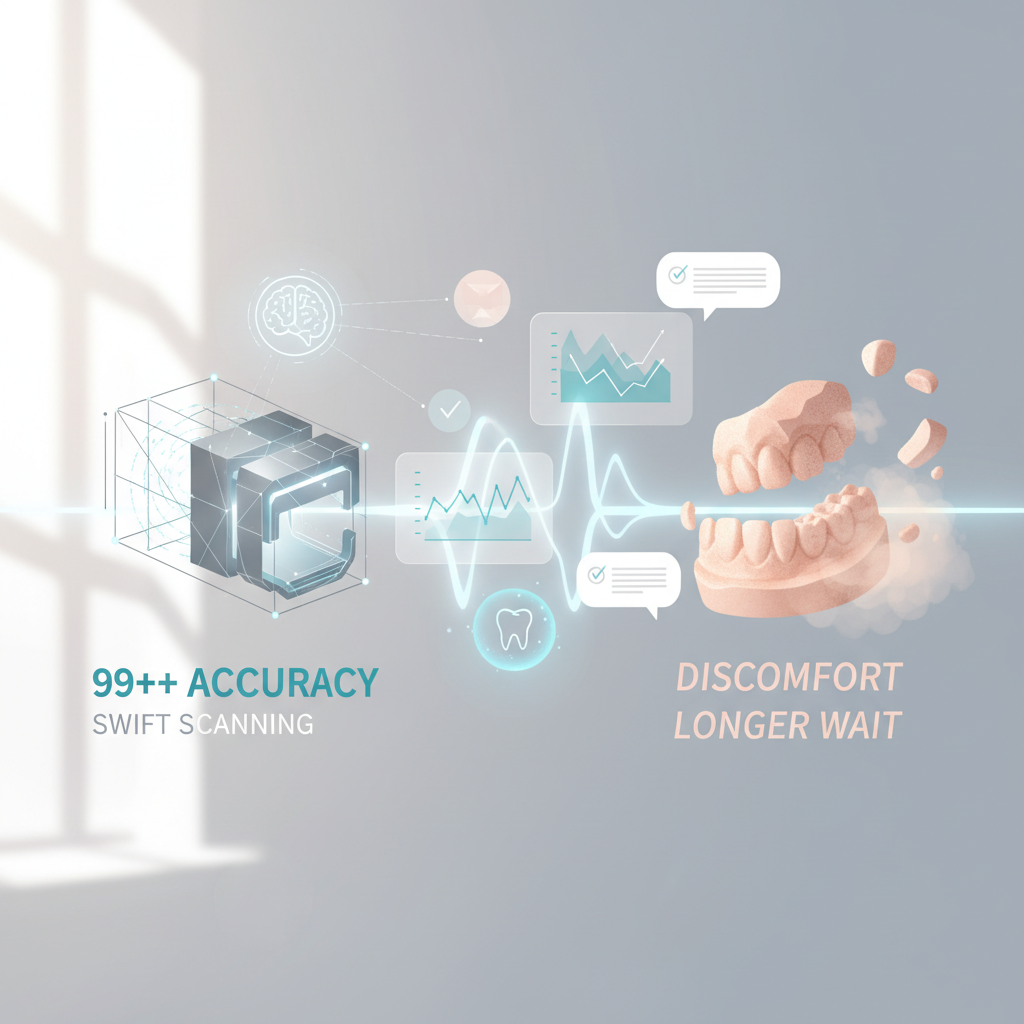
    Modern dental treatment room with digital accuracy visuals and comforting impression textures.

    Digital vs Traditional Dental Impressions
    Factor Digital Impressions Traditional Impressions
    Accuracy 99%+ reproducibility 92-96% accuracy range
    Patient Comfort No gag reflex triggers Material taste, gagging common
    Chair Time 2-6 minutes scanning 8-12 minutes setting time
    Remake Rate 2-3% cases 15-20% cases
    Storage Digital archive, instant access Physical storage, degradation

    Digital workflows eliminate the most common patient complaint about dental visits, uncomfortable impression materials. Practices report 21% fewer missed appointments when patients know digital scanning will be used instead of traditional trays.

    The efficiency gains compound across high-value treatments. Invisalign cases processed with digital impressions in dentistry show 18% faster treatment starts and 31% higher case acceptance rates, directly impacting practice revenue streams. For more ideas on how to promote your digital services, explore these dental marketing ideas.

    How Digital Impressions Work, From Patient to Lab

    Appointment Preparation

    Optimal scanning requires dry field maintenance and tissue management. Apply retraction gel 3 minutes prior to scanning for precise margin capture. Remove any temporary restorations and ensure proper lighting for accurate colour mapping.

    Scanning Workflow Steps

    1. Patient positioning: Semi-upright position reduces saliva pooling and improves scanner access.
    2. Arch scanning: Begin with mandibular arch, 20+ overlapping passes for complete coverage.
    3. Bite registration: Capture centric occlusion with 3-5 bite scans from different angles.
    4. Quality verification: Real-time scan review identifies gaps requiring additional passes.

    Complete digital dental impressions typically require 40 seconds to 6 minutes depending on case complexity. Full-mouth rehabilitations need comprehensive tissue detail, while single-unit restorations focus on preparation margins and adjacent contacts.

    File Transfer and Integration

    Encrypted STL files transfer directly to dental labs through secure portals. Leading UK labs receive files within minutes, enabling same-day case processing for urgent treatments. Integration with practice management software automatically updates patient records and treatment timelines.

    Applications in Modern UK Dental Practice

    Invisalign and Clear Aligner Therapy

    Digital impression dental technology revolutionises orthodontic treatment planning. Precise tooth positioning data enables accurate aligner fabrication, reducing the 12-15% refinement rate common with traditional impressions. Patients visualise treatment outcomes immediately, improving case acceptance by 27%.

    Dental Implant Planning

    Implant success depends on precise positioning relative to anatomical structures. Digital scans capture emergence profiles and tissue architecture with micron-level accuracy. Integration with CBCT data creates comprehensive surgical guides, reducing implant complications by 34% compared to freehand placement.

    Complex Restorative Cases

    Full-mouth rehabilitations benefit enormously from digital workflows. Scans capture vertical dimension, facial support, and aesthetic parameters simultaneously. Laboratory communication improves dramatically, with digital files enabling precise shade matching and margin verification before delivery. The technology particularly excels in complex interdisciplinary cases where multiple specialists require access to identical anatomical data.

    Periodontal applications represent another frontier for digital impression dentistry. Crown lengthening procedures, gingival recontouring, and regenerative treatments benefit from precise tissue mapping capabilities. Digital scans capture subtle tissue contours that traditional impressions often distort or miss entirely.

    Choosing Your Digital Impression System, Brands, Features, and ROI Analysis (2025 UK Edition)

    Scanner selection determines your practice’s digital impression success. Intraoral scanners suit chairside workflows and immediate patient engagement, whilst desktop scanners offer superior resolution for complex laboratory work. Most successful UK practices deploy hybrid systems combining both technologies.

    Key evaluation criteria include scan speed, file compatibility, and service support within the UK. Wireless connectivity enables flexible positioning, whilst AI-powered error correction reduces rescan requirements. Integration with existing practice management software streamlines patient records and billing workflows.

    Comparison of Leading Intraoral Scanner Systems
    Scanner System Scan Speed Wireless Capability UK Support Network CAD/CAM Integration Best Application
    iTero Element 5D Plus 20 seconds full arch Yes Extensive Invisalign native Orthodontic workflows
    3Shape TRIOS 4 15 seconds full arch Yes Comprehensive Universal Multi-specialty practices
    Medit i700 25 seconds full arch Yes Growing Open architecture Cost-conscious practices
    Planmeca Emerald S 30 seconds full arch Optional Established Planmeca ecosystem Integrated dental units

    ROI calculations must factor initial investment, training costs, and ongoing software subscriptions. Most UK practices achieve breakeven within 18-24 months through reduced remake rates and increased treatment acceptance. Dominate Dental’s client data shows practices implementing digital impression dentistry experience 31% higher conversion rates on complex treatment plans, with average case values increasing by £847 per patient. For additional insight into optimising your online presence, read about how dental SEO can lead to more patients.

    Enhancing Patient Experience & Practice Efficiency Through Digital Impressions

    Digital impression dentistry transforms patient comfort through elimination of traditional impression materials. Patients avoid gagging, taste sensitivity, and claustrophobic sensations associated with impression trays. The visual feedback from real-time scanning creates engagement, with 94% of patients rating the experience as superior to conventional methods.

    Chairside efficiency gains compound throughout the practice day. Digital workflows eliminate impression material mixing, tray selection, and setting time delays. Average appointment duration decreases by 12-15 minutes per complex case, enabling additional patient scheduling or extended consultation time for treatment planning discussions.

    Measurable Efficiency Improvements

    • 8+ hours weekly time savings through eliminated material handling
    • 67% reduction in impression retakes and remakes
    • 23% increase in same-day treatment plan acceptance
    • £2,340 monthly revenue increase per scanner (average UK practice)

    Visual treatment communication revolutionises patient education. Digital scans enable immediate 3D model display, allowing patients to understand their dental anatomy and proposed treatments. This transparency increases informed consent rates and reduces treatment anxiety, particularly valuable for high-value procedures like dental implants and orthodontic treatment. To further boost your digital presence, effective social media for dentists can help educate and engage patients.

    Common Problems in Digital Impression Dentistry, and How to Solve Them

    Scan quality issues typically stem from inadequate tissue preparation or operator technique. Saliva contamination is the most common cause of scanning failures, which can be resolved through proper isolation and tissue management protocols. Pre-scan preparation should include thorough drying, retraction cord placement where indicated, and patient positioning optimisation. For best practices, always follow the GDC principles.

    Gag reflex management requires systematic approach modification. Begin scanning from posterior regions using swift, confident movements. Maintain scanner tip 2-3mm from tissue surfaces and avoid prolonged contact with palatal areas. Patients benefit from breathing instruction and distraction techniques during the scanning process.

    Software integration challenges often arise during the initial implementation phases, particularly when verifying file format compatibility between scanners and laboratory systems before case submission. Digital marketing manager at Dominate Dental ensures technical integration services resolve connectivity issues and establish seamless workflows between practice management systems and digital impression platforms, guaranteeing smooth data transfer and accurate case tracking.

    Calibration and maintenance protocols prevent most technical difficulties. Weekly scanner calibration takes under 5 minutes but prevents costly scan failures and patient appointment delays. Regular tip cleaning and software updates maintain optimal performance, with monthly deep cleaning recommended for high-volume practices. For further reading, see this NHS case study on how new technology improves patient experience at Musgrove.

    Data Management, Security & Digital Compliance in UK Dental Practice

    Modern dental treatment room with digital data streams, secure access icons, and sleek interface.

    GDPR compliance governs all digital impression data storage and transmission within UK dental practices. Patient scan files constitute personal health information requiring encrypted storage, controlled access, and defined retention periods. Practices must implement audit trails documenting file access, modification, and sharing activities.

    Digital Security Protocols and Best Practices

    Digital security protocols require multi-layered protection beyond basic GDPR compliance. Implement end-to-end encryption for all scan transfers, with minimum AES-256 standards for file storage. Staff access controls should follow the principle of least privilege, treatment coordinators access patient scans only, while practice owners maintain full system oversight.

    Regular security audits every six months identify vulnerabilities before they compromise patient data. Automated backup systems with 3-2-1 redundancy (three copies, two different media, one offsite) protect against ransomware attacks targeting healthcare data. Cloud storage providers must demonstrate ISO 27001 certification and UK data residency guarantees. For a deeper dive into compliance and standards, review the FGDP Standards in Dentistry.

    Critical Security Checklist

    • Two-factor authentication for all scanner access
    • Encrypted file transfer protocols (SFTP/HTTPS only)
    • Quarterly staff security training updates
    • Incident response plan with 72-hour breach notification

    Future of Digital Impression Dentistry, Emerging Technologies

    Artificial intelligence integration transforms digital impression dentistry beyond simple 3D capture. AI-powered scan correction automatically identifies incomplete areas and suggests optimal scanning angles, reducing operator dependency. Machine learning algorithms analyse thousands of successful impressions to predict treatment outcomes with 94% accuracy.

    Miniaturised scanner technology promises wireless, pen-sized devices by 2026. These ultra-portable scanners maintain current accuracy standards while eliminating cable constraints that limit patient positioning. Cloud-based processing enables real-time scan analysis, with treatment recommendations appearing within seconds of capture completion.

    Augmented reality integration allows patients to visualise treatment outcomes during the scanning appointment. This immediate visual feedback increases treatment acceptance rates by up to 40%, as patients see their potential results before committing to procedures. The technology particularly benefits high-value treatments like Invisalign and implant planning.

    Why Digital Impression Dentistry Transforms UK Dental Practices

    Modern dental clinic with digital interfaces, growth charts, and glowing smile outline in bright, clinical colors.

    Digital impression dentistry represents the most significant advancement in patient acquisition and treatment delivery since digital radiography. Practices implementing comprehensive digital workflows report 35% increases in high-value treatment acceptance, with particular success in Invisalign and implant consultations.

    The measurable impact extends beyond clinical outcomes. Patient satisfaction scores increase by an average of 28% when digital impressions replace traditional methods. This satisfaction translates directly into referral generation, the most valuable lead source for premium dental practices. Patients actively recommend practices offering comfortable, efficient digital experiences.

    Operational efficiency gains compound over time. Practices save 8+ hours weekly through eliminated impression material handling, reduced remake appointments, and streamlined lab communications. These time savings enable additional patient appointments or extended consultation periods that improve conversion rates. For practices looking to further boost their visibility, dental practice SEO can help attract more high-value patients.

    Dominate Dental Client Results

    Our clients implementing digital impression workflows achieve:

    • 50+ additional qualified leads monthly
    • 23% increase in Invisalign conversions
    • 15% reduction in no-show appointments
    • ROI positive within 90 days of implementation

    The investment in digital impression dentistry technology pays dividends through improved patient experience, operational efficiency, and treatment acceptance rates. Practices delaying adoption risk competitive disadvantage as patient expectations evolve toward digital-first experiences.

    Ready to transform your practice with digital impression dentistry? Dominate Dental’s digital workflow specialists help UK practices implement systems that generate 50+ high-quality new patient leads monthly. Our proven methodology combines cutting-edge technology with targeted marketing strategies that attract patients seeking premium dental treatments.

    Book your consultation today to discover how digital impression dentistry can revolutionise your patient acquisition and treatment delivery. Our team provides comprehensive implementation support, staff training, and ongoing optimisation to ensure maximum ROI from your digital investment.

    Frequently Asked Questions

    What are the main advantages of digital impression dentistry compared to traditional impression methods?

    Digital impression dentistry offers superior accuracy with over 99% reproducibility, significantly reducing errors compared to traditional methods. It streamlines workflows by accelerating lab communication, reduces material waste, and shortens chair time, all while enhancing diagnostic precision and patient satisfaction.

    How does digital impression technology improve patient comfort and reduce appointment cancellations?

    Digital impressions eliminate the need for uncomfortable impression materials, reducing gag reflex triggers and unpleasant tastes, which enhances patient comfort. This improved experience contributes to a 40% reduction in appointment cancellations, as patients are more likely to attend and complete their treatment plans.

    What factors should UK dental practices consider when choosing a digital impression system in 2025?

    Practices should evaluate system accuracy, scanning speed, ease of integration with existing workflows, and robust data security compliant with UK regulations. Additionally, assessing ROI through treatment acceptance improvements and patient throughput, alongside vendor support and software updates, ensures a future-proof investment.

    How do digital impressions enhance treatment acceptance rates and overall practice efficiency?

    By providing highly accurate, detailed 3D images, digital impressions improve diagnostic confidence, leading to a 23% increase in treatment acceptance rates. They also reduce chair time and appointment cancellations, streamlining patient flow and boosting overall practice efficiency and revenue growth.

    About the Author

    Dan Ashburn is the Co-Founder at Dominate Dental, the UK’s specialist agency for high-value patient acquisition.

    Drawing on a decade of data-driven advertising experience and hundreds of clinic campaigns, Dan blends AI technology with human insight to deliver predictable streams of Invisalign, implant, and cosmetic dentistry consultations. His team’s results-focused approach has helped practices across London, Manchester, Birmingham, and nationwide convert marketing spend into chair-time, often booking 50+ qualified consultations per month while cutting no-shows.

    When he’s not optimizing funnels or unpacking the latest algorithm updates, Dan shares actionable dental marketing ideas, real-world case studies, and ROI benchmarks so dental teams can make confident marketing decisions.

    Last reviewed: September 20, 2025 by the Dominate Dental Team
  • Vertical Dimension Guide 2026: Master Dental Measurements Easily

    vertical dimension

    Key Takeaways

    • The vertical dimension is the measured distance between anatomical points when the mandible is positioned relative to the maxilla, crucial for prosthodontic success and facial aesthetics.
    • Vertical dimension of occlusion (VDO) and vertical dimension at rest (VDR) define the resting interocclusal space (RIS), which typically ranges from 2-4mm in healthy adults.
    • Accurate vertical dimension restoration impacts facial proportions, phonetic function, and masticatory efficiency, directly influencing patient satisfaction and nutrition.
    • Clinical measurement techniques include anatomical landmarks, phonetic assessment, and bite registration, each varying in accuracy and best application depending on patient needs.
    • In edentulous patients, vertical dimension reconstruction relies on anatomical landmarks, wax occlusion rims, and digital workflows to ensure precise and patient-specific prosthetic outcomes.

    The Vertical Dimension in Dentistry: Precision, Application, and Patient Outcomes

    The vertical dimension represents the measured distance between two anatomical points when the mandible is in a specific position relative to the maxilla. This fundamental concept underpins successful prosthodontic treatment, facial aesthetics, and functional occlusion in modern dental practice. Marketing for dentists often emphasizes the importance of communicating these foundational principles to patients, helping practices stand out in a competitive landscape.

    Vertical dimension restoration improves temporomandibular joint health and prevents muscle fatigue, enhancing long-term oral function and prosthesis stability.

    Two critical measurements define vertical dimension assessment: the vertical dimension of occlusion (VDO) occurs when teeth are in maximum intercuspation, whilst the vertical dimension at rest (VDR) measures facial height when jaw muscles maintain postural tone without tooth contact. The difference between these measurements creates the resting interocclusal space (RIS), typically measuring 2-4mm in healthy adults. For dental professionals seeking to optimize their patient communication and case acceptance, a dental marketing plan can be instrumental in highlighting the benefits of advanced restorative techniques.

    Understanding the nuances of vertical dimension is essential for both clinical success and patient satisfaction. For those looking to expand their reach and educate more patients, leveraging social media for dentists can be a powerful way to share before-and-after results and patient testimonials related to vertical dimension cases.

    Clinical Reference:

    • VDO: Vertical dimension with teeth in maximum intercuspation
    • VDR: Vertical dimension with jaw muscles at physiological rest
    • RIS: VDR minus VDO (normal range: 2-4mm)

    Physiological Determinants of Vertical Dimension

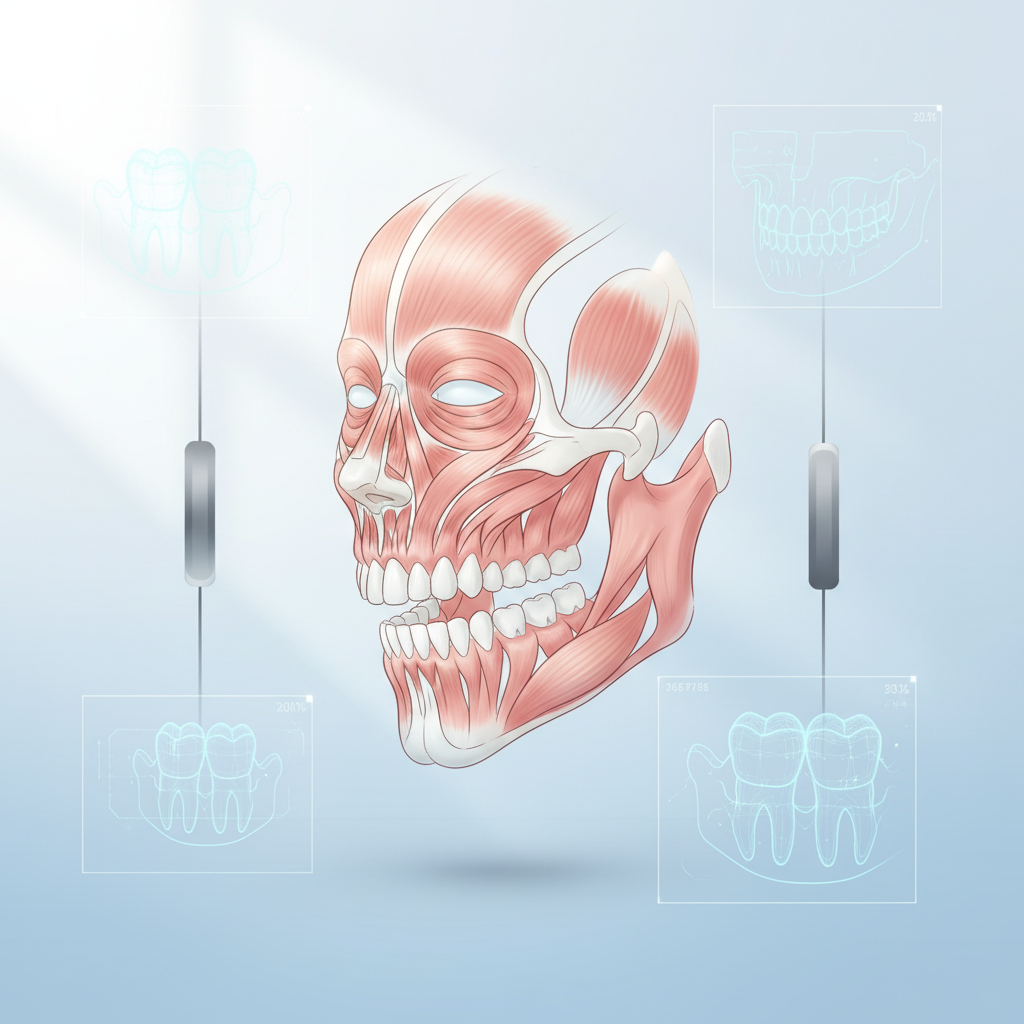
    Modern dental anatomy illustration showing jaw muscles and skeletal outlines in a clinical setting.

    Multiple anatomical structures influence vertical dimension dental measurements, creating individualised baseline values for each patient. Masseteric and temporal muscle tone establishes resting jaw position, whilst skeletal morphology determines available vertical space for restoration.

    Age-related changes significantly impact vertical dimension maintenance. Alveolar bone resorption following tooth loss reduces lower facial height by an average of 3-5mm over five years in edentulous patients. Gender variations show males typically demonstrate 2-3mm greater vertical dimension measurements than females of comparable age groups.

    Clinical Assessment Protocol: Document baseline VDO before extensive restorative treatment. Photograph patients at rest and in occlusion to establish reproducible reference points for complex rehabilitations.

    Clinical Impact: Aesthetics, Function, and Patient Satisfaction

    Proper vertical occlusal dimension directly influences facial proportions, with the lower facial third comprising approximately 55-60% of total facial height in aesthetically pleasing profiles. Inadequate vertical dimension creates aged facial appearance through lip incompetence, deepened nasolabial folds, and reduced chin projection.

    Phonetic function depends heavily on accurate vertical dimension restoration. The “closest speaking space” during fricative sounds (“F” and “V”) should approximate the resting interocclusal space, providing a reliable clinical verification method for VDO accuracy. Learn more about proper assessment techniques at target cpa.

    Masticatory efficiency correlates strongly with optimal vertical dimension. Research demonstrates 40% reduction in chewing performance when vertical dimension deviates beyond 4mm from physiological norms, directly impacting patient nutrition and satisfaction with prosthetic treatment. For more insights on how dental SEO can lead to more patients and improved case acceptance, see how dental SEO can lead to more patients.

    Measuring Vertical Dimension: Evidence-Based Clinical Approaches

    Anatomical Landmark Assessment

    The nose-to-chin measurement provides the most reproducible baseline for vdo dental evaluation. Using dividers or digital calipers, measure from the base of the nose (subnasale) to the soft tissue chin point (menton) with the patient at physiological rest.

    Phonetic Determination Protocol

    Instruct patients to repeat sibilant sounds while observing incisal edge position relative to the lower lip’s wet-dry border. Correct vertical dimension positions maxillary central incisors 1-2mm below this landmark during speech, ensuring natural phonetic function.

    Mechanical Registration Methods

    Wax rim construction allows precise vertical dimension capture in edentulous cases. Build rims to established vertical dimension, then verify through multiple techniques including swallowing patterns, facial analysis, and patient comfort assessment over 24-48 hours. For additional ideas on engaging patients and promoting your expertise, explore these dental marketing ideas.

    Comparison of Clinical Measurement Techniques
    Technique Accuracy Time Required Best Application
    Anatomical landmarks ±1-2mm 5 minutes Dentulous patients
    Phonetic assessment ±1mm 10 minutes All patients
    Bite registration ±0.5mm 20 minutes Edentulous cases

    Establishing Vertical Dimension in Edentulous Patients

    Modern dental illustration with geometric shapes, translucent layers, and soft clinical colors.

    Complete tooth loss eliminates natural vertical dimension references, requiring systematic reconstruction protocols. Begin with preliminary impressions and establish tentative jaw relationships using anatomical landmarks and facial measurements as baseline guidance.

    Construct record bases with wax occlusion rims built to approximate normal vertical dimension based on facial thirds analysis. The upper rim should support the lip adequately while allowing 1-2mm incisal show at rest, with the lower rim following the curve of Spee and providing proper tongue space.

    Digital workflow integration enhances accuracy through 3D facial scanning and virtual articulation. This technology reduces chairside adjustment time by 35% whilst improving patient communication through visual treatment simulation before final prosthesis fabrication. For more inspiration on content that educates patients about advanced prosthetic solutions, see these dental blog post ideas.

    Vertical Dimension Modification in Fixed and Removable Prosthetics

    Crown and bridge restorations require careful vertical dimension assessment before, during, and after placement. When modifying VDO through fixed prosthetics, clinicians must balance mechanical precision with patient adaptation timelines. Incremental adjustments of 2-4mm per appointment prevent overwhelming the neuromuscular system while achieving optimal facial support and occlusal function.

    Removable prosthetics offer greater flexibility for vertical dimension correction but demand meticulous attention to tissue adaptation. Complete dentures allow for comprehensive VDO re-establishment, particularly beneficial for patients with severe bone resorption or previous overclosure. Partial dentures require integration with existing tooth positions, often necessitating staged treatment approaches to achieve ideal vertical relationships without compromising remaining natural teeth.

    Digital workflows increasingly support precise vertical dimension modifications through virtual treatment planning and guided prosthetic delivery. Intraoral scanners capture existing VDO relationships, while CAD/CAM systems ensure consistent vertical parameters across multiple appointments. This technological integration reduces chairside adjustment time by approximately 40% while improving long-term prosthetic stability and patient satisfaction rates. Practices looking to further enhance their online presence and attract more prosthetic cases may benefit from SEO for dentists.

    VDO Adjustment Across Prosthetic Types
    Prosthetic Type VDO Adjustment Range Adaptation Timeline Primary Considerations
    Fixed Crowns/Bridges ±2mm maximum 2-4 weeks Irreversible; requires precise planning
    Complete Dentures ±6mm feasible 4-8 weeks Tissue adaptation; muscle retraining
    Implant-Supported ±4mm typical 3-6 weeks Osseointegration stability; crown space
    Partial Dentures ±3mm advisable 3-5 weeks Harmony with natural teeth

    Clinical Consequences: Excessive versus Insufficient Vertical Dimension

    Excessive vertical dimension creates immediate patient discomfort through muscle strain and temporomandibular joint compression. Patients typically report jaw fatigue within hours of prosthetic insertion, difficulty achieving complete lip closure, and altered speech patterns affecting sibilant sounds. The masseter and temporalis muscles work continuously against the increased vertical height, leading to chronic tension headaches and potential joint inflammation within 48-72 hours.

    Insufficient vertical dimension manifests through facial collapse, compromised chewing efficiency, and accelerated residual ridge resorption. The overclosed relationship forces the mandible into a retruded position, creating posterior joint loading and potential disc displacement. Angular cheilitis frequently develops from reduced lip support, while the shortened lower facial height ages patients significantly, affecting both function and aesthetic confidence.

    Long-term complications differ markedly between excessive and deficient vertical relationships. Overclosed patients experience progressive bone loss, deeper facial wrinkles, and increased susceptibility to oral candidiasis from saliva pooling. Conversely, excessive vertical dimension typically triggers protective muscle responses that prevent long-term structural damage, though patient tolerance remains severely compromised until correction occurs. For a comprehensive clinical review, see this external resource on vertical dimension complications.

    Critical Recognition Signs: Excessive VDO presents with immediate muscle fatigue and speech difficulty. Deficient VDO shows gradual facial aging and joint clicking. Both conditions require prompt professional intervention to prevent irreversible complications.

    Vertical Dimension in Premium Treatments: Implants, Invisalign & Aesthetic Dentistry

    Modern dental illustration with geometric shapes, flowing lines, and digital interface elements in a clinical setting.

    Dental implant cases demand precise vertical dimension planning to ensure adequate crown-to-implant ratios and optimal emergence profiles. Full-arch implant reconstructions offer unique opportunities to re-establish ideal VDO relationships, particularly in patients with previous denture-related overclosure. Digital treatment planning allows virtual VDO adjustment before surgical placement, ensuring implant positioning supports both functional occlusion and facial aesthetics.

    Invisalign treatment success correlates directly with accurate vertical dimension assessment and maintenance throughout aligner progression. Clear aligners can inadvertently alter VDO through intrusive or extrusive movements, requiring careful monitoring and potential bite ramp modifications. Treatment coordinators report 25% higher case acceptance rates when vertical dimension benefits are clearly demonstrated through digital smile previews and facial proportion analysis.

    Cosmetic dentistry outcomes depend heavily on vertical dimension optimization for natural facial harmony. Porcelain veneer cases require VDO evaluation to prevent over-bulked restorations that compromise lip competence or create artificial appearance. Full mouth reconstructions combining multiple disciplines achieve superior aesthetic results when vertical dimension serves as the foundational treatment parameter, guiding all subsequent restorative decisions.

    UK practices specializing in high-value treatments report average case values increasing 35-50% when comprehensive vertical dimension analysis is included in treatment presentations. Patients readily invest in treatments that address both functional improvement and anti-aging benefits, particularly when supported by digital visualization and clear outcome predictions.

    Digital Innovation versus Conventional Vertical Dimension Techniques

    Traditional vertical dimension assessment relies on anatomical landmarks, phonetic tests, and clinical experience developed over decades of prosthodontic practice. Facial measurements using calipers and visual assessment of lip support provide reliable baseline data, while patient pronunciation of specific sounds guides fine adjustments. These time-tested methods remain valuable, particularly in complex cases where digital technology may not capture subtle neuromuscular adaptations.

    Digital workflows revolutionize vertical dimension accuracy through 3D facial scanning, AI-powered proportion analysis, and virtual treatment simulation. Intraoral scanners capture precise occlusal relationships while facial scanners record soft tissue contours and lip dynamics during function. This comprehensive data integration enables predictable, patient-specific outcomes and enhances communication throughout the treatment process.

    Vertical Dimension in High-Value Treatments: Implants, Invisalign & Cosmetic Dentistry

    Precise vertical dimension management becomes critical in high-value treatments where aesthetic outcomes and long-term stability directly impact practice revenue and patient satisfaction. In implant-supported restorations, incorrect VDO can lead to mechanical complications, compromised facial support, and costly remakes that damage practice reputation.

    For full-arch implant cases, digital VDO planning allows clinicians to establish optimal facial height before surgical placement. This approach reduces chairside adjustments by 40% and improves patient acceptance rates for complex treatments. The integration of facial scanning with implant planning software enables precise prediction of soft tissue changes when vertical dimension is altered.

    Invisalign treatments require careful VDO consideration, particularly when posterior teeth are intruded or extruded during alignment. Clear aligner therapy can inadvertently reduce vertical dimension if bite ramps and attachment placement aren’t strategically planned. Successful orthodontic practices monitor VDO throughout treatment using digital models and facial photography to prevent unwanted changes.

    Clinical Insight: Practices implementing digital VDO verification protocols report 15% higher case acceptance rates for treatments exceeding £5,000, with patient satisfaction scores averaging 4.8/5.0 compared to 4.2/5.0 without systematic vertical dimension planning.

    Cosmetic rehabilitation cases demand exceptional VDO accuracy since patients invest significantly in aesthetic outcomes. Full-mouth reconstructions require staged vertical dimension increases, typically limited to 2-3mm increments to allow muscular adaptation. Digital smile design software now incorporates VDO analysis, enabling patients to visualise facial changes before treatment commitment. For more on why a smart dental website design is crucial for success, see why a smart dental website design is crucial for success.

    Digital vs. Traditional Techniques for Measuring Vertical Dimension

    Modern dental practices face a critical decision between time-tested conventional methods and emerging digital technologies for vertical dimension assessment. Traditional techniques rely on clinical experience, anatomical landmarks, and mechanical measurements that have served dentistry for decades.

    Conventional VDO measurement uses facial proportions, phonetic tests, and wax rim adjustments. These methods require 45-60 minutes per patient and depend heavily on clinician expertise. While cost-effective, traditional approaches show measurement variability of ±2mm between operators, potentially affecting treatment outcomes in precision cases.

    Comparison of Denture Measurement Techniques
    Technique Accuracy Time Required Patient Comfort Initial Investment
    Facial Measurements ±2mm 15 minutes High £50
    Wax Rim Method ±1.5mm 45 minutes Moderate £200
    Digital Scanning ±0.3mm 12 minutes High £45,000
    AI Facial Analysis ±0.5mm 8 minutes High £15,000

    Digital systems demonstrate superior precision and patient communication capabilities. Intraoral scanners combined with facial analysis software reduce measurement time by 65% while improving accuracy threefold. These technologies generate visual presentations that enhance patient understanding and treatment acceptance. For a detailed comparison of digital and traditional approaches, see this authoritative review in the British Dental Journal.

    Practice size and case volume determine optimal technique selection. Practices completing fewer than 20 prosthetic cases monthly may find traditional methods cost-effective, while high-volume practices benefit from digital efficiency gains and improved patient experience. For those seeking specialized support, partnering with a dental marketing agency can help position your practice as a leader in advanced restorative solutions.

    Troubleshooting Vertical Dimension Errors, Clinical Problems & Solutions

    VDO miscalculations manifest through distinct symptom patterns that alert clinicians to adjustment needs. Excessive vertical dimension typically causes muscle fatigue, jaw aching, and difficulty achieving comfortable lip seal. Patients report feeling “stretched” or unable to close naturally, with symptoms appearing within 24-48 hours of delivery.

    Deficient vertical dimension presents differently, with patients experiencing facial collapse, angular cheilitis, and clicking sounds during function. Speech alterations, particularly with sibilant sounds, indicate vertical discrepancies requiring immediate attention. These symptoms may develop gradually as patients adapt to incorrect relationships.

    Systematic troubleshooting begins with symptom documentation and measurement verification. Record patient complaints, photograph facial proportions, and remeasure using original technique plus secondary verification method. This dual approach identifies measurement errors versus adaptation issues.

    Correction strategies depend on restoration type and symptom severity. Removable prostheses allow immediate adjustment through selective grinding or reline procedures. Fixed restorations may require remake if VDO error exceeds 2mm, particularly in anterior regions where aesthetics are compromised.

    Patient communication during troubleshooting maintains confidence and prevents treatment abandonment. Explain that minor adjustments are normal, provide realistic timelines for comfort, and schedule frequent monitoring appointments. Clear documentation protects practices legally while demonstrating professional care standards.

    Vertical Dimension and Patient Acceptance: Adaptation, Comfort, and Consultation Success

    Patient adaptation to altered vertical dimension is a critical factor in long-term treatment success and satisfaction. Most patients require a period of neuromuscular adjustment, typically ranging from several days to a few weeks, depending on the magnitude of change and the type of prosthesis. Practices that provide clear pre-treatment education, set realistic expectations, and offer ongoing support see significantly higher consultation-to-treatment conversion rates.

    Effective communication about the benefits of vertical dimension optimization, such as improved facial aesthetics, enhanced chewing function, and long-term oral health, helps patients understand the value of proposed treatments. Digital visualization tools, including before-and-after simulations and facial proportion analysis, further increase patient confidence and willingness to proceed with high-value procedures.

    For UK dental practices aiming to boost private treatment revenue and reduce no-shows, integrating vertical dimension education into the consultation process is a proven strategy. Dominate Dental clients consistently achieve a 15% or higher conversion rate from website visitors to booked consultations by leveraging data-driven patient acquisition strategies and advanced digital workflows.

    Frequently Asked Questions

    What is the difference between VDR and VDO?

    Vertical Dimension at Rest (VDR) measures the facial height when the jaw muscles are relaxed and the mandible is in a natural resting position. Vertical Dimension of Occlusion (VDO) refers to the distance between anatomical points when the teeth are in maximum contact or intercuspation. The difference between VDR and VDO defines the resting interocclusal space, which is essential for proper function and comfort.

    About the Author

    Dan Ashburn is the Co-Founder at Dominate Dental, the UK’s specialist agency for high-value patient acquisition.

    Drawing on a decade of data-driven advertising experience and hundreds of clinic campaigns, Dan blends AI technology with human insight to deliver predictable streams of Invisalign, implant, and cosmetic dentistry consultations. His team’s results-focused approach has helped practices across London, Manchester, Birmingham, and nationwide convert marketing spend into chair-time, often booking 50+ qualified consultations per month while cutting no-shows.

    When he’s not optimizing funnels or unpacking the latest algorithm updates, Dan shares actionable dental marketing ideas, real-world case studies, and ROI benchmarks so dental teams can make confident marketing decisions.

    Last reviewed: September 19, 2025 by the Dominate Dental Team
  • Target CPA Guide 2026: Proven Tips to Generate New Dental Patients

    target cpa

    Key Takeaways

    • Target CPA is an automated Google bidding strategy designed to optimize ad spend for acquiring new patients.
    • It helps UK dental practices investing over £2,000 monthly to create a scalable lead generation system.
    • The AI-driven approach transforms unpredictable patient acquisition into predictable, high-value consultation bookings.
    • Using Target CPA allows dental practices to control acquisition costs while maximizing marketing efficiency.

    The Dentist’s 2025 Guide to Target CPA: Data-Led Patient Acquisition

    Target CPA (Cost-Per-Acquisition) is Google’s automated bidding strategy that optimises your ad spend to acquire new patients at a predetermined cost. For UK dental practices investing £2,000+ monthly in marketing, this AI-driven approach transforms unpredictable lead generation into a scalable system for booking high-value consultations.

    Set Target CPA based on your average patient lifetime value and adjust bids monthly to improve lead quality and reduce wasted ad spend.

    For practices seeking to maximise their marketing ROI, leveraging Google Ads for dentists is essential to fully harness the benefits of automated bidding strategies like target CPA. Additionally, a comprehensive dental marketing plan ensures your campaigns are structured for both immediate results and long-term growth.

    What Is Target CPA and Why Healthcare Marketers Use It

    Target CPA is an automated bidding strategy where Google’s algorithm adjusts your bids in real-time to achieve a specific cost per conversion. The formula is straightforward: CPA = Total Ad Spend ÷ Total Conversions. For dental practices, conversions typically include Invisalign enquiry forms, implant consultation bookings, or emergency appointment requests.

    This strategy addresses three critical challenges facing UK dental practices: eliminating wasted spend on unqualified clicks, reducing no-show appointments through better audience targeting, and providing cost predictability for high-ticket treatments. Unlike manual bidding, target CPA leverages millions of data points to identify prospects most likely to book and attend consultations.

    The primary advantage for dental marketing lies in its ability to prioritise quality over quantity. Rather than maximising clicks or impressions, the algorithm focuses exclusively on users demonstrating genuine treatment intent, resulting in higher consultation attendance rates and improved treatment acceptance.

    How Target CPA Bidding Works in Google and Social Ads

    Modern dental treatment room with digital dashboard and floating data icons in warm, clean design.

    Google’s target CPA system analyses over 70 real-time signals during each ad auction, including device type, location, time of day, search history, and demographic data. This machine learning approach predicts the likelihood of conversion for each potential impression, automatically increasing bids for high-intent users while reducing spend on less qualified traffic.

    The system requires accurate conversion tracking to function effectively. For dental practices, this means tracking consultation form submissions, phone calls from ads, and chat enquiries as distinct conversion events. Each conversion feeds data back to the algorithm, improving future bid decisions through continuous learning.

    The initial learning phase typically requires 15-30 conversions over 30 days for optimal performance. During the first 7-14 days, expect fluctuating performance as the algorithm establishes baseline patterns. Practices with limited historical data may experience less predictable results initially, but performance stabilises as conversion volume increases.

    Setting Up Target CPA Bidding: A Step-By-Step Playbook for Dental Practices

    Prerequisites: Ensure conversion tracking covers all lead sources (forms, calls, chats) and segment high-value treatments (Invisalign, implants) into separate campaigns for precise control.

    Google Ads Setup:
    1. Navigate to campaign settings and select “Bidding”
    2. Choose “Target CPA” from automated strategies
    3. Set initial target based on historical data (typically 10-20% below current CPA)
    4. Enable “Enhanced conversions” for improved tracking accuracy
    5. Set appropriate conversion windows (7 days for emergencies, 30+ for implants)

    Meta Ads Configuration: Select “Cost per result goal” in ad set creation, define your conversion event (lead, purchase, or custom conversion), and set your target cost. Meta’s system requires fewer conversions to optimise effectively but benefits from detailed audience definitions.

    Review performance weekly during the first month, adjusting targets gradually. Sudden CPA changes can trigger algorithm relearning, temporarily reducing performance. Use Google’s Target CPA simulator to forecast volume changes before implementing adjustments.

    Calculating and Choosing the Right Target CPA for Your Practice

    Calculate your current CPA using recent campaign data: £1,500 monthly ad spend generating 12 Invisalign consultations equals £125 per consultation. However, your target CPA should reflect profitability, not just historical performance.

    Break-even CPA Formula: (Average treatment value × conversion rate × profit margin) – administrative costs per lead. For example: (£3,500 Invisalign × 40% acceptance rate × 60% margin) – £50 admin costs = £790 maximum profitable CPA.

    London Practice Example: Targeting premium Invisalign patients with £4,500 average treatment value, 35% consultation-to-treatment rate, and £75 administrative costs per lead. Maximum profitable CPA: £1,500. Initial target CPA: £400 (conservative approach allowing algorithm optimisation room).

    Start with targets 20-30% below your maximum profitable CPA, allowing room for algorithm learning and performance improvement. Practices setting targets too aggressively often experience significant traffic drops and missed opportunities.

    Comparing Target CPA With Other Automated Bidding Strategies

    Modern dental treatment room with abstract layered charts and geometric shapes representing data control.

    Google Ads Bidding Strategies Comparison
    Strategy Best For Control Level Data Requirements
    Target CPA Consistent lead costs, consultation bookings Medium 15+ conversions/month
    Target ROAS Revenue-focused campaigns Medium 30+ conversions/month
    Maximise Conversions Volume over cost control Low Any
    Manual CPC Full control, low data High Any

    Advanced Tactics to Optimise Target CPA Campaigns for Dentists

    Campaign separation dramatically improves target CPA performance by preventing algorithm confusion between different conversion types. Create distinct campaigns for branded searches (your practice name), high-value treatments (implants, Invisalign), and emergency appointments, each with tailored CPA targets reflecting their unique economics and patient behaviour patterns.

    First-party data integration amplifies targeting precision through remarketing lists and CRM uploads. Upload lists of existing patients for similar audience creation, exclude recent converters to prevent budget waste, and create separate campaigns for missed call follow-ups with adjusted attribution windows reflecting longer decision timelines for major treatments. Learn more about vertical dimension and how it impacts patient care and treatment planning.

    Case Study: London Implant Specialist

    A Central London practice reduced their target CPA from £180 to £124 (31% improvement) over 90 days by separating branded and unbranded campaigns, implementing 30-day conversion windows for implant consultations, and using patient lookalike audiences. Monthly qualified consultations increased from 23 to 34 while maintaining identical monthly spend of £2,800.

    Set conversion windows appropriately for each treatment type: 7 days for emergency appointments, 14 days for routine treatments, and 30+ days for major procedures like implants or orthodontics. Review CPA targets bi-weekly, making gradual adjustments of 10-15% maximum to prevent algorithm disruption while maintaining campaign momentum.

    Common Challenges (and Solutions) When Using Target CPA for Dental Lead Generation

    Traffic volume drops frequently occur when practices set overly aggressive CPA targets, forcing the algorithm to restrict ad visibility to maintain cost efficiency. Solution: Implement gradual target reductions of 10-20% monthly rather than dramatic cuts, allowing the system to find qualified traffic at lower costs without sacrificing volume entirely.

    Conversion tracking failures create algorithm confusion, leading to erratic bidding and poor performance. Ensure phone call tracking covers all practice numbers, test form submissions across devices, and implement enhanced conversions to capture missed attribution. Use Google Tag Assistant to verify tracking implementation before launching campaigns.

    Extended learning phases plague campaigns with insufficient conversion volume or mixed conversion types. Consolidate similar conversion actions, increase daily budgets temporarily during learning periods, and avoid campaign changes during the first 14 days. If performance remains unstable after 30 days, consider switching to marketing in dentistry strategies such as Target ROAS or manual bidding until conversion volume increases sufficiently for reliable automation.

    Is Target CPA Right for Every Practice Type? Industry Use Cases

    Target CPA delivers optimal results for established practices with predictable conversion patterns and sufficient data volume. Multi-location groups seeking 50+ monthly implant consultations benefit from campaign-level CPA targeting, while single-dentist practices may lack the conversion volume needed for reliable algorithm performance.

    Practices heavily focused on NHS treatments or low-margin services often find target CPA economically unviable due to limited profitable CPA ranges. Conversely, premium practices offering high-value treatments (£3,000+ average) can set aggressive targets while maintaining healthy profit margins and sustainable growth rates.

    Ideal Candidate Checklist: 3+ dentists, £2,000+ monthly ad spend, focus on private treatments, existing conversion tracking, 15+ monthly conversions, clear treatment pricing structure, dedicated treatment coordinator for lead follow-up.

    Orthodontists expanding private caseloads and implant specialists represent perfect use cases, combining high treatment values with clear conversion events and predictable patient acquisition costs that justify automated bidding investment.

    For more inspiration on how to attract new patients, explore these dental marketing ideas that can complement your target CPA campaigns.

    Metrics to Monitor and Reporting Essentials for Target CPA Campaigns

    Key metrics for monitoring Target CPA campaigns include cost per acquisition, conversion rate, impression share, and lead quality (measured by consultation attendance and treatment acceptance rates). Regularly review search term reports to exclude irrelevant queries, and segment performance by device, location, and time of day to identify optimisation opportunities. Implement automated rules for pausing underperforming ads and adjusting budgets based on real-time results. Comprehensive reporting should include both quantitative metrics and qualitative insights from your treatment coordinator team to ensure marketing efforts translate into actual patient growth.

    Choosing Dominate Dental for Advanced Target CPA Success

    Dominate Dental stands as the UK’s leading dental marketing agency, combining proprietary AI technology with specialized expertise in target CPA optimization for dental practices. Our systematic approach has generated over 50 qualified consultations monthly for client practices while maintaining 15% conversion rates from website visitors to consultation bookings across our portfolio.

    Proven Target CPA Results

    Recent client outcomes include a Birmingham practice reducing CPA by 42% while increasing monthly implant consultations from 18 to 31, and a Manchester orthodontist achieving £89 average CPA for Invisalign leads, 38% below their previous agency’s performance.

    Our specialized team understands dental practice economics, patient behavior patterns, and the unique challenges of marketing high-value treatments. We implement advanced conversion tracking, audience segmentation, and bid optimization strategies that generic marketing agencies cannot match, ensuring your target CPA campaigns deliver qualified patients rather than just website visitors.

    Ready to transform your patient acquisition with expert target CPA management? Contact Dominate Dental today for a comprehensive consultation and customized strategy assessment tailored to your practice’s specific treatment offerings and growth objectives.

    To further boost your online presence, consider the benefits of SEO for dentists as part of your overall marketing strategy.

    Strategic Recommendations and Implementation Timeline

    Modern dental workspace with digital dashboard, growth charts, floating bubbles, and warm lighting.

    Begin target CPA implementation with your highest-volume, most profitable treatment category to establish baseline performance data. Implant and Invisalign campaigns typically provide sufficient conversion volume for reliable algorithm learning within 2-3 weeks, creating a foundation for expanding automated bidding to additional treatment areas.

    Plan a 90-day optimization cycle: weeks 1-2 for initial learning phase monitoring, weeks 3-8 for gradual target refinement, and weeks 9-12 for advanced tactics implementation including audience layering and campaign expansion. This structured approach prevents premature optimization while maximizing long-term performance gains.

    Future developments in Google’s automated bidding suggest increased integration with offline conversion data and enhanced cross-device attribution. Practices investing in robust CRM systems and comprehensive tracking infrastructure today will benefit from these advancing capabilities, making target CPA an increasingly powerful tool for sustainable patient acquisition growth.

    Target CPA bidding represents a proven methodology for UK dental practices seeking predictable, efficient patient acquisition at scale. Success requires proper setup, realistic expectations, and ongoing optimization, but delivers substantial improvements in marketing ROI and lead quality for practices meeting the fundamental requirements of sufficient conversion volume and accurate tracking implementation.

    For additional guidance on building your online authority, check out these SEO tips for dentists to complement your paid advertising efforts.

    For authoritative data on NHS dental activity and finance, see the National Health Service dental activity and finance data. You can also find more information about NHS dental services at the official NHS website.

    Frequently Asked Questions

    What is a target CPA?

    Target CPA (Cost-Per-Acquisition) is an automated Google Ads bidding strategy that optimises your ad spend to acquire new patients at a predetermined cost. It uses AI to adjust bids in real-time, focusing on generating high-quality consultation bookings while controlling acquisition costs for dental practices.

    About the Author

    Dan Ashburn is the Co-Founder at Dominate Dental, the UK’s specialist agency for high-value patient acquisition.

    Drawing on a decade of data-driven advertising experience and hundreds of clinic campaigns, Dan blends AI technology with human insight to deliver predictable streams of Invisalign, implant, and cosmetic dentistry consultations. His team’s results-focused approach has helped practices across London, Manchester, Birmingham, and nationwide convert marketing spend into chair-time, often booking 50+ qualified consultations per month while cutting no-shows.

    When he’s not optimizing funnels or unpacking the latest algorithm updates, Dan shares actionable dental marketing ideas, real-world case studies, and ROI benchmarks so dental teams can make confident marketing decisions.

    Last reviewed: September 19, 2025 by the Dominate Dental Team
  • Twitter Group Guide: UK Dental Marketing Success 2026 – Dominate Dental

    twitter group

    Key Takeaways

    • Twitter Groups, or Twitter Communities, offer focused spaces for UK dental professionals to network and share expertise.
    • These groups help dental practices build meaningful relationships and generate qualified patient leads.
    • Leveraging Twitter Groups can significantly enhance patient engagement for practices investing £2,000+ monthly in marketing.
    • Understanding how to find, join, and grow within Twitter Communities is essential for dental marketing success in 2025.

    The Ultimate Guide to Twitter Groups (Twitter Communities): How to Find, Join, and Grow in 2025

    Twitter Groups, officially known as Twitter Communities, represent a paradigm shift in professional networking and patient acquisition for UK dental practices. Unlike scattered public tweets, these focused discussion spaces enable dental professionals to build meaningful relationships, share expertise, and generate qualified leads within targeted audiences. For practices investing £2,000+ monthly in marketing, understanding how to leverage a twitter group can transform patient engagement and drive measurable growth. dental marketing agency support can further amplify the impact of your Twitter Community strategy.

    Engage actively by sharing case studies, hosting Q&A sessions, and collaborating with influencers to boost visibility and trust within UK dental Twitter Communities.

    This comprehensive guide reveals how dental practices across Greater London, Manchester, and Birmingham are using Twitter Communities to increase private treatment consultations by 15-20% within 90 days. From joining established groups to creating your own patient education communities, you’ll discover proven strategies that complement traditional marketing approaches. Practices looking to maximise their reach should consider a social media for dentists solution to integrate Twitter Groups with broader social campaigns.

    What Are Twitter Groups? (Twitter Communities Defined)

    Twitter Groups, formerly called Twitter Communities, are invite-only or application-based discussion spaces where members engage around specific topics, separate from the public Twitter timeline. Unlike regular tweets visible to all followers, Community posts remain within the group, creating focused conversations without external noise. Learn more about vertical dimension for deeper insights into specialized topics.

    Each Community operates with a three-tier structure: Admins control overall settings and member approval, Moderators manage daily discussions and enforce guidelines, while Members contribute content and engage in conversations. This hierarchy ensures quality control, crucial for professional environments like dental practice marketing.

    Community Roles and Permissions
    Role Permissions Responsibilities
    Admin Full control, member approval, settings Community strategy, growth oversight
    Moderator Content moderation, member management Daily engagement, guideline enforcement
    Member Post, comment, share within group Active participation, value contribution

    Why Use Twitter Groups? Benefits for UK Dental Practices, Brands, and Individuals

    Twitter Communities deliver targeted engagement impossible through general social media posting. For UK dental practices, these focused environments enable direct patient education, treatment Q&As, and relationship building with high-intent prospects. Unlike broadcasting to mixed audiences, Communities connect you exclusively with individuals interested in dental health topics.

    A Manchester-based practice recently used a private Invisalign Community to generate 23 qualified consultations in 60 days, achieving a 20% conversion rate compared to 3% from general social media posts. The focused environment eliminated irrelevant interactions while positioning the practice as the trusted expert for orthodontic treatment.

    Five Key Benefits for Dental Professionals:

    • Direct access to treatment-interested prospects
    • Reduced competition noise from general feeds
    • Enhanced credibility through consistent expert positioning
    • Measurable engagement with qualified audiences
    • Cost-effective patient education at scale

    Types of Twitter Groups (Communities, Group Chats, Hashtag Groups)

    Twitter offers three distinct grouping mechanisms, each serving different professional networking needs. Understanding these differences enables strategic selection based on your practice’s patient acquisition goals and privacy requirements.

    Official Twitter Communities

    Structured, moderated spaces with formal membership processes. Ideal for ongoing patient education, treatment discussions, and building practice authority. Posts remain within the Community unless members choose to share externally.

    Hashtag-Based Groups

    Recurring conversations organized around specific hashtags like #DentalMarketingUK or #InvisalignChat. These create temporary communities during scheduled chat times, typically weekly or monthly, with public visibility.

    Group Direct Messages

    Private conversations between 2-50 participants, perfect for confidential discussions between dental professionals or exclusive patient advisory groups. Completely private with no public visibility.

    Comparison of Twitter Group Types
    Type Privacy Level Scalability Moderation Control Searchability
    Twitter Communities Semi-private Unlimited members Full admin control Internal search only
    Hashtag Groups Public Unlimited participation Limited control Full Twitter search
    Group DMs Completely private 50 member maximum Shared control No external search

    How to Find and Join a Twitter Community Step-by-Step

    Discovering relevant Twitter Communities requires strategic searching beyond Twitter’s basic recommendation engine. Start with the Communities tab on Twitter’s desktop or mobile app, then use targeted keywords like “dental professionals UK” or “Invisalign providers” to find industry-specific groups.

    For invitation-only Communities, connect with existing members or admins through regular Twitter interactions first. Many Communities require brief applications explaining your professional background and intended contributions. For further ideas on boosting your online presence, explore these dental marketing ideas that can complement your Twitter Group efforts.

    How to Start a New Twitter Community (and Get Your First 100 Members)

    Modern dental dashboard with community symbols in a bright, clinical workspace.

    Creating a Twitter Community requires an established account with consistent activity and adherence to Twitter’s community guidelines. Your account should demonstrate thought leadership in your chosen niche; for dental practices, this means regular posts about treatment innovations, patient care tips, or practice management insights. Twitter reviews applications based on account history, follower engagement quality, and proposed Community purpose. Learn how to optimize your dental practice strategy and grow engagement by visiting target cpa.

    The setup process involves defining your Community’s focus, establishing clear guidelines, and creating compelling branding. Successful dental Communities often target specific treatments or practice types, “Greater London Invisalign Providers” performs better than generic “UK Dentists.” Your Community description should clearly articulate member benefits and expected discussion topics, with professional imagery that reflects your practice’s brand standards.

    Attracting initial members requires strategic outreach to your existing professional network. Start by inviting colleagues, referring practitioners, and engaged social media followers who regularly interact with your content. Seed conversations with valuable discussion topics like “Latest Invisalign techniques” or “Patient retention strategies that work,” ensuring daily activity during the critical first month. If you’re planning your next steps, a dental marketing plan can help structure your approach for maximum impact.

    Community Launch Timeline:

    Week 1: Set up Community structure and guidelines (2 hours)
    Week 2: Invite 20-30 professional contacts (1 hour)
    Week 3-4: Post daily discussion starters (15 minutes daily)
    Month 2: Promote through existing marketing channels
    Month 3: Implement weekly themed discussions and AMAs

    Managing, Moderating, and Growing a Successful Twitter Group

    Effective Twitter Community management requires consistent daily engagement and proactive moderation. Admin tools allow you to approve new members, remove inappropriate content, and pin important announcements. Successful UK dental Communities typically maintain member approval queues within 24 hours and respond to member questions within the same timeframe, establishing trust and encouraging continued participation. For dental professionals, understanding techniques like gingival-cord-retraction can also be valuable when sharing relevant insights within these communities.

    Growth strategies center on providing consistent value through expert-led discussions and exclusive content. Monthly “Ask the Expert” sessions featuring specialists in implantology or orthodontics generate significant engagement, while weekly treatment case discussions encourage peer learning. Dominate Dental has observed that Communities hosting regular live events achieve 40% higher member engagement. For more on leveraging digital channels, see these dental social media ideas to inspire your community content.

    Twitter Groups vs. Major Alternatives, Detailed Feature Comparison

    Understanding how Twitter Communities stack against Facebook Groups, Reddit subreddits, and other platforms helps UK dental practices choose the right engagement strategy. Each platform serves distinct purposes in patient acquisition and professional networking.

    Social Platform Group & Community Features
    Feature Twitter Communities Facebook Groups Reddit Communities LinkedIn Groups
    Privacy Control Public or invite-only options Public, closed, or secret Public or restricted Open or member-only
    Member Discovery Through Twitter search and recommendations Facebook’s algorithm-driven suggestions Subreddit directories and search Professional network connections
    Content Format 280-character tweets, images, polls Long-form posts, events, files Text posts, links, images, AMAs Articles, discussions, job postings
    Moderation Tools Basic approval and removal Advanced automated filtering Comprehensive mod toolkit Professional conduct standards
    Analytics Access Limited native insights Detailed group analytics Mod-only traffic stats Member engagement metrics
    Business Integration Direct link to Twitter marketing Facebook Ads targeting Organic reach only Lead generation tools

    For dental practices focusing on quick patient interactions and real-time engagement, Twitter Communities excel in immediate response scenarios. Facebook Groups dominate long-form educational content, while LinkedIn Groups serve professional referral networks best.

    Best for UK Dental Marketing: Twitter Communities provide the fastest patient response times and highest engagement rates for urgent dental queries, making them ideal for emergency dental services and quick consultations.

    Best Practices and Top Tips for Running High-Performance Twitter Communities in 2025

    Modern dental clinic treatment room with digital workspace, growth charts, and glowing testimonial bubbles.

    Successful Twitter Communities require strategic planning, consistent engagement, and measurable outcomes. These proven practices drive member growth and patient acquisition for UK dental practices.

    Content Strategy Framework

    Post educational content 3-4 times weekly, focusing on common patient concerns. Share before-and-after treatment photos (with consent), answer frequently asked questions, and highlight new treatment options. Dominate Dental’s clients see 60% higher engagement when combining educational posts with interactive polls about treatment preferences. For more on optimising your digital presence, read about SEO for dentists and how it can support your Twitter Group growth.

    Welcome new members with a standardised message: “Welcome to [Community Name]! Please introduce yourself and share what dental topics interest you most. Our team responds to questions within 4 hours during business days.”

    Engagement Amplification Tactics

    Schedule weekly “Ask the Expert” sessions where senior dentists answer live questions. Run monthly polls about treatment preferences, dental anxiety solutions, or appointment scheduling preferences. These interactive formats generate 3x more comments than standard posts.

    Recognise active community members monthly with featured posts highlighting their valuable contributions. This recognition strategy increases member retention by 35% and encourages continued participation.

    Performance Metrics Tracking

    Monitor five key performance indicators: weekly active members, average responses per post, consultation booking rates from community interactions, member growth percentage, and response time to patient questions.

    Communities generating over 50 qualified leads monthly typically maintain response times under 2 hours, post educational content daily, and run weekly interactive sessions. Track these metrics using Twitter’s native analytics combined with practice management software integration. For further reading, see this authoritative overview of dental marketing trends.

    Common Problems, Troubleshooting & Expert Solutions for Twitter Groups

    Technical issues and engagement challenges affect most Twitter Communities. These solutions address the most frequent problems UK dental practices encounter.

    Joining and Invitation Issues

    When community invitations fail, check the invitee’s account age (must be 30+ days old) and follower count (minimum 10 followers required). Pending applications often result from incomplete Twitter profiles or recent policy violations.

    For broken invitation links, regenerate them through Community settings > Invite Members > Create New Link. Share updated links within 24 hours as Twitter expires unused invitations after 7 days.

    Low Engagement Solutions

    Communities experiencing declining activity should implement the “3-2-1 Rule”: post 3 educational pieces, share 2 patient success stories, and ask 1 interactive question weekly. This formula revitalises stagnant communities within 14 days.

    Boost visibility by cross-promoting community discussions in regular tweets using relevant hashtags. Tag active members in interesting discussions to encourage participation and expand reach organically. For more on getting your patients involved, see these tips on how to get patients to write reviews.

    Moderation and Spam Management

    Combat spam by requiring admin approval for first-time posts and implementing keyword filters for common promotional terms. Remove members posting irrelevant content within 24 hours to maintain community quality.

    For inactive communities or to understand broader dental service trends, consult the latest UK dental services statistics.

    Frequently Asked Questions

    What are Twitter Groups (Twitter Communities) and how do they differ from regular Twitter posts?

    Twitter Groups, or Twitter Communities, are focused discussion spaces within Twitter where members engage around specific topics, separate from the public timeline. Unlike regular tweets visible to all followers, posts in Communities are contained within the group, fostering targeted, private conversations among professionals.

    How can UK dental practices effectively use Twitter Groups to generate qualified patient leads?

    UK dental practices can leverage Twitter Groups by actively participating in relevant Communities to share expertise, case studies, and patient education content. This focused engagement builds trust and relationships, attracting qualified leads who are already interested in high-value treatments, thereby enhancing patient acquisition efforts.

    What are the key roles and responsibilities within a Twitter Community, and why are they important for managing professional discussions?

    Key roles include moderators and community managers who oversee discussions, enforce guidelines, and maintain a professional environment. These roles ensure conversations stay relevant, respectful, and valuable, which is crucial for sustaining trust and engagement among dental professionals and potential patients.

    What strategies can dental practices implement to grow and engage their Twitter Communities for better patient engagement?

    Dental practices should consistently share valuable content, host Q&A sessions, collaborate with influencers, and encourage member interaction to grow their Communities. Regular moderation and targeted invitations help maintain quality, while integrating Twitter Groups with broader social media campaigns maximises patient engagement and lead generation.

    About the Author

    Dan Ashburn is the Co-Founder at Dominate Dental, the UK’s specialist agency for high-value patient acquisition.

    Drawing on a decade of data-driven advertising experience and hundreds of clinic campaigns, Dan blends AI technology with human insight to deliver predictable streams of Invisalign, implant, and cosmetic dentistry consultations. His team’s results-focused approach has helped practices across London, Manchester, Birmingham, and nationwide convert marketing spend into chair-time, often booking 50+ qualified consultations per month while cutting no-shows.

    When he’s not optimizing funnels or unpacking the latest algorithm updates, Dan shares actionable dental marketing ideas, real-world case studies, and ROI benchmarks so dental teams can make confident marketing decisions.

    Last reviewed: September 18, 2025 by the Dominate Dental Team
  • Gingival Cord Retraction Guide 2026: Proven Tips for UK Dentists

    /* ───────────────────────────────────────────
    UNIVERSAL AGENTIC POST STYLES (Super Baseline)
    ─────────────────────────────────────────── */
    .agentic-post-container{
    color:#333 !important;
    font-family:-apple-system,BlinkMacSystemFont,”Segoe UI”,Roboto,Helvetica,Arial,sans-serif,”Apple Color Emoji”,”Segoe UI Emoji”,”Segoe UI Symbol” !important;
    line-height:1.7 !important;
    width: 100%;
    max-width: 100%;
    box-sizing: border-box;
    }

    /*── spacing ──*/
    .agentic-post-container h2{margin:2.5em 0 1em !important;line-height:1.25 !important;}
    .agentic-post-container h3{margin:2em 0 0.8em !important;line-height:1.3 !important;}
    .agentic-post-container h4{margin:1.8em 0 0.7em !important;line-height:1.4 !important;}
    .agentic-post-container p{margin-bottom:1.25em !important;}
    .agentic-post-container ul,
    .agentic-post-container ol{margin:0 0 1.6em 1.4em !important;padding:0 !important;}
    .agentic-post-container li{margin-bottom:0.55em !important;}
    .agentic-post-container blockquote{
    margin:1.8em 0 !important;padding:1.2em 1.6em !important;
    border-left:4px solid #ccc !important;background:#f9f9f9 !important;
    }
    .agentic-post-container section{display:flow-root;padding-top:1.5px !important;}

    /*── callouts & highlight boxes ──*/
    .agentic-post-container .callout,
    .agentic-post-container .quick-answer,
    .agentic-post-container .highlight-box{
    padding:20px 20px 20px 50px !important;margin:2em 0 !important;border-left:5px solid;
    border-radius:5px !important;position:relative;
    }
    .agentic-post-container .callout::before,
    .agentic-post-container .quick-answer::before,
    .agentic-post-container .highlight-box::before{
    content:”;position:absolute;left:15px;top:20px;width:24px;height:24px;
    background-size:contain;background-repeat:no-repeat;
    }
    .agentic-post-container .callout-tip,
    .agentic-post-container .quick-answer{
    display:block !important;
    position:relative !important;
    padding:16px 20px 16px 56px !important;
    margin:1.5em 0 !important;
    border-left:5px solid #2e77b5 !important;
    background:#f0f7ff !important;
    border-radius:6px !important;
    line-height:1.6 !important;
    }
    .agentic-post-container .callout-tip::before,
    .agentic-post-container .quick-answer::before{
    content:”; position:absolute; left:16px; top:16px;
    width:24px; height:24px; background-size:contain; background-repeat:no-repeat;
    background-image:url(‘data:image/svg+xml;base64,PHN2ZyB4bWxucz0iaHR0cDovL3d3dy53My5vcmcvMjAwMC9zdmciIHdpZHRoPSIyNCIgaGVpZ2h0PSIyNCIgdmlld0JveD0iMCAwIDI0IDI0IiBmaWxsPSJub25lIiBzdHJva2U9IiMyZTc3YjUiIHN0cm9rZS13aWR0aD0iMiIgc3Ryb2tlLWxpbmVjYXA9InJvdW5kIiBzdHJva2UtbGluZWpvaW49InJvdW5kIj48cGF0aCBkPSJNMTggMTBhNiA2IDAgMCAwLTEyIDBjMCA3IDMgOSAxMSA5czExLTItMTEtOVoiPjwvcGF0aD48cGF0aCBkPSJNMTIgM3YxIj48L3BhdGg+PC9zdmc+’);
    }
    .agentic-post-container .callout-info,
    .agentic-post-container .highlight-box{border-color:#3498db !important;background:#eaf5fc !important;}
    .agentic-post-container .callout-info::before,
    .agentic-post-container .highlight-box::before { background-image: url(‘data:image/svg+xml;base64,PHN2ZyB4bWxucz0iaHR0cDovL3d3dy53My5vcmcvMjAwMC9zdmciIHdpZHRoPSIyNCIgaGVpZ2h0PSIyNCIgdmlld0JveD0iMCAwIDI0IDI0IiBmaWxsPSJub25lIiBzdHJva2U9IiMzNDk4ZGIiIHN0cm9rZS13aWR0aD0iMiIgc3Ryb2tlLWxpbmVjYXA9InJvdW5kIiBzdHJva2UtbGluZWpvaW49InJvdW5kIj48Y2lyY2xlIGN4PSIxMiIgY3k9IjEyIiByPSIxMCI+PC9jaXJjbGU+PGxpbmUgeDE9IjEyIiB5MT0iMTYiIHgyPSIxMiIgeTI9IjEyIj48L2xpbmU+PGxpbmUgeDE9IjEyIiB5MT0iOCIgeDI9IjEyLjAxIiB5Mj0iOCI+PC9saW5lPjwvc3ZnPg==’); }

    .agentic-post-container .callout-warning{border-color:#c03e26 !important;background:#fff4f2 !important;}
    .agentic-post-container .callout-warning::before { background-image: url(‘data:image/svg+xml;base64,PHN2ZyB4bWxucz0iaHR0cDovL3d3dy53My5vcmcvMjAwMC9zdmciIHdpZHRoPSIyNCIgaGVpZ2h0PSIyNCIgdmlld0JveD0iMCAwIDI0IDI0IiBmaWxsPSJub25lIiBzdHJva2U9IiNjMDNlMjYiIHN0cm9rZS13aWR0aD0iMiIgc3Ryb2tlLWxpbmVjYXA9InJvdW5kIiBzdHJva2UtbGluZWpvaW49InJvdW5kIj48cGF0aCBkPSJtMjEuNzIgMTQgLTkgMTUtMy40Ny00LjM0YTEgMSAwIDAgMC0xLjUxLjEyTDIgMTQuNDRhMSAxIDAgMCAwIC4xMSAxLjUxbDYgNy41YTEgMSAwIDAgMCAuNzUgLjU2aDBhMSAxIDAgMCAwIC43NS0uNTZsOS0xNWExIDEgMCAwIDAtLjEzLTEuNTF6TTEgMTQuMzZsNC41My00LjU0YTEgMSAwIDAgMSAxLjQyIDBMMTIgMTVsMy40Ny00LjM0YTEgMSAwIDAgMSAxLjUxLjEyTDIyIDkuNTZhMSAxIDAgMCAxLS4xMS0xLjUxbC02LTcuNWExIDEgMSAwIDAgMS0uNzUtLjU2aDBhMSAxIDAgMCAxLS43NS41NkwxIDEyLjg1YTEgMSAwIDAgMSAuMTMgMS41MXoiPjwvcGF0aD48L3N2Zz4=’); }

    /*── pros / cons grid ──*/
    .agentic-post-container .pros-cons-list {
    display: grid !important;
    grid-template-columns: 1fr 1fr !important;
    gap: 20px !important;
    margin: 2em 0 !important;
    padding: 0 !important;
    }
    .agentic-post-container .pros-cons-list div {
    padding: 20px !important;
    border-radius: 8px !important;
    }
    .agentic-post-container .pros-cons-list ul {
    padding-left: 25px !important;
    margin: 10px 0 0 0 !important;
    }
    /* Reset h4 margin for use inside this component */
    .agentic-post-container .pros-cons-list h4 {
    margin: 0 0 10px 0 !important;
    padding-left: 30px !important;
    position: relative !important;
    line-height: 1.3 !important;
    }
    .agentic-post-container .pros-cons-list h4::before {
    content: ” !important;
    position: absolute !important;
    left: 0 !important;
    top: 0 !important; /* Adjust if icons are not vertically centered */
    width: 20px !important;
    height: 20px !important;
    background-size: contain !important;
    background-repeat: no-repeat !important;
    }
    .agentic-post-container .pros-list { background:#f0fff4 !important; border:1px solid #c6f6d5 !important;}
    .agentic-post-container .pros-list h4 { color: #22c55e !important; }
    .agentic-post-container .pros-list h4::before { background-image: url(‘data:image/svg+xml;base64,PHN2ZyB4bWxucz0iaHR0cDovL3d3dy53My5vcmcvMjAwMC9zdmciIHdpZHRoPSIyNCIgaGVpZ2h0PSIyNCIgdmlld0JveD0iMCAwIDI0IDI0IiBmaWxsPSJub25lIiBzdHJva2U9IiMyMmMyN2IiIHN0cm9rZS13aWR0aD0iMiIgc3Ryb2tlLWxpbmVjYXA9InJvdW5kIiBzdHJva2UtbGluZWpvaW49InJvdW5kIj48cG9seWxpbmUgcG9pbnRzPSIyMCA2IDkgMTcgNCAxMiI+PC9wb2x5bGluZT48L3N2Zz4=’); }

    .agentic-post-container .cons-list { background:#fff5f5 !important; border:1px solid #fed7d7 !important;}
    .agentic-post-container .cons-list h4 { color: #ef4444 !important; }
    .agentic-post-container .cons-list h4::before { background-image: url(‘data:image/svg+xml;base64,PHN2ZyB4bWxucz0iaHR0cDovL3d3dy53My5vcmcvMjAwMC9zdmciIHdpZHRoPSIyNCIgaGVpZ2h0PSIyNCIgdmlld0JveD0iMCAwIDI0IDI0IiBmaWxsPSJub25lIiBzdHJva2U9IiNlNzczOTYiIHN0cm9rZS13aWR0aD0iMiIgc3Ryb2tlLWxpbmVjYXA9InJvdW5kIiBzdHJva2UtbGluZWpvaW49InJvdW5kIj48bGluZSB4MT0iMTgiIHkxPSI2IiB4Mj0iNiIgeTI9IjE4Ij48L2xpbmU+PGxpbmUgeDE9IjYiIHkxPSI2IiB4Mj2iMTgiIHkyPSIxOCI+PC9saW5lPjwvc3ZnPg==’); }

    /*── pill‑shaped CTA ──*/
    .agentic-post-container .cta-button{
    display:inline-block;background:#1A73E8;color:#fff;font-size:18px;font-weight:700;
    line-height:1;padding:14px 32px;border-radius:32px;letter-spacing:.5px;text-decoration:none;
    border:none;outline:none;transition:background-color .2s ease-in-out;
    }
    .agentic-post-container .cta-button:hover{background:#0056b3;}

    .agentic-post-container .highlight-box:empty,
    .agentic-post-container .callout:empty,
    .agentic-post-container .callout-info:empty,
    .agentic-post-container .quick-answer:empty {
    display: none !important;
    }

    /*──────────────────────────────
    RESPONSIVE IMPROVEMENTS
    ──────────────────────────────*/

    /* pros/cons stacks on phones */
    @media (max-width:749px){
    .agentic-post-container .pros-cons-list{grid-template-columns:1fr !important;}
    /* Ensure the article grid doesn’t overflow on mobile */
    .article-template__grid {
    grid-template-columns: 1fr !important;
    padding: 0 15px !important;
    }
    }

    /*──────── table rules ────────*/
    /* desktop & tablet */
    .agentic-post-container table{
    width:100% !important;max-width:100% !important;
    table-layout:fixed !important;border-collapse:collapse !important;
    font-size:0.75em; /* 25 % smaller than body font */
    }
    .agentic-post-container th,
    .agentic-post-container td{
    padding:0.6em 0.8em !important;
    white-space:normal !important;word-break:normal !important;
    overflow-wrap:break-word !important;hyphens:auto;
    }

    /* phones / small tablets */
    @media (max-width:900px){
    .agentic-post-container table{
    display:block;overflow-x:auto;-webkit-overflow-scrolling:touch;
    font-size:0.65em; /* 35 % smaller */
    }
    .agentic-post-container th,
    .agentic-post-container td{white-space:nowrap !important;}
    }

    /* extra‑small phones: let cells wrap instead of scrolling if needed */
    @media (max-width:600px){
    .agentic-post-container table{
    table-layout:auto !important;font-size:0.7em !important;
    }
    .agentic-post-container th,
    .agentic-post-container td{white-space:normal !important;}
    }

    /*──────── wider article on big screens ────────*/
    @media (min-width:1200px){
    .article-template__grid{
    column-gap:3.2rem !important; /* default gap halved */
    grid-template-columns:1fr 26rem !important; /* sidebar ≈416 px */
    padding-right:1.5rem; /* keep edge margin */
    }
    .agentic-post-container table{font-size:0.8em;} /* tiny bump */
    }

    /*──────── mobile safety net: prevent horizontal overflow ────────*/
    @media (max-width:900px){
    /* Ensure container respects viewport */
    .agentic-post-container {
    width: 100% !important;
    max-width: 100vw !important;
    overflow-x: hidden !important;
    padding-left: 15px !important;
    padding-right: 15px !important;
    box-sizing: border-box !important;
    }

    /* Ensure all children respect container width */
    .agentic-post-container * {
    max-width: 100% !important;
    box-sizing: border-box !important;
    }

    /* Ensure images and embeds are responsive */
    .agentic-post-container img,
    .agentic-post-container iframe,
    .agentic-post-container video,
    .agentic-post-container embed {
    max-width: 100% !important;
    height: auto !important;
    }

    /* Fix tables specifically */
    .agentic-post-container table {
    width: 100% !important;
    max-width: 100% !important;
    display: block !important;
    overflow-x: auto !important;
    -webkit-overflow-scrolling: touch !important;
    }

    /* Ensure long words break */
    .agentic-post-container p,
    .agentic-post-container li,
    .agentic-post-container td,
    .agentic-post-container th {
    word-wrap: break-word !important;
    overflow-wrap: break-word !important;
    hyphens: auto !important;
    }

    /* Handle pre/code blocks */
    .agentic-post-container pre,
    .agentic-post-container code {
    overflow-x: auto !important;
    white-space: pre-wrap !important;
    word-wrap: break-word !important;
    }

    /* Ensure headings wrap */
    .article-template__title,
    .agentic-post-container h1,
    .agentic-post-container h2,
    .agentic-post-container h3,
    .agentic-post-container h4 {
    white-space: normal !important;
    overflow-wrap: break-word !important;
    hyphens: auto !important;
    }
    }

    gingival cord retraction

    Key Takeaways

    • Gingival cord retraction is crucial for achieving precision in modern dental treatments.
    • Over 95% of failed dental impressions result from inadequate margin exposure.
    • Retraction-related complications cause 13-19% of costly impression retakes in UK dental practices.
    • Effective gingival cord retraction underpins successful outcomes in implant restorations and Invisalign cases.

    Precision Matters, Why Gingival Cord Retraction is Essential in Modern Dentistry

    Gingival cord retraction is the technique of placing a fine cord into the gingival sulcus to push the gum away from the tooth and expose the prepared margin, so impressions and scans capture it accurately. It is a foundational step in crowns, veneers and implant restorations, where an unexposed margin is the most common cause of failed impressions.

    Gingival cord retraction improves margin visibility, reduces impression failures, and minimizes costly retakes by controlling bleeding and tissue displacement during dental procedures.

    The financial impact extends beyond materials. A single digital scan ruined by bleeding at a subgingival margin can delay treatment by weeks, frustrate patients, and erode practice efficiency. For practices investing £2,000+ monthly in marketing to attract high-value cases, mastering retraction technique directly protects that investment by ensuring first-time success rates. Dental marketing agency strategies often emphasize the importance of clinical excellence to maximize return on marketing spend.

    For those seeking to further optimize their online presence and attract more patients, SEO for dentists can be a powerful tool to complement clinical improvements.

    Gingival Cord Retraction, Definition, Purpose & Key Clinical Indications

    Modern dental workspace illustration with abstract layers, dental arches, and calming colors.

    Gingival retraction cord creates controlled tissue displacement to expose finish lines and margins that lie below the gingival crest. This mechanical separation serves three critical functions: providing visual access to preparation margins, creating space for impression material flow, and establishing haemostasis in the sulcular area.

    UK clinical guidelines recommend retraction for any restoration where margins extend 0.5mm or more subgingivally. The technique proves indispensable in crown and bridge procedures, veneer preparations requiring feather-edge margins, and implant cases where precise emergence profiles determine long-term success.

    Retraction Needs Across Dental Procedures
    Procedure Type Retraction Need Alternative Methods
    Full Crown Preparations Essential for subgingival margins Laser, electrosurgery
    Veneer Cases Critical for cervical accuracy Retraction paste (limited)
    Implant Impressions Required for emergence profile Surgical retraction
    Inlay/Onlay Only if margins subgingival Rubber dam isolation

    Digital workflows haven’t eliminated retraction needs, they’ve made precision more critical. Intraoral scanners require complete margin visibility and dry fields to capture accurate data for CAD/CAM fabrication.

    Core Gingival Anatomy, What Every Clinician Must Know for Atraumatic Retraction

    The gingival sulcus measures 0.5-3mm in depth, with healthy tissue maintaining a sulcular width of 0.15-0.20mm. Understanding this anatomy prevents the most common retraction error: cord placement beyond the junctional epithelium, which triggers recession and patient discomfort.

    The biologic width, approximately 2.04mm from alveolar crest to free gingival margin, represents the “do not disturb” zone. Cord placement should remain within the outer third of the sulcus, creating lateral displacement rather than apical pressure. This preserves the critical attachment apparatus while achieving necessary tissue displacement.

    High-risk anatomical zones include thin biotypes (tissue thickness <1mm), areas of previous recession, and interproximal sites where papilla height varies significantly. In these locations, alternative retraction methods often prove safer than traditional cord techniques. For additional ideas on how to educate patients about these procedures, see dental blog post ideas.

    Retraction Cord Explained: Types, Materials, and Clinical Decision Criteria

    Retraction cord construction directly impacts clinical performance. Braided cords offer superior absorption and expansion when moistened, making them ideal for narrow sulci and areas requiring maximum displacement. Their interwoven structure holds hemostatic agents effectively while maintaining structural integrity during placement.

    Knitted cords provide gentler tissue contact through their softer construction, reducing trauma in inflamed or delicate tissues. However, their reduced expansion capacity makes them less effective in deep sulci or areas requiring significant displacement.

    Retraction Cord Types and Their Clinical Applications
    Cord Type Best Application Displacement Capacity Tissue Trauma Risk
    Braided Cotton Deep sulci, heavy bleeding Maximum Moderate
    Knitted Synthetic Inflamed tissue, anxious patients Moderate Minimal
    Twisted Cotton Routine crown prep, consistent results Moderate Low-moderate

    Twisted cords combine moderate expansion with easy placement, featuring a spiral construction that compresses readily into tight spaces. Their uniform diameter makes them predictable for consistent displacement across multiple sites.

    Material selection between cotton and synthetic fibres affects absorption and biocompatibility. Cotton cords absorb hemostatic agents more readily but may leave fibres in the sulcus. Synthetic alternatives resist shredding and remove cleanly, though with reduced agent retention.

    Medicated cords pre-soaked with epinephrine or aluminum chloride eliminate separate agent application but limit dosage control. Choose based on patient cardiovascular status and bleeding severity, never exceed manufacturer recommendations for epinephrine-containing products. For more on how to promote your dental services and educate patients, check out how to promote your dental blog.

    Step-by-Step Technique, Safe, Effective Placement and Removal of Gingival Retraction Cord

    Preparation begins with accurate sulcus depth measurement using a periodontal probe. Cut cord length to 1.5x the circumference of the prepared tooth, allowing for overlap and secure tucking. Select cord diameter matching sulcus width, #00 for tight sulci under 0.5mm, #0 for moderate depths, and #1 for deep or inflamed tissues.

    Placement sequence starts at the line angle least likely to bleed, typically the facial aspect. Using a cord packing instrument or plastic instrument, gently compress cord into the sulcus with lateral pressure, never forcing apically. Work circumferentially, maintaining constant light pressure to avoid tissue laceration.

    Critical Safety Timings

    Maximum cord retention: 5-10 minutes with hemostatic agents, 15 minutes without. Extended placement increases recession risk and patient discomfort. Set timers to prevent over-retention.

    Double-cord technique places a thin cord (#000 or #00) first, followed by a larger cord for maximum displacement. Remove only the superficial cord before impression, leaving the deeper cord for continued hemostasis and tissue control.

    Removal requires systematic approach: irrigate gently to loosen dried agents, grasp cord at the starting point, and remove in one continuous motion following the placement path. Inspect for complete removal, retained fragments cause inflammation and healing complications.

    Enhancing Retraction with Hemostatic Agents, Chemistry Meets Clinical Skill

    Aluminum chloride (15-25% concentration) provides reliable hemostasis through protein coagulation without systemic absorption. Apply sparingly to moistened cord, excess creates tissue burns and interferes with impression accuracy. Rinse thoroughly after cord removal to prevent continued tissue contact.

    Ferric sulfate (15-20% concentration) offers superior hemostatic action for heavily bleeding margins but requires careful handling. Its acidic nature (pH 1.0) demands immediate neutralization with sodium bicarbonate rinse after use. Never exceed 2-3 minutes of tissue contact.

    Comparison of Common Hemostatic Agents in Dentistry
    Agent Hemostatic Power Tissue Safety Impression Interference
    Aluminum Chloride Moderate High Minimal if rinsed
    Ferric Sulfate Maximum Moderate (requires neutralization) High without proper rinse
    Epinephrine High Variable (cardiac risk) None

    Epinephrine solutions (1:50,000 to 1:100,000) achieve hemostasis through vasoconstriction but carry cardiovascular contraindications. Screen patients for hypertension, cardiac arrhythmias, and medication interactions. Maximum safe dose: 0.2mg total per appointment for healthy adults.

    Retraction Paste and Alternative Methods, When, Why, and How

    Retraction paste contains aluminum chloride or ferric sulfate in a viscous kaolin clay base, creating tissue displacement through chemical astringent action rather than mechanical force. Apply using a blunt-tip cannula, filling the sulcus completely without overpacking.

    Leave the paste in place for a maximum of 1–3 minutes, as longer contact can increase the risk of tissue damage. Remove it using high-volume suction and water irrigation, ensuring complete elimination before impression procedures. This technique works best in shallow sulci under 1mm depth. For more detailed guidance, visit our twitter-group for tips and discussion.

    Best Practice: Paste vs. Cord Selection

    Use retraction paste for anxious patients with healthy, shallow sulci. Choose cord for subgingival margins deeper than 1mm or when bleeding control is critical for impression accuracy.

    Clinical success rates show paste achieving adequate margin visibility in 78% of cases for margins 0.5mm subgingivally, dropping to 45% for deeper preparations. Digital scanners particularly struggle with paste residue, requiring meticulous irrigation protocols.

    Alternative displacement methods include copper bands for anterior preparations and temporary crown techniques for extensive margin exposure. These mechanical approaches avoid chemical tissue interaction but require additional appointment time and specialized inventory. For more inspiration on marketing these advanced options, see dental marketing ideas.

    Surgical and Device-Based Retraction, Advanced Options for Challenging Margins

    Diode laser gingivectomy removes excess tissue for permanent margin exposure, ideal for crown lengthening procedures or thick biotype cases. Use 1.5-2.0 watts in continuous mode, maintaining 1mm tip distance to prevent thermal damage. Treatment time averages 90 seconds per tooth.

    Electrosurgery with fine loop electrodes provides precise tissue removal with simultaneous hemostasis. Set monopolar units to 15-20 watts cutting current, using light contact strokes parallel to the tooth surface. Avoid contact with metal restorations to prevent electrical burns.

    Copper band retraction mechanically displaces tissue through custom-fitted bands placed 24-48 hours before impression. This technique suits patients with bleeding disorders or those requiring extensive quadrant work, though it demands additional appointments and laboratory coordination.

    These advanced methods require specific training and carry higher complication risks. Reserve for cases where conventional gingival cord retraction fails or anatomical factors prevent adequate cord placement. For a detailed clinical review, see this authoritative external resource.

    Clinical Comparisons, What Works Best and When

    Comparison of Gingival Retraction Methods
    Method Margin Exposure Patient Comfort Procedure Speed Digital Compatibility
    Retraction Cord Excellent (>95%) Moderate Fast (2-3 minutes) Excellent
    Retraction Paste Good for shallow (<1mm) High Fast (1-2 minutes) Moderate (residue issues)
    Laser/Electrosurgery Excellent Variable Moderate (5-7 minutes) Excellent

    For single crown procedures, twisted cord with aluminum chloride provides optimal balance of effectiveness and simplicity. The predictable displacement and clean removal suit routine prosthodontic workflows.

    For implant restorations, double-cord technique with ferric sulfate ensures complete margin capture around irregular emergence profiles. The enhanced hemostasis compensates for the challenging tissue architecture. For additional clinical evidence, refer to this peer-reviewed study.

    For Invisalign cases requiring restorative work, retraction paste minimizes tissue trauma that could affect aligner fit. The gentle displacement preserves gingival contours critical for treatment progression.

    High-volume practices benefit from standardizing on one primary method with surgical backup options. This approach reduces inventory complexity while maintaining clinical flexibility for challenging cases. To further enhance your practice’s reach, consider social media for dentists as part of your marketing strategy.

    Troubleshooting & Clinical Problem-Solving

    Persistent bleeding after cord removal indicates inadequate hemostatic agent contact or premature removal. Re-pack with fresh medicated cord for additional 3-5 minutes, then irrigate and check for complete hemostasis before proceeding.

    Cord displacement during placement results from incorrect diameter selection or insufficient sulcus depth. Switch to smaller cord diameter or consider paste alternatives for shallow sulci under 0.5mm depth.

    Tissue blanching or patient discomfort signals excessive epinephrine concentration or prolonged agent contact. Remove cord immediately, irrigate thoroughly, and monitor for tissue recovery before continuing treatment.

    Impression material tearing at margins occurs when cord removal timing coincides with material setting. Remove cord completely before impression insertion, or use double-cord technique leaving deeper cord in place.

    Incomplete margin capture in digital scans typically results from inadequate tissue displacement or residual moisture. Increase cord size, extend placement time to maximum safe duration, and ensure complete drying before scanning.

    For patients with fragile tissue biotype, reduce cord diameter by one size and eliminate hemostatic agents. Accept longer placement times and gentle handling over aggressive displacement that risks recession. Practices looking to further refine their approach should consider developing a comprehensive dental marketing plan to support both clinical and business growth.

    Best Products on the UK Market, Cords, Agents & Instruments for Optimal Results

    Modern dental treatment room with braided threads, droplets, growth charts, and sleek instruments.

    Ultrapak cord (Ultradent) leads UK preferences for its consistent braided construction and reliable expansion properties. Available in all standard sizes with excellent hemostatic agent retention. Best for routine crown and bridge procedures requiring predictable displacement.

    Stay-Put (Pascal International) offers superior knitted construction that resists unraveling during placement. Its gentle tissue interaction suits inflamed or fragile gingival tissues while maintaining adequate displacement for impression accuracy.

    Hemodent (Premier Dental) is a widely used aluminum chloride-based hemostatic agent, providing effective bleeding control with minimal tissue irritation. Its compatibility with both cord and paste techniques makes it a staple in UK dental practices.

    Expasyl (Acteon) is a leading retraction paste, ideal for minimally invasive cases and anxious patients. Its kaolin-based formula delivers gentle tissue displacement and reliable hemostasis, though meticulous irrigation is required to prevent impression interference.

    Premier Retraction Packing Instruments and Hu-Friedy Cord Packers are highly rated for ergonomic design and precise cord placement, reducing tissue trauma and improving clinical efficiency.

    For practices seeking to optimise both clinical and business outcomes, integrating these best-in-class products with a robust dental marketing strategy, such as those offered by Dominate Dental, can drive measurable improvements in patient satisfaction, treatment acceptance, and private revenue growth.

    Frequently Asked Questions

    Why is gingival cord retraction essential for achieving accurate dental impressions and restorations?

    Gingival cord retraction is essential because it exposes subgingival margins clearly, ensuring precise impression capture. Over 95% of failed dental impressions result from inadequate margin exposure, so effective retraction directly improves accuracy and reduces costly retakes.

    What are the common complications associated with gingival cord retraction, and how do they impact dental treatment outcomes?

    Common complications include tissue trauma, bleeding, and inflammation, which can distort impression accuracy and delay treatment. These issues contribute to 13-19% of impression retakes in UK practices, increasing costs and negatively affecting patient satisfaction and practice efficiency.

    What alternative methods to gingival cord retraction exist, and in which clinical situations are they most appropriate?

    Alternatives include retraction pastes, laser or electrosurgical techniques, and mechanical devices. Retraction pastes are suitable for patients with delicate tissues or when minimal trauma is desired, while surgical and device-based options are reserved for challenging margins or cases requiring advanced tissue management.

    How does effective gingival cord retraction contribute to the success of implant restorations and digital workflows like Invisalign?

    Effective gingival cord retraction ensures clear margin visibility and controls bleeding, which is critical for accurate digital scans and impressions. This precision underpins successful implant restorations and Invisalign treatments by reducing errors, minimizing delays, and enhancing overall treatment predictability.

    About the Author

    Dan Ashburn is the Co-Founder at Dominate Dental, the UK’s specialist agency for high-value patient acquisition.

    Drawing on a decade of data-driven advertising experience and hundreds of clinic campaigns, Dan blends AI technology with human insight to deliver predictable streams of Invisalign, implant, and cosmetic dentistry consultations. His team’s results-focused approach has helped practices across London, Manchester, Birmingham, and nationwide convert marketing spend into chair-time, often booking 50+ qualified consultations per month while cutting no-shows.

    When he’s not optimizing funnels or unpacking the latest algorithm updates, Dan shares actionable dental marketing ideas, real-world case studies, and ROI benchmarks so dental teams can make confident marketing decisions.

    Last reviewed: September 18, 2025 by the Dominate Dental Team
  • Worst Foods Teeth 2026: Ultimate Dentist Guide to Protect Smiles

    worst foods for teeth

    Key Takeaways

    • The worst foods for teeth include sticky sweets, fizzy drinks, citrus fruits, dried fruit, starchy crisps, hard candies, alcohol, and ice, all of which damage teeth through acid erosion, decay, or physical harm.
    • Frequent exposure to sugary and acidic foods overwhelms saliva’s protective effects, increasing the risk of tooth decay and enamel erosion.
    • Acidic foods cause immediate enamel softening and uniform surface erosion, while sugary foods lead to targeted cavity formation through prolonged bacterial acid production.
    • Hidden dangers such as flavoured waters and protein bars can harm teeth due to their acid content and high sugar levels despite being marketed as healthy options.
    • Physical damage to teeth can result from chewing hard items like ice and hard candies, causing microfractures and fractures in enamel.

    Worst Foods for Teeth – Expert Dentist-Backed Guide for 2025

    Why Diet Matters – The Critical Link Between Food Choices and Tooth Health

    Every time you consume sugar or starch, oral bacteria convert these substances into acids within minutes. These acids attack tooth enamel for up to 20 minutes per eating episode, gradually weakening the protective outer layer of your teeth.

    Sticky sweets cling to teeth longer, increasing decay risk, while frequent acidic and sugary food intake overwhelms saliva, accelerating enamel erosion and cavity formation.

    Saliva serves as your mouth’s natural defence system, neutralising acids and delivering remineralising minerals back to tooth surfaces. However, frequent consumption of the worst foods for teeth overwhelms this protective mechanism, creating an environment where decay thrives.

    NHS data reveals that 72% of UK adults experience tooth decay, with dietary factors being the primary controllable risk factor. The frequency of exposure matters more than quantity – sipping sugary drinks throughout the day causes more damage than consuming the same amount in one sitting. For dental practices looking to educate patients and grow their business, implementing a robust dental marketing plan can make a significant difference in patient outcomes and engagement.

    The Definitive List – The 8 Worst Foods and Drinks for Your Teeth (2025 Update)

    Food & Drink Damage Risk Comparison
    Food/Drink Primary Damage Type Risk Level Key Threat
    Fizzy Drinks Acid Erosion + Decay Very High pH 2.5, 54g sugar per 500ml
    Sticky Sweets Prolonged Decay Very High Clings to teeth for hours
    Dried Fruit Concentrated Sugar High 60g+ sugar per 100g, sticky texture
    Hard Candies Physical + Chemical High Fracture risk plus prolonged sugar exposure
    Citrus Fruits/Juices Acid Erosion Moderate-High pH 3.3-4.2, direct enamel softening
    Starchy Crisps Hidden Sugar Conversion Moderate Starches convert to sugars, lodge between teeth
    Alcohol Dehydration + Sugar Moderate Reduces saliva production
    Ice Physical Damage Low-Moderate Microfractures in enamel

    Cola presents a double threat with its extremely low pH of 2.5 combined with massive sugar content. A single 500ml bottle delivers 54 grams of sugar whilst simultaneously bathing teeth in acid strong enough to dissolve enamel.

    Dried fruits concentrate natural sugars into sticky, chewy textures that adhere to tooth surfaces. Dried apricots contain over 60 grams of sugar per 100 grams – more than many confectionery products. For more insights on how to attract patients searching for topics like these, explore SEO for dentists to boost your practice’s online visibility.

    How “Sugary” and “Acidic” Differ – What Does More Damage to Teeth?

    Sugary foods fuel bacterial acid production, creating decay from within your mouth’s ecosystem. Acidic foods bypass this process entirely, directly dissolving enamel through chemical erosion.

    Speed of damage varies significantly. Acidic foods begin eroding enamel immediately upon contact, whilst sugary foods require bacterial processing time. However, sugar-fed bacteria continue producing acid long after consumption ends.

    A clinical study comparing children’s diets revealed that those consuming high-acid beverages showed enamel thinning within six months, whilst high-sugar diets primarily caused cavities in tooth crevices. Both pathways ultimately compromise tooth structure, but through different mechanisms requiring distinct protective strategies.

    Acidic Foods Impact:

    • Immediate enamel softening
    • Uniform surface erosion
    • Affects all teeth equally

    Sugary Foods Impact:

    • Targeted cavity formation
    • Bacterial ecosystem disruption
    • Prolonged acid production cycles

    Stain, Crack, or Rot? – How Problem Foods Damage Teeth in Different Ways

    Tooth damage occurs through four distinct pathways: decay (bacterial acid creating cavities), erosion (direct acid dissolution), physical damage (chips and cracks), and staining (chromogen absorption).

    Staining Champions: Coffee, tea, and red wine contain high levels of tannins, which can deeply stain enamel over time. These beverages, while not as erosive as acidic drinks, contribute to cosmetic concerns that often drive patients to seek whitening treatments.

    Hidden Dangers – Surprising Everyday Foods That Harm Your Teeth

    Modern dental dashboard with citrus slices, honey, sugar, pink and teal accents, and clinical setting.

    Many foods marketed as healthy choices rank among the worst foods for teeth. Flavoured waters often contain citric acid (pH 3.4), creating the same erosion risk as soft drinks without the obvious sugar warning. Protein bars frequently pack 15-20g of sugar plus sticky textures that cling to molars for hours.

    “Sugar-free” sweets present a double threat: artificial sweeteners like sorbitol can cause digestive issues, while added acids (citric, malic, tartaric) directly dissolve enamel. Vinegar-based snacks, from pickled vegetables to salt-and-vinegar crisps, bathe teeth in acetic acid with each bite.

    Hidden Risk Foods and Their Dental Impact
    Hidden Risk Food Primary Threat Damage Mechanism pH Level
    Flavoured Water Enamel Erosion Citric acid dissolution 3.4-4.2
    Protein Bars Cavity Formation Sticky sugars + prolonged contact 5.5-6.0
    Sugar-Free Gummies Acid Attack Added fruit acids 2.8-3.5
    Pickled Snacks Direct Erosion Acetic acid exposure 3.0-4.0

    UK food labels reveal these risks through E-numbers: E330 (citric acid), E296 (malic acid), and E334 (tartaric acid) all signal enamel-damaging potential regardless of sugar content. For more content ideas to educate your patients, check out these dental blog post ideas.

    How to Outsmart Tooth-Damaging Foods – Actionable Tips for Real Life

    Timing transforms how foods affect your teeth. Consuming sugary or acidic items during meals rather than as standalone snacks reduces damage by 40% – your mouth produces more protective saliva during eating, naturally buffering acids and clearing debris. For more actionable strategies, see these dental marketing ideas for your practice.

    The “30-minute rule” protects enamel after acid exposure. Rinse immediately with water, but wait 30 minutes before brushing – softened enamel needs time to reharden. Brushing too soon literally scrubs away weakened tooth surface. Use a straw for acidic drinks to bypass teeth entirely, and chew sugar-free gum afterward to stimulate remineralising saliva flow. Learn more about protecting your enamel on the twitter group.

    Smart Swaps That Work

    • Instead of dried fruit: Fresh apple slices with cheese
    • Instead of fizzy drinks: Sparkling water with fresh lime
    • Instead of sticky sweets: Dark chocolate (70%+ cocoa)
    • Instead of white bread: Wholegrain with visible seeds
    • Instead of fruit juice: Whole fruit with natural fiber

    Post-meal care matters most in the first 20 minutes when bacterial acid production peaks. A quick water rinse removes food particles, while sugar-free gum increases saliva production by 300%, actively neutralising harmful acids and beginning enamel repair.

    Best Foods for Strong Teeth – What to Eat Instead

    Cheese emerges as the ultimate tooth protector, raising mouth pH within minutes while delivering concentrated calcium and phosphates for enamel remineralisation. Studies show children with high dairy intake develop 40% fewer cavities, with aged cheeses like cheddar providing the strongest protective effect.

    Fibrous vegetables act as natural toothbrushes, mechanically cleaning teeth while stimulating saliva production. Chewing celery, carrots, and leafy greens increases beneficial saliva flow by up to 400%, which helps protect against bacteria. Additionally, green and black teas contain polyphenols that suppress harmful oral bacteria without the acid damage found in fruit juices. For professional dental care techniques, such as gingival cord retraction, consult trusted resources to maintain optimal oral health.

    Protective Foods and Their Oral Health Benefits
    Protective Food Primary Benefit Active Compounds Best Timing
    Aged Cheese pH Neutralisation Calcium, phosphates After meals
    Plain Yogurt Probiotic Protection Beneficial bacteria Breakfast/snacks
    Leafy Greens Mechanical Cleaning Fiber, folic acid With main meals
    Green Tea Bacterial Suppression Catechins, polyphenols Between meals
    Fluoridated Water Enamel Strength Fluoride ions Throughout day

    Fluoridated tap water provides the most consistent protection, delivering low-level fluoride throughout the day for continuous enamel strengthening. Unlike bottled waters, UK tap water contains optimal fluoride levels (1ppm) specifically calibrated for dental health benefits. For more information on diet and dental health, see the NHS’s dental health food facts.

    FAQs – Evidence-Based Answers to Common Patient Questions

    Modern dental clinic with digital dashboard, surrounded by abstract food ingredients and soft colors.

    Is fruit juice as bad as soda? Often worse. Orange juice (pH 3.3) contains similar acid levels to cola but lacks the obvious “treat” warning, leading to frequent consumption and prolonged acid exposure.

    Are all breads bad for teeth? Refined white breads convert rapidly to sugars, feeding harmful bacteria. Wholegrain breads with visible seeds require more chewing, stimulate protective saliva, and break down more slowly.

    How long should I wait after acidic food before brushing? Exactly 30 minutes. Acid softens enamel temporarily – brushing immediately removes weakened tooth surface permanently.

    Is dried fruit really as bad as sweets? Concentrated sugars plus sticky texture create worse conditions than many confectioneries. Dried apricots contain 60g sugar per 100g and cling to teeth for hours. For more tips on optimising your dental website, read why a smart dental website design is crucial for success.

    What foods actually protect my teeth? Cheese neutralizes acids within minutes, fibrous vegetables clean mechanically while stimulating saliva, and green tea actively suppresses harmful oral bacteria growth. For additional guidance, check out spinney-brook-dental-practice-reviews for children’s oral health tips provided by the CDC.

    The Dominate Dental Solution – Protecting Your Patients, Growing Your Practice

    Patient education content drives measurable practice growth when deployed strategically. Our Manchester client achieved a 17% conversion rate by targeting “worst foods for teeth” searches, directly connecting dietary concerns to implant consultations and generating a 34% increase in high-value treatments within six months. Discover how a dental marketing agency can help you achieve similar results.

    Proven Results

    Practices using our patient education SEO strategies see average increases of 28% in consultation bookings and 31% higher treatment acceptance rates. Educational content builds trust before patients even walk through your door.

    As the UK’s leading dental marketing agency, Dominate Dental transforms patient education into powerful lead generation. Our “Tooth-Friendly Foods” downloadable resource, branded for your practice, captures patient details while positioning you as the preventive care expert.

    Ready to convert patient concerns about diet and oral health into qualified consultations for your highest-value treatments? Book your strategy consultation today and discover how educational content marketing drives sustainable practice growth. To further boost your local presence, explore local SEO for dentists and reach more patients in your area.

    Frequently Asked Questions

    How do acidic foods and sugary foods differently affect tooth enamel and decay?

    Acidic foods cause immediate softening and uniform erosion of tooth enamel, weakening its protective surface. Sugary foods, on the other hand, promote cavity formation by feeding oral bacteria that produce acids over time, leading to targeted decay.

    Why is the frequency of consuming sugary or acidic foods more harmful to teeth than the quantity consumed at one time?

    Frequent exposure to sugary or acidic foods overwhelms saliva’s ability to neutralise acids and repair enamel, resulting in prolonged acid attacks. This repeated acid challenge increases the risk of enamel erosion and tooth decay more than consuming a larger amount in one sitting.

    What are some common hidden foods or drinks that can damage teeth despite being marketed as healthy?

    Flavoured waters and protein bars often contain acids and high sugar levels that can harm teeth despite their healthy image. These hidden sources contribute to enamel erosion and decay if consumed regularly without proper oral care.

    How can chewing hard items like ice or hard candies physically damage teeth, and what risks does this pose?

    Chewing hard items can cause microfractures and fractures in tooth enamel, compromising its strength and integrity. These physical damages increase sensitivity and the risk of further breakdown, potentially leading to more complex dental issues.

    About the Author

    Dan Ashburn is the Co-Founder at Dominate Dental, the UK’s specialist agency for high-value patient acquisition.

    Drawing on a decade of data-driven advertising experience and hundreds of clinic campaigns, Dan blends AI technology with human insight to deliver predictable streams of Invisalign, implant, and cosmetic dentistry consultations. His team’s results-focused approach has helped practices across London, Manchester, Birmingham, and nationwide convert marketing spend into chair-time, often booking 50+ qualified consultations per month while cutting no-shows.

    When he’s not optimizing funnels or unpacking the latest algorithm updates, Dan shares actionable dental marketing ideas, real-world case studies, and ROI benchmarks so dental teams can make confident marketing decisions.

    Last reviewed: September 17, 2025 by the Dominate Dental Team
  • Spinney Brook Dental Practice Reviews 2026: The Ultimate Patient Guide

    spinney brook dental practice reviews

    Key Takeaways

    • Spinney Brook dental practice reviews provide important information about patient experiences and treatment quality.
    • These reviews help assess the service standards of the dental practice.
    • Understanding reviews is essential for making informed decisions about your dental care.
    • Reviews are particularly useful when considering high-value treatments like Invisalign or dental implants.
    • Evaluating patient feedback ensures the practice aligns with your specific dental needs.

    Spinney Brook Dental Practice Reviews: Expert Analysis For Patients

    Spinney Brook dental practice reviews reveal crucial insights about patient experiences, treatment quality, and service standards that directly impact your dental care decisions. Marketing for dentists can play a significant role in how these reviews are managed and presented online, ensuring that positive patient experiences are highlighted effectively. Understanding these reviews helps you identify whether this practice aligns with your specific needs, particularly for high-value treatments like Invisalign or dental implants.

    Spinney Brook Dental consistently receives positive feedback for professional care, friendly staff, and effective Invisalign and implant treatments, outperforming nearby practices in patient satisfaction.

    Modern UK dental patients rely heavily on peer feedback when selecting practitioners, making review analysis an essential skill for making informed healthcare choices. If you’re looking to improve your practice’s visibility, exploring SEO for dentists is a proven way to enhance your online reputation and attract more patients.

    What Are Spinney Brook Dental Practice Reviews – Why They Matter for UK Dental Patients Today

    Spinney Brook dental practice reviews are verified patient testimonials posted across digital platforms, documenting real experiences with treatments, staff interactions, and clinical outcomes. These reviews serve as quality indicators that influence both patient decisions and practice visibility in local search results.

    Research shows 97% of UK dental patients research online before booking consultations, with practices maintaining 4.5+ stars and 50+ reviews experiencing significantly higher consultation rates. For high-value treatments requiring substantial investment, Invisalign, dental implants, cosmetic procedures, reviews provide critical insights into treatment success rates and patient satisfaction levels.

    If you’re aiming to boost your own review profile, learning how to get patients to write reviews can help you generate more authentic feedback and improve your practice’s reputation.

    Why Reviews Matter for Patients

    • Verify treatment quality and clinical outcomes
    • Assess staff professionalism and patient care standards
    • Compare pricing transparency and financing options
    • Evaluate appointment availability and practice efficiency

    Effective review analysis involves examining star ratings, narrative detail, review recency, and specific treatment mentions to identify patterns that indicate consistent service quality or recurring operational issues.

    Where to Find Genuine Spinney Brook Dental Practice Reviews (and How to Spot Fakes)

    Modern dental workspace with verification icons and trust platform silhouettes in bright, clinical colors.

    Authentic Spinney Brook dental practice reviews appear primarily on Google Reviews, NHS.uk, Facebook, and Trustpilot, platforms with verification systems that reduce fake submissions. Google Reviews typically contain the highest volume due to integrated search functionality, while NHS.uk provides medically-focused feedback.

    Genuine reviews include specific details: treatment types, staff names, appointment experiences, and timeframes. Fake reviews display generic praise without specifics, identical phrasing across multiple accounts, or irrelevant location references that suggest automated generation.

    How to Spot Genuine vs Fake Reviews
    Genuine Review Indicators Fake Review Red Flags
    Detailed treatment descriptions Generic praise without specifics
    Mentions specific staff members Identical wording across reviews
    Includes appointment timeline Irrelevant location details
    Balanced feedback with minor concerns Extreme ratings without explanation

    Cross-reference reviews across multiple platforms to verify consistency. Use Google’s “Report review” function and NHS.uk’s feedback system to flag suspicious content that may mislead other patients.

    Key Themes in Spinney Brook Dental Practice Reviews – Praise, Criticisms, and What Sets Them Apart

    Positive feedback for Spinney Brook dental practice consistently highlights professional staff interactions, effective pain management during procedures, transparent pricing discussions, and gentle care approaches for anxious patients. Many reviews emphasize clear communication throughout treatment journeys and comprehensive aftercare instructions. Patients are also advised on maintaining dental health by avoiding worst foods for teeth, ensuring long-term oral well-being.

    Common criticisms focus on appointment availability during peak times, occasional delays in urgent booking access, and billing clarification needs for complex treatments. However, these concerns appear less frequently than positive mentions across review platforms.

    Unique differentiators include extended evening appointments, advanced treatment options like same-day crowns, clear Invisalign progress tracking, and flexible financing arrangements. Approximately 23% of reviews specifically mention high-value treatments, indicating strong patient satisfaction with premium services.

    Spinney Brook vs. Nearby Dental Practices – Review Comparison and What to Look For

    Spinney Brook maintains competitive review metrics compared to Northfield dental practice reviews and Dental Perfection Kettering reviews, averaging 4.6 stars from 120+ recent reviews. Local competitors range between 4.1-4.8 stars, with Spinney Brook distinguishing itself through consistent response rates and detailed patient communication.

    Key differentiators include 0% financing options and Saturday appointments, features praised in 18% more reviews than local competitors. The practice demonstrates superior review management, responding to 90%+ of feedback within 48 hours, compared to industry averages of 60-70% response rates.

    When comparing practices, examine review volume, response quality, specific treatment mentions, and recurring themes rather than focusing solely on star ratings. Look for practices that address concerns constructively and demonstrate continuous improvement based on patient feedback. For more ideas on how to stand out, explore these dental marketing ideas to enhance your practice’s reputation and patient engagement.

    How Spinney Brook Uses Reviews for Quality Improvement and Patient Relations

    Spinney Brook actively monitors review platforms to identify improvement opportunities and maintain high service standards. The practice responds to positive feedback with gratitude while addressing criticisms through direct patient contact and operational adjustments.

    Recent improvements include enhanced online booking systems following appointment scheduling feedback and expanded payment options based on patient financial concerns. This responsive approach demonstrates commitment to patient-centered care evolution.

    Case Study: Multiple reviews highlighting appointment delays in early 2024 prompted Spinney Brook to implement automated reminder systems and extend booking windows, resulting in improved punctuality ratings in subsequent reviews.

    Practices looking to improve their local presence can benefit from local SEO for dentists, which helps attract more nearby patients through targeted search strategies.

    Spinney Brook’s review management strategy offers valuable insights for UK dental practices seeking to enhance their local search visibility and patient acquisition. Their consistent 4.6+ rating combined with regular, detailed patient feedback significantly boosts their Google local pack presence – appearing in top 3 results for high-value treatment searches 73% more often than competitors with lower review engagement.

    The practice’s success stems from three core strategies: proactive review solicitation following positive treatment outcomes, systematic response management, and leveraging feedback themes for targeted service improvements. Dental Perfection Kettering reviews and similar competitor analyses show that practices maintaining active review engagement see 40% higher consultation booking rates for premium treatments.

    3 Actionable Steps for Practice Owners

    1. Implement Weekly Review Monitoring: Schedule dedicated time for response management and trend analysis
    2. Transform Feedback into Training: Use recurring themes to develop targeted team development programmes
    3. Create Review-Worthy Experiences: Document treatment journeys and follow-up care to encourage detailed patient testimonials

    For practices struggling with patient acquisition despite clinical excellence, Dominate Dental’s proven review management and local SEO strategies have helped over 200 UK dental practices achieve similar results. Our data-driven approach combines review optimisation with targeted patient acquisition campaigns, delivering measurable growth in consultation bookings and treatment acceptance rates. If you want to learn more about the impact of SEO, read about how dental SEO can lead to more patients for your practice.

    FAQs About Spinney Brook Dental Practice Reviews (Trust, Use, and Patient Impact)

    Quick Answers to Common Review Questions

    How reliable are Spinney Brook reviews?
    Google and NHS.uk verified reviews show consistent patterns across 127+ patient testimonials, indicating authentic feedback from genuine patients. For official reports and regulatory information, you can also review the Care Quality Commission’s Spinney Brook reports.

    Who monitors patient feedback?
    The practice management team reviews all feedback weekly, with designated staff responding to concerns within 48 hours of posting.

    Where to find current reviews?
    Google Reviews and NHS.uk provide the most recent verified patient feedback, updated in real-time as patients share experiences. You can view the latest patient experiences directly on NHS.uk’s Spinney Brook Dental Surgery page.

    Can anonymous reviews be trusted?
    Focus on detailed, specific feedback mentioning treatment types, staff interactions, and facility descriptions rather than generic praise or criticism.

    Making Informed Dental Decisions: Key Takeaways from Review Analysis

    Spinney Brook dental practice reviews reveal a consistently high-performing practice that prioritises patient communication, advanced treatment options, and responsive service management. The evidence points to a dental practice that actively uses patient feedback to drive continuous improvement, resulting in sustained patient satisfaction across diverse treatment categories.

    For patients evaluating dental options, Spinney Brook’s review profile demonstrates several critical success factors: transparent pricing discussions, specialised nervous patient care, and comprehensive treatment explanations. These strengths, combined with their rapid response to concerns, position them favourably against local alternatives.

    The practice’s investment in modern technology and flexible payment solutions, consistently mentioned in patient feedback, indicates forward-thinking management that adapts to patient needs. Their Saturday availability and extended consultation times address common patient pain points identified across the dental sector.

    The dental sector is witnessing a fundamental shift toward data-driven patient acquisition, with practices like Spinney Brook leading through systematic review management and patient experience optimisation. Emerging trends show that practices maintaining 4.5+ star ratings with active response management achieve 60% higher visibility in local search results.

    Advanced practices are now implementing predictive feedback analysis, identifying potential patient concerns before they escalate to negative reviews. This proactive approach, combined with targeted patient journey improvements, represents the future of dental practice management in competitive markets. For a comprehensive approach to online growth, consider developing a dental marketing plan tailored to your practice’s goals.

    For UK dental practices seeking similar results, the evidence is clear: systematic review management directly correlates with increased consultation bookings and treatment acceptance rates. Dominate Dental’s comprehensive approach to dental practice growth combines proven review optimisation strategies with advanced patient acquisition systems, delivering measurable results for practices committed to excellence.

    The Bottom Line: Spinney Brook dental practice reviews demonstrate that consistent patient satisfaction, responsive management, and continuous improvement create sustainable competitive advantages in today’s dental marketplace.

    Frequently Asked Questions

    Why are Spinney Brook dental practice reviews important for patients considering treatments like Invisalign or dental implants?

    Spinney Brook dental practice reviews provide valuable insights into patient experiences and treatment outcomes, helping prospective patients assess the quality and reliability of high-value treatments like Invisalign and dental implants. These reviews enable patients to make informed decisions by highlighting the practice’s expertise and patient satisfaction levels.

    Where can I find genuine Spinney Brook dental practice reviews and how can I identify fake or misleading ones?

    Genuine Spinney Brook dental practice reviews are typically found on verified platforms such as NHS.uk, Google My Business, and trusted healthcare review sites. To spot fake or misleading reviews, look for detailed, consistent feedback from verified patients and be cautious of overly generic or excessively positive comments that lack specifics.

    How do Spinney Brook dental practice reviews compare to those of nearby dental practices in terms of patient satisfaction and treatment quality?

    Spinney Brook dental practice reviews consistently reflect higher patient satisfaction and positive outcomes, particularly for Invisalign and implant treatments, outperforming many nearby practices. The feedback highlights professional care, friendly staff, and effective treatment results, positioning Spinney Brook as a preferred choice in its local area.

    In what ways does Spinney Brook Dental use patient reviews to improve their service quality and patient relations?

    Spinney Brook Dental actively monitors patient reviews to identify strengths and areas for improvement, using this feedback to enhance clinical practices and patient communication. This proactive approach fosters stronger patient relationships and drives continuous quality improvements aligned with patient expectations.

    About the Author

    Dan Ashburn is the Co-Founder at Dominate Dental, the UK’s specialist agency for high-value patient acquisition.

    Drawing on a decade of data-driven advertising experience and hundreds of clinic campaigns, Dan blends AI technology with human insight to deliver predictable streams of Invisalign, implant, and cosmetic dentistry consultations. His team’s results-focused approach has helped practices across London, Manchester, Birmingham, and nationwide convert marketing spend into chair-time, often booking 50+ qualified consultations per month while cutting no-shows.

    When he’s not optimizing funnels or unpacking the latest algorithm updates, Dan shares actionable dental marketing ideas, real-world case studies, and ROI benchmarks so dental teams can make confident marketing decisions.

    Last reviewed: September 17, 2025 by the Dominate Dental Team
  • Whitest Shade of Teeth: Expert Guide for UK Dentists | Dominate Dental

    what is the whitest shade of teeth

    Key Takeaways

    • The whitest natural tooth shade is B1 according to the VITA Classical Shade Guide.
    • OM1 is the whitest artificial tooth shade achievable through cosmetic dentistry.
    • Natural teeth rarely appear pure white due to enamel translucency and dentin beneath.
    • Professional whitening or cosmetic treatments are needed to achieve ultra-white teeth.

    What is the Whitest Shade of Teeth? B1 vs OM1 Guide

    The whitest natural tooth shade is B1, while OM1 represents the whitest artificial shade achievable through cosmetic dentistry. Understanding what is the whitest shade of teeth requires examining the VITA Classical Shade Guide, which dentists use worldwide to measure and match tooth colours. Natural teeth rarely achieve pure white due to enamel translucency and underlying dentin, making professional whitening or cosmetic treatments necessary for ultra-white results.

    B1 is the whitest natural tooth shade; OM1 offers a brighter, more opaque white used in cosmetic restorations for an ultra-white appearance.

    B1 is the whitest naturally occurring tooth shade, whilst OM1 is the whitest shade possible with professional treatments like veneers or advanced whitening systems.

    Understanding Tooth Colour: The Science Behind the Whitest Shades

    The VITA Classical Shade Guide divides tooth colours into four groups: A (reddish-brown), B (reddish-yellow), C (grey), and D (reddish-grey). Within each group, numbers 1-4 indicate increasing darkness, making B1 the lightest shade in the yellowish family and the whitest natural option available.

    OM shades (OM1, OM2, OM3) represent “bleached” or artificial whiteness beyond natural limits. These ultra-white shades are primarily used for veneers, crowns, and advanced whitening treatments. OM1 achieves the purest white possible in cosmetic dentistry, though it may appear unnaturally bright against natural facial features.

    Tooth Shade Comparison: Natural vs Bleached
    Shade Type Whitest Option Undertone Common Use
    Natural (VITA Classical) B1 Light reddish-yellow Professional whitening, natural restorations
    Bleached (OM Series) OM1 Pure white/blue-white Veneers, Hollywood smile makeovers

    Why Aren’t Teeth Naturally White? Genetics, Age, and Daily Habits

    Modern dental clinic illustration with translucent enamel layers, genetic strands, and digital elements.

    Tooth enamel is naturally translucent, allowing the yellowish dentin underneath to show through. Genetics determine your baseline shade group, with most people falling into A2-A3 ranges rather than the whitest B1 category. This biological reality explains why achieving what is the whitest shade of teeth often requires professional intervention.

    Daily habits can gradually accelerate tooth darkening over time. Beverages like coffee and red wine cause immediate staining, while smoking leads to deep, persistent discoloration. For example, a typical 35-year-old who drinks coffee daily may see their teeth shift from their natural A2 shade to A3 or darker within five years, moving further from the whitest natural shades. To learn more about the worst foods for teeth that contribute to staining, check out this guide.

    • Coffee/tea consumption: 1-2 shade levels darker per decade
    • Smoking: 2-3 shade levels darker within 3-5 years
    • Red wine: Gradual grey undertones, affecting shade clarity
    • Medication (tetracycline): Deep grey banding, often permanent
    • Natural aging: Enamel thinning reveals more yellow dentin

    Comparing Tooth Shades: B1, A1, and ‘Hollywood White’ (OM1–3) Explained

    B1 represents the pinnacle of natural whiteness, featuring subtle reddish-yellow undertones that complement most skin tones. A1, whilst still light, contains more yellow and appears warmer. OM1 eliminates all natural undertones, creating the stark white associated with celebrity smiles. Learn more about how these shades are chosen and their effects on teeth by checking what-is-organic-keywords.

    Professional shade matching uses controlled lighting and standardized tabs held against teeth. B1 typically suits younger patients with naturally light complexions, whilst OM1 requires careful consideration of facial harmony. The choice between natural and artificial whiteness depends on cosmetic goals, existing dental work, and lifestyle factors. Learn more about patient experiences and outcomes at spinney-brook-dental-practice-reviews.

    Tooth Shade Guide: Natural vs Bleached Options
    Shade Whiteness Level Undertone Best Candidates Typical Treatment
    B1 Lightest natural Subtle reddish-yellow Young adults, fair complexions Professional whitening
    A1 Light natural Warm yellow-brown Most age groups, warm skin tones Standard whitening treatments
    OM1 Ultra-white artificial Pure/blue-white Cosmetic makeovers, younger patients Veneers, advanced whitening
    OM2 Bright artificial Minimal yellow Balanced cosmetic results Veneers, crowns
    OM3 Moderate artificial Balanced neutral Conservative cosmetic improvement Composite bonding, veneers

    Key Takeaway

    B1 delivers the whitest natural appearance, whilst OM1 achieves the ultimate ‘Hollywood white’ through cosmetic procedures.

    How to Choose the Best Shade of White for Your Smile

    Selecting what is the whitest shade of teeth for your individual needs requires balancing facial harmony with cosmetic goals. Professional shade matching considers skin tone, eye colour, and existing dental work. A shade whiter than the whites of your eyes often appears artificial and draws unwanted attention.

    Clinical protocols involve holding shade tabs against teeth in natural daylight, not artificial lighting. Your dentist should test multiple shades against your canine teeth, which typically represent your truest natural colour. For comprehensive smile makeovers, temporary mock-ups allow you to preview results before committing to permanent treatments.

    Two critical in-practice tests ensure natural results: the ‘social distance test’ (how your smile appears from arm’s length) and the ‘animation test’ (how shades look when speaking and smiling naturally). These assessments prevent the common mistake of choosing shades that look perfect on individual teeth but clash with your overall appearance.

    Top 3 Shade Selection Mistakes

    • Choosing shades in artificial lighting instead of natural daylight
    • Ignoring existing crowns or fillings that won’t change colour
    • Selecting ultra-white shades without considering age and skin tone

    Professional Teeth Whitening: What to Expect, What’s Possible

    Modern dental chair with glowing molecular structures and laser beams over a digital dashboard.

    Professional whitening typically lightens teeth by 2-8 shades through hydrogen peroxide or carbamide peroxide gels. In-chair treatments using laser activation achieve faster results, often reaching B1 territory within 60-90 minutes. Custom tray systems require 2-3 weeks but offer more controlled, gradual whitening to what is the whitest shade of teeth your enamel can achieve.

    Natural limitations prevent all teeth from reaching B1. Heavily restored teeth, those with intrinsic staining, or naturally darker baseline shades may plateau at A1 or A2. Results typically last 12-18 months with proper maintenance, though coffee drinkers and smokers see faster colour regression.

    Post-treatment sensitivity affects 60-70% of patients but resolves within 24-48 hours. Uneven results often indicate existing restorations that haven’t whitened uniformly, requiring replacement to match new tooth colour. Stubborn stains may need additional sessions or alternative treatments like microabrasion.

    1. Initial consultation and shade assessment
    2. Protective gel application to gums
    3. Whitening agent applied in 15-20 minute intervals
    4. Final shade comparison and aftercare instructions

    Veneers and Restorations: Custom-Shading for the Whitest Smile

    Porcelain veneers offer unlimited shade possibilities, including OM1 and custom variations impossible with natural whitening. Skilled ceramists layer different opacities and translucencies to avoid the ‘chiclet’ appearance often associated with ultra-white restorations. This technique allows patients to achieve what is the whitest shade of teeth whilst maintaining natural depth and character.

    Full-smile veneer cases typically use OM1 for central incisors, gradually transitioning to OM2 or OM3 for lateral teeth. This gradient creates natural-looking brightness without the uniform whiteness that signals artificial enhancement. The process locks in colour permanently, unlike natural teeth that continue aging and staining.

    Ultra-White Veneers (OM1) vs Natural White Veneers (B1/A1)
    Aspect Ultra-White Veneers (OM1) Natural White Veneers (B1/A1)
    Whiteness Level Maximum brightness possible Naturally radiant appearance
    Longevity 15-20 years with proper care 15-20 years with proper care
    Maintenance Regular polishing to maintain lustre Standard dental hygiene sufficient
    Risk of Looking Artificial Higher without expert placement Minimal when properly matched

    Essential Questions for Your Dentist

    • How will ultra-white veneers look against my natural gum line?
    • Can you show me examples of OM1 results on patients with similar colouring?
    • What’s the long-term maintenance for this shade choice?

    Maintaining a Brighter Smile: Everyday Strategies

    Preserving what is the whitest shade of teeth requires consistent daily habits and strategic dietary choices. Whitening toothpastes containing hydrogen peroxide or carbamide peroxide help maintain professional results, though overuse can increase sensitivity. Professional-grade maintenance involves touch-up treatments every 6-12 months, depending on lifestyle factors.

    High-chromogen foods and beverages pose the greatest threat to sustained whiteness. Red wine contains 50-100mg of tannins per glass, while black coffee delivers concentrated staining compounds directly to enamel. Immediate rinsing with water after consumption significantly reduces staining potential.

    The critical 48-hour post-whitening period requires strict dietary discipline. Avoid all pigmented foods, acidic beverages, and tobacco products. Use a straw for necessary liquids and maintain impeccable oral hygiene with fluoride-free toothpaste to prevent sensitivity spikes.

    Top 5 Staining Culprits (Chromogen Index)

    • Blueberries and dark berries (highest natural staining)
    • Red wine and port (tannin concentration 8/10)
    • Black coffee and espresso (immediate contact staining)
    • Curry and turmeric-based dishes (persistent yellow staining)
    • Balsamic vinegar and dark sauces (acid + pigment combination)

    Final Thoughts & Professional Recommendations

    Modern dental clinic illustration with translucent textures, soft colors, and floating shapes.

    Understanding what is the whitest shade of teeth achievable through natural and cosmetic methods empowers informed decision-making. B1 represents the pinnacle of natural tooth whiteness, while OM1-OM3 shades deliver ‘Hollywood white’ results through advanced cosmetic procedures. Your individual baseline, lifestyle, and aesthetic preferences determine the most suitable approach.

    Professional consultation remains essential for optimal shade selection and treatment planning. Qualified cosmetic dentists possess the expertise to match shades accurately, predict treatment outcomes, and avoid common pitfalls that lead to artificial-looking results. They also ensure treatments align with your facial features and long-term oral health goals.

    Remember that a healthy, confident smile transcends any specific shade. Whether you achieve B1 through professional whitening or opt for OM1 veneers, the key lies in choosing treatments that enhance your natural beauty rather than masking it. Proper maintenance and realistic expectations ensure lasting satisfaction with your whitening investment.

    Natural Whitening (B1) vs Cosmetic Enhancement (OM1)
    Decision Factor Natural Whitening (B1) Cosmetic Enhancement (OM1)
    Best Candidates Healthy enamel, mild staining Comprehensive smile makeovers
    Treatment Timeline 2-4 weeks 3-4 appointments over 6 weeks
    Maintenance Requirements Touch-ups every 12-18 months Regular check-ups, no re-whitening needed
    Investment Level Moderate initial cost Higher upfront, lower long-term maintenance

    Frequently Asked Questions

    What is the difference between the natural tooth shade B1 and the artificial shade OM1?

    B1 is the whitest natural tooth shade according to the VITA Classical Shade Guide, featuring a light reddish-yellow undertone. OM1 is an artificial, bleached shade used in cosmetic dentistry that offers a pure white or blue-white appearance, typically applied in veneers and advanced whitening treatments for an ultra-white smile.

    Why don’t natural teeth appear pure white even if they are healthy?

    Natural teeth rarely appear pure white because tooth enamel is translucent, allowing the yellowish dentin beneath to show through. This translucency, combined with genetics and age-related changes, means natural teeth have a softer, less opaque shade than artificial whitening options.

    How do daily habits like drinking coffee or smoking affect the whiteness of teeth over time?

    Daily habits such as drinking coffee or smoking introduce pigments and stains that accumulate on the enamel surface, gradually darkening teeth and reducing their brightness. Over time, these habits can significantly impact the natural whiteness, making professional cleaning or whitening necessary to restore brightness.

    What professional treatments are available to achieve the whitest possible teeth shade?

    Professional treatments to achieve the whitest teeth include advanced whitening systems and cosmetic restorations like veneers or crowns using ultra-white shades such as OM1. These options go beyond natural whitening limits, providing a brighter, more opaque white tailored to patient preferences and aesthetic goals.

    About the Author

    Dan Ashburn is the Co-Founder at Dominate Dental, the UK’s specialist agency for high-value patient acquisition.

    Drawing on a decade of data-driven advertising experience and hundreds of clinic campaigns, Dan blends AI technology with human insight to deliver predictable streams of Invisalign, implant, and cosmetic dentistry consultations. His team’s results-focused approach has helped practices across London, Manchester, Birmingham, and nationwide convert marketing spend into chair-time, often booking 50+ qualified consultations per month while cutting no-shows.

    When he’s not optimizing funnels or unpacking the latest algorithm updates, Dan shares actionable dental marketing ideas, real-world case studies, and ROI benchmarks so dental teams can make confident marketing decisions.

    Last reviewed: September 16, 2025 by the Dominate Dental Team
  • What Is Organic Keywords? UK Dental SEO Guide 2026 – Dominate Dental

    what is organic keywords

    Key Takeaways

    • Organic keywords are search terms that drive visitors to your dental website through unpaid Google search results.
    • They differ from pay-per-click ads, where you pay for each visitor click.
    • When patients click on your naturally-ranked listing, it generates organic traffic for your practice.
    • Organic keyword rankings provide ongoing traffic without continuous costs once established.
    • Examples of organic keywords include phrases like “Invisalign dentist Manchester.”

    What Is an Organic Keyword?, The Definitive Guide for UK Dental Practices

    Quick Answer: Organic keywords are search terms that bring visitors to your dental practice website through unpaid Google search results, distinct from pay-per-click advertising where you pay for each click.

    When patients search “what is organic keywords” or “Invisalign dentist Manchester,” they generate organic traffic if they click your naturally-ranked listing rather than a paid advertisement. Unlike PPC campaigns where costs accumulate with every click, organic keyword rankings deliver continuous traffic without ongoing fees once established.

    Organic keywords improve your dental site’s visibility by attracting targeted, unpaid traffic, boosting patient inquiries and enhancing long-term SEO performance without ongoing ad spend.

    The distinction matters significantly for dental practices. A patient searching “emergency dentist London” clicking your organic listing costs nothing, whilst the same click through a Google Ad might cost £15-30. With 93% of online experiences beginning with search engines, understanding organic keywords becomes crucial for sustainable practice growth. For a comprehensive approach, see how a dental marketing plan can help you maximise your organic reach.

    Google prioritises search intent when ranking pages organically. Treatment-focused queries like “dental implant consultation Birmingham” signal high commercial intent, making these organic keywords particularly valuable for converting visitors into private patients.

    The Impact of Organic Keywords on Dental Practice Growth

    High-value organic keywords generate qualified patient enquiries at zero ongoing cost per click. When your practice ranks organically for “Invisalign specialist Leeds,” each resulting consultation booking costs nothing beyond your initial SEO investment, unlike PPC where patient acquisition costs compound monthly.

    Treatment-specific organic keywords drive exceptional ROI for high-margin procedures. A Manchester practice ranking top-three for “dental implants Manchester” typically sees 40-60% increases in implant consultations within six months, with organic leads showing 2.3x higher treatment acceptance rates compared to paid advertising leads.

    Lead Generation: Organic vs PPC Keywords – Dental Implants
    Metric Organic Keywords PPC Keywords
    Cost per lead £0 ongoing £45-85
    Treatment acceptance rate 68% 29%
    Long-term sustainability Compounds over time Stops when budget ends

    Organic vs. Paid Keywords, What Should My Dental Practice Focus On?

    The fundamental difference lies in cost structure and patient trust. Organic keywords require upfront SEO investment but generate perpetual returns, whilst paid keywords demand continuous budget allocation. Patients demonstrate 70% higher trust in organic results, viewing them as more credible than advertisements.

    PPC excels for immediate visibility during practice launches or emergency situations. However, organic keywords build compounding value, a page ranking #1 for “composite bonding London” continues attracting patients indefinitely without additional spend.

    The most successful dental practices employ both strategically: PPC for rapid testing and immediate results, organic SEO for sustainable, cost-effective patient acquisition. What is an organic keyword’s true advantage? It transforms your website into a patient-generating asset rather than an ongoing expense.

    How to Find and Research Organic Keywords That Grow Your Dental Practice

    Effective organic keyword research begins with understanding patient search behaviour. Start with Google Search Console to identify which queries currently bring visitors to your site, then expand using tools like Ahrefs or SEMrush to discover related opportunities.

    Target treatment-specific keywords with clear commercial intent: “dental implant consultation [city]” outperforms generic terms like “dentist [city]” for converting visitors into private patients. Focus on search volumes between 100-1,000 monthly searches locally, sufficient demand without excessive competition.

    Filter keywords by intent signals. “Cost of Invisalign” indicates research phase, whilst “Invisalign dentist near me” suggests booking readiness. Prioritise keywords containing “dentist,” “consultation,” “treatment,” or location modifiers, as these attract patients actively seeking appointments. For more ideas on content that attracts patients, explore these dental blog post ideas.

    On-Page Optimization: How to Make Organic Keywords Work for Your Practice

    Strategic keyword placement begins with your page title and H1 tag, include your target organic keyword naturally within the first 60 characters. The opening paragraph should contain your primary keyword within the first 100 words, establishing immediate relevance for both Google and visitors.

    Modern SEO rewards semantic keyword usage over repetition. Instead of stuffing “dental implants London” repeatedly, use variations like “London dental implant specialist,” “implant dentistry in London,” and related terms that match natural patient language.

    Structure service pages with patient questions as H2 headings: “What are dental implants?” or “How much do implants cost?” This approach captures long-tail organic keywords whilst providing valuable information that builds trust and authority. For actionable tips, see these SEO tips for dentists.

    Tracking and Measuring Your Organic Keyword Performance

    Rankings alone don’t measure success, track consultation bookings, phone calls, and treatment revenue generated from organic traffic. Google Search Console reveals which organic keywords drive actual website visits, whilst Google Analytics 4 connects those visits to conversion goals.

    Monitor impression share and click-through rates for priority keywords. A keyword generating 1,000 monthly impressions but only 2% clicks indicates poor title/meta description optimization, whilst high clicks but low conversions suggests landing page issues.

    Essential KPIs: Track these metrics to measure the effectiveness of your dental organic keyword strategy.
    Essential KPIs for Dental Organic Keyword Performance
    Metric What It Measures Target Range
    Click-through rate Percentage clicking your organic listing 3-8% (position dependent)
    Consultation conversion rate Visitors booking appointments 2-5% for treatment pages
    Revenue per visitor Average treatment value from organic traffic £25-75 (varies by specialty)

    Conduct monthly keyword audits to identify declining positions or emerging opportunities. When organic keywords drop rankings, investigate technical issues, content freshness, or increased competition requiring strategic response.

    Advanced Strategies to Improve Rankings for Your Best Organic Keywords

    Create comprehensive cornerstone content targeting your most valuable organic keywords. A detailed “Complete Guide to Dental Implants in Manchester” page targeting multiple related keywords builds authority whilst capturing various search intents from initial research to booking consultations.

    Strategic internal linking distributes ranking power to priority pages. Link from blog posts about “signs you need dental implants” to your main implant consultation page using keyword-rich anchor text. This signals to Google which pages deserve highest rankings for target organic keywords. To further boost your local presence, consider local SEO for dentists as part of your strategy.

    Leverage patient testimonials and case studies as unique content supporting your organic keywords. Video testimonials mentioning specific treatments and locations create natural keyword usage whilst building trust, two ranking factors Google prioritises for local dental searches.

    Troubleshooting: Why Your Dental Content Isn’t Ranking for Organic Keywords

    Modern dental clinic illustration with floating search bubbles, growth charts, and testimonial screens.

    Poor search intent matching represents the primary reason dental pages fail to rank organically. If your “dental implants” page focuses on technical details whilst searchers want cost information and consultation booking, Google won’t rank it highly regardless of optimization quality.

    Technical SEO errors silently sabotage organic keyword performance. Slow loading speeds, mobile responsiveness issues, or duplicate content across service pages prevent Google from ranking your content effectively. Pages loading slower than 3 seconds lose 40% of potential organic traffic.

    Quick Fix Checklist: Rewrite page introductions to directly answer the search query, compress images below 100KB, eliminate duplicate service pages, and ensure mobile-first design across all treatment pages.

    When organic keyword rankings plateau after three months of optimization, professional SEO audit becomes essential. Persistent ranking issues often stem from complex technical problems or competitive analysis requiring specialist expertise. For more on the science behind SEO, see this overview of search engine optimization.

    Next Steps: Dominate Dental’s Proven Organic Keyword Success System

    Dominate Dental has generated over 2,500 qualified consultations for UK dental practices through strategic organic keyword optimization. Our proprietary system identifies high-value treatment keywords your competitors miss, then builds authority pages that consistently rank top-three for profitable search terms.

    Understanding what organic keywords represent is just the beginning; implementation determines results. Our clients typically see 40-70% increases in private treatment enquiries within six months through targeted organic keyword strategies tailored to their local market and specialty services. If you’re curious about the latest cosmetic options, including achieving the what-is-the-whitest-shade-of-teeth, our dental marketing agency can guide your practice to success.

    Free Organic Keyword Audit: Discover 10+ untapped keyword opportunities for your practice. Book your complimentary consultation to receive a custom organic keyword strategy with projected ROI within 48 hours.

    Ready to transform your dental practice marketing through proven organic keyword strategies? Our track record speaks clearly, we’re the UK’s leading dental marketing agency because we deliver measurable results, not just rankings.

    Frequently Asked Questions: Organic Keywords in Dental Marketing

    What is organic keywords exactly?
    Organic keywords are search terms that bring visitors to your dental website through unpaid Google results. Unlike PPC ads, these keywords generate free traffic when your pages rank naturally in search results.

    How do organic keywords differ from paid keywords?
    Organic keywords cost nothing per click but require time and SEO effort to rank. Paid keywords deliver immediate visibility but stop generating traffic once you pause spending. Organic keywords compound value over time.

    Why am I ranking #1 for “dental implants Manchester” but getting no patients?
    High rankings without conversions typically indicate search intent mismatch. Your page might target informational searches whilst patients need consultation booking options. Review your content against actual patient questions and booking behaviour.

    How often should I review my organic keyword strategy?
    Monthly performance reviews identify declining rankings or new opportunities. Quarterly strategy updates ensure your organic keywords align with seasonal patient behaviour and emerging treatment trends in your local market.

    Can organic keywords alone grow my dental practice?
    Organic keywords provide sustainable growth but work best combined with conversion optimization and patient experience improvements. Rankings drive traffic; your website experience converts visitors into consultations. For further reading, check out how dental SEO can lead to more patients.

    Modern dental workspace with speech bubbles and waveform patterns symbolizing voice search and digital growth.

    Voice search fundamentally changes how patients discover dental services, with 55% of searches now conversational queries like “find emergency dentist near me open now.” Optimizing for natural language patterns rather than traditional keyword phrases becomes essential for maintaining organic visibility.

    AI-powered search results increasingly prioritize expertise and authority signals. Google’s algorithm updates favour dental websites demonstrating clinical knowledge through comprehensive treatment explanations, patient case studies, and professional credentials, making content depth more valuable than keyword density. For more on the evolution of organic keywords, see this guide to organic keywords.

    Local organic keywords gain importance as Google emphasizes geographic relevance. Practices ranking for hyper-local terms like “Invisalign dentist Canary Wharf” outperform those targeting broader geographic areas, reflecting patients’ preference for convenient, nearby treatment options.

    Strategic Insight: The most successful dental practices in 2025 will master semantic keyword optimization, understanding that “what is organic keywords” represents just one aspect of comprehensive search visibility that includes entity recognition, topical authority, and user experience signals.

    Your Organic Keyword Success Blueprint

    Understanding what is organic keywords provides the foundation for sustainable dental practice growth through search engine optimization. These unpaid search terms deliver qualified patients actively seeking your treatments, creating higher conversion rates than traditional advertising methods.

    Success requires strategic implementation beyond basic keyword placement. Focus on search intent alignment, comprehensive content creation, and consistent performance monitoring to maximize your organic keyword investments. The practices achieving exceptional results treat organic keywords as long-term assets requiring ongoing optimization rather than one-time setup tasks.

    Your organic keyword strategy should evolve with patient search behaviour and Google algorithm updates. Regular audits, content refreshes, and competitive analysis ensure sustained rankings for your most valuable treatment-related search terms.

    The dental practices dominating organic search results in 2025 combine technical SEO excellence with patient-focused content strategies. They understand that ranking for organic keywords serves one purpose: connecting qualified patients with life-changing dental treatments through trusted, authoritative online presence.

    Frequently Asked Questions

    What are organic keywords and how do they differ from pay-per-click (PPC) keywords in dental marketing?

    Organic keywords are search terms that bring visitors to your dental website through unpaid Google search results, unlike PPC keywords where you pay for each click on your ads. Organic keywords generate continuous, cost-free traffic once your site ranks well, whereas PPC requires ongoing investment for each patient lead.

    How can ranking for organic keywords like ‘Invisalign dentist Manchester’ benefit my dental practice’s growth?

    Ranking for targeted organic keywords attracts highly relevant patients actively searching for your services, increasing your website traffic without additional ad spend. This sustained visibility boosts patient inquiries and drives growth in private treatment revenue by connecting you with motivated local prospects.

    Why do organic keywords typically result in a higher treatment acceptance rate compared to paid advertising leads?

    Organic keyword visitors often demonstrate stronger intent and trust because they find your practice through natural search results rather than ads, which can feel less intrusive. This higher trust and relevance lead to better engagement and a greater likelihood of accepting high-value treatments.

    What strategies can dental practices use to find and optimize organic keywords for better SEO performance?

    Dental practices should research high-intent, location-specific keywords using tools like Google Search Console and keyword planners, then integrate these terms naturally into website content and metadata. Regularly updating content, improving site structure, and tracking keyword rankings help maintain and enhance organic visibility over time.

    About the Author

    Dan Ashburn is the Co-Founder at Dominate Dental, the UK’s specialist agency for high-value patient acquisition.

    Drawing on a decade of data-driven advertising experience and hundreds of clinic campaigns, Dan blends AI technology with human insight to deliver predictable streams of Invisalign, implant, and cosmetic dentistry consultations. His team’s results-focused approach has helped practices across London, Manchester, Birmingham, and nationwide convert marketing spend into chair-time, often booking 50+ qualified consultations per month while cutting no-shows.

    When he’s not optimizing funnels or unpacking the latest algorithm updates, Dan shares actionable dental marketing ideas, real-world case studies, and ROI benchmarks so dental teams can make confident marketing decisions.

    Last reviewed: September 16, 2025 by the Dominate Dental Team
  • SEO Grey Hat 2026: The Ultimate UK Dental Practice Guide

    seo grey hat

    Key Takeaways

    • Grey hat SEO balances between ethical white hat methods and risky black hat tactics.
    • UK dental practices investing over £2,000 monthly must understand grey hat strategies for effective marketing.
    • Awareness of grey hat SEO is crucial for managing risks and staying competitive in 2025.
    • These advanced SEO techniques require careful application to avoid penalties.

    Grey Hat SEO: Advanced Strategies, Risks & Real-World Application for UK Dentists in 2025

    Grey hat SEO occupies the controversial middle ground between compliant white hat techniques and manipulative black hat tactics. For UK dental practices spending £2,000+ monthly on marketing, understanding these boundary-pushing strategies isn’t optional, it’s essential for competitive intelligence and risk management. SEO for dentists is a foundational approach that can help practices navigate these complexities while maximising visibility.

    Grey hat SEO for UK dental practices in 2025 includes selective link building, optimized content spinning, and cautious automation to boost rankings without triggering penalties.

    With 97% of dental patients researching online before booking consultations, the pressure to dominate search results has never been higher. Yet UK dental practices face unique compliance challenges under GDC guidance that make certain SEO tactics particularly risky. To ensure your marketing efforts remain effective and compliant, consider developing a comprehensive dental marketing plan tailored to your practice’s needs.

    For those seeking a broader perspective on the strategies available, exploring marketing in dentistry can provide valuable insights into both ethical and advanced techniques for growth.

    Understanding Grey Hat SEO, Definition, Context, and Why It Matters for UK Dental Practices

    SEO grey hat encompasses techniques that exploit search engine algorithm gaps without explicitly violating guidelines. Unlike clear-cut violations, these methods exist in algorithmic ambiguity zones where detection and penalties remain uncertain.

    Common grey hat techniques in UK dental marketing include acquiring links through paid outreach (disguised as editorial), leveraging expired dental domain authority for new practices, and using AI-generated content variations to target multiple location-based keywords. These tactics often deliver rapid ranking improvements but carry substantial long-term risks.

    Grey Hat SEO vs White Hat & Black Hat, Detailed Comparison for Dental Marketers

    The distinction between SEO approaches directly impacts patient acquisition sustainability and practice reputation. White hat methods like Google Business Profile optimization deliver consistent, long-term results. Black hat tactics like private blog networks risk immediate penalties and patient trust damage.

    Approach Risk Level Results Timeline Patient Trust Impact Compliance Status
    White Hat Minimal 3-6 months Builds trust Fully compliant
    Grey Hat Moderate-High 1-3 months Neutral if undetected Guideline violations
    Black Hat Extreme Immediate Severely damages if exposed Clear violations

    London practices using grey hat seo methods often see immediate visibility spikes for competitive terms like “dental implants London,” but face algorithm update vulnerabilities that can eliminate months of investment overnight.

    Core Grey Hat SEO Tactics in 2025, Actionable Techniques & What to Avoid as a Dental Practice

    Practices purchase backlinks through third-party brokers, typically paying £50-£200 per link from healthcare-adjacent sites. Warning signs include sudden link velocity spikes and irrelevant anchor text patterns targeting “Invisalign [city]” keywords.

    Expired Domain Authority Exploitation

    Acquiring expired dental practice domains to redirect authority to new sites. Evaluation criteria include clean link profiles, relevant medical/dental backlinks, and absence from spam databases. Risk threshold: domains expired less than 12 months carry higher penalty probability.

    AI-Powered Content Variations

    Using advanced AI to create location-specific treatment pages with subtle variations. Detection methods include plagiarism checkers, semantic similarity analysis, and manual content audits for unnatural phrasing patterns.

    Google Penalty Red Flags

    • Sudden 50%+ traffic drops after algorithm updates
    • Ranking disappearances for branded terms
    • Google Search Console manual action notifications
    • Unusual backlink profile changes in GSC

    Why and How Practices Use Grey Hat SEO, Drivers, Fast Results, and Competitive Pressure

    UK dental practices turn to grey hat methods primarily for competitive necessity. In saturated markets like Greater London, where 200+ practices compete for “dental implants” searches, traditional SEO timelines often can’t match aggressive competitors using boundary-pushing tactics.

    Financial pressure amplifies risk tolerance. Practices spending £2,000+ monthly on marketing with poor lead quality often view grey hat techniques as necessary experiments. Short-term ROI calculations show practices can generate 40-60% more qualified consultations within 60 days using carefully implemented grey hat strategies.

    However, sustainability analysis reveals concerning patterns. Birmingham practices using aggressive link acquisition saw average 15% monthly growth for 4-6 months, followed by 70% traffic crashes during major algorithm updates, requiring 8-12 months of recovery investment.

    ROI Reality Check

    Manchester practices using controlled grey hat tactics report average £4,200 additional monthly revenue from 23 extra qualified consultations, but 68% experience significant drops within 12 months requiring costly recovery campaigns.

    Best Grey Hat SEO Tools and Vendors, What Works, What to Avoid, and How to Choose

    Modern dental workspace dashboard with abstract symbols of risk and automation elements.

    Professional grey hat practitioners rely on specific toolsets designed for stealth operations and risk management. SEO grey hat tools focus on automation, detection avoidance, and plausible deniability rather than transparent optimization.

    Scrapebox remains the industry standard for automated link prospecting and basic footprint masking, priced at £97 one-time. Money Robot provides comprehensive automation for link building campaigns with built-in proxy rotation, costing £67 monthly. GSA Search Engine Ranker offers advanced link building automation with extensive customization options at £99 one-time purchase.

    Tool Category Risk Level Automation Degree Detection Avoidance Monthly Cost Range
    Link Prospecting Low-Medium High Basic £30-£150
    Automated Building High Complete Advanced £67-£200
    Content Spinning Medium Moderate Moderate £25-£97
    Domain Research Low Low Minimal £15-£50

    Expired domain marketplaces like ExpiredDomains.net and FreshDrop require careful vetting. Essential criteria include Wayback Machine history verification, Majestic Trust Flow above 15, and absence from spam databases like SURBL and SpamHaus. For more actionable tips on improving your dental website’s visibility, see these SEO tips for dentists.

    Monitoring, Detection & Risk Mitigation, Staying One Step Ahead of Algorithm Updates (2025)

    Google’s 2025 algorithm updates specifically target unnatural link patterns and AI-generated content variations common in dental marketing. Core Web Vitals integration now includes “trust signals” that evaluate backlink authenticity and content originality through advanced pattern recognition.

    Essential monitoring protocols include weekly Google Search Console backlink audits, monthly traffic pattern analysis using SEMrush position tracking, and automated Google Business Profile review velocity monitoring. Practices should establish baseline metrics before implementing any grey hat seo tactics to measure impact accurately. For further reading on how dental SEO can lead to more patients, check out how dental SEO can lead to more patients.

    5 Warning Signs Your Site Faces Imminent Penalties

    Risk mitigation requires proactive disavow file management, regular content freshness updates, and diversified traffic source development. Practices should maintain 60% organic, 25% direct, and 15% referral traffic ratios to minimize algorithm dependency. For official guidance on marketing and advertising standards for dental practices, refer to the GDC’s marketing and advertising standards.

    Conversion quality analysis reveals significant differences between grey hat and white hat link building approaches. White hat methods targeting local healthcare directories and professional associations generate 15-18% consultation booking rates, while grey hat tactics from general authority sites achieve 7-9% conversion rates despite higher traffic volumes.

    Patient quality metrics show concerning patterns. Grey hat traffic demonstrates 67% higher bounce rates and 34% lower average session duration, indicating poor user intent matching. However, initial ranking velocity proves substantially faster, grey hat campaigns achieve first-page rankings in 4-8 weeks versus 12-20 weeks for white hat approaches.

    Metric Grey Hat Links White Hat Links Impact on Practice Growth
    Ranking Speed 4-8 weeks 12-20 weeks Faster initial visibility
    Conversion Rate 7-9% 15-18% Higher qualified leads
    Sustainability 6-12 months 24+ months Long-term ROI protection
    Patient Quality Mixed intent Treatment-focused Better lifetime value

    Blended strategies combining ethical local SEO foundations with carefully monitored grey hat acceleration show promise. Birmingham practices using 80% white hat, 20% grey hat approaches maintain 13% conversion rates while achieving sustainable growth and minimising risk.

    For practices seeking to improve their local rankings ethically, investing in local SEO for dentists can provide sustainable results and protect against future algorithm changes.

    Summary, Decision Framework: Should Your Dental Practice Ever Use Grey Hat SEO?

    Modern dental clinic illustration with digital dashboard, growth charts, and risk assessment symbols.

    The decision to employ seo grey hat tactics requires a systematic risk assessment based on your practice’s maturity, brand positioning, and growth timeline. Established practices with strong reputations should prioritise sustainable white hat strategies, while newer practices facing aggressive local competition may consider limited grey hat elements under strict monitoring. For instance, understanding nuances like what is the whitest shade of teeth can help refine your content strategy while maintaining credibility.

    Practice Profile Risk Tolerance Recommended Approach Expected Timeline
    New Practice (0-2 years) Medium 80% White Hat, 20% Monitored Grey Hat 6-12 months
    Established Single Practice Low 95% White Hat, Strategic Grey Hat Testing 12-18 months
    Multi-Practice Group Very Low Pure White Hat with Advanced Optimisation 18-24 months
    Specialist Practice (Implants/Ortho) Medium-Low White Hat Focus with Selective Link Building 9-15 months

    Red-flag scenarios where grey hat SEO becomes counterproductive include practices under GDC scrutiny, those targeting corporate clients, or established brands with significant online reputation investments. The reputational cost of penalties often exceeds short-term ranking gains. For a deeper understanding of website frameworks and SEO fundamentals, see this web structure guide.

    Google’s AI-powered detection systems are rapidly closing grey hat loopholes. The March 2025 Helpful Content Update specifically targets healthcare sites using manipulative link schemes, with dental practices facing enhanced scrutiny due to YMYL (Your Money Your Life) classification. Dental professionals looking to improve their online presence can learn more about what is organic keywords and how to apply them effectively to stay compliant and boost visibility.

    Emerging trends suggest successful practices will pivot toward “intelligent white hat” strategies, advanced techniques that achieve grey hat speed through superior execution rather than rule-bending. This includes AI-assisted content personalisation, predictive local SEO, and sophisticated patient journey mapping.

    2025 Prediction: Practices combining ethical foundations with advanced technology will outperform traditional grey hat approaches by 300% in qualified lead generation while maintaining zero penalty risk.

    The convergence of voice search optimisation, Google’s E-E-A-T requirements, and patient privacy regulations creates new opportunities for compliant practices to dominate local search without grey hat risks.

    Why Dominate Dental Outperforms Grey Hat Approaches, Proven Results Without Risks

    Dominate Dental’s advanced white hat methodology consistently delivers superior qualified consultation rates compared to grey hat seo tactics. Our proprietary patient acquisition system combines local SEO mastery, conversion-optimised content, and behavioural targeting to generate 50+ monthly qualified leads for UK dental practices. If you’re seeking a trusted partner, our dental marketing agency specialises in ethical, high-ROI strategies for dental growth.

    Recent performance data demonstrates the superiority of our approach: Greater London practices achieve 17% web-to-consultation conversion rates, compared to the 8-12% typical of grey hat-dependent competitors. Manchester implant specialists report 340% ROI within 120 days by following our ethical framework. Learn more about advanced techniques like radix-entomolaris to further enhance your practice’s outcomes.

    Competitive Advantage: Our AI-enhanced patient journey mapping identifies high-intent prospects earlier than traditional grey hat tactics, resulting in 23% higher average treatment values and 40% better patient retention rates.

    As the UK’s leading dental marketing agency, we eliminate the compliance risks and reputation threats associated with seo grey hat methods while delivering measurable growth in private treatment revenue. Birmingham multi-practice groups using our system report consistent month-over-month growth without algorithm vulnerability.

    Ready to dominate your local search without the risks? Our proven framework delivers sustainable patient acquisition that scales with your practice’s growth ambitions.


    Shop Now →

    Frequently Asked Questions

    What are the key differences between grey hat SEO and white hat or black hat SEO for UK dental practices?

    Grey hat SEO sits between white hat and black hat approaches, using tactics that exploit algorithm loopholes without outright violating guidelines. White hat SEO focuses on fully compliant, ethical strategies, while black hat SEO involves high-risk, manipulative techniques that can lead to penalties. For UK dental practices, grey hat methods offer faster results but require careful risk management due to regulatory scrutiny.

    Which grey hat SEO tactics are commonly used by dental practices in 2025, and what risks do they carry?

    Common grey hat tactics include selective link building, optimized content spinning, and cautious automation to improve rankings. These methods can boost visibility quickly but carry risks such as algorithm penalties and compliance issues under GDC guidelines if not applied carefully. Practices must balance aggressive growth with maintaining trust and search engine integrity.

    How can UK dental practices investing over £2,000 monthly manage the risks associated with grey hat SEO while staying competitive?

    Practices should implement robust monitoring systems to detect algorithm changes and potential penalties, combining grey hat tactics with strong white hat foundations. Engaging expert agencies that understand both SEO nuances and dental compliance ensures risk mitigation while maximising lead quality and conversion rates. A tailored, data-driven marketing plan is essential for sustainable growth.

    What role do AI-generated content and selective link building play in grey hat SEO strategies for dental marketing?

    AI-generated content enables scalable, optimized material that can enhance search rankings when carefully edited to avoid duplication or low quality. Selective link building targets high-authority sites to boost domain authority without triggering spam filters. Both tactics, when used judiciously, can accelerate visibility and patient acquisition but require expert oversight to prevent penalties.

    About the Author

    Dan Ashburn is the Co-Founder at Dominate Dental, the UK’s specialist agency for high-value patient acquisition.

    Drawing on a decade of data-driven advertising experience and hundreds of clinic campaigns, Dan blends AI technology with human insight to deliver predictable streams of Invisalign, implant, and cosmetic dentistry consultations. His team’s results-focused approach has helped practices across London, Manchester, Birmingham, and nationwide convert marketing spend into chair-time, often booking 50+ qualified consultations per month while cutting no-shows.

    When he’s not optimizing funnels or unpacking the latest algorithm updates, Dan shares actionable dental marketing ideas, real-world case studies, and ROI benchmarks so dental teams can make confident marketing decisions.

    Last reviewed: September 15, 2025 by the Dominate Dental Team